Kartikeya: The Divine Warrior, Son of Shiva and Parvati, and Commander of the Gods
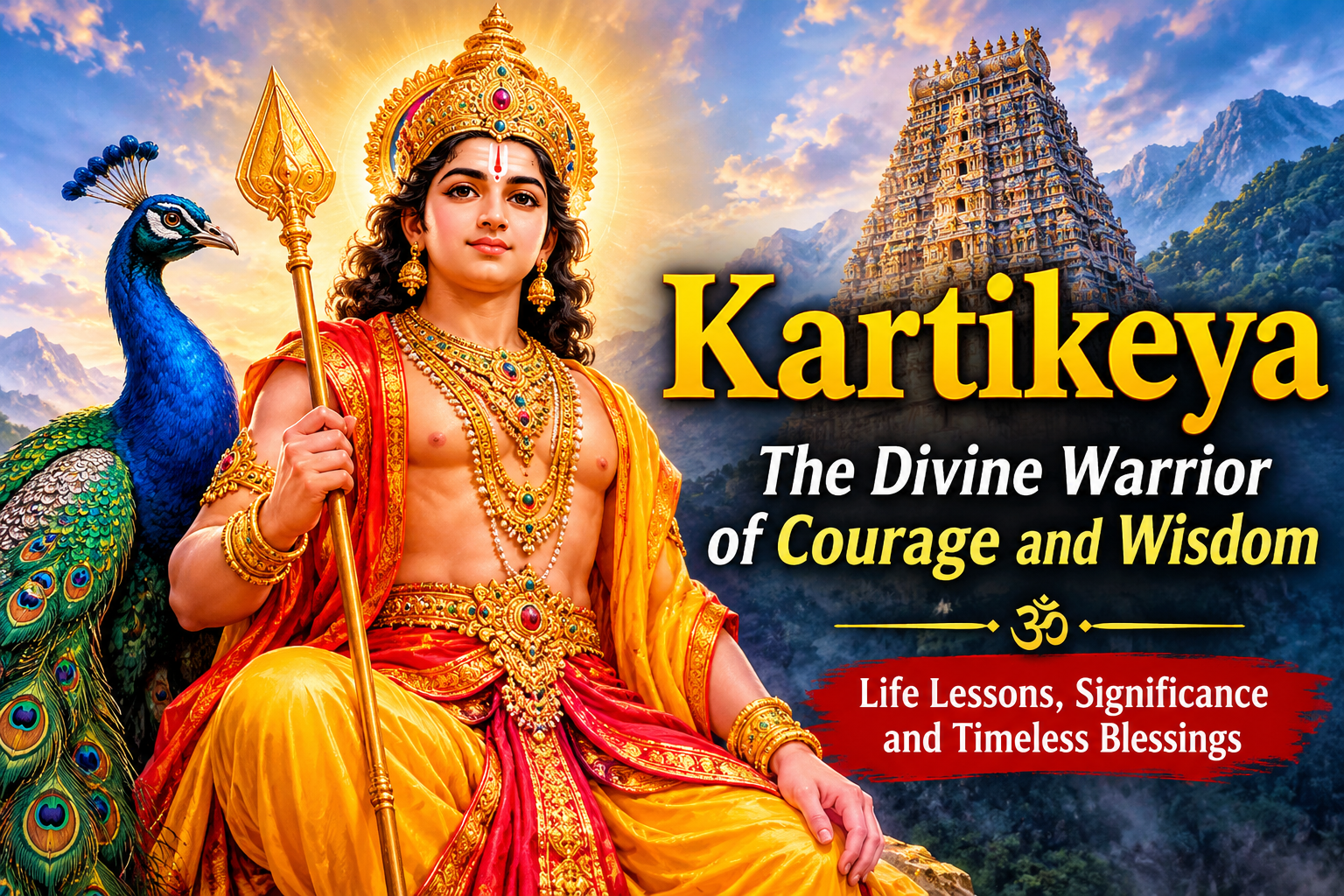
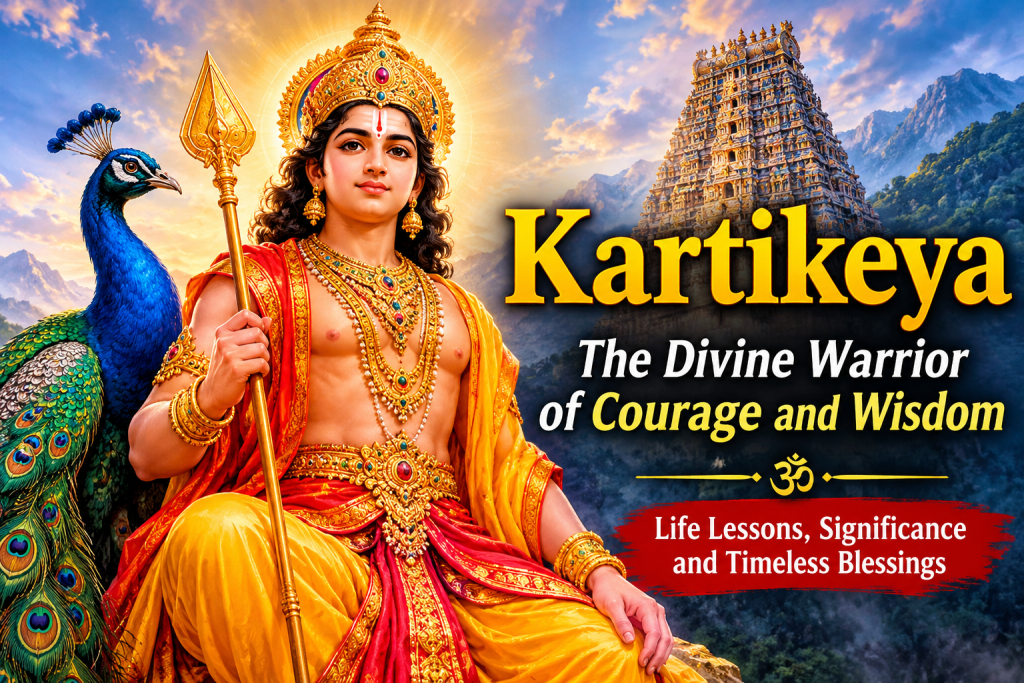
Kartikeya, also widely known as Skanda, Murugan, Subrahmanya and Kumara, is one of the most revered deities in Hinduism. Celebrated as the divine commander of the celestial army, he represents courage, wisdom, discipline, youthful energy and the triumph of righteousness over evil. As the son of Lord Shiva and Goddess Parvati, Kartikeya occupies a special position in Hindu mythology and devotional traditions, particularly in India, Sri Lanka, Malaysia, Singapore and other parts of the world.
His fascinating birth, extraordinary childhood, victory over powerful demons and profound spiritual teachings have inspired generations of devotees, poets, artists and spiritual seekers. In South India, especially Tamil Nadu, Lord Murugan is worshipped with immense devotion, while in other parts of India, he is popularly known as Kartikeya or Skanda.
His divine spear, known as the Vel, symbolises the destruction of ignorance and evil. His majestic peacock vehicle represents the conquest of pride and worldly desires, while his youthful appearance signifies purity, strength and eternal spiritual energy.
As devotees continue to celebrate his divine presence through festivals, temple worship and sacred pilgrimages, Kartikeya remains an enduring symbol of divine protection and the victory of good over evil.
This article explores the fascinating mythology, divine birth, family, symbolism, important scriptures, famous temples, festivals and worldwide worship of Lord Kartikeya.
1. Who Is Lord Kartikeya in Hinduism?
Karttikeya / Murugan — Hindu · Hitchhiker’s Guide to ReligionNorfolk Murugan Temple | Community Pooja in NorwichPaper Print on Hardboard of Lord Kartikeya on Peacock8
Lord Kartikeya is a prominent Hindu deity associated with warfare, divine leadership, courage, knowledge and spiritual enlightenment. He is the son of Lord Shiva, the supreme ascetic, and Goddess Parvati, the divine mother and embodiment of Shakti. He is also the brother of Lord Ganesha.
In Hindu religious traditions, Kartikeya is regarded as the commander-in-chief of the Devas, the celestial beings who protect cosmic order. His principal responsibility is to defend righteousness and destroy demonic forces that threaten the universe.
His name appears in different forms across Hindu scriptures and regional traditions. The most familiar names include:
- Kartikeya: Associated with his upbringing by the six Krittika mothers.
- Skanda: A celebrated Sanskrit name connected with his divine warrior identity.
- Murugan: The beloved Tamil name, meaning a beautiful, youthful or radiant one.
- Subrahmanya: A name particularly popular in South Indian worship.
- Kumara: Meaning a young prince or youthful divine being.
- Shanmukha: The six-faced deity.
- Guha: Meaning the mysterious or hidden one.
- Mahasena: Meaning the great commander of the celestial army.
- Saravanabhava: A name associated with his miraculous birth in a reed-filled forest.
Although the names differ, they generally refer to the same divine personality.
Kartikeya is especially important in Shaivism, one of the major traditions of Hinduism that regards Lord Shiva as the supreme divine reality. His worship also incorporates ancient regional traditions, particularly the Tamil worship of Murugan.
In northern India, Kartikeya is often portrayed as a youthful, unmarried deity who remains devoted to spiritual discipline. In several South Indian traditions, however, he is worshipped with his two consorts, Valli and Devasena (also called Deivanai).
These regional differences demonstrate the richness and diversity of Hindu religious culture.
2. The Divine Birth of Kartikeya
The birth of Lord Kartikeya is one of the most fascinating episodes in Hindu mythology. Different scriptures narrate his appearance in different ways, but the central theme remains the same: his birth was necessary to defeat a powerful demon and restore cosmic balance.
According to an important Puranic narrative, a mighty demon named Tarakasura had obtained a powerful boon through severe penance. The boon made him extremely difficult to defeat, and he believed that only a son of Lord Shiva could bring about his destruction.
At that time, Lord Shiva was deeply absorbed in meditation following the death of his first consort, Goddess Sati. He had withdrawn from worldly affairs and remained detached from the activities of the universe.
Tarakasura took advantage of this situation. He began disturbing the celestial worlds, defeating the Devas and creating widespread fear among the gods.
Unable to overcome the demon, the Devas approached Lord Brahma and sought his guidance. Brahma explained that Tarakasura could only be defeated by a son born to Shiva.
The gods therefore needed the divine union of Shiva and Parvati.
Goddess Parvati, who was born as the daughter of Himavan, the king of the mountains, undertook severe spiritual practices to win the love of Lord Shiva. Through her devotion and determination, she eventually succeeded in awakening Shiva’s interest in divine companionship.
Their union paved the way for the birth of a powerful divine warrior.
However, the divine energy associated with Shiva’s fiery power was so immense that its transfer and preservation became an extraordinary cosmic event.
Different Puranic accounts describe different stages of this process. Agni, the god of fire, and Ganga, the sacred river goddess, are associated with carrying or nurturing the divine energy in several versions of the story.
Eventually, the divine energy reached a forest of reeds known as Sharavana. There, a miraculous child appeared.
This child was none other than Lord Kartikeya.
His extraordinary birth was not merely the arrival of another divine being. It represented the appearance of the force destined to restore order to the universe.
3. Why Is Kartikeya Called the Son of Six Mothers?
Birth of Skanda (Kartikeya) – Vamana Purana Adhyaya 31 | Vietnamese | Vedapathvedapath.app
One of the most remarkable features of Kartikeya’s birth story is his association with six divine mothers known as the Krittikas.
According to the popular account, six celestial women discovered the divine child in the Sharavana forest. They lovingly cared for and nourished him.
These six mothers are traditionally identified with the Krittika stars, associated with the Pleiades star cluster.
In one celebrated version of the story, the child manifested six faces so that he could receive nourishment from all six mothers simultaneously.
Consequently, he became known as Shanmukha or Shadanana, meaning the six-faced one.
He also acquired the name Kartikeya because of his association with the Krittikas.
The six faces have a deeper spiritual significance in Hindu religious interpretation. They are sometimes understood as representing the ability to perceive the universe in every direction. They also symbolise divine awareness, wisdom and the overcoming of limitations.
His six faces are popularly associated with six divine qualities:
- Wisdom and spiritual understanding.
- Courage and determination.
- Compassion and love.
- Strength and protection.
- Knowledge and enlightenment.
- Victory over ignorance and evil.
These interpretations are not identical in every tradition, but they demonstrate how Kartikeya’s unusual appearance has acquired profound spiritual meaning.
His connection with six mothers also represents the universal character of motherhood. The divine child receives affection and protection beyond the boundaries of biological parenthood.
4. Kartikeya as the Commander of the Celestial Army
Skanda Battle Against Tarakasura — Epic Mythology HD Wallpaper – HD Wallpaper | God Picturesgodpictures.in
After his miraculous birth, Kartikeya rapidly developed into a powerful warrior.
The gods recognised his extraordinary abilities and appointed him as the commander-in-chief of the celestial army.
He became known as Devasenapati, meaning the commander of the army of the Devas.
His principal mission was to defeat Tarakasura and protect the three worlds.
The demon had become increasingly powerful and had established his authority through fear, violence and oppression. The celestial beings were unable to restore peace without divine intervention.
Kartikeya accepted the responsibility of leading the heavenly forces.
His appointment was significant because it represented the emergence of youthful divine energy against destructive power.
Although he was young, he possessed extraordinary intelligence, courage and military skill. He understood that strength alone could not guarantee victory. Discipline, strategic thinking and unwavering determination were equally important.
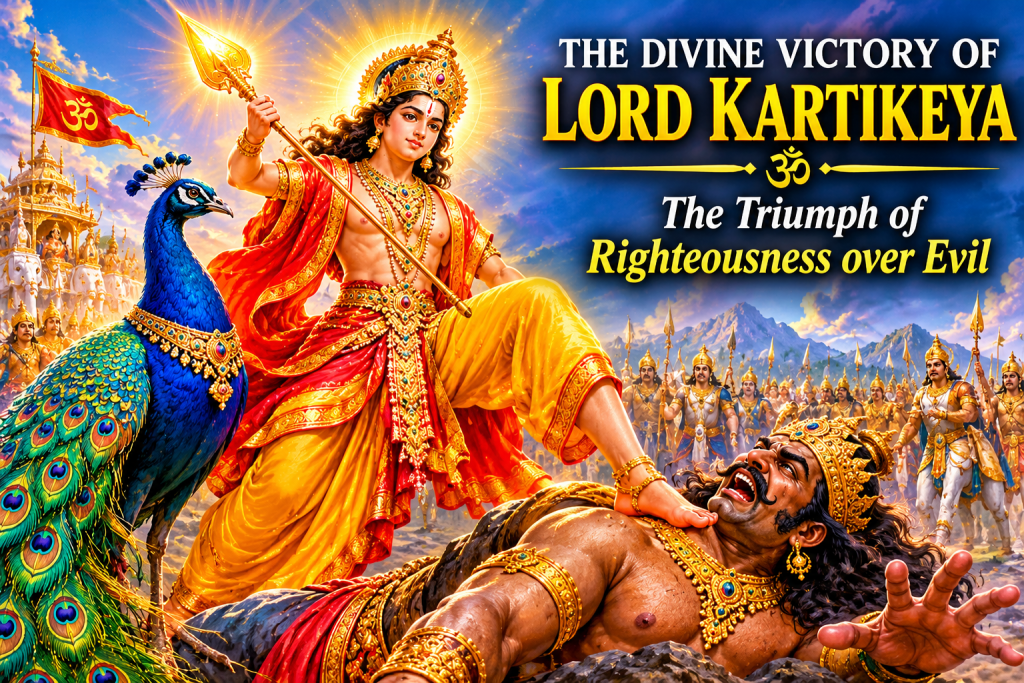
In the ensuing battle, Kartikeya confronted Tarakasura and ultimately defeated him.
This victory restored confidence among the Devas and established Kartikeya as one of the greatest divine warriors in Hindu mythology.
His role as the commander of the celestial army also explains why devotees seek his blessings for courage, confidence, discipline and success in difficult situations.
He is not simply a god of physical warfare. His battle is also interpreted as the eternal struggle between righteousness and destructive tendencies within human life.
5. The Great Battle Against Surapadman
Soorasamharam 2025: The Skanda Shasti Puja Annual Celebrationinstaastro.com
Apart from the battle against Tarakasura, one of the most celebrated episodes associated with Kartikeya is his victory over the demon Surapadman.
This story is particularly important in Tamil religious tradition and forms the central theme of the Skanda Purana’s Tamil devotional narrative, the Kanda Puranam.
Surapadman was a powerful asura who had acquired immense strength through penance. Along with his brothers, he established a formidable demonic kingdom and began troubling the Devas.
The celestial beings were helpless against his power.
They approached Lord Shiva and Goddess Parvati, seeking divine intervention. Kartikeya was entrusted with the responsibility of defeating the demon.
Before the battle, Goddess Parvati gave her son a divine spear known as the Vel.
The Vel was not an ordinary weapon. It represented the concentrated power of divine Shakti and the wisdom required to destroy evil.
Armed with this sacred weapon, Kartikeya marched towards the demon’s kingdom.
A tremendous battle followed. The forces of the Devas confronted the army of Surapadman in a fierce struggle.
Kartikeya displayed extraordinary courage and divine power. He defeated the demon’s forces and eventually confronted Surapadman himself.
According to the traditional Tamil account, Surapadman transformed himself into a gigantic mango tree in an attempt to escape destruction.
Kartikeya split the tree into two with his Vel.
The two halves transformed into a peacock and a rooster.
Instead of simply destroying them, Kartikeya accepted the peacock as his divine vehicle and the rooster as the emblem on his flag.
The peacock became known as Paravani, while the rooster became an important symbol associated with Murugan.
This episode carries a profound spiritual message.
The transformation of the demon into the divine symbols of Kartikeya represents the possibility of overcoming destructive tendencies and transforming negative energy into something constructive.
The peacock symbolises the conquest of pride and worldly attachments, while the rooster represents vigilance and the awakening of consciousness.
The victory of Kartikeya over Surapadman is celebrated annually through Skanda Sashti, one of the most important festivals dedicated to the deity.
6. The Divine Vel: The Sacred Weapon of Kartikeya
Murugan Thunai – Private Prayers & Blessings from Lord Murugan | முருகன் துனைmuruganthunai.in
The Vel is perhaps the most recognisable symbol of Lord Kartikeya.
It is a divine spear associated with Goddess Parvati’s blessings and represents the power of divine knowledge.
According to the popular Tamil tradition, Parvati presented the Vel to her son before his battle against Surapadman.
The weapon gave Kartikeya the strength to overcome the demon and restore cosmic order.
However, its significance extends far beyond warfare.
In spiritual interpretation, the Vel represents knowledge that penetrates ignorance. Just as a spear can pierce an obstacle, divine wisdom can remove confusion, falsehood and negative tendencies from the human mind.
The Vel also represents:
- The power of truth.
- The destruction of ignorance.
- Protection from evil.
- Courage in difficult circumstances.
- The victory of righteousness.
- The blessings of the Divine Mother.
In many Murugan temples, the Vel is worshipped as a sacred manifestation of divine power.
Devotees offer flowers, perform special prayers and seek blessings through its worship.
The weapon is also closely associated with Thaipusam, during which devotees commemorate the divine gift of the Vel and express their devotion through vows and religious observances.
7. Why Does Lord Kartikeya Ride a Peacock?
स्कंद षष्ठी का व्रत करने से भगवान कार्तिकेय करते हैं सभी मनोकामनाएं पूरीnewsgram.in
The peacock is the divine vehicle, or Vahana, of Lord Kartikeya.
It is one of the most beautiful and meaningful elements of his iconography.
The association between Kartikeya and the peacock is particularly significant because of the Surapadman legend.
As described in the traditional Tamil narrative, the demon’s transformation into a peacock resulted in the bird becoming Kartikeya’s vehicle.
The peacock has several symbolic meanings.
Its colourful feathers represent beauty, magnificence and divine splendour. However, the bird also symbolises pride and worldly attraction.
Kartikeya riding the peacock represents the control of such tendencies through spiritual wisdom and self-discipline.
In many traditional representations, the peacock is also shown standing upon or near a serpent. This image is interpreted as the triumph of higher spiritual awareness over destructive impulses.
The peacock is therefore more than a means of transportation. It represents the divine warrior’s ability to control powerful forces and direct them towards righteousness.
The image of Kartikeya with his Vel and peacock has become one of the most familiar and beloved representations in Hindu devotional art.
8. The Family of Lord Kartikeya: Shiva, Parvati and Ganesha
Har Har Mahadev Photos Of Lord Shiva Lord Shiva Famil Vrogueco 236×278narodnatribuna.info
Kartikeya belongs to one of the most celebrated divine families in Hinduism.
His father is Lord Shiva, his mother is Goddess Parvati, and his brother is Lord Ganesha.
Together, they represent different dimensions of divine consciousness and cosmic activity.
Lord Shiva: Shiva represents supreme consciousness, detachment, meditation and the transformative power of the universe. As his son, Kartikeya inherits the divine energy required to protect cosmic order.
Goddess Parvati: Parvati represents divine motherhood, love, compassion and Shakti, the universal creative energy. Her blessings are especially associated with Kartikeya’s sacred Vel and his power to defeat evil.
Lord Ganesha: Ganesha is the remover of obstacles and the deity of wisdom, prosperity and auspicious beginnings. Kartikeya and Ganesha are brothers, although their personalities and responsibilities differ.
A popular Hindu story describes a contest between the two brothers to determine who could travel around the world first.
According to one widely narrated version, Kartikeya immediately mounted his peacock and began travelling around the universe. Ganesha, instead of undertaking a physical journey, walked around his parents, explaining that his parents represented the entire universe to him.
Ganesha was consequently declared the winner.
Kartikeya’s response to the result differs among regional tellings, and some versions associate the episode with his departure to Palani.
The story is often interpreted as a lesson about the different forms of wisdom. Kartikeya represents action, determination and exploration, while Ganesha represents insight and the understanding that the highest truth may be found through devotion.
The episode also illustrates the affectionate but distinctive relationship between the two divine brothers.
9. The Two Consorts of Kartikeya: Devasena and Valli
Tanjore Painting Murugan: Divine Art Worth Treasuring – Shobitamshobitam.com
In many South Indian traditions, particularly Tamil Nadu, Lord Murugan is worshipped with two consorts: Devasena and Valli.
Their stories are important parts of Murugan’s religious identity.
Devasena or Deivanai
Devasena, also known as Deivanai, is traditionally associated with the celestial world.
In popular accounts, she is the daughter of Indra, the king of the Devas, and is given in marriage to Kartikeya following his victory over the demonic forces.
Their marriage represents the union of divine strength and celestial order.
Valli
Valli has a different and equally fascinating story.
She is associated with the natural and earthly world and is traditionally described as the daughter of a tribal chief.
According to the Tamil legend, Murugan fell in love with Valli and wished to marry her.
However, winning her affection required several playful and dramatic events.
Murugan appeared before her in different forms, sometimes with the assistance of his brother Ganesha. Through these divine encounters, Valli eventually recognised his true identity and accepted him.
Their marriage represents divine love, devotion and the closeness between God and ordinary devotees.
The Spiritual Meaning of the Two Consorts
In some devotional interpretations, Devasena represents the path of disciplined or formal devotion, while Valli represents spontaneous and wholehearted love.
Together, they illustrate the idea that divine grace can be approached through different spiritual paths.
It is important to remember that not every Hindu tradition presents Kartikeya as married. In several northern Indian traditions, he is worshipped as a celibate deity and is closely associated with the name Kumara.
These differences are part of the diversity of Hindu mythology.
10. The Six Sacred Abodes of Lord Murugan
The six sacred temples of Lord Murugan in Tamil Nadu are collectively known as Arupadai Veedu.
These shrines are among the most important pilgrimage destinations for Murugan devotees.
Each temple is associated with a significant episode in the deity’s life and represents a different aspect of his divine personality.Arupadai Veedu: Exploring the Six Sacred Abodes of Lord Murugan – PujalaneThiruchendur – Destination To PlanTemplePurohit.com – Palani Dhandayuthapani temple is one of the Six Abodes of Murugan. It is located in the town of Palani in Dindigul, 100 kilometres (62 mi) s… | Lord murugan wallpapers, Lord murugan, Indian gods6
1. Thiruparankundram Murugan Temple
Located near Madurai, Thiruparankundram is traditionally regarded as the place where Kartikeya married Devasena after defeating the demonic forces.
The temple is particularly famous for its rock-cut architecture and its religious significance.
It is one of the six sacred abodes and attracts thousands of devotees throughout the year.
2. Tiruchendur Murugan Temple
Devotees not barred from Tiruchendur temple shore at nights, cops rebut chargesdtnext.in
Situated along the coast of the Bay of Bengal, the Tiruchendur Murugan Temple is one of the most important shrines dedicated to Lord Murugan.
According to tradition, this is the place associated with Kartikeya’s victory over Surapadman.
The annual Skanda Sashti celebrations here are particularly famous. The dramatic Soorasamharam ceremony attracts enormous crowds of devotees.
Its location beside the sea gives the temple a distinctive spiritual and geographical identity.
3. Palani Dhandayuthapani Swamy Temple
Arulmigu Sri Dhandayuthapani Swamy Thirukkovil Guidechalbanjare.com
Palani is one of the most celebrated pilgrimage destinations associated with Lord Murugan.
The principal deity is worshipped as Dhandayuthapani Swamy, representing a youthful ascetic holding a staff.
A popular legend connects the temple with the divine fruit contest between Kartikeya and Ganesha.
According to the story, Kartikeya became disappointed after learning that Ganesha had won the contest by circumambulating their parents. He left Kailash and settled on the hill at Palani.
His parents eventually came to console him.
The phrase commonly associated with the story is Pazham Nee, meaning “You are the fruit” or “You are the wisdom itself”, depending on the interpretation.
Palani is especially famous for its Panchamirtham, a sacred offering prepared from fruits and other ingredients.
4. Swamimalai Murugan Temple
Swamimalai is associated with a remarkable episode in which Kartikeya teaches the meaning of the sacred Pranava mantra, Om, to his own father, Lord Shiva.
According to tradition, when Shiva asked his son about the meaning of Om, Kartikeya agreed to explain it only if Shiva listened to him as a student.
Shiva accepted this condition.
Kartikeya then revealed the profound meaning of the sacred syllable.
This episode established him as Swaminatha, the teacher of the Lord.
It demonstrates that divine wisdom is not determined by age or conventional hierarchy.
5. Tiruttani Murugan Temple
Tiruttani is traditionally associated with Kartikeya’s peaceful state following his victory over Surapadman.
The temple stands on a hill and is one of the most important pilgrimage centres in Tamil Nadu.
It represents tranquillity, spiritual discipline and the restoration of inner balance after conflict.
6. Pazhamudircholai Murugan Temple
Located in a beautiful natural setting near Madurai, Pazhamudircholai is the sixth sacred abode.
It is particularly associated with Murugan’s divine grace and his connection with nature.
The famous Tamil poet-saint Avvaiyar is associated with a popular story here.
According to the legend, Murugan appeared before her as a young boy and playfully asked whether she wanted roasted or unroasted fruits.
The encounter became a lesson in humility and the endless nature of divine wisdom.
Together, the six temples provide a spiritual journey through the different dimensions of Lord Murugan’s divine personality.
11. Kartikeya in Hindu Scriptures and Classical Literature
Lord Kartikeya has a significant presence in several Hindu scriptures, epics and classical literary works.
His mythology developed through different religious and regional traditions, which explains why his birth and activities are sometimes described differently.
The Mahabharata: The epic contains important narratives concerning Skanda’s birth, divine identity and military role. The Skanda-related sections describe his association with the celestial army and the defeat of demonic forces.
The Ramayana: The Bala Kanda includes a narrative about the birth of Kartikeya involving Agni and Ganga. This version differs in certain details from other Puranic accounts.
The Skanda Purana: This enormous Sanskrit Purana is associated with Skanda and contains extensive religious, geographical and devotional material. Its Tamil literary counterpart, the Kanda Puranam, is particularly influential in Murugan worship.
The Shiva Purana: It includes narratives about Shiva, Parvati and their divine family, including the birth and significance of Kartikeya.
The Kalidasa’s Kumarasambhava: One of the most celebrated works of classical Sanskrit poetry is Kumarasambhava, traditionally attributed to the great poet Kalidasa. Its central subject is the birth of Kumara, the divine son of Shiva and Parvati.
The poem explores the divine relationship between Shiva and Parvati and the cosmic purpose behind the birth of their son.
Through these texts, Kartikeya emerges not only as a warrior but also as a symbol of divine knowledge, youthful strength and spiritual discipline.
12. The Spiritual Significance of Lord Kartikeya’s Six Faces
The six faces of Kartikeya are among the most distinctive features of his divine appearance.
Known as Shanmukha, he is often depicted with six faces and twelve arms, although other representations show him with two or four arms.
His six faces are understood in various devotional traditions as manifestations of divine knowledge and universal awareness.
They also have a symbolic connection with the six directions and the ability to observe and protect the universe from every side.
Some spiritual interpretations associate the six faces with the conquest of six internal enemies:
- Kama – uncontrolled desire.
- Krodha – anger.
- Lobha – greed.
- Moha – attachment or delusion.
- Mada – pride or arrogance.
- Matsarya – jealousy or envy.
These six tendencies are considered obstacles to spiritual development in Hindu philosophy.
Kartikeya’s six faces therefore represent the wisdom and strength required to overcome these inner enemies.
His twelve arms, when depicted, signify his extraordinary divine abilities and his capacity to perform multiple protective and righteous actions.
His iconography communicates an important message: the greatest victory is not merely the defeat of an external enemy but the conquest of one’s own weaknesses.
13. Important Festivals Dedicated to Lord Kartikeya
Lord Kartikeya is worshipped throughout the year, but certain festivals hold exceptional importance among his devotees.
These celebrations combine mythology, religious rituals, fasting, processions, music and community participation.Up the steps at Batu Caves | MalaysiaNow| சூரனின் ஆணவத்தை அழித்து தன்னுள் ஆட்கொண்டார் முருகபெருமான்-Karthigai Deepam holiday shift: Govt answers whether employees get leave today or tomorrow8
Skanda Sashti
Skanda Sashti, also called Kanda Sashti, is one of the most important festivals dedicated to Kartikeya.
It commemorates his victory over Surapadman and the restoration of cosmic order.
The festival is generally observed over six days during the Tamil month of Aippasi, corresponding approximately to October or November.
Devotees undertake fasting, chant sacred hymns, visit Murugan temples and participate in special religious ceremonies.
The concluding day is associated with Soorasamharam, the dramatic enactment of Kartikeya’s victory over Surapadman.
The following day, many devotees celebrate Thirukalyanam, commemorating the divine marriage of Murugan and Devasena.
The latest 2026 celebration: The six-day Kanda Sashti festival was observed from November 10 to November 15 in major Murugan temples in Tamil Nadu. The Soorasamharam ceremony took place on November 15, followed by Thirukalyanam on November 16. Large numbers of devotees gathered at Tiruchendur, Palani, Swamimalai and other important shrines. Temple authorities also made special arrangements for crowd management and the smooth movement of pilgrims. Deccan Chronicle+2
The celebrations in Mumbai’s Matunga also featured special prayers, milk abhishekam, devotional hymns and traditional offerings. Free Press Journal
Thaipusam
Thaipusam 2025 | Devotion | Sacrifice | Faith | Resilience | Tradition | Spirituality | Culture | Celebration | Religious Festival | Hindu Festival | Sacred Rituals | Tamil Community | Pilgrimage | Divine Connection | Spiritual Journey | Heritage | Unity | Strength | Vibrancecamouflageclicks.com
Thaipusam is another major festival dedicated to Lord Murugan.
It is celebrated during the Tamil month of Thai, generally in January or February, on the day associated with the Pushya or Poosam star.
The festival commemorates the divine grace of Goddess Parvati, particularly the gifting of the sacred Vel to Murugan in the popular Tamil tradition.
Devotees express their devotion through fasting, prayers, processions and the carrying of Kavadis.
A Kavadi is a decorated structure carried on the shoulders as an act of religious dedication. Some devotees also carry pots of milk, known as Paal Kudam, as offerings to the deity.
The celebrations at Batu Caves in Malaysia are particularly famous. Thousands of devotees and visitors gather to witness the colourful processions and elaborate religious observances.
Thaipusam is also celebrated in Singapore, Sri Lanka, Mauritius, India and other countries with significant Tamil communities.
Vaikasi Visakam
Vaikasi Visakam is traditionally celebrated as the birth festival of Lord Murugan.
It takes place during the Tamil month of Vaikasi, generally in May or June, when the Visakam star is prominent.
Devotees visit Murugan temples, perform special pujas, offer flowers and participate in religious processions.
The festival is particularly important for devotees seeking divine blessings, courage, knowledge and spiritual development.
Karthigai Deepam
Karthigai Deepam is a festival of sacred lights associated with Lord Shiva and Lord Murugan.
It is observed during the Tamil month of Karthigai, generally in November or December.
Devotees illuminate their homes and temples with traditional oil lamps.
The festival is particularly associated with the sacred hill of Tiruvannamalai, where a huge beacon of light is traditionally lit on the hilltop.
Karthigai Deepam represents the triumph of divine light over darkness and is also connected with the spiritual traditions surrounding Kartikeya’s name and the Krittika stars.
Monthly Krittika and Sashti Observances
Apart from major annual festivals, devotees worship Kartikeya on Krittika Nakshatra days and Sashti Tithi throughout the year.
Many followers observe monthly fasting, visit temples and recite devotional hymns.
These regular observances allow devotees to maintain a continuous spiritual connection with the deity.
14. Worship of Lord Kartikeya in India
సుబ్రహ్మణ్య స్వామి పూజ — వేదిక్ వారధిvedicvaradhi.com
Kartikeya is worshipped in different parts of India under different names and religious traditions.
His popularity is particularly strong in South India, but his influence extends across the country.
Tamil Nadu: Lord Murugan is one of the most beloved deities in Tamil religious culture. His six sacred abodes attract pilgrims throughout the year. Murugan is deeply connected with Tamil literature, music, poetry and cultural identity.
Kerala: Subrahmanya worship is popular in several temples. The Haripad Sree Subrahmanya Swamy Temple is an important centre of devotion.
Karnataka: The Kukke Subramanya Temple is one of the most prominent pilgrimage destinations associated with Lord Subrahmanya. It is especially famous for rituals connected with serpent worship.
Andhra Pradesh and Telangana: Lord Subrahmanya is worshipped in numerous temples, where devotees seek blessings for family well-being, spiritual protection and prosperity.
Maharashtra: Kartikeya is worshipped as Kartik Swami or Kartikeya in different regional traditions. Certain temples and religious observances are particularly associated with the deity.
North India: Kartikeya is known by names such as Skanda and Kartik. His image appears in Hindu temples, religious literature and traditional representations of Shiva’s family.
The differences in worship demonstrate how one divine personality can become part of several regional cultures while retaining a shared mythological foundation.
15. Kartikeya Worship Beyond India
Cruise Layover Tour from Port Klang in Petaling Jaya | PelagoThe Divine Lance: Thaipusam and Murugan Worship in Singapore | BiblioAsiaவரலாற்று சிறப்புமிக்க நல்லூர் கந்தசுவாமி ஆலய வருடாந்த பெருவிழா தொடர்பில் வெளியான அறிவிப்பு – ஜே.வி.பி நியூஸ்
The worship of Lord Kartikeya has travelled far beyond the geographical boundaries of India.
Tamil migration, cultural exchanges and the preservation of Hindu traditions have helped establish Murugan worship in several countries.
Sri Lanka
Lord Murugan is worshipped with great devotion in Sri Lanka, particularly among Tamil Hindu communities.
The Nallur Kandaswamy Temple in Jaffna is one of the most important Murugan temples in the country.
The annual Nallur festival attracts large numbers of devotees and is famous for its colourful processions and religious ceremonies.
Kataragama, an important pilgrimage destination in southern Sri Lanka, is also associated with Skanda or Murugan. It is particularly significant because people from different religious communities visit the sacred site.
Malaysia
Malaysia is one of the most important centres of Murugan worship outside India.
The Batu Caves temple complex near Kuala Lumpur is internationally recognised for its magnificent golden statue of Lord Murugan.
The site becomes particularly famous during Thaipusam, when enormous numbers of devotees gather for religious processions and offerings.
The festival demonstrates the continuing importance of Hindu traditions among Malaysian Tamil communities.
Singapore
The Sri Thendayuthapani Temple in Singapore is an important centre of Murugan worship.
Thaipusam is observed with elaborate processions, devotional singing and the carrying of Kavadis.
The festival attracts not only devotees but also people interested in the cultural and religious heritage of Singapore.
Mauritius
Hindu communities in Mauritius also celebrate Thaipusam and other Murugan-related festivals.
Temples dedicated to Subramanya serve as centres of worship and cultural identity.
Other Countries
Murugan worship is also found in the United Kingdom, Canada, Australia, South Africa and other countries where Tamil Hindu communities have established temples and cultural institutions.
Through these religious traditions, Kartikeya has become an important symbol of Hindu cultural continuity across the world.
16. The Meaning of Kartikeya’s Name and His Different Forms
The various names of Kartikeya reflect his divine attributes, mythology and regional traditions.
| Name | Meaning or significance |
|---|---|
| Kartikeya | Associated with the six Krittika mothers |
| Skanda | His ancient Sanskrit divine name |
| Murugan | The youthful and beautiful deity |
| Subrahmanya | A widely worshipped divine name |
| Kumara | The eternal divine youth |
| Shanmukha | The six-faced one |
| Shadanana | The deity with six faces |
| Mahasena | The great commander |
| Devasenapati | Commander of the celestial army |
| Swaminatha | The divine teacher of Shiva |
| Saravanabhava | The one born in the reed forest |
| Guha | The mysterious or hidden divine one |
These names are not merely different ways of addressing the deity. Each reflects a particular aspect of his mythology or spiritual significance.
For example, Swaminatha highlights his role as a teacher, while Mahasena emphasises his military leadership.
Similarly, Murugan expresses his youthful beauty and divine charm, while Shanmukha describes his extraordinary six-faced form.
17. The Spiritual and Philosophical Teachings of Kartikeya
Beyond his extraordinary mythology, Lord Kartikeya represents several important spiritual principles.
His life and divine activities offer lessons that remain meaningful in modern society.
Courage in the face of difficulties: Kartikeya’s battle against powerful demons teaches that difficulties should be confronted with courage and determination. Fear should not become an obstacle to righteousness.
The importance of knowledge: His association with the Vel represents the power of wisdom. Knowledge enables individuals to distinguish truth from falsehood and overcome ignorance.
Discipline and self-control: As the commander of the celestial army, Kartikeya symbolises discipline, organisation and responsibility. These qualities are essential for personal development and collective progress.
Respect for motherhood: His relationship with the six Krittika mothers demonstrates the importance of maternal affection and care.
Humility: The story of Kartikeya and Ganesha illustrates that strength, speed and achievement are not the only measures of wisdom. True understanding requires humility.
Victory over inner enemies: The six faces of Kartikeya are often associated with overcoming the six negative tendencies of the human mind. This interpretation encourages spiritual purification.
Transformation rather than destruction: The Surapadman legend offers a particularly interesting message. The demon’s transformation into the peacock and rooster suggests that negative forces can be redirected towards a higher purpose.
These teachings make Kartikeya relevant not only as a mythological warrior but also as a guide to ethical and spiritual living.
18. Why Is Kartikeya Important in Modern Hindu Society?
In contemporary Hindu society, Kartikeya continues to occupy an important position as a symbol of courage, knowledge, discipline and divine protection.
His worship connects ancient religious narratives with present-day cultural and spiritual practices.
For young people, Kartikeya represents youthful energy, confidence and the determination to overcome challenges.
For students and knowledge seekers, his association with Swaminatha offers a reminder that learning is a lifelong journey and wisdom can emerge from unexpected sources.
For families, his relationship with Shiva, Parvati and Ganesha represents divine affection and the importance of family bonds.
For devotees facing difficult circumstances, his image as the commander of the celestial army provides spiritual encouragement.
His festivals also contribute to the preservation of regional languages, music, literature, temple traditions and community relationships.
In particular, the international celebration of Thaipusam demonstrates how religious traditions can maintain their cultural significance even when communities move across national boundaries.
The continuing popularity of Murugan temples, devotional songs and sacred pilgrimages shows that Kartikeya’s spiritual appeal remains strong.
19. Important Mantras Dedicated to Lord Kartikeya
Devotees recite various mantras to express their devotion and seek the blessings of Lord Kartikeya.
Some widely known devotional mantras include:
1. Saravanabhava Mantra\[ \text{ॐ सरवणभवाय नमः} \]
Om Saravanabhavaya Namah
This mantra invokes the divine name of Kartikeya associated with his miraculous birth in the Sharavana forest.
2. Subrahmanya Mantra\[ \text{ॐ सुब्रह्मण्याय नमः} \]
Om Subrahmanyaya Namah
This is a simple devotional invocation of Lord Subrahmanya.
3. Skanda Mantra\[ \text{ॐ स्कन्दाय नमः} \]
Om Skandaya Namah
This mantra invokes Lord Skanda and is recited by devotees seeking courage, spiritual strength and divine protection.
4. Shanmukha Mantra\[ \text{ॐ षण्मुखाय नमः} \]
Om Shanmukhaya Namah
This mantra honours the six-faced manifestation of Kartikeya.
Devotees may recite these mantras during daily worship, temple visits, fasting observances and special festivals.
Mantra recitation is traditionally regarded as a means of cultivating concentration, devotion and inner peace.
20. Conclusion: Lord Kartikeya, the Eternal Symbol of Courage and Wisdom
Lord Kartikeya is much more than the divine commander of the celestial army. He represents the eternal power of righteousness, the importance of wisdom and the courage required to confront evil.
His extraordinary birth, upbringing by the six Krittika mothers, victory over Tarakasura and Surapadman, and association with the divine Vel and peacock have made him one of the most fascinating figures in Hindu mythology.
His six sacred abodes in Tamil Nadu, celebrated festivals such as Skanda Sashti and Thaipusam, and worldwide devotional traditions demonstrate his enduring religious and cultural importance.
The story of Kartikeya also offers a timeless message for humanity: true strength is not simply the ability to defeat others but the ability to overcome one’s own ignorance, arrogance, anger and destructive tendencies.
His divine spear symbolises the wisdom that removes darkness, while his peacock represents the mastery of worldly desires.
As the son of Shiva and Parvati, the brother of Ganesha and the beloved Murugan of millions of devotees, Kartikeya continues to inspire people through his courage, compassion and spiritual brilliance.
His life reminds us that whenever darkness threatens righteousness, divine wisdom and courage can emerge to restore balance.
May Lord Kartikeya bless everyone with wisdom, courage, discipline, prosperity and the strength to overcome all difficulties.
Om Saravanabhavaya Namah!
21. Latest News: Kartikeya Worship and the 2026 Kanda Sashti Celebrations
The 2026 Kanda Sashti celebrations once again highlighted the continuing popularity of Lord Murugan among Hindu devotees.
Major temples in Tamil Nadu, including Tiruchendur, Palani, Swamimalai, Tiruttani, Thiruparankundram and Pazhamudircholai, organised special religious programmes.
The six-day celebrations attracted large numbers of pilgrims, particularly for the Soorasamharam ceremony on November 15.
The festival’s conclusion was followed by Thirukalyanam on November 16, commemorating the divine marriage of Murugan and Devasena.
The celebrations also received attention outside Tamil Nadu, with temples in Mumbai organising special abhishekam, prayers and devotional activities.
These observances demonstrate that Kartikeya’s mythology is not confined to ancient scriptures. His stories continue to inspire large religious gatherings and cultural celebrations across India and beyond. Deccan Chronicle+2
*Updated on 18 November, 2026