Parsva Ekadashi: Vrat, Vamana Story & Significance
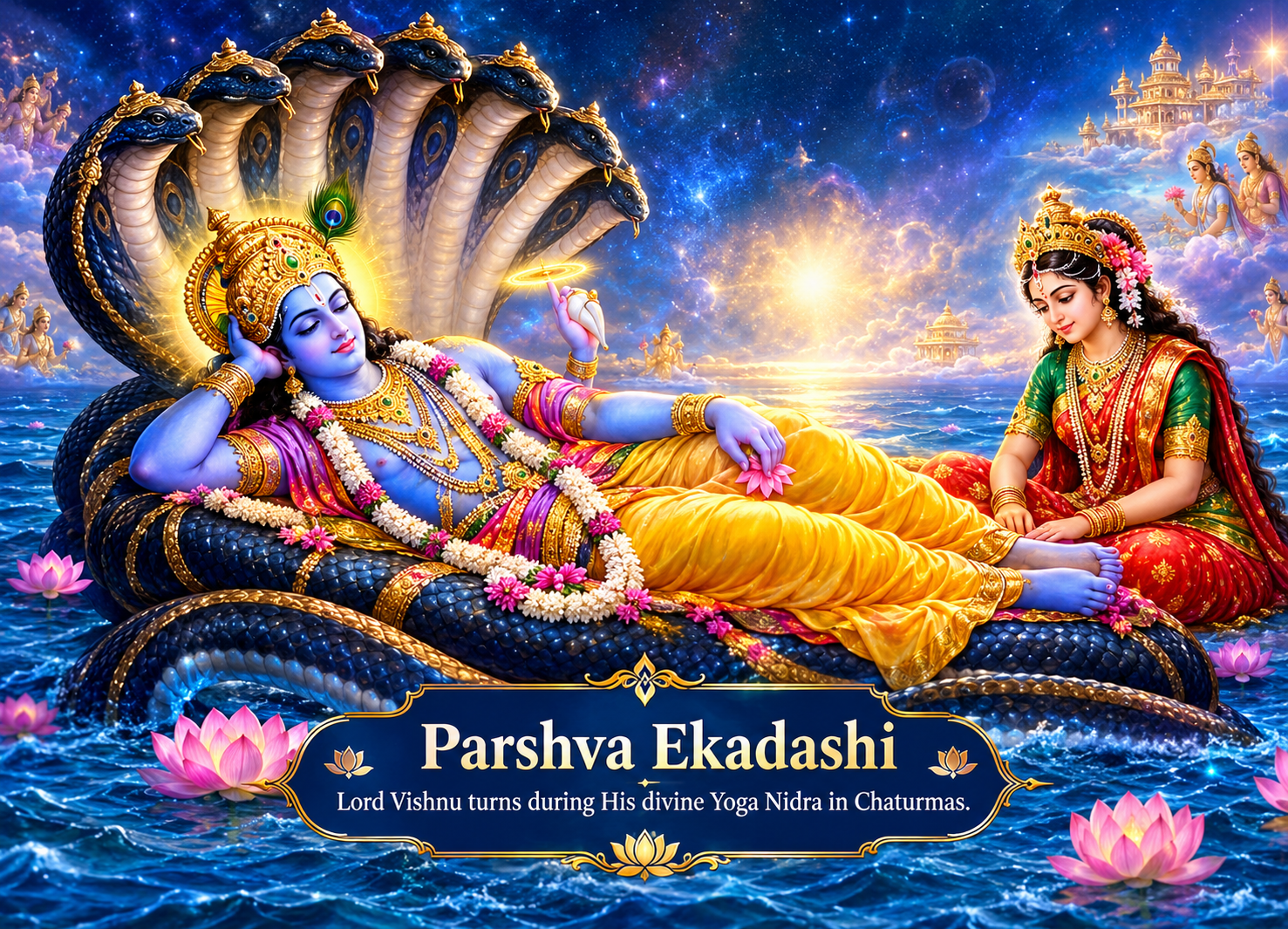
Parsva Ekadashi, also known as Parivartini Ekadashi, Vamana Ekadashi, Padma Ekadashi, and Jayanti Ekadashi, is an important Ekadashi observed during the Shukla Paksha of the Bhadrapada month. This sacred day is dedicated to Lord Vishnu and is especially associated with His Vamana avatar and the famous story of King Bali.
The name Parsva is associated with the Sanskrit concept of the “side,” while Parivartini refers to turning or changing position. According to a widely followed Hindu tradition, Lord Vishnu, who is resting in divine Yoga Nidra during Chaturmas, changes His sleeping position on this Ekadashi. This is why the day is popularly known as Parsva or Parivartini Ekadashi.
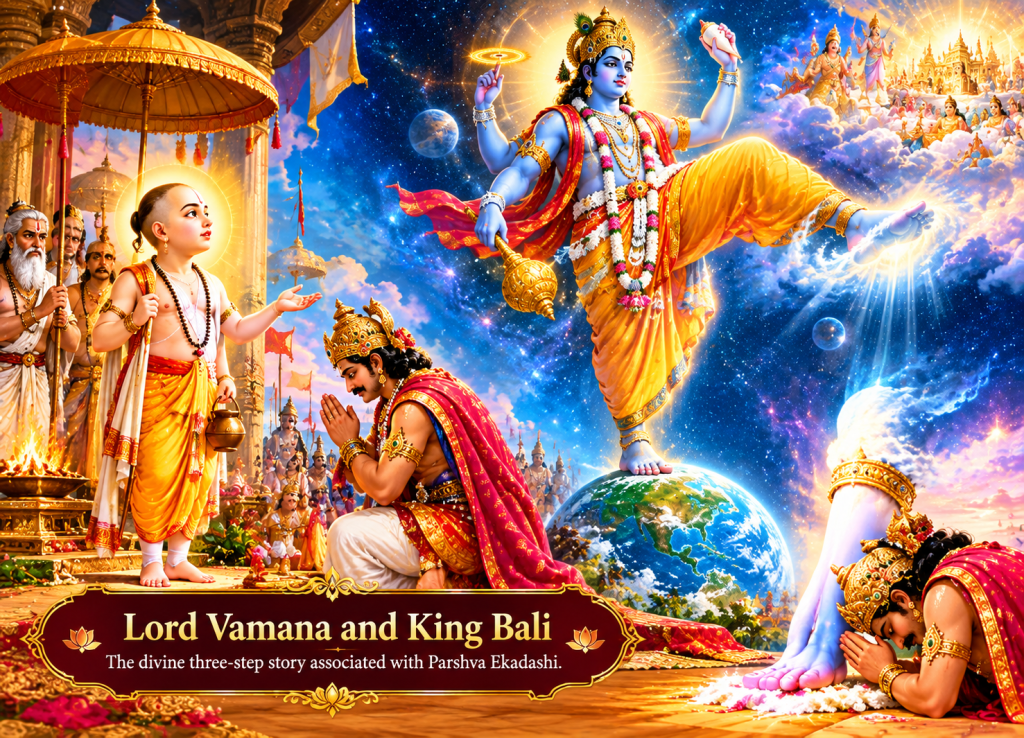
Parsva Ekadashi also recalls one of the most profound stories associated with Lord Vishnu: His incarnation as Vamana, the divine dwarf Brahmana who approached the powerful and generous King Bali and asked for three paces of land. Vamana then assumed His magnificent cosmic form and covered the worlds in two steps. When there was nowhere left for the third step, Bali offered his own head.
The story beautifully combines devotion, humility, truthfulness, divine grace, generosity, and surrender.
In 2026, Parsva Ekadashi falls on Tuesday, September 22. The exact Ekadashi and Dwadashi timings, including the parana period, should be checked according to the local panchanga because lunar calculations vary by location.
What Is Parsva Ekadashi?
Parsva Ekadashi is the Ekadashi, or eleventh lunar day, of the bright fortnight (Shukla Paksha) of Bhadrapada.
It is one of the many sacred Ekadashi observances in the Hindu lunar calendar. Ekadashi is traditionally regarded as a day for reducing worldly distractions, controlling the senses, remembering God, and directing the mind toward spiritual practices.
Different regions and Vaishnava traditions use different names for this Ekadashi. Commonly used names include:
- Parsva Ekadashi
- Parivartini Ekadashi
- Vamana Ekadashi
- Padma Ekadashi
- Jayanti Ekadashi
These names highlight different aspects of the observance. “Parivartini” emphasizes the turning or changing of Lord Vishnu’s position during His cosmic sleep, while “Vamana” connects the day with Lord Vishnu’s Vamana incarnation.
The observance is particularly meaningful because it falls during Chaturmas, the four-month sacred period traditionally associated with Lord Vishnu’s Yoga Nidra.
Parsva Ekadashi 2026 Date
Parsva Ekadashi will be observed on Tuesday, September 22, 2026.
The Ekadashi tithi begins on September 21 and continues into September 22. Since Hindu dates are calculated according to the lunar day and local sunrise, devotees should consult a reliable local panchanga for the precise fasting and parana timings.
Parsva Ekadashi 2026 at a Glance
| Particular | Details |
|---|---|
| Name | Parsva Ekadashi |
| Other names | Parivartini Ekadashi, Vamana Ekadashi, Padma Ekadashi, Jayanti Ekadashi |
| Year | 2026 |
| Date | Tuesday, September 22, 2026 |
| Lunar month | Bhadrapada |
| Paksha | Shukla Paksha |
| Tithi | Ekadashi |
| Main deity | Lord Vishnu |
| Associated avatar | Lord Vamana |
| Main theme | Lord Vishnu’s change of sleeping position during Chaturmas |
| Important story | Vamana and King Bali |
| Fast breaking | Dwadashi during the prescribed parana period |
The exact parana time varies according to location. Devotees should therefore use a local panchanga rather than applying a single time everywhere.
Why Is It Called Parsva Ekadashi?
The word Parsva is associated with the side of the body.
Hindu tradition describes Lord Vishnu as resting in Yoga Nidra during Chaturmas. On Parsva Ekadashi, devotees believe that the Lord changes His sleeping position from one side to the other.
This turning is the central symbolism behind the observance.
The related name Parivartini Ekadashi comes from parivartana, meaning change, transformation, or turning. Thus, the day can be understood as the Ekadashi associated with divine turning and transformation.
This idea carries a beautiful spiritual message. Life is never completely static. Human beings also pass through periods of rest, uncertainty, transformation, and renewal. The symbolic turning of Lord Vishnu reminds devotees that change is a natural part of existence.
Parsva Ekadashi and Chaturmas
To understand Parsva Ekadashi, it is helpful to understand Chaturmas.
Chaturmas literally refers to a period of four months. In many Hindu traditions, it begins around Devshayani Ekadashi in the month of Ashadha and concludes around Devutthana or Prabodhini Ekadashi in Kartika.
According to traditional belief, Lord Vishnu enters Yoga Nidra during this period and rests upon Shesha, the divine serpent, in the cosmic ocean.
Parsva Ekadashi occurs approximately in the middle of this period.
Thus, three important stages can be symbolically connected:
Devshayani Ekadashi → Lord Vishnu enters Yoga Nidra
Parsva Ekadashi → Lord Vishnu changes His position
Devutthana Ekadashi → Lord Vishnu awakens
The middle stage gives Parsva Ekadashi its distinctive character.
The concept is not simply about physical sleep. In religious symbolism, divine rest represents a sacred period of withdrawal, preservation, and cosmic balance. The turning of Vishnu signifies movement within that period of divine stillness.
The Vamana Connection
Parsva Ekadashi is also called Vamana Ekadashi because of its association with Lord Vamana, one of the incarnations of Lord Vishnu.
Vamana appeared as a young Brahmana during the reign of King Bali, a powerful ruler of the Asura lineage.
King Bali was renowned for his generosity and his determination to keep his promises. Through his strength, devotion, discipline, and military achievements, he had become extraordinarily powerful.
The Devas became concerned about the growing power of Bali. Lord Vishnu therefore appeared as Vamana.
The story is one of the most famous narratives in Vaishnava tradition.
Parsva Ekadashi Vrat Katha: The Story of Vamana and King Bali
According to traditional accounts, King Yudhishthira asked Lord Krishna about the Ekadashi occurring during the bright fortnight of Bhadrapada. The narrative connects the observance with Lord Vishnu and His Vamana incarnation.
The Vamana-Bali story is central to understanding the spiritual significance associated with this Ekadashi.
King Bali’s Power
King Bali was the grandson of the great devotee Prahlada.
He was a powerful ruler who had conquered vast territories and gained influence over the three worlds. Yet Bali was also famous for his generosity.
He performed great sacrifices and gave gifts to Brahmanas and others who approached him.
His spiritual merit and power became so great that the Devas became concerned about the balance of the cosmic order.
Lord Vishnu decided to intervene.
The Arrival of Vamana
Vishnu appeared in the form of Vamana, a young Brahmana with a small physical form.
Vamana arrived at the sacrificial arena where King Bali was performing a great ritual.
Bali welcomed the young Brahmana respectfully.
As was customary, Bali offered to give Vamana whatever He desired.
Vamana made a remarkably modest request.
He asked only for three paces of land, measured according to His own steps.
Bali was surprised.
The king possessed enormous wealth and territory, so the request seemed insignificant. He agreed to grant it.
However, Bali’s teacher Shukracharya recognized the divine identity of Vamana and warned Bali that the mysterious Brahmana was actually Lord Vishnu.
Shukracharya advised Bali to reconsider his promise.
But Bali had already given his word.
He chose to remain faithful to his promise.
Vamana Becomes Trivikrama
After Bali granted the request, the small Vamana form suddenly expanded into a magnificent cosmic form.
This form is often known as Trivikrama, the Lord who takes three great strides.
With His first step, He covered the earthly realm.
With His second step, He covered the heavens.
Now there was nowhere left for the third step.
Vamana asked Bali where He should place His third foot.
Bali understood that the visitor was none other than Lord Vishnu Himself.
He bowed before the Lord and offered his own head.
The essence of Bali’s surrender is that he offered himself when he had no material possession left to give.
The Lord then placed His foot upon Bali, and the king was sent to Sutala, a realm of the netherworld.
Yet the story does not end simply with punishment.
Vishnu’s Blessing to Bali
Bali’s willingness to surrender everything rather than break his word is an important part of the traditional interpretation of the story.
Lord Vishnu was pleased with Bali’s devotion and truthfulness.
In several traditions, Vishnu grants Bali special protection and promises His presence with him.
The story therefore contains a deeper message: material power may be temporary, but truthfulness, humility, generosity, and devotion have lasting spiritual value.
The Vamana-Bali narrative is one reason Parsva Ekadashi is regarded as a meaningful day for remembering Lord Vishnu.
Spiritual Significance of Parsva Ekadashi
Parsva Ekadashi is traditionally considered an auspicious day for Vishnu worship, fasting, prayer, meditation, charity, and self-discipline.
Devotees observe the day not merely as a food restriction but as an opportunity to turn the mind toward God.
Several spiritual themes are associated with the observance.
1. Devotion to Lord Vishnu
The primary focus is devotion to Lord Vishnu.
Devotees may worship Vishnu as Narayana, Hari, Lakshminarayana, or Vamana.
A Vishnu image or murti can be decorated with flowers, sandalwood paste, Tulsi leaves, lamps, and other appropriate offerings.
2. Self-Control
Ekadashi fasting represents control over the senses.
Food is only one part of this discipline. Devotees may also try to control anger, harsh speech, excessive entertainment, unnecessary arguments, and other distractions.
In this sense, the deeper purpose of the vrat is internal purification.
3. Humility
The story of Vamana and Bali strongly emphasizes humility.
Bali possessed enormous power, yet before the Divine he ultimately surrendered everything.
The story reminds devotees that wealth, authority, physical strength, and social status are temporary.
4. Keeping One’s Word
Bali’s decision to honor his promise is another important theme.
His story teaches the value of integrity and commitment.
5. Spiritual Transformation
The name Parivartini suggests transformation.
Devotees can use the day as an opportunity to reflect on personal habits and make positive changes.
The “turning” of Lord Vishnu can symbolically inspire a person to turn away from harmful habits and toward a more spiritual way of living.
How to Observe Parsva Ekadashi Vrat
The precise method of observing Ekadashi varies among families, regions, and Vaishnava traditions. Some devotees observe a strict waterless fast, while others take only fruits, milk, or permitted fasting foods.
A simple traditional observance can include the following steps.
1. Prepare on Dashami
Devotees traditionally begin preparing on the previous day, Dashami.
A simple sattvic meal may be taken, avoiding foods that are not permitted according to one’s tradition.
The evening can be spent in prayer and preparation for the fast.
2. Take a Holy Bath
On Ekadashi morning, devotees rise early, bathe, wear clean clothing, and prepare the worship area.
If possible, the puja room or altar should be cleaned.
3. Take a Sankalpa
The devotee may make a simple mental or spoken resolve to observe the Ekadashi vrat with devotion.
The sankalpa can include a prayer for spiritual strength, self-control, devotion, and forgiveness for mistakes.
4. Worship Lord Vishnu
Place an image or murti of Lord Vishnu or Vamana on a clean altar.
Offer:
- Tulsi leaves
- Flowers
- Sandalwood paste
- Incense
- A ghee or oil lamp
- Fruits
- Water
- Sattvic offerings
5. Chant Vishnu Mantras
A simple and widely used mantra is:
Om Namo Bhagavate Vasudevaya
Devotees may repeat the mantra according to their capacity.
Other practices can include reciting Vishnu Sahasranama, reading the Bhagavad Gita, listening to Hari-katha, or reading the story of Vamana and King Bali.
6. Observe the Fast
Different forms of fasting may be followed.
Some devotees observe:
- Nirjala fasting — no food or water
- Jala fasting — water only
- Phalahara — fruits and permitted fasting foods
- A simple Ekadashi diet
Strict fasting is not appropriate for everyone. Anyone with health concerns, medical dietary requirements, pregnancy, or other special circumstances should follow appropriate advice rather than undertaking an extreme fast.
The spiritual purpose of Ekadashi should not be reduced to physical suffering.
7. Spend the Day in Spiritual Activities
The day can be devoted to:
- Prayer
- Meditation
- Vishnu mantra chanting
- Reading scriptures
- Listening to devotional stories
- Visiting a Vishnu temple
- Charity
- Helping people in need
- Avoiding unnecessary arguments and negative thoughts
8. Night Worship
Some devotees remain awake late into the night, singing devotional songs or chanting the Lord’s names.
This practice is optional and varies according to tradition.
The important principle is sincere devotion rather than simply remaining awake for its own sake.
What Can Be Eaten During Parsva Ekadashi?
Dietary rules differ among Hindu communities.
Devotees following a fasting diet may commonly choose foods such as:
- Fruits
- Milk
- Yogurt, according to tradition
- Coconut
- Nuts
- Certain roots and tubers
- Water
- Other foods permitted by their Ekadashi tradition
Many traditions avoid ordinary grains, beans, lentils, and certain other foods on Ekadashi.
However, Ekadashi food rules are not identical everywhere. Different sampradayas and regional traditions may have their own lists.
Therefore, devotees should follow the rules of their family or spiritual tradition.
Parsva Ekadashi Puja Vidhi
A simple home puja can be performed without elaborate arrangements.
Puja Materials
You may arrange:
- A picture or murti of Lord Vishnu or Vamana
- A clean cloth
- Water
- A small vessel
- Tulsi leaves
- Flowers
- Sandalwood paste
- Incense
- Ghee lamp
- Fruits
- Sattvic bhoga
- A bell, if available
Simple Puja Procedure
- Clean the worship area.
- Place Lord Vishnu’s image or murti on the altar.
- Light the lamp.
- Light incense.
- Offer water.
- Apply sandalwood paste if appropriate.
- Offer flowers and Tulsi.
- Chant Om Namo Bhagavate Vasudevaya.
- Read or listen to the Parsva Ekadashi vrat katha.
- Recite Vishnu Sahasranama or selected Vishnu prayers.
- Offer bhoga.
- Perform arati.
- Pray for devotion, wisdom, peace, and spiritual progress.
The worship should be performed with sincerity rather than concern about elaborate ritual arrangements.
Parsva Ekadashi Mantra
One of the simplest mantras devotees may chant is:
ॐ नमो भगवते वासुदेवाय
Om Namo Bhagavate Vasudevaya
Meaning:
“I bow to Lord Vasudeva, the Supreme Divine Lord.”
Devotees may also chant:
Om Namo Narayanaya
This mantra is traditionally associated with Lord Narayana.
During the Vamana aspect of the observance, devotees may meditate on Lord Vamana and remember His three cosmic steps.
Parsva Ekadashi and Charity
Charity is an important part of many Hindu vrat traditions.
On Parsva Ekadashi, devotees may offer food, clothing, educational materials, or other useful necessities to people in need.
Charity should ideally be performed with humility and without expecting recognition.
Giving food is especially meaningful during a fasting observance because it transforms one’s personal discipline into an act of compassion toward others.
A devotee may also support a temple, spiritual institution, educational project, or charitable activity according to personal belief and circumstances.
What Is the Spiritual Benefit of Parsva Ekadashi?
Traditional Hindu scriptures and devotional literature describe Ekadashi fasting as spiritually beneficial and associate it with purification, devotion, merit, and liberation.
Such benefits belong to the realm of religious belief and tradition, rather than scientifically established physical effects.
The commonly described spiritual benefits include:
- Developing devotion to Lord Vishnu
- Strengthening self-control
- Reducing attachment to material pleasures
- Cultivating humility
- Encouraging charity
- Seeking forgiveness
- Purifying one’s thoughts
- Increasing remembrance of God
- Developing discipline
- Encouraging spiritual reflection
For devotees, the greatest benefit is not simply the completion of a fast but the opportunity to deepen one’s relationship with the Divine.
The Deeper Symbolism of Vamana’s Three Steps
The three steps of Vamana have inspired many philosophical interpretations.
The first step covering the earth can remind us of the physical world and material existence.
The second step reaching the heavens suggests the vastness of the cosmic order.
The missing third step turns attention toward the individual self.
Bali’s offering of his own head represents complete surrender.
Thus, the story can be understood as a movement from:
Possession → Humility → Surrender
King Bali had everything, but before the Divine he ultimately recognized that nothing truly belonged to him.
This is one of the enduring spiritual lessons of the Vamana story.
Parsva Ekadashi and the Meaning of Turning
The most distinctive image associated with this Ekadashi is Lord Vishnu turning in His sleep.
At first glance, this may appear to be a simple mythological detail.
But it carries a deeper symbolic meaning.
Human life also requires change.
Sometimes we become attached to habits, opinions, possessions, ambitions, or other patterns that no longer help our spiritual development.
A “turning” can represent a conscious decision to change direction.
Parsva Ekadashi can therefore become a day of personal reflection:
What should I change?
What negative habit should I leave?
Where should I become more compassionate?
How can I deepen my devotion?
What can I surrender to God?
In this way, the ancient symbolism of Vishnu’s turning becomes personally meaningful.
Parsva Ekadashi During Chaturmas
Chaturmas is traditionally regarded as a spiritually significant period.
Because Parsva Ekadashi occurs during this four-month period, it can serve as a reminder to examine one’s spiritual practices.
A devotee may use this occasion to renew a personal commitment to:
- Daily prayer
- Meditation
- Reading scripture
- Sattvic living
- Charity
- Self-discipline
- Truthfulness
- Compassion
- Devotional chanting
The day therefore becomes not merely an annual festival but an opportunity for spiritual renewal.
Parsva Ekadashi and Lord Vamana
The connection between Parsva Ekadashi and Vamana gives the day a distinctive identity.
Lord Vamana appears small, but His divine form is limitless.
This contrast contains an important spiritual message.
What appears insignificant may contain immeasurable power.
A simple request for “three steps of land” becomes an event involving the entire universe.
Likewise, a small act of devotion can become spiritually significant when performed with sincerity.
A simple Tulsi leaf, a lamp, a mantra, a charitable act, or a sincere prayer may appear small externally, but devotion gives these actions deeper meaning.
Parsva Ekadashi Vrat: Important Things to Remember
Before observing the fast, devotees should keep several points in mind.
Follow Your Tradition
Different Vaishnava and regional traditions may have different fasting rules.
Check the Local Panchanga
Ekadashi and Dwadashi timings depend on location. Do not use a timing published for another city without checking whether it applies to your location.
Do Not Force an Extreme Fast
A strict fast is not compulsory for every person. Health and personal circumstances should be respected.
Focus on Devotion
Ekadashi is more than avoiding food.
Prayer, remembrance, self-control, compassion, and spiritual reflection are central to the observance.
Observe Parana Correctly
The fast is traditionally broken on Dwadashi, during the prescribed parana period.
The correct time changes according to location and lunar calculations, so devotees should consult a local panchanga.
Parana: Breaking the Parsva Ekadashi Fast
Parana means breaking the Ekadashi fast.
Traditionally, devotees break the fast on the following Dwadashi day at the prescribed time.
The parana period is important because the fast is not simply ended whenever convenient. Hindu calendars calculate a suitable period for breaking the fast.
Because sunrise and lunar calculations vary geographically, devotees should check the local panchanga for the correct parana period.
A simple sattvic meal may be taken after the fast is properly concluded.
Parsva Ekadashi: A Day of Devotion and Transformation
Parsva Ekadashi brings together several important themes of Hindu spirituality.
It remembers Lord Vishnu’s cosmic rest during Chaturmas.
It celebrates the symbolic turning of the Lord from one side to another.
It recalls the magnificent Vamana incarnation.
It tells the story of King Bali’s generosity, truthfulness, and surrender.
It encourages fasting and self-control.
And it gives devotees an opportunity to turn inward.
The story of Vamana and Bali is especially powerful because Bali is not remembered merely as someone who lost his kingdom. His story also emphasizes the greatness of keeping one’s word and surrendering before the Divine.
Vamana’s three steps demonstrate that the entire universe ultimately belongs to the Supreme.
Parsva Ekadashi therefore encourages devotees to ask themselves what they truly possess and what they are willing to surrender.
How to Celebrate Parsva Ekadashi at Home
A simple family observance can be deeply meaningful.
In the morning, clean the home and prepare a small Vishnu altar.
Place an image of Lord Vishnu or Vamana and decorate it with flowers and Tulsi.
Light a lamp and incense.
Offer water and fruits.
Then chant:
Om Namo Bhagavate Vasudevaya
Children can be introduced to the story of Vamana and King Bali in a simple and engaging way.
During the day, family members can read a chapter from the Bhagavad Gita, listen to Vishnu-related devotional songs, or discuss the meaning of truthfulness, humility, charity, and devotion.
In the evening, the family may perform Vishnu arati.
The observance does not need to be expensive or elaborate.
Sincere devotion is the heart of the vrat.
Parsva Ekadashi: Lessons from King Bali
King Bali’s story offers several lessons that remain relevant today.
Generosity
Bali was known for giving freely.
The story encourages us to share what we have with others.
Truthfulness
Bali had given his word and chose not to withdraw it even after learning the true identity of Vamana.
Humility
His encounter with Vamana demonstrates the limitations of worldly power.
Surrender
When he had nothing else to offer, Bali offered himself.
Divine Grace
The story ultimately emphasizes Vishnu’s compassion and the possibility of divine grace even after a person’s worldly circumstances change completely.
Frequently Asked Questions About Parsva Ekadashi
Is Parsva Ekadashi the same as Parivartini Ekadashi?
Yes. These names are commonly used for the same Ekadashi. It is also known in different traditions as Vamana Ekadashi, Padma Ekadashi, and Jayanti Ekadashi.
When is Parsva Ekadashi in 2026?
Parsva Ekadashi falls on Tuesday, September 22, 2026.
Which deity is worshipped on Parsva Ekadashi?
The principal deity is Lord Vishnu, with special emphasis on His Vamana avatar.
Why does Lord Vishnu turn on Parsva Ekadashi?
According to traditional belief, Lord Vishnu changes His sleeping position during His Yoga Nidra in Chaturmas. This symbolic turning gives the day its names Parsva and Parivartini.
What is the main story of Parsva Ekadashi?
The major associated story is the appearance of Lord Vamana and His encounter with King Bali.
Can everyone observe a strict fast?
No one should feel compelled to undertake an extreme fast. Fasting practices differ by tradition, and people with health or dietary concerns should follow appropriate guidance.
What mantra can be chanted?
A simple Vishnu mantra is:
Om Namo Bhagavate Vasudevaya
When should the Parsva Ekadashi fast be broken?
The fast is traditionally broken on Dwadashi during the prescribed parana period. The exact time depends on location and the local panchanga.
Is Parsva Ekadashi connected with Chaturmas?
Yes. It occurs during Chaturmas and is traditionally regarded as the Ekadashi on which Lord Vishnu changes His sleeping position.
Conclusion
Parsva Ekadashi is a sacred day dedicated to Lord Vishnu that beautifully combines mythology, devotion, fasting, self-discipline, and spiritual reflection.
Known also as Parivartini Ekadashi and Vamana Ekadashi, it is observed during the bright fortnight of Bhadrapada. The central tradition says that Lord Vishnu, resting in Yoga Nidra during Chaturmas, changes His position on this Ekadashi.
The day is also closely associated with Lord Vamana and King Bali. The story of Vamana’s three cosmic steps and Bali’s ultimate surrender teaches timeless lessons about humility, truthfulness, generosity, and devotion.
For devotees, the most meaningful way to observe Parsva Ekadashi is not simply to remain without food. It is to turn the mind toward God, reduce unnecessary distractions, practice self-control, offer charity, remember Lord Vishnu, and cultivate positive spiritual qualities.
The “turning” of Lord Vishnu can also become a symbol for our own lives.
Just as the Lord is believed to turn during His cosmic rest, Parsva Ekadashi invites us to consider whether we too need to turn—from distraction toward devotion, from pride toward humility, from selfishness toward compassion, and from attachment toward surrender.
In this sense, Parsva Ekadashi is not only a day on the Hindu lunar calendar. It is an invitation to turn the heart toward the Divine.
May Lord Vishnu and Lord Vamana bless all devotees with devotion, wisdom, peace, humility, and spiritual strength.
*Related Articles: 24 Ekadashi Days
[Updated on 22 September, 2026]