Sushruta: The Father of Surgery Who Transformed Ancient Indian Medicine and Inspired Modern Healthcare
When the history of medicine is explored, the names of great physicians who changed human understanding of health and healing naturally come forward. Among these extraordinary figures, Sushruta holds a unique and respected position. Known as the “Father of Surgery,” Sushruta was an ancient Indian physician and surgeon whose remarkable knowledge, techniques, and scientific approach laid the foundation of surgical practices thousands of years ago.
Long before modern hospitals, advanced machines, and contemporary surgical equipment existed, Sushruta developed detailed methods of surgery, anatomy, diagnosis, and medical training. His famous work, the Sushruta Samhita, remains one of the most important texts in the history of Ayurveda and ancient medical science. His contributions not only shaped Indian medicine but also influenced the development of surgery around the world.
Sushruta’s achievements are especially remarkable because he introduced concepts that resemble modern surgical principles, including careful observation, practical training, surgical instruments, wound management, and reconstructive procedures. His work proves that ancient civilizations possessed highly advanced scientific knowledge.
Who Was Sushruta?
Sushruta was an ancient Indian physician believed to have lived around the 6th century BCE. He is traditionally associated with the ancient city of Kashi (present-day Varanasi), which was an important center of learning and culture in ancient India.
Very little is known about his personal life, but his medical teachings have survived through his great masterpiece, the Sushruta Samhita. According to traditional accounts, Sushruta was a student of Dhanvantari, the revered teacher of Ayurveda and medicine. Under this tradition, Sushruta learned the principles of healing, surgery, and medical science.
Unlike many physicians of ancient times whose works disappeared, Sushruta’s knowledge continued through generations because his teachings were preserved in written form. His systematic approach made him one of the most influential figures in medical history.
Sushruta Samhita: The Ancient Encyclopedia of Surgery
The greatest contribution of Sushruta is the Sushruta Samhita, a comprehensive medical text that describes various aspects of medicine and surgery. It is considered one of the foundational texts of Ayurveda.
The Sushruta Samhita contains detailed discussions on:
- Surgical procedures
- Human anatomy
- Diseases and diagnosis
- Treatment methods
- Medicinal plants
- Surgical instruments
- Fracture treatment
- Wound care
- Eye surgery
- Plastic and reconstructive surgery
The text is divided into different sections that explain both theoretical knowledge and practical methods. It shows that Sushruta believed a physician should not depend only on written knowledge but should also gain practical experience.
His teachings emphasized that a surgeon must have patience, skill, discipline, and deep understanding of the human body.
Sushruta’s Contribution to Surgery
Sushruta’s greatest achievement was the development of surgical techniques at a time when surgery was considered extremely difficult and risky. He described numerous operations and procedures with extraordinary detail.
One of his most famous contributions was reconstructive surgery, especially the repair of damaged noses. This procedure is considered an early form of rhinoplasty or plastic surgery.
In ancient India, nose injuries could occur due to punishment, warfare, or accidents. Sushruta developed a technique to reconstruct the nose using skin from another part of the body. This method was highly advanced for its time and later became known internationally.
Modern historians of medicine recognize Sushruta’s work as one of the earliest documented examples of reconstructive surgery.
Sushruta and the Beginning of Plastic Surgery
Today, plastic surgery is a major branch of modern medicine, but its historical roots can be traced back to ancient India through Sushruta’s teachings.
The techniques described in the Sushruta Samhita influenced later surgical practices. His approach involved careful planning, precise cutting, shaping of tissues, and proper healing methods.
Sushruta demonstrated that surgery was not merely a mechanical process but a combination of knowledge, accuracy, and artistic skill.
His work on reconstructive procedures earned him global recognition as one of the earliest pioneers of plastic surgery.
Knowledge of Human Anatomy
A major reason behind Sushruta’s surgical success was his understanding of anatomy. He believed that a surgeon must know the structure of the human body before performing any operation.
The Sushruta Samhita describes bones, muscles, blood vessels, organs, and different parts of the body. According to traditional accounts, Sushruta encouraged students to study anatomy through careful examination.
This practical approach was revolutionary because many ancient medical systems were based mainly on philosophical ideas. Sushruta combined theory with observation and experience.
His emphasis on anatomy became an important foundation for surgical education.
Sushruta’s Surgical Instruments
Another remarkable contribution of Sushruta was his description of surgical instruments. The Sushruta Samhita mentions various tools used for cutting, extracting, probing, and treating injuries.
These instruments were designed for specific purposes and reflected a high level of craftsmanship.
Some categories of instruments included:
- Cutting instruments
- Sharp surgical tools
- Forceps-like devices
- Tubes and probes
- Instruments for removing foreign objects
Sushruta also explained how surgeons should handle and maintain instruments. His attention to cleanliness and preparation shows an early understanding of surgical safety.
Medical Training and Education According to Sushruta
Sushruta believed that becoming a surgeon required proper education and practical training. He did not support the idea that someone could become a doctor only by studying books.
He emphasized that students should learn:
- Medical theory
- Anatomy
- Practical skills
- Ethical responsibilities
- Patient care
According to his teachings, a physician must have compassion and should always work for the welfare of patients.
This idea of combining knowledge, skill, and ethics remains central to modern medical education.
Sushruta’s Approach to Patient Care
Sushruta viewed medicine as a service to humanity. He believed that a physician should treat patients with kindness and responsibility.
His teachings focused not only on curing diseases but also on preventing illness and maintaining health.
He highlighted the importance of:
- Proper diet
- Clean living
- Balanced lifestyle
- Early diagnosis
- Careful treatment
These principles connect ancient Ayurvedic ideas with modern concepts of preventive healthcare.
Sushruta’s Influence on Global Medicine
Although Sushruta lived thousands of years ago, his ideas traveled beyond India. Ancient medical texts were translated into different languages, allowing his knowledge to reach other regions.
His surgical methods influenced medical traditions in various parts of the world. The detailed descriptions of operations and instruments made the Sushruta Samhita an important historical document.
Many scholars consider Sushruta one of the earliest pioneers who helped establish surgery as a scientific discipline.
A Historic Tribute in Edinburgh: Sushruta Honoured by the Global Surgical Community
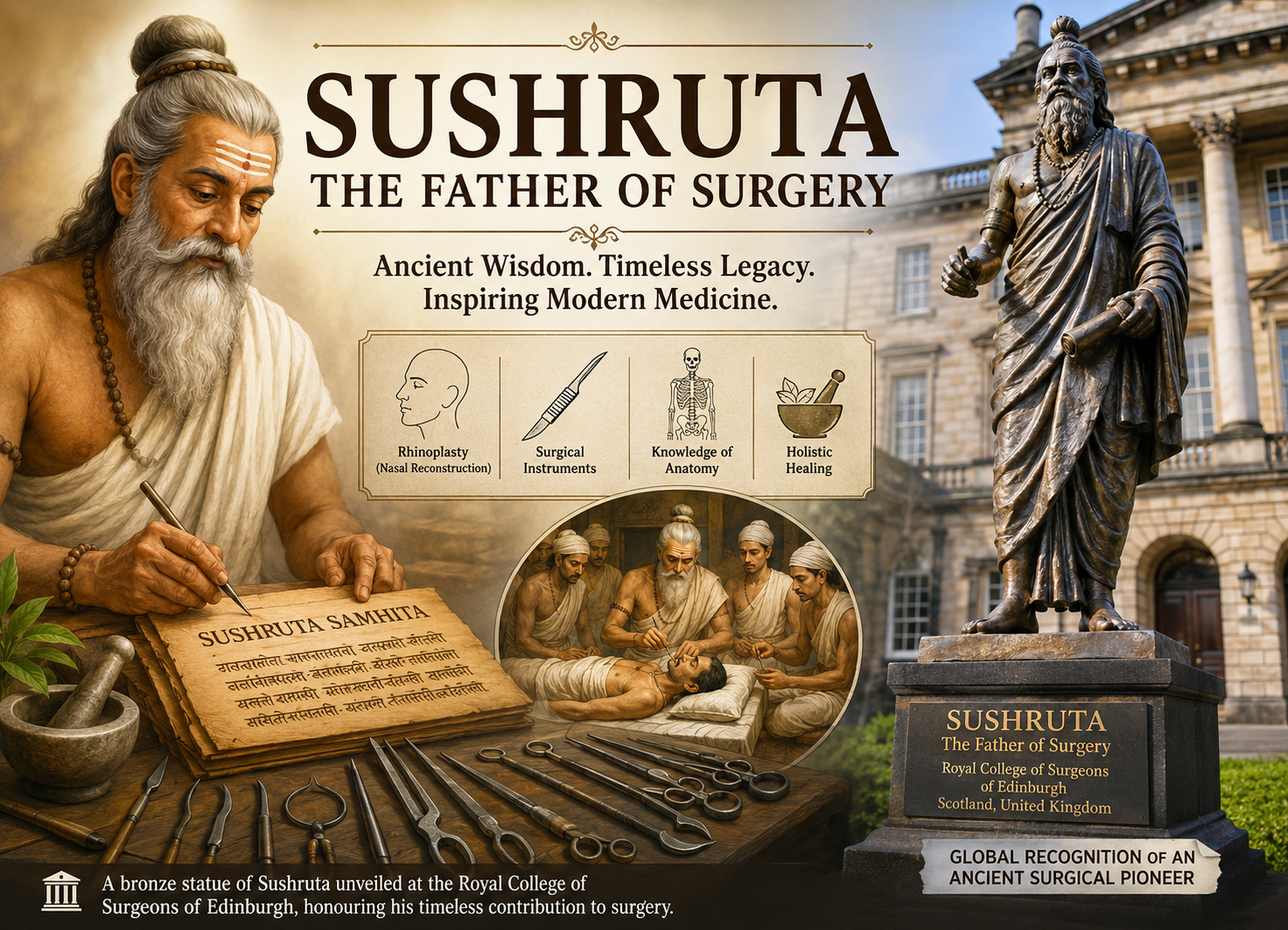
The timeless contribution of Maharishi Sushruta to the field of surgery received a remarkable international recognition recently when a bronze statue of Sushruta was unveiled at the Royal College of Surgeons of Edinburgh (RCSEd), Scotland, United Kingdom—one of the world’s oldest and most respected surgical institutions. The tribute represents a global acknowledgment of Sushruta’s pioneering role in the history of surgery and his influence on medical knowledge across centuries.
The bronze sculpture, installed as part of the institution’s heritage collection, honours Sushruta as the ancient Indian physician widely regarded as the “Father of Surgery.” The installation highlights the connection between ancient Indian surgical traditions and modern surgical practices, showing how medical knowledge has developed through contributions from different civilizations.
The statue stands as a symbol of respect for Sushruta’s groundbreaking work described in the Sushruta Samhita, where detailed explanations of surgical procedures, instruments, anatomy, and reconstructive techniques were recorded thousands of years ago. His innovations, especially in reconstructive surgery and nasal reconstruction (early rhinoplasty), continue to be studied as important milestones in the history of medicine.
This recognition in Edinburgh is especially significant because it places the memory of an ancient Indian surgeon within a modern global center of surgical education. It reminds the world that the journey of surgery did not begin only in recent centuries but has roots in ancient scientific traditions where pioneers like Sushruta carefully observed, experimented, and documented medical knowledge.
The unveiling of Sushruta’s statue reflects the growing appreciation of his contribution beyond geographical boundaries. From ancient Kashi to a prestigious surgical institution in Scotland, Sushruta’s legacy continues to inspire doctors, researchers, and medical students around the world.
Sushruta’s Legacy in Modern Times
Today, Sushruta is remembered not only in India but across the world as a symbol of medical innovation and scientific curiosity.
Medical institutions, research organizations, and scholars continue to study his contributions. His name represents the connection between ancient wisdom and modern scientific progress.
In an age when advanced technology dominates healthcare, Sushruta’s story reminds us that observation, knowledge, dedication, and human compassion have always been the true foundations of medicine.
Why Sushruta Is Called the Father of Surgery
The title “Father of Surgery” is given to Sushruta because of his extraordinary contributions to surgical knowledge. He documented procedures systematically, trained students, developed surgical techniques, and promoted scientific methods.
His achievements include:
- Early reconstructive surgery
- Detailed surgical descriptions
- Surgical instruments
- Anatomy studies
- Medical education principles
- Scientific approach to treatment
These contributions make him one of the greatest medical pioneers in human history.
Sushruta and the Pride of Ancient Indian Science
The story of Sushruta highlights the richness of ancient Indian scientific traditions. His achievements show that India was home to advanced knowledge systems in fields such as medicine, mathematics, astronomy, and engineering.
Sushruta’s work is not only a part of medical history but also a valuable example of human creativity and innovation.
His life teaches that scientific progress comes from curiosity, observation, and the desire to improve human life.
Conclusion: The Immortal Legacy of Sushruta
Sushruta was far ahead of his time. His understanding of surgery, anatomy, medical education, and patient care created a remarkable chapter in the history of medicine.
The Sushruta Samhita continues to inspire researchers and medical professionals even today. His contributions prove that ancient knowledge can have lasting importance when it is based on observation, experience, and dedication.
As the world celebrates medical advancements, the name of Sushruta remains a shining symbol of human intelligence and compassion. His legacy reminds us that the journey of modern medicine began with the efforts of visionary healers like him.
Sushruta was not only an ancient surgeon; he was a pioneer whose ideas helped shape the future of healthcare.