Durva Ganapati Vrat: Significance, Puja Vidhi, Vrat Katha and Benefits
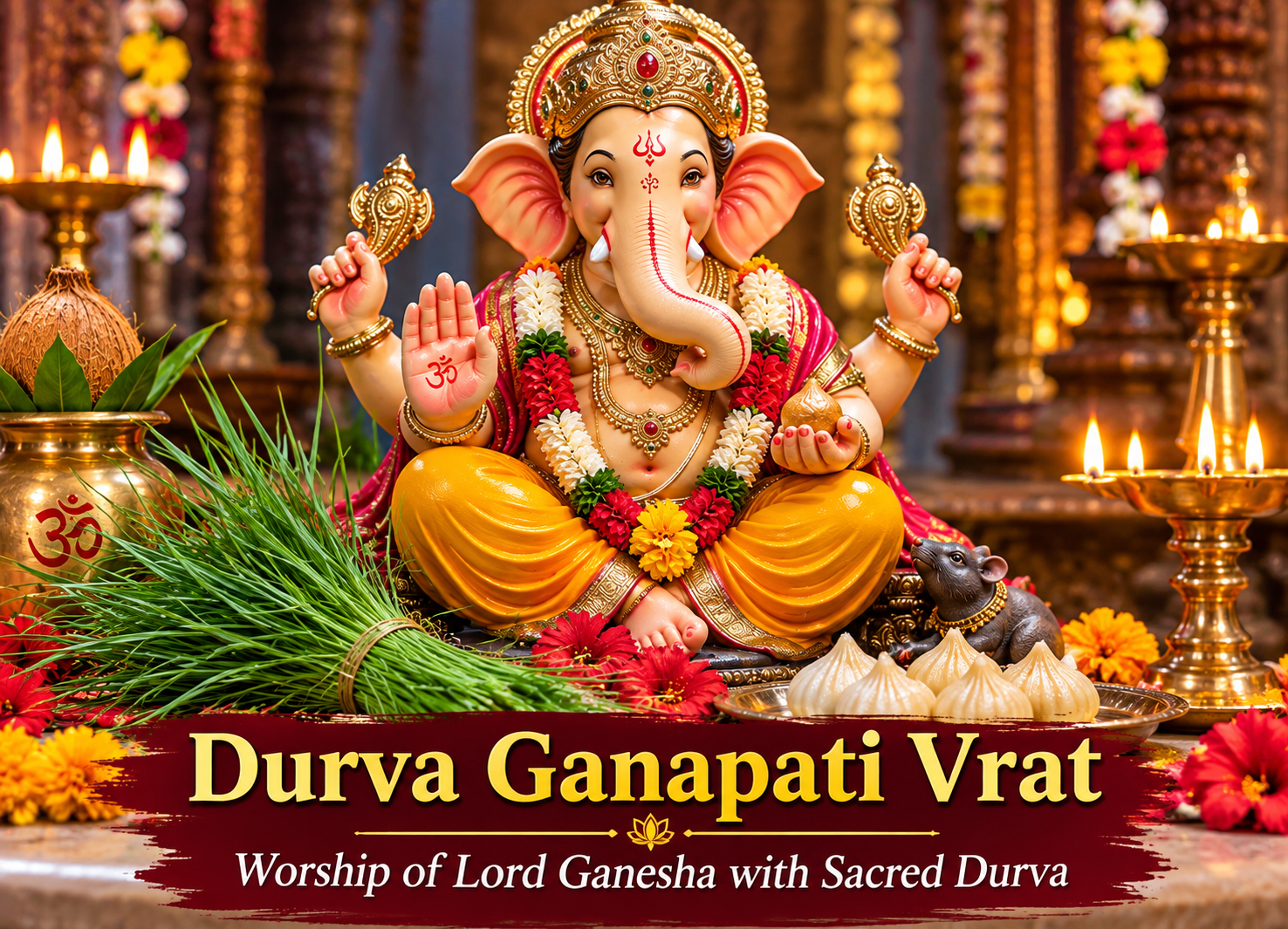
Hinduism has many sacred observances dedicated to Lord Ganesha. Among them, Durva Ganapati Vrat holds a special place because it combines the worship of Lord Ganesha with the offering of one of His most beloved sacred plants—durva grass.
Durva Ganapati Vrat is associated with Shukla Paksha Chaturthi of the month of Shravan. It is particularly known in parts of western and southern India, although devotees of Lord Ganesha in many other regions may also observe the day according to their family or regional traditions. Some traditional sources identify it as a special form of Vinayaka Chaturthi observance in which durva receives particular importance.
The word durva refers to a hardy, fine-bladed grass commonly identified botanically as Cynodon dactylon. In Hindu ritual practice, it is far more than an ordinary plant. Durva is closely connected with Ganesha worship and is traditionally offered to the deity in small bunches.
The importance of Durva Ganapati Vrat comes from several layers of Hindu tradition. There is the spiritual symbolism of durva, the mythology associated with Lord Ganesha, the discipline of fasting, the recitation of prayers, and the deeper idea of overcoming obstacles through devotion and self-control.
This article explores the meaning, history, significance, vrat katha, puja vidhi, offerings, fasting practices, mantras, and spiritual lessons associated with Durva Ganapati Vrat.
Note: Vrat practices can vary by region, sampradaya, temple and family tradition. The procedure below presents a commonly described traditional form rather than a rule that every devotee must follow.
What Is Durva Ganapati Vrat?
Durva Ganapati Vrat is a Hindu religious observance dedicated to Lord Ganesha, performed especially on Shravana Shukla Chaturthi, the fourth lunar day of the bright fortnight of Shravan.
The observance is sometimes called Durva Ganapati Chaturthi or Durva Ganpati Vrat.
The special feature of this vrata is the prominent use of durva grass in the worship of Ganesha. Lord Ganesha is traditionally worshipped with durva throughout the year, but on this particular vrata the relationship between Ganesha and durva becomes the central theme of the ritual.
According to traditional accounts, Shravana Shukla Chaturthi is considered highly auspicious for Ganesha worship. Drik Panchang describes this Chaturthi as a special observance dedicated to Lord Ganesha and notes that regional and family traditions can introduce variations in the puja procedure.
The vrata is not simply about avoiding food. Like other Hindu vratas, it is intended to cultivate devotion, discipline, purity, concentration and self-control.
When Is Durva Ganapati Vrat Observed?
Durva Ganapati Vrat is traditionally associated with Shukla Paksha Chaturthi in the month of Shravan.
The exact Gregorian date changes every year because Hindu lunar months are based on the lunar calendar.
For example, one Hindu calendar source lists August 16, 2026 for Durva Ganapati Vrat in its calendar tradition.
However, devotees should always consult a reliable local panchang when determining the exact date and puja timings for their location. Lunar-day calculations can vary depending on geographical location and the calendar tradition being followed.
It is also important not to confuse Durva Ganapati Vrat with Sankashti Chaturthi. Sankashti Chaturthi occurs on Krishna Paksha Chaturthi, whereas Durva Ganapati Vrat is associated with Shukla Paksha Chaturthi of Shravan.
Similarly, it should not be confused with the major Ganesh Chaturthi festival, which is celebrated on Shukla Paksha Chaturthi in the month of Bhadrapada.
Why Is Durva So Important to Lord Ganesha?
One of the most recognizable features of Ganesha worship is the offering of durva.
Durva is a humble plant. It grows easily and can survive conditions in which many other plants struggle. This simple characteristic has given it powerful symbolic meaning.
In devotional interpretation, durva represents:
- resilience,
- simplicity,
- purity,
- renewal,
- humility,
- vitality,
- and the ability to survive difficulties.
Traditional sources also explain that durva has a special spiritual relationship with Ganesha and is believed to attract the divine principle associated with Him.
The offering therefore teaches an important spiritual lesson: God does not require expensive offerings when they are made without devotion. A simple blade of sacred grass offered with sincerity can become deeply meaningful.
The Mythological Story Behind Offering Durva to Ganesha
One traditional explanation for the association between Ganesha and durva concerns an episode in which Ganesha experienced intense heat or burning.
According to a popular traditional account, Ganesha became disturbed by an extraordinary burning sensation. Various attempts were made to relieve Him, but the discomfort continued. Finally, durva grass was placed upon His head, and the heat was relieved.
Because of this association, devotees began offering durva to Ganesha as an especially beloved and cooling offering.
This story is found in traditional explanations of Ganesha worship, although versions of the story can differ between sources and regional traditions.
The story also gives the ritual a beautiful symbolic meaning.
Fire represents intensity, anger, ego and uncontrolled desires. Durva, with its freshness and coolness, represents calmness and balance.
Thus, the ritual can be understood as a prayer:
“May the divine presence remove the inner heat of anger, confusion, pride and anxiety.”
The Spiritual Symbolism of Durva
Durva is a small plant, but its symbolism is large.
1. Symbol of Resilience
Durva can spread and grow rapidly. Even when cut, it can regenerate.
For devotees, this becomes a reminder of spiritual resilience.
Life contains obstacles, failures and unexpected difficulties. Like durva, a person should learn to rise again.
2. Symbol of Humility
Durva is not a luxurious flower. It is an ordinary grass.
Yet it is highly valued in Ganesha worship.
This teaches that spiritual value does not depend on material cost.
3. Symbol of Purity
The fresh green appearance of durva is associated with freshness and life.
Offering fresh durva represents the offering of a pure heart and sincere intention.
4. Symbol of Renewal
Because durva grows again after being cut, it can symbolize renewal and the continuation of life.
5. Symbol of Simplicity
Ganesha worship is often accessible to ordinary people. A devotee does not necessarily need elaborate arrangements to express devotion.
A clean place, a Ganesha image or murti, some durva, flowers, water, fruit and sincere prayer can form the basis of a simple home worship.
Why Are 21 Durva Blades Commonly Offered?
The number 21 has a special place in traditional Ganesha worship.
Many Ganesha puja traditions recommend offering durva in groups or bunches, with 21 being particularly common. Some traditions also use other odd numbers such as 3, 5 or 7.
The number 21 is therefore not merely a decorative convention.
In devotional symbolism, it can represent completeness and disciplined worship. Different traditions give different interpretations to the number, so it is better not to insist on one single explanation.
What matters most is the bhava, or devotional attitude, behind the offering.
If 21 fresh durva blades are available and this is the practice followed in the devotee’s tradition, they may be offered respectfully. If a particular family tradition prescribes another number, that tradition may be followed.
What Kind of Durva Should Be Offered?
Traditional Ganesha worship generally prefers fresh and tender durva.
Some traditional sources recommend tender shoots with an odd number of blades, such as 3, 5 or 7.
Before offering durva:
- Collect clean and fresh blades.
- Remove dry or damaged portions.
- Wash them gently with clean water.
- Keep them fresh until the puja.
- Offer them respectfully before or during Ganesha worship.
One traditional explanation recommends soaking durva in water to keep it fresh before offering it.
There is no need to turn the ritual into a complicated process. Cleanliness and devotion are more important than unnecessary ritual anxiety.
Durva Ganapati Vrat Puja Vidhi
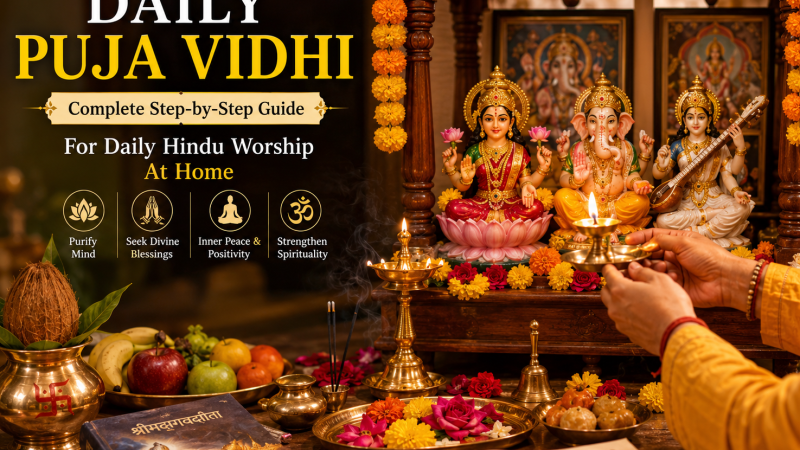
The exact procedure varies according to family and regional customs. A simple home observance may follow the steps below.
Step 1: Wake Up Early
On the day of the vrata, devotees traditionally rise early.
After completing normal morning activities, they take a bath and wear clean clothes.
The purpose is not merely physical cleanliness. The bath also represents mental preparation for worship.
Step 2: Clean the Puja Space
The place where Ganesha will be worshipped should be cleaned.
A small altar can be prepared with:
- a Ganesha murti or image,
- a clean cloth,
- flowers,
- durva,
- water,
- fruits,
- sweets,
- incense,
- a lamp,
- sandalwood paste,
- and other customary puja items.
A simple arrangement is perfectly suitable for home worship.
Step 3: Make a Sankalpa
Before beginning the puja, the devotee may make a sankalpa, or devotional resolution.
The sankalpa is a statement of intention.
One may mentally pray:
“O Lord Ganesha, I observe this Durva Ganapati Vrat with devotion. Please give me wisdom, strength, purity of mind and the ability to overcome obstacles.”
The sankalpa should be sincere rather than complicated.
Step 4: Invoke Lord Ganesha
Begin the worship by remembering Lord Ganesha.
A widely used Ganesha mantra is:
Om Gam Ganapataye Namah
This mantra may be repeated according to one’s tradition.
The devotee may also recite the Ganesha Atharvashirsha, Ganapati stotras or other prayers if familiar with them.
Step 5: Offer Water
Water may be offered to Ganesha as part of the traditional worship.
The devotee can mentally offer the water with reverence and gratitude.
If a full ritual bath is performed for a murti, it should be done according to the custom appropriate for that murti and one’s family tradition.
Step 6: Offer Sandalwood and Flowers
Sandalwood paste and flowers may be offered to Lord Ganesha.
Red flowers are traditionally popular in Ganesha worship, although the precise flowers used can vary by tradition.
The important point is respectful offering.
Step 7: Offer Durva
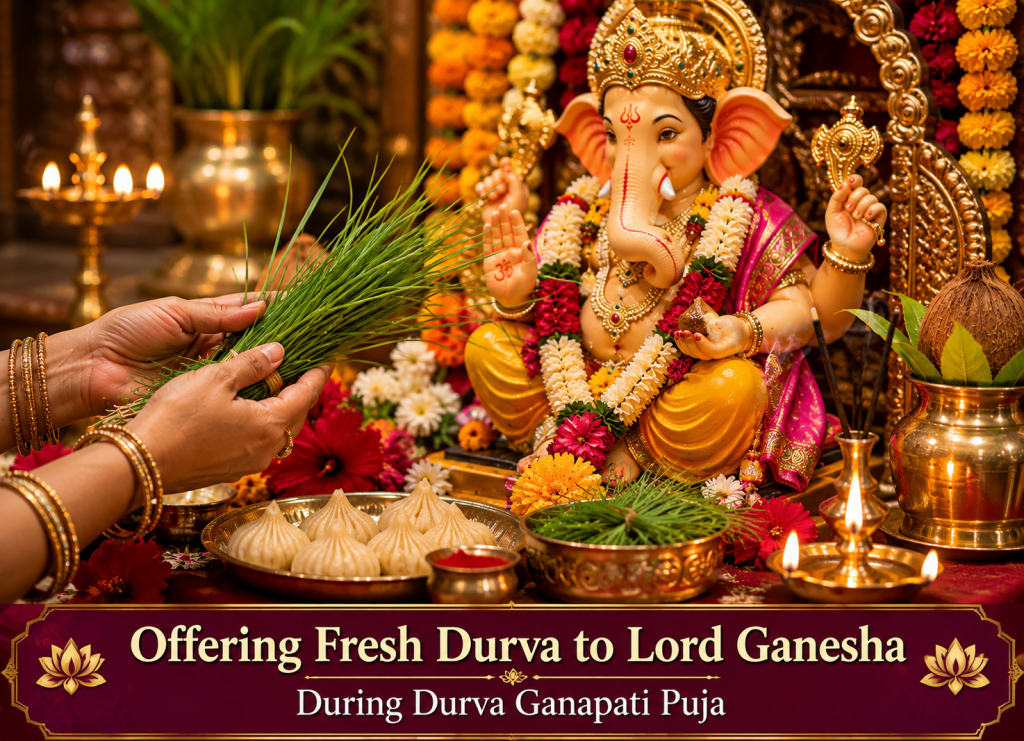
This is the central part of Durva Ganapati worship.
Take the clean durva and offer it to Ganesha while remembering Him.
Many devotees offer 21 durva or 21 blades/bunches according to their tradition.
A simple prayer may be recited:
“Om Gam Ganapataye Namah.”
As each offering is made, the devotee can contemplate the qualities represented by Ganesha—wisdom, discrimination, humility, strength and the removal of obstacles.
Step 8: Offer Naivedya
Traditional Ganesha worship commonly includes modak as a special offering.
Fruits, sweets, coconut and other vegetarian foods may also be offered according to family tradition.
Sanatan Sanstha notes the traditional importance of modak in Ganesha worship.
After offering the food, devotees may receive it as prasada.
Step 9: Light the Lamp and Incense
A lamp may be lit before Ganesha.
Incense may also be offered if customary.
The flame can be viewed as a symbol of divine knowledge.
Just as a lamp removes darkness from a room, wisdom removes the darkness of ignorance.
Step 10: Recite Ganesha Prayers
Devotees may recite one or more of the following:
- Ganapati mantra,
- Ganesha Ashtottara Shatanamavali,
- Ganapati Atharvashirsha,
- Ganesha Chalisa,
- Ganesha stotra,
- or a simple personal prayer.
There is no requirement to recite every available prayer.
Even a few minutes of sincere prayer can make the observance meaningful.
Step 11: Perform Aarti
After the offerings and prayers, perform Ganesha aarti according to the family’s tradition.
The devotee may sing or recite a familiar aarti.
The atmosphere should be peaceful and devotional.
Step 12: Pradakshina and Namaskar
After the puja, devotees may offer respectful pranama and perform pradakshina according to their family tradition.
The number of circumambulations can vary.
Some regional traditions associated with Durva Ganapati Vrat prescribe specific numbers of namaskars and pradakshinas. For example, one Marathi tradition describes six durva offerings along with six namaskars and six pradakshinas.
This illustrates why local traditions should be respected rather than assuming that one procedure is universal.
Durva Ganapati Vrat Fasting Rules
Fasting is an important part of many Hindu vratas, but fasting practices vary significantly.
Some devotees observe a complete fast.
Others take fruits, milk or light vegetarian food.
Some observe a partial fast and concentrate primarily on prayer and worship.
The purpose of fasting is traditionally connected with self-discipline, not suffering.
A person should not undertake a strict fast if it could harm their health. Children, older people and anyone with medical or dietary needs should follow appropriate guidance from a parent, guardian or qualified health professional rather than attempting an extreme fast.
For a simple devotional observance, one can focus on:
- avoiding unnecessary indulgence,
- maintaining a calm mind,
- eating simple vegetarian food if fasting,
- speaking respectfully,
- avoiding anger,
- praying,
- and spending time in spiritual reflection.
In this sense, the deepest form of fasting is not merely fasting from food. It is fasting from negative habits.
Durva Ganapati Vrat Katha
Traditional literature and regional traditions preserve different narratives connected with Chaturthi and Durva Ganapati worship.
One important Chaturthi narrative tells of King Ashvasena, who suffered from severe illness after neglecting the observance of Chaturthi. Sage Devala explained the importance of the vrata and instructed him in Ganesha worship. The king subsequently observed the Chaturthi vrata with his people, and the traditional account describes his recovery and the restoration of well-being.
The story emphasizes the traditional belief that sincere observance of Chaturthi brings auspiciousness and spiritual merit.
Other regional traditions specifically connect Durva Ganapati worship with the worship of Durva Devi and Durva Mahaganapati. One traditional account describes the vrata as having been taught by Mahadeva to Sanatkumara and says that divine figures including Parvati, Vishnu, Saraswati, Indra and Kubera were associated with its observance. These accounts belong to traditional religious literature and regional devotional practice.
The exact details of the katha may therefore differ from one tradition to another.
Rather than seeing these differences as contradictions, they can be understood as part of the rich diversity of Hindu religious storytelling.
What Are the Benefits of Durva Ganapati Vrat?
Devotees traditionally observe Durva Ganapati Vrat with several spiritual intentions.
1. Removal of Obstacles
Ganesha is widely worshipped as Vighnaharta, the remover of obstacles.
Devotees therefore pray to Him before important activities and during periods of difficulty.
Durva Ganapati Vrat is traditionally believed to strengthen this devotional connection.
2. Growth in Wisdom
Ganesha represents intelligence, discrimination and wisdom.
Therefore, worshipping Ganesha is especially meaningful for students and anyone seeking clarity in decision-making.
The deeper benefit is not simply asking for success. It is asking for the wisdom needed to choose the right path.
3. Peace of Mind
Prayer and disciplined observance can help create a peaceful mental atmosphere.
The ritual gives the devotee time to step away from everyday distractions and focus on something sacred.
4. Prosperity and Auspiciousness
Traditional accounts associate Ganesha worship with prosperity, good fortune and auspicious beginnings.
Some traditional Durva Ganapati accounts specifically associate the vrata with blessings such as wealth, prosperity and children.
These should be understood as traditional religious beliefs, rather than guaranteed material outcomes.
5. Family Well-Being
Many devotees perform Ganesha worship for the welfare of their families.
The prayer may include wishes for peace, harmony, health and prosperity within the household.
6. Spiritual Discipline
A vrata teaches discipline.
The devotee chooses to dedicate a particular day to prayer, simplicity and self-control.
This discipline can become more valuable than the external ritual itself.
Durva Ganapati Vrat and the Deeper Meaning of Ganesha Worship
The true purpose of the vrata can be understood through the symbolism of Lord Ganesha.
The Large Head
Ganesha’s large head is traditionally associated with wisdom and broad thinking.
It reminds devotees to think before acting.
The Large Ears
His large ears symbolize attentive listening.
A wise person should listen carefully before making judgments.
The Trunk
The trunk represents adaptability and strength.
It can perform delicate tasks but is also powerful.
This suggests that wisdom requires both flexibility and strength.
The Large Belly
Ganesha’s rounded belly is often interpreted as the ability to accept and digest life’s experiences.
It teaches patience and emotional balance.
The Mouse
Ganesha’s vehicle, the mouse, is often interpreted symbolically as representing restless desires.
The divine intellect controls the restless mind rather than allowing desire to control the person.
Thus, Durva Ganapati Vrat becomes more than a ritual involving grass.
It becomes a practice of controlling the mind, developing wisdom and overcoming inner obstacles.
Durva Ganapati Vrat and the Importance of Simplicity
One of the most beautiful lessons of this vrata is simplicity.
A devotee can see an ordinary blade of grass and remember the divine.
This changes the way we look at the natural world.
The plant is no longer merely a plant. It becomes an object of reverence because it participates in a sacred tradition.
This is also one reason Hindu worship has traditionally included flowers, leaves, fruits, water, grains and other elements of nature.
The message is simple:
Spirituality does not always require something rare or expensive.
A sincere heart can transform a simple offering into an act of devotion.
Durva Ganapati Vrat at Home
Devotees who cannot visit a temple can observe the vrata at home.
A simple home puja may include:
- Cleaning the worship area.
- Placing a Ganesha image or murti.
- Taking a bath and wearing clean clothes.
- Making a sankalpa.
- Lighting a lamp.
- Offering flowers.
- Offering fresh durva.
- Reciting “Om Gam Ganapataye Namah.”
- Offering fruits or modak.
- Performing aarti.
- Offering pranama.
- Taking prasada.
The emphasis should remain on devotion rather than elaborate arrangements.
What Should Be Offered to Lord Ganesha?
Common offerings include:
- Durva grass
- Modak
- Fruits
- Coconut
- Flowers
- Sandalwood paste
- Water
- Incense
- A lamp
- Simple vegetarian naivedya
The exact list can differ according to local custom.
The most important offering is bhakti, or devotion.
Common Mistakes to Avoid
There are a few things devotees should keep in mind.
Do Not Treat the Vrat as Only a Food Fast
The purpose is spiritual discipline.
If someone avoids food but spends the day in anger, arguments or harmful behavior, the deeper purpose of the vrata is missed.
Do Not Become Excessively Anxious About Minor Ritual Details
Different traditions prescribe different procedures.
A sincere devotee should not become frightened that a minor variation automatically destroys the spiritual value of worship.
Do Not Waste Natural Offerings
Durva and flowers should be collected respectfully.
Avoid unnecessary destruction of plants.
Do Not Force Yourself Into Extreme Fasting
Fasting should be undertaken responsibly.
The devotional purpose is more important than physical hardship.
Durva Ganapati Vrat vs Ganesh Chaturthi
These two observances are related but not identical.
| Feature | Durva Ganapati Vrat | Ganesh Chaturthi |
|---|---|---|
| Main deity | Lord Ganesha | Lord Ganesha |
| Main tithi | Shravan Shukla Chaturthi | Bhadrapada Shukla Chaturthi |
| Special feature | Durva receives special importance | Installation and festival worship of Ganesha |
| Duration | Generally a one-day vrata, with some traditions having longer observances | Often observed over multiple days |
| Regional practice | Strongly associated with certain regional traditions | Widely celebrated across India and beyond |
| Main spiritual theme | Ganesha worship with special emphasis on durva | Birth/festival celebration of Lord Ganesha |
A traditional source notes that Durva Ganapati Vrata occurs one month before the Bhadrapada Ganesh Chaturthi in the calendar tradition described there.
Is Durva Ganapati Vrat the Same as Vinayaka Chaturthi?
The terms can overlap in devotional usage, but they should not always be treated as completely identical.
Vinayaka Chaturthi generally refers to worship of Lord Ganesha on Shukla Paksha Chaturthi.
Durva Ganapati Vrat is a particularly associated observance of the Shravan Shukla Chaturthi in which durva has special importance.
Regional traditions may use different names.
Therefore, when researching the vrata, it is useful to search for all of these names:
Durva Ganapati Vrat, Durva Ganapati Chaturthi, Durva Ganpati Vrat, Shravan Shukla Chaturthi and Vinayaka Chaturthi.
A Simple Prayer for Durva Ganapati Vrat
A devotee may conclude the puja with a simple prayer:
“O Lord Ganesha, remover of obstacles, please bless me with wisdom, patience, strength and devotion. May I overcome ignorance, anger, fear and confusion. May my thoughts be pure, my actions righteous and my heart peaceful. Please bless my family and guide us toward the right path.”
A prayer does not need to be long to be meaningful.
The sincerity of the devotee is more important than the number of words.
The Message of Durva Ganapati Vrat for Modern Life
The ancient vrata has lessons that remain relevant today.
Modern life is often filled with stress, distraction and constant competition.
Durva Ganapati Vrat creates an opportunity to pause.
For one day, the devotee can step away from unnecessary distractions and remember:
- patience is valuable,
- wisdom is greater than impulsiveness,
- simplicity can be beautiful,
- nature deserves respect,
- obstacles can be faced with courage,
- and spiritual discipline can strengthen the mind.
The humble durva becomes a reminder that strength does not always look powerful.
Sometimes strength looks like a small green blade of grass that continues to grow.
Frequently Asked Questions About Durva Ganapati Vrat
What is Durva Ganapati Vrat?
Durva Ganapati Vrat is a vrata dedicated to Lord Ganesha, traditionally observed on Shravan Shukla Chaturthi, with special emphasis on offering sacred durva grass.
When is Durva Ganapati Vrat celebrated?
It is traditionally observed on Shukla Paksha Chaturthi during the month of Shravan. The Gregorian date changes every year according to the Hindu lunar calendar.
Why is durva offered to Lord Ganesha?
Durva has a special place in traditional Ganesha worship. Mythological and spiritual explanations connect it closely with Ganesha and describe it as a particularly auspicious offering to Him.
How many durva should be offered to Ganesha?
Twenty-one durva blades or appropriate bunches are commonly offered, although traditions may also prescribe other odd numbers such as 3, 5 or 7.
Can Durva Ganapati Vrat be observed at home?
Yes. A simple home puja with a Ganesha image or murti, fresh durva, flowers, water, naivedya and prayers can be performed according to one’s family tradition.
Is fasting compulsory?
Fasting practices differ. Some devotees observe a complete fast, while others follow a partial fast or eat simple vegetarian food. The vrata should be observed responsibly.
What is the main mantra for Durva Ganapati Vrat?
A commonly used Ganesha mantra is:
Om Gam Ganapataye Namah.
What food is offered to Ganesha?
Modak is among the most traditional offerings. Fruits and other vegetarian foods may also be offered according to regional and family customs.
Is Durva Ganapati Vrat the same as Ganesh Chaturthi?
No. They are separate observances associated with different Chaturthi dates. Durva Ganapati Vrat is traditionally associated with Shravan Shukla Chaturthi, while the major Ganesh Chaturthi festival is observed in Bhadrapada.
What is the main benefit of Durva Ganapati Vrat?
Devotees traditionally observe it for Ganesha’s blessings, wisdom, auspiciousness, removal of obstacles, prosperity and spiritual well-being. These are matters of religious faith rather than guaranteed material results.
Conclusion
Durva Ganapati Vrat is a beautiful expression of devotion to Lord Ganesha.
Its special significance comes from the sacred relationship between Ganesha and durva grass. The humble green grass becomes a powerful symbol of resilience, simplicity, purity and renewal.
The vrata also reminds devotees that worship is not merely about external rituals. Its deeper purpose is to transform the mind.
When a devotee offers durva to Ganesha, the offering can become a prayer for strength.
When the devotee lights a lamp, it can represent the light of wisdom.
When the devotee observes a fast, it can represent self-control.
When the devotee recites the Ganesha mantra, it can become an effort to calm the mind.
And when the devotee bows before Ganesha, it can represent humility before the divine.
The central message of Durva Ganapati Vrat can therefore be expressed in a simple thought:
May Lord Ganesha remove the obstacles outside us, and may He also give us the wisdom to overcome the obstacles within us.
With faith, simplicity and sincere devotion, Durva Ganapati Vrat becomes not only a traditional religious observance but also a meaningful opportunity for reflection, discipline and spiritual growth.