Moksha: The Hindu Path to Eternal Life and True Happiness
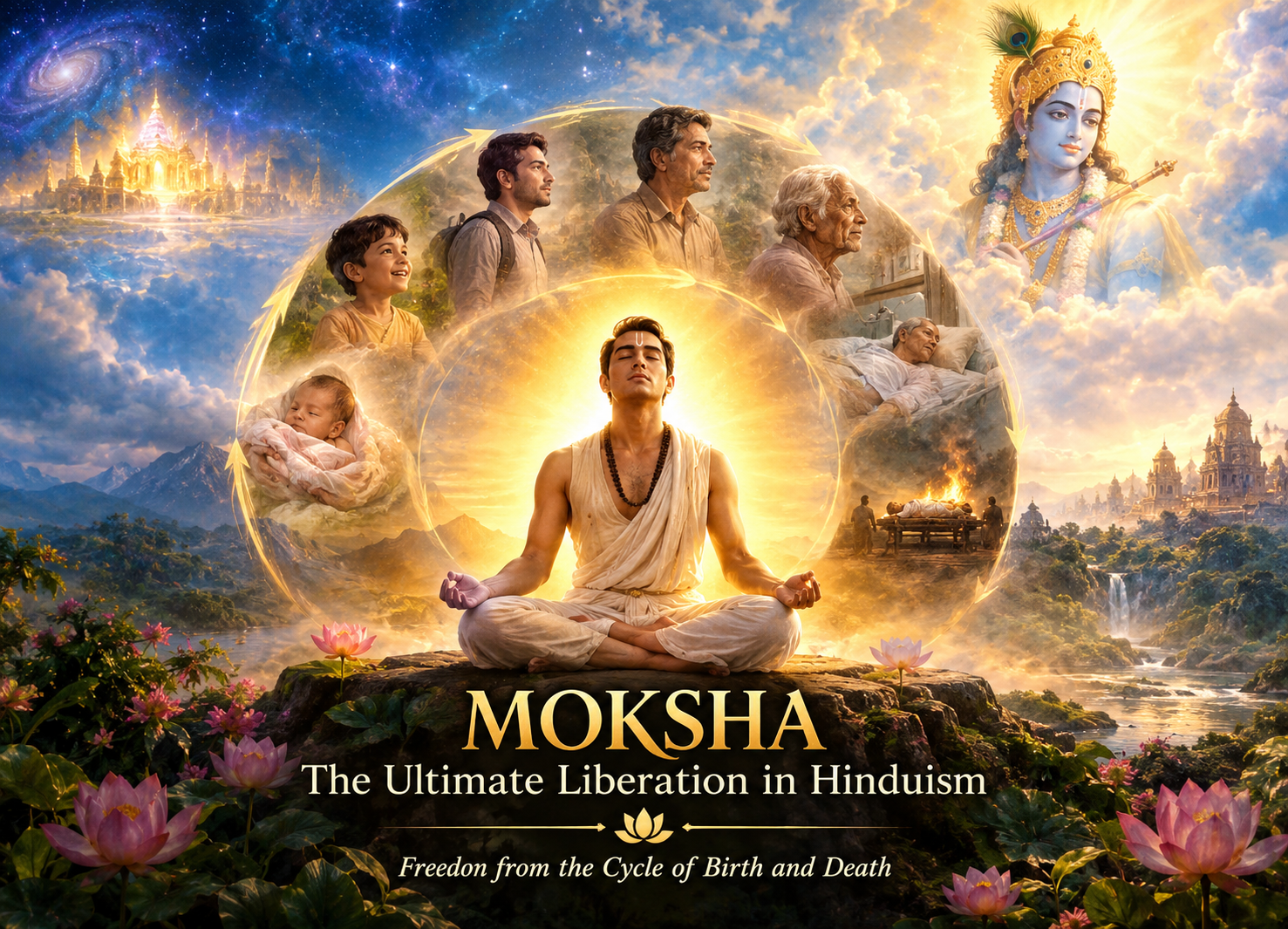
Life is one of the greatest mysteries. We are born, grow from childhood into adulthood, experience happiness and sorrow, build relationships, pursue knowledge and possessions, grow old, and eventually leave the physical body. Yet Hindu philosophy asks a profound question: Is this temporary existence the whole of life, or is there a deeper reality beyond the body and mind?
The Hindu concept of Moksha begins with this question.
Moksha is generally understood as liberation—the freedom of the individual self from the cycle of birth and death. It is not simply a place that one reaches after death. It is a profound spiritual realization in which a person understands the true nature of the self, recognizes its distinction from the temporary body and mind, and becomes free from the ignorance and attachment that bind consciousness to material existence.
From this perspective, material existence is temporary because everything associated with the material body is temporary. Youth becomes old age. Health can become disease. Relationships change. Possessions disappear. Circumstances rise and fall. Finally, the physical body dies.
The soul, however, is described in Hindu philosophy as eternal.
Therefore, Moksha can be understood as the awakening to our eternal spiritual nature.
What Is Moksha?
The Sanskrit word Moksha comes from the root muc, meaning “to release,” “to free,” or “to liberate.” In Hindu thought, Moksha therefore refers to liberation from bondage.
The bondage is primarily associated with samsara, the continuing cycle of birth, death, and rebirth.
According to many Hindu philosophical traditions, the individual self does not begin with the birth of the physical body and does not cease to exist when the body dies. The body is temporary, while the conscious self, or atman, is eternal.
Moksha occurs when ignorance is overcome and the true nature of the self is realized.
This is why Moksha is sometimes described as the ultimate goal of human life. Human beings have the capacity to seek food, shelter, pleasure, security, family, wealth, social recognition, and many other things. But Hindu philosophy asks whether these temporary achievements can provide permanent fulfillment.
If everything material eventually changes and disappears, then happiness dependent entirely upon material things must also be temporary.
Moksha points toward something beyond this temporary cycle.
It is the search for eternal spiritual fulfillment.
Is Material Life Really Life?
From an ordinary perspective, material life is certainly real. We experience the world through our senses, interact with other people, work, eat, sleep, love, struggle, create, and learn.
Hindu philosophy does not require us to deny these experiences.
Instead, it asks us to understand their limitations.
The physical body is born, develops, becomes mature, ages, and eventually dies. The mind also changes constantly. Our thoughts, emotions, opinions, desires, and memories can change throughout life.
Yet there is an enduring sense of “I” behind these changing experiences.
As children, we had one body. As adults, we have another. Our thoughts and personalities have also changed. Nevertheless, we recognize ourselves as the same person.
This raises an important philosophical question:
Who is the “I” that experiences all these changes?
Hindu spirituality identifies this deeper self with the atman—the conscious spiritual self.
Therefore, when Hindu teachings describe material existence as a form of death or suffering, the point is not that physical life has no value. Rather, it is that a life identified exclusively with the temporary body cannot provide the permanent happiness that the eternal self seeks.
The body belongs to the changing world.
The self belongs to the realm of consciousness.
Understanding this distinction is the beginning of spiritual wisdom.
The Body and the Self
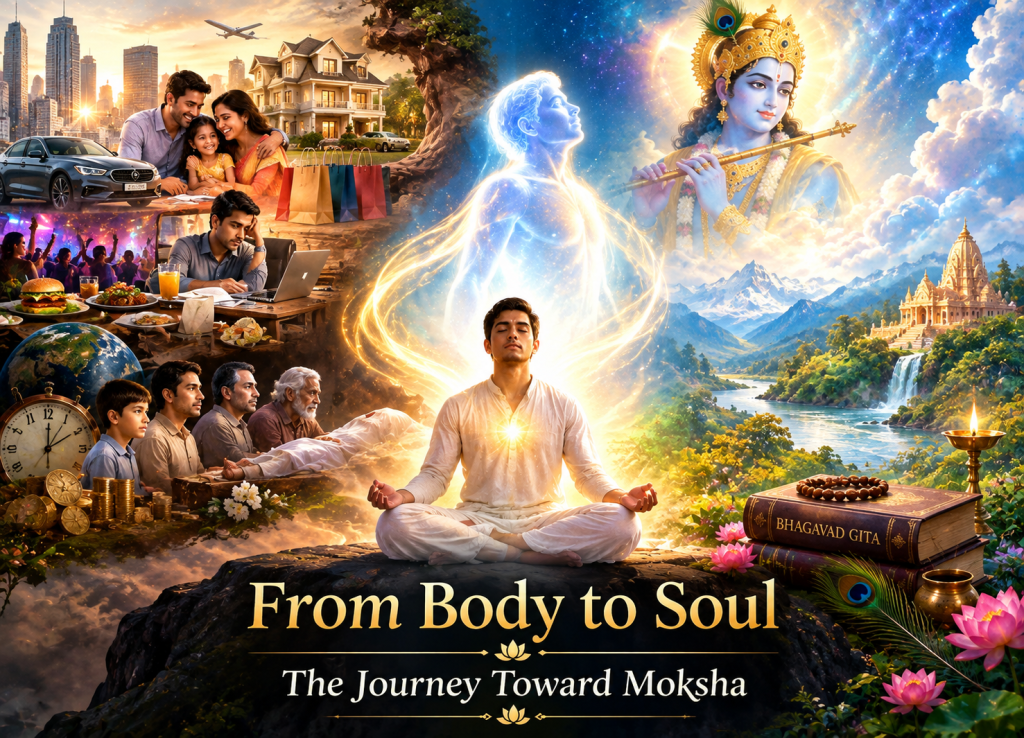
One of the most important teachings in Hindu philosophy is the distinction between the body and the self.
The body is composed of material elements and is constantly changing. The self is the conscious principle that experiences the body.
We commonly say:
“My body.”
“My mind.”
“My thoughts.”
“My feelings.”
“My possessions.”
The language itself suggests a distinction between the experiencer and the things experienced.
If we say “my body,” then who is the “my”?
If the body is the possession or instrument, who is its possessor?
This inquiry is central to spiritual knowledge.
The Bhagavad Gita repeatedly teaches that the physical body is temporary while the soul is eternal. Krishna explains to Arjuna that the embodied self passes through different stages of bodily existence just as a person changes from childhood to youth and old age.
The physical body changes, but the conscious self remains.
This realization changes our understanding of life.
Instead of thinking, “I am merely this temporary body,” a person begins to understand, “I am an eternal conscious being temporarily associated with this body.”
That shift in consciousness is one of the foundations of the journey toward Moksha.
Why Does Material Existence Bring Suffering?
Human life contains pleasure as well as suffering. Hindu philosophy does not ignore happiness, friendship, love, beauty, achievement, or other positive experiences.
The deeper problem is impermanence.
Whatever begins in the material world eventually changes.
A newborn child becomes an adult.
Strength becomes weakness.
Health can become illness.
Relationships may be separated by circumstances.
Wealth can be lost.
Fame disappears.
And every embodied person eventually encounters death.
The Bhagavad Gita describes birth, old age, disease, and death as characteristic difficulties of embodied existence.
This does not mean that every moment of life is miserable. Rather, it means that material happiness cannot provide absolute security because its objects are temporary.
A person may experience extraordinary pleasure today and still know that circumstances can change tomorrow.
Therefore, the question becomes:
Can there be a form of happiness that does not depend entirely upon changing external circumstances?
Hindu spirituality answers yes.
That happiness is connected with the realization of the self.
Real Happiness and the Search for Pleasure
Modern life often measures happiness through external achievements.
A person may believe that happiness will come from a better house, a larger income, a new vehicle, greater popularity, entertainment, luxury, or sensory enjoyment.
There is nothing inherently wrong with enjoying the legitimate comforts of life.
The problem arises when temporary pleasure is mistaken for ultimate happiness.
Sense enjoyment is temporary. A delicious meal satisfies hunger for a while. Sleep provides rest, but eventually we become tired again. Entertainment produces excitement, but the experience passes. Material possessions may give pleasure, but their novelty often fades.
The cycle continues:
desire → acquisition → enjoyment → dissatisfaction → new desire.
Hindu philosophy asks us to look beyond this cycle.
The deeper spiritual happiness of the self is not dependent upon constantly acquiring new objects.
The goal is not simply to increase the quantity of pleasure but to discover its source.
According to the spiritual vision of Hinduism, the soul naturally seeks lasting fulfillment because its own nature is spiritual and eternal.
Eating, Sleeping, Mating and Defending
Human beings share several basic biological activities with other living creatures.
We eat.
We sleep.
We reproduce.
We protect ourselves.
These activities are necessary for embodied life. Hindu philosophy does not suggest that human beings should abandon them.
But human life offers something more.
Animals primarily act according to instinct and immediate biological needs. Human beings possess the ability to question existence, contemplate morality, seek truth, understand consciousness, pursue spiritual knowledge, and ask what happens beyond bodily existence.
Therefore, if human civilization becomes completely centered on consumption and sensory satisfaction, Hindu philosophy would regard that as a failure to use the higher potential of human consciousness.
The question is not whether we should eat, sleep, maintain families, work, or protect ourselves.
The question is:
Is that all human life is meant to be?
If the entire purpose of life becomes satisfying bodily desires, then there is little difference between human existence and animal existence except the sophistication of our methods.
Human intelligence gives us the opportunity to pursue a higher purpose.
That higher purpose is spiritual realization.
Consumer Civilization and the Endless Pursuit of More
Modern civilization has developed extraordinary technologies and industries. Human beings can travel across continents, communicate instantly across the planet, produce enormous quantities of food and goods, and benefit from remarkable scientific discoveries.
Yet material abundance does not automatically create spiritual fulfillment.
The modern economy encourages continuous consumption. We manufacture products, purchase them, replace them, and seek newer versions.
This process can satisfy many physical needs, but it can also create an endless cycle of wanting.
The Hindu spiritual perspective asks us to consider the environmental and psychological consequences of unlimited consumption.
Natural resources are extracted to produce homes, furniture, clothing, food containers, electronic devices, vehicles, packaging, and countless other products. Forests, minerals, water, land, and energy are consumed to support modern lifestyles.
The question is therefore not simply:
“How much can humanity consume?”
It is also:
“What do we actually need for a meaningful life?”
A spiritually mature civilization would seek balance.
It would provide material necessities while recognizing that human fulfillment cannot be reduced to consumption.
Nature in Hindu Thought
Hindu philosophy traditionally sees nature as something sacred rather than merely an object of exploitation.
The earth, rivers, mountains, forests, animals, trees, and elements have an important place in Hindu religious imagination.
The Ganges is revered as a sacred river. Mountains such as Kailash hold profound spiritual significance. Trees such as the banyan and peepal are associated with sacred traditions. Animals appear throughout Hindu mythology as companions, vehicles, or manifestations connected with divine beings.
This worldview can encourage a relationship with nature based upon respect rather than unlimited exploitation.
When human beings recognize that life is interconnected, environmental responsibility becomes more than an economic necessity. It becomes a spiritual responsibility.
The pursuit of Moksha does not require hatred of the material world.
Rather, it can encourage us to understand that the material world is temporary and should therefore be approached with wisdom, restraint, gratitude, and responsibility.
Spiritual Knowledge Begins With Self-Knowledge
Krishna makes a profound statement at the beginning of the Ninth Chapter of the Bhagavad Gita:
“My dear Arjuna, because you are never envious of Me, I shall impart to you this most confidential knowledge and realization, knowing which you shall be relieved of the miseries of material existence.”
— Bhagavad Gita 9.1
This teaching emphasizes that spiritual knowledge is not merely intellectual information.
It must become realization.
A person can read hundreds of books about the soul without actually realizing the soul.
Someone can speak about meditation without practicing it.
Someone can discuss compassion without living compassionately.
Spiritual knowledge becomes transformative when it changes consciousness.
Therefore, the path toward Moksha begins with a fundamental inquiry:
Who am I?
Am I merely this body?
Am I my changing thoughts?
Am I my emotions?
Or am I the conscious self that experiences all of these?
This inquiry can gradually transform our relationship with the world.
Krishna’s Teaching About the Highest Knowledge
Krishna continues in Bhagavad Gita 9.2:
“This knowledge is the king of education, the most secret of all secrets. It is the purest knowledge, and because it gives direct perception of the self by realization, it is the perfection of religion. It is everlasting, and it is joyfully performed.”
— Bhagavad Gita 9.2
The importance of this teaching lies in the relationship between knowledge and realization.
Ordinary education teaches us about the external world. Spiritual education asks us to understand the one who experiences that world.
Science can tell us many things about the physical body.
Psychology can examine the mind.
Philosophy can examine consciousness and existence.
But spiritual traditions ask an even deeper question:
What is the eternal self behind bodily and mental experience?
For Hindu spirituality, knowing the self is not merely another academic subject. It is directly connected with freedom from suffering.
Moksha and the Eternal Soul
The concept of an eternal soul is fundamental to many Hindu traditions.
The soul is not considered a temporary product of the body. Rather, the body is regarded as a temporary vehicle through which the soul experiences material existence.
This idea is vividly presented in the Bhagavad Gita.
The body can be destroyed, but the soul is not destroyed with it.
If the soul is eternal, then death is not the annihilation of the self. It is a transition involving the embodied condition.
This is the philosophical foundation for the Hindu understanding of rebirth.
As long as ignorance, karma, attachment, and material desires continue to bind the individual to worldly existence, the cycle of birth and death continues.
Moksha means freedom from that cycle.
Thus, Moksha is not simply “going somewhere after death.”
It is freedom from the bondage that repeatedly brings the self into temporary material existence.
Moksha Is More Than Escaping Suffering
It would be incomplete to define Moksha merely as an escape from pain.
Hindu spirituality presents liberation as a positive spiritual state.
The liberated soul is not simply free from suffering; it realizes its true nature and its relationship with ultimate reality.
Different Hindu philosophical traditions explain the nature of liberation in somewhat different ways.
Advaita Vedanta emphasizes realization of the essential unity of Atman and Brahman. Vishishtadvaita emphasizes the soul’s eternal relationship with the Supreme while retaining individuality. Dvaita emphasizes an eternal distinction between the individual soul and the Supreme Being.
Despite important philosophical differences, these traditions share a profound concern with liberation from ignorance and bondage.
Moksha therefore represents the culmination of spiritual realization.
Krishna and the Path of Devotion
For devotees of Krishna, liberation is deeply connected with bhakti, or loving devotion.
The devotee does not merely seek freedom from suffering.
The devotee seeks a loving relationship with the Supreme.
This transforms the understanding of happiness.
Material enjoyment is based largely upon using objects for one’s own satisfaction.
Devotional spirituality reverses this orientation.
Instead of asking:
“How can I enjoy the world?”
the devotee asks:
“How can I serve the Divine?”
This change in consciousness is central to Krishna’s teachings.
Bhakti can involve chanting the Divine Name, remembering Krishna, hearing sacred teachings, worship, prayer, service, offering food, association with spiritually minded people, and cultivating devotion in everyday life.
The purpose is not merely to perform external religious actions.
The purpose is to transform consciousness.
The Higher Pleasure of Spiritual Life
The Bhagavad Gita teaches that spiritual happiness is superior to temporary sensory pleasure.
When a person discovers a higher form of fulfillment, lower attractions naturally become less powerful.
This principle can be understood even through ordinary experience.
A child may consider a simple toy immensely valuable. As the child grows older, the same toy may become unimportant because the person’s interests have developed.
Similarly, spiritual realization can change one’s understanding of pleasure.
The spiritual seeker does not necessarily have to fight every desire through force.
Instead, the seeker cultivates a higher taste.
As consciousness becomes increasingly absorbed in spiritual knowledge, devotion, meditation, service, and remembrance of the Divine, temporary sensory pleasures lose some of their controlling power.
The goal is not repression.
It is transformation.
How Can a Person Move Toward Moksha?
Hinduism offers several spiritual paths, and different traditions place different emphasis on them.
1. Jnana — The Path of Knowledge
Jnana means knowledge or wisdom.
The seeker examines the distinction between the eternal self and the temporary body.
Questions such as “Who am I?” and “What is permanent?” become central to spiritual practice.
Study of the Upanishads, Bhagavad Gita, Vedanta, and other spiritual texts can deepen this understanding.
But true jnana is not merely collecting information.
It is realization.
2. Bhakti — The Path of Devotion
Bhakti is loving devotion to the Divine.
For Krishna devotees, this means cultivating remembrance, love, surrender, prayer, chanting, and service to Krishna.
Bhakti transforms the heart.
Instead of being dominated by selfish desire, consciousness gradually becomes oriented toward divine love.
3. Karma Yoga — The Path of Selfless Action
Karma Yoga teaches people to perform their duties without selfish attachment to the fruits of their actions.
A person can work, raise a family, teach, serve society, or perform professional responsibilities while cultivating spiritual consciousness.
The important transformation is internal.
Action continues, but attachment changes.
Work becomes an offering rather than merely a means for personal gratification.
4. Dhyana — Meditation
Meditation helps quiet the restless mind and turn awareness inward.
The mind is constantly moving toward objects, memories, fears, plans, and desires.
Through meditation and disciplined spiritual practice, the seeker learns to observe the mind rather than becoming completely controlled by it.
This can create greater clarity about the distinction between consciousness and mental activity.
Moksha Does Not Mean Rejecting Life
A misunderstanding sometimes arises that pursuing Moksha means abandoning all worldly responsibilities.
That is not necessarily the case.
The Bhagavad Gita itself is set on a battlefield. Krishna does not simply tell Arjuna to abandon his responsibilities.
Instead, Krishna teaches him how to perform his duty with spiritual understanding.
This is an important lesson.
A person can live in the world without being completely possessed by the world.
One can work without making wealth the ultimate purpose.
One can love family without forgetting that relationships are temporary.
One can enjoy nature without exploiting it.
One can use material possessions without allowing possessions to control consciousness.
One can participate in society while maintaining spiritual awareness.
Therefore, Moksha is ultimately about freedom of consciousness, not merely physical withdrawal from society.
Surrender and Liberation
For the devotee, surrender to Krishna is one of the highest expressions of spiritual life.
Surrender does not mean weakness.
It means recognizing that the individual ego is not the ultimate controller of existence.
Human beings cannot control everything.
We cannot permanently stop aging.
We cannot prevent every disease.
We cannot prevent death.
We cannot control every external event.
But we can cultivate our consciousness.
We can choose what we value.
We can choose whether to live only for temporary gratification or to seek a deeper spiritual purpose.
Surrender therefore becomes an act of wisdom.
The individual places trust in the Divine and gradually releases excessive egoism, attachment, and fear.
The Ultimate Meaning of Human Life
If material existence were permanent, the pursuit of material happiness might seem sufficient.
But Hindu philosophy begins from the recognition that material existence is temporary.
Therefore, human intelligence should be used to discover what is permanent.
We may spend decades building homes, careers, businesses, reputations, and collections of possessions. But eventually, the body itself must be left behind.
What remains?
According to Hindu philosophy, the soul remains.
This is why spiritual knowledge is considered so important.
The real question of life is not simply:
“What can I acquire?”
It is:
“Who am I?”
And beyond that:
“What is my relationship with the Supreme Reality?”
These questions lead the human mind from temporary concerns toward eternal truth.
Moksha and True Happiness
True happiness, from the perspective of Moksha, is not simply the absence of pain.
It is the realization of one’s spiritual identity.
A person who understands the self as eternal no longer sees death in exactly the same way.
A person who understands the temporary nature of possessions becomes less controlled by greed.
A person who recognizes the changing nature of the body becomes less obsessed with physical appearance.
A person who understands the instability of worldly circumstances develops greater equanimity.
And a person who develops devotion toward Krishna discovers a source of joy that does not depend entirely upon external circumstances.
This is why the pursuit of Moksha is ultimately a pursuit of lasting spiritual happiness.
Is Moksha the End of Life?
Paradoxically, Moksha can be described as the beginning of real life.
From the ordinary material perspective, birth is the beginning and death is the end.
From the spiritual perspective, the soul is eternal.
Birth is associated with embodiment.
Death is associated with leaving the present body.
Moksha is freedom from the repeated cycle altogether.
Therefore, liberation is not annihilation.
It is not the destruction of consciousness.
It is not simply the disappearance of individuality in every Hindu philosophical tradition.
Rather, Moksha represents the fulfillment of the soul’s spiritual destiny, understood differently by different schools of Hindu thought.
For devotees of Krishna, it ultimately means attaining freedom from material bondage and awakening to one’s eternal relationship with the Supreme.
Living With Moksha as the Goal
One does not have to wait until old age to begin thinking about Moksha.
Spiritual life can begin today.
We can begin by asking ourselves what truly matters.
We can spend some time reading the Bhagavad Gita.
We can practice meditation.
We can chant the Divine Name.
We can pray.
We can serve others.
We can perform our duties honestly.
We can reduce unnecessary consumption.
We can cultivate compassion toward animals, people, and nature.
We can observe our desires rather than allowing every desire to control us.
Most importantly, we can gradually shift our identity from “I am this body” toward “I am an eternal conscious self.”
That transformation is the beginning of spiritual life.
The Journey From Matter to Spirit
Human existence can therefore be understood as a journey of consciousness.
At first, consciousness is directed almost entirely toward the external world.
We ask:
What can I eat?
What can I buy?
What can I possess?
How can I become successful?
How can I become admired?
How can I experience more pleasure?
Spiritual wisdom gradually changes the questions.
Who am I?
What is permanent?
What is the nature of consciousness?
Why do I suffer?
What is the purpose of human life?
What is my relationship with the Divine?
How can I live without unnecessary attachment?
How can I cultivate love, wisdom, compassion, and devotion?
These questions mark the movement from material consciousness toward spiritual consciousness.
Moksha: The Ultimate Liberation
Moksha is one of the highest ideals of Hindu spirituality because it addresses the deepest human problem: the search for lasting fulfillment in a temporary world.
The material body is temporary.
The mind is constantly changing.
The objects of sensory pleasure are temporary.
Possessions are temporary.
Circumstances are temporary.
Even the present form of our relationships is temporary.
But Hindu spiritual philosophy teaches that the self is eternal.
Therefore, permanent happiness cannot ultimately be found in temporary things.
The answer is not necessarily to hate the world or abandon ordinary life. Instead, the answer is to understand the world properly, fulfill our responsibilities wisely, and seek the eternal reality beyond temporary appearances.
Krishna’s teachings in the Bhagavad Gita invite Arjuna—and through him, all spiritual seekers—to awaken to this deeper understanding.
The journey begins with knowledge.
It develops through discipline, selfless action, meditation, devotion, and surrender.
And its ultimate destination is liberation.
Moksha is freedom from the cycle of birth and death. It is freedom from ignorance, attachment, and the false identification of the self with the temporary body. It is the awakening of consciousness to its eternal spiritual nature.
A life that is completely dependent upon temporary things will eventually encounter disappointment because everything temporary must change.
But spiritual realization points toward something beyond change.
The body begins and ends.
The soul is eternal.
The world changes.
The search for Truth remains.
And when consciousness awakens to its eternal nature and its relationship with the Divine, the journey toward Moksha begins.
Real life, in the deepest spiritual sense, begins when we discover who we truly are.
Final Thought
The ultimate question is therefore not simply “How long can I live?”
It is:
“What is life beyond the temporary body?”
Hinduism answers that the true self is eternal, and the highest purpose of human existence is to realize that truth.
That realization is the doorway to Moksha—the ultimate liberation from the cycle of birth and death, and the discovery of lasting spiritual happiness.
[Updated on 14 September, 2026]