Goddess Katyayani-The Sixth Form of Navadurga
Among the countless manifestations of the Divine Mother in Hinduism, Goddess Durga occupies a particularly significant position as the embodiment of supreme feminine power, courage, compassion and protection. She is worshipped in numerous forms, each representing a different aspect of divine energy and spiritual wisdom. Among these manifestations, Goddess Katyayani holds a special place as the sixth form of Navadurga, the nine divine manifestations of Goddess Durga worshipped during the sacred festival of Navratri (Sharadiya Navratri and Chaitra Navratri).
Goddess Katyayani is widely recognised as the powerful warrior manifestation of the Divine Mother. She represents courage, determination, righteousness and the destruction of negative forces. Her divine appearance symbolises the victory of good over evil and the protection of the universe from destructive powers.
According to traditional Hindu accounts, Goddess Katyayani is associated with Sage Katyayana, after whom she received her name. She is also closely connected with the legendary battle against Mahishasura, the powerful buffalo demon whose oppression threatened the gods and disturbed the cosmic balance. In many traditions, Katyayani is identified with Mahishasuramardini, the slayer of Mahishasura.
Devotees worship Goddess Katyayani on the sixth day of Navratri, known as Shashthi. On this auspicious occasion, people pray to her for courage, strength, protection, prosperity, family happiness and the fulfilment of sincere wishes.
Her importance is not limited to the battlefield or the destruction of evil. The Bhagavata Purana(Srimad Bhagavatam) also describes how the young unmarried cowherd girls of Vrindavan worshipped Goddess Katyayani with great devotion, praying to receive Lord Krishna as their husband.
Thus, Goddess Katyayani represents two seemingly different but deeply connected dimensions of divine femininity: the fierce power that destroys injustice and the compassionate mother who listens to the sincere prayers of her devotees.
The Meaning and Origin of the Name Katyayani
The name Katyayani (Kātyāyanī) is traditionally associated with the great sage Katyayana. She is understood as the Goddess connected with his lineage or the divine daughter who manifested in his hermitage.
According to one popular traditional account, Sage Katyayana was a devoted worshipper of the Divine Mother. He performed severe penance and offered prayers for a long period, wishing that the Supreme Goddess would appear as his daughter.
Pleased with his devotion, the Goddess accepted his prayer and manifested in his hermitage. Since she appeared in association with Sage Katyayana, she became known as Katyayani.
Another Puranic account connects her manifestation with the combined divine energies of the gods, which took form in the hermitage of Sage Katyayana.
Although the details differ among traditional accounts, both explanations establish her close relationship with the sage and her divine origin.
The name Katyayani therefore carries a spiritual significance beyond a simple personal identity. It represents the connection between divine grace and sincere devotion.
Her appearance also demonstrates an important principle of Hindu spirituality: the Supreme Divine can manifest in different forms to fulfil different cosmic purposes.
Katyayani: The Sixth Goddess of Navadurga
Navadurga refers to the nine celebrated manifestations of Goddess Durga worshipped during the nine days of Navratri.
The nine forms are:
- Shailaputri – The Daughter of the Mountain King.
- Brahmacharini – The Goddess of Penance and Devotion.
- Chandraghanta – The Goddess of Courage and Protection.
- Kushmanda – The Creator of the Cosmic Universe.
- Skandamata – The Divine Mother of Lord Skanda.
- Katyayani – The Divine Warrior Goddess.
- Kalaratri – The Destroyer of Darkness and Fear.
- Mahagauri – The Goddess of Purity and Peace.
- Siddhidatri – The Bestower of Spiritual Accomplishments.
These nine manifestations represent different dimensions of divine energy and the spiritual journey of a devotee.
The sixth manifestation, Katyayani, is especially associated with courage, determination, righteous action and the destruction of evil.
Her position in the sequence is meaningful. Following Skandamata, who represents motherhood, affection and divine protection, Katyayani appears as the warrior Mother who actively confronts injustice.
She demonstrates that compassion does not mean weakness. Sometimes, protecting goodness requires extraordinary courage and the strength to confront destructive forces.
The Devi Kavacham, traditionally recited as part of the Durga Saptashati worship tradition, names Katyayani as the sixth of the nine forms of Durga.
The relevant Sanskrit passage reads:
पञ्चमं स्कन्दमातेति षष्ठं कात्यायनी तथा।
Transliteration: Panchamam Skandamateti Shashtham Katyayani Tatha.
Meaning: The fifth form is Skandamata, and the sixth form is Goddess Katyayani.
This establishes her recognised position among the nine manifestations of the Divine Mother.
The Divine Origin of Goddess Katyayani
The origin of Goddess Katyayani is described through different traditional narratives in Hindu Puranic literature.
One popular account connects her manifestation with the severe penance of Sage Katyayana, while another explains her appearance through the combined divine energy of the gods.
According to the latter narrative, the universe was once threatened by the increasing power of Mahishasura. The demon had acquired extraordinary strength and had become almost impossible for the gods to defeat.
His growing influence disturbed the natural and cosmic order. The gods became helpless and approached the supreme divine powers for protection.
Lord Brahma, Lord Vishnu and Lord Shiva, together with the other gods, recognised that a divine power was necessary to defeat the demon.
Their combined energy manifested as an extraordinary radiance. The divine brilliance of the gods gathered together and took the form of a magnificent Goddess.
In the traditional account associated with the Vamana Purana, this divine energy manifested in the hermitage of Sage Katyayana, who gave the Goddess her recognised form.
The gods then presented her with divine weapons and ornaments, preparing her for the great battle against Mahishasura.
She became known as Katyayani.
Her manifestation conveyed a profound spiritual message: when destructive forces become powerful and righteousness is threatened, divine energy emerges to restore balance.
The Goddess was not created merely to fight a battle. Her appearance represented the collective strength of divine forces united for the protection of the universe.
The Legend of Goddess Katyayani and Mahishasura
The story of Goddess Katyayani is closely connected with the legendary battle between the Divine Mother and Mahishasura.
Mahishasura was a powerful asura whose name is associated with the Sanskrit word Mahisha, meaning buffalo.
According to the popular Puranic narrative, Mahishasura performed severe penance and received a boon that made him extraordinarily powerful. Believing that no male being could defeat him, he became arrogant and began challenging the authority of the gods.
With his growing strength, Mahishasura attacked the heavenly kingdom and defeated the celestial beings.
The gods were forced to leave their heavenly abode. The demon occupied the throne of Indra and began spreading fear throughout the three worlds.
The suffering of the gods and the disturbance of cosmic order called for divine intervention.
The supreme divine powers united their energies, and the magnificent Goddess emerged.
She possessed extraordinary beauty, immense strength and an incomparable divine radiance. The gods presented her with various weapons to help her overcome the demon.
Lord Shiva gave her a trident, Lord Vishnu presented a discus, and other gods offered their respective divine weapons. She also received a lion as her vehicle, symbolising extraordinary courage and power.
Armed with divine weapons, the Goddess prepared to confront Mahishasura.
When Mahishasura learned about her appearance, he initially underestimated her strength. He sent his army to challenge the Goddess, but her divine power proved overwhelming.
A fierce battle began between the forces of the demon and the Divine Mother.
Mahishasura repeatedly changed his appearance. He assumed different forms, including those of a buffalo and other powerful creatures, attempting to escape the Goddess’s attacks.
However, the Divine Mother remained fearless and determined.
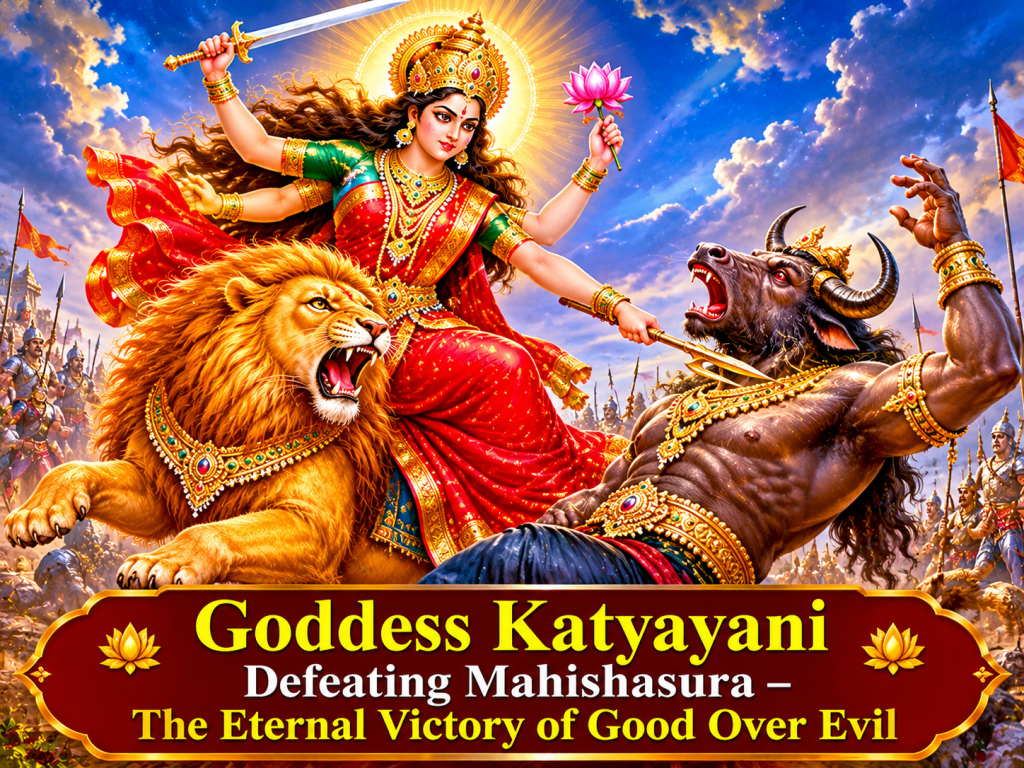
Eventually, she confronted Mahishasura in his buffalo form. She attacked him with her divine weapons and finally defeated him.
The destruction of Mahishasura restored peace and righteousness.
Because she defeated the buffalo demon, the Goddess became widely revered as Mahishasuramardini.
In many devotional traditions, Katyayani is identified with this victorious warrior manifestation of Durga.
The victory of the Goddess is celebrated as a reminder that evil, however powerful it may appear, cannot ultimately overcome divine righteousness.
Spiritual significance of the legend
The battle between Katyayani and Mahishasura can also be understood symbolically.
Mahishasura represents arrogance, uncontrolled desires, ignorance, cruelty and destructive tendencies within human nature.
The Goddess represents divine wisdom, courage, self-discipline and righteousness.
Her victory teaches that human beings must overcome their inner weaknesses through determination, spiritual awareness and righteous action.
Thus, the story is not simply about a divine battle. It is also a spiritual lesson about the importance of conquering the negative tendencies that prevent individuals from living a meaningful and virtuous life.
The Divine Appearance and Iconography of Goddess Katyayani
Goddess Katyayani is traditionally depicted as an extraordinarily beautiful and powerful Goddess with a radiant complexion, divine ornaments and a majestic appearance.
Her iconography reflects the combination of feminine beauty and extraordinary warrior strength.
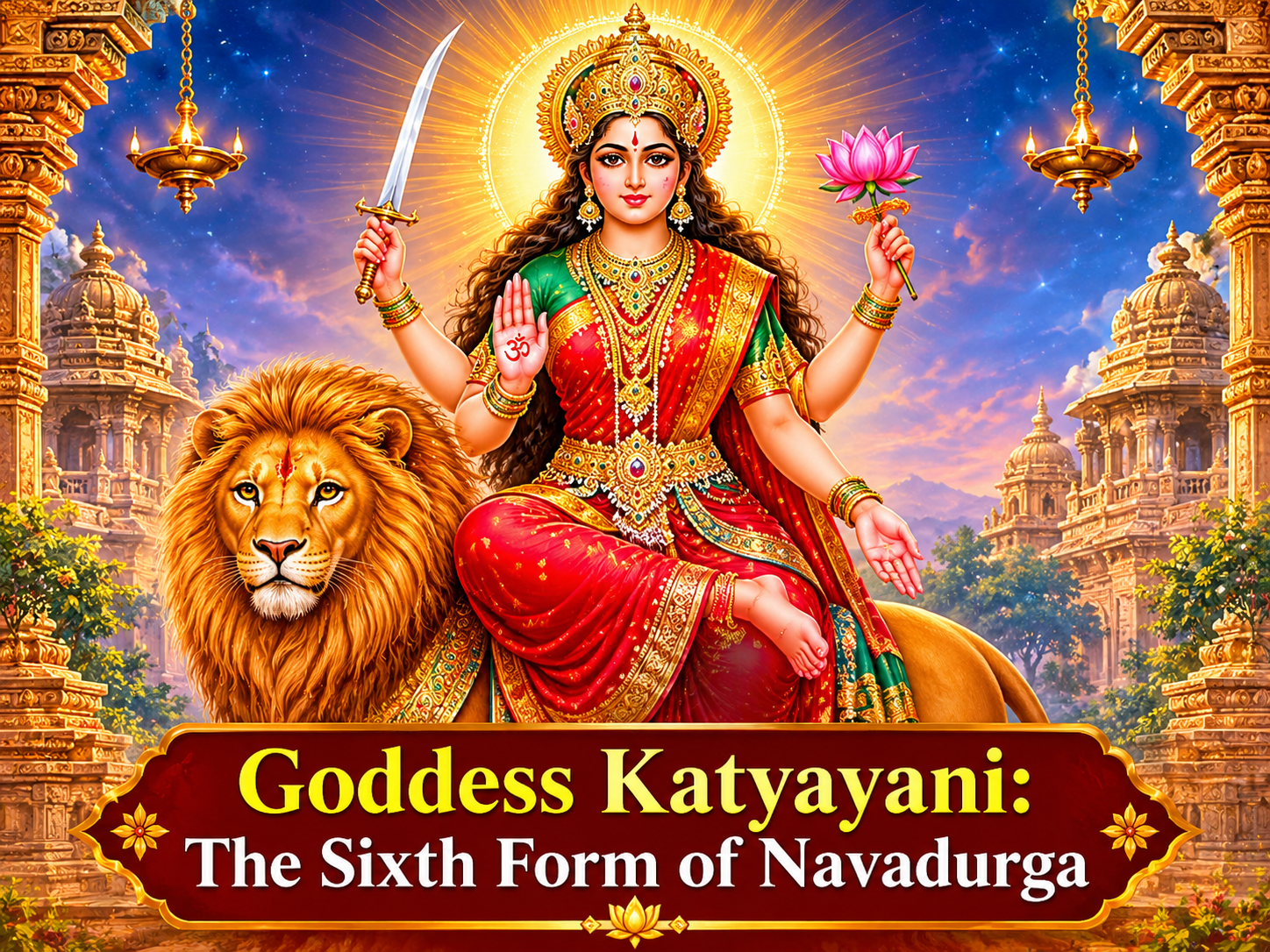
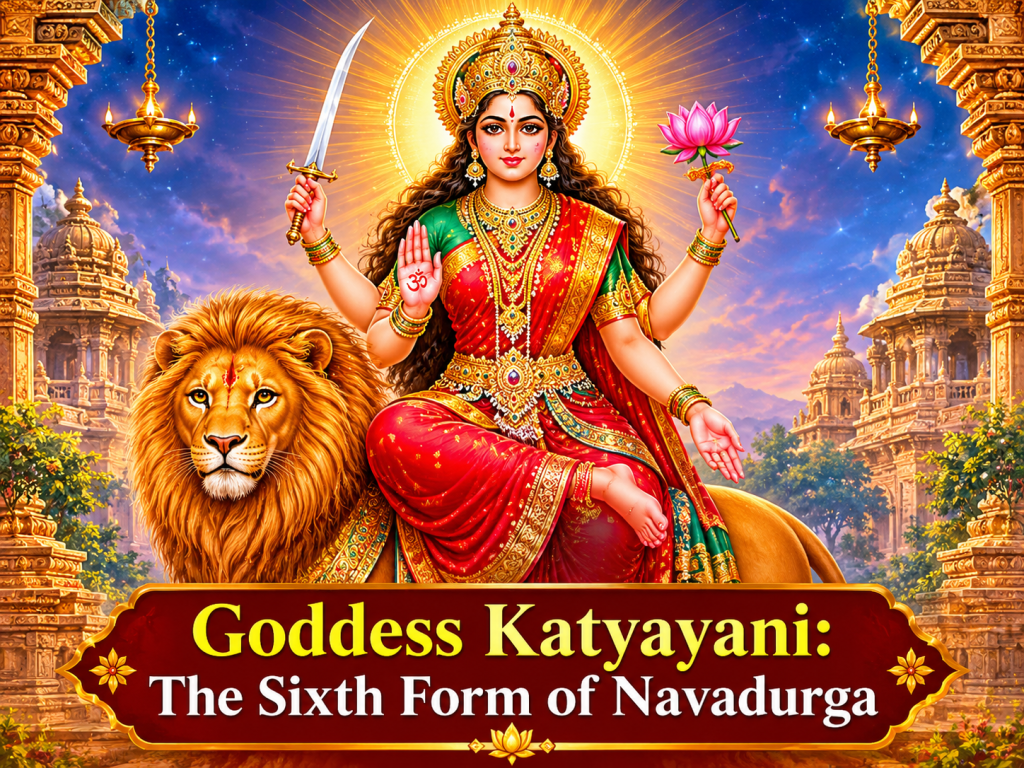
She is commonly portrayed with four arms and riding a lion.
However, artistic representations may differ according to regional traditions, temple practices and particular forms of Goddess Durga.
Four Divine Arms
The four arms of Goddess Katyayani represent her extraordinary divine capabilities.
In a widely recognised depiction, she holds a sword and a lotus in two hands, while her remaining hands display the Abhaya Mudra and Varada Mudra.
Each attribute carries a particular spiritual meaning.
The Sword
The sword represents the destruction of ignorance, injustice and negative tendencies.
It symbolises the Goddess’s determination to protect righteousness and remove obstacles from the path of spiritual development.
The Lotus
The lotus represents purity, beauty, spiritual awakening and detachment.
Although it grows in muddy water, it remains beautiful and untouched by the surrounding impurities.
Similarly, the lotus reminds devotees to maintain purity of thought and action while living in the material world.
Abhaya Mudra
Abhaya Mudra is the gesture of fearlessness and protection.
Through this gesture, the Goddess assures her devotees that they should not surrender to fear when facing difficulties.
It represents divine protection and the courage to confront challenges.
Varada Mudra
Varada Mudra represents blessings, generosity and the fulfilment of sincere wishes.
It reminds devotees that the Divine Mother is compassionate towards those who approach her with faith and devotion.
The Lion: Her Divine Vehicle
Goddess Katyayani rides a lion, which is one of the most important elements of her iconography.
The lion represents courage, authority, strength and fearlessness.
As the king of the forest, the lion symbolises extraordinary power and the ability to face danger without hesitation.
The Goddess riding the lion demonstrates that divine strength remains in control of powerful energies.
It also teaches human beings to control their anger, ego and uncontrolled desires instead of allowing these emotions to dominate their lives.
Three Eyes
In many traditional depictions, Katyayani is shown with three eyes.
The three eyes represent divine perception and the ability to understand the past, present and future.
They also symbolise the Goddess’s extraordinary wisdom and awareness.
Her divine appearance therefore combines strength, knowledge, compassion and protection.
Why Is Goddess Katyayani Worshipped on the Sixth Day of Navratri?
Navratri is one of the most important Hindu festivals dedicated to the worship of Goddess Durga and her different manifestations.
The festival is observed over nine nights and ten days, although customs and dates vary according to regional calendars and traditions.
Each day is dedicated to one of the nine forms of Navadurga.
Goddess Katyayani is worshipped on the sixth day, known as Shashthi.
On this day, devotees offer prayers to the Divine Mother and seek her blessings for courage, protection, happiness and success.
The sixth day represents the transition from spiritual preparation to decisive action.
The earlier forms of Navadurga teach devotion, discipline, purity, creativity and motherhood. Katyayani represents the strength required to put these spiritual qualities into practice.
Her worship reminds devotees that faith should be accompanied by righteous action.
A person may possess knowledge and good intentions, but without courage and determination, it may become difficult to overcome injustice and personal weaknesses.
Katyayani therefore inspires devotees to become strong, responsible and fearless.
Religious and Spiritual Significance of Katyayani Worship
The worship of Goddess Katyayani carries several important spiritual meanings.
1. Courage and Fearlessness
Katyayani is worshipped as the embodiment of extraordinary courage.
Her battle against Mahishasura demonstrates that fear should never prevent individuals from standing against injustice.
Devotees seek her blessings to overcome personal difficulties, insecurity and fear.
2. Victory Over Evil
The Goddess represents the triumph of righteousness over destructive forces.
Her victory over Mahishasura reminds people that evil and arrogance may appear powerful for a time, but they cannot permanently defeat truth and justice.
3. Protection and Divine Grace
As a manifestation of Durga, Katyayani is regarded as a compassionate protector of her devotees.
People worship her for the protection of their families, homes and communities.
4. Determination and Self-Confidence
Her warrior appearance inspires individuals to develop determination and self-confidence.
She teaches that success requires patience, discipline and the courage to face challenges.
5. Purity of Mind and Heart
The lotus associated with her iconography represents purity.
Her worship encourages devotees to maintain honesty, kindness and spiritual awareness in everyday life.
6. Destruction of Inner Negativity
The story of Mahishasura can also be interpreted as a reminder to overcome arrogance, greed, jealousy, hatred and uncontrolled desires.
Katyayani symbolises the inner strength necessary for this spiritual struggle.
Goddess Katyayani and the Gopis of Vrindavan
One of the most beautiful references to Goddess Katyayani appears in the Bhagavata Purana, particularly in the tenth Skandha, Chapter 22.
This chapter describes the devotion of the young unmarried gopis of Vrindavan towards Goddess Katyayani.
According to the narrative, during the month of Margashirsha, the young cowherd girls of Vraja observed a special vow dedicated to the Goddess.
They worshipped Katyayani with great devotion, following a month-long religious observance.
Every morning, they bathed in the waters of the Yamuna River and offered prayers to the Divine Mother.
Their principal wish was to receive Lord Krishna, the beloved son of Nanda Maharaja, as their husband.
They prepared an image of the Goddess from sand and worshipped her with flowers, incense and other offerings.
Their prayer is expressed in the following famous Sanskrit mantra:
कात्यायनि महामाये महायोगिन्यधीश्वरि।
नन्दगोपसुतं देवि पतिं मे कुरु ते नमः॥
Transliteration:
Katyayani Mahamaye Mahayoginyadhishvari,
Nandagopasutam Devi Patim Me Kuru Te Namah.
Meaning:
O Goddess Katyayani, O Supreme Divine Mother, O great possessor of divine power and controller of the cosmic energies, please bless me so that the son of Nanda Maharaja, Lord Krishna, may become my husband. I offer my respectful salutations to you.
This prayer is particularly important in the Katyayani worship tradition.
It demonstrates that the Goddess was worshipped not only as a powerful warrior but also as a divine Mother who could grant the sincere wishes of her devotees.
The story also highlights the spiritual relationship between Goddess Katyayani and Lord Krishna.
The gopis approached the Divine Mother with complete faith and devotion, seeking her blessings for their cherished desire.
In the broader devotional interpretation, their longing for Krishna represents the soul’s desire for divine love and union with the Supreme.
Consequently, Katyayani is also worshipped by unmarried women who seek a suitable life partner and marital happiness.
However, the deeper message of the story extends beyond marriage. It highlights sincerity, devotion and the importance of surrendering one’s wishes to the Divine.
Katyayani Puja During Navratri
Goddess Katyayani is worshipped with special devotion on the sixth day of Navratri.
Although the exact rituals differ across regions and families, devotees generally observe the occasion through prayer, offerings, mantra recitation and meditation.
Preparation for Worship
Devotees usually clean the place of worship before beginning the puja.
An image or idol of Goddess Katyayani is placed on a clean altar.
The worship area may be decorated with flowers, lamps, incense and traditional devotional objects.
Some devotees observe fasting according to their family traditions and personal religious practices.
Invocation of the Goddess
The worship begins with prayers inviting the Divine Mother to accept the offerings.
Devotees meditate upon her divine appearance, remembering her four arms, lion vehicle and powerful warrior form.
They seek her blessings for courage, protection and spiritual progress.
Offerings
Traditional offerings may include flowers, fruits, sweets, incense, lamps and other items considered auspicious.
Honey is also associated with Katyayani worship in several devotional traditions.
The offerings are made with devotion rather than for material display.
Recitation of Mantras
Devotees recite Katyayani mantras to express their reverence and seek divine blessings.
One of the simplest mantras is:
ॐ देवी कात्यायन्यै नमः॥
Om Devi Katyayanyai Namah.
Meaning: Salutations to Goddess Katyayani.
Another widely recited prayer is:
कात्यायनि महामाये महायोगिन्यधीश्वरि।
नन्दगोपसुतं देवि पतिं मे कुरु ते नमः॥
This mantra is especially associated with the Katyayani vrata described in the Bhagavata Purana.
Aarti and Prayers
After the offerings and mantra recitation, devotees perform aarti using a lighted lamp.
They sing devotional hymns and pray for the welfare of their families and the well-being of all living beings.
The worship concludes with the distribution of prasad among family members and other devotees.
The most important aspect of Katyayani Puja is sincere devotion, purity of intention and respect for the Divine Mother.
Katyayani Vrat: The Sacred Vow
Katyayani Vrat is a devotional observance dedicated to Goddess Katyayani.
It is especially associated with the young gopis of Vrindavan, who worshipped the Goddess to receive Lord Krishna as their husband.
Following this tradition, unmarried women in different Hindu communities observe Katyayani Vrat and pray for a compatible life partner and a happy married life.
Some devotees also observe the vow for family prosperity, personal well-being and the fulfilment of sincere wishes.
The nature and duration of the observance may differ according to regional customs.
For many devotees, the vrat is not merely a religious activity. It is also an opportunity to practise self-discipline, patience, purity and devotion.
The spiritual value of the observance lies in developing a sincere relationship with the Divine Mother.
Symbolism of Goddess Katyayani in Human Life
The worship of Goddess Katyayani is deeply connected with the challenges and responsibilities of everyday human life.
Her divine qualities offer several lessons that remain relevant across generations.
Courage in Difficult Situations
Life is full of challenges. Sometimes individuals must face injustice, disappointment and uncertainty.
Katyayani teaches that courage is essential for overcoming such situations.
The Importance of Righteous Action
The Goddess does not merely represent strength; she represents strength used for a noble purpose.
Her victory reminds humanity that power should be used to protect others rather than dominate them.
Control Over Ego
Mahishasura’s arrogance ultimately leads to his destruction.
The story teaches that uncontrolled pride and excessive self-confidence can become the greatest obstacles to personal growth.
Respect for Women
Katyayani represents the extraordinary power of the feminine divine.
Her warrior form challenges the idea that strength and leadership belong exclusively to men.
She demonstrates that women embody courage, wisdom, compassion and the ability to protect society.
Faith and Determination
The devotion of the gopis demonstrates the importance of sincere faith.
Their observance teaches that meaningful aspirations require patience, commitment and spiritual dedication.
The Association of Katyayani with Shakti
In Hindu philosophy, Shakti represents the fundamental divine energy responsible for creation, preservation and transformation.
Without Shakti, the cosmic functions of the universe would remain incomplete.
Goddess Durga is one of the most celebrated manifestations of this supreme feminine power.
Katyayani represents the dynamic and protective dimension of Shakti.
She is the energy that emerges when injustice threatens the natural order.
Her divine power is not understood merely as physical strength. It also represents spiritual awareness, determination and the ability to transform destructive circumstances.
The Goddess teaches that divine energy can manifest in different ways according to the needs of the universe.
Sometimes it appears as a loving mother, sometimes as a source of wisdom and sometimes as an invincible warrior.
Katyayani is the embodiment of the last of these qualities.
Katyayani in Hindu Scriptures and Religious Traditions
The name and worship of Katyayani are connected with several important Hindu textual and devotional traditions.
The Devi Kavacham identifies her as the sixth form of Navadurga.
The Bhagavata Purana, particularly its tenth Skandha, Chapter 22, provides an important account of the gopis’ Katyayani worship.
Puranic traditions, including accounts associated with the Vamana Purana and other Shakta texts, connect the Goddess with Sage Katyayana and the defeat of Mahishasura.
The Devi Mahatmya, contained within the Markandeya Purana, is another foundational text for understanding the broader tradition of the Divine Mother and her victory over Mahishasura.
It is useful to understand that different Hindu scriptures and regional traditions may present related narratives with variations in names, circumstances and details.
Therefore, Katyayani’s association with the Mahishasura legend should be understood within the wider Puranic tradition of Durga and Mahishasuramardini rather than assuming that every text narrates the same episode in precisely the same way.
These diverse traditions collectively demonstrate the importance of the Goddess in Hindu religious life.
Goddess Katyayani in Different Regional Traditions
The worship of Goddess Katyayani is not restricted to one geographical area.
Her devotees are found in different parts of India and other countries where Hindu communities celebrate Navratri and worship the Divine Mother.
In North India, Katyayani is worshipped with particular devotion during the nine days of Navratri.
In Gujarat, Navratri celebrations include devotional singing, garba and dandiya, accompanied by prayers to the different manifestations of Durga.
In West Bengal, the wider Durga tradition is celebrated with extraordinary enthusiasm during Durga Puja. The victory of the Divine Mother over Mahishasura remains a central theme of the festival.
In Vrindavan and other parts of Braj, Katyayani worship carries special significance because of the Bhagavata Purana’s account of the gopis’ vrata.
In Bangladesh, the worship of Goddess Durga is an important part of Hindu religious and cultural life. Although the principal celebrations may focus on Durga and her family, the nine manifestations of the Goddess also hold an important place in devotional traditions.
In different communities, Katyayani Puja is also observed independently with local customs, devotional gatherings and cultural programmes.
These regional differences enrich Hindu religious culture and demonstrate how the worship of the Divine Mother has developed across different communities.
The Spiritual Message of Goddess Katyayani for the Modern World
The story and worship of Goddess Katyayani offer valuable lessons for contemporary society.
The modern world faces numerous challenges, including violence, discrimination, dishonesty, injustice, environmental destruction and social divisions.
The divine qualities represented by Katyayani provide an inspiring spiritual framework for addressing these problems.
Her courage encourages people to stand against injustice.
Her wisdom teaches individuals to distinguish between right and wrong.
Her compassion reminds society to protect the vulnerable.
Her victory over Mahishasura symbolises the importance of overcoming destructive tendencies.
Her association with the gopis reminds devotees of the value of sincere love and dedication.
Katyayani also represents the importance of women’s empowerment.
Her image as a powerful warrior demonstrates that feminine energy is not limited to nurturing and motherhood. It also includes leadership, independence, intelligence, strength and the ability to defend righteousness.
In this sense, the Goddess remains a timeless symbol of dignity and empowerment.
Her message is relevant not only to religious devotees but also to anyone who values courage, justice, compassion and moral responsibility.
Frequently Asked Questions About Goddess Katyayani
1. Who is Goddess Katyayani?
Goddess Katyayani is the sixth manifestation of Goddess Durga among the nine forms of Navadurga. She is worshipped as a powerful warrior Goddess who represents courage, protection, determination and the destruction of evil.
2. Why is Katyayani called the sixth form of Navadurga?
According to the traditional sequence of the nine forms of Durga mentioned in the Devi Kavacham, Katyayani is the sixth manifestation, following Skandamata and preceding Kalaratri.
3. On which day is Goddess Katyayani worshipped?
Goddess Katyayani is worshipped on the sixth day of Navratri, known as Shashthi.
4. Who was Sage Katyayana?
Sage Katyayana was a revered Hindu sage associated with the origin of Goddess Katyayani. According to a popular tradition, the Goddess manifested as his daughter after he performed penance and prayed for her appearance.
5. Why is Goddess Katyayani associated with Mahishasura?
In Puranic traditions, Katyayani is associated with the warrior form of Durga who defeated Mahishasura, the buffalo demon who threatened the cosmic order.
6. What is the vehicle of Goddess Katyayani?
The lion is the traditional vehicle of Goddess Katyayani. It symbolises courage, strength, authority and fearlessness.
7. How many hands does Goddess Katyayani have?
She is commonly depicted with four arms, holding a sword and lotus and displaying Abhaya and Varada Mudras. Other artistic and regional representations may differ.
8. Why did the gopis worship Goddess Katyayani?
According to the Bhagavata Purana, the unmarried gopis of Vrindavan observed a month-long Katyayani vrata, praying that Lord Krishna would become their husband.
9. Which mantra is associated with Goddess Katyayani?
One of her principal mantras is:
Om Devi Katyayanyai Namah.
The famous Katyayani prayer from the Bhagavata Purana is also widely recited.
10. What are the blessings associated with Katyayani worship?
Devotees worship her for courage, protection, happiness, determination, family well-being, marital happiness and spiritual progress.
11. What does Goddess Katyayani symbolise?
She symbolises divine feminine power, righteousness, courage, self-confidence, protection and the victory of good over evil.
12. What offerings are made to Goddess Katyayani?
Flowers, fruits, sweets, incense, lamps and honey are among the offerings associated with her worship. Practices differ across regional traditions.
Conclusion: The Eternal Power of the Divine Mother
Goddess Katyayani, the sixth manifestation of Navadurga, represents one of the most powerful expressions of divine feminine energy in Hinduism.
Her legendary victory over Mahishasura demonstrates the triumph of righteousness over evil, while her association with Sage Katyayana highlights the relationship between sincere devotion and divine grace.
The Bhagavata Purana’s account of the gopis’ Katyayani vrata presents another beautiful dimension of her divine personality. It portrays her as a compassionate Mother who receives the heartfelt prayers of her devotees.
Her four arms, divine weapons, lotus and lion vehicle communicate important spiritual lessons about courage, purity, protection and determination.
During the sixth day of Navratri, devotees worship her with prayers, offerings, fasting and mantra recitation, seeking her blessings for happiness, prosperity and spiritual strength.
However, the true significance of Katyayani worship extends beyond rituals and celebrations.
She inspires humanity to fight against injustice, overcome personal weaknesses, respect feminine power and maintain faith in righteousness.
Her story reminds us that darkness cannot permanently overcome light and that genuine strength must always serve a noble purpose.
May Goddess Katyayani bless the world with courage, wisdom, protection, peace and prosperity.
Jai Maa Katyayani!
*Related Articles: 1. Sharadiya Navratri: Nine Nights of Goddess Durga
2. Chaitra Navratri- A Grand Hindu Festival
*Updated on 13 November, 20026