Hanuman Chalisa: 40 Verses, English Meaning and Significance
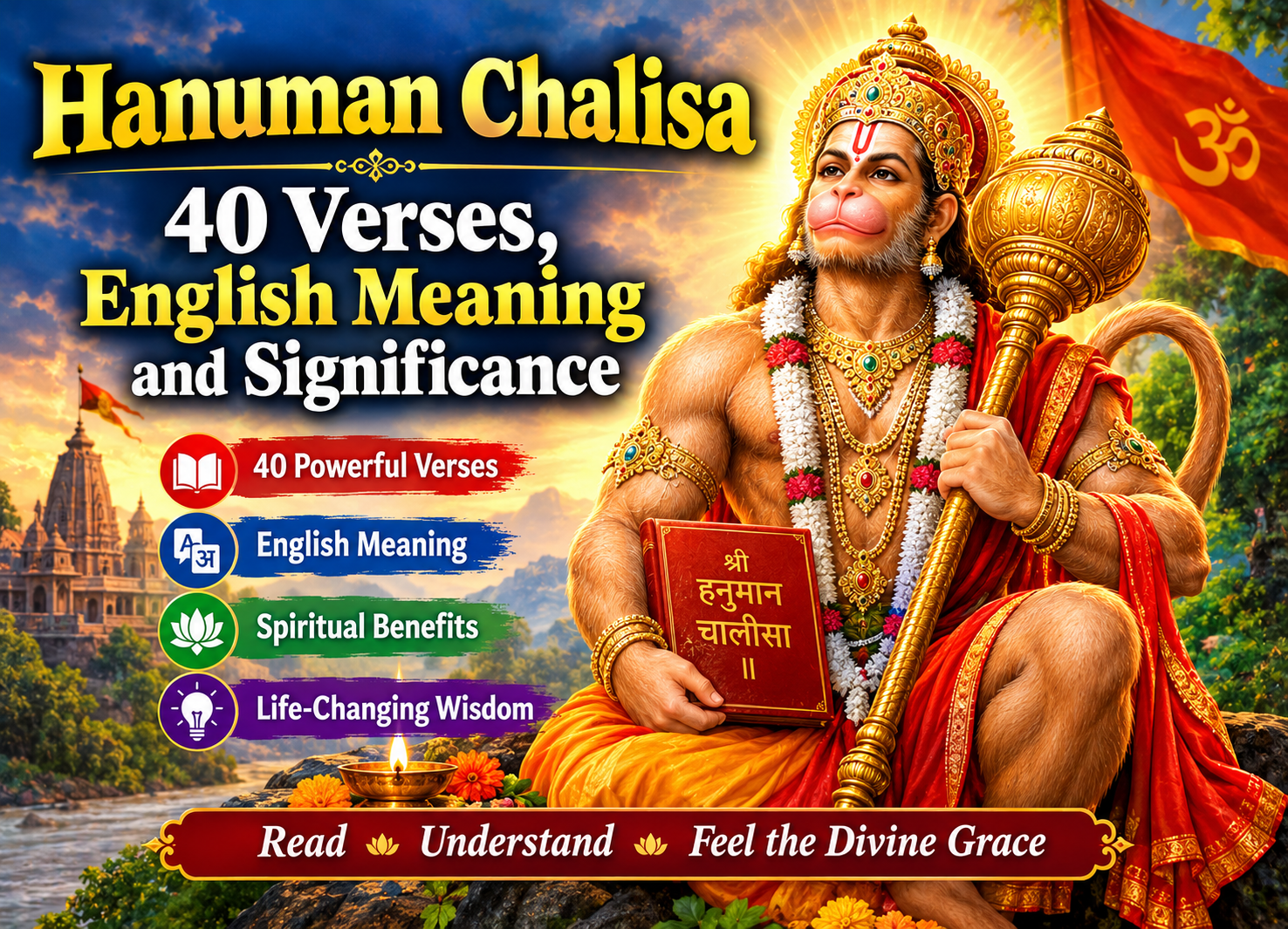
The Hanuman Chalisa is one of the most beloved and widely recited devotional prayers dedicated to Lord Hanuman, the great devotee of Lord Rama. For centuries, devotees have turned to this sacred hymn for courage, spiritual strength, devotion, protection and inner peace.
Traditionally attributed to Goswami Tulsidas, the Hanuman Chalisa consists of forty chaupais, or devotional verses, framed by opening and closing dohas. The word Chalisa comes from chalis, meaning forty.
The prayer describes Hanuman as an ocean of wisdom and virtue, a mighty warrior, a devoted servant of Lord Rama, a protector of the righteous and a destroyer of fear and evil. Yet the central message of the Chalisa is not simply Hanuman’s extraordinary physical strength. His greatest quality is his selfless devotion to Lord Rama.
The Hanuman Chalisa has remained relevant across generations because its message speaks directly to universal human experiences. Everyone encounters fear, uncertainty, obstacles, suffering and difficult decisions. Hanuman’s example teaches that strength should be accompanied by wisdom, power by humility, and ability by service.
A remarkable recent event has also brought the Hanuman Chalisa into worldwide attention.
In October 2026, Indian Flydubai Captain Smit Machchhar survived a terrifying mid-air attack after his co-pilot allegedly attacked him and attempted to take control of the aircraft. During a conversation with Indian Prime Minister Narendra Modi after the incident, Machchhar said that he regularly recites the Hanuman Chalisa whenever he faces difficulty and that he was reciting it during the crisis as well. He credited God for saving him and said the prayer gave him strength during the ordeal.
The aircraft, flying from Dubai to Tel Aviv, was carrying 174 passengers and eight crew members. After the attack, the aircraft made an emergency landing in Tabuk, Saudi Arabia. Captain Machchhar, despite suffering serious injuries, managed to open the cockpit door, allowing others to intervene and helping avert a potentially catastrophic outcome.
His story offers a striking modern example of one of the central teachings associated with Hanuman: when fear strikes, courage must take action.
This article explores the Hanuman Chalisa in detail, including all forty verses with their English translations and meanings, its history, spiritual significance, traditional benefits, and the inspiring connection to Captain Smit Machchhar’s recent experience.
Who Is Lord Hanuman?
Lord Hanuman is one of the most revered figures in Hindu tradition. He is particularly celebrated as the supreme devotee of Lord Rama.
According to the Ramayana tradition, Hanuman was born to Anjana and Kesari and is associated with Vayu, the divine personification of wind. Therefore, he is known by names such as Pavanputra, Pavansut and Vayuputra.
Hanuman represents an extraordinary combination of qualities.
He is:
- immensely strong,
- highly intelligent,
- fearless,
- humble,
- disciplined,
- devoted,
- compassionate,
- loyal,
- and committed to dharma.
His physical strength alone does not explain his greatness.
Hanuman’s greatness comes from the fact that he uses his strength for a higher purpose. His abilities are devoted to Lord Rama and to the protection of righteousness.
This is why Hanuman is so important in Hindu spirituality.
He demonstrates that true power is not the ability to dominate others but the ability to serve what is righteous.
What Does “Hanuman Chalisa” Mean?
The word Chalisa comes from the Hindi word chalis, meaning forty.
The central portion of the prayer contains forty chaupais praising Lord Hanuman and describing his qualities, powers and deeds.
The traditional structure consists of:
- An opening Doha
- A second introductory Doha
- Forty Chaupais
- A concluding Doha
The verses move from praise of Hanuman’s wisdom and strength to descriptions of his service to Rama and finally to the spiritual benefits associated with remembering him.
Who Composed the Hanuman Chalisa?
The Hanuman Chalisa is traditionally attributed to Goswami Tulsidas, the celebrated poet-saint best known for the Ramcharitmanas.
Tulsidas played an enormous role in making devotion to Lord Rama accessible to ordinary people through devotional poetry in languages understood by the general population.
The Hanuman Chalisa similarly presents profound spiritual ideas in a relatively simple poetic form.
It does not require the reader to understand complicated philosophical terminology.
Instead, it tells the story through Hanuman’s character:
Be strong.
Be wise.
Be humble.
Serve others.
Remember God.
Do not surrender to fear.
The Recent Story of Captain Smit Machchhar and the Hanuman Chalisa
One of the most remarkable recent references to the Hanuman Chalisa came from Indian airline captain Smit Machchhar.

On October 1, 2026, Flydubai Flight FZ1073, travelling from Dubai to Tel Aviv, became the scene of a serious cockpit attack. According to reports, the Omani co-pilot allegedly attacked Captain Machchhar and attempted to take control of the aircraft. The aircraft subsequently lost altitude rapidly before the crisis was brought under control.
Captain Machchhar suffered serious injuries but managed to open the cockpit door. Passengers and crew members then intervened, and the aircraft was eventually diverted to Tabuk, Saudi Arabia, where it made an emergency landing.
After the incident, Prime Minister Narendra Modi spoke to Captain Machchhar by video call.
During that conversation, Machchhar revealed something deeply personal: whenever he experiences difficulty, he recites the Hanuman Chalisa. He said that he was reciting the Chalisa during the terrifying incident as well. He explained that the prayer gave him courage and helped him in the difficult moment. He also expressed his belief that God had saved him.
This does not mean that the aircraft was saved by the prayer alone. The emergency was overcome through the courage and actions of Captain Machchhar, passengers and crew members, along with the successful emergency landing. But his testimony shows the powerful personal role that faith can play during an extreme crisis.
The story is particularly meaningful when viewed alongside one of the central themes of the Hanuman Chalisa:
“Sankat te Hanuman chhudavai” — Hanuman frees one from difficulties.
For Captain Machchhar, the prayer became a source of courage while he was fighting to survive and protect the people aboard the aircraft.
His experience gives a contemporary context to an ancient devotional practice.
Complete Hanuman Chalisa with English Translation and Meaning
Opening Doha
1. Shri Guru Charan Saroj Raj
Shri Guru Charan Saroj Raj,
Nij Manu Mukuru Sudhari.
Baranau Raghubar Bimal Jasu,
Jo Dayaku Phal Chari.
English Translation
With the dust of my Guru’s lotus feet, I cleanse the mirror of my mind. I describe the pure glory of Lord Rama, the best of the Raghu dynasty, who grants the four fruits of life.
Meaning
The prayer begins with humility.
Tulsidas first remembers the Guru and seeks purification of the mind. The mind is compared to a mirror. A dusty mirror cannot reflect clearly, and similarly a disturbed mind cannot clearly perceive spiritual truth.
The four fruits of life traditionally refer to:
- Dharma — righteousness
- Artha — prosperity
- Kama — legitimate fulfillment of desires
- Moksha — liberation
Opening Doha 2
Buddhiheen Tanu Janike
Buddhiheen Tanu Janike,
Sumirau Pavan-Kumar.
Bal Buddhi Vidya Dehu Mohi,
Harahu Kalesa Vikar.
English Translation
Knowing myself to be lacking in wisdom, I remember you, O Son of the Wind. Grant me strength, intelligence and knowledge, and remove my suffering and faults.
Meaning
The devotee asks Hanuman for three great qualities:
strength, intelligence and knowledge.
This is important because Hanuman represents physical power as well as wisdom.
The Forty Verses
Verse 1
Jai Hanuman Gyan Gun Sagar,
Jai Kapis Tihun Lok Ujagar.
Translation
Victory to Hanuman, the ocean of knowledge and virtues! Victory to the Lord of the Vanaras, whose glory illuminates the three worlds.
Meaning
Hanuman is introduced as an ocean of knowledge and virtue. His greatness is intellectual, moral and spiritual—not merely physical.
Verse 2
Ram Doot Atulit Bal Dhama,
Anjani-Putra Pavan-Sut Nama.
Translation
You are the messenger of Lord Rama and the abode of incomparable strength. You are the son of Anjana and are known as the Son of the Wind.
Meaning
Hanuman’s identity is closely connected with his service to Rama. His immense strength exists for a righteous purpose.
Verse 3
Mahabir Bikram Bajrangi,
Kumati Nivar Sumati Ke Sangi.
Translation
O great hero, powerful like the thunderbolt, you remove misguided thoughts and accompany those of noble understanding.
Meaning
Hanuman removes kumati, or misguided thinking, and promotes sumati, wise and righteous understanding.
Verse 4
Kanchan Baran Biraj Subesa,
Kanan Kundal Kunchit Kesa.
Translation
Your complexion shines like gold, and you are beautifully adorned. You wear earrings and have curly hair.
Meaning
This verse describes Hanuman’s majestic and radiant appearance.
Verse 5
Hath Bajra Au Dhwaja Birajai,
Kandhe Moonj Janeu Sajai.
Translation
You hold the thunderbolt and a banner in your hands, while a sacred thread made from munja grass adorns your shoulder.
Meaning
The vajra represents strength, while the sacred thread represents discipline and spiritual responsibility.
Verse 6
Shankar Suvan Kesari Nandan,
Tej Pratap Maha Jag Vandan.
Translation
You are regarded as the divine son of Shankara and the son of Kesari. Your radiance and glory are revered throughout the world.
Meaning
Hanuman’s divine connection with Shiva is emphasized along with his earthly association with Kesari.
Verse 7
Vidyavan Guni Ati Chatur,
Ram Kaj Karibe Ko Atur.
Translation
You are learned, virtuous and extremely intelligent, always eager to perform the work of Lord Rama.
Meaning
Knowledge and intelligence become truly valuable when used for a noble purpose.
Hanuman does not use knowledge to glorify himself. He uses it in service.
Verse 8
Prabhu Charitra Sunibe Ko Rasiya,
Ram Lakhan Sita Man Basiya.
Translation
You delight in hearing the stories of the Lord, and Lord Rama, Lakshmana and Sita dwell within your heart.
Meaning
Hanuman carries Rama, Lakshmana and Sita within his heart.
His devotion is therefore both internal and external.
Verse 9
Sukshma Roop Dhari Siyahin Dikhawa,
Bikat Roop Dhari Lank Jarawa.
Translation
You assumed a subtle form when appearing before Sita and a formidable form when burning Lanka.
Meaning
Hanuman demonstrates extraordinary control over his abilities.
He knows when to become gentle and subtle and when to become powerful and terrifying.
True strength includes self-control.
Verse 10
Bhim Roop Dhari Asur Sanhare,
Ramachandra Ke Kaj Sanware.
Translation
Taking a mighty form, you destroyed the demons and accomplished the work of Lord Rama.
Meaning
Hanuman’s strength is directed toward protecting righteousness.
Verse 11
Laye Sanjivan Lakhan Jiyaye,
Shri Raghuvir Harashi Ur Laye.
Translation
You brought the Sanjivani herb and restored Lakshmana’s life. Lord Rama joyfully embraced you.
Meaning
This recalls Hanuman’s famous journey to obtain the life-restoring herb needed for Lakshmana.
It represents determination, loyalty and selfless service.
Verse 12
Raghupati Kinhi Bahut Badai,
Tum Mama Priya Bharatahi Sam Bhai.
Translation
Lord Rama greatly praised you and said that you were as dear to him as his brother Bharata.
Meaning
Rama’s love for Hanuman demonstrates the extraordinary value of sincere devotion.
Verse 13
Sahas Badan Tumharo Jas Gavein,
As Kahi Shripati Kanth Lagavein.
Translation
Even a thousand mouths could sing your glory, yet it would not be enough. Saying this, Lord Rama embraced you.
Meaning
Hanuman’s glory is presented as beyond complete description.
Verse 14
Sanakadik Brahmadi Munisa,
Narad Sarad Sahit Ahisa.
Translation
Sanaka and other sages, Brahma and great seers, Narada, Saraswati and Shesha all praise your glory.
Meaning
The verse places Hanuman’s greatness within a cosmic spiritual context.
Verse 15
Jam Kuber Digpal Jahan Te,
Kabi Kobid Kahi Sake Kahan Te.
Translation
Even Yama, Kubera, the guardians of the directions, poets and learned scholars cannot fully describe your glory.
Meaning
No amount of language can completely express Hanuman’s greatness.
Verse 16
Tum Upkar Sugrivahin Kinha,
Ram Milay Raj Pad Dinha.
Translation
You helped Sugriva by bringing him to Lord Rama, through whom he regained his kingdom.
Meaning
Hanuman served as a bridge between Sugriva and Rama and helped restore rightful order.
Verse 17
Tumharo Mantra Vibhishan Mana,
Lankeshwar Bhaye Sab Jag Jana.
Translation
Vibhishana accepted your counsel and became the king of Lanka, as the world knows.
Meaning
This verse highlights Hanuman’s wisdom as well as his strength.
Verse 18
Jug Sahasra Yojan Par Bhanu,
Leelyo Tahi Madhur Phal Janu.
Translation
The Sun, thousands of yojanas away, appeared to you like a delicious fruit, and you leapt toward it.
Meaning
This recalls the famous story of Hanuman’s extraordinary childhood power and fearlessness.
Verse 19
Prabhu Mudrika Meli Mukh Mahi,
Jaladhi Langhi Gaye Acharaj Nahi.
Translation
Carrying Lord Rama’s ring in your mouth, you crossed the ocean; for one like you, this was no wonder.
Meaning
The crossing of the ocean represents extraordinary courage and devotion.
Rama’s ring served as a token of identity when Hanuman met Sita.
Verse 20
Durgam Kaj Jagat Ke Jete,
Sugam Anugrah Tumhare Tete.
Translation
All difficult tasks in the world become easier through your grace.
Meaning
Devotees traditionally understand this verse as a prayer for help in overcoming obstacles.
Verse 21
Ram Duare Tum Rakhvare,
Hot Na Agya Binu Paisare.
Translation
You are the guardian at Lord Rama’s door; no one enters without your permission.
Meaning
Hanuman is portrayed as the devoted guardian of Rama’s presence.
Verse 22
Sab Sukh Lahai Tumhari Sarna,
Tum Rakshak Kahu Ko Darna.
Translation
Those who take refuge in you receive happiness; when you are their protector, there is nothing to fear.
Meaning
Hanuman symbolizes protection, confidence and freedom from fear.
Verse 23
Aapan Tej Samharo Aapai,
Teenon Lok Hank Te Kanpai.
Translation
Only you can control your immense power; the three worlds tremble at your mighty call.
Meaning
The verse teaches that controlling one’s power is as important as possessing power.
Verse 24
Bhoot Pisach Nikat Nahi Aavai,
Mahavir Jab Naam Sunavai.
Translation
Frightening and negative forces do not come near when the name of Mahavira is remembered.
Meaning
Traditionally, this verse expresses Hanuman’s protective power.
It can also be understood psychologically as a reminder that courage and faith can help a person overcome fear.
Verse 25
Nasai Rog Harai Sab Pira,
Japat Nirantar Hanumat Bira.
Translation
Suffering and pain are said to be overcome through continuous remembrance of brave Hanuman.
Meaning
Devotees traditionally regard Hanuman as a source of strength during illness and hardship.
This is a devotional belief and should not be understood as a replacement for proper medical treatment.
Verse 26
Sankat Te Hanuman Chhudavai,
Man Kram Vachan Dhyan Jo Lavai.
Translation
Hanuman frees devotees from difficulties when they remember him with mind, action and speech.
Meaning
This verse emphasizes complete devotion.
Mind, action and speech should be brought into harmony.
Verse 27
Sab Par Ram Tapasvi Raja,
Tin Ke Kaj Sakal Tum Saja.
Translation
Lord Rama is the supreme king among the virtuous and disciplined, and you accomplish all his tasks.
Meaning
Hanuman is the perfect example of selfless service.
Verse 28
Aur Manorath Jo Koi Lavai,
Soi Amit Jivan Phal Pavai.
Translation
Whoever approaches you with sincere desires receives abundant fruits in life.
Meaning
Devotees traditionally interpret this as a blessing for sincere prayers.
The deeper teaching is that devotion should transform the devotee rather than merely fulfill material wishes.
Verse 29
Charon Jug Partap Tumhara,
Hai Parsiddh Jagat Ujiyara.
Translation
Your glory extends through all four ages, and your radiance is renowned throughout the world.
Meaning
Hanuman’s devotion is described as timeless and enduring.
Verse 30
Sadhu Sant Ke Tum Rakhvare,
Asur Nikandan Ram Dulare.
Translation
You protect sages and saints, destroy evil forces, and are beloved of Lord Rama.
Meaning
Hanuman represents protection of righteousness and the defeat of forces opposed to dharma.
Verse 31
Ashta Siddhi Nau Nidhi Ke Data,
As Var Dinh Janaki Mata.
Translation
You are the giver of the eight spiritual accomplishments and the nine treasures; Mother Janaki granted you this blessing.
Meaning
The verse refers to the traditional eight siddhis and nine nidhis.
These symbolize extraordinary spiritual abilities and forms of prosperity.
Verse 32
Ram Rasayan Tumhare Pasa,
Sada Raho Raghupati Ke Dasa.
Translation
You possess the spiritual essence of devotion to Rama and remain forever the servant of Lord Rama.
Meaning
This is one of the most important verses in the entire Chalisa.
Hanuman’s greatest identity is not that he is powerful.
It is that he is Rama’s servant.
Verse 33
Tumhare Bhajan Ram Ko Pavai,
Janam Janam Ke Dukh Bisravai.
Translation
Through devotion to you, one attains Lord Rama and forgets the suffering associated with countless births.
Meaning
Hanuman is regarded as a pathway to deeper devotion to Rama.
Verse 34
Ant Kaal Raghubar Pur Jai,
Jahan Janma Hari-Bhakt Kahai.
Translation
At the end of life, the devotee reaches the abode of Lord Rama and, if born again, is known as a devotee of Hari.
Meaning
The verse expresses the traditional Hindu belief that sincere devotion influences one’s spiritual destiny.
Verse 35
Aur Devata Chitt Na Dharai,
Hanumat Sei Sarva Sukh Karai.
Translation
With the mind focused on Hanuman, the devotee attains spiritual happiness through his devotion.
Meaning
The verse emphasizes one-pointed devotion.
It should not be understood as disrespect toward other Hindu deities. Rather, it expresses the devotional practice of concentrating one’s heart on a chosen form of the Divine.
Verse 36
Sankat Katai Mitai Sab Pira,
Jo Sumirai Hanumat Balbira.
Translation
Difficulties are overcome and suffering is relieved for those who remember mighty Hanuman.
Meaning
This verse is especially meaningful for devotees who turn toward Hanuman during difficult periods.
It teaches the spiritual attitude of confronting fear with courage.
Verse 37
Jai Jai Jai Hanuman Gosain,
Kripa Karahu Gurudev Ki Nain.
Translation
Victory, victory, victory to Lord Hanuman! Please shower your grace upon me like a revered spiritual teacher.
Meaning
The devotee now directly asks Hanuman for grace and guidance.
Verse 38
Jo Sat Bar Path Kar Koi,
Chhutahi Bandi Maha Sukh Hoi.
Translation
Whoever repeatedly recites the Chalisa with devotion becomes free from bondage and experiences great spiritual happiness.
Meaning
Traditional devotees understand this as freedom from spiritual and worldly bondage.
Verse 39
Jo Yah Padhe Hanuman Chalisa,
Hoy Siddhi Sakhi Gaurisa.
Translation
Whoever recites this Hanuman Chalisa attains spiritual fulfillment; Lord Shiva is regarded as the witness to this truth.
Meaning
The verse emphasizes the spiritual power traditionally associated with sincere recitation.
Verse 40
Tulsidas Sada Hari Chera,
Keejai Nath Hriday Mah Dera.
Translation
Tulsidas is forever a servant of Lord Hari. O Lord, please make your dwelling place within my heart.
Meaning
The final verse expresses the ultimate purpose of devotion.
Tulsidas does not ask merely for worldly success.
He asks for the Divine to live within his heart.
Closing Doha
Pavan Tanay Sankat Haran,
Mangal Murati Roop.
Ram Lakhan Sita Sahit,
Hriday Basahu Sur Bhup.
English Translation
O Son of the Wind, remover of difficulties and embodiment of auspiciousness, please dwell within my heart together with Lord Rama, Lakshmana and Sita.
Meaning
The closing prayer brings everything back to devotion.
The devotee asks not merely for protection from problems but for Rama, Sita, Lakshmana and Hanuman to remain within the heart.
The Main Teachings of the Hanuman Chalisa
1. Strength Must Be Used for Good
Hanuman possesses enormous strength, but he never uses it for selfish purposes.
His power is dedicated to Rama and dharma.
This teaches us that having power is not enough. What matters is how we use it.
2. Courage Is Essential
Hanuman repeatedly faces seemingly impossible situations.
He crosses the ocean.
He enters Lanka.
He searches for Sita.
He confronts powerful enemies.
He carries the Sanjivani.
His life demonstrates that fear should not prevent righteous action.
This teaching has a striking modern parallel in Captain Smit Machchhar’s experience.
Despite suffering serious injuries during the cockpit attack, Machchhar realized that he needed to act and succeeded in opening the cockpit door. He later told Prime Minister Modi that he had been reciting the Hanuman Chalisa during the ordeal.
3. Knowledge Must Be Combined with Wisdom
Hanuman is described as Vidyavan, learned, and Guni, virtuous.
Knowledge without character can become dangerous.
Hanuman shows the ideal combination:
Knowledge + wisdom + discipline + humility.
4. Humility Is a Sign of True Greatness
Hanuman is one of the most powerful figures in Hindu tradition, yet he calls himself a servant of Rama.
His humility makes his greatness even more extraordinary.
The Hanuman Chalisa therefore teaches:
The greater one’s ability, the greater one’s responsibility to serve.
5. Devotion Requires Action
Hanuman does not merely think about serving Rama.
He acts.
His devotion becomes visible through his courage, discipline, intelligence and service.
This is an important message for modern devotees as well.
Prayer can inspire action, but action is still necessary.
Hanuman Chalisa and the Power of Faith During Crisis
The story of Captain Smit Machchhar provides an especially contemporary example of this idea.
During the Flydubai crisis, the aircraft faced an extraordinary emergency. Machchhar was seriously injured but continued to act. After the incident, he explained that he had been reciting the Hanuman Chalisa and that the prayer gave him courage.
His statement should be understood as his personal spiritual experience.
It would be inaccurate to claim that the Hanuman Chalisa mechanically or scientifically caused the aircraft to survive.
Instead, the story illustrates something deeply human:
Faith can give a person psychological and spiritual strength when circumstances become overwhelming.
Captain Machchhar’s actions, together with those of passengers and crew, were crucial in averting the tragedy. The aircraft eventually landed safely in Tabuk, Saudi Arabia.
For devotees of Hanuman, however, his experience carries an additional spiritual significance.
The Chalisa repeatedly speaks of courage in the face of danger.
And Captain Machchhar said that during one of the most dangerous moments of his life, he turned toward this ancient prayer.
Traditional Benefits of Reciting Hanuman Chalisa
Devotees traditionally associate the Hanuman Chalisa with several spiritual benefits.
Courage
Hanuman is the embodiment of fearlessness. Remembering him can inspire courage.
Mental Strength
Regular devotional recitation can help focus the mind and create a sense of inner stability.
Protection
Hanuman is traditionally worshipped as a protector against fear and negative influences.
Devotion
The Chalisa strengthens devotion to Hanuman and, through him, to Lord Rama.
Discipline
Regular recitation develops a spiritual routine.
Confidence
Remembering Hanuman’s heroic deeds can encourage devotees to approach difficult situations with greater confidence.
Spiritual Focus
The verses repeatedly direct the mind toward virtues such as humility, courage, wisdom and service.
These are traditional devotional beliefs, not scientific guarantees. Prayer can complement one’s efforts and provide spiritual comfort, but it should not replace medical, professional or emergency assistance when such help is required.
When Should the Hanuman Chalisa Be Recited?
There is no single universally required time for reciting the Hanuman Chalisa.
Devotees may recite it:
- in the morning,
- in the evening,
- on Tuesdays,
- on Saturdays,
- during personal prayer,
- during Hanuman Jayanti,
- before beginning an important task,
- during difficult periods,
- or during temple worship.
Some devotees recite it once, while others recite it multiple times.
The most important element is sincerity.
How to Recite the Hanuman Chalisa
A simple devotional practice can be followed.
Find a clean and peaceful place.
Sit comfortably.
Take a few moments to calm the mind.
If it is part of your tradition, light a lamp or incense.
Remember Lord Rama, Sita, Lakshmana and Hanuman.
Then recite the Chalisa slowly and attentively.
Afterward, reflect on one or two qualities of Hanuman that you want to develop in your own life.
For example:
Monday: discipline
Tuesday: courage
Wednesday: wisdom
Thursday: service
Friday: humility
Saturday: perseverance
Sunday: devotion
The exact schedule is not essential. The purpose is to turn the prayer into a way of cultivating better character.
Hanuman and the Ideal of Seva
The word seva means selfless service.
Hanuman is perhaps one of Hinduism’s greatest examples of seva.
He does not serve Rama because he expects wealth.
He does not serve because he wants political power.
He does not serve because he wants public recognition.
He serves because he loves Rama.
This principle can be applied to everyday life.
Seva may mean:
- helping parents,
- assisting elderly people,
- helping someone in difficulty,
- protecting animals,
- caring for nature,
- teaching children,
- supporting a person in need,
- speaking truthfully,
- protecting the vulnerable,
- or contributing to society.
In this way, the Hanuman Chalisa is not merely asking us to praise Hanuman.
It is also asking us to learn from Hanuman.
Hanuman as a Symbol of the Disciplined Mind
Hanuman can also be understood symbolically as a representation of a disciplined and powerful mind.
An uncontrolled mind can produce:
- fear,
- anger,
- confusion,
- jealousy,
- distraction,
- and despair.
A disciplined mind can accomplish extraordinary things.
Hanuman demonstrates this principle beautifully.
His enormous abilities are under control.
His strength serves wisdom.
His intelligence serves dharma.
His courage serves Rama.
His entire life is directed toward a higher purpose.
Thus, the Hanuman Chalisa can be summarized through a powerful spiritual formula:
Strength + Wisdom + Discipline + Humility + Devotion = True Inner Power
Why Hanuman Chalisa Remains Popular Today
The popularity of the Hanuman Chalisa has continued for generations because its message is universal.
People still experience:
- fear,
- uncertainty,
- illness,
- financial problems,
- personal loss,
- professional pressure,
- family difficulties,
- failure,
- loneliness,
- and self-doubt.
The Chalisa offers a spiritual response to these experiences.
When we are afraid, Hanuman represents courage.
When we become arrogant, Hanuman represents humility.
When we feel powerless, Hanuman represents strength.
When we become confused, Hanuman represents wisdom.
When we become selfish, Hanuman represents service.
When we lose spiritual direction, Hanuman represents devotion.
This is why an ancient prayer can remain meaningful in a modern world.
The Hanuman Chalisa and Modern Life
The recent experience of Captain Smit Machchhar illustrates how an ancient devotional practice can remain personally meaningful even in highly modern circumstances.
A commercial aircraft, advanced technology, international aviation and modern emergency systems were involved in the incident.
Yet in the middle of that crisis, Captain Machchhar turned to a devotional hymn that has been recited by generations of Hindu devotees.
His testimony reminds us that technological progress does not eliminate the human need for courage, faith and emotional strength.
Modern life gives us sophisticated tools.
But during a crisis, human beings still need:
courage, presence of mind, discipline and hope.
These are precisely the qualities associated with Hanuman.
Hanuman Chalisa as a Prayer for Courage
Among all the qualities celebrated in the Chalisa, courage stands out.
But Hanuman’s courage is not reckless.
He does not fight merely to demonstrate strength.
He acts when action is necessary.
He becomes subtle when subtlety is needed.
He becomes powerful when power is necessary.
He advises when advice is needed.
He searches when searching is necessary.
He carries the Sanjivani when someone’s life depends upon it.
This is intelligent courage.
And that may be one of the most important lessons of the Hanuman Chalisa for modern life.
Courage does not mean having no fear.
Courage means doing what must be done despite fear.
Conclusion
The Hanuman Chalisa is one of Hinduism’s most enduring devotional prayers.
Its forty verses celebrate Lord Hanuman as an extraordinary combination of strength, wisdom, courage, discipline, humility and devotion.
Yet the greatest lesson of Hanuman’s life is that all these qualities are placed in the service of Lord Rama and dharma.
The prayer begins by asking for wisdom and strength. It then describes Hanuman’s divine qualities, his extraordinary deeds and his unwavering service to Rama. Finally, it asks for divine grace and for Rama, Sita, Lakshmana and Hanuman to dwell within the devotee’s heart.
The recent experience of Indian Flydubai Captain Smit Machchhar has given the Hanuman Chalisa a striking contemporary connection. During the terrifying cockpit attack on Flight FZ1073, Machchhar said that he was reciting the Hanuman Chalisa, a prayer he turns to whenever he faces difficulty. Despite serious injuries, he acted to protect the aircraft, while passengers and crew also intervened, and the plane ultimately made an emergency landing in Tabuk, Saudi Arabia.
His account should not be interpreted as proof that chanting alone physically saved the aircraft. Rather, it demonstrates how deeply faith can become a source of courage, determination and inner strength for an individual facing extraordinary circumstances.
That is also the deeper message of Hanuman.
He does not teach us simply to wait for miracles.
He teaches us to become courageous.
He teaches us to use our abilities responsibly.
He teaches us to remain humble even when we become powerful.
He teaches us to serve others.
And above all, he teaches us to remain devoted to what is righteous.
The Hanuman Chalisa therefore remains not only a prayer of devotion but also a timeless lesson in character.
May Lord Hanuman bless us with strength when we are weak, courage when we are afraid, wisdom when we are confused, humility when we succeed, and devotion when we lose our way.
Jai Hanuman!
Jai Shri Ram!
*Related Article: Hanuman: The Divine Monkey God
[Updated on: 04 October, 2026]