Bhagavad Gita Chapter 7: Jnana Vijnana Yoga

The Bhagavad Gita Chapter 7, traditionally known as Jnana Vijnana Yoga (ज्ञानविज्ञानयोग), is the seventh chapter of the 18-chapter Bhagavad Gita. The Sanskrit title is commonly translated as “The Yoga of Knowledge and Realization” or “Knowledge and Wisdom.” The chapter contains 30 verses.

In the preceding chapters, Lord Krishna has explained Karma Yoga, meditation, the nature of the Self, and the importance of disciplined spiritual practice. In Chapter 7, Krishna takes Arjuna deeper into the nature of the Divine. He explains His material and spiritual energies, Prakriti, Maya, devotion, knowledge, and the relationship between the individual being and the Supreme.
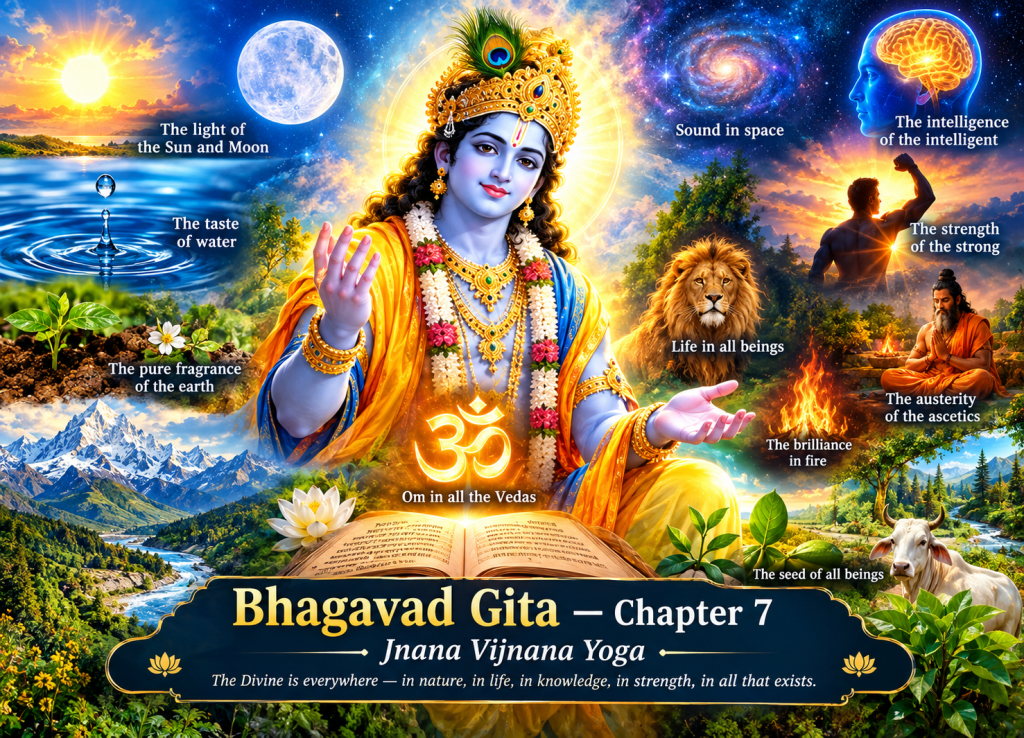
One of the central ideas of this chapter is that the Divine is not separate from creation. Krishna describes Himself through familiar experiences: the taste of water, the light of the sun and moon, the sacred syllable Om, the fragrance of earth, the power within living beings, and the intelligence of the wise.
The chapter also introduces four kinds of devotees—those who are distressed, those who seek knowledge, those who seek worldly fulfillment, and the wise—and emphasizes the special spiritual understanding of the jnani, the person who knows the Divine deeply.
Below are all 30 Sanskrit slokas of Bhagavad Gita Chapter 7, followed by English translations and short explanations.
Bhagavad Gita Chapter 7: Jnana Vijnana Yoga
Verse 7.1
श्रीभगवानुवाच ।
मय्यासक्तमनाः पार्थ योगं युञ्जन्मदाश्रयः ।
असंशयं समग्रं मां यथा ज्ञास्यसि तच्छृणु ॥७.१॥
English Translation:
The Supreme Lord said: O Partha, listen to how, with your mind attached to Me, practicing Yoga and taking refuge in Me, you shall know Me fully and without doubt.
Short Explanation:
Krishna begins by explaining that true knowledge of the Divine requires both spiritual practice and a mind devoted to God. Knowledge becomes deeper when it is joined with sincere devotion and surrender.
Verse 7.2
ज्ञानं तेऽहं सविज्ञानमिदं वक्ष्याम्यशेषतः ।
यज्ज्ञात्वा नेह भूयोऽन्यज्ज्ञातव्यमवशिष्यते ॥७.२॥
English Translation:
I shall explain to you fully this knowledge together with realization, knowing which nothing further remains to be known in this world.
Short Explanation:
Krishna distinguishes between intellectual knowledge and realized knowledge. Knowing spiritual truth is one thing; directly realizing it and living according to it is another.
Verse 7.3
मनुष्याणां सहस्रेषु कश्चिद्यतति सिद्धये ।
यततामपि सिद्धानां कश्चिन्मां वेत्ति तत्त्वतः ॥७.३॥
English Translation:
Among thousands of people, perhaps one strives for perfection; and among those who strive and attain perfection, perhaps one truly knows Me.
Short Explanation:
Deep spiritual realization is described as rare because it requires sustained effort, purification, wisdom, and devotion.
Verse 7.4
भूमिरापोऽनलो वायुः खं मनो बुद्धिरेव च ।
अहङ्कार इतीयं मे भिन्ना प्रकृतिरष्टधा ॥७.४॥
English Translation:
Earth, water, fire, air, space, mind, intellect, and ego—these eight constitute My divided material nature.
Short Explanation:
Krishna describes Apara Prakriti, or the lower material nature, in eight aspects. The first five are the traditional elements, while mind, intellect, and ego belong to the subtle material realm.
Verse 7.5
अपरेयमितस्त्वन्यां प्रकृतिं विद्धि मे पराम् ।
जीवभूतां महाबाहो ययेदं धार्यते जगत् ॥७.५॥
English Translation:
This is My lower nature. But know, O mighty-armed Arjuna, that I have another, higher nature—the living beings by whom this world is sustained.
Short Explanation:
Krishna now introduces Para Prakriti, the higher nature associated with conscious living beings. Thus, creation consists not merely of physical matter but also of the living principle.
Verse 7.6
एतद्योनीनि भूतानि सर्वाणीत्युपधारय ।
अहं कृत्स्नस्य जगतः प्रभवः प्रलयस्तथा ॥७.६॥
English Translation:
Know that all beings arise from these two natures. I am the source of the entire universe and also its dissolution.
Short Explanation:
Both material nature and conscious life ultimately depend upon the Supreme. Krishna identifies Himself as the source from which creation emerges and into which it ultimately returns.
Verse 7.7
मत्तः परतरं नान्यत्किञ्चिदस्ति धनञ्जय ।
मयि सर्वमिदं प्रोतं सूत्रे मणिगणा इव ॥७.७॥
English Translation:
O Dhananjaya, there is nothing higher than Me. All this is strung upon Me like clusters of jewels upon a thread.
Short Explanation:
The famous image of jewels strung on a thread illustrates the unseen Divine support behind the entire universe. Though the thread may not be visible, it holds the jewels together.
Verse 7.8
रसोऽहमप्सु कौन्तेय प्रभास्मि शशिसूर्ययोः ।
प्रणवः सर्ववेदेषु शब्दः खे पौरुषं नृषु ॥७.८॥
English Translation:
O son of Kunti, I am the taste in water, the light of the sun and moon, the sacred syllable Om in all the Vedas, sound in space, and the ability in human beings.
Short Explanation:
Krishna teaches Arjuna to recognize the Divine through ordinary experiences. The refreshing taste of water, sunlight, moonlight, sacred sound, and human capability can all become reminders of God.
Verse 7.9
पुण्यो गन्धः पृथिव्यां च तेजश्चास्मि विभावसौ ।
जीवनं सर्वभूतेषु तपश्चास्मि तपस्विषु ॥७.९॥
English Translation:
I am the pure fragrance of the earth and the brilliance in fire. I am the life in all beings and the austerity of ascetics.
Short Explanation:
The Divine is described as the essential quality that gives something its distinctive character. Life itself and sincere spiritual discipline are manifestations through which one may contemplate the Supreme.
Verse 7.10
बीजं मां सर्वभूतानां विद्धि पार्थ सनातनम् ।
बुद्धिर्बुद्धिमतामस्मि तेजस्तेजस्विनामहम् ॥७.१०॥
English Translation:
O Partha, know Me as the eternal seed of all beings. I am the intelligence of the intelligent and the splendor of the splendid.
Short Explanation:
Krishna presents Himself as the eternal source underlying life, intelligence, and excellence. Whatever genuine wisdom or brilliance exists ultimately depends upon the Divine source.
Verse 7.11
बलं बलवतां चाहं कामरागविवर्जितम् ।
धर्माविरुद्धो भूतेषु कामोऽस्मि भरतर्षभ ॥७.११॥
English Translation:
I am the strength of the strong, free from desire and attachment. And in all beings, O best of the Bharatas, I am desire that is not contrary to Dharma.
Short Explanation:
Krishna does not reject strength or desire completely. Strength becomes noble when it is free from selfish attachment, while desire has a rightful place when it does not violate Dharma.
Verse 7.12
ये चैव सात्त्विका भावा राजसास्तामसाश्च ये ।
मत्त एवेति तान्विद्धि न त्वहं तेषु ते मयि ॥७.१२॥
English Translation:
Whatever states arise from Sattva, Rajas, or Tamas, know that they all proceed from Me. Yet I am not contained in them; they exist within Me.
Short Explanation:
The three Gunas—Sattva, Rajas, and Tamas belong to material nature. They arise within the Divine order, but the Supreme transcends their limitations.
Verse 7.13
त्रिभिर्गुणमयैर्भावैरेभिः सर्वमिदं जगत् ।
मोहितं नाभिजानाति मामेभ्यः परमव्ययम् ॥७.१३॥
English Translation:
Deluded by these three states arising from the Gunas, the entire world does not recognize Me, who am beyond them and imperishable.
Short Explanation:
People can become absorbed in the changing qualities of material nature and therefore fail to recognize the eternal reality beyond them.
Verse 7.14
दैवी ह्येषा गुणमयी मम माया दुरत्यया ।
मामेव ये प्रपद्यन्ते मायामेतां तरन्ति ते ॥७.१४॥
English Translation:
This divine Maya of Mine, consisting of the three Gunas, is difficult to cross. But those who take refuge in Me alone cross beyond this Maya.
Short Explanation:
Maya is powerful because it binds consciousness to the changing world and its attractions. Krishna teaches that sincere surrender to the Divine provides the way beyond this bondage.
Verse 7.15
न मां दुष्कृतिनो मूढाः प्रपद्यन्ते नराधमाः ।
माययापहृतज्ञाना आसुरं भावमाश्रिताः ॥७.१५॥
English Translation:
Those who are deluded by Maya, whose knowledge has been obscured, and who have adopted an ungodly disposition do not surrender to Me.
Short Explanation:
When selfishness, ignorance, and harmful tendencies dominate the mind, a person may turn away from spiritual truth. Krishna emphasizes the importance of overcoming such inner obstacles.
The Four Types of Devotees
Verse 7.16
चतुर्विधा भजन्ते मां जनाः सुकृतिनोऽर्जुन ।
आर्तो जिज्ञासुरर्थार्थी ज्ञानी च भरतर्षभ ॥७.१६॥
English Translation:
O Arjuna, four kinds of virtuous people worship Me: the distressed, the seeker of knowledge, the seeker of worldly prosperity, and the wise.
Short Explanation:
Krishna recognizes different reasons why people turn toward God. Some seek relief from suffering, some seek understanding, some seek prosperity, and others seek spiritual realization.
Verse 7.17
तेषां ज्ञानी नित्ययुक्त एकभक्तिर्विशिष्यते ।
प्रियो हि ज्ञानिनोऽत्यर्थमहं स च मम प्रियः ॥७.१७॥
English Translation:
Among them, the wise person, ever steadfast and devoted to the One, is distinguished. I am exceedingly dear to the wise, and the wise person is dear to Me.
Short Explanation:
The jnani approaches God with steady devotion rooted in spiritual understanding rather than merely seeking a particular worldly result.
Verse 7.18
उदाराः सर्व एवैते ज्ञानी त्वात्मैव मे मतम् ।
आस्थितः स हि युक्तात्मा मामेवानुत्तमां गतिम् ॥७.१८॥
English Translation:
All these devotees are noble, but I regard the wise person as My very Self. Being steadfast in devotion, that person is established in Me as the supreme goal.
Short Explanation:
Krishna does not dismiss the other devotees. He calls them all noble while emphasizing that the wise devotee recognizes the Divine as the ultimate purpose of life.
Verse 7.19
बहूनां जन्मनामन्ते ज्ञानवान्मां प्रपद्यते ।
वासुदेवः सर्वमिति स महात्मा सुदुर्लभः ॥७.१९॥
English Translation:
After many births, the person who has attained true knowledge surrenders to Me, realizing, “Vasudeva is all.” Such a great soul is very rare.
Short Explanation:
This is one of the chapter’s most profound teachings. Spiritual wisdom ultimately leads to the recognition of the Divine presence as the foundation of all existence. Such realization is described as extremely rare.
Worship, Faith and the Divine
Verse 7.20
कामैस्तैस्तैर्हृतज्ञानाः प्रपद्यन्तेऽन्यदेवताः ।
तं तं नियममास्थाय प्रकृत्या नियताः स्वया ॥७.२०॥
English Translation:
Those whose knowledge is carried away by various desires worship other deities, following particular rules according to their own nature.
Short Explanation:
Krishna explains that personal desires can influence the form of worship a person chooses. The verse examines the relationship between desire, faith, and spiritual understanding.
Verse 7.21
यो यो यां यां तनुं भक्तः श्रद्धयार्चितुमिच्छति ।
तस्य तस्याचलां श्रद्धां तामेव विदधाम्यहम् ॥७.२१॥
English Translation:
Whatever form a devotee desires to worship with faith, I make that faith steady in that form.
Short Explanation:
Krishna acknowledges the diversity of devotional approaches. Faith itself is presented as operating within the Divine order.
Verse 7.22
स तया श्रद्धया युक्तस्तस्याराधनमीहते ।
लभते च ततः कामान्मयैव विहितान्हि तान् ॥७.२२॥
English Translation:
Endowed with that faith, the devotee worships that form and obtains the desires sought through it; those benefits are ultimately granted by Me.
Short Explanation:
The verse presents the Supreme as the ultimate source behind the results received through devotional worship.
Verse 7.23
अन्तवत्तु फलं तेषां तद्भवत्यल्पमेधसाम् ।
देवान्देवयजो यान्ति मद्भक्ता यान्ति मामपि ॥७.२३॥
English Translation:
The fruits obtained by those of limited understanding are temporary. Worshippers of the deities reach those deities, while My devotees come to Me.
Short Explanation:
Krishna distinguishes between temporary spiritual or worldly rewards and the enduring goal of union with the Supreme.
Krishna’s Transcendent Nature
Verse 7.24
अव्यक्तं व्यक्तिमापन्नं मन्यन्ते मामबुद्धयः ।
परं भावमजानन्तो ममाव्ययमनुत्तमम् ॥७.२४॥
English Translation:
Those who lack understanding think that I, the Unmanifest, have now become manifest. They do not know My supreme, imperishable nature.
Short Explanation:
Krishna says that His visible manifestation should not be mistaken for the entirety of His eternal nature. The Divine transcends the limitations of ordinary material existence.
Verse 7.25
नाहं प्रकाशः सर्वस्य योगमायासमावृतः ।
मूढोऽयं नाभिजानाति लोको मामजमव्ययम् ॥७.२५॥
English Translation:
I am not manifest to everyone, being veiled by My Yoga-Maya. This deluded world does not know Me as unborn and imperishable.
Short Explanation:
The Divine may not be recognized by ordinary perception. Krishna attributes this lack of recognition to Yoga-Maya and the limitations of worldly consciousness.
Verse 7.26
वेदाहं समतीतानि वर्तमानानि चार्जुन ।
भविष्याणि च भूतानि मां तु वेद न कश्चन ॥७.२६॥
English Translation:
O Arjuna, I know all beings of the past, present, and future, but no one truly knows Me.
Short Explanation:
Krishna describes His knowledge as transcending time. The Supreme knows all beings, while an individual being cannot fully comprehend the infinite Divine through ordinary knowledge alone.
Verse 7.27
इच्छाद्वेषसमुत्थेन द्वन्द्वमोहेन भारत ।
सर्वभूतानि सम्मोहं सर्गे यान्ति परन्तप ॥७.२७॥
English Translation:
O Bharata, all beings become deluded at birth by the illusion of dualities arising from desire and aversion.
Short Explanation:
Human beings are often pulled between likes and dislikes, attraction and repulsion, pleasure and pain. These opposing forces can obscure spiritual understanding.
Verse 7.28
येषां त्वन्तगतं पापं जनानां पुण्यकर्मणाम् ।
ते द्वन्द्वमोहनिर्मुक्ता भजन्ते मां दृढव्रताः ॥७.२८॥
English Translation:
But those whose wrong actions have come to an end through righteous living, and who are freed from the delusion of dualities, worship Me with firm determination.
Short Explanation:
Purity of conduct and spiritual discipline gradually free the mind from confusion. Such people can approach devotion with greater steadiness and clarity.
Liberation, Brahman and the Final Moment
Verse 7.29
जरामरणमोक्षाय मामाश्रित्य यतन्ति ये ।
ते ब्रह्म तद्विदुः कृत्स्नमध्यात्मं कर्म चाखिलम् ॥७.२९॥
English Translation:
Those who strive for liberation from old age and death by taking refuge in Me know Brahman completely, along with the Self and the whole field of action.
Short Explanation:
Krishna connects devotion with liberation. Those who seek freedom from the cycle of mortality through the Divine come to understand Brahman, the Self, and Karma.
Verse 7.30
साधिभूताधिदैवं मां साधियज्ञं च ये विदुः ।
प्रयाणकालेऽपि च मां ते विदुर्युक्तचेतसः ॥७.३०॥
English Translation:
Those who know Me together with Adhibhuta, Adhidaiva, and Adhiyajna, with their minds steadfast in Me, know Me even at the time of death.
Short Explanation:
The chapter concludes by emphasizing unwavering spiritual awareness. A person who understands the Divine in relation to the material world, the divine principle, and sacrifice remains established in that knowledge even at the final moment.
Major Teachings of Bhagavad Gita Chapter 7
1. Knowledge must become realization
The chapter’s title, Jnana Vijnana Yoga, combines jnana—knowledge—with vijnana—realized or experiential understanding. Krishna does not merely ask Arjuna to collect information. He teaches him to know the Divine through spiritual practice and direct realization.
2. The universe has material and spiritual dimensions
Krishna describes eight aspects of His lower nature:
- Earth
- Water
- Fire
- Air
- Space
- Mind
- Intellect
- Ego
He then describes a higher nature associated with living beings. Thus, Chapter 7 presents a distinction between the material aspects of existence and the conscious principle that sustains life.
3. God can be contemplated through everyday life
One of the beautiful features of Chapter 7 is Krishna’s description of Himself through ordinary experiences. The taste of water, sunlight, moonlight, Om, fragrance, life, intelligence, strength, and other qualities become opportunities for spiritual remembrance.
This teaching makes spirituality deeply connected with everyday life.
4. Maya can obscure spiritual knowledge
The three Gunas—Sattva, Rajas, and Tamas—shape material existence. Krishna explains that Maya is difficult to cross, but surrender to the Divine provides a path beyond it.
5. Devotion takes different forms
Chapter 7 recognizes four broad categories of devotees:
- Arta — one who is distressed
- Jijnasu — one who seeks knowledge
- Artharthi — one who seeks material fulfillment
- Jnani — one who knows the Divine deeply
All are described as noble, while the jnani is particularly praised for unwavering devotion and spiritual realization.
6. “Vasudeva is all”
Verse 7.19 contains one of the chapter’s most memorable declarations:
“वासुदेवः सर्वमिति” — “Vasudeva is all.”
It represents the culmination of spiritual understanding described in this chapter. The seeker gradually moves beyond fragmented perception and recognizes the Divine as the foundation of everything.
Why Bhagavad Gita Chapter 7 Is Important
Chapter 7 forms an important bridge between spiritual practice and divine realization. Krishna does not simply discuss abstract philosophy. He shows Arjuna how the Divine relates to the physical universe, living beings, human qualities, devotion, Maya, and liberation.
The chapter encourages readers to see spirituality not as something completely separate from daily existence, but as a way of understanding the reality behind ordinary experience.
When we taste water, see sunlight, recognize intelligence, witness the power of life, practice self-control, or sincerely turn toward God, Chapter 7 invites us to remember the Divine source behind these experiences.
Its message can therefore be summarized in a simple movement:
Knowledge → Understanding → Devotion → Realization → Liberation
Conclusion
Bhagavad Gita Chapter 7, Jnana Vijnana Yoga, is a profound teaching on the nature of God, the universe, the individual soul, Maya, and devotion. Across its 30 verses, Lord Krishna gradually reveals how the visible and invisible dimensions of existence are connected to the Supreme.
The chapter teaches that intellectual knowledge alone is not enough. True wisdom grows when knowledge becomes realization, when the mind becomes steady, and when devotion becomes sincere.
From the eightfold material nature to the higher spiritual nature, from Maya to surrender, and from the four kinds of devotees to the realization that “Vasudeva is all,” Chapter 7 offers a comprehensive vision of spiritual life.
For a reader studying the Bhagavad Gita, this chapter provides an especially meaningful lesson: the Divine can be sought not only through formal spiritual practice but also through awareness of the sacred presence underlying the world around us.
*Related Articles: Bhagavad Gita Chapter 6: Dhyana Yoga
[Updated on 21 September, 2026]