51 Sati Peethas: The Divine Abodes of Goddess Shakti | Complete List, History, Mythology, Locations and Spiritual Significance
Introduction: The Eternal Spiritual Power of 51 Sati Peethas
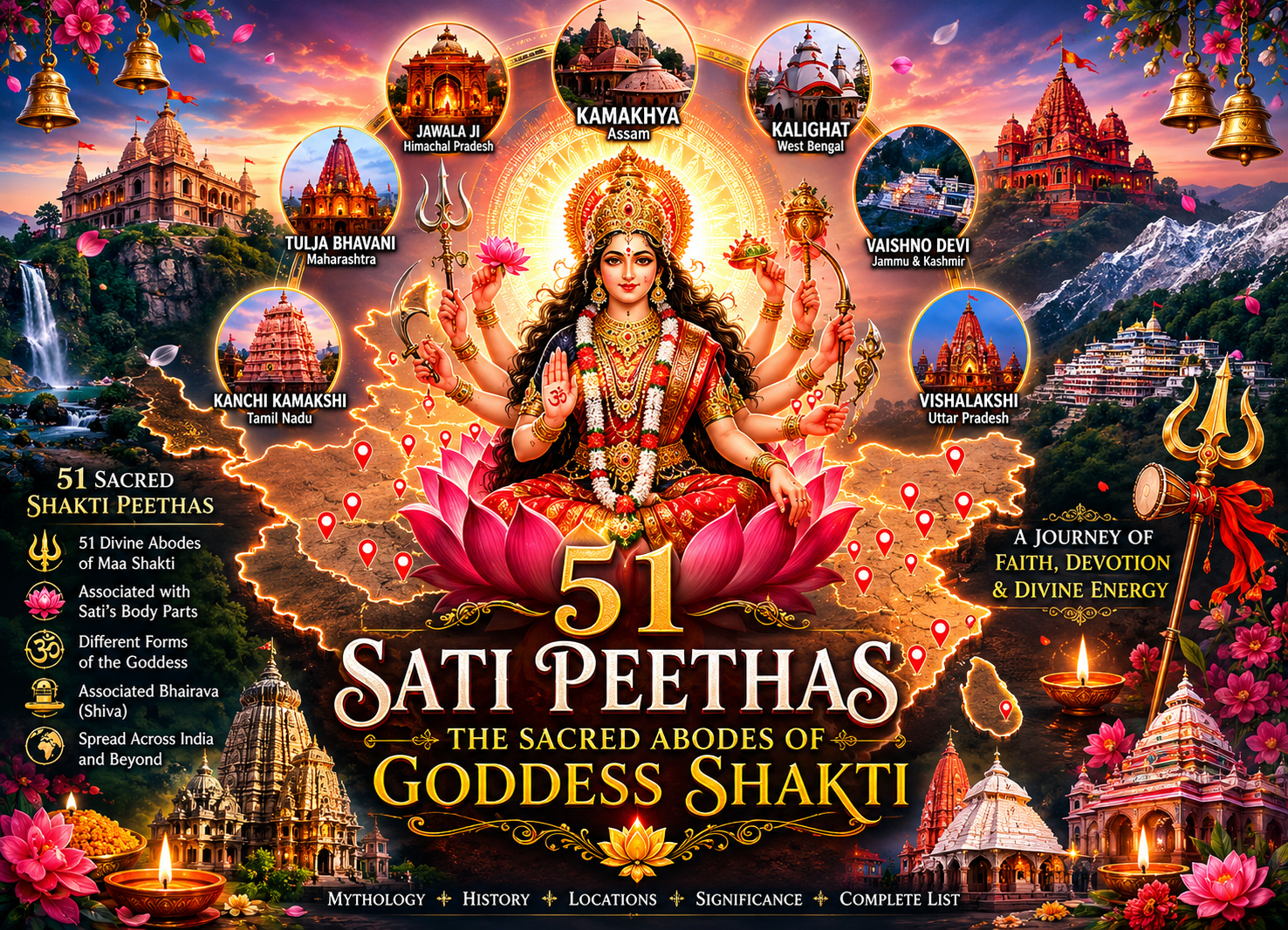
The sacred tradition of the 51 Sati Peethas occupies a highly respected position in Hindu spirituality and Shakta philosophy. These holy places are considered the powerful energy centers of Goddess Shakti, the supreme feminine force of the universe. Spread across different regions of the Indian subcontinent, the Shakti Peethas are not only important pilgrimage destinations but also symbols of devotion, sacrifice, divine energy, and the eternal connection between Lord Shiva and Goddess Shakti.
For thousands of years, devotees have travelled to these sacred temples seeking the blessings of the Divine Mother. Each Peetha carries a unique spiritual identity connected with Goddess Sati, a manifestation of Adi Shakti, and represents a particular form of divine energy.
The story of the 51 Sati Peethas combines mythology, philosophy, history, and religious traditions. These sacred sites continue to attract millions of devotees every year and remain among the most important spiritual landmarks of Hindu culture.
The Mythological Origin of the 51 Sati Peethas
The origin of the Shakti Peethas is connected with the famous story of Goddess Sati and Lord Shiva.
According to Hindu scriptures, Goddess Sati was the daughter of King Daksha Prajapati and the first wife of Lord Shiva. Sati deeply loved Shiva and chose him as her husband despite her father’s opposition.
King Daksha considered Shiva unsuitable because Shiva lived a simple life away from royal traditions. Because of this disagreement, Daksha developed resentment toward Shiva.
Once, Daksha organized a grand Yajna (sacred ritual) and invited all gods, sages, and celestial beings except Lord Shiva and Goddess Sati.
Feeling hurt by the insult toward her husband, Sati went to the Yajna ceremony. There, Daksha publicly criticized Lord Shiva. Unable to tolerate the humiliation of her beloved husband, Goddess Sati sacrificed herself by entering the sacred fire.
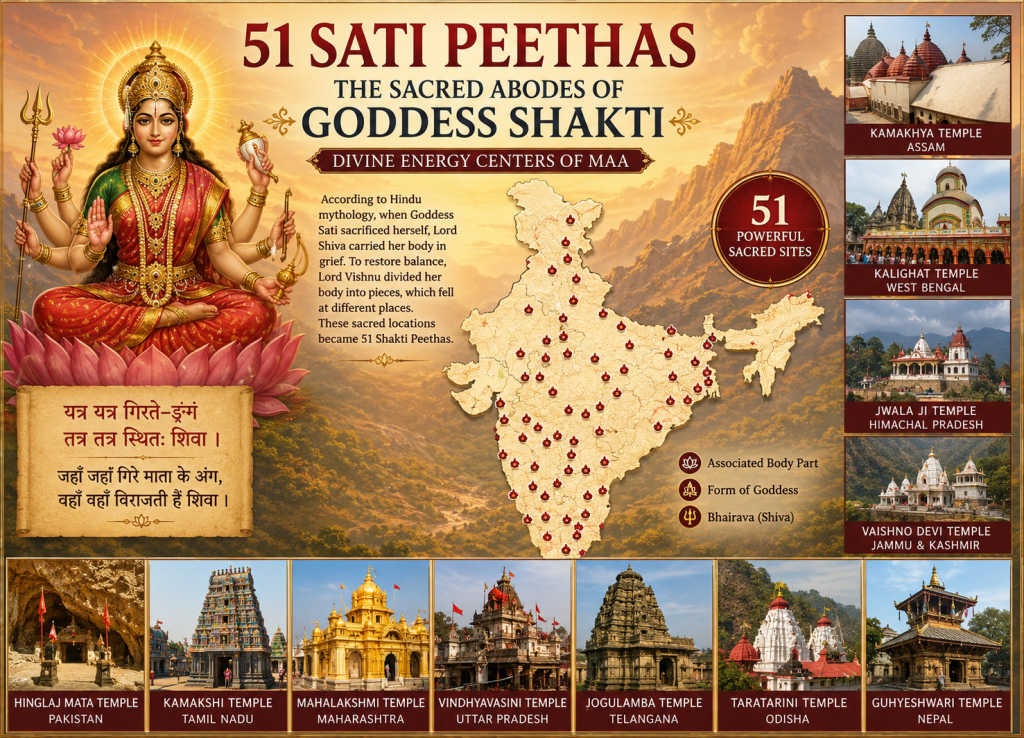
When Lord Shiva came to know about Sati’s death, he became filled with sorrow and anger. He lifted Sati’s body on his shoulders and performed the destructive cosmic dance known as Tandava.
The universe became unstable due to Shiva’s grief. To restore cosmic balance, Lord Vishnu used his Sudarshan Chakra and divided Sati’s body into several parts.
As Lord Shiva travelled carrying Sati’s body, different parts fell at different places. These sacred locations became known as Shakti Peethas.
Meaning of Shakti Peetha
The word Shakti means divine energy or power, while Peetha means a sacred seat or place.
Therefore, a Shakti Peetha is considered a sacred place where the divine power of Goddess Sati exists.
Every Shakti Peetha is traditionally associated with:
- A body part or ornament of Goddess Sati
- A form of Goddess Shakti
- A form of Lord Shiva known as Bhairava
The Shakti Peethas represent the unity of Shiva and Shakti. According to Hindu philosophy, Shiva represents consciousness, while Shakti represents the energy that activates creation.
Why Are There 51 Shakti Peethas?
Different religious texts mention different numbers of Shakti Peethas, including 4, 18, 51, 52, and 108. However, the tradition of 51 Sati Peethas is among the most widely accepted.
The number 51 is spiritually significant because it corresponds with the 51 letters of the Sanskrit alphabet. In Shakta philosophy, these sacred sounds represent the vibrations of the Divine Mother.
Each Peetha is therefore believed to represent a unique expression of Goddess Shakti.
Complete List of 51 Sati Peethas and Their Significance
1. Hinglaj Mata Shakti Peetha – Pakistan
Located in Balochistan, Hinglaj Mata Temple is one of the oldest Shakti Peethas. It is considered a powerful center of Goddess worship.
Devotees believe that this sacred cave temple carries the divine energy of Maa Hinglaj.
2. Shankari Devi Shakti Peetha – Sri Lanka
Located in Trincomalee, this Peetha represents the ancient spread of Shakti worship beyond India.
It is dedicated to Goddess Shankari, a form of Parvati.
3. Sugandha Shakti Peetha – Bangladesh
Associated with Goddess Sunanda, this sacred place is connected with ancient Devi worship traditions.
4. Mahamaya Shakti Peetha – Kashmir
The Kashmir region has historically been an important center of Shakti philosophy. This Peetha is associated with Goddess Mahamaya.
5. Jwala Ji Shakti Peetha – Himachal Pradesh
Famous for its eternal natural flames, Jwala Ji is one of the most unique Shakti temples.
The flame itself is worshipped as the manifestation of Goddess Shakti.
6. Bhairav Parvat Shakti Peetha – Madhya Pradesh
Located near Ujjain, this sacred place is connected with ancient Shaiva and Shakta traditions.
7. Attahas Shakti Peetha – West Bengal
Dedicated to Goddess Phullara, this Peetha is an important pilgrimage site in Bengal.
8. Bahula Shakti Peetha – West Bengal
This temple represents another powerful form of Goddess Shakti worshipped by devotees.
9. Kalighat Shakti Peetha – Kolkata
One of the most famous Shakti Peethas, Kalighat Temple is dedicated to Goddess Kali.
Millions of devotees visit this sacred temple every year.
10. Nandikeshwari Shakti Peetha – West Bengal
Located in Sainthia, this temple is dedicated to Goddess Nandini.
11. Kirit Shakti Peetha – West Bengal
Associated with the divine crown of Goddess Sati, this Peetha represents the glory of the Goddess.
12. Ratnavali Shakti Peetha – West Bengal
An ancient sacred site associated with Goddess Shakti traditions.
13. Vakreshwar Shakti Peetha – West Bengal
Famous for its temple and natural hot springs, Vakreshwar is a significant spiritual destination.
14. Kamakhya Shakti Peetha – Assam
One of the most powerful Shakti Peethas in India.
The Kamakhya Temple represents the creative power of the Goddess and is famous for Tantric traditions.
The annual Ambubachi Mela attracts devotees from across the world.
15. Tripura Sundari Shakti Peetha – Tripura
Dedicated to Goddess Tripura Sundari, this temple is among the most respected Devi temples of Northeast India.
16. Bhimashankari Shakti Peetha – Maharashtra
Associated with ancient Goddess traditions of Maharashtra.
17. Tulja Bhavani Shakti Peetha – Maharashtra
A famous temple dedicated to Goddess Bhavani, worshipped as a protector and motherly force.
18. Mahalakshmi Shakti Peetha – Maharashtra
Located in Kolhapur, this temple is one of the most important Devi temples in India.
19. Vishalakshi Shakti Peetha – Varanasi
Located in the holy city of Kashi, this temple is dedicated to Goddess Vishalakshi.
20. Prayag Shakti Peetha – Uttar Pradesh
Associated with the sacred region of Prayagraj.
21. Vindhyavasini Shakti Peetha – Uttar Pradesh
A famous temple dedicated to Goddess Vindhyavasini.
22. Kamakshi Shakti Peetha – Tamil Nadu
Located in Kanchipuram, this temple represents the divine feminine energy of Goddess Kamakshi.
23. Bhramaramba Shakti Peetha – Andhra Pradesh
Located at Srisailam, it is one of the most important Shiva-Shakti pilgrimage sites.
24. Jogulamba Shakti Peetha – Telangana
Dedicated to Goddess Jogulamba, it is a major South Indian Shakti shrine.
25. Guhyeshwari Shakti Peetha – Nepal
Located near Kathmandu, this Himalayan temple is considered highly sacred.
26. Manibandh Shakti Peetha – Rajasthan
An ancient Devi worship center connected with Shakti traditions.
27. Biraja Shakti Peetha – Odisha
One of Odisha’s oldest Goddess temples, dedicated to Maa Biraja.
28. Taratarini Shakti Peetha – Odisha
A famous hilltop temple dedicated to Goddess Tara and Tarini.
29. Chattal Shakti Peetha – Bangladesh
A sacred Devi temple connected with ancient Shakta traditions.
30. Yashoreswari Shakti Peetha – Bangladesh
An important Shakti shrine dedicated to Goddess Yashoreswari.
31. Jayanti Shakti Peetha – Meghalaya
Associated with Goddess Jayanti and Himalayan spiritual traditions.
32–51. Other Traditional Shakti Peethas
The remaining Peethas mentioned in various traditional lists include:
- Kankalitala Shakti Peetha
- Kurukshetra Shakti Peetha
- Mithila Shakti Peetha
- Shuchi Shakti Peetha
- Lanka Shakti Peetha
- Godavari Tat Shakti Peetha
- Narmada Shakti Peetha
- Ramgiri Shakti Peetha
- Sarvashail Shakti Peetha
- Devikupa Shakti Peetha
- Panch Sagar Shakti Peetha
- Ratnavali Shakti Peetha
- Ujjayini Shakti Peetha
- Nepal Shakti Peetha
- Vimala Shakti Peetha
- Other regional Peethas preserved through Shakta traditions
Different scriptures and regional traditions sometimes vary regarding the exact names and locations, but all represent the same divine principle — the eternal power of Goddess Shakti.
Spiritual Importance of Visiting Shakti Peethas
Devotees believe that visiting Shakti Peethas helps in:
- Receiving blessings of Maa Durga
- Removing negativity
- Finding mental peace
- Strengthening devotion
- Experiencing spiritual awakening
Many pilgrims undertake Shakti Peetha journeys as a form of religious dedication.
Shakti Peethas and Indian Cultural Heritage
The Shakti Peethas have influenced Indian art, architecture, music, literature, and festivals.
Celebrations like Durga Puja, Navratri, and Kali Puja reflect the continuing importance of Goddess worship.
These temples preserve thousands of years of spiritual traditions and cultural history.
The Eternal Presence of Maa Shakti
The 51 Sati Peethas are not only sacred temples but also symbols of the eternal presence of divine energy. They represent the strength, compassion, creativity, and protective power of Goddess Shakti.
From Kamakhya in Assam to Kalighat in Bengal and Hinglaj in Pakistan, these sacred places continue to inspire millions of devotees.
The story of Sati and the creation of the Shakti Peethas teaches a timeless message — divine energy exists everywhere, and the power of the Mother Goddess continues to guide and protect the universe.
The 51 Sati Peethas remain an eternal journey of faith, devotion, and spiritual discovery.