🔥The Five Temples That Control the Universe? The Astonishing Mystery of the Panchabhuta Temples 🌍🔥💧🌬️🌌
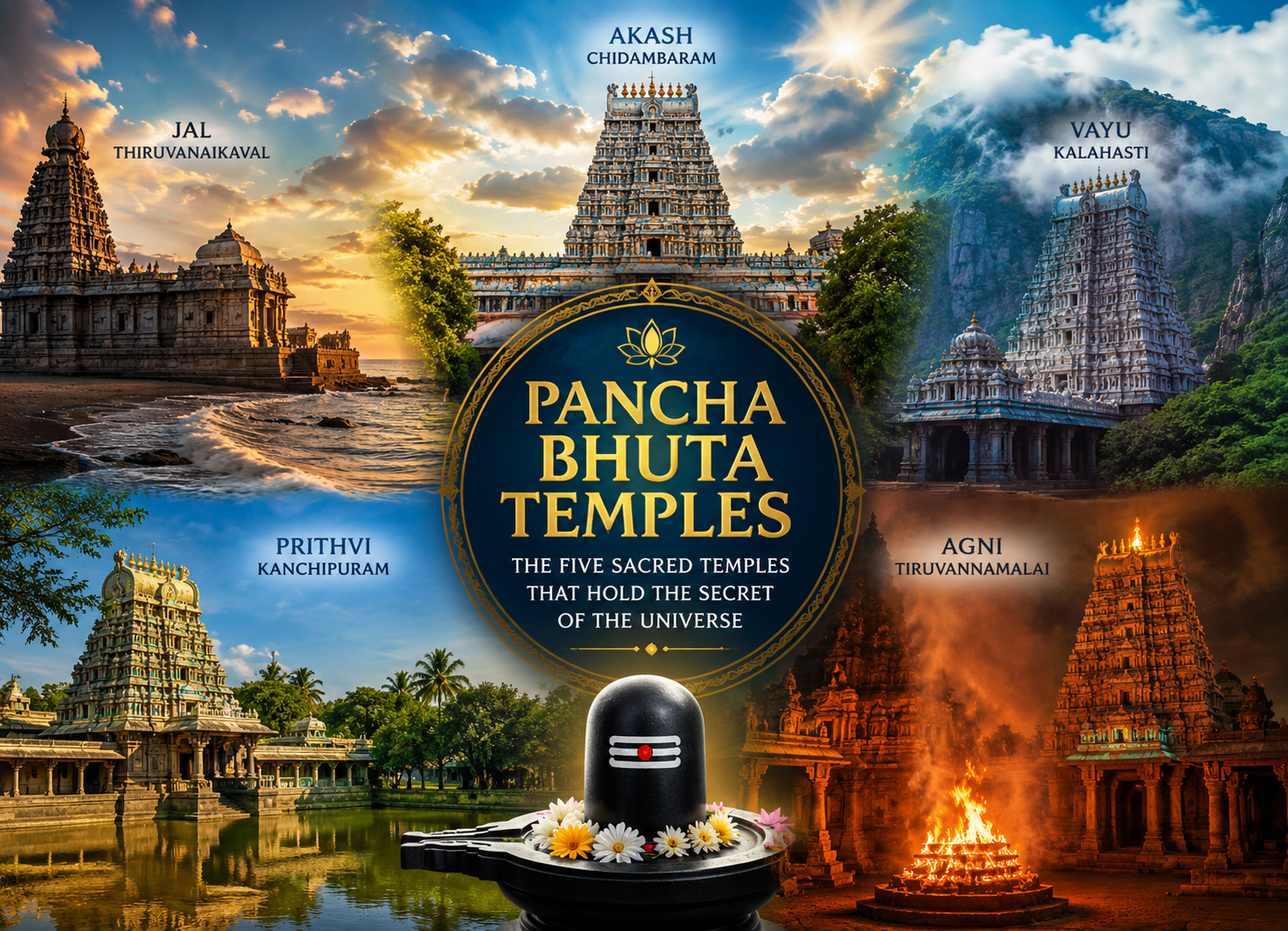
Imagine visiting five ancient temples that together represent the very building blocks of the universe.
Earth. Water. Fire. Air. Space.
According to ancient Hindu philosophy, these five elements—known as the Pancha Mahabhutas—are not merely components of nature. They are the foundation of all existence, including the human body, the cosmos, and every living being.
Scattered across South India are five extraordinary Shiva temples known as the Panchabhuta Temples or Pancha Bhoota Sthalams. Each temple is dedicated to one of these cosmic elements and has fascinated devotees, historians, architects, and scientists for centuries.
Are these merely places of worship, or do they hide an ancient understanding of the universe that modern science is only beginning to appreciate?
Let’s explore the incredible mysteries behind these sacred temples.
What Are the Panchabhuta Temples?
The word Panchabhuta comes from two Sanskrit words:
- Pancha = Five
- Bhuta = Elements
According to Hindu philosophy, everything in existence is composed of five primary elements:
- Earth (Prithvi)
- Water (Apas)
- Fire (Agni)
- Air (Vayu)
- Space (Akasha)
Lord Shiva is believed to manifest Himself in these five elemental forms through five sacred temples located mainly in Tamil Nadu and Andhra Pradesh.
Together, they symbolize the harmony between nature, spirituality, and cosmic energy.
The Ancient Science Behind the Five Elements
Long before modern chemistry and physics emerged, ancient Indian sages described the universe using the concept of five fundamental elements.
These elements represent not only physical matter but also spiritual consciousness.
Earth (Prithvi)
Represents stability, strength, patience, and physical existence.
Water (Apas)
Represents purification, emotions, adaptability, and life itself.
Fire (Agni)
Represents transformation, energy, wisdom, and divine illumination.
Air (Vayu)
Represents movement, breath, freedom, and life force.
Space (Akasha)
Represents consciousness, infinity, vibration, and the divine.
Interestingly, these concepts closely resemble holistic approaches still studied today in yoga and Ayurveda.
1. Ekambareswarar Temple – The Earth Element
Location: Kanchipuram, Tamil Nadu
The first Panchabhuta temple represents Earth (Prithvi).
Legend says Goddess Parvati fashioned a Shiva Lingam from river sand beneath a sacred mango tree and worshipped Lord Shiva there.
When floods threatened the Lingam, she embraced it to protect it. Pleased by her devotion, Shiva appeared before her and accepted her worship.
One of the temple’s greatest attractions is its legendary mango tree, believed to be over 3,500 years old according to tradition.
The tree is said to produce four different varieties of mangoes from its branches, symbolizing the four Vedas.
The Shiva Lingam here is made of sand and is treated with extraordinary care during rituals.
2. Jambukeswarar Temple – The Water Element
Location: Tiruchirappalli (Trichy), Tamil Nadu
This temple represents Water (Apas).
Its greatest mystery is astonishing.
A natural underground spring continuously supplies water beneath the Shiva Lingam.
Even during scorching summers, water mysteriously emerges around the Lingam.
No one has fully explained how this underground water source has continued uninterrupted for centuries.
The temple beautifully symbolizes purity, nourishment, and life’s continuous flow.
Another fascinating tradition is that during the midday ritual, the priest dresses as Goddess Parvati while offering worship to Lord Shiva.
This ritual represents the eternal dialogue between Shiva and Shakti.
3. Arunachaleswarar Temple – The Fire Element
Location: Tiruvannamalai, Tamil Nadu
This magnificent temple represents Fire (Agni).
According to legend, Lord Shiva once appeared as an infinite pillar of fire.
Neither Lord Brahma nor Lord Vishnu could find its beginning or end.
To commemorate this divine event, Shiva manifested as the sacred Arunachala Hill.
Every year, during the famous Karthigai Deepam festival, a gigantic lamp is lit atop the hill.
The flame can be seen from miles away and attracts millions of pilgrims.
Many devotees believe the hill itself is Shiva.
Walking around the entire mountain, known as Girivalam, is considered highly auspicious.
4. Srikalahasteeswara Temple – The Air Element
Location: Srikalahasti, Andhra Pradesh
This temple represents Air (Vayu).
One of its greatest mysteries has puzzled visitors for generations.
Inside the sanctum, a lamp flame continuously flickers despite the absence of visible airflow.
Even when the chamber remains completely enclosed, the flame never stands perfectly still.
Devotees believe this symbolizes the invisible yet ever-present element of air.
The temple is also renowned for Rahu-Ketu dosha remedies and attracts thousands seeking spiritual relief.
Its ancient architecture and legends make it one of India’s most revered Shiva temples.
5. Chidambaram Nataraja Temple – The Space Element
Location: Chidambaram, Tamil Nadu
The final Panchabhuta temple represents Space (Akasha).
Unlike traditional Shiva temples centered solely on the Lingam, this temple celebrates Shiva as Nataraja, the Cosmic Dancer.
His divine dance symbolizes creation, preservation, and dissolution of the universe.
The temple is famous for the mysterious Chidambara Rahasyam, meaning “The Secret of Chidambaram.”
Behind a curtain lies what appears to be empty space adorned with sacred golden bilva leaves.
This “empty” space symbolizes the invisible presence of the Divine.
It teaches that God exists beyond physical form.
Perhaps no other temple expresses the concept of infinity more beautifully.
Are the Panchabhuta Temples Scientifically Aligned?
Many researchers and enthusiasts have noted fascinating geographical patterns associated with these temples.
Some believe that several of the temples exhibit remarkable alignments and sophisticated architectural planning, reflecting the advanced knowledge of ancient Indian builders. Their orientation, astronomical considerations, and engineering continue to be studied and admired.
However, claims that all five temples form a perfectly aligned straight line or were intentionally positioned according to advanced geospatial principles remain debated and have not been conclusively established by archaeological evidence.
What is beyond dispute is the extraordinary architectural brilliance and symbolic integration of nature within these sacred sites.
The Spiritual Journey Through the Five Elements
Pilgrims often undertake a journey to all five temples in a specific order.
The experience symbolizes spiritual evolution:
- Earth teaches stability.
- Water teaches purity.
- Fire removes ignorance.
- Air brings freedom.
- Space reveals ultimate consciousness.
Many devotees believe completing this pilgrimage balances both body and mind.
Architectural Marvels Beyond Their Time
These temples are engineering masterpieces.
Some astonishing features include:
- Massive stone towers built without modern machinery.
- Intricate carvings with extraordinary precision.
- Vast temple complexes covering hundreds of acres.
- Advanced water management systems.
- Remarkable ventilation and acoustics.
- Alignment with celestial events and traditional sacred geometry.
Despite being over a thousand years old, these temples continue to amaze architects and historians alike.
Why Millions Continue to Visit
Every year, millions of devotees and tourists visit these temples.
Some come seeking blessings.
Others seek answers to life’s deepest questions.
Many arrive simply to witness the timeless beauty of India’s spiritual heritage.
Regardless of one’s beliefs, the Panchabhuta Temples offer an unforgettable experience where mythology, philosophy, architecture, and devotion come together.
Lessons the Panchabhuta Temples Teach Humanity
The message of these temples remains deeply relevant today.
Nature is not separate from us—it is our very essence.
When we pollute rivers, destroy forests, or exploit natural resources, we disrupt the balance of the very elements that sustain life.
The Panchabhuta Temples remind us to honor Earth, conserve Water, respect Fire, breathe pure Air, and appreciate the vastness of Space. This ancient wisdom resonates strongly with modern ideas of environmental stewardship and holistic well-being.
Best Time to Visit
The ideal time to explore all five Panchabhuta Temples is from October to March, when the weather in South India is pleasant for travel.
Many devotees also plan their visits during festivals such as:
- Maha Shivaratri
- Karthigai Deepam
- Arudra Darshan
- Panguni Uthiram
These occasions bring the temples alive with grand rituals, music, and vibrant cultural celebrations.
Final Thoughts
The Panchabhuta Temples are more than ancient monuments—they are living symbols of a profound philosophy that sees the entire universe as interconnected. Whether approached as sacred pilgrimage sites, architectural masterpieces, or expressions of India’s timeless spiritual heritage, they continue to inspire awe.
In a world searching for balance between science, spirituality, and nature, these five temples stand as enduring reminders that the elements sustaining the cosmos also sustain our own lives. Their message is simple yet profound: by living in harmony with the five elements, we move closer to harmony within ourselves and with the universe.