Shmashan Dwipavali in Barisal: A Historic Festival of Light and Remembrance
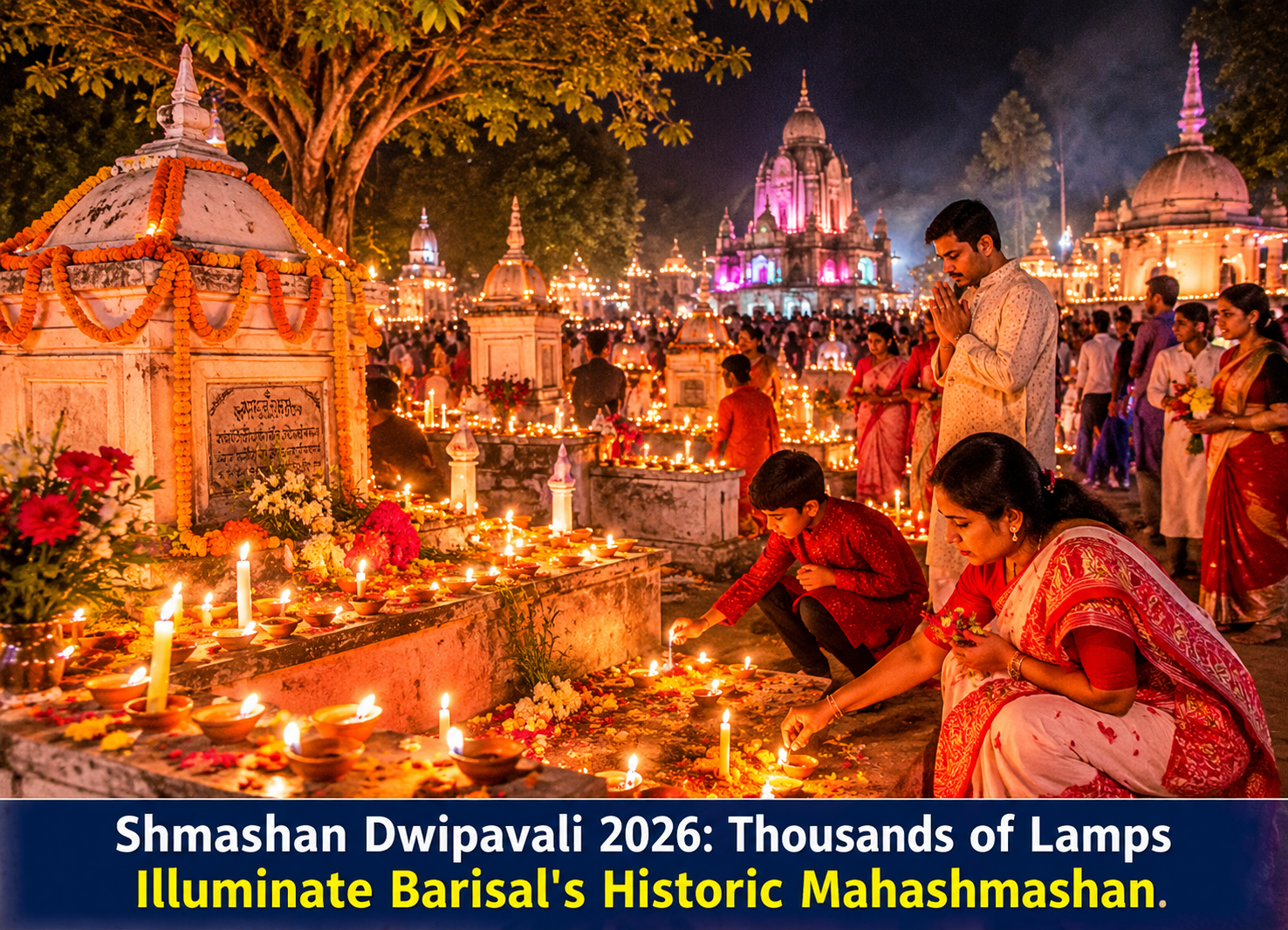
Barisal, Bangladesh, November 9, 2026: Thousands of flickering lamps and candles transformed the historic Kawnia Mahashmashan in Barisal into a spectacular landscape of light on November 7, as devotees gathered to observe the traditional Shmashan Dwipavali (Shmashan Dipabali). The annual religious and cultural celebration brought together people from different parts of Bangladesh and neighbouring countries to remember their departed family members, offer prayers for their eternal peace and preserve a remarkable tradition that has continued for generations.
Observed on the sacred occasion of Bhoot Chaturdashi, the eve of Kali Puja, Shmashan Dwipavali is an extraordinary expression of remembrance, devotion and respect for ancestors. Unlike conventional Diwali celebrations, which primarily illuminate homes, temples and public spaces, this unique festival brings light to cremation grounds and memorial structures. Families decorate the resting places of their loved ones with flowers, light traditional lamps, burn incense and offer food in remembrance of those who are no longer physically present.
The 2026 celebration once again highlighted the historical, religious and cultural importance of Barisal’s Mahashmashan, widely recognised as one of the largest and most remarkable cremation-ground festival venues in the Indian subcontinent. According to preliminary estimates from the organisers, approximately 100,000 people attended this year’s celebration. NTV Online+2
Shmashan Dwipavali 2026: A Night of Thousands of Lights
On Saturday evening, November 7, the historic cremation ground in the Kawnia area of Barisal became the centre of a remarkable gathering. Thousands of candles, oil lamps and other lights illuminated the memorial structures, creating an atmosphere of solemnity, devotion and emotional remembrance.
Families arrived carrying flowers, candles, incense sticks and food offerings. Many spent time cleaning and decorating the memorial structures of their parents, grandparents and other relatives. Some placed their loved ones’ favourite dishes near the memorials as a symbolic expression of affection and remembrance.
Among the offerings were traditional foods, including fish, sweets and payesh (rice pudding). For many families, these offerings represented an emotional connection with people whose memories remain an inseparable part of their lives.
The evening was not simply a religious gathering. It was also a deeply personal occasion for thousands of people who returned to the cremation ground to remember their loved ones and share memories with other family members.
According to reports published after the event, devotees participated in the celebration from Bangladesh as well as India, Nepal, Sri Lanka and different European countries. The participation of people from outside Bangladesh demonstrated the wider cultural significance of this historic Barisal tradition. NTV Online+3
The celebration continued into the night, with the illuminated memorials creating an unforgettable scene across the extensive cremation-ground complex.
The Historic Barisal Mahashmashan
উপমহাদেশের সর্ববৃহৎ শ্মশান দীপাবলি উৎসব পালন হবে বরিশালে | Dhaka Journaldhakajournal.com
The Kawnia Mahashmashan is one of the most historically significant cremation grounds in Bangladesh. Located in the Kawnia area of Barisal city, it has been associated with the Hindu community’s religious and cultural life for approximately two centuries.
The cremation ground is spread across nearly six acres of land. It contains an extraordinary collection of memorial structures, commonly known as samadhi math or smriti math, erected in memory of deceased individuals.
The exact number of memorial structures varies among published reports. Recent reports have cited figures ranging from more than 61,000 to over 70,000, depending on the counting method and the inclusion of older and newer structures. More than 50,000 of these are reported to be permanent or brick-built memorials, while thousands of others are comparatively simple structures. NTV Online+3
These memorials give the Mahashmashan a distinctive appearance. Unlike an ordinary cremation ground, where the memory of the deceased may be preserved through temporary markers, this historic site contains numerous permanent structures that reflect generations of family remembrance.
The cremation ground is therefore not merely a place associated with death. It is also a repository of family histories, social memories and cultural heritage.
Over the years, the Mahashmashan has become an important landmark of Barisal, attracting visitors, researchers, photographers and people interested in the religious traditions of Bangladesh.
A Tradition Rooted in Nearly Two Centuries of History
The history of Shmashan Dwipavali in Barisal is closely connected with the long-standing religious practices of the Hindu community in the region.
Historical newspaper reports have documented the celebration for well over a century. A report published in The Daily Star in November 2005 stated that the festival was observed at the Adi Shamshan Ghat and Natun Shamshan Ghat in Barisal and had been practised for more than 150 years at that time. The Daily Star+1
Subsequent reports have associated the tradition with the middle of the nineteenth century, particularly around 1850. A 2023 report by Dhaka Tribune also described the festival as a tradition dating back to approximately that period. Dhaka Tribune+1
The Mahashmashan itself is often described as approximately 200 years old. However, the establishment of the cremation ground and the beginning of the organised annual festival should not necessarily be considered the same historical event.
According to local accounts, the practice developed through the religious and social customs of Hindu families who wished to remember their departed relatives on a particular sacred occasion.
Over generations, the individual family observances gradually became a large community gathering. Today, Shmashan Dwipavali is an important annual event in Barisal’s religious calendar.
The festival’s historical continuity is particularly remarkable because it has survived changing political circumstances, social transformations and the passage of generations.
For families who have maintained the tradition over many decades, attending the Mahashmashan on this occasion is not simply an annual activity. It is a continuation of a responsibility towards their ancestors and an opportunity to pass family traditions to younger generations.
Why Is Shmashan Dwipavali Celebrated on Bhoot Chaturdashi?
Bhoot Chaturdashi 2025: ভূতচতুর্দশীতে ১৪ প্রদীপ ১৪ পুরুষের জন্যই শুধু জ্বালানো হয়? জানুন শাস্ত্রমত | Hindustan Times Banglahindustantimes.com
Shmashan Dwipavali is traditionally observed on Bhoot Chaturdashi, the fourteenth lunar day of Krishna Paksha (the waning phase of the Moon) in the Hindu month of Kartik, immediately before Kali Puja and the wider Diwali celebrations.
The word Bhoot is associated with spirits or departed beings, while Chaturdashi means the fourteenth lunar day. In Hindu tradition, this occasion is connected with remembering departed ancestors and acknowledging the spiritual relationship between the living and the dead.
In Bengal, Bhoot Chaturdashi is also associated with the custom of lighting fourteen lamps, commonly called Choddoprodeep, in remembrance of fourteen generations of ancestors. Although customs differ between regions and families, the central idea is to honour departed family members and seek blessings for the household.
In Barisal, this ancestral remembrance takes a particularly distinctive form. Rather than limiting the observance to individual homes, families visit the Mahashmashan and illuminate the memorials of their deceased relatives.
The occasion offers an opportunity to remember parents, grandparents, relatives and other loved ones who have passed away. It also reminds people of the continuity of family relationships across generations.
The timing of the festival is significant because it connects the remembrance of ancestors with the wider spiritual atmosphere of Kali Puja and Diwali.
While Diwali symbolises the victory of light over darkness, Shmashan Dwipavali gives that symbolism an additional emotional meaning: the light of memory continues even after physical separation.
How Families Celebrate the Festival
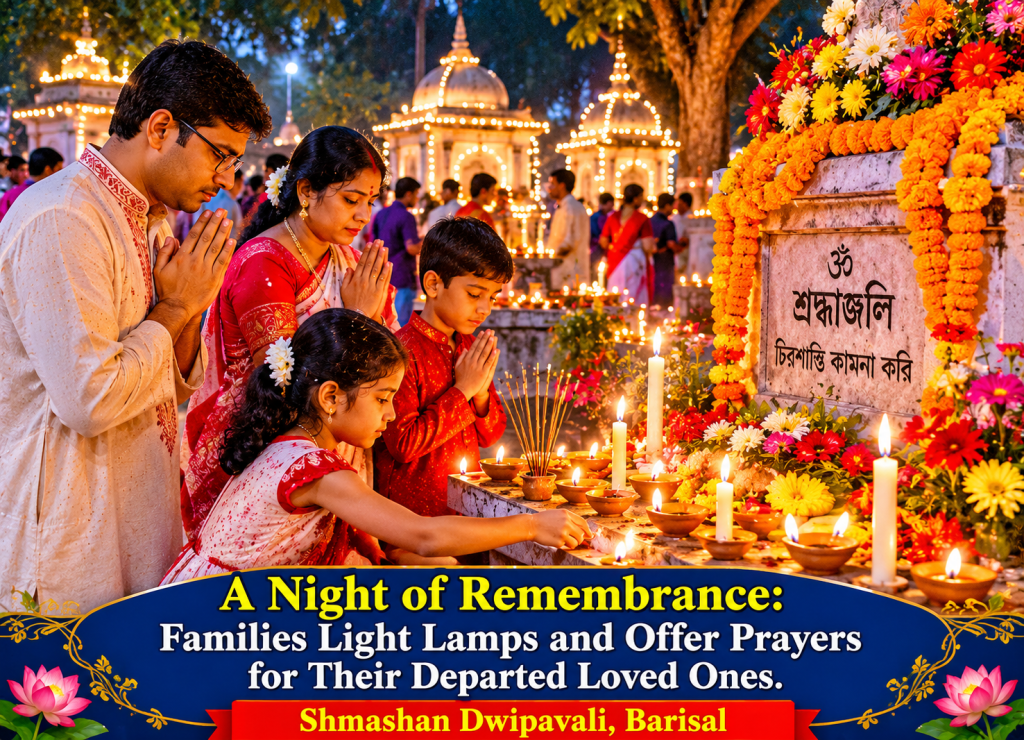
The most distinctive feature of Shmashan Dwipavali is the personal involvement of families in decorating and illuminating the memorials of their departed relatives.
The preparations often begin well before the evening of the celebration.
1. Cleaning and Decorating Memorial Structures
Families visit the Mahashmashan to clean the memorials of their deceased relatives. Older structures may be washed, repaired or freshly painted, while flowers and decorative materials are arranged around them.
For many families, maintaining the memorial is an important expression of respect.
Some people travel long distances to participate in these preparations, especially when they live outside Barisal or abroad.
2. Lighting Lamps and Candles
বরিশালের মহাশ্মশান প্রদীপের আলোয় আলোকিতittefaq.com.bd
As evening approaches, families begin lighting candles, earthen lamps and other traditional lights.
The soft glow of thousands of lamps gradually illuminates the memorial structures, pathways and surrounding areas.
This is the most visually striking aspect of the festival. The entire cremation ground appears transformed into a vast landscape of light.
For devotees, each lamp represents an expression of love, respect and remembrance.
3. Offering Flowers and Incense
Flowers are an important part of the observance. Families decorate memorials with garlands and fresh flowers, while incense sticks are burned as part of their prayers.
The fragrance of incense, the sight of flowers and the gentle light of candles create a solemn devotional atmosphere.
People often spend several minutes or even hours at the memorials, remembering personal experiences and praying for the peace of their departed relatives.
4. Offering Favourite Foods of the Departed
One particularly touching tradition is placing food associated with the deceased near their memorials.
Some families bring fish, sweets, fruits, payesh and other favourite dishes of their departed relatives.
During the 2026 celebration, visitors were reported to have offered foods such as hilsa fish and payesh in memory of their loved ones. NTV Online+1
These offerings express the continuing emotional bond between family members and the deceased.
They are symbolic gestures of affection rather than an indication that the departed physically consume the food.
5. Prayers for Eternal Peace
The central purpose of the gathering is to remember the departed and pray for their peace.
Families offer prayers according to their religious customs. Some perform rituals at individual memorials, while others participate in collective devotional observances.
The festival also provides an opportunity for relatives to meet, share memories and strengthen family relationships.
The Spiritual Significance of Light in Shmashan Dwipavali
Light has a profound symbolic meaning in Hindu philosophy.
It represents knowledge, purity, hope, divine consciousness and the victory of truth over ignorance.
The Upanishadic prayer Asato Ma Sadgamaya expresses this spiritual aspiration beautifully:
असतो मा सद्गमय
तमसो मा ज्योतिर्गमय
मृत्योर्मामृतं गमय।
Asato Ma Sadgamaya, Tamaso Ma Jyotirgamaya, Mrityor Ma Amritam Gamaya.
Meaning:
Lead me from untruth to truth, from darkness to light, and from mortality to immortality.
This famous prayer from the Brihadaranyaka Upanishad reflects the deeper spiritual philosophy associated with the lighting of lamps.
At Barisal’s Mahashmashan, the lamps have a particularly emotional significance. They illuminate a place that ordinarily reminds visitors of mortality, separation and the impermanence of human existence.
Yet, during Shmashan Dwipavali, the same place becomes a symbol of hope, affection and remembrance.
The lights do not erase the sorrow of losing loved ones. Instead, they transform remembrance into a meaningful spiritual experience.
For devotees, the festival conveys the message that although the physical body is temporary, the love, teachings and memories of those who have passed away continue to influence the lives of their descendants.
Hindu Philosophy and the Concept of Life After Death
The religious significance of Shmashan Dwipavali can also be understood through the Hindu understanding of the soul and the cycle of birth and death.
According to the Bhagavad Gita, the soul is eternal and is not destroyed when the physical body dies.
In Chapter 2, Verse 20, Lord Krishna explains:
न जायते म्रियते वा कदाचित्।
Na jayate mriyate va kadachit.
Meaning: The soul is never born, nor does it ever die.
The teaching continues by explaining that the soul is eternal, beyond destruction and unaffected by the death of the physical body.
This philosophical perspective helps explain why remembrance of departed ancestors occupies an important place in Hindu religious life.
Hindu traditions include several practices associated with honouring ancestors, such as Shraddha, Tarpana and Pitru Paksha observances.
These practices differ in their rituals and timing, but they share a common foundation: gratitude towards previous generations and recognition of the role ancestors play in the continuity of family and society.
Shmashan Dwipavali in Barisal expresses this sentiment through the lighting of lamps and the decoration of memorials.
It is important to recognise that the festival’s local customs are not identical to every Hindu ancestral ritual. Rather, they represent a distinctive regional tradition shaped by the religious and cultural history of Barisal.
The Connection Between Shmashan Dwipavali, Diwali and Kali Puja
Kali Puja 2026 in CR Park — Night of the Dark Goddess | Chittaranjan Parkchittaranjanpark.com
Shmashan Dwipavali takes place during the same broader festive period associated with Diwali and Kali Puja.
Although the three observances are connected through their timing and symbolism, they have different characteristics.
Diwali, also known as Deepavali, is widely celebrated as the festival of lights. It symbolises the victory of light over darkness and good over evil. Homes, temples and public spaces are decorated with lamps, candles and colourful decorations.
Kali Puja, particularly important in Bengal, is dedicated to Goddess Kali, the divine embodiment of Shakti. Devotees worship the goddess for protection, spiritual strength and the destruction of evil forces.
Shmashan Dwipavali, on the other hand, places special emphasis on remembering departed relatives and honouring ancestors through the illumination of cremation-ground memorials.
The relationship between Goddess Kali and the cremation ground is also significant in Hindu religious symbolism.
Goddess Kali is traditionally associated with cremation grounds in several forms of her iconography and spiritual traditions. The cremation ground represents the impermanence of worldly existence, the destruction of ego and the ultimate reality beyond material attachment.
Therefore, the observance of Shmashan Dwipavali immediately before Kali Puja carries a distinctive spiritual atmosphere.
It brings together the themes of mortality, remembrance, devotion and the eternal nature of the soul.
Famous Personalities Associated with Barisal Mahashmashan
The historical importance of the Barisal Mahashmashan is further enhanced by its association with notable personalities.
Among the historically significant names connected with the site are members of the family of the renowned Bengali poet Jibanananda Das.
The cremated remains of the poet’s father, Satyānanda Das, and grandfather, Sarbananda Das, are associated with the historic cremation ground.
The site is also reported to preserve the ashes of Ashwini Kumar Dutta, the prominent educationist, social reformer and political leader of Bengal. NTV Online+1
These historical associations make the Mahashmashan important not only to the Hindu community but also to people interested in the cultural and intellectual history of Bengal.
The presence of memorials connected with notable individuals gives the location an additional historical dimension.
Visitors who come to observe Shmashan Dwipavali therefore encounter a place that preserves both personal family memories and connections with the wider history of the region.
The Festival’s Importance for the Hindu Community of Bangladesh
Shmashan Dwipavali has become one of the most distinctive religious and cultural gatherings of the Hindu community in southern Bangladesh.
For many Hindus living in Barisal and neighbouring districts, the festival is an important annual occasion to reconnect with their ancestral roots.
People who have moved to Dhaka, other major cities or foreign countries often return to Barisal during this period. Their visits demonstrate how religious traditions can preserve family connections even when generations become geographically separated.
The festival also provides an opportunity for younger generations to learn about their family histories.
Children accompanying their parents and grandparents can discover the names of their ancestors, learn about their family traditions and understand why memorial structures have been preserved for so many years.
In this way, Shmashan Dwipavali functions as an informal bridge between generations.
It also demonstrates the diversity of Hindu religious practices in Bangladesh. While many people are familiar with the traditional celebrations of Durga Puja, Kali Puja, Janmashtami and Rath Yatra, Shmashan Dwipavali represents a less widely known but equally meaningful regional tradition.
Its preservation contributes to the richness of Bangladesh’s religious and cultural heritage.
Participation from India, Nepal and Other Countries
One of the remarkable characteristics of Barisal’s Shmashan Dwipavali is its ability to attract visitors from beyond the country’s borders.
Every year, people from different parts of Bangladesh and neighbouring countries visit the Mahashmashan to remember their relatives.
India and Nepal have particularly strong cultural and religious connections with the Hindu traditions observed in Bangladesh.
The 2026 celebration also attracted visitors from Sri Lanka and various European countries, according to local organisers and news reports. NTV Online+2
For many overseas visitors, the festival provides an opportunity to reconnect with their ancestral homeland and family heritage.
Some visitors may have family members whose memorials are located in the historic cremation ground. Others attend to experience a unique religious tradition that has been preserved in Barisal for generations.
The international participation also gives the festival an important cultural dimension.
It demonstrates how a local religious practice can become a gathering point for people connected through shared history, family memories and spiritual beliefs.
Security Arrangements During Shmashan Dwipavali 2026
Given the large number of visitors, ensuring public safety is an important responsibility during the festival.
The 2026 celebration witnessed additional security arrangements around the Kawnia Mahashmashan and its surrounding areas.
According to Barisal Metropolitan Police, approximately 300 police personnel were deployed to maintain law and order and ensure the safety of devotees and visitors.
Plainclothes police officers and members of different intelligence agencies also maintained surveillance to prevent unwanted incidents.
These measures were particularly important because thousands of people gathered in a relatively concentrated area during the evening and night.
The arrangements helped facilitate the religious observances while allowing visitors to move around the cremation ground. NTV Online+1
Security planning is an essential part of organising such a large public religious gathering. Proper crowd management, traffic control, emergency medical assistance and fire-safety measures can further improve the experience for visitors in future years.
The Role of the Barisal Mahashmashan Protection Committee
The preservation and organisation of Shmashan Dwipavali require considerable effort.
The Barisal Mahashmashan Protection Committee plays an important role in maintaining the cremation ground and coordinating the annual observance.
Its responsibilities include the maintenance of memorial structures, cleaning the premises, organising arrangements for the festival and facilitating the participation of visitors.
One particularly meaningful responsibility is the care of memorials whose family members no longer live in Bangladesh.
According to the Bangladesh Sangbad Sangstha (BSS), approximately 900 memorial structures belong to people whose relatives are no longer living in the country. The committee takes responsibility for lighting candles at these memorials during the festival. জাতীয়+1
This is an especially touching aspect of the tradition.
It ensures that memorials are not left entirely forgotten simply because the descendants of the deceased have moved away.
The committee’s involvement demonstrates that Shmashan Dwipavali is not only about individual family observances. It is also about collective responsibility, compassion and the preservation of shared cultural heritage.
Challenges in Preserving the Historic Mahashmashan
Despite its historical importance, maintaining a large and old cremation ground presents several challenges.
The memorial structures represent different architectural styles and periods. Some are well-maintained, while others may require repairs and conservation.
The large annual gathering also places additional pressure on the facilities and surrounding infrastructure.
Preserving the Mahashmashan should therefore be considered a long-term cultural heritage responsibility.
Several initiatives could help ensure the survival of this historic location.
1. Conservation of historic memorials: Older and architecturally significant structures should be documented, repaired and protected from unnecessary alteration.
2. Digital documentation: A digital archive containing photographs, inscriptions, names and available historical information could help preserve the stories associated with individual memorials.
3. Improved visitor facilities: Clean drinking water, sanitation, lighting, designated walking routes and emergency assistance would make the annual celebration more accessible.
4. Environmental management: The responsible disposal of candles, plastic materials, flowers and food offerings is essential to maintaining the cleanliness of the cremation ground.
5. Historical research: Local historians, cultural organisations and educational institutions could work together to establish a more detailed historical record of the Mahashmashan and the origins of Shmashan Dwipavali.
These initiatives would help protect the location for future generations while maintaining the authenticity of its religious traditions.
Shmashan Dwipavali as a Symbol of Communal Harmony
175-years-old Shamshan Dipali festival observeddhakatribune.com
Religious festivals are an important part of Bangladesh’s cultural identity.
The country has a long history of diverse religious communities living alongside one another and contributing to its cultural landscape.
Shmashan Dwipavali represents an important aspect of this diversity.
Although the celebration is rooted in Hindu religious beliefs and customs, its central human message is universal: remembering loved ones, respecting family heritage and recognising the importance of compassion.
The sight of thousands of people gathering peacefully to honour their departed relatives is a powerful expression of shared human emotion.
Grief, love, remembrance and gratitude are not limited to any particular religion or community.
The festival therefore offers an opportunity for people from different backgrounds to understand and appreciate the cultural traditions of their neighbours.
Preserving such traditions is important for maintaining the pluralistic cultural heritage of Bangladesh.
It also reminds society that religious diversity should be respected and celebrated as an important part of national life.
The Unique Cultural Identity of Barisal
Barisal, situated in the southern part of Bangladesh, is widely known for its rivers, natural beauty, agricultural heritage and rich cultural traditions.
The region has produced notable writers, intellectuals, social reformers and cultural personalities.
The historic Mahashmashan adds another important dimension to the city’s identity.
Shmashan Dwipavali gives Barisal a distinctive place on the cultural map of Bangladesh because of the scale, history and unusual character of the celebration.
Unlike many religious festivals that are primarily associated with temples or public squares, this event takes place in a cremation-ground complex.
The transformation of the Mahashmashan into a landscape of thousands of lights is both visually striking and spiritually meaningful.
The festival also offers an opportunity to promote cultural tourism in Barisal.
Visitors interested in history, architecture, Hindu traditions and regional heritage can learn about the Mahashmashan and its long-standing customs.
However, any tourism initiative should respect the religious character of the location. Visitors should behave respectfully, avoid disturbing families engaged in prayers and seek permission before photographing private memorial observances.
The purpose should be to encourage cultural understanding rather than turn a place of remembrance into an ordinary tourist attraction.
Why Shmashan Dwipavali Is Different from Other Diwali Celebrations
Although the name includes the word Dwipavali, the celebration in Barisal has a special focus that distinguishes it from conventional Diwali festivities.
| Feature | Conventional Diwali | Shmashan Dwipavali |
|---|---|---|
| Main focus | Celebration of light and prosperity | Remembrance of departed loved ones |
| Main locations | Homes, temples and public spaces | Cremation grounds and memorials |
| Lighting | Diyas, candles and decorative lights | Lamps and candles at memorial structures |
| Religious emphasis | Victory of light over darkness | Ancestral remembrance and prayers |
| Special offerings | Sweets, fruits and devotional offerings | Flowers and foods associated with the deceased |
| Atmosphere | Festive and celebratory | Devotional, emotional and reflective |
Both observances share the symbolism of light, but their expressions and immediate purposes are different.
Shmashan Dwipavali provides a unique regional interpretation of the broader Deepavali tradition.
It connects the celebration of light with the remembrance of those who came before us.
The Future of Shmashan Dwipavali: Preserving a Living Heritage
The continued observance of Shmashan Dwipavali demonstrates the strength of cultural traditions in preserving collective memory.
However, the future of this remarkable celebration depends on the active involvement of local communities, cultural organisations, historians and the younger generation.
The historic Mahashmashan should be preserved not only as a religious location but also as an important part of Barisal’s historical identity.
Greater public awareness of the festival could help people across Bangladesh understand its significance. Educational programmes, historical exhibitions, documentary films and digital archives could introduce this unique tradition to a wider audience.
The annual festival also deserves responsible media coverage that highlights its cultural, spiritual and historical dimensions rather than focusing exclusively on the spectacular illumination.
There is an opportunity to establish Shmashan Dwipavali as an important example of Bangladesh’s diverse intangible cultural heritage.
Most importantly, its original purpose must remain at the centre of all preservation efforts: remembering departed family members with love, dignity and devotion.
Conclusion: When Thousands of Lights Keep Memories Alive
The Shmashan Dwipavali of Barisal is much more than an annual religious celebration. It is a remarkable expression of love, remembrance, spirituality and cultural continuity.
On the evening of November 7, 2026, thousands of lamps once again illuminated the historic Kawnia Mahashmashan. Behind every light was a family memory, a personal story and a silent prayer for someone who had departed from the world.
For some visitors, the festival was an opportunity to remember their parents. For others, it was a moment to honour grandparents and ancestors whose lives shaped their families.
The gathering also reflected the enduring connection between generations and the importance of preserving traditions in an increasingly changing world.
In Hindu philosophy, the physical body is temporary, but the soul is eternal. Shmashan Dwipavali gives this spiritual understanding a deeply human expression.
The lamps illuminate not only memorial structures but also the memories and affection that continue to connect the living with those who have passed away.
As the people of Barisal continue this nearly two-century-old tradition, the Mahashmashan remains a powerful symbol of the belief that love and remembrance transcend the boundaries of life and death.
Shmashan Dwipavali is, ultimately, a celebration of light in the midst of remembrance—a festival where thousands of lamps keep the memories of generations alive.
Sources and References
The article is based on contemporary reporting and historical coverage from the following news organisations:
- Bangladesh Sangbad Sangstha (BSS) – Shmashan Dipabali 2026.
- NTV Online – Barisal Celebrates the Largest Shmashan Dwipavali Festival.
- Jago News 24 – Shmashan Dwipavali Celebrated in Barisal.
- Dhaka Tribune – Age-old Shamshan Dipali Festival.
- The Daily Star – Hindus Observe Dipali Festival in Barisal (2005).
- Dhaka Tribune – 175-year-old Shamshan Dipali Festival (2024).