Science in the Vedas: Ancient Knowledge and Discoveries
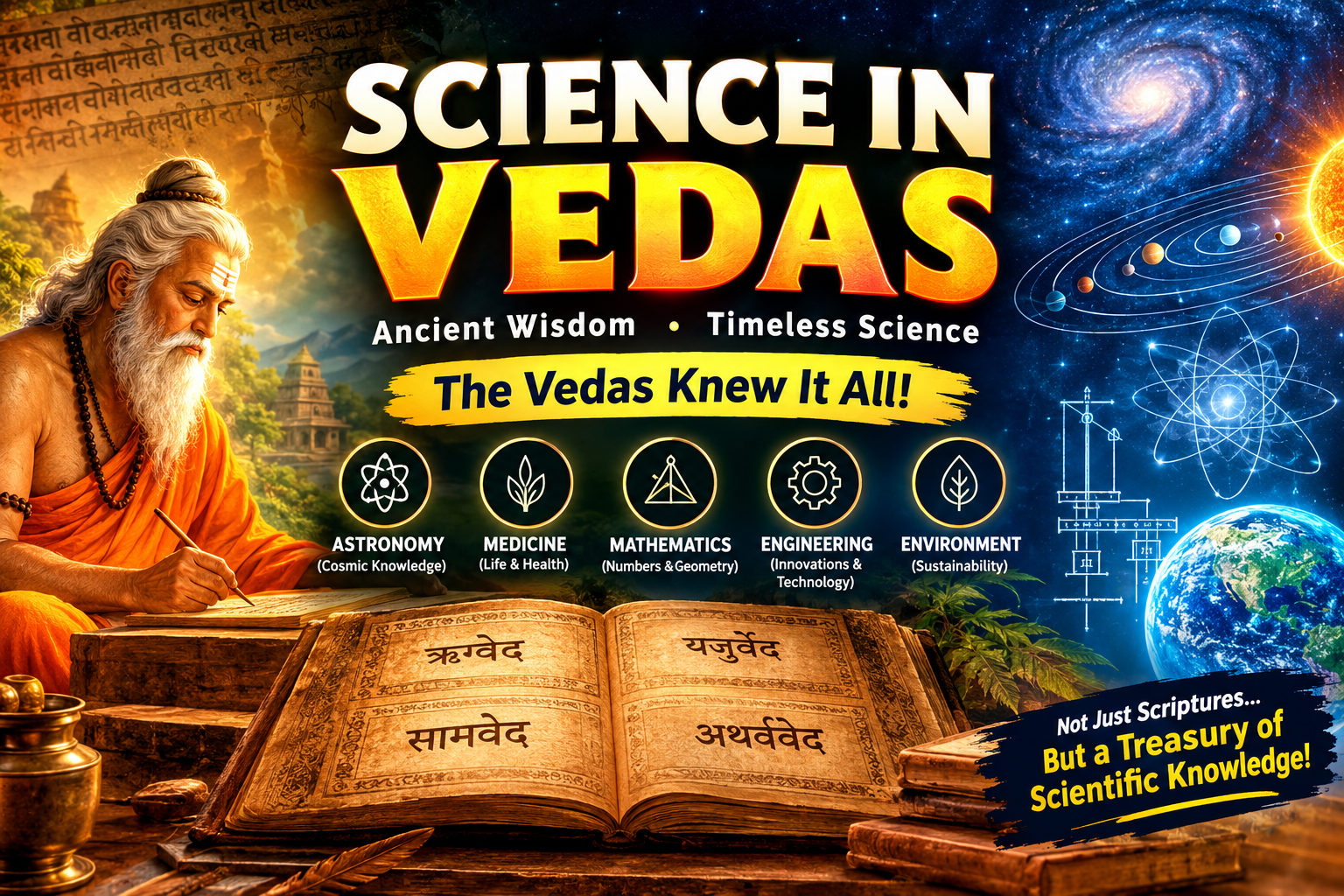
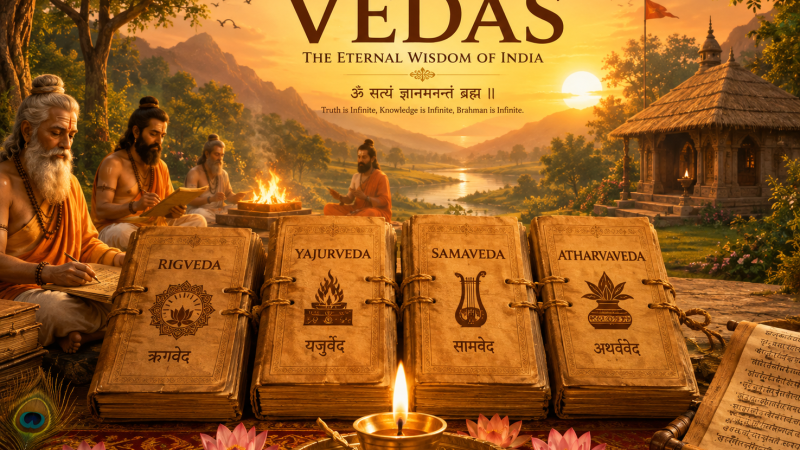
The Vedas are among the oldest surviving bodies of sacred literature in the world. They form the foundation of Hindu religious and philosophical traditions and preserve hymns, prayers, rituals, reflections on existence, and observations of the natural world. The four Vedas are the Rigveda, Yajurveda, Samaveda, and Atharvaveda.
One fascinating aspect of Vedic literature is its relationship with science. The hymns describe the Sun, dawn, fire, rain, rivers, medicinal plants, the Earth, the heavens, and the mysterious origin of the universe. They reveal how ancient Indian thinkers observed their surroundings and attempted to understand the forces that sustained life.
Some passages invite philosophical questions that remain relevant to modern readers. Others preserve practical knowledge associated with agriculture, healing traditions, timekeeping, and the use of natural resources.
However, an important distinction must be made. The Vedas are sacred and poetic texts, not modern scientific textbooks. Their references to nature and the cosmos can demonstrate early observation, intellectual curiosity, and philosophical imagination, but they do not automatically establish that modern physics, chemistry, astronomy, or biology were fully developed in Vedic times.
The history of Indian science includes several periods and many different works. Mathematics, astronomy, medicine, metallurgy, and engineering developed through contributions made over centuries. Vedic hymns are part of this broader intellectual history, alongside later texts such as the Vedangas, the Shulba Sutras, the Ayurveda Samhitas, and classical astronomical treatises.
Understanding these distinctions allows us to appreciate the Vedas without exaggerating their scientific claims. It also helps us recognize the remarkable curiosity with which ancient Indian sages approached the mysteries of existence.
1. The Four Vedas and Their Relationship with Science
Study of Vedas | Bhishma IKS유네스코 국제기록유산센터 > 유네스코 세계기록유산 > 국제목록Vedic Literature: Four Vedas, Upanishads, Shruti and Smriti | UPSC Notes7
Each Veda has a distinctive character. Together, they preserve a wide range of religious, poetic, cultural, and philosophical material.
Rigveda: Nature, the Cosmos, and Observation
The Rigveda is particularly important for exploring early Vedic ideas about nature and the universe. Its hymns praise Agni, Indra, Surya, Ushas, Varuna, the Ashvins, and other divine figures associated with natural and cosmic powers.
The hymns contain observations about sunrise, seasonal change, rain, rivers, fire, and the regular appearance of celestial objects. They also explore questions about creation, order, and the relationship between human beings and the universe.
Yajurveda: Ritual Practice, Measurement, and Order
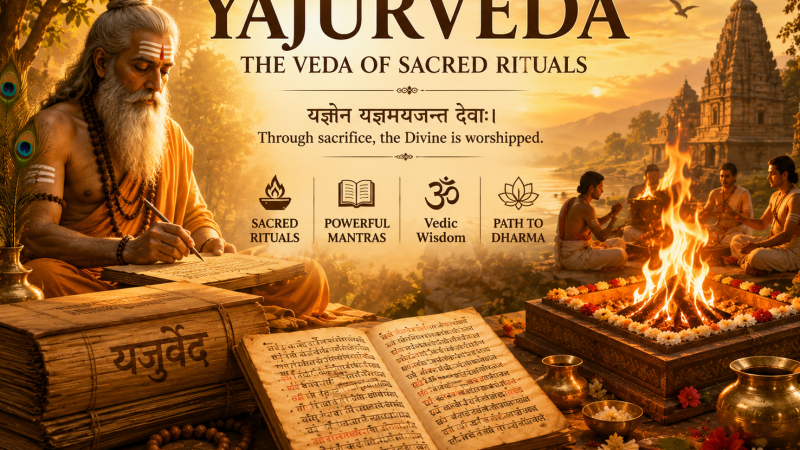
The Yajurveda contains formulas and instructions associated with sacrificial rituals. These practices required careful attention to sequence, measurement, orientation, and timing.
Ritual construction and the arrangement of sacrificial spaces contributed to practical traditions involving geometry and measurement. More systematic geometric rules are preserved in the Shulba Sutras, which belong to the broader Vedic ritual literature rather than the four Vedic Samhitas themselves.
Samaveda: Chanting, Sound, and Musical Tradition
The Samaveda is closely connected with chanting and musical performance. Many of its verses are drawn from the Rigveda and arranged for ritual singing.
Its significance for the history of sound lies mainly in the disciplined transmission of recitation, pitch patterns, rhythm, and musical practice. These traditions are interesting from the perspectives of acoustics and musicology, although the Samaveda is not a modern textbook of sound physics.
Atharvaveda: Health, Plants, and Everyday Life
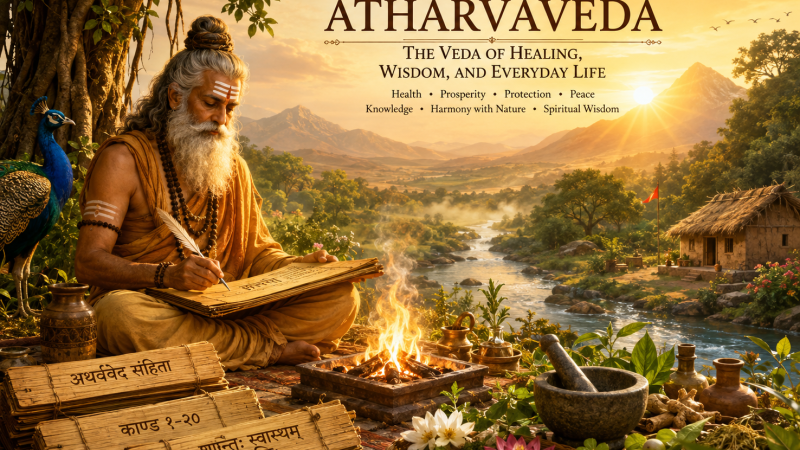
The Atharvaveda contains hymns concerned with healing, protection, plants, health, social well-being, and philosophical questions.
Its references to medicinal herbs and remedies make it particularly important when studying the historical development of Indian medicine. Some passages combine practical knowledge of plants with prayers and ritual practices. They should therefore be understood within their original cultural context rather than treated as equivalent to modern clinical medicine. Vedic Heritage Portal+2
2. Nasadiya Sukta: The Mystery of the Universe
One of the most fascinating hymns for readers interested in cosmology is the Nasadiya Sukta, found in Rigveda 10.129.
The hymn asks profound questions about the beginning of existence. What existed before the universe came into being? Was there something, or was there nothing in the way we understand those terms? How did creation begin? Can anyone know the ultimate answer?
Rather than presenting a simple account of creation, the hymn develops its ideas through uncertainty and questioning.
What Does Nasadiya Sukta Teach?
The hymn begins by exploring a state in which ordinary distinctions between existence and non-existence, death and immortality, and day and night do not yet apply in their familiar forms.
It then asks how the universe emerged and whether its origin can be known with certainty.
One of its most remarkable features is the final question: even the highest observer may or may not know how creation occurred.
This willingness to ask an unanswered question makes the hymn especially interesting to modern readers.
Connection with Modern Cosmology
Modern cosmology investigates the evolution of the observable universe using mathematical models, astronomical observations, and physical theories. The Big Bang model, for example, describes the universe’s evolution from an early hot, dense state approximately 13.8 billion years ago.
The Nasadiya Sukta does not provide this model, calculate the age of the universe, or describe modern cosmological evidence. Its importance lies instead in its philosophical investigation of origins and the limits of knowledge.
Both ancient philosophical inquiry and modern science demonstrate the importance of asking questions. However, they use different methods to pursue answers.
Modern cosmology tests hypotheses against observations and mathematical predictions, while the Nasadiya Sukta expresses its questions through sacred poetry and philosophical reflection.
Important hymn: Rigveda 10.129 — Nasadiya Sukta.
This hymn is a valuable example of the intellectual depth of Vedic literature and its enduring invitation to contemplate the origin of existence. Sanskrit Documents+1
3. Hiranyagarbha Sukta: The Golden Embryo of Creation
Another important hymn is the Hiranyagarbha Sukta, found in Rigveda 10.121.
The Sanskrit term Hiranyagarbha is commonly translated as “Golden Embryo” or “Golden Womb.” In the hymn, Hiranyagarbha represents a primordial creative principle associated with the emergence and ordering of the universe.
The hymn asks who sustains the world and identifies a supreme creative power in relation to the heavens, Earth, and living beings.
Its Philosophical Significance
The Hiranyagarbha Sukta reflects an effort to understand the universe as an ordered whole rather than a random collection of unrelated things.
The hymn connects the origin and maintenance of existence with a fundamental creative principle. It expresses the intuition that the diversity of the world may have an underlying source.
Is Hiranyagarbha the Big Bang?
Some modern interpretations compare the golden embryo with the beginning of the universe. Such comparisons can be meaningful as philosophical analogies, but they should not be confused with scientific equivalence.
The Big Bang is a physical cosmological model supported by evidence such as the expansion of the universe and cosmic microwave background radiation. Hiranyagarbha belongs to a sacred and philosophical framework.
The hymn does not provide the equations, measurements, or observational predictions used in modern cosmology.
Nevertheless, its central question—how the universe originated and what sustains its order—remains intellectually significant.
Important hymn: Rigveda 10.121 — Hiranyagarbha Sukta.
4. Surya Sukta: The Sun as a Source of Life and Light
Aditya Hridayam: The Heart of the Sun — Complete Text, Meaning & Benefits for NRIs — NRI Globenriglobe.com
The Sun occupies an important place in Vedic literature. Numerous hymns celebrate Surya as a source of light, a marker of time, and a power that sustains the natural world.
Rigveda 1.50 is one of the best-known hymns addressed to Surya. It celebrates the Sun’s appearance and its illuminating influence.
Other solar hymns occur throughout the Rigveda, reflecting the importance of the Sun in everyday life and religious thought.
The Sun and Human Life
The Sun provides the light and energy necessary for life on Earth. Its radiation supports photosynthesis, influences weather patterns, and helps regulate biological rhythms.
For ancient agricultural communities, the regular appearance of the Sun was essential for determining the time of day, organizing work, and observing seasonal changes.
The Vedic hymns reveal an appreciation of these life-supporting qualities, expressed through devotional poetry.
The Sun and Timekeeping
Observing the Sun’s apparent movement across the sky helped ancient communities distinguish morning from evening and recognize changes throughout the year.
The development of calendars and astronomical timekeeping in India involved additional traditions, including the Vedanga Jyotisha and later astronomical works.
It would be inaccurate to assume that every Vedic hymn describing the Sun contains a complete scientific explanation of solar motion. The hymns primarily express reverence, observation, and symbolic understanding.
Important hymn: Rigveda 1.50 — Surya Sukta.
The hymn remains a meaningful example of how natural observation and religious devotion can coexist within an ancient literary tradition.
5. Ushas Sukta: The Science of Dawn and Daily Cycles
Ushas, the Vedic goddess of dawn, is celebrated in many hymns of the Rigveda. Among these are Rigveda 1.48 and 1.113.
The dawn is presented as a recurring natural event that brings light, awakens living beings, and opens a new period of activity.
These hymns are notable for their vivid descriptions of changing light, the disappearance of darkness, and the regular return of morning.
What Can We Learn from the Dawn?
Modern science explains sunrise through Earth’s rotation. As a particular location on Earth turns toward the Sun, daylight begins to appear.
Ancient observers did not need modern astronomical instruments to recognize the regularity of dawn. Repeated observation of the sky was sufficient to establish daily patterns and their importance to human activity.
The Ushas hymns also reveal how natural cycles shaped early understandings of time, renewal, work, and life.
Beyond Astronomy
The dawn is also a powerful symbol of hope, awakening, and the renewal of existence.
In this way, Vedic poetry combines observations of the natural world with spiritual and emotional meaning.
Important hymns: Rigveda 1.48 and 1.113 — Ushas hymns.
These passages are useful for understanding the place of natural cycles in Vedic thought, even though they are not formal astronomical treatises.
6. Maruts and Indra: Rain, Storms, and Atmospheric Phenomena
Rain was essential to agriculture, livestock, and human survival in ancient India. Vedic literature therefore gives considerable attention to clouds, storms, thunder, and rainfall.
Indra is frequently praised as a powerful deity associated with storms, victory, and the release of life-giving waters. The Maruts are portrayed as dynamic powers associated with wind, storm, and atmospheric activity.
These hymns express the importance of rainfall in a society whose prosperity depended heavily on the natural environment.
Vedic Descriptions of Rain
Several hymns celebrate the arrival of rain, the movement of clouds, and the release of waters. The famous Indra–Vritra narratives portray the release of waters through mythic imagery.
Such descriptions reflect the central importance of water availability in ancient communities.
The Modern Scientific Explanation
Modern meteorology explains rainfall through atmospheric processes involving evaporation, condensation, cloud formation, and precipitation. Thunderstorms also involve complex electrical and atmospheric processes.
The Vedic hymns do not present these mechanisms in the systematic form used by contemporary meteorology. Instead, they offer religious and poetic interpretations of natural forces.
Still, their attention to rainfall and seasonal patterns shows how closely early communities observed and depended on their environment.
Relevant hymns: Rigveda 1.32, which describes Indra’s victory over Vritra, and numerous hymns addressed to the Maruts.
The historical value of these hymns lies partly in the evidence they provide about how ancient people understood the relationship between the atmosphere, water, and agricultural life.
7. Prithvi Sukta: The Earth and Environmental Awareness
The Prithvi Sukta, also known as the Bhumi Sukta(Kshetrapati Suktam), is found in Atharvaveda 12.1. It is one of the most important Vedic hymns for readers interested in the relationship between humanity and the natural world.
The hymn praises the Earth as the foundation of life and recognizes its many forms of richness, including soil, plants, mountains, and other natural features.
It expresses gratitude for the land that supports human communities and recognizes the dependence of living beings on the Earth.
The Earth as a Living Foundation
The hymn describes the Earth as a source of nourishment and stability. Human beings depend on its resources, and the land provides the conditions necessary for agriculture, habitation, and social life.
This outlook encourages readers to reflect on the relationship between human prosperity and the health of the natural environment.
Connection with Environmental Science
Modern environmental science examines soil fertility, biodiversity, water resources, pollution, climate, and the effects of human activity on ecosystems.
The Bhumi Sukta does not provide a modern ecological model, but its reverence for the Earth offers a meaningful ethical perspective for contemporary environmental discussions.
Its themes can encourage people to appreciate soil, protect natural resources, and recognize the dependence of human life on the environment.
A Message for the Modern World
Today, environmental challenges include deforestation, soil degradation, plastic pollution, water scarcity, and climate change.
The Bhumi Sukta can be read as an invitation to cultivate gratitude and responsibility toward the Earth.
It should not be described as a complete scientific theory of ecology. Rather, it is an important sacred text whose values can support thoughtful environmental awareness.
Important hymn: Atharvaveda 12.1 — Bhumi Sukta or Prithvi Sukta. Vedic Heritage Portal+1
8. Apah Sukta: Water, Purification, and Human Well-Being
Water is another recurring theme throughout Vedic literature. Rivers, rain, and waters are praised as sources of nourishment, purification, and life.
The Rigveda contains hymns addressed to Apah, the waters. Rigveda 10.9 is an important example.
These hymns reflect the practical and symbolic importance of water in ancient Indian society.
Water and the Natural World
Water supports plants, animals, agriculture, and human settlements. Rivers also served as important routes of transportation and centres of community life.
The Vedic hymns reveal an awareness of water’s value and its relationship to human well-being.
The Scientific Importance of Water
Modern science explains the properties of water, its role in cellular processes, and its movement through the hydrological cycle. Evaporation, condensation, precipitation, infiltration, and runoff continuously move water through the atmosphere, land, and oceans.
Clean water is also essential for sanitation and public health.
Although the Vedic hymns do not offer modern hydrology or microbiology, their respect for water provides a meaningful connection to present-day discussions about water conservation and responsible use.
Purification and Public Health
In Vedic traditions, water is often associated with purification. This has religious and cultural meanings, and it should not automatically be equated with modern water treatment or disinfection.
Today, safe drinking water requires appropriate treatment, protection from contamination, and, where necessary, testing for harmful microorganisms and chemicals.
A respectful reading of the Apah hymns can therefore inspire appreciation for water while recognizing the importance of scientific methods in ensuring its safety.
Important hymn: Rigveda 10.9 — Apah hymns.
9. Atharvaveda and the Early History of Medicine
The Atharvaveda is especially important for studying the early history of Indian healing traditions. Its hymns refer to diseases, medicinal plants, protection, recovery, and the desire for long life.
Healing practices in this period combined several elements, including plant-based remedies, prayers, ritual actions, and beliefs about the causes of illness.
Medicinal Plants in Vedic Literature
Ancient communities depended heavily on plants for food and practical remedies. The Atharvaveda preserves references to herbs and their associations with healing.
These passages are valuable for understanding the cultural history of medicinal plant use in ancient India.
However, a plant’s mention in a sacred text does not by itself establish its medical effectiveness. Scientific evaluation requires identifying the plant correctly, determining its chemical properties, studying appropriate doses, and testing its safety and efficacy.
From Vedic Healing to Ayurveda
Ayurveda developed into a broader medical tradition with systematic discussions of health, disease, diagnosis, diet, and treatment. Its classical literature includes the Charaka Samhita and Sushruta Samhita.
The Atharvaveda is historically associated with the early development of Indian medicine, but it is not a complete version of classical Ayurveda.
The development of Indian medical knowledge took place over an extended period, through the contributions of many practitioners and scholars. MSRVVP+2
Can Vedic Remedies Be Used Today?
Traditional plant knowledge may provide valuable leads for pharmacological research. Some modern medicines have originated from natural compounds, while many traditional remedies have not been demonstrated to work as claimed.
Safety matters because medicinal plants can cause side effects, interact with medicines, or contain harmful substances.
Vedic references should therefore be studied historically and scientifically rather than treated as substitutes for evidence-based medical care.
10. Important Vedic Hymns Related to Healing and Plants
Several parts of Vedic literature are relevant to the history of medicine and plant knowledge.
A. Oshadhi Sukta — Rigveda 10.97
The Oshadhi Sukta praises medicinal herbs and recognizes their healing significance. It is one of the most relevant hymns for exploring traditional relationships between plants and human health.
The hymn presents plants as valuable resources associated with recovery and well-being.
From a historical perspective, it illustrates the importance of plant knowledge among ancient communities.
B. Bheshajani and Healing Hymns of the Atharvaveda
The Atharvaveda contains numerous hymns related to healing and protection from disease. Such passages are often discussed within the broader category of bheshaja, a term associated with remedies or medicine.
They reflect the early history of Indian ideas about illness, recovery, and the use of natural substances.
C. Herbs and the Development of Pharmacology
Modern pharmacology investigates the chemical constituents of plants and how they interact with the human body.
Studying plants mentioned in ancient literature can help historians understand traditional knowledge and may suggest questions for further research. However, each claimed medicinal effect must be evaluated independently.
Important references: Rigveda 10.97 and the healing-related hymns of the Atharvaveda.
11. Vedic Astronomy: Stars, the Sun, and Timekeeping
Contributions of Ancient Indian Science and Mathematicsstories.gaathastory.com
Astronomy has a long history in India. Early observations of celestial objects were important for ritual calendars, seasonal activities, navigation of time, and understanding the regular patterns of the sky.
Vedic literature mentions the Sun, stars, dawn, and other celestial phenomena. These references belong to the early history of Indian astronomical thought.
Nakshatras and the Lunar Calendar
The concept of nakshatras, or lunar mansions, became important in Indian astronomy and calendrical traditions. Nakshatras divide the path of the Moon into recognizable sections used in traditional timekeeping.
The detailed development of these systems spans several historical periods. Later astronomical and calendrical literature provides more systematic rules for calculating celestial positions and dates.
Vedanga Jyotisha
The Vedanga Jyotisha is an important early Indian work concerned with determining appropriate times for Vedic rituals through observations and calculations related to the Sun and Moon.
It belongs to the auxiliary literature associated with Vedic learning rather than being one of the four Vedic Samhitas.
Its historical importance lies in the development of calendrical calculation and the mathematical treatment of time.
From Observation to Mathematical Astronomy
Over time, Indian astronomy developed increasingly sophisticated computational methods. Later scholars, including Aryabhata, Brahmagupta, and Bhaskara II, made major contributions to mathematical astronomy.
These achievements should be placed in their correct historical periods instead of attributing every later discovery directly to the earliest Vedic hymns.
The Vedas preserve early references to celestial phenomena, while later texts show the development of more systematic astronomical science. Sanskrit+1
Important references: Rigveda 1.50, the Ushas hymns, and the later Vedanga Jyotisha.
12. Vedic Mathematics: What the Texts Actually Show
The phrase “Vedic Mathematics” is used in more than one sense. It can refer broadly to mathematics in the ancient Indian intellectual tradition, or specifically to a modern system of calculation popularized under that name.
To understand the history accurately, these meanings should be distinguished.
Mathematics in Vedic Ritual Traditions
Ritual construction required the measurement and arrangement of spaces, including the construction of altars of prescribed shapes and dimensions.
The Shulba Sutras preserve geometric rules used in this context. They belong to the broader Vedic ritual literature and provide evidence of practical mathematical knowledge in ancient India.
These texts discuss the construction of geometric figures and transformations of shapes, including relationships between the sides of right-angled figures.
The Shulba Sutras and Geometry
The Shulba Sutras contain rules for constructing squares, rectangles, and other figures needed for ritual purposes. Some formulations express geometric relationships comparable to the Pythagorean theorem.
Their importance is historical: they demonstrate that practical geometry developed in ancient India in connection with specific cultural and ritual needs.
Is Modern Vedic Mathematics Directly Found in the Four Vedas?
The modern calculation system widely known as Vedic Mathematics was popularized by Bharati Krishna Tirthaji in the twentieth century. It uses a collection of concise calculation techniques associated with Sanskrit sutras.
Its techniques can be useful as mental arithmetic shortcuts, but historians do not generally treat the entire modern system as a direct mathematical exposition contained in the four Vedic Samhitas.
Similarly, the Shulba Sutras are more appropriate sources for studying early Indian geometry than claims that all modern mathematical formulas were already explicitly stated in the Vedas.
Important related texts: The Shulba Sutras and the later Indian mathematical tradition.
13. Agni Sukta: Fire, Energy, and Transformation
The very first hymn of the Rigveda is dedicated to Agni. Rigveda 1.1 presents Agni as a central figure in Vedic worship and ritual.
Fire held enormous practical importance in ancient life. It provided warmth, light, cooking, and a means of transforming materials. It also played a central role in Vedic sacrificial ceremonies.
The Importance of Fire in Human Civilization
The controlled use of fire transformed human societies long before the composition of the Vedas. Cooking made many foods easier to digest, while heat enabled various crafts and manufacturing processes.
In Vedic literature, Agni carries religious, symbolic, and ritual meanings. Fire is not simply described as a physical process; it is also associated with communication between worshippers and the divine.
Connection with Modern Energy Science
Modern physics describes energy in terms of measurable quantities and processes. Combustion involves chemical reactions in which energy is released as heat and often light.
Agni hymns do not formulate the modern laws of thermodynamics or the chemistry of combustion. Their importance lies in the central place of fire in Vedic ritual, culture, and thought.
The hymns nevertheless provide an opportunity to reflect on how a natural phenomenon can be understood in different ways: as a physical process, as a practical resource, and as a symbol of sacred transformation.
Important hymn: Rigveda 1.1 — Agni Sukta.
14. Rta: Cosmic Order and the Regularity of Nature
The concept of Rta is one of the important ideas in Vedic thought. It is associated with order, truth, and the proper arrangement of the cosmos.
In Vedic hymns, Rta relates to the regularities that sustain the world, including the movement of celestial objects, the cycles of nature, and the moral order of existence.
Rta and Natural Regularities
The Sun appears to move across the sky in a predictable daily pattern. Seasons recur, and living communities depend on the regular availability of water and food.
These patterns were vital to ancient people. Their observation helped communities organize agricultural work, religious ceremonies, and social activities.
The Vedic concept of Rta expresses a vision of a world governed by an intelligible order rather than complete disorder.
Is Rta the Same as a Scientific Law?
Not exactly. Scientific laws are developed through observation, experimentation, mathematical reasoning, and testing. They describe relationships that can be investigated and used to make predictions.
Rta is a broader religious and philosophical concept that combines cosmic, ethical, and social dimensions.
The comparison is useful when discussing humanity’s search for order in nature, but it would be inaccurate to identify Rta directly with a particular law of physics.
Relevant hymns: Several hymns to Varuna and other Vedic deities discuss Rta and the maintenance of cosmic order.
15. Vedic Knowledge of Agriculture and Food
Agriculture was fundamental to the survival of ancient societies. Vedic literature reflects the importance of cattle, grain, rain, fertile land, and the prosperity of communities.
The hymns express prayers for food, successful harvests, healthy livestock, and favourable natural conditions.
The Relationship Between Nature and Agriculture
Successful farming depends on soil quality, water availability, seasonal patterns, seed selection, and the health of plants and animals.
Ancient farmers accumulated practical knowledge through experience. They learned when to sow, how to manage livestock, and how environmental conditions influenced the harvest.
Vedic references to these concerns help historians understand the material and cultural world in which the hymns were transmitted.
Traditional Knowledge and Modern Agricultural Science
Modern agriculture uses soil analysis, plant genetics, meteorological forecasting, irrigation engineering, and scientific methods of pest management.
The Vedic hymns are not agricultural manuals comparable to modern scientific publications. However, their references to farming and food provide historical evidence of the importance of environmental knowledge to ancient communities.
They also remind modern readers that human prosperity remains connected to healthy soil, reliable water, and sustainable food production.
16. Sound and Chanting: The Samaveda and Acoustics
The Samaveda provides a valuable starting point for examining the historical relationship between sacred chanting and sound.
Vedic recitation traditions developed careful methods for preserving pronunciation, pitch, accent, and the sequence of words. These practices helped maintain the integrity of sacred texts across generations.
The Importance of Accurate Recitation
Oral transmission demands careful listening and repetition. Different recitational techniques helped preserve the sound patterns of the Vedas and reduce errors in transmission.
These traditions are important subjects for linguistics, musicology, oral history, and the study of performance.
The Scientific Study of Sound
Modern acoustics investigates sound waves, frequency, amplitude, resonance, and the ways sound travels through different materials.
Vedic chanting can also be studied scientifically by examining pitch patterns, vocal production, rhythm, and acoustic properties.
However, traditional claims about the spiritual or medical effects of particular chants should be distinguished from experimentally established effects. Chanting may support relaxation or focused attention for some people, but specific health claims require appropriate scientific evidence.
The Samaveda’s strongest historical connection with science is its sophisticated tradition of musical recitation and oral preservation.
17. Panchamahabhuta: The Five Great Elements
An influential concept in Indian philosophical traditions is Panchamahabhuta, commonly translated as the five great elements: earth, water, fire, air, and space.
These elements provide a traditional framework for understanding the composition and qualities of the world.
Their importance extends beyond Vedic hymns into later Indian philosophical and medical systems, where the elements receive different interpretations.
How Should We Compare the Five Elements with Modern Science?
The five elements are not equivalent to the chemical elements in the periodic table.
Modern chemistry recognizes more than one hundred chemical elements, each defined by its atomic number. Physics also distinguishes matter, energy, fields, and the structure of spacetime.
The traditional five-element framework is philosophical and cosmological rather than a modern classification of chemical substances.
Nevertheless, it offers a historical example of how people attempted to organize their experience of the natural world into a coherent conceptual system.
The comparison can be intellectually productive as long as the differences between ancient philosophical categories and modern scientific classifications remain clear.
18. The Ashvins and Traditional Ideas of Healing
The Ashvins are divine figures associated with healing, rescue, restoration, and the overcoming of difficulties in Vedic mythology.
Numerous Rigvedic hymns praise their assistance to those in distress and describe extraordinary acts of recovery.
These stories are significant for the history of ideas about health and healing in ancient Indian culture.
Mythology and the History of Medicine
Stories about divine healers can reveal how communities understood illness, disability, restoration, and the desire to overcome suffering.
They also provide context for the development of medical traditions in which spiritual practices and practical remedies existed together.
However, miraculous episodes in sacred poetry should not be treated as clinical case reports or direct evidence of surgical techniques.
Historical medical procedures must be studied through appropriate textual, archaeological, and material evidence.
Relevant hymns: Rigveda 1.112 and other hymns addressed to the Ashvins.
19. Vedic Science and the Scientific Method
The relationship between Vedic literature and science becomes clearer when we distinguish three different kinds of knowledge.
Observation of Nature
The Vedic hymns contain descriptions of natural events such as dawn, sunlight, rainfall, rivers, plants, and seasonal change.
These passages reveal attention to the environment and the ways in which natural processes shaped daily life.
Philosophical Inquiry
Hymns such as the Nasadiya Sukta ask questions about existence, creation, and the limits of human knowledge.
Such questions belong to the history of philosophy and are relevant to broader discussions about the nature of knowledge.
Systematic Scientific Investigation
Modern science relies on structured observation, measurable evidence, the testing of hypotheses, reproducibility where applicable, and the revision of explanations when evidence changes.
A poetic description of the Sun does not establish a complete theory of astronomy. A reference to a medicinal herb does not establish its effectiveness against a disease. A philosophical question about creation does not constitute a mathematical model of the universe.
Recognizing these differences does not diminish the importance of the Vedas. Instead, it enables a more accurate understanding of their historical, spiritual, and intellectual contributions.
20. Important Vedic Hymns Related to Science: A Quick Reference
The following table highlights useful hymns and related texts for further study.
| Hymn or text | Reference | Main theme |
|---|---|---|
| Nasadiya Sukta | Rigveda 10.129 | Creation, existence, and uncertainty |
| Hiranyagarbha Sukta | Rigveda 10.121 | The origin and order of the universe |
| Surya Sukta | Rigveda 1.50 | The Sun, light, and daily life |
| Ushas hymns | Rigveda 1.48, 1.113 | Dawn and recurring natural cycles |
| Agni Sukta | Rigveda 1.1 | Fire, ritual, and transformation |
| Indra and Vritra | Rigveda 1.32 | Mythic imagery of storms and the release of waters |
| Oshadhi Sukta | Rigveda 10.97 | Medicinal herbs and healing |
| Apah hymns | Rigveda 10.9 | Waters, purification, and well-being |
| Bhumi Sukta | Atharvaveda 12.1 | Earth, nourishment, and the natural world |
| Healing hymns | Atharvaveda, various references | Remedies, plants, illness, and recovery |
| Vedanga Jyotisha | Vedic auxiliary literature | Calendrical calculation and ritual timekeeping |
| Shulba Sutras | Vedic ritual literature | Geometry and altar construction |
These references are starting points for further research. Translation, interpretation, and the arrangement of particular hymns can vary between editions and textual traditions.
21. Why the Scientific Study of Vedic Literature Matters Today
Studying the Vedas alongside the history of science offers several benefits.
First, it helps us understand how ancient people interpreted their environment. Their observations of celestial bodies, rainfall, plants, and the changing seasons were closely connected with survival, agriculture, ritual, and social life.
Second, it highlights the relationship between poetry, philosophy, religion, and intellectual inquiry. Ancient thinkers often approached the world through several forms of understanding rather than separating every question into modern academic disciplines.
Third, it encourages the preservation and critical study of historical knowledge. Sanskrit texts can provide important evidence about early ideas, practices, and cultural values. Scholars can compare their contents with archaeology, historical linguistics, botanical research, and the history of mathematics and medicine.
Finally, the study of Vedic literature can encourage curiosity. The Nasadiya Sukta invites reflection on what can be known. The Bhumi Sukta encourages appreciation of the Earth. The hymns to the Sun and waters highlight the importance of natural processes to human life.
These themes remain relevant even when modern scientific explanations differ from ancient interpretations.
Conclusion: The Vedas as a Source of Ancient Wisdom and Inquiry
Science in the Vedas is a fascinating subject because it brings together ancient Indian literature, observations of nature, philosophical questions, and the broader history of knowledge.
The Rigveda contains remarkable hymns about the origin of the universe, the Sun, dawn, fire, rain, medicinal herbs, and the order of existence. The Atharvaveda provides valuable material for studying early healing traditions, plants, and humanity’s relationship with the Earth. The Yajurveda and Samaveda preserve important ritual and recitational traditions that can be examined from historical, mathematical, and musical perspectives.
The Nasadiya Sukta remains particularly memorable for its questions about creation and uncertainty. The Hiranyagarbha Sukta explores the idea of a primordial creative principle. The Surya and Ushas hymns celebrate the light and regularity of the natural world, while the Bhumi Sukta expresses reverence for the Earth that sustains life.
At the same time, it is important to distinguish ancient religious and philosophical ideas from modern scientific discoveries. The Vedas do not contain every modern scientific theory in a hidden or fully developed form. Indian science advanced through many centuries of observation, calculation, experimentation, debate, and scholarship.
A balanced understanding therefore requires both respect for tradition and commitment to historical accuracy.
For readers of Hinduism, the Vedas offer spiritual insight, cultural heritage, and enduring questions about existence. For historians and students of science, they provide evidence of how ancient Indian communities thought about the natural world.
Their lasting value lies not in proving that every modern discovery was already known, but in preserving a rich tradition of wonder, reflection, and the human desire to understand the universe.
References for Further Reading
For a reliable article, these sources are useful for checking the hymns, translations, and historical context.
- Vedic Heritage Portal — Samhitas: Explore the Vedic texts.
- Vedic Heritage Portal — Atharvaveda: Read about the Atharvaveda.
- Nasadiya Sukta — Rigveda 10.129: Read the hymn and its English translation.
- Department of Sanskrit, Central Sanskrit University: Learn about Sanskrit and the sciences.
- Indian Journal of History of Science: Research on medicinal plants in the Atharvaveda.
These sources provide a starting point for further research into Vedic literature, astronomy, mathematics, and traditional medicine. Vedic Heritage Portal+3
*Related Article: Vedas: The Eternal Wisdom of Ancient India