Valmiki Jayanti: Celebrating the Life of Sage Valmiki
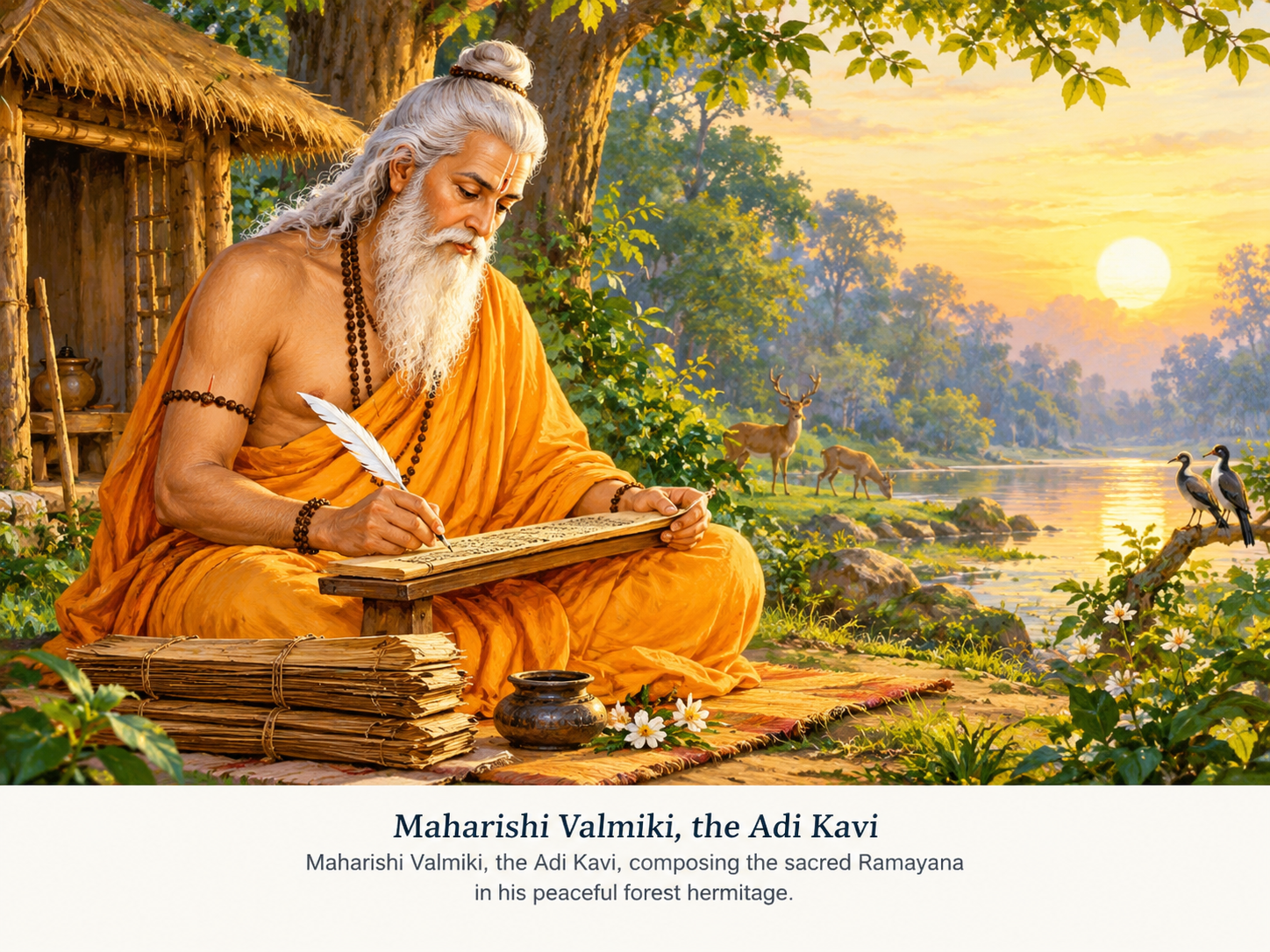
Valmiki Jayanti is an important Hindu observance dedicated to Maharishi Valmiki, the revered sage traditionally regarded as the author of the Ramayana, one of the greatest literary and spiritual works of ancient India. Known as the Adi Kavi, meaning the first poet, Valmiki occupies a special place in Hindu religious tradition, Sanskrit literature, and the cultural history of the Indian subcontinent.
The Valmiki Ramayana tells the inspiring story of Lord Rama, his devotion to dharma, his relationship with Sita, his loyalty to his family, and his struggle against the forces of injustice represented by Ravana. Beyond narrating the life of a divine hero, the epic explores universal questions about truth, duty, sacrifice, compassion, leadership, and the responsibilities of human life.
Valmiki Jayanti celebrates not only the birth of a great sage but also the enduring power of knowledge, spiritual transformation, and poetic expression. His traditional life story teaches that a person’s past does not have to determine their future. Through sincere effort, self-reflection, and devotion, an individual can follow a path toward wisdom and a meaningful life.
Observed with prayers, devotional gatherings, religious processions, and readings from the Ramayana, this occasion inspires millions of devotees to remember the sage’s contribution. It also provides an opportunity to reflect on the importance of education, moral character, social dignity, and respect for all human beings.
When Is Valmiki Jayanti Celebrated?
Valmiki Jayanti is generally observed on the full moon day, known as Purnima, of the Hindu lunar month of Ashwin. In many regional calendars, the occasion is associated with the Sharad Purnima period.
The precise Gregorian date changes every year because Hindu observances follow the lunar calendar. The date may also vary slightly across regions because of differences in local calendars and religious conventions.
In 2026, devotees should consult a reliable regional Hindu Panchang for the locally observed date and the relevant Purnima tithi. The lunar tithi may begin or end at different times, and local observance can depend on the calendar tradition followed.
Valmiki Jayanti is celebrated particularly widely in northern and central India, although Maharishi Valmiki is revered throughout India and by Hindu communities elsewhere in the world. In several places, the day is marked by special worship at temples dedicated to the sage.
The observance is also known as Maharishi Valmiki Jayanti and Pragat Diwas, a term used in some communities to commemorate the sage’s appearance or manifestation.
For 2026, Valmiki Jayanti falls on Monday, 26 October, according to the commonly followed Indian Panchang calculations. The Purnima tithi begins on 25 October and continues into the morning of 26 October. Readers should check their local Panchang for regional observance details. Drik Panchang+1
Who Was Maharishi Valmiki?
Valmiki Jayanti 2020 Quotes: 10 inspirational and motivational quotes by Maharishi Valmiki from Ramayanatimesofindia.indiatimes.com
Maharishi Valmiki is one of the most respected sages in Hindu tradition. He is widely known as the author of the Valmiki Ramayana, the Sanskrit epic that recounts the life and adventures of Lord Rama. His literary and spiritual contributions have influenced religious thought, classical poetry, theatre, music, painting, sculpture, and storytelling for centuries.
Valmiki is traditionally honoured as the Adi Kavi, or the first poet, because the Ramayana is regarded as the Adi Kavya, or the first epic poem, in Sanskrit literary tradition. The work is admired not only for its poetic beauty but also for its exploration of moral dilemmas, human emotions, and the duties of individuals within families and society.
The exact historical period in which Valmiki lived is uncertain. Traditional accounts associate him with the time of Lord Rama, while modern historical research cannot establish a definitive date for his life. His importance, however, extends far beyond questions of chronology.
The sage is remembered as a spiritual teacher, a poet, and a guide who transformed a profound experience of grief into an enduring literary creation. His story has become a symbol of the possibilities of personal transformation and the power of wisdom to change a person’s life.
The Story of Valmiki’s Transformation
One of the most popular traditional stories associated with Valmiki describes his transformation from Ratnakara, a forest robber, into a great sage. This account is especially significant because it teaches that a person can change their life through sincere self-reflection, spiritual discipline, and a willingness to abandon wrongdoing.
Ratnakara’s Early Life
According to a widely circulated traditional account, Ratnakara lived in a forest and survived by robbing travellers. Some versions describe him as a highway robber who took money and possessions from people passing through the forest. He committed these acts to support himself and his family.
Although Ratnakara believed that his actions were justified by his family’s needs, he had not fully considered the moral consequences of his behaviour. His life changed when he encountered the wandering sage Narada.
The Encounter with Sage Narada
Narada Muni, a revered sage known for his devotion to Lord Vishnu and his travels throughout the worlds, encountered Ratnakara in the forest.
Ratnakara attempted to rob him, but Narada remained calm. Instead of responding with fear, the sage asked him an important question: would the members of his family, for whose benefit he committed wrongful acts, also accept responsibility for the consequences of those actions?
Ratnakara was confident that his family would share his burden. Narada encouraged him to return home and ask them directly.
When Ratnakara questioned his family, he discovered that although they depended on his support, they would not necessarily share the consequences of his wrongdoing. This realisation forced him to reconsider his choices.
The encounter introduced him to an important truth: every person must take responsibility for their own actions.
Meditation on the Name of Rama
Deeply affected by Narada’s words, Ratnakara returned to the sage and sought guidance. Narada advised him to devote himself to meditation and spiritual practice.
In the popular version of the story, Ratnakara found it difficult to pronounce the sacred name Rama directly. He was therefore instructed to repeat the word Mara, meaning death. Through continuous repetition, the sounds eventually formed the name Rama.
Ratnakara immersed himself in meditation for a long period. An anthill gradually grew around his motionless body. When he eventually emerged from his meditation, he had undergone a profound spiritual transformation.
The Sanskrit word valmika means an anthill. According to the traditional account, the sage received the name Valmiki because he emerged from the anthill after his long penance.
This narrative is a religious and moral tradition rather than a historically verified biography. Its enduring message is that sincere effort, repentance, and spiritual discipline can help a person move away from destructive behaviour toward a more meaningful life.
Lessons from Valmiki’s Transformation
The story of Ratnakara offers several important lessons.
First, it reminds people that harmful actions cannot be justified simply because they are performed for the benefit of family members. Personal responsibility remains essential.
Second, it teaches that no one should be judged solely by their past. A person who recognises their mistakes and genuinely works to change can develop a new direction in life.
Third, the story emphasises the importance of a wise teacher. Narada did not merely punish or condemn Ratnakara; he encouraged him to question his beliefs and discover a better path.
Finally, it demonstrates the value of patience. Spiritual growth is not necessarily immediate. It may require sustained practice, self-discipline, and determination.
These lessons make Valmiki Jayanti meaningful even for people who approach the story as a moral allegory rather than a literal account.
How Valmiki Became the Adi Kavi
The title Adi Kavi means the first poet. Maharishi Valmiki received this traditional distinction because of the extraordinary origin of the poetic metre associated with the Ramayana.
According to the opening books of the Valmiki Ramayana, the sage once visited the banks of the Tamasa River. There he saw a pair of krauncha birds enjoying each other’s company. A hunter suddenly killed one of the birds, causing the other to cry out in distress.
Witnessing this tragedy, Valmiki experienced profound sorrow and indignation. Words emerged from him in a measured poetic form, expressing condemnation of the hunter’s violent act.
This verse is traditionally regarded as the first shloka of the Ramayana’s poetic tradition. The account connects poetry with an emotional response to suffering and injustice.
The story is particularly significant because it presents poetic expression as something that can arise from compassion. Valmiki’s grief did not remain a passing emotion; it became the beginning of a literary tradition that would influence generations.
In this sense, the title Adi Kavi represents more than literary priority. It symbolises the ability of poetry to give meaningful expression to human emotions, moral questions, and spiritual insight.
The Ramayana: Valmiki’s Greatest Contribution
Who Wrote the Ramayana? Valmiki and Traditionbhaktilipi.in
The Ramayana is traditionally attributed to Maharishi Valmiki and remains one of the foundational epics of Hindu civilisation. Its influence can be seen in religious practice, literature, art, performance, philosophy, and popular culture throughout South and Southeast Asia.
The Sanskrit epic is commonly described as containing approximately 24,000 verses divided into seven kandas, or major books. Different textual traditions and editions may vary in their arrangement and details.
The seven kandas are:
- Bala Kanda: Describes Rama’s early life, his education, his encounter with the sage Vishvamitra, and his marriage to Sita.
- Ayodhya Kanda: Narrates the events surrounding Rama’s exile from Ayodhya and the grief of his family.
- Aranya Kanda: Describes Rama, Sita, and Lakshmana’s life in the forest and the abduction of Sita by Ravana.
- Kishkindha Kanda: Introduces Rama’s alliance with Sugriva and his meeting with Hanuman.
- Sundara Kanda: Celebrates Hanuman’s journey to Lanka, his discovery of Sita, and his extraordinary devotion to Rama.
- Yuddha Kanda: Recounts the war against Ravana and the events surrounding Sita’s rescue. This book is also known as Lanka Kanda in some traditions.
- Uttara Kanda: Contains later episodes associated with Rama’s reign, including the traditional account of Sita’s life in Valmiki’s hermitage and the story of her sons.
The Story of Lord Rama
At the heart of the Ramayana is the life of Lord Rama, regarded in Hinduism as an incarnation of Lord Vishnu. Rama is celebrated for his commitment to dharma, or righteous conduct, even when fulfilling his responsibilities demands personal sacrifice.
His exile demonstrates the conflict between personal happiness and duty. His relationship with Sita raises questions about love, loyalty, courage, and the treatment of women. His alliance with Hanuman and Sugriva demonstrates the importance of friendship, cooperation, and trust.
The confrontation with Ravana explores the consequences of arrogance, uncontrolled desire, and the misuse of power. Ravana is portrayed as a powerful and learned ruler whose strengths are overshadowed by destructive choices.
The epic’s significance lies partly in its refusal to present life as a series of easy decisions. Its characters face difficult circumstances, and their choices invite readers to consider what righteousness requires.
Why the Ramayana Remains Relevant
The Ramayana continues to be read because its central questions remain meaningful.
How should a person respond when duty conflicts with personal desire? What makes a leader worthy of respect? How can loyalty be balanced with moral responsibility? What are the consequences of pride and anger?
The epic provides different episodes through which readers can explore these questions. Its interpretations have also developed across regions, languages, and religious communities, producing numerous retellings and adaptations.
The Valmiki Ramayana is therefore both a sacred literary work and a major part of the wider cultural heritage of India and neighbouring countries.
Valmiki’s Connection with Lord Rama, Sita, Lava, and Kusha
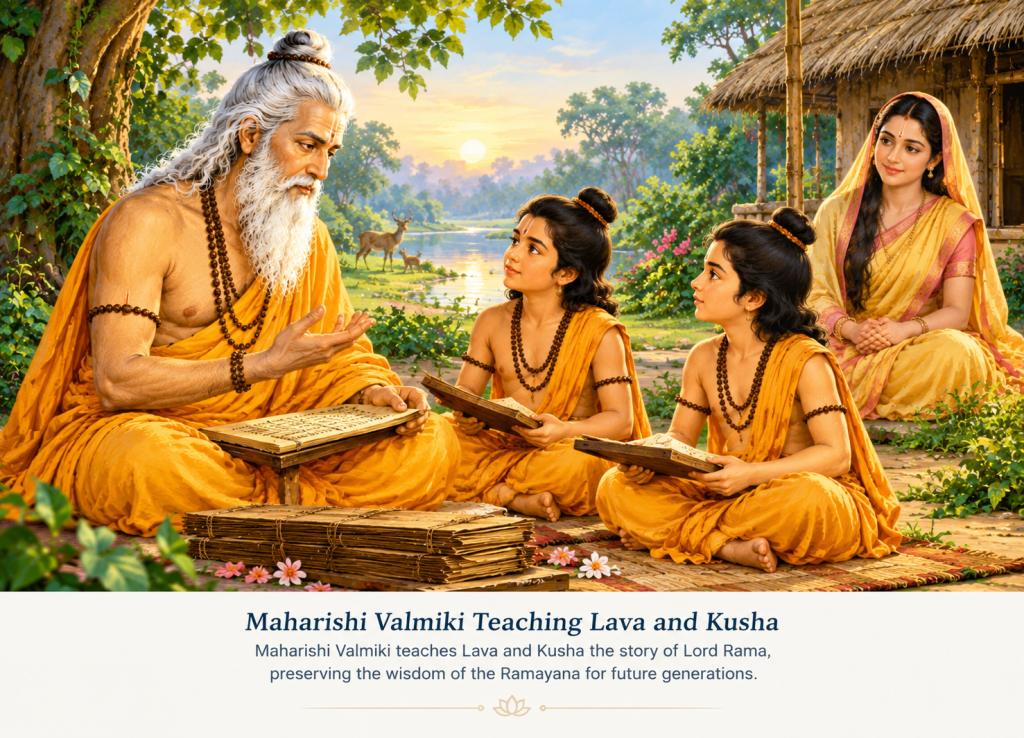
Maharishi Valmiki occupies an important position in the later episodes of the Ramayana, particularly in the traditional narrative concerning Sita and her sons.
After Sita’s separation from Rama, Valmiki’s hermitage becomes a place of refuge for her. The sage offers her shelter and protection, and she gives birth to the twins Lava and Kusha there.
The twins grow up under Valmiki’s care. According to the epic tradition, the sage educates them and teaches them the story of Rama through the verses of the Ramayana.
Lava and Kusha become skilled in reciting the epic. In a celebrated episode, they sing the story before Rama, who gradually comes to recognise its connection with his own life.
This narrative establishes Valmiki not only as a poet but also as a teacher, guardian, and transmitter of cultural knowledge.
His hermitage represents a place where learning, compassion, and disciplined living can flourish. By protecting Sita and educating her children, Valmiki demonstrates the importance of providing shelter to those in difficulty and ensuring that knowledge passes from one generation to the next.
The story also illustrates the relationship between literature and memory. Through the recitation of the Ramayana, personal experiences become part of a larger narrative that can be preserved and shared with society.
Religious and Spiritual Significance of Valmiki Jayanti
Valmiki Jayanti is more than a celebration of a literary figure. It is an occasion for devotees to reflect on the spiritual values associated with Maharishi Valmiki and the teachings preserved in the Ramayana.
1. The Power of Transformation
Valmiki’s traditional life story demonstrates that personal transformation is possible. Even someone who has made serious mistakes can choose to change their behaviour and pursue a more constructive path.
The occasion encourages people to examine their actions honestly and make sincere efforts to improve themselves.
2. The Importance of Dharma
Dharma is a central concept in Hindu philosophy, encompassing duty, righteousness, moral order, and responsible conduct.
The Ramayana presents numerous examples of individuals struggling to uphold dharma in complicated situations. Valmiki Jayanti offers an opportunity to consider how these principles can be applied to contemporary life.
3. Devotion and Spiritual Discipline
The traditional story of Valmiki’s meditation illustrates the value of perseverance, contemplation, and devotion.
Devotees may use the occasion to practise prayer, meditation, mantra recitation, or the study of sacred literature.
4. Compassion for Living Beings
The story of the krauncha birds connects the birth of poetic expression with an encounter with suffering. It reminds readers that compassion can inspire both ethical action and creative expression.
This message can encourage greater kindness toward people, animals, and the natural world.
5. Respect for Knowledge and Education
Valmiki’s role as a poet and teacher makes him an enduring symbol of learning. His association with Lava and Kusha emphasises the importance of education and the transmission of knowledge.
The day can inspire families and communities to encourage reading, support students, and preserve literary traditions.
6. Human Dignity and Social Inclusion
Valmiki Jayanti is also an important occasion for many communities that honour Maharishi Valmiki as a spiritual and cultural guide.
His traditional transformation story challenges the idea that a person’s social position or earlier life must permanently define their worth. His legacy can inspire reflection on dignity, equality, access to education, and the need to treat all people with respect.
How Is Valmiki Jayanti Celebrated?
TOPSHOT-INDIA-RELIGION-HINDUISMBank holiday today on Valmiki Jayanti: Banks to remain close in THESE states for celebrations | Today News
The way Valmiki Jayanti is celebrated varies across regions, temples, and communities. There is no single compulsory ritual observed by every devotee. Common practices include the following.
1. Worship of Maharishi Valmiki
Devotees visit temples dedicated to Maharishi Valmiki or arrange worship at home. Images or statues of the sage may be decorated with flowers, garlands, and traditional offerings.
Prayers are offered in gratitude for his spiritual and literary contribution. Some communities organise special ceremonies led by priests or religious teachers.
2. Reading and Recitation of the Ramayana
One of the most meaningful ways to observe the occasion is to read or listen to the Ramayana.
Temples and community organisations may arrange readings, storytelling sessions, or public recitations. Some programmes focus on particular episodes, such as Rama’s exile, Hanuman’s devotion, or Valmiki’s care for Sita and her sons.
Reading the epic with attention to its moral themes can help devotees connect its teachings with everyday life.
3. Shobha Yatra and Religious Processions
In several Indian towns and cities, communities organise Shobha Yatras, or devotional processions, in honour of Maharishi Valmiki.
Participants may carry decorated portraits of the sage, sing devotional songs, chant sacred names, and share messages about education, unity, and moral conduct.
The scale and form of these processions depend on local traditions and community arrangements.
4. Bhajans and Kirtans
Devotional music is an important part of many celebrations. Bhajans, kirtans, and religious discourses may be organised in temples and community halls.
Songs praising Lord Rama, Hanuman, and Maharishi Valmiki help create an atmosphere of devotion and collective participation.
5. Charity and Community Service
Some communities mark the day by distributing food, clothes, books, or other useful items to people in need. Others organise blood donation drives, educational activities, or community meals.
These practices reflect the idea that spiritual observance should encourage compassion and responsible action.
Charity is especially meaningful when it is offered respectfully, without discrimination or an expectation of public recognition.
6. Educational and Cultural Programmes
Schools, libraries, cultural organisations, and religious institutions may hold discussions about Valmiki’s life and the Ramayana.
Students can participate in essay competitions, poetry readings, storytelling, drama, and art activities. Such programmes help younger generations learn about the epic’s literary importance and moral themes.
7. Visiting Temples
Devotees may visit temples dedicated to Maharishi Valmiki or Lord Rama. Temples associated with the sage’s traditional life story can attract pilgrims and visitors, especially during the Jayanti period.
Visitors should follow local temple customs and show respect for the religious practices of the community.
How to Observe Valmiki Jayanti at Home
Devotees who cannot visit a temple can observe Valmiki Jayanti at home through simple devotional and educational activities. The purpose is to honour the sage and reflect on his teachings rather than to follow an elaborate set of ceremonies.
Here is a simple way to observe the day:
- Clean the prayer area: Prepare a clean and peaceful place for worship.
- Offer prayers: Place an image of Maharishi Valmiki, if available, and offer flowers, incense, or a lamp according to family tradition.
- Read the Ramayana: Read a passage from the Valmiki Ramayana or listen to a reliable recitation.
- Practise meditation: Spend a few minutes in silence, reflecting on truth, compassion, and self-improvement.
- Teach children about Valmiki: Share his traditional life story and explain the importance of education and moral responsibility.
- Help someone in need: Offer food, books, or other useful assistance to someone who would benefit from it.
- Conclude with prayer: Pray for wisdom, peace, and the well-being of all living beings.
These are suggestions, not compulsory rules. Families can follow their own customs and the guidance of their religious tradition.
Important Teachings Associated with Maharishi Valmiki
The legacy of Valmiki offers several lessons that remain relevant in modern society.
Never Give Up on Personal Improvement
The traditional story of Ratnakara teaches that people are capable of change. Mistakes should not be ignored, but they need not determine the rest of a person’s life.
Recognising wrongdoing, accepting responsibility, and taking meaningful steps toward improvement are important parts of personal growth.
Take Responsibility for Your Actions
Ratnakara’s encounter with Narada encourages people to think carefully about the consequences of their decisions.
Family responsibilities, financial pressures, and social expectations do not remove the need to act ethically. Each individual must consider whether their choices harm others.
Make Knowledge Accessible
Valmiki’s association with teaching and the transmission of the Ramayana highlights the value of education.
Knowledge becomes more meaningful when it is shared. Parents, teachers, writers, and community leaders all contribute to society when they help others learn and think independently.
Respect Compassion and Justice
The episode of the krauncha birds demonstrates how suffering can awaken moral awareness. Compassion is not simply an emotion; it can motivate people to oppose cruelty and protect those who are vulnerable.
Preserve Cultural Heritage
The Ramayana has survived through manuscripts, oral recitations, regional adaptations, theatre, music, and visual art. Valmiki Jayanti reminds communities that cultural heritage must be studied, preserved, and passed on to future generations.
Choose Humility over Arrogance
The Ramayana repeatedly explores the dangers of pride and the misuse of power. Its characters demonstrate that strength, intelligence, and authority become destructive when separated from ethical responsibility.
Valmiki’s legacy encourages people to use their abilities in ways that benefit others.
Maharishi Valmiki’s Influence on Indian Literature and Culture
The influence of Valmiki extends far beyond the original Sanskrit epic. The Ramayana has inspired countless works across the Indian subcontinent and Southeast Asia.
Over centuries, poets and religious teachers have retold Rama’s story in different languages and literary forms. Important examples include Tulsidas’s Ramcharitmanas in Awadhi and Kamban’s Ramavataram in Tamil. These works draw on the broader Ramayana tradition while expressing distinctive regional, literary, and devotional perspectives.
The epic has also inspired classical dance, folk theatre, puppetry, painting, sculpture, television, cinema, and modern literature.
Ram Lila performances, for example, bring episodes from Rama’s life to audiences through dramatic storytelling. Temple sculptures depict scenes from the epic, while devotional songs celebrate Rama, Sita, Hanuman, and other characters.
These adaptations demonstrate how a literary work can become part of the living culture of different communities.
The Ramayana has also travelled beyond India. Versions and adaptations of the story have influenced cultural traditions in countries such as Thailand, Cambodia, Indonesia, and Laos. The characters and episodes sometimes appear in forms that reflect the religious beliefs and artistic traditions of their respective societies.
Although these retellings differ, they demonstrate the extraordinary reach of the Ramayana tradition.
Valmiki Jayanti therefore celebrates not only a sage but also a literary legacy that has continued to inspire creativity, religious devotion, and cultural exchange across generations.
Valmiki Jayanti and the Importance of Reading the Ramayana Today
In a world shaped by rapid technological change, social pressures, and competing responsibilities, ancient literature can still provide opportunities for reflection.
The Ramayana encourages readers to think about the relationship between individual choices and their consequences. Its stories explore leadership, loyalty, friendship, family relationships, sacrifice, and the struggle to uphold moral principles.
Modern readers may not interpret every episode in the same way. Some approach the epic primarily as sacred scripture, while others study it as literature, philosophy, or cultural history. Respectful engagement with these different approaches can deepen understanding.
Parents can introduce children to age-appropriate stories from the Ramayana, explaining not only what happens but also why characters make particular decisions.
Teachers can use selected episodes to encourage discussion about responsibility, courage, compassion, and the ethical use of power.
Readers can also compare different Ramayana traditions to understand how communities have interpreted the same broad narrative in distinct ways.
In each case, Valmiki Jayanti becomes an opportunity to turn remembrance into learning.
Is Valmiki Jayanti a Public Holiday?
Valmiki Jayanti is recognised in several parts of India, and its official holiday status depends on the relevant central, state, or local calendar.
In some jurisdictions, it is an optional or restricted holiday rather than a universal public holiday. Government offices, educational institutions, banks, and private businesses may follow different rules depending on their location.
In Bangladesh and other countries outside India, Valmiki Jayanti may be observed by Hindu communities without being an official public holiday.
Anyone planning to attend a local celebration or visit a temple should consult local announcements for the applicable date, programme, and opening arrangements.
Frequently Asked Questions About Valmiki Jayanti
1. What is Valmiki Jayanti?
Valmiki Jayanti is the annual observance honouring Maharishi Valmiki, the revered sage traditionally credited with composing the Sanskrit Ramayana. It celebrates his spiritual legacy and contribution to Indian literature.
2. When is Valmiki Jayanti in 2026?
Valmiki Jayanti falls on Monday, 26 October 2026, according to commonly followed Indian Panchang calculations. Local calendars may differ slightly, so devotees should consult a regional Panchang. Drik Panchang+1
3. Why is Maharishi Valmiki called Adi Kavi?
Adi Kavi means the first poet. Valmiki is traditionally given this title because of his association with the origin of Sanskrit epic poetry and the composition of the Ramayana.
4. Who wrote the Ramayana?
The Sanskrit Valmiki Ramayana is traditionally attributed to Maharishi Valmiki. Many other Ramayana versions were composed by poets and authors in different languages over the centuries.
5. Was Valmiki originally a robber?
According to a popular traditional story, Valmiki was originally Ratnakara, a robber who underwent a spiritual transformation after meeting Sage Narada. This account is widely retold as a lesson in repentance and personal change, although it is not an independently verified historical biography.
6. What is the connection between Valmiki and Lord Rama?
Valmiki is traditionally regarded as the author of the Ramayana, which narrates Lord Rama’s life. In the epic’s later narrative, Valmiki also provides refuge to Sita and teaches the Ramayana to her sons, Lava and Kusha.
7. How many verses are there in the Valmiki Ramayana?
The epic is traditionally described as containing approximately 24,000 verses divided into seven kandas. The precise arrangement can vary among textual traditions and editions.
8. What is the significance of Valmiki Jayanti?
The day honours Valmiki’s spiritual transformation, literary achievement, and contribution to Hindu tradition. It encourages devotion, education, compassion, moral responsibility, and respect for cultural heritage.
9. How can I celebrate Valmiki Jayanti?
You can offer prayers, read the Ramayana, participate in a temple programme, listen to devotional songs, teach children about the sage, or help people in need.
10. Is Valmiki Jayanti the same as Sharad Purnima?
Both observances are associated with the full moon of the Ashwin lunar month in many Hindu calendar traditions. However, their religious significance differs: Valmiki Jayanti honours Maharishi Valmiki, while Sharad Purnima has its own regional and devotional traditions. The precise observance dates can depend on the local Panchang.
Conclusion
Valmiki Jayanti is a celebration of wisdom, spiritual growth, poetry, and the enduring influence of the Ramayana. Maharishi Valmiki’s place in Hindu tradition rests not only on his association with one of India’s greatest epics but also on the values represented by his traditional life story.
The transformation of Ratnakara into Valmiki reminds us that genuine change begins with self-reflection and a willingness to accept responsibility. His emergence as the Adi Kavi demonstrates how compassion and deep emotion can inspire extraordinary creative expression. His care for Sita and the education of Lava and Kusha further emphasise the importance of kindness, learning, and the preservation of knowledge.
The Ramayana continues to inspire people because it addresses questions that remain relevant across generations: how to act responsibly, how to respond to adversity, how to recognise the consequences of pride, and how to pursue a life guided by dharma.
On Valmiki Jayanti, devotees can honour the sage by offering prayers, studying his literary legacy, supporting education, practising compassion, and helping those in need.
The most meaningful tribute to Maharishi Valmiki is not simply to remember his name, but to reflect on the lessons associated with his life and apply their positive values in everyday conduct.
May the wisdom of Maharishi Valmiki inspire knowledge, compassion, righteousness, and peace in the lives of all.
*Related Articles: 1. Valmiki: The Author Of Ramayana
2. Valmiki Ramayana- Summary Of The Ramayana Story