Chhath Puja 2026: Devotees Across India, Bangladesh and the World Celebrate the Festival of the Sun
17 November 2026
Devotion to Surya (the Sun God) illuminated riverbanks, ponds and community gathering places as Hindu devotees across different parts of the world observed Chhath Puja 2026, one of the most spiritually significant festivals in the Hindu religious calendar. Rooted in the ancient traditions of the Indian subcontinent, the four-day festival brings together millions of worshippers who express gratitude to Surya Dev, the Sun God, and seek the blessings of Chhathi Maiya for health, happiness, prosperity and family well-being.
This year’s celebrations took place from November 13 to November 16, with the principal evening and morning offerings performed on November 15 and 16 respectively. From the traditional Chhath ghats of Bihar, Jharkhand and Uttar Pradesh to urban centres such as New Delhi and Kolkata, the festival once again demonstrated the enduring strength of Hindu religious traditions.
Beyond India, Chhath Puja also remained an important cultural and spiritual occasion for Hindu communities in neighbouring Bangladesh and among South Asian diaspora communities in countries including the United States, the United Kingdom, Canada and Australia.
The festival’s distinctive rituals, including strict fasting, traditional food preparation, offerings of fruits and sweets, and prayers to both the setting and rising Sun, make it different from many other Hindu celebrations. Its emphasis on discipline, gratitude, purity and respect for nature continues to attract devotees across generations.
Chhath Puja 2026: Dates and Four-Day Observance
According to the Hindu lunar calendar, Chhath Puja is observed on Kartika Shukla Shashthi, the sixth day of the bright fortnight of the Hindu month of Kartika. The festival traditionally begins four days before the main observance and concludes with prayers to the rising Sun on the following morning.
In 2026, the festival followed this schedule:
| Date | Day | Main observance |
|---|---|---|
| November 13 | Friday | Nahay Khay |
| November 14 | Saturday | Kharna |
| November 15 | Sunday | Sandhya Arghya |
| November 16 | Monday | Usha Arghya and Parana |
The schedule was also reflected in the 2026 Chhath calendar published by the Kolkata Municipal Corporation and the Indian government’s Incredible India tourism portal.
The main rituals were performed according to local sunrise and sunset times. This is particularly important for devotees living outside India, as the offerings are made according to the Sun’s position at their own locations rather than Indian Standard Time.
Grand Chhath Observances Across India
India remains the principal centre of Chhath Puja celebrations, particularly in Bihar, Jharkhand, eastern Uttar Pradesh and several other northern and eastern states.
Although the festival has its deepest cultural roots in the Mithila and Bhojpuri-speaking regions, its popularity has expanded considerably over the years. Migration, urbanisation and the movement of communities across the country have helped establish Chhath celebrations in cities far beyond its traditional geographical heartland.
Bihar: The Traditional Heartland of Chhath Puja
Bihar is widely regarded as the cultural heartland of Chhath Puja. The festival occupies a particularly important place in the religious and social lives of Bihari families.
Patna, Gaya, Muzaffarpur, Bhagalpur, Darbhanga, Purnia and other cities and towns witnessed the customary preparations and celebrations associated with the festival.
Riverbanks, ponds and specially arranged ghats became important gathering places for devotees. Families prepared traditional offerings, cleaned their surroundings and arranged bamboo baskets filled with seasonal fruits and other sacred items.
The Ganga riverbanks in Patna traditionally attract large numbers of worshippers. Similar scenes are associated with the rivers and water bodies throughout the state.
One of the most distinctive features of Bihar’s Chhath celebrations is the participation of entire families and neighbourhood communities. Relatives help prepare offerings, organise ritual materials and decorate the ghats.
Traditional Chhath songs, particularly those sung by women, form an essential part of the atmosphere. These devotional songs express gratitude to the Sun God, invoke Chhathi Maiya and describe the emotional experiences of devotees observing the difficult fast.
Thekua, a traditional sweet prepared from wheat flour, jaggery and ghee, remains among the most recognisable offerings of the festival.
For many Bihari families, Chhath is not simply a religious occasion but an important expression of cultural identity and family heritage.
Jharkhand: Devotion Along Rivers and Water Bodies
Chhath Puja also holds considerable significance in Jharkhand, where the festival is celebrated with traditional devotion in urban and rural communities.
Ranchi, Jamshedpur, Dhanbad, Bokaro and other locations have established Chhath traditions.
During the festival, devotees gather near rivers, ponds, reservoirs and specially prepared water bodies to perform the prescribed rituals.
The observance is particularly important among families with cultural connections to Bihar and eastern Uttar Pradesh. However, its appeal has gradually extended beyond these communities.
The preparations involve cleaning the ghats, arranging lighting and maintaining suitable spaces for devotees. Bamboo baskets containing fruits, sugarcane, coconuts and other offerings are carried to the water’s edge.
The evening and morning offerings create two memorable moments of the festival. During Sandhya Arghya, worshippers offer prayers as the Sun approaches the horizon. The following morning, they return to welcome the rising Sun with Usha Arghya.
Uttar Pradesh: A Festival of Faith and Family Traditions
Eastern Uttar Pradesh is another major region associated with Chhath Puja.
Varanasi, Gorakhpur, Ballia, Deoria, Ghazipur, Mau and other districts have strong cultural connections with the festival.
The ghats along the Ganga and other rivers become important centres of religious activity. Devotees also perform Chhath rituals beside local ponds and community water bodies.
The festival is particularly prominent among Bhojpuri-speaking communities, whose folk songs and family traditions preserve the distinctive cultural character of Chhath.
In recent years, the festival has also become increasingly visible in other parts of Uttar Pradesh, including cities where large numbers of people from Bihar and eastern Uttar Pradesh have settled.
New Delhi: Extensive Preparations and Thousands of Devotional Gatherings
New Delhi has emerged as one of the major urban centres for Chhath Puja outside its traditional heartland.
A large population of people originating from Bihar, Jharkhand and eastern Uttar Pradesh lives in the national capital. For these communities, Chhath provides an opportunity to maintain their ancestral religious traditions while living away from their native places.
Preparations for the 2026 festival included arrangements for numerous ghats and public gathering areas.
According to a report published by The Indian Express, Delhi planned to prepare more than 1,400 ghats for the festival, compared with 1,326 in the previous year. Authorities also discussed sanitation, lighting, security surveillance, temporary shelters, toilets and facilities for women.
These preparations highlighted the growing scale of Chhath Puja in India’s capital.
The festival’s popularity has also encouraged community organisations and residential associations to arrange local celebrations so that families do not have to travel long distances to reach a suitable water body.
West Bengal: Chhath Puja in Kolkata and Other Cities
West Bengal has a significant Chhath-observing population, particularly in Kolkata, Howrah, Asansol, Durgapur and industrial townships.
Kolkata’s cultural diversity has contributed to the popularity of the festival, especially among residents with roots in Bihar, Jharkhand and Uttar Pradesh.
The ghats along the Hooghly River and other water bodies traditionally serve as gathering places for devotees.
During Chhath, the city experiences a distinctive combination of Bengali urban life and North Indian religious traditions.
The festival also reflects the contribution of migrant communities to the cultural diversity of West Bengal.
Families prepare traditional offerings, observe fasts and participate in community prayers. Thekua, seasonal fruits, sugarcane and other traditional food items remain important elements of the celebrations.
Other Indian States and Major Cities
Chhath Puja is no longer confined to the states traditionally associated with its origins.
Communities in Maharashtra, Gujarat, Rajasthan, Punjab, Haryana, Karnataka, Telangana and other parts of India also observe the festival.
Mumbai, Pune, Ahmedabad, Surat, Jaipur, Chandigarh, Bengaluru and Hyderabad are among the urban centres where Chhath celebrations have developed through migrant communities and local religious organisations.
The growing presence of Chhath in these cities illustrates how regional traditions can become national cultural expressions.
For many families living far from their ancestral homes, organising a local Chhath celebration is an important way of preserving their religious identity and passing traditions to younger generations.
Chhath Puja in Bangladesh: A Neighbouring Country’s Shared Religious Heritage
Bangladesh also has a connection with Chhath Puja through Hindu communities, particularly families with cultural and ancestral links to Bihar and other regions of northern India.
Although Chhath is not as widely observed across Bangladesh as Durga Puja, Kali Puja or Janmashtami, it remains meaningful to devotees who maintain the tradition.
The country’s Hindu population includes communities with diverse regional, linguistic and cultural backgrounds. Their religious practices reflect the historical movement of people across the Bengal region and the wider Indian subcontinent.
Chhath is one of the traditions that demonstrates this cultural diversity.
Dhaka and Urban Hindu Communities
Dhaka is an important centre of Hindu religious and cultural activities in Bangladesh. Devotees observing Chhath follow the traditional four-day sequence, including Nahay Khay, Kharna, Sandhya Arghya and Usha Arghya.
The city’s rivers, ponds and other suitable water bodies provide the natural setting for the central rituals.
The Buriganga and other water bodies in and around the capital are geographically relevant to the tradition of offering prayers near water. However, individual arrangements depend on local community participation and the availability of suitable and safe locations.
Chhath observances are generally organised through family and community networks rather than being treated as a nationwide public festival.
The festival’s timing in 2026 was also relevant to Bangladeshi devotees. November 15 corresponded to Kartika Shukla Shashthi in Dhaka, with local sunrise at approximately 6:13 a.m. and sunset at approximately 5:13 p.m.
These local timings are important because the evening and morning offerings must correspond to the Sun’s actual position at the place of worship.
Cultural Connections Between Bangladesh and the Indian Subcontinent
The observance of Chhath in Bangladesh reflects the broader cultural connections that have developed across the Indian subcontinent.
Historical migration, family relationships and the movement of communities have contributed to the preservation of religious traditions beyond their original geographical centres.
For families with roots in Bihar, eastern Uttar Pradesh or other Chhath-observing regions, the festival can carry particularly strong emotional significance.
It offers an opportunity to maintain ancestral practices, introduce children to traditional customs and strengthen community relationships.
At the same time, Chhath’s central message of gratitude to the natural world has a universal appeal that extends beyond any particular linguistic or regional community.
It is important to distinguish between the presence of the tradition in Bangladesh and the scale of its observance. Bangladesh does not have the same extensive Chhath infrastructure or nationwide celebrations seen in Bihar or Delhi. Publicly available reporting on the precise scale of the country’s 2026 observances is also limited.
Nevertheless, the festival remains an important religious occasion for the families and communities that observe it.
Chhath Puja Celebrations Beyond India and Bangladesh
The international spread of Chhath Puja is closely connected with the South Asian diaspora.
People originating from Bihar, Jharkhand, Uttar Pradesh, Nepal and neighbouring regions have carried their religious and cultural traditions to different parts of the world.
As a result, Chhath is now observed in several countries where Hindu and South Asian communities have established permanent or temporary settlements.
United States: Chhath Brings South Asian Communities Together
The United States has witnessed the growth of organised Chhath celebrations, particularly in locations with significant Indian and Nepali communities.
An important example came from Elmsford, New York, where a Chhath gathering took place on November 15, 2026.
According to a report published by NepYork on November 15, worshippers from Nepal, India, Bangladesh and Pakistan gathered at the residence of Sujata and Dr. Binod Shah.
The annual celebration, organised by Dr. Shah since 2010 with support from the Madheshi Association in America, brought together members of different South Asian communities.
The gathering included Sandhya Arghya, devotional activities and cultural performances. The organisers also emphasised the importance of preserving religious and cultural traditions for younger generations.
Nepal’s Consul General in New York, Dadhiram Bhandari, attended the event and highlighted its contribution to maintaining cultural heritage abroad.
The celebration was a notable example of how Chhath can become a shared cultural experience among people from different South Asian backgrounds.
It also demonstrated that religious traditions can continue to flourish even when devotees live thousands of kilometres away from their ancestral homes.
United Kingdom: Preserving Traditions in a New Environment
The United Kingdom has a long-established South Asian diaspora, including communities from Bihar, Uttar Pradesh, Jharkhand and Nepal.
Chhath Puja is observed by families and cultural associations in different British cities.
London and surrounding areas are important centres of South Asian community activities. Devotees adapt the traditional rituals to the available environment, using suitable ponds, lakes and community gathering spaces where arrangements permit.
The festival’s essential elements remain unchanged: fasting, traditional offerings and prayers to the setting and rising Sun.
One distinctive feature of observing Chhath in Britain is the need to adjust ritual schedules to local sunrise and sunset times.
The festival also provides an opportunity for children born outside South Asia to learn about their parents’ religious traditions.
Canada: Community Participation and Cultural Continuity
Canada is another destination where Chhath Puja is observed by South Asian families.
Cities with significant Indian and Nepali populations, including Toronto and other urban centres, provide opportunities for community-based celebrations.
Families and cultural organisations work together to arrange the necessary ritual materials and suitable locations.
The cold November weather can make outdoor observances particularly challenging. Nevertheless, the determination of devotees to maintain the tradition reflects the importance of Chhath in their religious lives.
The festival also encourages cooperation between families, especially when traditional offerings and ritual materials are not readily available locally.
Australia: Chhath Across Continents
Chhath Puja has also found a place among South Asian communities in Australia.
A report published by The Times of India on November 17, 2026, highlighted how Sydney has become a home away from home for people from Bihar observing Chhath.
The report described the extensive preparations undertaken by community members, including efforts to arrange traditional items such as sugarcane, mango leaves and the mould used to prepare thekua.
The collective effort of sourcing and sharing ritual materials demonstrates how religious traditions can strengthen social relationships among migrant communities.
For many families, celebrating Chhath in Australia is not simply about performing a religious ritual. It is also about preserving a connection with their ancestral homeland.
Nepal: A Strong Cultural and Religious Connection
Nepal has a particularly close cultural connection with Chhath Puja.
The festival is deeply rooted in the Mithila region of Nepal, especially among Maithili-speaking communities.
Janakpur is one of the important centres of Chhath observance, while celebrations also take place in other parts of the country.
The festival shares many traditions with those observed in Bihar and eastern Uttar Pradesh.
Devotees gather near ponds, rivers and other water bodies to offer prayers to Surya Dev and Chhathi Maiya.
Chhath is also a significant expression of Mithila’s cultural heritage, reflected in traditional songs, family customs and community participation.
The celebrations in Nepal illustrate that Chhath is not restricted by modern national borders. Its traditions are shared across communities with common cultural and historical connections.
Understanding the Four Days of Chhath Puja
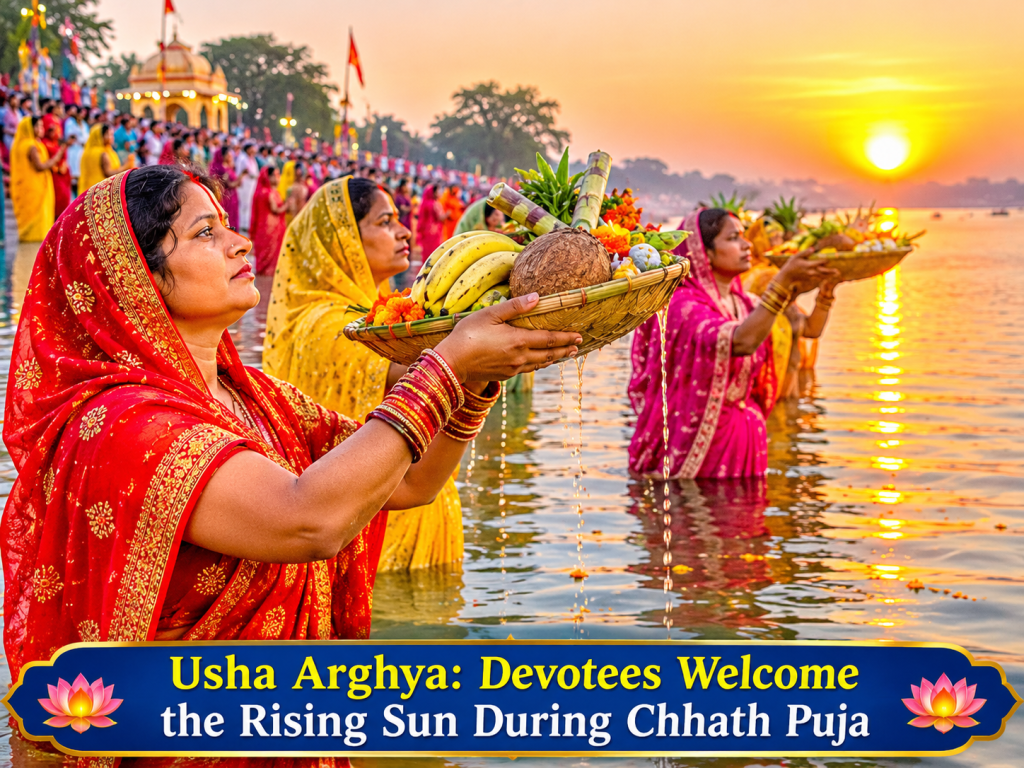
The distinctive identity of Chhath Puja comes from its four-day sequence of religious observances.
Each day has a particular meaning and involves different preparations and rituals.
Day One: Nahay Khay
Nahay Khay marks the beginning of the festival.
On this day, devotees take a ritual bath, clean their homes and prepare themselves for the days of fasting and worship.
The preparation of food is particularly important. Meals are generally prepared using traditional ingredients and methods, with particular attention paid to cleanliness and purity.
Common dishes include rice, chana dal and bottle gourd preparations.
The food is traditionally prepared without onion and garlic, according to the customs followed by many Chhath-observing families.
Nahay Khay represents purification and the beginning of a period of spiritual discipline.
Day Two: Kharna
The second day is known as Kharna or Lohanda and Kharna.
Devotees generally observe a fast throughout the day and conclude it after sunset following prayers.
Traditional offerings often include jaggery-based kheer, roti and other specially prepared foods.
The prasad is distributed among family members and other people.
After Kharna, many devotees begin a rigorous fast lasting approximately 36 hours, during which they traditionally abstain from both food and water.
This demanding practice is one of the most distinctive features of Chhath Puja.
Day Three: Sandhya Arghya
The third day is the principal evening observance.
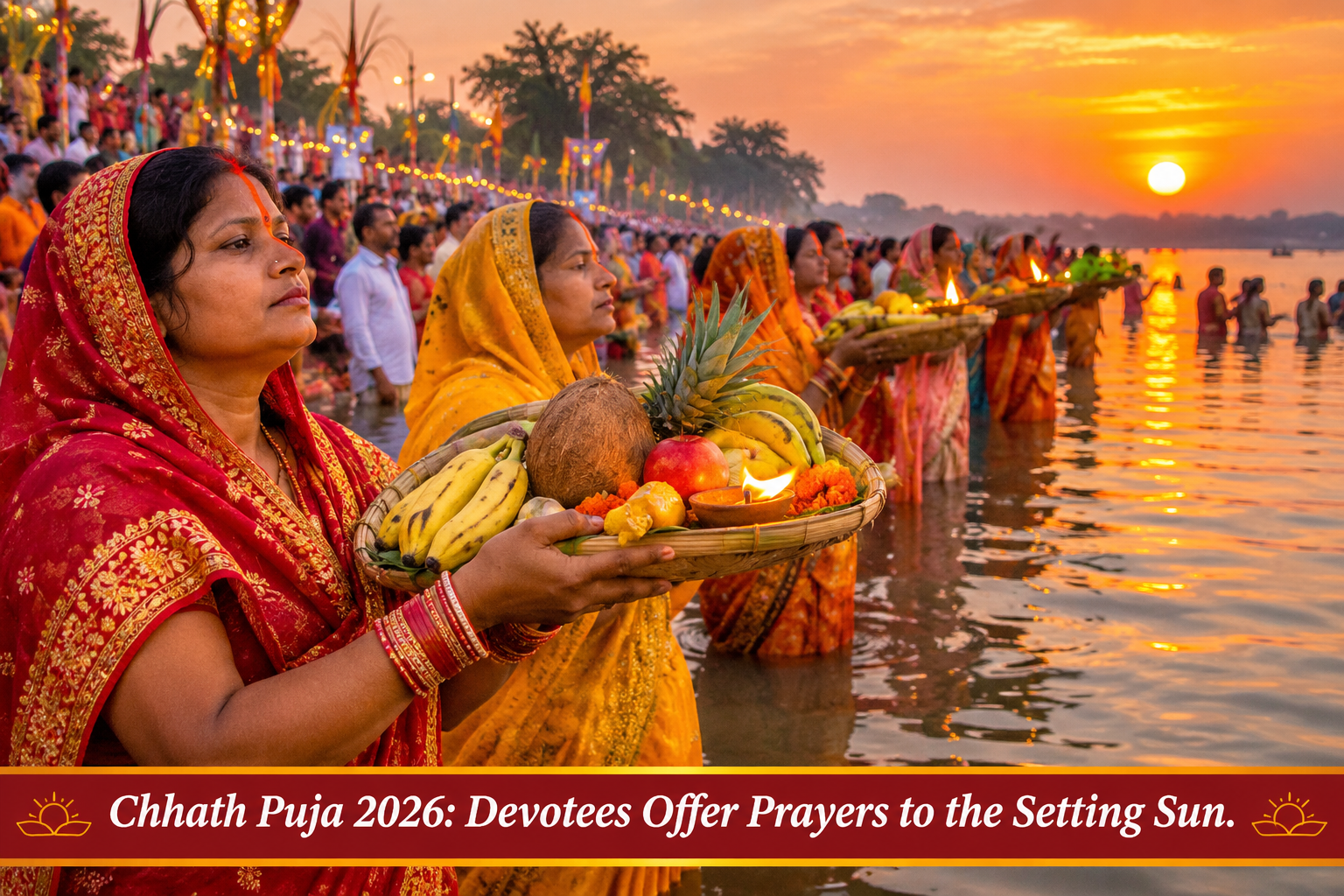
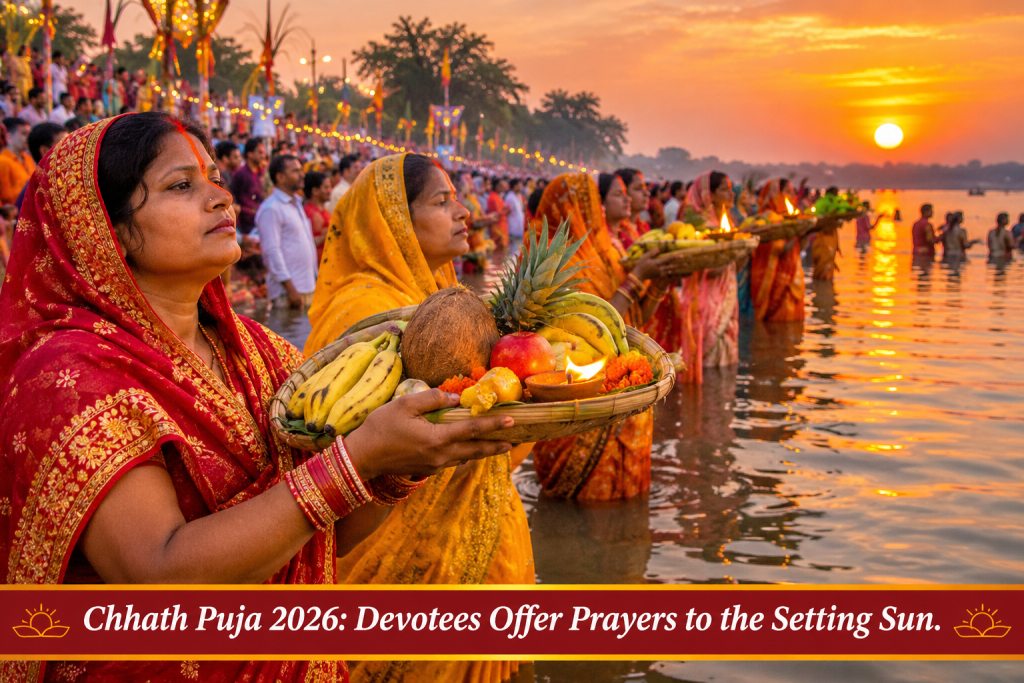
Devotees gather near rivers, ponds and other water bodies to offer Arghya to the setting Sun.
The offerings are arranged in bamboo baskets or traditional containers known as daura and soop.
They commonly include:
- Sugarcane.
- Bananas and seasonal fruits.
- Coconuts.
- Thekua and other traditional sweets.
- Rice and other ritual food items.
- Lamps and other customary puja materials.
As sunset approaches, devotees enter the water and offer prayers to Surya Dev.
The sight of worshippers standing in water with offerings in their hands creates one of the most beautiful and recognisable scenes associated with Chhath.
The evening prayers also express gratitude for the Sun’s contribution to life, agriculture and the natural environment.
Day Four: Usha Arghya and Parana
The final day begins before sunrise.
Devotees return to the riverbanks or other water bodies to offer prayers to the rising Sun.
This ritual is called Usha Arghya.
The worshippers stand in the water and offer Arghya as the first rays of sunlight appear on the horizon.
After completing the morning prayers, devotees conclude their fast through a ritual known as Parana.
The distribution of prasad among family members, relatives and neighbours marks the completion of the festival.
The final morning is particularly emotional for many families because it represents the successful completion of the demanding four-day observance.
The Religious Significance of Worshipping the Setting and Rising Sun
One of the most remarkable aspects of Chhath Puja is that devotees worship both the setting and rising Sun.
In many religious traditions, sunrise is associated with beginnings, energy and renewal. Sunset, on the other hand, represents the conclusion of the day’s activities.
Chhath embraces both moments as equally worthy of reverence.
The evening offering expresses gratitude to the setting Sun for sustaining life throughout the day. The following morning’s offering welcomes the returning sunlight and symbolises renewal, hope and continuity.
This practice also carries a broader philosophical message.
Human life depends on the natural world, and the Sun plays an essential role in maintaining life on Earth. By worshipping Surya Dev, devotees acknowledge this dependence and express their gratitude for the natural forces that sustain existence.
The festival therefore combines religious devotion with an appreciation of nature.
Chhathi Maiya and the Spiritual Importance of the Festival
Although Surya Dev is the principal deity worshipped during Chhath, Chhathi Maiya also occupies a central position in the festival.
She is revered as a protective divine mother who blesses devotees and their families with health, happiness and prosperity.
Many worshippers observe the festival seeking blessings for their children and loved ones.
Women traditionally play a particularly prominent role in the observance, although men also participate in fasting, preparing offerings and performing the rituals.
Chhathi Maiya is remembered through devotional songs and prayers that express the affection, faith and hopes of devotees.
The relationship between Surya Dev and Chhathi Maiya gives the festival its distinctive spiritual character.
Thekua: An Essential Part of Chhath Traditions
No discussion of Chhath Puja is complete without mentioning thekua.
Thekua is a traditional sweet prepared using wheat flour, jaggery or sugar, ghee and sometimes ingredients such as coconut and cardamom.
The dough is shaped using traditional moulds and deep-fried until golden brown.
Its preparation is associated with cleanliness, devotion and family participation.
Thekua is offered as prasad and distributed among relatives, neighbours and other devotees.
Other important offerings include coconuts, bananas, apples, sugarcane, seasonal fruits and traditional homemade foods.
These offerings reflect the agricultural and natural character of Chhath Puja.
Chhath Puja and Environmental Awareness
Chhath Puja has a particularly close relationship with nature.
Unlike many Hindu festivals that centre on elaborate temple ceremonies or idol worship, Chhath is primarily performed in the natural environment, especially near rivers and ponds.
The Sun, water, earth and agricultural produce all have important roles in the observance.
This makes the festival an opportunity to reflect on environmental responsibility.
The cleanliness of rivers and ponds is particularly important because devotees perform their prayers in or near these water bodies.
Community organisations and local authorities can contribute by ensuring that the ghats are clean, safe and properly maintained.
The responsible disposal of offerings, plastic-free arrangements and protection of water quality should also be encouraged.
The traditional use of bamboo baskets and natural materials offers an opportunity to reduce dependence on disposable plastic products.
The festival’s spiritual message of gratitude towards nature can therefore inspire practical efforts to protect the environment.
Chhath Puja: A Celebration of Family Unity and Social Harmony
Another important feature of Chhath Puja is the collective participation of communities.
Although the fasting and principal rituals are undertaken by individual devotees, the preparations often involve entire families and neighbourhoods.
Relatives work together to prepare food, arrange offerings and organise the journey to the ghats.
Neighbours help one another, and community organisations arrange facilities for people who may not have access to private water bodies.
The distribution of prasad further strengthens relationships between families and communities.
In diaspora communities, these activities become even more meaningful because people living away from their ancestral homes can recreate familiar cultural environments.
The recent gathering in Elmsford, New York, involving participants from several South Asian countries, demonstrates how Chhath can create opportunities for cultural exchange and friendship.
The festival therefore has significance beyond its religious rituals. It is also a celebration of belonging, cooperation and shared heritage.
Why Chhath Puja Is Becoming Increasingly Visible Worldwide
Several factors have contributed to the growing international presence of Chhath Puja.
First, migration has helped spread the festival beyond its traditional geographical centres. People from Bihar, Jharkhand, Uttar Pradesh and Nepal have settled in different parts of the world while maintaining their religious practices.
Second, community organisations have played an important role in arranging public celebrations. These organisations help devotees find suitable locations, source traditional materials and organise collective prayers.
Third, younger generations are increasingly interested in learning about their cultural heritage. Celebrating Chhath provides an opportunity for children born abroad to understand the religious traditions of their families.
Finally, digital communication has made it easier for communities to remain connected. Photographs, videos and devotional songs shared through social media allow families and friends to participate emotionally in celebrations taking place thousands of kilometres away.
These developments have helped Chhath evolve from a predominantly regional festival into an increasingly visible international religious and cultural observance.
Chhath Puja’s Timeless Message of Gratitude and Devotion
The conclusion of Chhath Puja 2026 once again highlighted the remarkable strength of a tradition built around faith, discipline, family relationships and reverence for nature.
From the traditional riverbanks of Bihar and Jharkhand to the urban ghats of New Delhi and Kolkata, the festival continued to hold a special place in the lives of devotees.
In Bangladesh, it remained a meaningful expression of faith for communities maintaining connections with the wider traditions of the Indian subcontinent. Meanwhile, celebrations in the United States, Australia, Nepal and other parts of the world demonstrated the ability of cultural traditions to travel across national borders.
The four-day observance may have ended, but its message remains relevant throughout the year.
Chhath Puja teaches people to appreciate the forces of nature, respect the environment, practise self-discipline and remain grateful for the blessings of life.
Its worship of both the setting and rising Sun carries a beautiful message: every ending makes way for a new beginning.
As devotees offer their prayers to Surya Dev and seek the blessings of Chhathi Maiya, Chhath Puja continues to shine as one of the most distinctive and meaningful expressions of Hindu religious heritage.
Sources and news references
The following sources are particularly useful for checking the 2026 dates and reported celebrations:
- Incredible India – Chhath Puja 2026 – Official Indian tourism information and festival dates.
- Drik Panchang – Chhath Calendar 2026 – Four-day festival schedule.
- The Indian Express – Delhi’s preparations for Chhath Puja – Preparations for more than 1,400 ghats.
- NepYork – Chhath celebration in Elmsford, New York – International community celebrations involving Indian, Bangladeshi, Nepali and Pakistani participants.
- The Times of India – Sydney celebrates Chhath – Cultural traditions among the Bihari diaspora.
- Hindustan Times – Chhath Puja 2026 dates and timings – Festival significance and city-wise timings.
Editorial note: Specific 2026 reporting on Bangladesh is limited. The article therefore describes the country’s Chhath tradition without presenting unverified crowd sizes, locations or nationwide celebrations as established news facts.