Talnavami Vrat: Rituals, Story and Significance
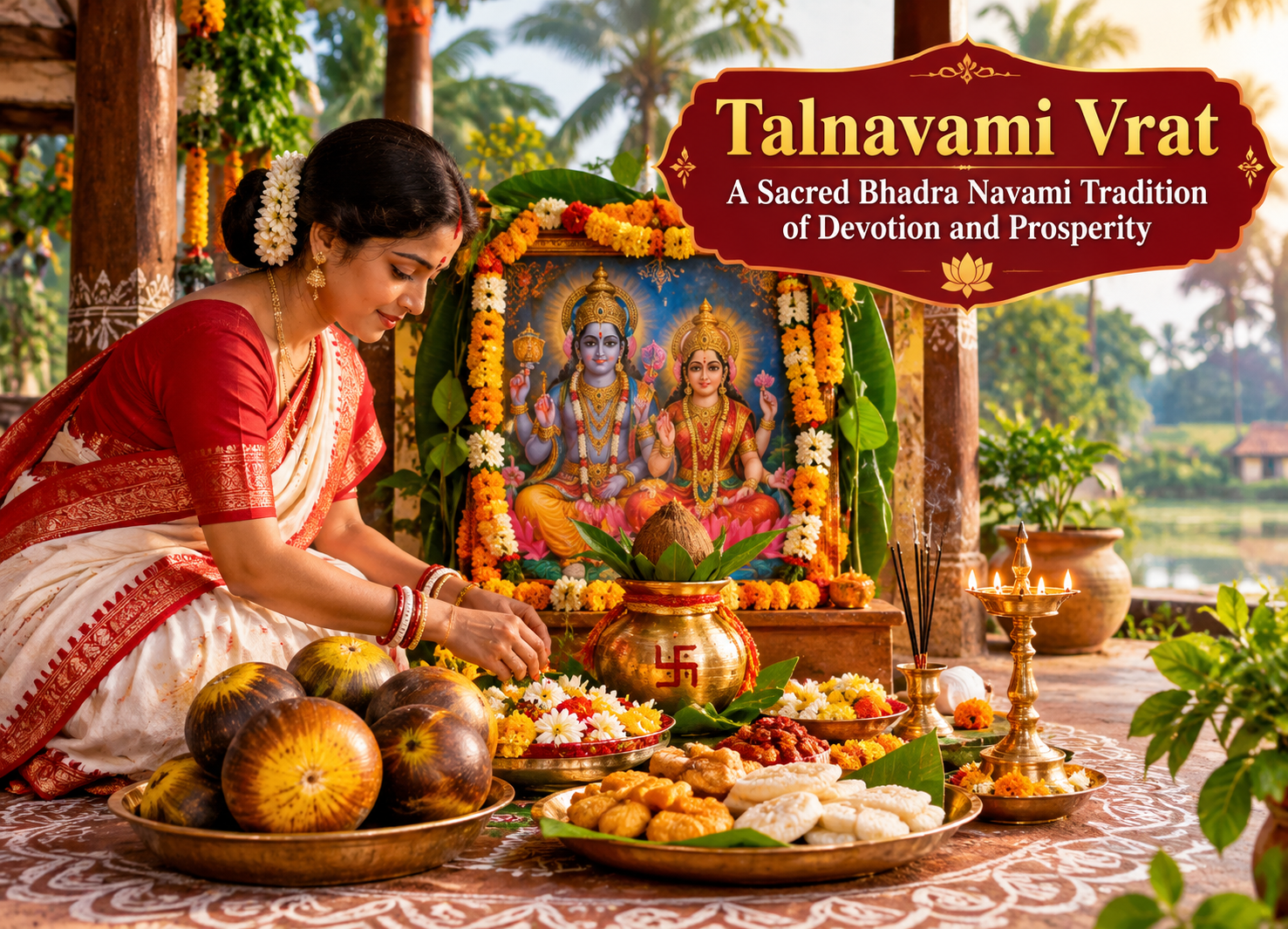
Talnavami Vrat is a traditional Hindu vrat observed on the Navami Tithi of the Shukla Paksha in the month of Bhadra. It is particularly associated with Bengali and Eastern Indian religious culture, where the arrival of ripe tal, the palmyra fruit, is closely connected with seasonal food traditions, devotional practices and rural life.
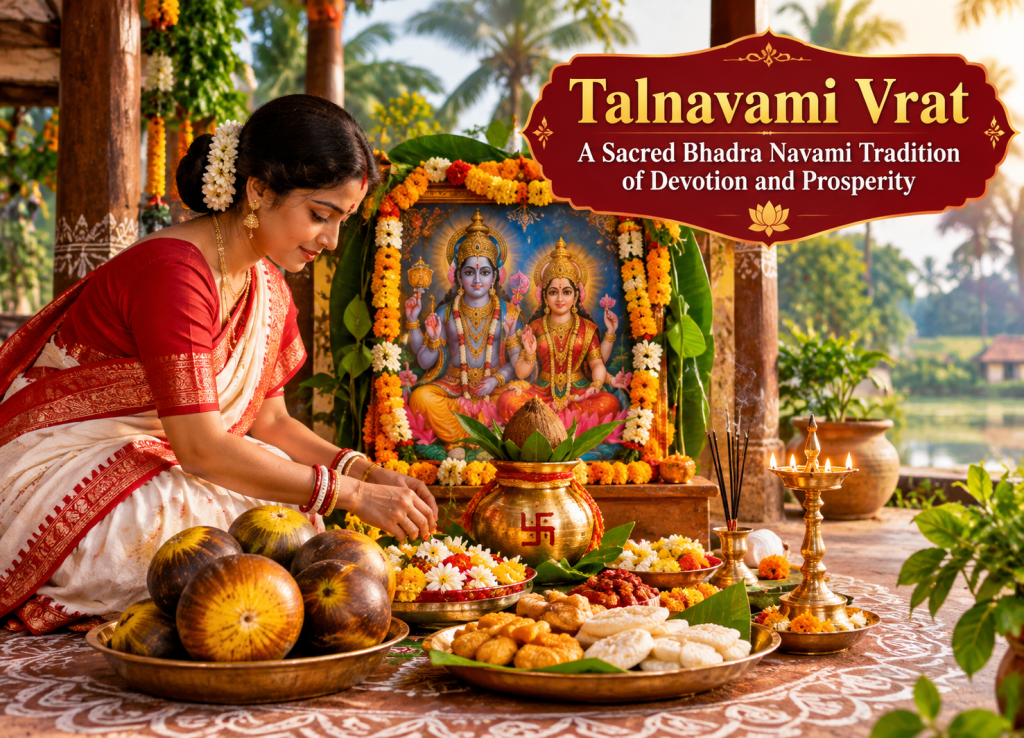
The name Talnavami comes from two words: tal, referring to the palmyra fruit, and Navami, referring to the ninth lunar day. The vrat is therefore strongly associated with the sacred offering of tal fruit on Bhadra Shukla Navami.
Traditional accounts describe Talnavami as a vrat connected with Lakshmi-Narayana worship, marital well-being, family happiness, prosperity and devotion. In one widely circulated vrat tradition, devotees are instructed to worship Lakshmi and Narayana, offer tal fruit and other items, prepare pitha and observe a series of customary acts of devotion and charity. Some traditional accounts also prescribe continuing the vrat for nine years, followed by an udyapana, or ceremonial completion.
Talnavami is also closely connected with the seasonal culture of Bengal. During Bhadra, ripe tal becomes an important ingredient in many traditional preparations, including taler bora, taler pitha, taler phuluri and other sweets and delicacies. Thus, the observance brings together religion, devotion, food culture, family tradition and the natural cycle of the Bengali year.
It is important to remember that Hindu vrat practices can vary between regions, families and local traditions. Therefore, the details given below represent commonly described traditions rather than a single universal procedure followed by every Hindu family.
What Is Talnavami Vrat?
Talnavami Vrat is a traditional Hindu observance performed on Bhadra Shukla Navami, the ninth lunar day of the bright fortnight of Bhadra.
The most distinctive feature of this vrat is the importance given to tal fruit. Devotees offer the fruit to the deity and prepare various traditional foods from ripe tal. The vrat is especially known in Bengal and other parts of Eastern India. Sources describing the tradition identify Lakshmi-Narayana as the principal deities worshipped during the vrat.
The observance has traditionally been associated with married women, particularly those seeking family happiness and auspiciousness. Traditional descriptions use the term sadhaba or sadhava for married women whose husbands are living. However, practices differ from household to household, and modern devotees may approach the observance according to their family tradition and personal faith.
At its heart, Talnavami is an expression of devotion, gratitude and prayer for a peaceful household.
When Is Talnavami Vrat Observed?
Talnavami is observed on the Shukla Paksha Navami Tithi of Bhadra month.
The Hindu lunar calendar does not correspond exactly to the Gregorian calendar. Therefore, the Gregorian date of Talnavami changes every year.
The most reliable way to determine the date is to consult the local Hindu panjika or panchang, because the beginning and ending times of the Navami Tithi can differ according to geographical location.
Talnavami is traditionally placed after Janmashtami and Radhashtami in the Bhadra seasonal cycle. Some Bengali descriptions specifically identify it as the day following Radhashtami.
Because lunar dates are calculated according to tithi rather than an ordinary midnight-to-midnight calendar day, devotees should follow the local panchang when determining the exact observance time.
Why Is It Called Talnavami?
The name itself explains one of the most distinctive features of the vrat.
Tal means the palmyra fruit, while Navami means the ninth lunar day.
Tal trees have long been an important part of the landscape and culture of Bengal and Eastern India. The fruit ripens during the Bhadra season and is traditionally used to prepare numerous foods.
Talnavami therefore represents an interesting meeting point between seasonal nature and religious culture.
The fruit that becomes abundant during this period becomes part of the devotional offering. In this way, an ordinary seasonal fruit is transformed into a sacred offering through worship.
Traditional descriptions specifically emphasize that tal should be offered during Talnavami. Some accounts also mention nine fruits as part of the puja materials.
The Religious Significance of Tal Fruit
Tal is much more than a seasonal fruit in Bengali culture.
The tall palmyra tree is familiar throughout rural Bengal. Its fruit, leaves, wood and sap have historically been used in different ways. The ripe fruit is especially associated with Bhadra and with traditional Bengali cooking.
During Talnavami, the fruit becomes part of a religious offering.
This reflects an important principle found throughout Hindu culture: nature itself can become an offering to the Divine.
Flowers, fruits, leaves, water, grains and other natural products are frequently used in Hindu worship. Their significance does not necessarily depend upon their monetary value. Instead, the devotee offers something with reverence and gratitude.
Talnavami expresses this idea beautifully. A seasonal fruit becomes a symbol of abundance, gratitude and devotion.
Talnavami and Lakshmi-Narayana Worship
Traditional Talnavami vrat instructions commonly mention the worship of Lakshmi-Narayana.
Lakshmi is associated with prosperity, abundance, auspiciousness and well-being, while Narayana is a revered name and form of Lord Vishnu.
Worshipping Lakshmi-Narayana together gives the observance a broad spiritual meaning. The devotee does not merely pray for material wealth. The traditional household ideal includes peace, stability, harmony, devotion and prosperity.
A home may possess wealth but lack peace. Similarly, material comfort alone cannot guarantee family happiness.
The worship of Lakshmi-Narayana can therefore be understood as a prayer for a balanced household in which prosperity is accompanied by righteousness, mutual respect and spiritual awareness.
Talnavami Vrat Katha
The traditional Talnavami Vrat Katha is connected with Satyabhama, one of the principal queens associated with Lord Krishna.
According to a popular traditional account, Satyabhama experienced sorrow and sought guidance from a sage or ascetic. She asked how she could overcome her difficulties and attain happiness.
The ascetic told her about Talnavami Vrat.
He instructed her to observe the vrat during Bhadra Shukla Navami with devotion and to worship Lakshmi-Narayana. The offering of tal fruit was presented as an important part of the observance.
The traditional account further describes Satyabhama faithfully observing the vrat for nine years. At the completion of the observance, Narayana appeared and blessed her, telling her that her period of misfortune had come to an end and that she would experience happiness and auspiciousness.
This story is not presented as a historical account. Rather, it belongs to the traditional vrat-katha literature through which religious values and devotional practices have been transmitted from one generation to another.
The deeper message of the story is the importance of faith, patience, discipline and devotion.
The Spiritual Message of the Vrat Katha
The story of Satyabhama contains several themes that remain meaningful today.
1. Faith during difficult times
The story begins with difficulty and emotional suffering. Instead of abandoning her spiritual path, Satyabhama seeks guidance.
This reflects the traditional Hindu understanding that difficulties can become opportunities for spiritual growth.
2. Patience
The traditional observance is described as continuing for nine years.
Whether or not every modern devotee follows this extended practice, the story highlights the value of patience. Spiritual practices are not always presented as instant solutions.
3. Discipline
A vrat involves intentional discipline. Preparing offerings, maintaining cleanliness, remembering the Divine and following one’s chosen observances require attention and commitment.
4. Devotion
The external rituals have meaning when accompanied by sincere devotion.
The central purpose is not simply to complete a checklist of rituals but to cultivate reverence and gratitude.
Traditional Talnavami Vrat Materials
The exact list of materials may vary according to local custom. A traditional description includes items such as:
- Kalash or water pot
- Clean puja space
- Dhupa or incense
- Dipa or oil lamp
- Flowers
- Fruits
- Tal fruit
- Nine fruits in some traditions
- Sweets
- Pitha
- Offerings for Lakshmi-Narayana
- Items required for customary charity
- New cloth for the concluding ceremony in some traditions
Traditional sources specifically mention a kalash, incense, lamp, flowers, offerings, nine fruits and sweets. They also describe giving a new cloth and monetary dakshina to a Brahmin during the concluding ceremony.
Devotees should follow their family tradition or guidance from their local priest for any additional requirements.
How to Prepare for Talnavami Vrat
Preparation is an important part of many Hindu vrat traditions.
Clean the home
The puja area should be cleaned carefully.
A clean environment is traditionally regarded as appropriate for worship. In Bengal, devotees may decorate the floor around the puja area with alpana, a traditional decorative design.
Prepare the puja space
Choose a clean and peaceful place for the worship.
A small altar can be arranged with the image or murti of Lakshmi-Narayana, flowers, a lamp and the required offerings.
Arrange the tal fruit
Since tal is central to the observance, ripe and clean tal fruit should be prepared for offering.
If tal is unavailable in a particular location, devotees should consult their family tradition or priest rather than inventing a replacement ritual.
Prepare traditional food
Tal can be used to make a variety of traditional Bengali preparations.
These include taler bora, taler phuluri, taler pitha, taler luchi and taler kheer. Such foods are strongly associated with the Bhadra season and Talnavami cultural tradition.
Talnavami Puja Vidhi
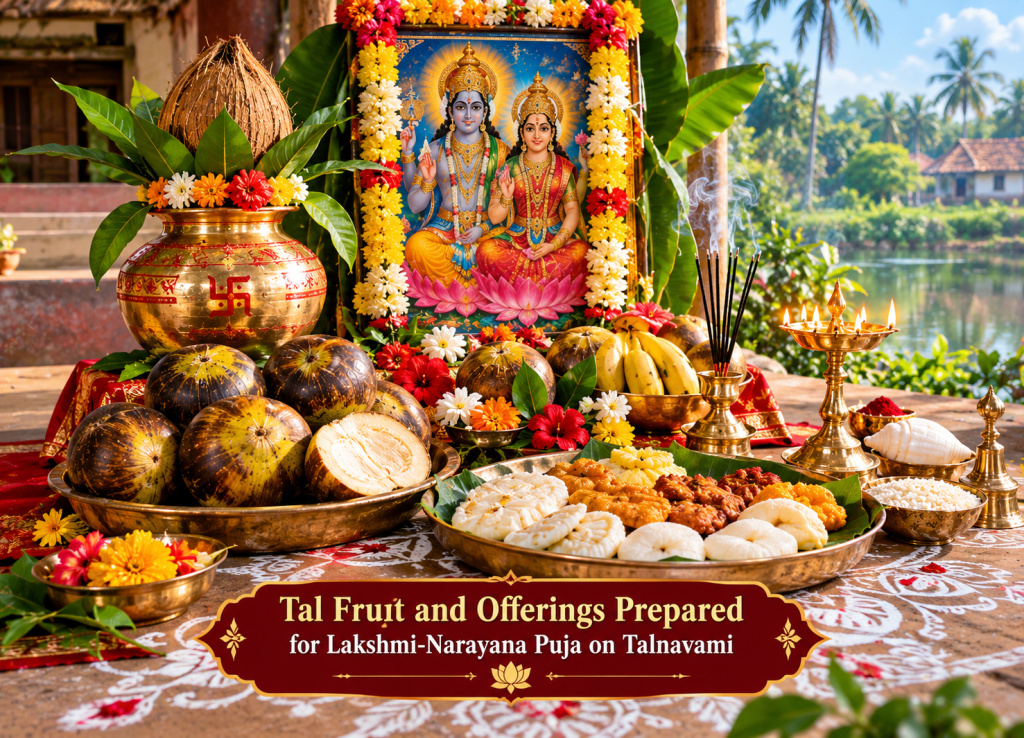
The exact puja procedure varies by tradition, but a commonly described sequence can be understood as follows.
Step 1: Take a devotional resolve
Begin the observance with a sincere prayer and resolve to perform the vrat according to one’s family tradition.
Step 2: Cleanse and prepare
After bathing and wearing clean clothes, prepare the worship area.
Step 3: Decorate the altar
Place the kalash and arrange flowers, lamps and other puja materials.
An alpana may be drawn around the puja space according to Bengali custom.
Step 4: Worship Lakshmi-Narayana
Offer flowers, incense, lamp, water, fruits and other appropriate offerings to Lakshmi-Narayana.
The devotee should pray with sincerity rather than focusing only on the material value of the offerings.
Step 5: Offer tal fruit
Tal is one of the defining offerings of Talnavami.
The fruit should be offered respectfully before the deity.
Step 6: Offer pitha and other foods
Traditional accounts describe preparing pitha and offering food to Narayana.
The food should first be regarded as an offering to the Divine before it is distributed or consumed.
Step 7: Read or listen to the vrat katha
The Talnavami Vrat Katha may be read or heard.
Listening to a vrat katha is traditionally considered an important part of many Hindu observances because it connects the ritual with its spiritual teaching.
Step 8: Charity and feeding
Traditional descriptions mention feeding Brahmins and giving appropriate dakshina.
Today, the spirit of this practice can also be understood through acts of charity and feeding those in need, while devotees continue to follow the customs appropriate to their tradition.
Step 9: Complete the observance
After the puja, devotees follow their chosen fasting or dietary practice and conclude the day’s observance according to family tradition.
Fasting on Talnavami
Fasting practices can differ considerably among Hindu families.
Some devotees may observe a strict fast, while others may take fruits, milk or a simple vegetarian meal. In some traditions, the food rules are connected to the specific vrat being observed.
Therefore, there is no need to assume that every devotee follows exactly the same fasting pattern.
For anyone with medical conditions, taking regular medication, or having particular dietary needs, fasting should be approached responsibly and according to appropriate medical advice.
The spiritual purpose of a vrat is self-discipline and devotion, not harm to the body.
Talnavami and Married Women
Traditional descriptions of Talnavami particularly associate the vrat with married women.
The traditional intention includes prayers for marital happiness, family welfare and auspiciousness. Some traditional sources state that women observing the vrat pray for continued happiness with their husbands and for the welfare of their families.
Such descriptions belong to a particular social and religious tradition.
For modern Hindu families, the broader spiritual meaning can be understood as a prayer for mutual love, respect, harmony, prosperity and well-being within the family.
The Traditional Nine-Year Observance
One distinctive feature of some Talnavami traditions is the instruction to continue the vrat for nine consecutive years.
Traditional accounts describe Satyabhama following the observance for nine years and then performing an udyapana, or completion ceremony.
The number nine has a familiar place in Hindu religious culture. It appears in concepts such as Navaratri and other groups of nine sacred elements.
However, the nine-year Talnavami observance should be understood as a traditional practice, not as a universal requirement for every person who observes Talnavami.
Those undertaking a long-term vrat should follow the specific tradition passed down in their family or the guidance of a knowledgeable priest.
What Is Udyapana?
Udyapana means the ceremonial completion of a long-term religious observance.
When a vrat is traditionally prescribed for a particular number of years, the completion may involve a special puja, offerings, charity, feeding and dakshina.
In descriptions of Talnavami Vrat, the nine-year observance is followed by such a concluding ceremony. Traditional instructions mention giving a new cloth and dakshina to a Brahmin.
The purpose is not simply to mark the end of a religious obligation. It expresses gratitude to the Divine for allowing the devotee to complete the vow.
Talnavami Food Tradition
One of the most beautiful aspects of Talnavami is its connection with Bengali food culture.
When ripe tal becomes available during Bhadra, households traditionally prepare different dishes from the fruit.
Taler Bora
Taler bora is one of the best-known traditional preparations made from ripe tal.
The pulp is mixed with suitable ingredients and shaped into small fritters before being cooked.
Taler Phuluri
Taler phuluri is another seasonal preparation associated with ripe tal. It can be prepared in sweet or savoury forms according to regional and household preference.
Taler Pitha
Different varieties of pitha may be prepared using tal pulp.
Taler Kheer
Tal pulp can also be incorporated into sweet preparations such as kheer.
These foods are not merely culinary items. They preserve memories of Bengali seasonal life and rural household traditions. Talnavami therefore connects religious observance with the agricultural and culinary rhythm of the region.
Talnavami and Bengali Rural Culture
Talnavami has a particularly strong connection with rural Bengal.
The tall silhouette of the palmyra tree is a familiar part of the countryside. During the rainy season and Bhadra, ponds, village paths, green fields and tal trees create a distinctive landscape.
Traditional festivals often emerge from such close relationships between people and nature.
Talnavami is a good example of how a seasonal natural product can become part of a religious tradition.
The observance also reflects the social character of village life. Preparing food, inviting others, listening to vrat stories, making offerings and sharing meals could turn a religious day into a community occasion.
Talnavami and the Bengali Calendar
The festival calendar of Bengal contains many observances connected with particular lunar days and seasonal changes.
Talnavami falls within the Bhadra period, when the monsoon landscape is still prominent and ripe tal becomes widely available.
Its position after Janmashtami and Radhashtami also places it within a period rich in Vaishnava-related devotional associations. Some popular accounts connect the broader Bhadra Navami period with the celebrations surrounding Krishna and Radha.
However, these associations should not be confused with the specific vrat-katha tradition of Talnavami. Different communities may explain the significance of the day differently.
Is Talnavami a Major Pan-Indian Festival?
Talnavami is better understood as a regional Hindu vrat and cultural observance rather than a universally observed pan-Indian festival.
It is particularly associated with Bengal and Eastern India. Sources describing the tradition note its presence in the eastern part of India.
This regional character does not make the tradition less meaningful.
Hindu religious culture contains thousands of local festivals, vratas, temple traditions and family observances. Many of them are deeply important to the communities that preserve them even when they are not widely observed throughout India.
Talnavami is one such tradition.
Spiritual Significance of Talnavami Vrat
The spiritual value of Talnavami can be understood through several themes.
Devotion
The devotee remembers Lakshmi-Narayana and places spiritual life at the centre of the observance.
Gratitude
The seasonal fruit and food offerings remind devotees to appreciate the gifts of nature.
Family harmony
Traditional prayers focus strongly on household happiness and marital well-being.
Charity
Feeding others and giving appropriate offerings express the principle of sharing one’s blessings.
Self-discipline
The vrat encourages restraint, attention and conscious living.
Preservation of tradition
Observing Talnavami helps preserve regional Hindu customs, stories, recipes, art and family practices.
What Does Talnavami Teach Us Today?
Talnavami can be understood beyond its external rituals.
In modern life, people often become disconnected from seasonal food, nature and traditional community life.
A festival such as Talnavami can remind us to reconnect with these things.
The palmyra fruit does not appear in a supermarket as an anonymous product when viewed through the traditional lens. It carries the memory of the tree, the monsoon, the village, the household kitchen, the puja altar and generations of people who prepared food from it.
Similarly, a simple oil lamp can become a reminder of spiritual awareness.
A flower can represent beauty and impermanence.
Food can become an offering before it becomes a meal.
And a vrat can become an opportunity for self-reflection.
Talnavami and Respect for Nature
Hindu traditions frequently connect spirituality with the natural world.
Talnavami provides a particularly clear example.
The principal symbol of the observance is a fruit that comes from a tree deeply associated with the landscape of Bengal and Eastern India.
The tradition encourages us to see nature not merely as a source of consumption but also as something worthy of gratitude.
This idea can be especially meaningful today, when environmental awareness has become increasingly important.
Respecting trees, protecting water bodies, reducing food waste and preserving traditional agricultural biodiversity can all be viewed as practical expressions of gratitude toward nature.
A Simple Talnavami Prayer
Devotees may pray according to their own family tradition.
A simple prayer can express the essential spirit of the observance:
“O Lakshmi-Narayana, please bless our family with peace, devotion, harmony and well-being. May our home be filled with righteousness, compassion and gratitude. May we learn to accept the gifts of nature with humility and use them wisely. Please guide us on the path of devotion and dharma.”
A sincere prayer is more important than elaborate language.
Frequently Asked Questions About Talnavami Vrat
What is Talnavami Vrat?
Talnavami Vrat is a traditional Hindu vrat observed on Bhadra Shukla Navami. It is especially associated with Bengal and Eastern India and is characterized by tal fruit offerings and Lakshmi-Narayana worship.
When is Talnavami observed?
It is observed on the Shukla Paksha Navami Tithi of Bhadra month. The Gregorian date changes every year, so devotees should consult a reliable local panchang.
Why is tal fruit important on Talnavami?
Tal is the principal seasonal symbol of the vrat. Traditional descriptions specifically mention offering tal fruit during the observance.
Which deities are worshipped on Talnavami?
Traditional vrat instructions describe the worship of Lakshmi-Narayana.
Who traditionally observes Talnavami Vrat?
Traditional Bengali descriptions particularly associate the vrat with married women. However, practices differ among families and regions.
Is fasting compulsory?
Fasting practices vary. Devotees should follow their family tradition or the instructions of their religious teacher. Health considerations should always be respected.
What foods are prepared for Talnavami?
Traditional preparations include taler bora, taler phuluri, taler pitha, taler luchi and taler kheer, although the exact menu differs by household and region.
What is the Talnavami Vrat Katha?
The popular vrat katha tells of Satyabhama receiving instructions about Talnavami Vrat from an ascetic and observing the vrat for nine years. The traditional account concludes with divine blessings.
Does Talnavami have a nine-year rule?
Some traditional accounts prescribe observing the vrat for nine years followed by an udyapana. This is a specific traditional practice and may not be followed identically by every family.
What is the main purpose of Talnavami Vrat?
Traditionally, it is associated with family happiness, marital well-being, prosperity and auspiciousness. At a spiritual level, it emphasizes devotion, discipline, gratitude and charity.
Conclusion
Talnavami Vrat is a beautiful example of the way Hindu spirituality can bring together devotion, nature, food, family and seasonal culture.
Observed on Bhadra Shukla Navami, the vrat is especially associated with tal fruit and the worship of Lakshmi-Narayana. Traditional accounts describe tal offerings, pitha, fruits, charity, feeding and other devotional practices. The popular vrat katha of Satyabhama gives the observance an additional message of patience, faith and perseverance.
For Bengali and Eastern Indian communities, Talnavami also preserves something beyond ritual. It keeps alive the memory of village ponds, tall palmyra trees, seasonal fruits, traditional kitchens, alpana, family gatherings and generations of devotional practice.
The deeper meaning of the vrat can be found in its spirit rather than in material possessions.
A fruit becomes an offering.
A meal becomes prasada.
A family gathering becomes an expression of love.
A seasonal tradition becomes a form of gratitude.
And a simple day of worship becomes an opportunity to remember the Divine.
In this way, Talnavami remains a meaningful part of the rich and diverse world of Hindu vrat traditions.
May Lakshmi-Narayana bless every home with peace, harmony, devotion, prosperity and spiritual well-being.