Krishna Bat: The Sacred Krishna Fig Tree of India
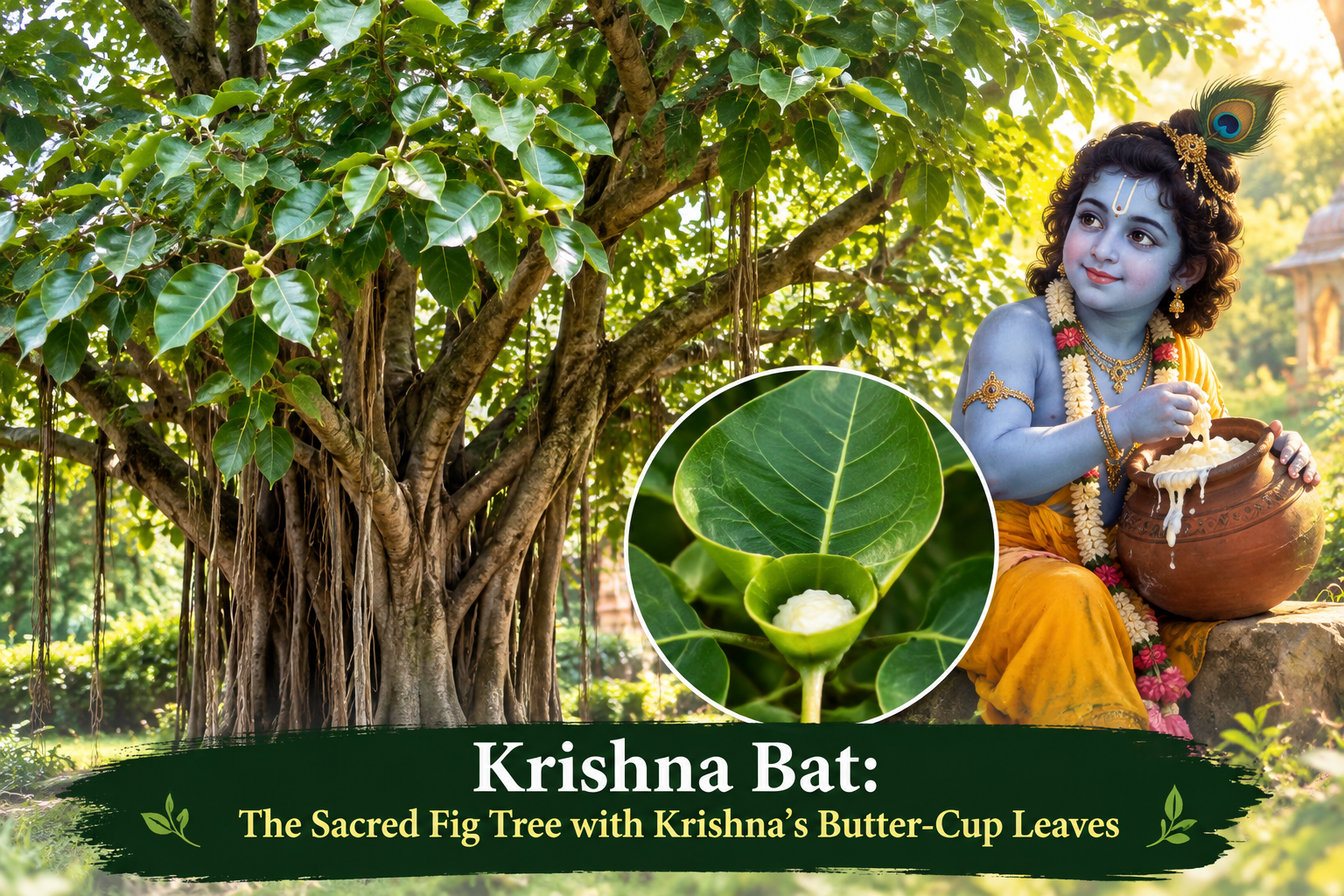
India is home to thousands of remarkable trees, many of which are connected with religion, mythology, traditional medicine, and local culture. Among them, Krishna Bat is especially fascinating. Known scientifically as Ficus krishnae C.DC., this unusual tree is famous for its distinctive leaves, which develop a natural cup- or pouch-like structure near the base.
The tree is also known by several names, including Krishna Fig, Krishna’s Butter Cup, Krishna’s Cup, and Makhan Katori. In Bengali, it is known as Krishnabat (কৃষ্ণবট). The name “Makhan Katori,” meaning a small bowl or cup for butter, is particularly interesting because it connects the tree’s unusual leaves with one of the most beloved childhood stories of Lord Krishna—the divine child who loved butter and was famous for stealing it.
Botanically, Ficus krishnae belongs to the Moraceae family, the same broad family that includes the banyan and many other fig species. Kew’s Plants of the World Online currently accepts Ficus krishnae as a distinct species and lists India as its native range. It grows primarily in wet tropical conditions.
What makes Krishna Bat extraordinary is the meeting of botany and mythology. Its unusual leaf structure has inspired traditional stories for generations, while modern botanical studies have examined whether the species should be regarded as distinct from the common banyan, Ficus benghalensis. Recent taxonomic research provides evidence supporting its treatment as a separate species.
Let us explore the fascinating story, appearance, religious significance, scientific identity, traditional uses, and conservation importance of Krishna Bat.
What Is Krishna Bat?
Krishna Bat is a large evergreen fig tree scientifically known as Ficus krishnae C.DC. It belongs to:
- Kingdom: Plantae
- Order: Rosales
- Family: Moraceae
- Genus: Ficus
- Species: Ficus krishnae
The species was formally published by C. de Candolle in 1906. Kew currently recognizes Ficus krishnae as an accepted species. A former name, Ficus benghalensis var. krishnae, is treated as a synonym.
The tree is native to India and has also been introduced to Sri Lanka. It is associated particularly with tropical environments.
The most remarkable feature is its leaf. Instead of having an ordinary flat leaf surface like many trees, Krishna Bat develops a characteristic folded or cup-like area at the base of the leaf. This structure has given rise to the popular names Krishna’s Butter Cup and Makhan Katori.
The Botanical Survey of India describes Krishna Bat as a very large, fast-growing evergreen tree that can reach around 30 metres in height, with spreading branches and aerial roots.
Why Is It Called Krishna Bat?
The name “Krishna Bat” literally connects the tree with Lord Krishna.
The traditional story is associated with Krishna’s childhood in Gokul and Vrindavan, where he was famous for his love of butter. According to popular folklore, young Krishna would steal butter from the homes of the cowherd women and enjoy it with his friends.
One version of the traditional story says that when Krishna was caught by his mother Yashoda while enjoying or stealing butter, he tried to hide the butter by rolling or placing it inside one of the leaves of this unusual tree.
The leaf’s natural cup-like shape is therefore popularly explained as a reminder of Krishna’s butter-loving childhood.
The Botanical Survey of India records this folklore and notes that the unusual pocket-like fold at the base of the leaf has inspired stories connecting the tree with Krishna’s butter-stealing pastimes.
This is an important distinction to make: the butter story is a religious and folk tradition, not a botanical explanation for how the leaf evolved. Botanically, the cup-shaped structure is a natural characteristic of the plant.
The Famous “Makhan Katori” Leaf
The leaf of Krishna Bat is responsible for much of its fame.
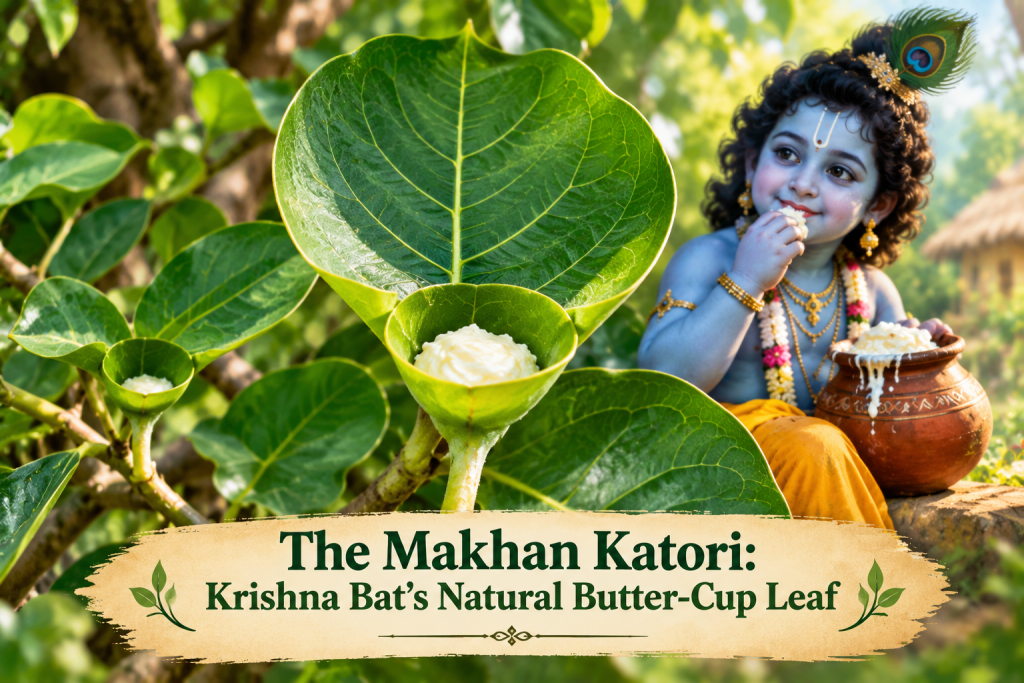
The Hindi name Makhan Katori can be translated roughly as “butter bowl.” In popular descriptions, the leaf resembles a small natural bowl or cup. Some descriptions also compare its shape to a spoon.
The Botanical Survey of India explains that the leaves have a pocket-like fold at their base. This unusual morphology distinguishes the plant from the ordinary banyan and is one of the major reasons for its cultural importance.
Scientific research has found that the leaf characteristics are not simply a superficial curiosity. Detailed taxonomic studies have identified several differences between Ficus krishnae and Ficus benghalensis, including differences involving leaves, aerial roots, stipules, petioles, receptacle structures, anatomy, chromosome characteristics, DNA content, and other features.
Thus, the famous “butter cup” is both a botanical curiosity and a cultural symbol.
Krishna Bat and the Childhood of Lord Krishna
Lord Krishna’s childhood is filled with charming stories.
Unlike many religious stories that focus mainly on cosmic events, Krishna’s childhood stories often present him as playful, mischievous, affectionate, and full of divine charm. His butter-stealing adventures are among the best-known.
The stories of Makhan Chor, or the “butter thief,” are particularly popular in North Indian devotional traditions.
Krishna would reportedly enter the houses of the gopis with his friends, find pots of butter, and enjoy the delicious food. Sometimes the women complained to Yashoda about his activities. Yet his mischievous behavior was understood not simply as ordinary childhood mischief but as an expression of divine love.
The Krishna Bat legend fits beautifully into this cultural world. Its unusual leaf looks like a natural little bowl, making it easy for devotees to imagine it as a vessel in which the young Krishna could hide or hold butter.
This is why the tree has acquired a special emotional association with Bal Krishna, the child form of Lord Krishna.
Is Krishna Bat the Same as the Banyan Tree?
This question deserves careful attention.
Krishna Bat belongs to the Ficus genus and resembles the banyan. For many years, taxonomists debated whether Ficus krishnae should be treated as a distinct species or as a variety or subspecies of the common banyan, Ficus benghalensis.
An older classification treated it as:
Ficus benghalensis var. krishnae
However, detailed research published in Phytotaxa argued for reinstating Ficus krishnae as a separate species. The researchers identified differences in morphology, anatomy, cytology, and other characteristics.
A later molecular and morphological study also found evidence supporting species-level separation. Researchers compared Ficus krishnae with Ficus benghalensis using morphological characteristics and DNA markers and concluded that the evidence supports treating Ficus krishnae as an independent species.
Kew’s current Plants of the World Online database accepts Ficus krishnae as a species and lists Ficus benghalensis var. krishnae as a synonym.
Therefore, for modern botanical writing, Krishna Bat can appropriately be described as Ficus krishnae.
Physical Characteristics of Krishna Bat
Krishna Bat is not a small ornamental shrub. It can become a substantial tree.
According to the Botanical Survey of India, it can grow to approximately 30 metres tall and has spreading branches and aerial roots.
Its major characteristics include:
1. Large evergreen tree
Krishna Bat is evergreen and can develop a broad, spreading crown.
2. Aerial roots
Like several large fig trees, it may produce aerial roots from its branches. These roots can eventually grow downward toward the ground.
3. Distinctive leaves
The leaves are its most famous feature. They develop a characteristic pocket-like or cup-shaped fold at the base.
4. Small figs
Scientific studies describe its figs as very small. One taxonomic and ethnobotanical study recorded fig sizes ranging approximately from 1 to 3 millimetres.
5. Large variation in leaves
Research has documented considerable variation in leaf dimensions and form. A 2021 study reported leaf sizes ranging from approximately 8 × 7 cm to 25 × 11 cm among the material examined.
The exact appearance can therefore vary depending on the individual tree and its growing conditions.
Where Does Krishna Bat Grow?
Kew identifies India as the native range of Ficus krishnae. It grows primarily in wet tropical environments and has also been introduced to Sri Lanka.
The tree is cultivated in botanical gardens and collections because of its unusual appearance and cultural importance.
The Botanical Survey of India records an interesting history for the plant in its garden collections. The species was brought to scientific attention in 1896 by David Prain, then Director of the Botanical Survey of India, from a private garden near the Acharya Jagadish Chandra Bose Indian Botanic Garden in Howrah. Two stem cuttings were obtained and introduced into the garden, after which twigs were distributed to other gardens in India and abroad.
This history demonstrates how botanical gardens can play an important role in preserving rare or culturally significant plants.
Krishna Bat in Bengal
Krishna Bat has a special linguistic connection with Bengal.
In Bengali, it is called কৃষ্ণবট (Krishnabat). Botanical references list “Krishnabat” as a Bengali name for Ficus benghalensis var. krishnae, the older taxonomic treatment of the plant.
The tree is also significant from a conservation perspective in parts of West Bengal. A biodiversity study reported Krishna Bat (Ficus krishnii) among threatened plants in Bankura district, recording only a small number of mature individuals in several localities.
This makes the preservation of naturally occurring populations particularly important.
For Bengal, therefore, Krishna Bat is more than a mythological tree. It is also part of the region’s botanical heritage.
Krishna Bat and Hindu Sacred Trees
Trees occupy an important position in Hindu culture.
The banyan, peepal, neem, bilva, tulsi, and many other plants have strong religious and cultural associations. Trees are frequently connected with deities, sages, sacred places, festivals, meditation, and traditional rituals.
Krishna Bat is particularly distinctive because its religious identity is closely connected with the childhood stories of Lord Krishna.
The sacred character of the plant should be understood as part of India’s larger tradition of viewing nature through a spiritual lens.
In this tradition, a tree is not merely a biological object. It can become a living reminder of divine stories and moral values.
The Krishna Bat’s unusual leaf provides a powerful example of how natural forms can inspire religious imagination.
Do Not Confuse Krishna Bat With Banshi Vat
There is an important difference between Krishna Bat and Banshi Vat.
The names may sound similar, but they refer to different concepts.
Krishna Bat generally refers to the botanical species Ficus krishnae, famous for its cup-shaped leaves and association with Krishna’s butter-stealing folklore.
Banshi Vat, on the other hand, refers to a sacred banyan associated with Krishna’s flute-playing pastimes in Vrindavan. “Banshi” means flute, while “Vat” means banyan tree. According to the Mathura district’s official tourism information, Banshi Vat is traditionally associated with Krishna playing his flute and the gopis coming to hear it, especially in connection with the Maharaas tradition.
Thus:
Krishna Bat = Ficus krishnae, the Krishna fig or Makhan Katori tree.
Banshi Vat = a sacred banyan associated with Krishna’s flute and Maharaas traditions.
Keeping these two names separate makes an article about Krishna Bat more accurate.
Traditional Medicinal Importance
Krishna Bat has also attracted attention in Ayurvedic and folk medicine.
Traditional medicinal literature has associated different parts of Ficus krishnae with a variety of uses. A scientific review of its ethnomedicinal background reports traditional applications involving conditions such as ulcers, fever, vomiting, inflammation, dysentery, liver inflammation, piles, and other ailments.
However, traditional use should not automatically be interpreted as proof of clinical effectiveness.
Modern research has investigated some of these traditional claims.
For example, researchers have examined extracts of Ficus krishnae for antidiabetic activity. A study published in PLOS ONE investigated stem-bark extracts and identified two triterpene alcohols—cycloartenol and 24-methylenecycloartanol—that showed antidiabetic activity in experimental models.
Another experimental study examined petroleum-ether leaf extract in alloxan-induced diabetic rats and reported reductions in blood glucose levels.
These findings are scientifically interesting, but they should not be interpreted as evidence that Krishna Bat can replace prescribed diabetes treatment in humans. Much of the available evidence is based on laboratory or animal research, rather than large clinical trials.
Other Reported Biological Activities
Researchers have investigated different parts of Ficus krishnae for several biological properties.
A taxonomical and ethnomedicinal study reported investigations into:
- antibacterial activity,
- antioxidant activity,
- antidiabetic activity,
- anti-inflammatory activity,
- anticancer activity,
- antimicrobial activity, and
- immunomodulatory effects.
These findings make Krishna Bat an interesting subject for pharmacological research.
At the same time, responsible health writing should distinguish between traditional medicine, laboratory experiments, animal studies, and proven human treatments.
A plant may contain biologically active compounds without being established as a safe or effective medicine for a particular disease.
Therefore, Krishna Bat should be admired for its medicinal potential while avoiding unsupported claims about cures.
The Scientific Study of Krishna Bat
The scientific story of Krishna Bat is almost as interesting as its mythology.
For many years, botanists debated its relationship with the common banyan. The unusual leaves initially attracted attention, but researchers later found that the differences extended beyond leaf shape.
The 2015 taxonomic revision examined numerous specimens and reported differences involving:
- plant height,
- aerial roots,
- stipules,
- petioles,
- leaf appendages,
- structures of the fig receptacle,
- chromosome characteristics,
- DNA content,
- stomatal characteristics,
- parenchymatous cells, and
- nodal anatomy.
A later study added molecular evidence. Researchers used DNA markers including ITS2 and trnH-psbA to examine relationships between Ficus krishnae and Ficus benghalensis. Their analysis supported the idea that Ficus krishnae can be treated as a separate species.
This is an excellent example of how modern science can revisit questions that were previously based mainly on visible characteristics.
Conservation: Why Krishna Bat Needs Protection
The religious importance of Krishna Bat is one reason to protect it, but its botanical rarity makes conservation important as well.
Kew’s Plants of the World Online currently includes a predicted extinction-risk assessment for Ficus krishnae and reports a predicted threatened status with confident assessment under the cited Angiosperm Extinction Risk Predictions project.
A biodiversity assessment of Bankura district also listed Krishna Bat as critically endangered at the district level, with only a handful of mature individuals recorded in the surveyed localities.
These findings underline a valuable lesson: a plant may be culturally famous while still being vulnerable in nature.
Habitat destruction, loss of mature trees, limited natural regeneration, and replacement of natural vegetation can all threaten rare plant populations.
Botanical gardens, universities, research institutions, temples, and private conservation gardens can therefore contribute to the survival of this remarkable tree.
Krishna Bat in Botanical Gardens
Botanical gardens are particularly important for unusual plants such as Krishna Bat.
The Botanical Survey of India’s account demonstrates how cultivated specimens helped spread the species to gardens in India and other countries.
A notable example has also been reported from the Harisingh Gour University Botanical Garden in Sagar, Madhya Pradesh, where a Krishna Bat specimen was reportedly maintained for decades. A 2023 report described it as a rare tree and highlighted its distinctive bowl-like leaves and religious folklore.
Such collections can serve several purposes:
- Conservation
- Botanical education
- Scientific research
- Public awareness
- Cultural preservation
When people see the unusual leaf for themselves, the connection between the plant and the Krishna legend becomes much easier to understand.
The Spiritual Meaning of Krishna Bat
The Krishna Bat can be viewed as a symbol of the intimate relationship between nature and devotion.
The story does not depend on the tree being mentioned in every ancient scripture. Rather, generations of people have looked at its unusual leaves and connected their shape with a beloved story about Krishna.
This is a common feature of Indian religious culture. Natural objects often become associated with divine stories because they help devotees remember spiritual ideas through everyday experiences.
The Krishna Bat leaf can therefore symbolize:
- Krishna’s playful childhood,
- divine love,
- innocence,
- the beauty of nature,
- the sacredness of plants,
- the preservation of cultural memory, and
- the connection between mythology and the natural world.
The story also reminds us that religious traditions can inspire people to respect and preserve living nature.
Krishna Bat and the Symbolism of Butter
Butter has a special place in stories of young Krishna.
In devotional literature and popular Hindu culture, butter represents the sweetness of Krishna’s childhood. His butter thefts are humorous, but they also carry devotional meaning.
The devotees do not see Krishna merely as a naughty child. His playful actions become expressions of divine charm.
The “butter bowl” leaf of Krishna Bat therefore has a powerful symbolic effect. A simple botanical structure becomes a visual reminder of the playful Krishna.
That is why names such as Makhan Katori and Krishna’s Butter Cup are so memorable.
How Is Krishna Bat Different From an Ordinary Banyan?
At first glance, Krishna Bat can resemble a banyan because both belong to the fig family and can develop aerial roots.
But several characteristics distinguish Ficus krishnae.
The most obvious is the distinctive cup-shaped or pocket-like leaf base.
Scientific studies have identified additional differences in morphology, anatomy, cytology, and DNA characteristics.
So, although the two trees are closely related, Krishna Bat should not simply be described as an ordinary banyan with unusual leaves.
Modern taxonomic databases recognize Ficus krishnae as an accepted species.
Interesting Facts About Krishna Bat
Here are some fascinating facts about this remarkable tree:
1. Its scientific name is Ficus krishnae
The species belongs to the Moraceae family.
2. It is associated with Lord Krishna
Its unusual leaf has inspired traditional stories about Krishna and butter.
3. It is called Makhan Katori
The name refers to the leaf’s bowl-like appearance.
4. It can become a large tree
The Botanical Survey of India reports that it can reach about 30 metres.
5. It produces aerial roots
These are characteristic of many large Ficus trees.
6. Its figs are tiny
Research has recorded fig sizes of approximately 1–3 mm.
7. Its taxonomy has been debated
It was once treated under Ficus benghalensis, but current Kew treatment accepts Ficus krishnae as a species.
8. It has traditional medicinal importance
Different parts of the plant have been used in traditional medicine.
9. Modern science has investigated its chemistry
Research has identified compounds with antidiabetic activity in experimental studies.
10. It may be conservation-sensitive
Current Kew-linked extinction-risk predictions classify it as threatened, while regional assessments have also reported serious conservation concerns.
Why Krishna Bat Is Important Today
In today’s rapidly changing world, Krishna Bat represents more than an unusual tree.
It stands at the intersection of religion, folklore, botany, traditional medicine, biodiversity, and conservation.
For devotees, it recalls the charming childhood of Lord Krishna.
For botanists, it is a fascinating member of the Ficus genus.
For researchers, it offers opportunities to study plant chemistry and taxonomy.
For conservationists, it represents a species that deserves protection.
For cultural historians, it demonstrates how natural objects become woven into the stories and traditions of communities.
And for ordinary visitors, its unusual leaves provide a simple but beautiful reminder that nature itself can be full of surprises.
Final Thoughts
Krishna Bat, or Ficus krishnae, is one of India’s most fascinating sacred plants. Its distinctive cup-shaped leaves have inspired the affectionate names Krishna Fig, Krishna’s Butter Cup, and Makhan Katori. The traditional story connects these leaves with young Krishna’s famous love of butter, transforming a botanical curiosity into a memorable symbol of devotion.
Scientific research adds another layer to the story. Modern taxonomy recognizes Ficus krishnae as an accepted species, while detailed studies have identified morphological and genetic differences between it and the common banyan, Ficus benghalensis.
The plant also has a history of traditional medicinal use, and researchers have investigated its potential biological activities, including antidiabetic effects. However, these scientific findings should be understood carefully and should not replace established medical treatment.
Perhaps most importantly, Krishna Bat reminds us that India’s sacred landscape is deeply connected with its natural heritage. A leaf can preserve a story. A tree can inspire devotion. And a botanical species can become a living link between mythology and biodiversity.
Protecting Krishna Bat therefore means protecting not only a rare and remarkable plant, but also a small part of the cultural memory associated with Lord Krishna.
For anyone interested in Hindu mythology, sacred trees, Indian botany, or the fascinating relationship between nature and spirituality, Krishna Bat deserves a special place among India’s most extraordinary trees.
*Related Articles: Krishna: The Divine Playwright of Love and Wisdom