Shaligram Shila: A Sacred Form of Lord Vishnu
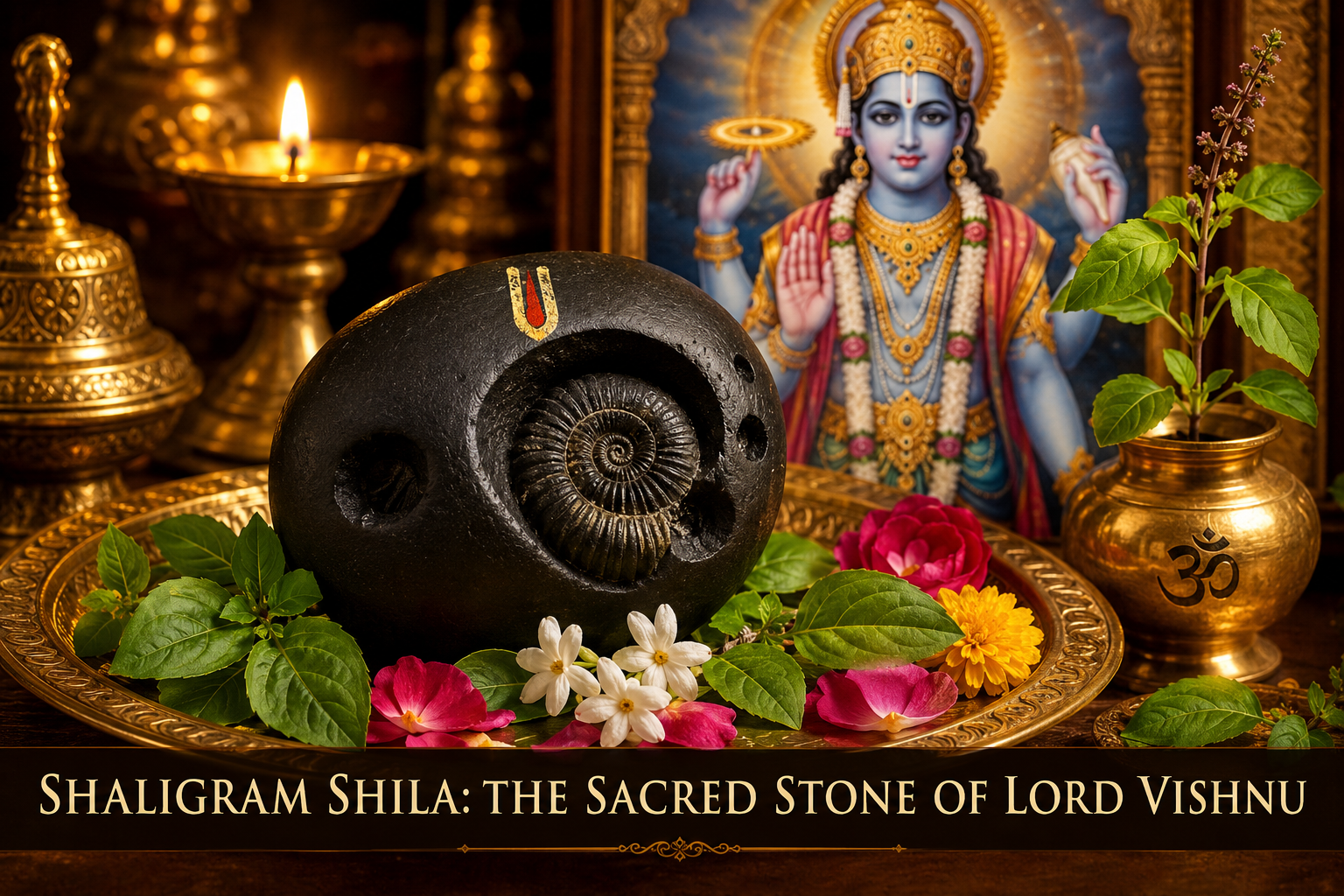
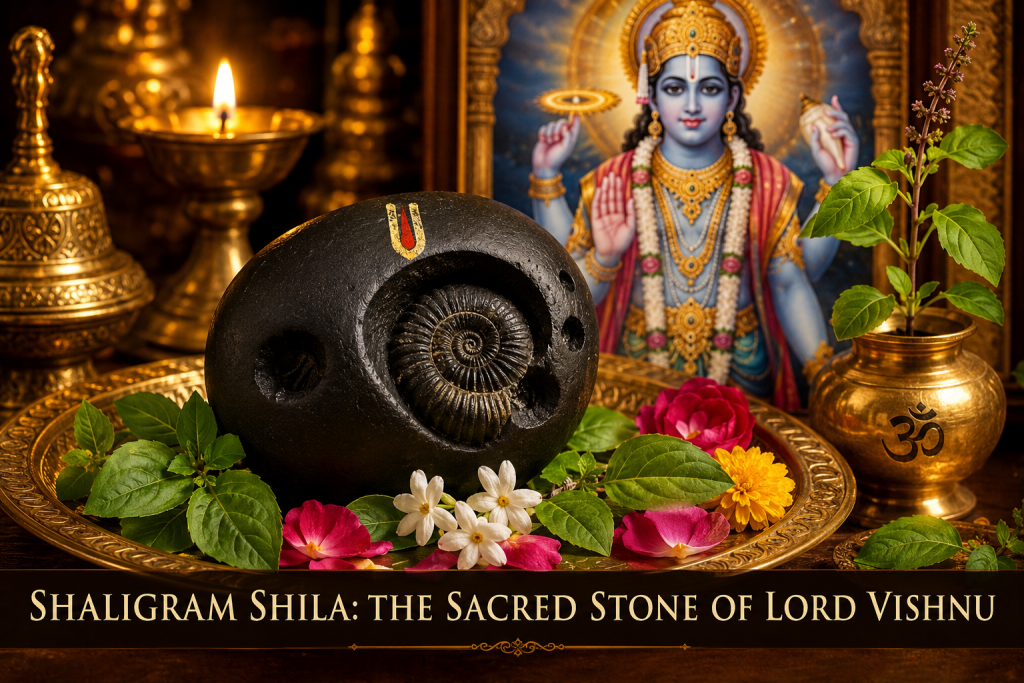
Among the many sacred objects worshipped in Hinduism, Shaligram Shila holds a unique and highly respected position. Unlike most Hindu deities represented through statues or traditionally consecrated images, Shaligram is a naturally occurring stone that devotees regard as a manifestation of Lord Vishnu.
For Vaishnavas, a Shaligram is not simply a beautiful or unusual stone. It is regarded as a sacred, self-manifest form of Vishnu. The stone is traditionally collected from the Kali Gandaki River in Nepal, particularly the Himalayan region associated with Muktinath and the Gandaki basin.
Shaligram Shilas are generally dark or black and often contain naturally formed spirals, cavities, lines and circular markings. Devotees traditionally associate these markings with Vishnu’s divine attributes, especially the Sudarshana Chakra.
At the same time, geology provides another fascinating perspective. Many Shaligrams are fossilized ammonites or ammonite-bearing stones formed from ancient marine life. Their existence connects Hindu religious tradition with the extraordinary geological history of the Himalayas.
This combination of faith, mythology, pilgrimage, nature and ancient geology makes Shaligram Shila one of the most fascinating sacred objects in Hinduism.
What Is Shaligram Shila?
The Sanskrit term is commonly written as Śālagrāma-śilā, while English spellings include Shaligram, Shaligrama, Salagrama, Saligram and Shalagram.
The word Shila means stone. Therefore, Shaligram Shila can broadly be understood as the sacred Shaligram stone.
In Vaishnava tradition, it is considered a naturally manifested form of Vishnu. It is therefore different from an ordinary stone or a stone image carved by human hands.
Shaligrams are traditionally associated with the Kali Gandaki River of Nepal, a major Himalayan river. The river flows through the region of Mustang and near sacred pilgrimage destinations such as Muktinath.
The natural markings on individual stones are particularly important. Different forms, shapes, openings and spiral patterns have traditionally been associated with different manifestations of Vishnu.
Some Shaligrams are round, while others are elongated, flattened or irregular. Some contain a clearly visible spiral fossil pattern, while others have one or more natural openings.
For devotees, these natural characteristics can have deep religious significance.
The Divine Connection Between Shaligram and Lord Vishnu
The central belief surrounding Shaligram Shila is simple yet profound:
Shaligram is regarded as a natural manifestation of Lord Vishnu.
This belief is particularly strong in Vaishnavism. Traditional Hindu literature describes Shalagrama as a sacred form through which Vishnu can be worshipped.
One important distinction is that devotees do not necessarily regard Shaligram as merely a symbolic representation of Vishnu. Rather, the Shila itself is treated as the divine presence.
This makes Shaligram worship especially significant in Vaishnava households.
A devotee may place a Shaligram on the home altar, bathe it with water, offer Tulsi leaves and flowers, light a lamp and recite Vishnu mantras.
Modern descriptions of Shaligram worship also emphasize that its sacred status does not depend upon human carving. The naturally occurring form itself is central to its religious identity.
Where Are Shaligram Shilas Found?
The most famous source of Shaligram Shilas is the Kali Gandaki River in Nepal.
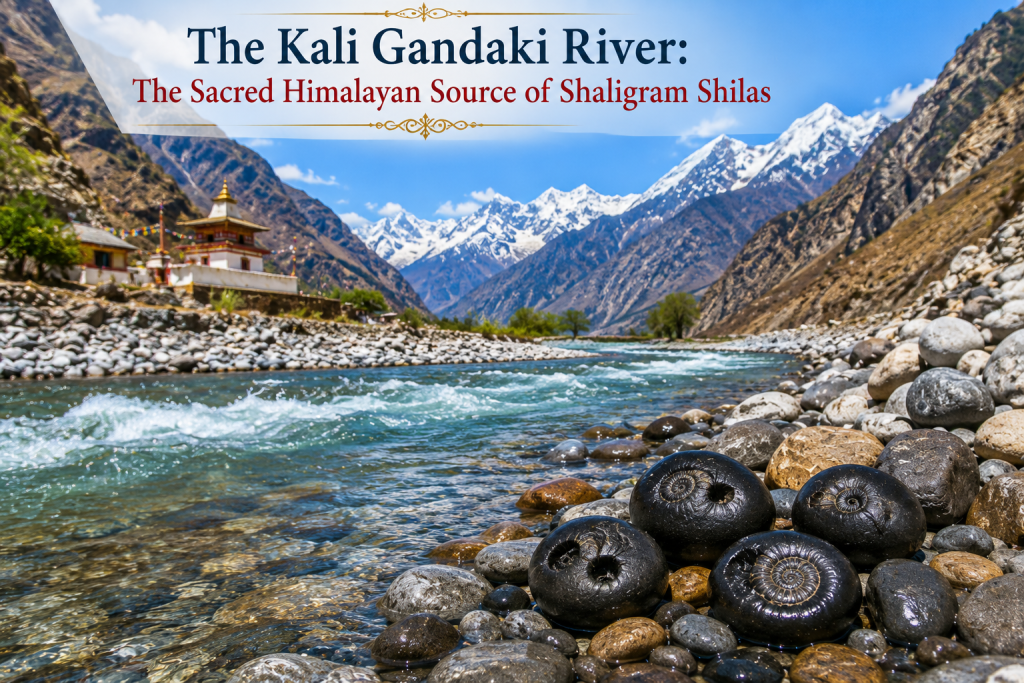
The river flows through one of the most dramatic landscapes of the Himalayas. The region surrounding Muktinath is especially important to Hindu pilgrims.
The Kali Gandaki valley is famous not only for its religious importance but also for its geological richness. Ancient marine fossils occur in the rocks of this region because the Himalayan mountains were formed from geological formations connected with the ancient Tethys Ocean.
For centuries, pilgrims have collected sacred stones from the river region.
The association between the river, the sacred landscape and Vishnu gives Shaligram an importance that goes beyond the physical stone itself.
The broader pilgrimage area includes places such as Muktinath, Damodar Kunda and the Gandaki valley, all of which have important religious associations in Hindu tradition.
The Geological Story Behind Shaligram
The scientific story of Shaligram is equally fascinating.
Many Shaligrams are associated with ammonites, extinct marine animals related to modern cephalopods. Their spiral shells were preserved as fossils over immense periods of geological time.
This may seem surprising because the fossils are found high in the Himalayas.
The explanation lies in the geological history of the region.
Millions of years ago, the area that is now the Himalayas was associated with the ancient Tethys Sea. Marine organisms lived in those waters. Their remains eventually became buried in sediments.
Later, the Indian tectonic plate moved northward and collided with the Eurasian plate. This enormous geological process contributed to the formation and uplift of the Himalayan mountain system.
Rocks containing marine fossils were subsequently raised to great elevations. Rivers such as the Kali Gandaki then cut through the mountains and exposed fossil-bearing rocks.
This is why an ancient marine fossil can be found today in a Himalayan river.
Scientific sources identify Shaligrams primarily with fossil ammonites and related fossil material.
Thus, Shaligram provides a remarkable example of how religious meaning and geological history can coexist.
For a devotee, it is a manifestation of Vishnu.
For a geologist, it can be a remarkable fossil from an ancient marine environment.
Both perspectives make the stone fascinating.
The Legend of Shaligram and Tulsi
One of the most famous stories connected with Shaligram involves Goddess Tulsi and Lord Vishnu.
There are different versions of the legend in Hindu traditions, and details can vary from one text or regional tradition to another.
A widely circulated version connects Tulsi with the demon king Jalandhara.
Jalandhara was extraordinarily powerful. According to the legend, his strength was connected to the purity and devotion of his wife, Vrinda.
The gods eventually sought Vishnu’s help because Jalandhara had become extremely difficult to defeat.
Vishnu intervened in a manner that caused Vrinda to lose her spiritual protection. When Vrinda discovered what had happened, she became deeply distressed and cursed Vishnu to become a stone.
According to this tradition, Vishnu accepted the curse.
Thus, Vishnu manifested as Shaligram Shila.
Vrinda herself became associated with Tulsi, the sacred basil plant.
The story then establishes a profound relationship between Tulsi and Shaligram.
This is why Tulsi leaves are considered especially dear to Vishnu and are traditionally offered during Shaligram worship. Some traditions also celebrate the symbolic marriage of Tulsi and Shaligram during Tulsi Vivah.
The legend is therefore not simply a story about a stone. It expresses themes of devotion, divine play, transformation and the eternal relationship between Vishnu and Tulsi.
Why Is Tulsi Offered to Shaligram?
Tulsi occupies a special place in Vaishnava worship.
Devotees consider Tulsi Devi especially dear to Lord Vishnu. Therefore, offering a Tulsi leaf to a Shaligram is regarded as a particularly sacred act.
A simple home ritual may involve:
- Cleaning the worship area.
- Placing the Shaligram respectfully on a clean altar.
- Bathing the Shila with clean water.
- Offering Tulsi leaves.
- Offering flowers.
- Lighting a lamp.
- Chanting Vishnu’s name or a Vishnu mantra.
- Offering food as naivedya.
- Performing arati.
The exact ritual varies between families, sects and traditions.
The most important element is generally devotion and reverence, rather than elaborate ceremony.
Shaligram and Muktinath
The sacred landscape of Muktinath is deeply connected with Shaligram tradition.
Muktinath is one of the most important pilgrimage destinations in Nepal and is sacred to both Hindus and Buddhists.
For Hindus, Muktinath is associated with Lord Vishnu and liberation. The Gandaki River flowing through the surrounding region is famous for Shaligram stones.
Pilgrims visiting the region may therefore encounter Shaligrams in their natural Himalayan environment.
This makes the pilgrimage particularly meaningful.
Instead of seeing the sacred stone only on a household altar, devotees can contemplate its connection with the river, mountains and ancient landscape from which it originates.
The physical journey through the Himalayan landscape becomes part of the spiritual experience.
Different Types of Shaligram Shila
There are numerous traditional classifications of Shaligram.
They are identified according to characteristics such as:
- Shape
- Size
- Colour
- Number of openings
- Spiral markings
- Natural lines
- Chakra-like patterns
- Surface characteristics
- Other distinctive natural formations
Traditional texts and later works provide elaborate classifications of Shaligrams. Some sources associate particular forms with specific manifestations or avatars of Vishnu.
Some commonly discussed forms include Shaligrams associated traditionally with:
It is important to remember that the exact classification can differ between traditional sources. Therefore, online lists claiming that every specific shape has exactly one universally accepted meaning should be treated cautiously.
Sudarshana Chakra Markings
One of the most striking features of many Shaligrams is the spiral or circular fossil pattern.
Devotees often associate these markings with the Sudarshana Chakra, the divine discus of Lord Vishnu.
Scientifically, these patterns can correspond to the preserved structure of ammonite shells.
Religiously, however, the same natural pattern is interpreted as a sacred sign of Vishnu.
This is one of the most beautiful examples of how the natural appearance of an object can become deeply integrated into religious symbolism.
A spiral that a paleontologist sees as a fossil structure can simultaneously be understood by a devotee as a divine chakra.
Spiritual Importance of Shaligram Shila
Shaligram is revered for several spiritual reasons.
1. A Natural Form of Vishnu
The most important belief is that Shaligram is a naturally manifested form of Lord Vishnu.
2. Symbol of Preservation
Vishnu is traditionally regarded as the preserver of the universe. Worshipping his Shila therefore reminds devotees of divine protection and cosmic order.
3. Focus for Meditation
The simple natural form of a Shaligram can provide a powerful focus for prayer and meditation.
4. Connection with Ancient Tradition
Shaligram worship connects modern devotees with a very old Vaishnava tradition.
5. Devotion
Daily worship encourages discipline, remembrance of God and devotional practice.
6. Connection with Tulsi
The relationship between Shaligram and Tulsi gives special importance to both the sacred stone and the Tulsi plant.
Shaligram Shila Benefits According to Hindu Belief
Many devotees believe that worshipping Shaligram brings spiritual and worldly blessings.
Traditional beliefs commonly associate Shaligram worship with:
- Spiritual growth
- Peace of mind
- Devotion to Vishnu
- Protection from negativity
- Prosperity
- Family harmony
- Purification of the mind
- Removal of obstacles
- Blessings of Lord Vishnu
- Progress on the spiritual path
However, these should be understood as religious beliefs, not scientifically proven effects.
The deepest benefit of Shaligram worship is arguably the cultivation of devotion and disciplined spiritual practice.
A person who regularly performs prayer, meditation and devotional rituals may develop greater mindfulness, gratitude and spiritual awareness.
How to Worship Shaligram Shila at Home
Shaligram worship does not necessarily require an elaborate temple.
A clean and peaceful place can be used for a home altar.
A simple traditional routine may be:
Step 1: Clean the Altar
Keep the worship area clean.
Step 2: Bathe the Shaligram
Devotees commonly bathe Shaligram with clean water. Some traditions use additional sacred substances, but practices vary.
Step 3: Offer Tulsi
Place fresh Tulsi leaves respectfully before or upon the Shaligram according to one’s family tradition.
Step 4: Offer Flowers
Fresh flowers can be offered to Lord Vishnu.
Step 5: Light a Lamp
A lamp may be lit as an offering of light.
Step 6: Chant Mantras
Devotees may chant:
“Om Namo Bhagavate Vasudevaya.”
This is one of the best-known Vishnu mantras.
Step 7: Offer Naivedya
Simple vegetarian food may be offered.
Step 8: Perform Arati
The worship can conclude with arati and prayer.
The precise procedure varies among Vaishnava traditions, so those following a particular sampradaya should follow the guidance of their tradition or spiritual teacher.
Does Shaligram Need Prana Pratishtha?
A major feature of Shaligram tradition is the belief that the stone is naturally sacred.
Unlike an ordinary statue that may undergo Prana Pratishtha as part of temple consecration, Shaligram is traditionally regarded as inherently divine.
In other words, devotees believe that Vishnu is already present in the Shaligram.
This idea is one of the reasons Shaligram has such a special status in Vaishnavism.
Nevertheless, household practices differ, and devotees may receive specific instructions from their guru or family tradition.
Can Shaligram Be Kept at Home?
Yes. Shaligram Shilas are traditionally worshipped in many Hindu and Vaishnava households.
However, devotees generally treat them with great respect.
A Shaligram should not be treated as a decorative stone.
If someone brings one into a home for worship, it is wise to establish a simple and sustainable daily routine rather than performing elaborate rituals for a few days and then neglecting it.
The central principle is respect, cleanliness and devotion.
Important Things to Remember Before Buying a Shaligram
The popularity of Shaligram has created a market for stones sold as authentic Shaligrams.
This creates an important problem.
Not every black stone with a spiral or painted marking is necessarily a genuine natural Shaligram.
Modern sources have documented the availability of carved, painted, molded and imitation stones marketed as Shaligrams.
Therefore, buyers should be careful.
A genuine Shaligram is traditionally associated with the Kali Gandaki region. Scientific identification may involve examination of fossil characteristics and geological material.
If authenticity is important to you, purchase only through a reputable source and ask about provenance rather than relying solely on photographs or claims such as “rare,” “powerful” or “100% guaranteed.”
Also remember that spiritual value should not be reduced to commercial price.
A Shaligram does not become spiritually superior simply because someone sells it at a very high price.
Are All Black Stones Shaligrams?
No.
This is an important point.
The Kali Gandaki region contains different types of rocks and fossils. A naturally black, rounded stone is not automatically a Shaligram.
Likewise, a stone with a circular marking may not necessarily represent a specific Vishnu form.
Traditional identification depends on natural features and established classifications.
Modern scientific identification can also help distinguish fossil material from manufactured replicas.
Therefore, people should avoid sensational claims about a stone being a “rare Shaligram” without credible evidence.
Shaligram and Hindu Philosophy
Shaligram also has philosophical importance.
Hinduism has many ways of understanding divine presence.
God can be approached through:
- Form
- Sound
- Mantra
- Nature
- Sacred places
- Sacred rivers
- Images
- Symbols
- Meditation
Shaligram beautifully combines several of these ideas.
It is a natural object connected with a sacred river, a sacred landscape and a particular deity.
It also demonstrates the Hindu idea that the divine can be encountered within the natural world.
For a devotee, the stone is therefore not merely an object sitting on an altar. It becomes a reminder of the presence of Vishnu in creation.
Shaligram and the Concept of Swayambhu
The word Swayambhu broadly refers to something that is self-manifest or naturally manifested rather than created by human hands.
Shaligram is traditionally understood in this way.
Its sacredness is connected with its natural formation.
This makes Shaligram different from a conventional sculpted image.
The devotee does not need to imagine that an artist created the shape of Vishnu. Instead, the natural stone itself becomes the object of devotion.
This is one reason Shaligram worship has survived for centuries and continues to attract devotees today.
Shaligram and Tulsi Vivah
The relationship between Tulsi and Shaligram is especially celebrated during Tulsi Vivah.
Tulsi Vivah is a Hindu ritual symbolically celebrating the marriage of Tulsi Devi with Vishnu, often represented by Shaligram or another form of Vishnu.
The festival is particularly important in many Vaishnava households.
During the ceremony, Tulsi is decorated like a bride and Shaligram is worshipped as the divine groom.
The ritual symbolizes the sacred union of devotion and divinity.
For many families, it is also an occasion for prayer, celebration and spiritual renewal.
Shaligram in Daily Vaishnava Life
The importance of Shaligram is not limited to major festivals.
Many devotees worship it every day.
A simple daily ritual can become a spiritual discipline.
The devotee wakes, cleans the altar, bathes the Shaligram, offers Tulsi and flowers, chants Vishnu’s name and offers food.
The routine may take only a few minutes.
Yet repeating this practice every day can create a strong sense of connection with one’s faith.
In this way, Shaligram becomes part of everyday spiritual life rather than something remembered only during festivals.
Why Is Shaligram Considered So Powerful?
From a religious perspective, the answer is connected with Vishnu’s presence.
Devotees believe that Shaligram is not merely a symbol but a direct natural manifestation of Vishnu.
From a psychological and devotional perspective, a sacred object can also serve as a constant reminder of one’s spiritual values.
Every time a devotee sees the Shaligram, it can remind them of:
- Dharma
- Compassion
- Truth
- Devotion
- Self-control
- Gratitude
- Divine protection
Thus, its power can be understood both through traditional religious belief and through the role of sacred objects in devotional practice.
Shaligram: Where Science Meets Faith
Perhaps the most fascinating aspect of Shaligram is the way science and spirituality describe the same object differently.
Science says:
Many Shaligrams are fossilized ammonites preserved in Himalayan geological formations.
Hindu tradition says:
Shaligram is a naturally manifested form of Lord Vishnu.
These statements operate within different frameworks.
Science investigates physical origin, fossilization and geology.
Religion addresses sacred meaning, divine presence and devotional practice.
There is no need to dismiss the geological explanation simply because devotees consider the stone sacred.
In fact, the geological history makes the object even more extraordinary.
Imagine holding a stone that preserves evidence of an ancient marine world while simultaneously being worshipped as a manifestation of Vishnu.
That is what makes Shaligram so remarkable.
Shaligram Shila: A Sacred Stone with an Ancient Story
Shaligram Shila is much more than a black stone from a Himalayan river.
It is a meeting point of Hindu mythology, Vaishnava devotion, pilgrimage, sacred geography, geology and ancient fossil history.
For millions of years, the fossils associated with Shaligram existed as remnants of ancient marine life. Geological forces eventually raised the rocks into the Himalayas. Rivers exposed and transported them.
Hindu tradition then gave these naturally formed stones a profound sacred identity as manifestations of Lord Vishnu.
For devotees, a Shaligram placed on a home altar represents the living presence of Narayana.
Its natural spiral may evoke the Sudarshana Chakra, while its connection with the Kali Gandaki River reminds worshippers of the sacredness of nature and the divine presence within creation.
The story of Shaligram therefore exists on several levels. It is a religious tradition, a symbol of devotion, a part of Himalayan pilgrimage and also a fascinating piece of Earth’s geological history.
The Sacred Journey of a Shaligram
The journey of a Shaligram from the Himalayan landscape to a devotee’s home can itself be viewed as symbolic.
It begins in the ancient geological history of the Himalayas. Fossil material formed in an ancient marine environment and remained preserved within rocks for an immense period of time. Geological movements later lifted those rocks into the Himalayan region.
The Kali Gandaki River gradually exposed and transported pieces of fossil-bearing rock.
Eventually, a pilgrim or devotee may discover such a stone and recognize its traditional religious significance.
The stone then travels from the river to a place of worship.
There, its meaning changes from being simply part of the natural landscape to becoming an object of daily devotion.
This journey beautifully connects Earth, river, mountain, pilgrimage and faith.
Shaligram as a Symbol of Vishnu’s Eternal Presence
Lord Vishnu is traditionally associated with preservation, balance and the protection of cosmic order.
The worship of Shaligram reflects these ideas in a particularly simple form.
There is no elaborate sculpted body, crown or throne. Instead, the devotee worships a naturally formed stone.
This simplicity can itself become spiritually meaningful.
A Shaligram reminds devotees that the divine does not necessarily have to be approached through something created by human hands. Sacredness can also be experienced through nature.
The stone can therefore become a reminder that the divine presence is not limited to temples or elaborate rituals.
It can be remembered in a river, a mountain, a fossil, a plant or a simple moment of prayer.
The Importance of Reverence and Responsibility
Because Shaligram is considered sacred, devotees traditionally treat it with considerable respect.
It should not be regarded merely as an expensive collectible or a decorative object.
People who choose to worship Shaligram should understand the tradition associated with it and follow a practice that they can maintain sincerely.
It is also important to avoid commercial exploitation of religious belief.
Claims that a particular Shaligram will automatically bring enormous wealth, cure diseases or guarantee success should be treated with caution. Such claims go beyond what can reasonably be established either scientifically or universally within Hindu tradition.
The spiritual value of Shaligram lies primarily in faith, devotion, remembrance of Vishnu and disciplined worship.
Shaligram in Modern Times
Even in the modern world, Shaligram continues to have a strong place in Hindu religious culture.
Devotees worship Shaligrams in homes, temples and religious institutions. Pilgrims continue to visit the sacred Himalayan region associated with the Kali Gandaki River and Muktinath.
At the same time, Shaligram has attracted the attention of historians, geologists, fossil enthusiasts and researchers interested in the relationship between religion and the natural world.
The stone is therefore relevant to both traditional and modern discussions.
For religious communities, it remains a sacred manifestation of Vishnu.
For science, it provides an opportunity to understand ancient marine fossils and the geological processes that shaped the Himalayas.
For students of culture, it demonstrates how natural objects can acquire profound religious meaning.
Shaligram and the Beauty of Hindu Sacred Geography
Hindu religious traditions often connect particular deities with particular rivers, mountains, forests and geographical locations.
The Shaligram tradition is an excellent example of this relationship.
The Kali Gandaki is not simply a river in this context. It forms part of a sacred landscape associated with Vishnu.
The Himalayas are not merely mountains. They occupy an important place in Hindu imagination as a realm of pilgrimage, meditation and divine presence.
Muktinath is not merely a geographical destination. It is a sacred pilgrimage centre where religious traditions and the Himalayan environment come together.
Thus, Shaligram helps demonstrate how Hindu sacred geography can transform an ordinary geographical landscape into a spiritually meaningful one.
What Makes Shaligram Different from an Ordinary Idol?
A traditional Hindu deity may be represented through a sculpted image made from stone, metal, wood or other materials.
Such images may undergo rituals of consecration before being installed for worship.
Shaligram is different because its natural formation is central to its identity.
The stone is not carved by an artist to create the appearance of Vishnu.
Instead, its natural shape and markings are interpreted within the Vaishnava religious tradition.
This distinction gives Shaligram a unique position among sacred objects.
It is simultaneously natural, ancient, geological and devotional.
The Deeper Meaning of Shaligram Worship
At its deepest level, Shaligram worship is not about the physical value of a stone.
It is about remembrance.
When a devotee offers water, Tulsi, flowers or food to Shaligram, the ritual becomes an expression of love and surrender toward Lord Vishnu.
The daily act of worship can encourage a devotee to remember spiritual principles throughout everyday life.
The stone becomes a focal point for devotion.
It can remind a person to live with greater patience, compassion, honesty and self-control.
In this sense, the real significance of Shaligram is not determined by its size, colour or market value.
Its significance comes from the faith with which it is worshipped.
Frequently Asked Questions About Shaligram Shila
What is Shaligram Shila?
Shaligram Shila is a naturally occurring sacred stone traditionally associated with Lord Vishnu. It is especially associated with the Kali Gandaki River region of Nepal.
Is Shaligram a form of Lord Vishnu?
In Vaishnava tradition, Shaligram is regarded as a natural or self-manifest form of Lord Vishnu.
Where are Shaligrams found?
They are traditionally associated with the Kali Gandaki River and surrounding Himalayan region of Nepal, particularly the area connected with Muktinath and the Gandaki basin.
Are Shaligrams fossils?
Many stones traditionally identified as Shaligrams are associated with fossil ammonites or ammonite-bearing geological material. Their exact geological characteristics can vary.
Why are Shaligrams black?
Many Shaligrams are dark or black because of the geological material in which the fossil structures are preserved. Their appearance varies from stone to stone.
Why is Tulsi offered to Shaligram?
Tulsi is especially sacred in Vaishnava worship and is traditionally regarded as dear to Lord Vishnu. Hindu traditions also connect Tulsi with the legend of Vrinda and Shaligram.
Can Shaligram be worshipped at home?
Yes. Shaligram is traditionally worshipped in many Hindu and Vaishnava homes. Devotees generally maintain cleanliness and follow a regular devotional practice.
Does Shaligram need Prana Pratishtha?
Traditionally, Shaligram is regarded as inherently sacred and naturally manifested, so it is distinct from an ordinary image that requires consecration. Specific practices can vary among traditions.
What mantra can be chanted during Shaligram worship?
A commonly used Vishnu mantra is:
Om Namo Bhagavate Vasudevaya.
Devotees may also chant other Vishnu or Narayana mantras according to their tradition.
Is every spiral stone a Shaligram?
No. A spiral or circular marking alone does not establish that a stone is an authentic Shaligram. Natural fossil characteristics, provenance and traditional identification should be considered.
Final Thoughts: Why Shaligram Shila Remains Sacred
Shaligram Shila occupies a remarkable place in Hindu spirituality.
It is a stone, yet devotees see the presence of God within it.
It is a fossil, yet it is also an object of worship.
It comes from a river, yet it is associated with one of Hinduism’s most revered deities.
It belongs to the ancient geological history of the Earth, yet it remains part of the living religious traditions of millions of people.
This extraordinary combination gives Shaligram a special character.
The Kali Gandaki River carried these ancient stones through the Himalayan landscape, while generations of devotees gave them a sacred place in their spiritual lives. The natural spirals and cavities found on the stones became associated with the divine symbols of Vishnu, particularly the Sudarshana Chakra.
The legends surrounding Vishnu, Tulsi and Vrinda further enriched the tradition, creating a powerful connection between the sacred stone and the Tulsi plant.
For Vaishnava devotees, Shaligram is not simply something to look at. It is something to worship, remember and approach with devotion.
For pilgrims, it represents the sacred landscape of the Himalayas and the spiritual importance of the Gandaki region.
For geologists, it offers a fascinating glimpse into a distant marine past and the enormous geological forces that created the Himalayas.
And for anyone interested in Hindu culture, Shaligram demonstrates how faith and nature can become deeply intertwined.
Perhaps this is the most beautiful lesson of Shaligram Shila.
A single natural stone can tell several stories at once.
It can tell the story of an ancient sea, the rise of the Himalayas, the flow of a sacred river, the legends of Vishnu and Tulsi, the devotion of pilgrims and the daily prayers of families.
For believers, its greatest significance remains simple: Shaligram is a sacred presence of Lord Vishnu and a reminder of the eternal divine.
Whether viewed through the eyes of a devotee, a pilgrim, a historian or a geologist, Shaligram Shila remains one of the most fascinating sacred stones in the Hindu tradition.
Its journey from an ancient marine world to the banks of the Kali Gandaki, and from there to the altars of devotees, is a remarkable story of nature, faith, mythology and time.
And that is why Shaligram Shila continues to be revered as a sacred form of Lord Vishnu.
*Related Articles: 1. Lord Vishnu: The Preserver and Protector of the Universe
2. Sudarshana Chakra: Divine Discus of Vishnu
3. Tulsi Vivah: A Ceremonial Marriage of Tulsi with Vishnu