Bhagavad Gita Chapter 11:Vishvarupa Darshana Yoga
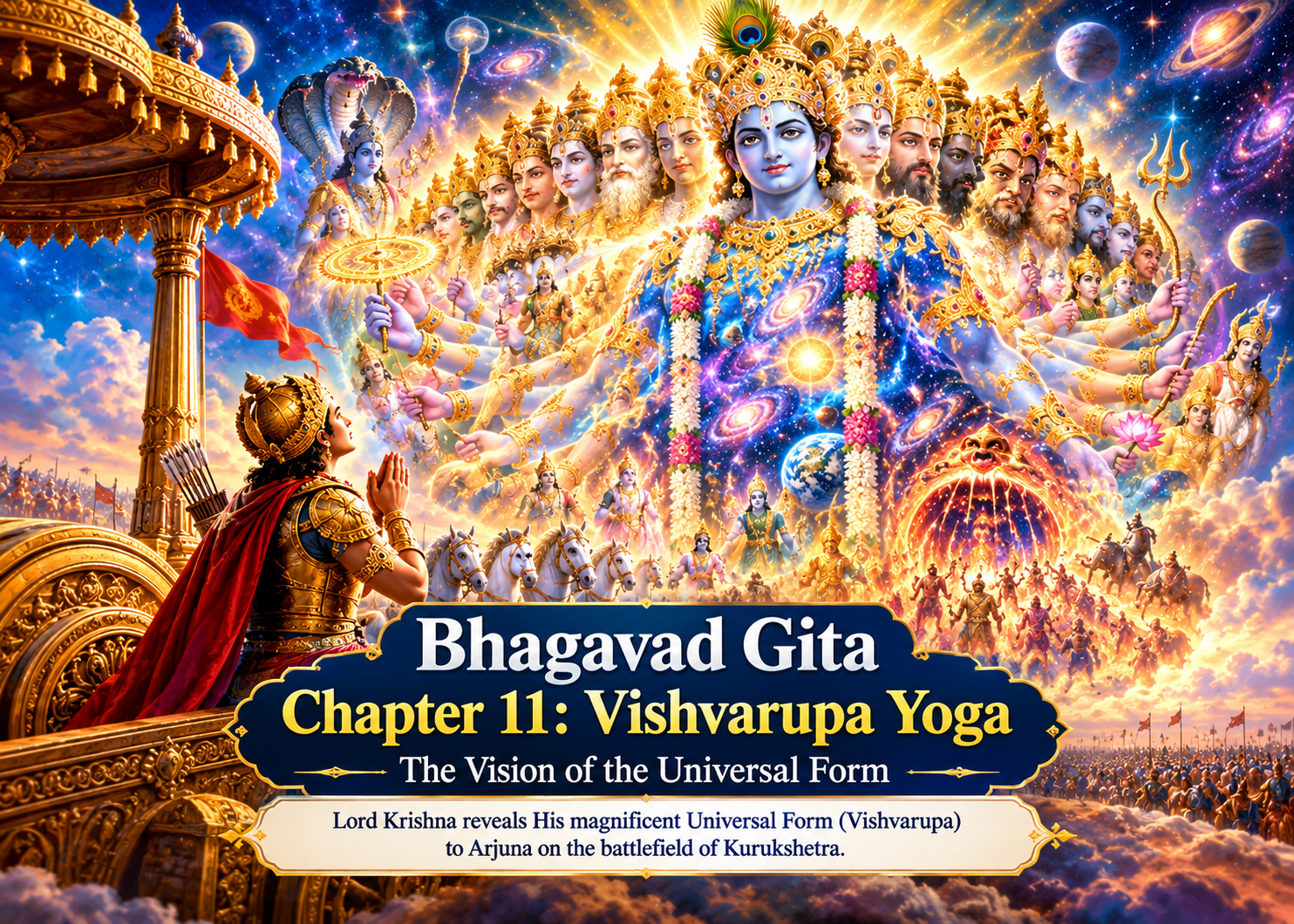

The eleventh chapter of the Bhagavad Gita is one of the most extraordinary and spiritually profound chapters in Hindu philosophy. Known as Vishvarupa Darshana Yoga, or The Yoga of the Vision of the Universal Form, this chapter describes how Lord Krishna reveals His magnificent, limitless, and awe-inspiring cosmic form to Arjuna on the battlefield of Kurukshetra.
In this divine revelation, Arjuna witnesses the entire universe within Krishna. He sees countless faces, eyes, arms, and celestial ornaments, along with the gods, sages, heavenly beings, and all the worlds. He also beholds the terrifying aspect of time, through which warriors and mighty rulers are moving toward their destined deaths.
This vision transforms Arjuna’s understanding of God, creation, time, life, and death. He realizes that Krishna is not merely his friend, cousin, or charioteer but the Supreme Divine Reality encompassing all existence.
Bhagavad Gita Chapter 11 teaches that the Divine is both the source and the ultimate destination of the universe. It reminds humanity that the visible world represents only a small part of a reality far greater than the ordinary human mind can comprehend.
In this article, we will explore the Sanskrit name of Chapter 11, its background, the meaning of its verses, the revelation of Krishna’s Universal Form, its philosophical teachings, and its relevance to modern life.
1. Introduction to Bhagavad Gita Chapter 11
The Bhagavad Gita consists of eighteen chapters and forms part of the great Indian epic, the Mahabharata. It presents a spiritual dialogue between Lord Krishna and the warrior Arjuna before the beginning of the Kurukshetra war.
The first ten chapters gradually develop important ideas about the nature of the self, righteous action, knowledge, meditation, divine manifestations, and devotion. By the end of Chapter 10, Krishna has explained His extraordinary manifestations throughout the universe. Arjuna has begun to understand that Krishna is far more than an ordinary human being.
Yet, intellectual understanding is not the same as direct spiritual experience. Arjuna wishes to see the divine reality for himself.
Chapter 11 answers this desire. Krishna grants Arjuna divine vision and reveals His Universal Form, also called Vishvarupa.
The Sanskrit word Vishvarupa combines vishva, meaning universe or all existence, and rupa, meaning form or appearance. Thus, Vishvarupa means the form that encompasses the entire universe.
The chapter is traditionally known as Vishvarupa Darshana Yoga. The word darshana means seeing or having a vision, while yoga refers to spiritual union, discipline, or a path toward realizing the Divine.
This chapter is particularly significant because it moves the dialogue beyond philosophical explanation into a direct revelation of divine majesty.
Arjuna sees that the same Supreme Being who has been guiding him as a friend contains the whole cosmos within Himself. The distinction between the individual and the universal, between the Creator and creation, becomes the central subject of this extraordinary vision.
2. Background: Why Does Arjuna Ask to See Krishna’s Universal Form?
Before Chapter 11 begins, Arjuna listens to Krishna’s explanations about the Divine.
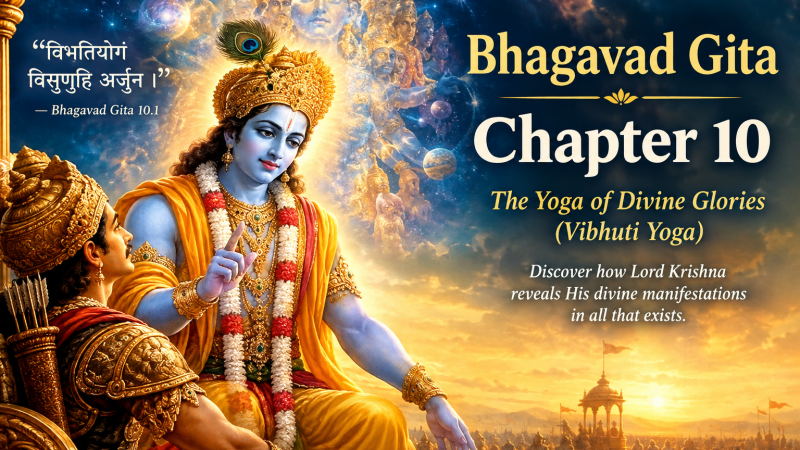
In Chapter 10, known as Vibhuti Yoga, Krishna describes His divine manifestations. He explains that among mountains He is Meru, among bodies of water He is the ocean, among lights He is the sun, and among living beings He is the consciousness that sustains life. These examples illustrate His presence in the most powerful, magnificent, and remarkable aspects of existence.
Arjuna is deeply impressed by these teachings. He recognizes Krishna as the Supreme Lord and accepts the spiritual truth of His words.
However, Arjuna now desires a direct vision of Krishna’s universal nature. He wants to see how all divine manifestations, celestial beings, and cosmic forces are united in one supreme form.
His request is not simply curiosity about an extraordinary spectacle. It arises from his growing spiritual understanding and his desire to experience the truth Krishna has explained.
Krishna agrees to reveal this form, but He makes an important distinction: the Universal Form cannot be perceived through ordinary human eyesight. Arjuna must receive divine vision to witness it.
This establishes one of the chapter’s central teachings: the highest spiritual reality cannot always be comprehended through ordinary senses or intellectual reasoning alone.
In the Gita’s narrative, divine grace enables Arjuna to perceive what would otherwise remain beyond his natural capacity.
3. The Structure of Bhagavad Gita Chapter 11
Chapter 11 contains 55 verses in the commonly used numbering of the Bhagavad Gita. These verses form a continuous narrative of spiritual revelation, divine power, fear, surrender, and devotion.
The chapter can be understood through five major stages.
- Arjuna’s request: Arjuna asks Krishna to reveal His supreme divine form.
- The granting of divine vision: Krishna explains that ordinary eyes cannot perceive the Universal Form and grants Arjuna divine sight.
- The cosmic revelation: Arjuna beholds countless divine manifestations, celestial beings, and the entire universe within Krishna.
- The revelation of Time: Arjuna sees the terrifying aspect of the Divine as the force through which warriors and rulers meet their destined end.
- Surrender and devotion: Arjuna praises Krishna, apologizes for treating Him casually in the past, and learns that sincere devotion is essential for realizing the Supreme Lord.
These stages show that the Universal Form is not merely a beautiful image of divinity. It reveals both the wonderful and frightening dimensions of existence.
The same cosmic reality that creates and sustains life also encompasses destruction and transformation. Krishna’s Universal Form therefore presents a vision of reality that goes beyond the limited human distinction between what appears pleasant and what appears terrible.
4. Arjuna’s Request for the Divine Vision
At the beginning of the chapter, Arjuna expresses his gratitude for Krishna’s teachings. He acknowledges that Krishna has explained profound spiritual truths concerning the origin and dissolution of living beings.
Arjuna now wishes to witness Krishna’s supreme form if Krishna considers him capable of seeing it.
His request demonstrates an important quality of spiritual inquiry: he does not simply reject what he cannot see, nor does he insist that his own understanding is complete. Instead, he asks for an experience that may deepen his knowledge.
Krishna responds by telling Arjuna to behold His divine manifestations in numerous forms and colors. These manifestations include celestial beings, extraordinary powers, and countless wonders never seen before by ordinary human eyes.
Krishna explains that Arjuna will see the entire universe, including everything moving and unmoving, gathered within His body.
The significance of this revelation is immense. Ordinarily, human beings perceive the universe as a collection of separate objects and living beings. Mountains, rivers, stars, animals, human societies, and celestial bodies appear to exist independently.
The Universal Form presents another perspective: all these different forms belong to a greater divine reality.
In this vision, diversity does not disappear. Rather, the innumerable forms of existence are seen as interconnected within the Supreme.
Arjuna’s request also illustrates the relationship between spiritual knowledge and grace. He has listened carefully to Krishna’s teachings, but the actual vision becomes possible only when Krishna grants him divine sight.
5. Krishna Grants Divine Eyes to Arjuna
One of the most important teachings in this chapter concerns the limitations of ordinary perception.
Krishna tells Arjuna that he cannot see the Universal Form with his ordinary eyes. He must therefore receive divine vision.
This teaching suggests that spiritual reality cannot always be understood through the physical senses alone. Human eyes can observe shapes, colors, distances, and movements, but they cannot independently reveal the ultimate significance of existence.
Similarly, the human intellect can analyze the world, formulate theories, and understand many natural processes. Yet the Gita presents spiritual realization as a deeper form of understanding that requires more than sensory observation.
Within the religious framework of the text, Krishna’s gift of divine vision represents divine grace. Arjuna does not manufacture the experience through personal power; he receives the ability to perceive something beyond his normal capacity.
This distinction also encourages humility. A person may possess education, intelligence, wealth, or social authority without understanding every dimension of existence.
The chapter invites readers to recognize that knowledge has limits and that genuine wisdom includes an awareness of those limits.
For devotees, the episode also emphasizes that the Divine reveals itself according to divine will. Human effort matters, but spiritual realization is not presented as something that can be demanded or controlled.
6. The Magnificent Universal Form of Lord Krishna

After granting divine vision, Krishna reveals His extraordinary Universal Form.
Arjuna sees countless mouths, eyes, faces, arms, and divine ornaments. The form shines with celestial weapons, garlands, and garments. Its radiance is so overwhelming that the combined brilliance of a thousand suns rising simultaneously might offer an idea of its splendor.
The description conveys a light beyond ordinary comparison. Krishna’s form is not limited to the familiar human appearance in which Arjuna has known Him.
Within this vast manifestation, Arjuna perceives numerous gods, sages, celestial beings, and wonders of creation. He sees the whole universe gathered together in the body of the Supreme Lord.
The vision is simultaneously beautiful, majestic, and difficult to comprehend.
The Universal Form is not simply a gigantic human body. It symbolizes the limitless reality in which all beings and cosmic forces exist.
The symbolism of countless faces and eyes
The many faces and eyes of Krishna’s Universal Form may be understood as symbols of His all-encompassing presence and knowledge.
No single direction, place, or realm lies outside the vision of the Supreme. What appears separate to human beings belongs to a greater whole.
The symbolism of countless arms
The countless arms and divine weapons express limitless power and the capacity to act throughout creation.
They also remind readers that the forces sustaining the universe are far greater than any individual person’s strength.
The radiance of a thousand suns
The comparison with a thousand suns conveys the overwhelming brilliance of the vision. It communicates something that ordinary language cannot fully capture.
The imagery should not be reduced to a literal astronomical measurement. Its principal purpose is to express divine magnificence beyond familiar experience.
The entire universe within Krishna
Perhaps the most significant aspect of the revelation is that Arjuna sees the whole universe within Krishna.
This image presents the Supreme as more than one being situated somewhere in the cosmos. Krishna’s Universal Form encompasses the cosmos itself.
The vision challenges the assumption that God, if understood as the ultimate reality, must be limited to one visible body or one particular location.
In this chapter, Krishna reveals a form that includes all worlds, beings, and manifestations.
7. Arjuna Sees the Gods and Celestial Beings
During the vision, Arjuna observes numerous divine and celestial beings within Krishna’s Universal Form.
The description includes prominent deities, sages, celestial serpents, and other extraordinary inhabitants of the traditional Hindu cosmos.
These beings appear within the universal manifestation rather than as independent realities beyond it.
The religious significance is that the different divine powers recognized in Hindu traditions can be viewed as belonging to one supreme cosmic reality.
Hinduism contains diverse philosophical schools and understandings of the relationship between the Supreme, the gods, and the universe. Chapter 11 offers a powerful vision in which all these celestial manifestations are encompassed by Krishna.
The chapter therefore encourages readers to consider unity within diversity. Countless beings may have different identities and functions, yet the Universal Form places them within one all-embracing divine presence.
Arjuna’s experience is not merely an encounter with many gods at once. It is the realization that the entire cosmic order is connected with Krishna’s supreme nature.
8. From Wonder to Fear: The Terrifying Aspect of the Universal Form
At first, Arjuna is filled with wonder and reverence. However, his emotions change as he continues to behold Krishna’s Universal Form.
He sees enormous mouths, fearsome teeth, and a terrifying cosmic appearance. Great warriors and rulers from the opposing armies are entering the blazing mouths of the Divine.
The imagery becomes increasingly intense. Arjuna recognizes figures such as Bhishma, Drona, Karna, and other warriors associated with the great conflict.
The sight fills him with fear because he sees that even the most powerful human beings cannot escape the force of time.
This is one of the chapter’s most profound transitions. The Universal Form is not only the source of beauty, abundance, and celestial glory. It also encompasses destruction.
Human beings naturally prefer to see divinity in forms associated with protection, prosperity, and happiness. Chapter 11 expands this perspective by revealing that the cosmic order includes death and transformation as well.
Destruction, in this context, is not necessarily a declaration that every individual tragedy is desirable or morally good. Rather, the chapter presents mortality as an unavoidable dimension of embodied existence.
Every kingdom eventually changes. Every generation passes away. Every physical form is subject to transformation.
Arjuna’s fear arises because he can no longer view the coming battle simply as a contest between two armies. He is confronted with the vastness of a cosmic order in which human life is finite.
This revelation prepares him for Krishna’s explanation of His relationship with Time.
9. Krishna as Time: The Force That Brings All Things to Their End
One of the most famous teachings of Bhagavad Gita Chapter 11 occurs when Krishna identifies Himself as Time, the mighty force that brings worlds toward destruction.
The Sanskrit expression kālo ‘smi is commonly translated as “I am Time.”
This declaration has inspired centuries of philosophical discussion because it connects the Divine with the universal process of change, mortality, and the ending of worldly forms.
Time affects everyone regardless of wealth, status, physical strength, or political authority. A mighty king and an ordinary person alike experience the passing of years. Entire civilizations rise, flourish, and decline.
Arjuna’s vision makes this truth immediate and unavoidable.
What does Krishna mean by saying, “I am Time”?
Within the Gita’s narrative, Krishna reveals Himself as the cosmic power through which the destruction of the opposing warriors is already unfolding.
Arjuna is distressed because he fears the deaths that the battle will cause. Krishna explains that the warriors are already subject to the power of Time and that Arjuna’s role must be understood within this larger reality.
This does not mean that human actions are meaningless or that individuals can disregard moral responsibility. The wider teaching of the Gita repeatedly emphasizes duty, disciplined action, and the importance of acting without selfish attachment.
Rather, the revelation challenges Arjuna’s belief that he alone is responsible for determining the entire course of events.
He must act, but he cannot control every outcome.
The lesson of mortality
The chapter asks readers to acknowledge that physical existence is temporary.
This realization can be painful, especially when it concerns loved ones, personal ambitions, or cherished institutions. Yet awareness of mortality may also help people prioritize what matters most.
Compassion, integrity, wisdom, service, and spiritual understanding can become more important when one recognizes that wealth and power do not last forever.
The Gita’s teaching is not an invitation to become indifferent to suffering. It is an invitation to face reality with wisdom rather than allowing fear to destroy one’s ability to act responsibly.
Time and human responsibility
Krishna’s revelation also raises a philosophical question: if events unfold within a greater cosmic order, what is the role of human choice?
The Gita’s answer is not simple fatalism. Arjuna is still instructed to perform his duty.
The distinction lies between responsible action and the illusion of complete control. A person must make choices carefully, consider consequences, and fulfill legitimate responsibilities, while recognizing that the final results depend on factors beyond individual control.
This teaching remains relevant in personal life, public service, education, leadership, and every field where people must make difficult decisions amid uncertainty.
10. Why Does Arjuna Ask, “Who Are You in This Terrible Form?”
Overwhelmed by the cosmic vision, Arjuna asks Krishna to explain His identity in this fierce manifestation.
He is no longer looking at his familiar friend in the ordinary way. The form before him is so immense and terrifying that he seeks an explanation of its true nature.
Krishna responds by identifying Himself as Time, engaged in the destruction of the worlds. He explains that the warriors gathered on the battlefield are destined to perish, and he urges Arjuna to rise and perform his duty.
This exchange marks a turning point in the chapter.
Previously, Arjuna’s hesitation had been shaped by his personal relationships. He could see Bhishma as his respected elder, Drona as his teacher, and the other warriors as relatives, friends, and familiar individuals.
The Universal Form forces him to confront a larger perspective. The battle is taking place within a cosmic order that extends far beyond his personal wishes.
Yet Krishna does not ask Arjuna to abandon discernment or responsibility. He directs him toward action in accordance with his duty as understood within the epic’s moral and spiritual framework.
For modern readers, this episode raises an important question: how can we fulfill our responsibilities when circumstances are painful and outcomes are uncertain?
The chapter suggests that wisdom involves understanding one’s role without assuming that one controls the whole world. We must still act thoughtfully, but we should not confuse responsibility with absolute control.
11. The Meaning of “I Have Already Destroyed Them”
Krishna tells Arjuna that the opposing warriors have already been overcome by His cosmic power and that Arjuna should become an instrument in the unfolding events.
This statement can be difficult to understand if taken outside the context of the Mahabharata.
Within the narrative, Krishna is explaining the destiny of the warriors in the specific setting of the Kurukshetra war. He is not providing a general license for violence or suggesting that anyone may harm others simply by claiming to be an instrument of God.
The Gita’s broader teachings concern disciplined action, discernment, self-control, and devotion. The concept of divine purpose must therefore be understood alongside the text’s emphasis on righteous conduct.
The idea of being an instrument also carries a spiritual meaning. It encourages a person to release the egoistic belief that every achievement depends entirely on personal greatness.
A teacher may help students learn, a physician may treat patients, and a public servant may work for the welfare of society. Each can perform a meaningful role while recognizing that the results depend on many circumstances beyond individual power.
The lesson is not to stop thinking or acting independently. Rather, it is to combine responsible effort with humility.
12. Arjuna’s Apology to Krishna
After witnessing the Universal Form, Arjuna becomes deeply conscious of Krishna’s supreme majesty.
He remembers how he has treated Krishna as a close companion. In their earlier interactions, Arjuna sometimes addressed Him casually, joked with Him, or behaved with the familiarity of friendship.
Arjuna now feels that he did not fully understand the divine nature of the person who had been guiding him.
He asks Krishna for forgiveness for any disrespectful behavior that may have occurred through friendship, carelessness, or ignorance.
This moment reveals the emotional depth of the chapter.
Arjuna’s relationship with Krishna does not become meaningless after the revelation. Instead, he understands that the familiar human relationship existed alongside a much greater divine reality.
The episode teaches that sincere self-reflection is an important part of spiritual growth. As understanding deepens, people may recognize mistakes they previously failed to notice.
True humility does not require a person to deny every positive quality or live in constant guilt. It means being willing to acknowledge errors, seek forgiveness when appropriate, and change one’s conduct.
Arjuna’s apology also shows that devotion can include love, friendship, reverence, and surrender. These feelings need not be entirely separate; they can deepen as understanding grows.
13. Why Does Arjuna Request Krishna’s Familiar Form Again?
After witnessing the immense Universal Form, Arjuna asks Krishna to return to the familiar appearance in which he has known Him.
The cosmic revelation has filled him with awe, but also with fear and emotional exhaustion. He longs to see Krishna’s gentler form again.
Krishna responds by revealing a more familiar divine appearance.
This episode is essential because it shows that the Universal Form, although magnificent, is not the only form through which devotees relate to the Divine.
The limitless cosmic reality can be difficult for the human mind to approach. A personal form offers a more intimate focus for love, prayer, contemplation, and devotion.
Within many Hindu devotional traditions, worshippers approach the Divine through particular forms of deities. Such forms allow devotees to develop a personal relationship with God through familiar symbols, stories, prayers, and practices.
Chapter 11 does not simply dismiss this personal relationship in favor of an abstract cosmic vision. Instead, it places the familiar and the universal within a broader spiritual understanding.
For many devotees, this is one of the chapter’s most comforting lessons: divine greatness and personal closeness need not be contradictory.
14. The Importance of Bhakti Yoga in Chapter 11
Toward the end of the chapter, Krishna explains that His supreme form cannot be fully understood through the ordinary performance of religious practices alone.
The chapter emphasizes the importance of devotion, sincere spiritual discipline, and a mind directed toward the Divine.
This teaching should not be interpreted as a rejection of Vedic study, charity, religious observances, or austerity. Rather, the passage stresses that these activities by themselves do not guarantee the direct realization described in the chapter.
Devotion involves more than outward appearance. It concerns the orientation of the heart and mind.
A person may perform religious ceremonies regularly yet remain dominated by arrogance, hostility, or selfishness. Another person may express devotion through prayer, compassion, honest work, and a sincere effort to overcome ego.
The Gita invites readers to examine the inner quality of their spiritual life.
What is Bhakti Yoga?
Bhakti Yoga is the path of loving devotion to the Divine.
It can include prayer, remembrance of God’s name, worship, meditation, service, and the cultivation of trust in the Supreme.
Different Hindu traditions interpret the relationship between the individual soul and the Divine in different ways. Nevertheless, devotion is a major spiritual path in many of them.
In Chapter 11, devotion becomes especially significant because the Universal Form is too vast to be mastered through intellectual analysis alone. Arjuna’s experience leads him toward reverence and surrender.
Devotion and everyday life
The teaching can be applied without withdrawing from ordinary responsibilities.
A devoted person may continue to teach, study, raise a family, support a community, or perform public duties. Spiritual practice can influence the way these responsibilities are carried out.
Honesty, patience, compassion, humility, and concern for others can become expressions of one’s devotion.
In this sense, Bhakti Yoga is not merely a practice performed at a particular time of day. It can shape a person’s entire approach to life.
15. The Final Teaching: Who Can Attain Krishna?
At the end of Chapter 11, Krishna describes the qualities of a person who can attain Him.
The passage emphasizes devotion directed toward the Supreme, freedom from excessive attachment, and action performed for the Divine.
It also describes a person who bears no hatred toward any being.
This final point is particularly important. Devotion is not presented simply as an emotional declaration or a claim of religious identity. It must be accompanied by a transformation in the way a person approaches the world.
A person who sincerely seeks spiritual growth should work to reduce hostility, selfishness, and destructive attachment.
This does not mean accepting injustice without question or refusing to establish appropriate boundaries. Rather, it means resisting the tendency to let hatred dominate one’s thoughts and actions.
The chapter’s concluding teaching connects devotion with conduct. Love of the Divine should influence how people treat others and how they fulfill their responsibilities.
16. Major Spiritual Lessons of Bhagavad Gita Chapter 11
The Universal Form offers several important lessons for personal and spiritual development.

1. The universe is greater than our limited perspective
Human beings see only a small part of existence. The Universal Form encourages humility and reminds us that our individual perspective cannot explain everything.

2. Knowledge requires humility
Arjuna is a capable warrior, yet he needs divine vision to witness Krishna’s cosmic form. His experience reminds us to remain open to learning.

3. Change is an unavoidable part of existence
Krishna’s identity as Time reminds us that physical forms, relationships, institutions, and achievements are subject to change.

4. Devotion involves trust and sincerity
Bhakti is not limited to outward religious activity. It involves a sincere orientation toward the Divine and a willingness to grow spiritually.

5. Fulfill your responsibilities without demanding total control
The chapter encourages Arjuna to act according to his duty while recognizing that the entire course of events is beyond his personal control.
These lessons are not limited to the ancient battlefield. They can guide people facing uncertainty, professional challenges, personal loss, and difficult moral choices.
17. The Philosophical Significance of Vishvarupa
Bhagavad Gita Chapter 11 has a special place in Hindu philosophical thought because it presents a vivid vision of the relationship between the Supreme, the universe, and individual beings.
The Universal Form can be interpreted through several related themes.
Unity and diversity
The universe contains innumerable forms of life and matter. The chapter presents them as included within one divine manifestation.
This imagery encourages contemplation of the relationship between diversity and unity. Individual beings retain their distinct characteristics, yet none stands outside the universal vision presented by Krishna.
The limits of human understanding
Arjuna cannot perceive the Universal Form through ordinary eyesight. Divine vision is necessary.
The narrative suggests that ultimate reality exceeds the categories through which human beings ordinarily understand the world.
It encourages humility without requiring people to abandon reason or careful inquiry.
Creation and destruction
The Universal Form contains both extraordinary beauty and terrifying destruction.
This combination prevents an overly simplistic understanding of the cosmos. The chapter asks readers to confront the reality that existence involves birth, growth, decline, and death.
Personal devotion and cosmic divinity
Krishna is both the familiar companion of Arjuna and the Supreme Lord revealing the Universal Form.
The contrast is central to the chapter’s devotional power. The personal form makes a relationship with the Divine possible, while the Universal Form reveals a reality that exceeds ordinary human categories.
Different Hindu schools interpret these themes in distinct ways, but the chapter’s imagery remains a powerful expression of divine supremacy and cosmic interconnectedness.
18. Relevance of Bhagavad Gita Chapter 11 in Modern Life
Although the Universal Form is revealed in the setting of an ancient epic, its central questions remain relevant today.
Modern people face uncertainty about their careers, relationships, financial security, health, social responsibilities, and the future of the world. The desire to control every outcome can create considerable anxiety.
Chapter 11 encourages a broader perspective.
First, it teaches humility. No individual possesses complete knowledge or unlimited power. Recognizing this can make us more willing to learn, listen, and cooperate with others.
Second, it reminds us of impermanence. Positions, possessions, and achievements may change. Instead of relying entirely on temporary sources of satisfaction, we can cultivate values that remain meaningful across changing circumstances.
Third, it encourages responsible action. Arjuna is not instructed to escape from his responsibilities simply because the situation is difficult. He is encouraged to understand his duty and act with determination.
Fourth, it gives spiritual significance to devotion. Prayer, reflection, and remembrance of the Divine can help devotees cultivate patience, humility, and inner strength.
Finally, the chapter encourages us to recognize that our lives are connected with something greater than our individual interests. Whether expressed through religious devotion, service, or ethical conduct, this awareness can encourage a more thoughtful approach to life.
These applications should be understood as reflections on the chapter rather than claims that every modern problem has a simple scriptural solution.
19. Why Is Bhagavad Gita Chapter 11 Important?
Chapter 11 is important because it brings together several central themes of the Bhagavad Gita.
It reveals Krishna’s supreme cosmic nature, illustrates the limitations of ordinary perception, confronts Arjuna with the reality of death, and directs him toward devotion and responsible action.
The chapter also helps explain why Arjuna’s relationship with Krishna changes throughout the dialogue. He begins by seeing Krishna primarily as his companion and charioteer. Through the Universal Form, he recognizes a divine reality beyond that familiar relationship.
The vision does not remove every difficulty from Arjuna’s life. The war remains, and difficult choices still have to be made. However, his understanding of the situation has deepened.
This is one of the chapter’s lasting messages: spiritual insight does not necessarily remove life’s challenges, but it can transform how we understand and respond to them.
The Universal Form is therefore not only a description of divine magnificence. It is a turning point in Arjuna’s spiritual journey.
20. Conclusion: The Infinite Divine Reality
Bhagavad Gita Chapter 11, Vishvarupa Darshana Yoga, presents one of the most powerful visions of divinity in Hindu sacred literature.
When Krishna reveals His Universal Form, Arjuna sees countless manifestations of the cosmos within a single divine reality. He witnesses celestial beauty, extraordinary power, and the terrifying force of Time.
The experience changes his understanding of Krishna and deepens his awareness of the relationship between individual life and the universe.
The chapter teaches that the Divine cannot be confined to the limited forms through which human beings ordinarily understand existence. It also reminds us that creation and destruction, beauty and terror, and personal relationships and cosmic reality can all be contemplated within the vast vision of the Universal Form.
At the same time, the chapter concludes with an emphasis on devotion, disciplined action, and freedom from hatred.
Its message is not simply to marvel at the greatness of God, but to allow spiritual understanding to influence how we live.
For readers seeking wisdom from the Bhagavad Gita, Chapter 11 offers an enduring invitation: recognize the limitations of the ego, accept the reality of change, perform your responsibilities with sincerity, and cultivate a deeper relationship with the Divine.
The Universal Form reminds us that what we see is only a part of a much greater reality. Through humility, devotion, and thoughtful action, we can approach that reality with greater wisdom and reverence.
21. Frequently Asked Questions About Bhagavad Gita Chapter 11
1. What is the name of Bhagavad Gita Chapter 11?
Chapter 11 is called Vishvarupa Darshana Yoga, meaning the Yoga of the Vision of the Universal Form. It describes Krishna revealing His cosmic form to Arjuna.
2. How many verses are there in Bhagavad Gita Chapter 11?
Bhagavad Gita Chapter 11 contains 55 verses in the commonly used chapter numbering.
3. What is the main message of Chapter 11?
Its central message is that the Supreme Divine encompasses the universe, including creation and destruction. The chapter also emphasizes humility, devotion, awareness of mortality, and responsible action.
4. Why does Krishna show His Universal Form to Arjuna?
Arjuna asks to see Krishna’s supreme divine nature after listening to His explanations of divine manifestations in Chapter 10. Krishna grants him divine vision so that he can witness the Universal Form.
5. What does Vishvarupa mean?
Vishvarupa means the Universal Form or the form encompassing the entire universe. In Chapter 11, it represents Krishna’s all-encompassing cosmic manifestation.
6. What does Krishna mean by “I am Time”?
Krishna reveals Himself as the cosmic power of Time, through which worlds and embodied beings move toward transformation and destruction. The teaching emphasizes mortality and the limits of individual control.
7. What is the spiritual significance of Chapter 11?
The chapter reveals the relationship between the individual, the universe, and the Supreme. It teaches that spiritual understanding involves humility and devotion, not merely intellectual knowledge.
8. What is the final teaching of Bhagavad Gita Chapter 11?
The chapter concludes by emphasizing unwavering devotion to Krishna, dedicating one’s actions to the Divine, and living without hatred toward any being.
*Related Article: Bhagavad Gita Chapter 10: Vibhuti Yoga