Bhagavad Gita Chapter 10: Vibhuti Yoga
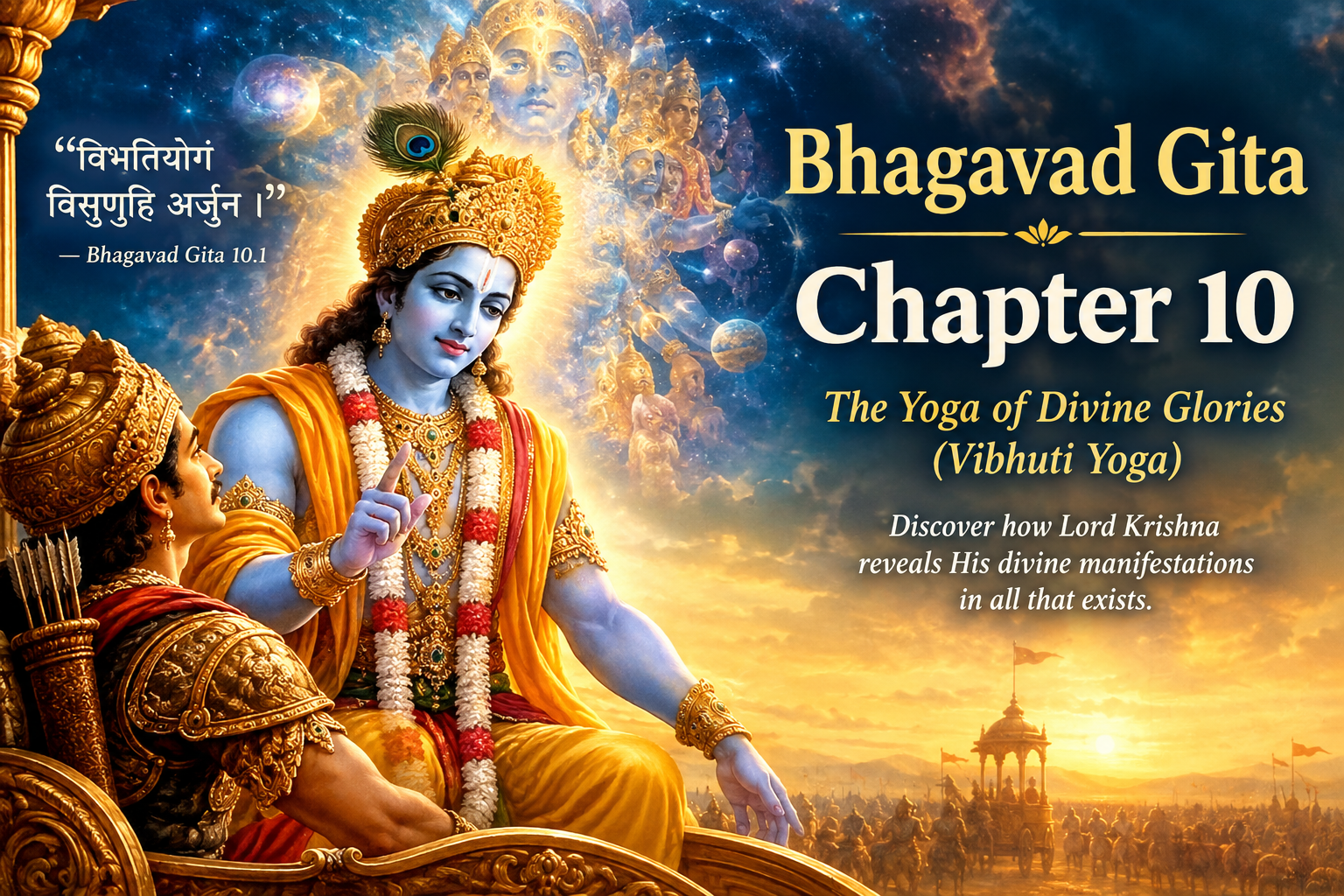
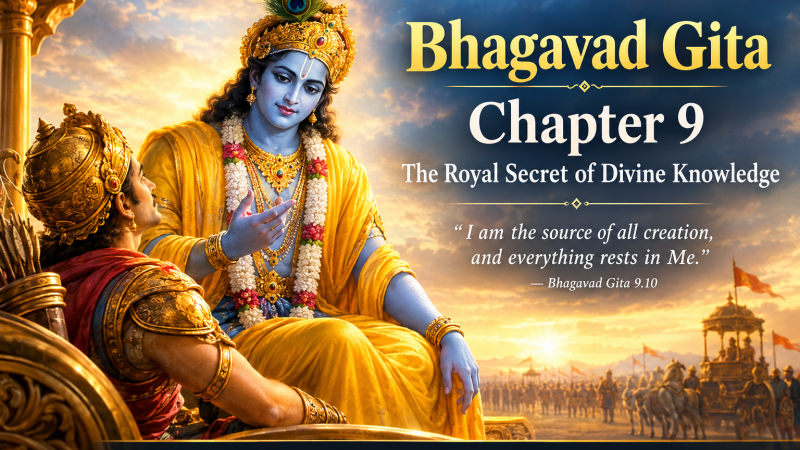
Bhagavad Gita Chapter 10, known as Vibhuti Yoga or The Yoga of Divine Glories, is one of the most inspiring chapters of the Bhagavad Gita. In this chapter, Lord Krishna explains to Arjuna how His divine presence can be recognized throughout the universe.
After explaining the nature of devotion, knowledge, and the Supreme Reality in the earlier chapters, Krishna now describes His vibhutis—His extraordinary manifestations, powers, and glories. He shows Arjuna that wherever there is exceptional beauty, strength, wisdom, brilliance, greatness, or excellence, it can be understood as a manifestation of the Divine.
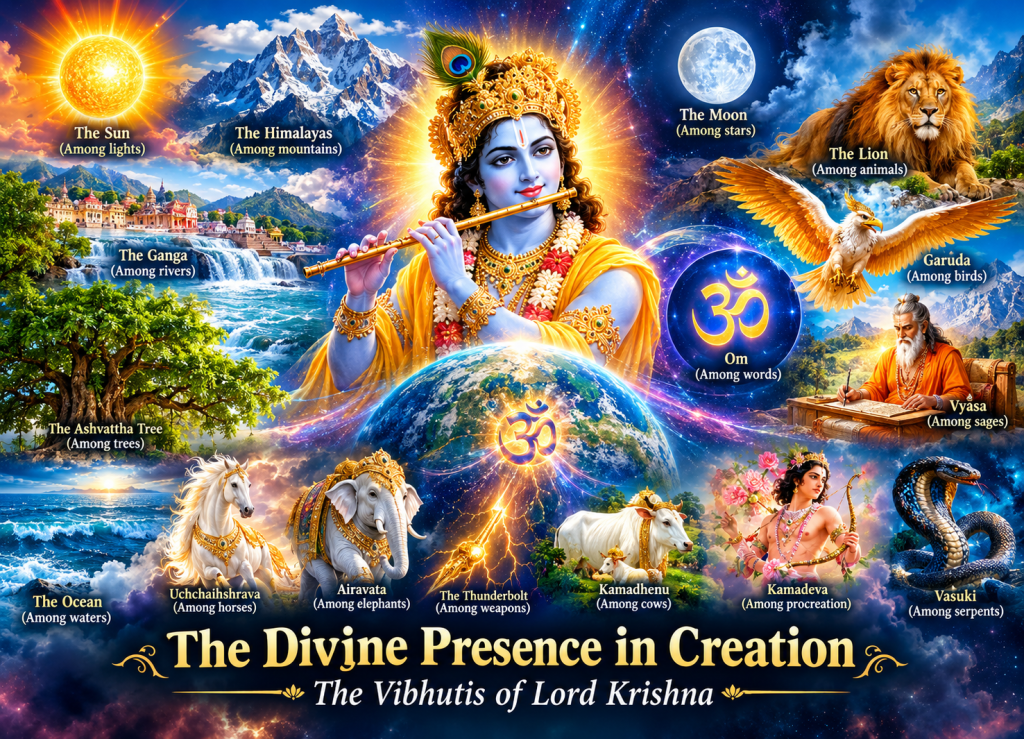
Chapter 10 contains 42 Sanskrit slokas. Krishna begins by declaring that He is the ultimate source of the gods, sages, and all qualities found among living beings. He then gives Arjuna a remarkable series of examples: among lights He is the Sun, among mountains He is Meru, among rivers He is the Ganga, among weapons He is the thunderbolt, among trees He is the Ashvattha, among animals He is the lion, and among warriors He is Rama.
The chapter reaches its philosophical climax when Krishna explains that all extraordinary manifestations of existence are merely a fraction of His divine splendor. Finally, He declares that the entire universe is sustained by only one portion of His infinite being.
The central message is simple but profound: the Divine is not distant from creation. The sacred can be recognized through the highest and most beautiful expressions of life.
What Is Vibhuti Yoga?
The Sanskrit word vibhuti can refer to divine glory, magnificence, power, splendor, or extraordinary manifestation. Therefore, Vibhuti Yoga is the path of understanding God through His manifestations in the world.
Arjuna already knows that Krishna is not merely an ordinary human being. Krishna has gradually revealed Himself as the Supreme Reality. Yet Arjuna wants to understand how he can remember the Divine constantly.
This question is important. A person may believe in God but still struggle to maintain spiritual awareness while performing everyday activities. Krishna therefore gives Arjuna a practical method.
He tells him to recognize the Divine in the greatest expressions of existence.
The brilliant Sun can remind us of divine radiance.
The Himalayas can remind us of divine majesty.
The Ganga can remind us of spiritual purity.
Wisdom can remind us of divine intelligence.
Truth can remind us of divine presence.
Courage can remind us of divine strength.
Thus, the world itself becomes a field for spiritual remembrance.
Bhagavad Gita Chapter 10: All 42 Slokas, English Translation and Explanation
Sloka 10.1
श्रीभगवानुवाच
भूय एव महाबाहो शृणु मे परमं वचः ।
यत्तेऽहं प्रीयमाणाय वक्ष्यामि हितकाम्यया ॥ १०.१ ॥
English Translation:
The Supreme Lord said: O mighty-armed Arjuna, listen again to My supreme teaching. Because you are dear to Me, I shall speak it to you for your welfare.
Explanation:
Krishna begins by addressing Arjuna affectionately. He is not merely giving intellectual information; He is teaching Arjuna for his spiritual welfare. The verse shows the importance of listening with love, faith, and openness.
Sloka 10.2
न मे विदुः सुरगणाः प्रभवं न महर्षयः ।
अहमादिर्हि देवानां महर्षीणां च सर्वशः ॥ १०.२ ॥
English Translation:
Neither the hosts of gods nor the great sages know My origin, for I am the source of the gods and the great sages in every respect.
Explanation:
Krishna explains that the Supreme cannot be understood as something that has been created by another being. The gods and sages themselves arise from the Supreme Reality. Therefore, God is the ultimate source rather than an effect of another cause.
Sloka 10.3
यो मामजमनादिं च वेत्ति लोकमहेश्वरम् ।
असम्मूढः स मर्त्येषु सर्वपापैः प्रमुच्यते ॥ १०.३ ॥
English Translation:
One who knows Me as unborn, beginningless, and the Supreme Lord of all worlds, remaining free from delusion among mortals, becomes liberated from all wrongdoing.
Explanation:
Krishna emphasizes three ideas: He is unborn, beginningless, and the Supreme Lord of the worlds. Genuine understanding of the Divine removes spiritual ignorance and frees a person from the confusion that leads to harmful actions.
Sloka 10.4
बुद्धिर्ज्ञानमसम्मोहः क्षमा सत्यं दमः शमः ।
सुखं दुःखं भवोऽभावो भयं चाभयमेव च ॥ १०.४ ॥
English Translation:
Intelligence, knowledge, freedom from delusion, forgiveness, truthfulness, control of the senses, tranquility of mind, happiness, sorrow, birth, death, fear, and fearlessness—
Explanation:
Krishna begins describing the many qualities and experiences found among living beings. Both positive and difficult experiences exist within the order of creation. Understanding their divine source helps a person remain balanced.
Sloka 10.5
अहिंसा समता तुष्टिस्तपो दानं यशोऽयशः ।
भवन्ति भावा भूतानां मत्त एव पृथग्विधाः ॥ १०.५ ॥
English Translation:
Nonviolence, equanimity, contentment, austerity, charity, fame and dishonor—all these different qualities of beings arise from Me alone.
Explanation:
Human beings possess many different qualities. Krishna identifies their ultimate source in the Divine. The verse encourages humility because even qualities we consider our own gifts ultimately depend upon a greater spiritual source.
Sloka 10.6
महर्षयः सप्त पूर्वे चत्वारो मनवस्तथा ।
मद्भावा मानसा जाता येषां लोक इमाः प्रजाः ॥ १०.६ ॥
English Translation:
The seven great sages of ancient times and the four Manus arose from My nature and mind; from them have descended the beings of these worlds.
Explanation:
Krishna refers to the great sages and Manus associated with the cosmic order of creation. The teaching emphasizes that the entire chain of creation ultimately proceeds from the Supreme.
Sloka 10.7
एतां विभूतिं योगं च मम यो वेत्ति तत्त्वतः ।
सोऽविकम्पेन योगेन युज्यते नात्र संशयः ॥ १०.७ ॥
English Translation:
One who truly knows this divine glory and this Yoga of Mine becomes firmly united with unwavering spiritual understanding. Of this there is no doubt.
Explanation:
Knowing God’s manifestations is not merely an exercise in memorizing names. True understanding strengthens one’s spiritual connection with the Divine.
Sloka 10.8
अहं सर्वस्य प्रभवो मत्तः सर्वं प्रवर्तते ।
इति मत्वा भजन्ते मां बुधा भावसमन्विताः ॥ १०.८ ॥
English Translation:
I am the source of everything; from Me all creation proceeds. Knowing this, the wise worship Me with deep devotion.
Explanation:
This is one of the central verses of Chapter 10. Krishna identifies Himself as the ultimate source of existence. Realizing this naturally leads the wise toward devotion, gratitude, and surrender.
Sloka 10.9
मच्चित्ता मद्गतप्राणा बोधयन्तः परस्परम् ।
कथयन्तश्च मां नित्यं तुष्यन्ति च रमन्ति च ॥ १०.९ ॥
English Translation:
With their minds absorbed in Me and their lives dedicated to Me, My devotees enlighten one another by speaking of Me continually. They find satisfaction and joy in doing so.
Explanation:
Spiritual conversation is itself a form of devotion. Devotees encourage one another by discussing God’s teachings, qualities, and presence. Such remembrance produces inner joy.
Sloka 10.10
तेषां सततयुक्तानां भजतां प्रीतिपूर्वकम् ।
ददामि बुद्धियोगं तं येन मामुपयान्ति ते ॥ १०.१० ॥
English Translation:
To those who remain constantly united with Me and worship Me with love, I give the wisdom by which they come to Me.
Explanation:
Krishna says that sincere devotion receives divine guidance. Buddhi-yoga here means a higher spiritual intelligence that directs the devotee toward realization.
Sloka 10.11
तेषामेवानुकम्पार्थमहमज्ञानजं तमः ।
नाशयाम्यात्मभावस्थो ज्ञानदीपेन भास्वता ॥ १०.११ ॥
English Translation:
Out of compassion for them, dwelling within their hearts, I destroy the darkness born of ignorance with the radiant lamp of knowledge.
Explanation:
The Divine is described as an inner light. Spiritual ignorance is compared with darkness, while knowledge is compared with a lamp. Through sincere devotion and divine grace, ignorance gradually disappears.
Arjuna Recognizes Krishna’s Supreme Nature
Sloka 10.12
अर्जुन उवाच
परं ब्रह्म परं धाम पवित्रं परमं भवान् ।
पुरुषं शाश्वतं दिव्यमादिदेवमजं विभुम् ॥ १०.१२ ॥
English Translation:
Arjuna said: You are the Supreme Brahman, the Supreme Abode, the Supreme Purifier. You are the eternal Divine Person, the primordial God, unborn and all-pervading.
Explanation:
Arjuna now openly acknowledges Krishna’s supreme nature. His understanding has deepened through Krishna’s previous teachings.
Sloka 10.13
आहुस्त्वामृषयः सर्वे देवर्षिर्नारदस्तथा ।
असितो देवलो व्यासः स्वयं चैव ब्रवीषि मे ॥ १०.१३ ॥
English Translation:
All the sages declare You to be so, as do the divine sage Narada, Asita, Devala, and Vyasa; and now You Yourself are telling me this.
Explanation:
Arjuna points to the testimony of respected sages. His faith is not based merely on emotion but is supported by spiritual teachers and Krishna’s own revelation.
Sloka 10.14
सर्वमेतदृतं मन्ये यन्मां वदसि केशव ।
न हि ते भगवन्व्यक्तिं विदुर्देवा न दानवाः ॥ १०.१४ ॥
English Translation:
O Krishna, I accept as true everything You have told me. Neither the gods nor the demons can fully understand Your divine manifestation.
Explanation:
Arjuna expresses complete trust in Krishna. The Supreme Reality is beyond the complete comprehension of beings who themselves exist within creation.
Sloka 10.15
स्वयमेवात्मनात्मानं वेत्थ त्वं पुरुषोत्तम ।
भूतभावन भूतेश देवदेव जगत्पते ॥ १०.१५ ॥
English Translation:
O Supreme Person, O Source of all beings, Lord of all beings, God of gods, Lord of the universe, You alone know Yourself completely.
Explanation:
The Infinite cannot be completely measured by finite intellectual abilities. Krishna alone fully knows His own limitless nature.
Sloka 10.16
वक्तुमर्हस्यशेषेण दिव्या ह्यात्मविभूतयः ।
याभिर्विभूतिभिर्लोकानिमांस्त्वं व्याप्य तिष्ठसि ॥ १०.१६ ॥
English Translation:
Please describe fully Your divine manifestations through which You pervade and remain within these worlds.
Explanation:
Arjuna asks Krishna to explain how the Divine can be recognized throughout creation. This request leads to the great catalogue of divine manifestations in the remainder of the chapter.
Sloka 10.17
कथं विद्यामहं योगिंस्त्वां सदा परिचिन्तयन् ।
केषु केषु च भावेषु चिन्त्योऽसि भगवन्मया ॥ १०.१७ ॥
English Translation:
O Yogin, how may I know You while constantly meditating upon You? In what forms and manifestations should I contemplate You, O Lord?
Explanation:
Arjuna asks a deeply practical spiritual question: How can an ordinary person remember the Divine throughout daily life? Krishna’s answer is a spiritual map of the universe.
Sloka 10.18
विस्तरेणात्मनो योगं विभूतिं च जनार्दन ।
भूयः कथय तृप्तिर्हि शृण्वतो नास्ति मेऽमृतम् ॥ १०.१८ ॥
English Translation:
O Janardana, please describe again in detail Your Yoga and divine manifestations. I never become satisfied hearing Your words of nectar.
Explanation:
Arjuna’s desire to hear spiritual wisdom has become intense. He compares Krishna’s teachings to nectar, emphasizing the joy that comes from hearing sacred knowledge.
Krishna Describes His Divine Manifestations
Sloka 10.19
श्रीभगवानुवाच
हन्त ते कथयिष्यामि दिव्या ह्यात्मविभूतयः ।
प्राधान्यतः कुरुश्रेष्ठ नास्त्यन्तो विस्तरस्य मे ॥ १०.१९ ॥
English Translation:
The Supreme Lord said: Very well, O best of the Kurus. I shall tell you about My principal divine manifestations, for there is no end to the extent of My glories.
Explanation:
Krishna makes it clear that His manifestations are infinite. The examples that follow are only the principal ones.
Sloka 10.20
अहमात्मा गुडाकेश सर्वभूताशयस्थितः ।
अहमादिश्च मध्यं च भूतानामन्त एव च ॥ १०.२० ॥
English Translation:
O Arjuna, I am the Self dwelling in the hearts of all beings. I am their beginning, their middle, and their end.
Explanation:
This is one of the deepest declarations of the chapter. Krishna is not merely saying that God is somewhere in the universe. He says that the Divine Self dwells within all beings.
Sloka 10.21
आदित्यानामहं विष्णुर्ज्योतिषां रविरंशुमान् ।
मरीचिर्मरुतामस्मि नक्षत्राणामहं शशी ॥ १०.२१ ॥
English Translation:
Among the Adityas I am Vishnu; among lights I am the radiant Sun. Among the Maruts I am Marichi, and among the stars I am the Moon.
Explanation:
Krishna selects the most prominent examples from different cosmic categories. The Sun and Moon symbolize divine radiance and the ordering power of the cosmos.
Sloka 10.22
वेदानां सामवेदोऽस्मि देवानामस्मि वासवः ।
इन्द्रियाणां मनश्चास्मि भूतानामस्मि चेतना ॥ १०.२२ ॥
English Translation:
Among the Vedas I am the Sama Veda; among the gods I am Indra. Among the senses I am the mind, and among living beings I am consciousness.
Explanation:
The verse moves from sacred scripture and celestial beings to the human mind and consciousness. It reminds us that awareness itself is a profound expression of the Divine.
Sloka 10.23
रुद्राणां शङ्करश्चास्मि वित्तेशो यक्षरक्षसाम् ।
वसूनां पावकश्चास्मि मेरुः शिखरिणामहम् ॥ १०.२३ ॥
English Translation:
Among the Rudras I am Shankara; among the Yakshas and Rakshasas I am Kubera. Among the Vasus I am Fire, and among mountains I am Meru.
Explanation:
Krishna continues through different groups of beings and natural forms. Meru represents extraordinary majesty and cosmic centrality in traditional Hindu cosmology.
Sloka 10.24
पुरोधसां च मुख्यं मां विद्धि पार्थ बृहस्पतिम् ।
सेनानीनामहं स्कन्दः सरसामस्मि सागरः ॥ १०.२४ ॥
English Translation:
O Arjuna, know Me as Brihaspati among priests, Skanda among commanders, and the ocean among bodies of water.
Explanation:
Brihaspati represents spiritual wisdom and leadership, Skanda represents martial leadership, and the ocean represents vastness and majesty.
Sloka 10.25
महर्षीणां भृगुरहं गिरामस्म्येकमक्षरम् ।
यज्ञानां जपयज्ञोऽस्मि स्थावराणां हिमालयः ॥ १०.२५ ॥
English Translation:
Among great sages I am Bhrigu; among words I am the single imperishable syllable Om. Among sacrifices I am the sacrifice of silent or repeated recitation, and among immovable things I am the Himalayas.
Explanation:
The verse brings together Bhrigu, Om, japa, and the Himalayas. These represent spiritual wisdom, sacred sound, devotional practice, and majestic stability.
Sloka 10.26
अश्वत्थः सर्ववृक्षाणां देवर्षीणां च नारदः ।
गन्धर्वाणां चित्ररथः सिद्धानां कपिलो मुनिः ॥ १०.२६ ॥
English Translation:
Among all trees I am the Ashvattha; among divine sages I am Narada. Among the Gandharvas I am Chitraratha, and among perfected beings I am the sage Kapila.
Explanation:
The Ashvattha tree is deeply significant in Hindu philosophy. Narada represents devotion and divine wisdom, while Kapila is associated with profound philosophical insight.
Sloka 10.27
उच्चैःश्रवसमश्वानां विद्धि माममृतोद्भवम् ।
ऐरावतं गजेन्द्राणां नराणां च नराधिपम् ॥ १०.२७ ॥
English Translation:
Among horses know Me as Ucchaihshrava, born from the churning associated with nectar; among mighty elephants I am Airavata; and among human beings I am the king.
Explanation:
Ucchaihshrava and Airavata are celebrated symbols of extraordinary excellence. Krishna again teaches Arjuna to recognize divine glory through the finest example within each category.
Sloka 10.28
आयुधानामहं वज्रं धेनूनामस्मि कामधुक् ।
प्रजनश्चास्मि कन्दर्पः सर्पाणामस्मि वासुकिः ॥ १०.२८ ॥
English Translation:
Among weapons I am the thunderbolt; among cows I am Kamadhenu. I am the power of procreation represented by Kamadeva, and among serpents I am Vasuki.
Explanation:
The thunderbolt represents irresistible power, Kamadhenu represents abundance, procreative energy represents continuation of life, and Vasuki represents extraordinary strength among serpents.
Sloka 10.29
अनन्तश्चास्मि नागानां वरुणो यादसामहम् ।
पितॄणामर्यमा चास्मि यमः संयमतामहम् ॥ १०.२९ ॥
English Translation:
Among the Nagas I am Ananta; among aquatic beings I am Varuna. Among the ancestors I am Aryaman, and among those who maintain discipline I am Yama.
Explanation:
This verse associates the Divine with cosmic order, depth, discipline, and authority. The examples demonstrate that divine presence can be found in many dimensions of existence.
Sloka 10.30
प्रह्लादश्चास्मि दैत्यानां कालः कलयतामहम् ।
मृगाणां च मृगेन्द्रोऽहं वैनतेयश्च पक्षिणाम् ॥ १०.३० ॥
English Translation:
Among the Daityas I am Prahlada; among those who measure or control I am Time. Among animals I am the lion, and among birds I am Garuda.
Explanation:
Prahlada represents devotion even in an unfavorable environment. Time represents the unstoppable movement of existence. The lion and Garuda symbolize strength, majesty, and freedom.
Sloka 10.31
पवनः पवतामस्मि रामः शस्त्रभृतामहम् ।
झषाणां मकरश्चास्मि स्रोतसामस्मि जाह्नवी ॥ १०.३१ ॥
English Translation:
Among purifying forces I am the wind; among warriors bearing weapons I am Rama. Among aquatic creatures I am the Makara, and among flowing rivers I am the Ganga.
Explanation:
This is especially significant for devotees of Lord Rama and the Ganga. The Ganga, traditionally known as Jahnavi, is presented as the foremost among flowing rivers and therefore as a reminder of divine purity.
Sloka 10.32
सर्गाणामादिरन्तश्च मध्यं चैवाहमर्जुन ।
अध्यात्मविद्या विद्यानां वादः प्रवदतामहम् ॥ १०.३२ ॥
English Translation:
O Arjuna, I am the beginning, the middle, and the end of creation. Among all forms of knowledge I am spiritual knowledge, and among those who debate I am the reasoning that leads toward truth.
Explanation:
Krishna connects Himself with the entire process of existence—beginning, continuation, and conclusion. He also gives special importance to spiritual knowledge and truthful reasoning.
Sloka 10.33
अक्षराणामकारोऽस्मि द्वन्द्वः सामासिकस्य च ।
अहमेवाक्षयः कालो धाताहं विश्वतोमुखः ॥ १०.३३ ॥
English Translation:
Among letters I am the letter A; among compounds I am the dual form. I am inexhaustible Time, and I am the cosmic sustainer whose face is turned in every direction.
Explanation:
The letter A has a foundational place in Sanskrit sound. Krishna again uses a basic element to point toward the underlying unity of existence. Time and the universal sustainer reveal the vast cosmic dimension of the Divine.
Sloka 10.34
मृत्युः सर्वहरश्चाहमुद्भवश्च भविष्यताम् ।
कीर्तिः श्रीर्वाक्च नारीणां स्मृतिर्मेधा धृतिः क्षमा ॥ १०.३४ ॥
English Translation:
I am death, which takes away all things, and I am the source of what is yet to arise. Among feminine qualities I am fame, prosperity, speech, memory, intelligence, steadfastness, and forgiveness.
Explanation:
Krishna presents both death and future birth as aspects of the cosmic process. The verse also honors qualities traditionally expressed through feminine forms, including wisdom, patience, memory, and forgiveness.
Sloka 10.35
बृहत्साम तथा साम्नां गायत्री छन्दसामहम् ।
मासानां मार्गशीर्षोऽहमृतूनां कुसुमाकरः ॥ १०.३५ ॥
English Translation:
Among the Sama hymns I am the Brihat-Sama; among meters I am the Gayatri. Among months I am Margashirsha, and among seasons I am spring, the season of flowers.
Explanation:
The verse highlights sacred music, sacred meter, a revered month, and spring. Spring symbolizes renewal, beauty, fertility, and the joyful expression of nature.
Sloka 10.36
द्यूतं छलयतामस्मि तेजस्तेजस्विनामहम् ।
जयोऽस्मि व्यवसायोऽस्मि सत्त्वं सत्त्ववतामहम् ॥ १०.३६ ॥
English Translation:
Among those who employ strategy I am the skill of the game; I am the brilliance of the brilliant. I am victory, determination, and the goodness of those who possess noble qualities.
Explanation:
This verse can initially appear surprising because Krishna mentions gambling or strategic play. The deeper point is that extraordinary ability itself comes from the Divine, although human beings remain responsible for how they use their abilities.
Sloka 10.37
वृष्णीनां वासुदेवोऽस्मि पाण्डवानां धनञ्जयः ।
मुनीनामप्यहं व्यासः कवीनामुशना कविः ॥ १०.३७ ॥
English Translation:
Among the Vrishnis I am Vasudeva; among the Pandavas I am Dhananjaya, Arjuna. Among sages I am Vyasa, and among poets I am Ushana, the poet-seer.
Explanation:
Krishna now includes Himself and Arjuna among His examples. Arjuna is reminded that his own extraordinary qualities can also be understood as divine gifts.
Sloka 10.38
दण्डो दमयतामस्मि नीतिरस्मि जिगीषताम् ।
मौनं चैवास्मि गुह्यानां ज्ञानं ज्ञानवतामहम् ॥ १०.३८ ॥
English Translation:
Among those who discipline, I am the power of correction; among those who seek victory, I am sound strategy. Among secrets I am silence, and among the wise I am knowledge.
Explanation:
Discipline, strategy, silence, and wisdom are all valuable forms of strength. Sometimes truth is expressed through words, while at other times silence itself becomes meaningful.
Sloka 10.39
यच्चापि सर्वभूतानां बीजं तदहमर्जुन ।
न तदस्ति विना यत्स्यान्मया भूतं चराचरम् ॥ १०.३९ ॥
English Translation:
O Arjuna, I am also the seed of all beings. Nothing moving or unmoving can exist without Me.
Explanation:
The seed is a powerful metaphor for the Divine source of life. Every living being ultimately depends upon the Supreme Reality. The verse expresses the fundamental unity underlying creation.
Sloka 10.40
नान्तोऽस्ति मम दिव्यानां विभूतीनां परन्तप ।
एष तूद्देशतः प्रोक्तो विभूतेर्विस्तरो मया ॥ १०.४० ॥
English Translation:
O conqueror of enemies, there is no end to My divine manifestations. What I have described to you is only a brief indication of My glories.
Explanation:
Krishna makes an important qualification: the long list is not complete. Divine manifestations are infinite. The examples are only tools for meditation and understanding.
Sloka 10.41
यद्यद्विभूतिमत्सत्त्वं श्रीमदूर्जितमेव वा ।
तत्तदेवावगच्छ त्वं मम तेजोंऽशसम्भवम् ॥ १०.४१ ॥
English Translation:
Whatever being possesses extraordinary glory, beauty, excellence, strength, or splendor—know that to arise from a portion of My divine radiance.
Explanation:
This verse gives the central practical lesson of Vibhuti Yoga. Whenever we encounter genuine greatness, beauty, courage, wisdom, or brilliance, we can see it as a reflection of divine power.
This does not mean that every impressive human achievement is automatically righteous. Rather, Krishna directs the mind toward recognizing the divine source behind genuine excellence.
Sloka 10.42
अथवा बहुनैतेन किं ज्ञातेन तवार्जुन ।
विष्टभ्याहमिदं कृत्स्नमेकांशेन स्थितो जगत् ॥ १०.४२ ॥
English Translation:
But what need is there for you to know all these details, O Arjuna? With only a single portion of Myself, I pervade and sustain this entire universe.
Explanation:
Krishna concludes with an extraordinary statement. Even all the manifestations listed in the chapter are only a tiny indication of His infinite nature. The entire universe is sustained by only one portion of the Divine.
The Main Teachings of Bhagavad Gita Chapter 10
1. God Is the Source of Everything
One of the most important statements in Chapter 10 is:
“I am the source of everything; from Me all creation proceeds.”
This changes the way a devotee sees the world. Instead of considering the universe spiritually empty, one begins to see existence as dependent upon a deeper divine reality.
2. The Divine Can Be Recognized in Excellence
Krishna does not ask Arjuna to see divinity only in temples, sacred places, or formal worship.
He points toward the Sun, Moon, mountains, rivers, trees, animals, sages, warriors, knowledge, courage, intelligence, beauty, and many other manifestations.
The lesson is powerful:
Whenever you encounter extraordinary excellence, let it remind you of the Divine.
A beautiful sunrise can become meditation.
The flow of the Ganga can become meditation.
A moment of genuine kindness can become meditation.
A wise teacher can become a reminder of divine wisdom.
Courage in difficult circumstances can remind us of divine strength.
3. Devotion and Knowledge Work Together
Chapter 10 does not separate knowledge and devotion.
Krishna explains the nature of the Divine and then describes how devotees remember Him. Knowledge gives direction to devotion, while devotion makes spiritual knowledge living and meaningful.
The devotee does not merely think, “God exists.”
The devotee gradually learns to think:
“The Divine is present throughout existence.”
4. God Is Present Within All Beings
Verse 10.20 is especially important:
“I am the Self dwelling in the hearts of all beings.”
This teaching has profound ethical implications.
If the Divine is present within all beings, then hatred, cruelty, arrogance, and unnecessary violence become spiritually destructive.
Seeing the Divine within others can cultivate compassion, humility, patience, and respect.
5. Spiritual Remembrance Can Become a Daily Practice
Vibhuti Yoga offers a practical meditation technique.
Whenever you see something magnificent, remember Krishna.
When you see the Sun—remember divine radiance.
When you see the mountains—remember divine stability.
When you see a river—remember divine flow.
When you witness wisdom—remember divine knowledge.
When you see courage—remember divine strength.
When you experience genuine love—remember the Divine source of love.
In this way, everyday life becomes a continuous spiritual reminder.
Why Bhagavad Gita Chapter 10 Is Important
Chapter 10 occupies a special place within the Bhagavad Gita because it connects the transcendent Divine with the visible universe.
Earlier teachings can sometimes seem abstract. Terms such as Brahman, Atman, karma, yoga, and spiritual knowledge can be difficult for beginners.
Vibhuti Yoga provides concrete examples.
Krishna essentially says:
Look at the greatest things around you.
Look at the brilliance of the Sun.
Look at the majesty of the Himalayas.
Look at the sacredness associated with the Ganga.
Look at the wisdom of great sages.
Look at the strength of the lion.
Look at the courage of great heroes.
Look at the intelligence of the wise.
Then understand that their excellence is a reflection of the Supreme.
This makes Chapter 10 especially accessible to spiritual seekers.
Vibhuti Yoga and the Hindu Understanding of Nature
Chapter 10 also provides a deeply spiritual way of viewing nature.
The natural world is not merely a collection of physical objects. Mountains, rivers, trees, animals, seasons, celestial bodies, and natural forces can all become reminders of the Divine.
This perspective helps explain why many elements of nature hold special importance within Hindu traditions.
The Ganga is revered not simply as water.
The Himalayas are not merely geological formations.
The Sun is not merely a physical source of light.
Sacred trees are not merely plants.
Through Vibhuti Yoga, nature can become a doorway to contemplation.
Vibhuti Yoga and Modern Life
The teachings of Chapter 10 remain relevant even in the modern world.
People today often become absorbed in competition, material achievement, social status, and personal success. Vibhuti Yoga provides a different perspective.
When we achieve something important, we should not become arrogant. We can recognize that our abilities depend on countless forces beyond our individual control.
When we see someone more talented than ourselves, we do not need to respond with jealousy. We can appreciate the excellence and see it as an expression of divine potential.
When we experience beauty, we can pause instead of immediately moving on.
When we experience difficulty, we can remember that life contains both happiness and sorrow, birth and death, fear and fearlessness.
The chapter therefore encourages gratitude, humility, awareness, and devotion.
The Meaning of “I Am” in Chapter 10
One of the most striking features of this chapter is Krishna’s repeated use of the first-person declaration:
“Among this, I am that.”
Among mountains—Meru.
Among rivers—the Ganga.
Among weapons—the thunderbolt.
Among animals—the lion.
Among birds—Garuda.
Among sages—Vyasa.
Among warriors—Rama.
Among knowledge—spiritual knowledge.
These statements are not simply a list of mythological associations.
They train the mind to recognize unity behind diversity.
The world contains countless names and forms, but the Divine Reality behind them is one.
The Final Message of Chapter 10
The final two verses summarize the entire teaching.
Krishna first says that every extraordinary manifestation—every form of beauty, brilliance, strength, glory, or excellence—is born from a portion of His divine radiance.
Then He goes even further.
He says that the entire universe is sustained by only one portion of His being.
This means that no list can fully describe the Divine.
The Sun is not God in isolation.
The Ganga is not God in isolation.
The Himalayas are not God in isolation.
A great sage is not God in isolation.
Rather, each can serve as a window through which the human mind can contemplate divine greatness.
This is the heart of Vibhuti Yoga.
Bhagavad Gita Chapter 10 in One Simple Message
If the entire chapter had to be summarized in a few lines, its teaching could be expressed like this:
See the Divine in the highest and noblest expressions of life.
When you see wisdom, remember the Divine.
When you see courage, remember the Divine.
When you see beauty, remember the Divine.
When you see greatness, remember the Divine.
When you see the majesty of nature, remember the Divine.
And when you look within yourself, remember that the same Supreme Reality dwells within the hearts of all beings.
Conclusion
Bhagavad Gita Chapter 10, Vibhuti Yoga, offers a magnificent vision of the relationship between God and the universe. Lord Krishna reveals that His divine presence can be contemplated through the most remarkable manifestations of existence.
He describes Himself as the Self within all beings, the source of creation, the Sun among lights, the Ganga among rivers, the Himalayas among immovable things, the lion among animals, Rama among warriors, spiritual knowledge among forms of knowledge, and the seed of all beings.
Yet Krishna repeatedly reminds Arjuna that these examples are only a small indication of His limitless glory.
The chapter therefore teaches both immanence and transcendence: the Divine is present throughout creation, yet the Divine is infinitely greater than everything we can see or describe.
For a spiritual seeker, Vibhuti Yoga provides a beautiful daily practice. Instead of separating spiritual life from ordinary life, one can learn to transform ordinary experiences into opportunities for remembrance.
A sunrise can inspire gratitude.
A river can inspire purity.
A mountain can inspire steadiness.
Wisdom can inspire humility.
Courage can inspire devotion.
Beauty can inspire wonder.
In this way, the world itself becomes a reminder of the Divine.
The final teaching of Chapter 10 is therefore not merely about identifying Krishna’s manifestations. It is about learning to see with spiritual awareness.
When the mind begins to recognize divine excellence everywhere, devotion becomes natural, gratitude becomes deeper, and the apparent separation between the sacred and the ordinary begins to disappear.
That is the enduring beauty of Vibhuti Yoga—the Yoga of Divine Glories.
*Related Article: Bhagavad Gita Chapter 9: Raja Vidya Raja Guhya Yoga