Vedas: The Eternal Wisdom of Ancient India
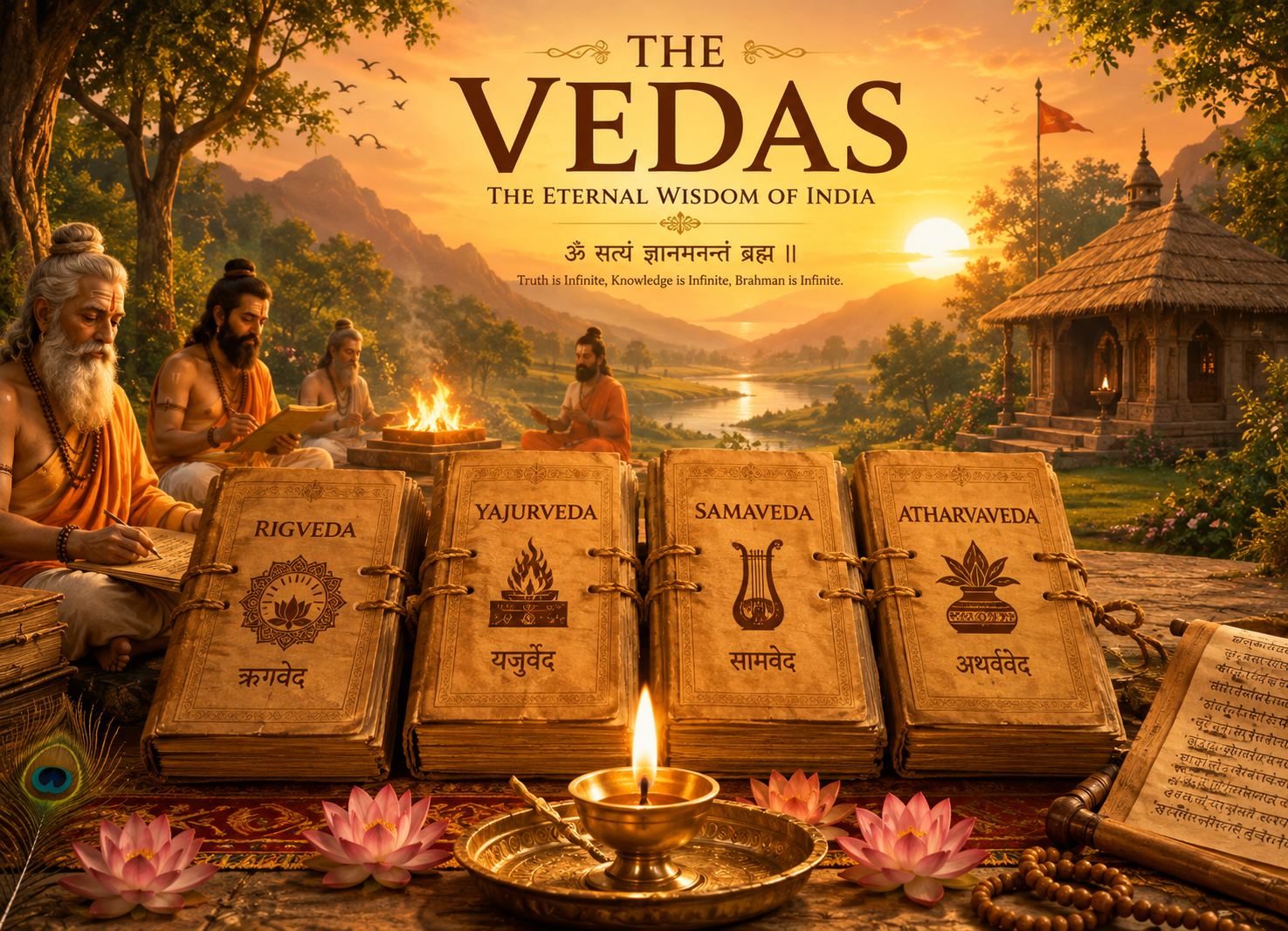
The Vedas are the oldest and most sacred scriptures of Hinduism. They are not merely religious books but a vast collection of spiritual knowledge, philosophical ideas, hymns, prayers, rituals, and practical wisdom that have guided Indian civilization for thousands of years. The Vedas are considered the foundation of Hindu philosophy and have profoundly influenced religion, culture, literature, science, music, medicine, and ethics across the Indian subcontinent.
Unlike many ancient texts written by a single author, the Vedas are believed to be divine revelations that were “heard” by enlightened sages known as Rishis during deep states of meditation. For this reason, they are called Śruti, meaning “that which is heard.” According to Hindu tradition, these eternal truths were not invented by human beings but were revealed by the Supreme Reality and preserved through an unbroken oral tradition.
Even in the twenty-first century, the teachings of the Vedas continue to inspire scholars, philosophers, scientists, spiritual seekers, yoga practitioners, and millions of devotees around the world. Whether someone is interested in spirituality, history, philosophy, or ancient Indian culture, understanding the Vedas provides a deeper appreciation of one of humanity’s oldest surviving knowledge systems.
What Are the Vedas?
The Vedas are the oldest body of sacred literature in Hinduism and among the oldest surviving literary works in the world. They consist of thousands of hymns, verses, chants, rituals, prayers, and philosophical discussions that were composed in Vedic Sanskrit.
The Vedas address a wide variety of subjects, including:
- Spiritual wisdom
- Worship of divine forces
- Nature and the universe
- Ethics and moral living
- Meditation
- Sacrificial rituals (Yajnas)
- Cosmology
- Social harmony
- Human duties
- Inner realization
Far from being limited to religion alone, the Vedas present a holistic vision of life in which the material and spiritual worlds are deeply interconnected.
The wisdom contained in these scriptures later became the basis for many important Hindu texts, including the Upanishads, Puranas, Ramayana, Mahabharata, Bhagavad Gita, and various schools of Hindu philosophy.
The Meaning of the Word “Veda”
The word Veda comes from the Sanskrit root “Vid,” which means:
- To know
- To understand
- To perceive
- To gain wisdom
Therefore, the word Veda literally means:
“Knowledge” or “Sacred Wisdom.”
However, this knowledge is not confined to academic learning. It represents universal truth, spiritual realization, and an understanding of the cosmos, human life, and the Divine.
The Vedas teach that true knowledge goes beyond information. Genuine wisdom transforms the individual, leading from ignorance to enlightenment.
Why Are the Vedas Called Eternal?
Hindu tradition describes the Vedas as Sanatana, meaning eternal.
According to Vedic philosophy:
- Truth is eternal.
- Divine wisdom always exists.
- The Rishis did not create the Vedas.
- They simply realized eternal truths through meditation.
Because of this belief, the Vedas are regarded as Apaurusheya, meaning “not of human origin.”
Unlike ordinary books written by authors, the Vedas are believed to exist beyond time. Every cosmic cycle reveals this eternal wisdom anew to enlightened sages.
This concept makes the Vedas unique among the world’s ancient scriptures.
Why the Vedas Are Important
The importance of the Vedas extends far beyond religion. They have shaped Indian civilization in countless ways for more than three thousand years.
Their significance includes:
1. Foundation of Hinduism
Almost every major Hindu tradition traces its roots to Vedic teachings.
The concepts of:
all find their earliest expressions in the Vedas.
2. Source of Spiritual Wisdom
The Vedas encourage individuals to seek truth through inquiry, discipline, and self-realization rather than blind belief.
Many later spiritual traditions—including Vedanta, Yoga, and several schools of Hindu philosophy—developed directly from Vedic ideas.
3. Preservation of Ancient Knowledge
The Vedas preserve information about:
- Ancient society
- Ritual practices
- Agriculture
- Astronomy
- Ethics
- Music
- Linguistics
- Medicine
- Governance
They provide historians with valuable insights into one of the world’s oldest civilizations.
4. Influence on Indian Culture
Many customs still practiced today originate from Vedic traditions, including:
- Marriage ceremonies
- Sacred fire rituals
- Naming ceremonies
- Temple worship
- Festivals
- Chanting of mantras
These traditions continue to connect millions of people with their cultural heritage.
5. Universal Message
The Vedas promote values such as:
- Truth
- Compassion
- Unity
- Harmony
- Respect for nature
- Peace
- Self-discipline
These timeless principles remain relevant in today’s rapidly changing world.
The Divine Origin of the Vedas
According to Hindu tradition, the Vedas were not written in the ordinary sense.
Instead, ancient sages entered profound states of meditation where they experienced divine sound and eternal truth.
These sages became known as Mantra Drashta, meaning “Seers of the Mantras.”
They did not invent the hymns.
They perceived them.
The knowledge was then passed from teacher to student with extraordinary precision for countless generations.
Later, the great sage Vyasa, also known as Krishna Dvaipayana Vyasa, organized this immense body of knowledge into four principal collections:
- Rigveda
- Yajurveda
- Samaveda
- Atharvaveda
This organization made the preservation and transmission of Vedic wisdom more systematic.
Historical Background of the Vedas
Modern scholars generally estimate that the oldest portions of the Vedas were composed between 1500 BCE and 1200 BCE, with some traditions arguing for even earlier dates. The texts developed over many centuries through an oral tradition before being written down much later.
The Vedic period is often divided into two broad phases:
Early Vedic Period
This period is characterized by:
- Composition of the Rigveda
- Nature worship
- Fire sacrifices
- Tribal communities
- Pastoral lifestyle
The hymns primarily praise deities associated with natural forces.
Later Vedic Period
As society evolved:
- Kingdoms emerged.
- Rituals became more elaborate.
- Philosophical inquiry deepened.
- Social institutions developed further.
This period also laid the groundwork for the philosophical discussions found in the Upanishads.
The Language of the Vedas
The Vedas were composed in Vedic Sanskrit, an older form of Sanskrit that differs in vocabulary, grammar, and pronunciation from Classical Sanskrit.
Vedic Sanskrit is highly poetic and symbolic. Many hymns employ metaphor, layered meanings, and sophisticated poetic structures.
Because pronunciation was considered sacred, even a minor error in chanting was traditionally believed to alter the intended effect of a mantra.
As a result, generations of scholars developed remarkably precise methods of memorization and recitation.
The Remarkable Oral Tradition
One of the most extraordinary achievements of ancient India is the preservation of the Vedas through oral transmission.
For thousands of years:
- Students memorized every syllable.
- Teachers corrected pronunciation.
- Multiple recitation techniques ensured accuracy.
- Entire texts were preserved without written manuscripts.
Different methods of chanting—such as Pada Patha, Krama Patha, and Ghana Patha—acted as built-in safeguards against errors, making the Vedic oral tradition one of the most sophisticated memory systems in human history.
This meticulous preservation has enabled the Vedas to survive with an exceptional degree of textual continuity.
The Structure of the Vedas
Each of the four Vedas follows a similar internal structure, consisting of four major sections.
1. Samhita
The Samhitas contain the core hymns, mantras, and prayers used in worship and rituals.
These are the oldest portions of the Vedas.
2. Brahmana
The Brahmanas explain:
- Ritual procedures
- Symbolism of sacrifices
- Duties of priests
- Ceremonial practices
They provide practical guidance for performing Vedic rituals.
3. Aranyaka
The Aranyakas, or “forest texts,” serve as a bridge between ritual practice and philosophical contemplation.
They were traditionally studied by those who had retired from household life to pursue deeper spiritual reflection.
4. Upanishad
The Upanishads represent the philosophical culmination of Vedic thought.
They explore profound questions such as:
- Who am I?
- What is Brahman?
- What is the nature of the soul?
- Why do humans suffer?
- What is liberation?
These texts emphasize inner realization over external ritual and have profoundly influenced Indian philosophy.
Core Concepts Introduced in the Vedas
Although different sections emphasize different themes, several foundational ideas appear throughout Vedic literature:
- Rta (Cosmic Order): The universal law that sustains harmony in nature and society.
- Dharma: Living in accordance with righteousness and duty.
- Yajna (Sacrifice): Acts of offering that symbolize reciprocity between humans, nature, and the divine.
- Mantra: Sacred sounds believed to carry spiritual significance and transformative power.
- Satya (Truth): Commitment to truth in thought, speech, and action.
- Brahman: The ultimate, all-pervading reality that later becomes central in the Upanishads.
- Atman: Atman is the inner self or soul, whose relationship with Brahman is explored in depth in later Vedic philosophy.
Why the Vedas Still Matter Today
Although composed thousands of years ago, the Vedas continue to speak to modern readers because they address enduring questions about life, purpose, ethics, and humanity’s relationship with the natural world.
Their teachings encourage:
- Respect for knowledge and education.
- Harmony with nature.
- Ethical living.
- Self-discipline and inner growth.
- Spiritual inquiry.
- Peaceful coexistence.
- Lifelong learning.
These timeless ideals have allowed the Vedas to remain relevant across cultures and generations.
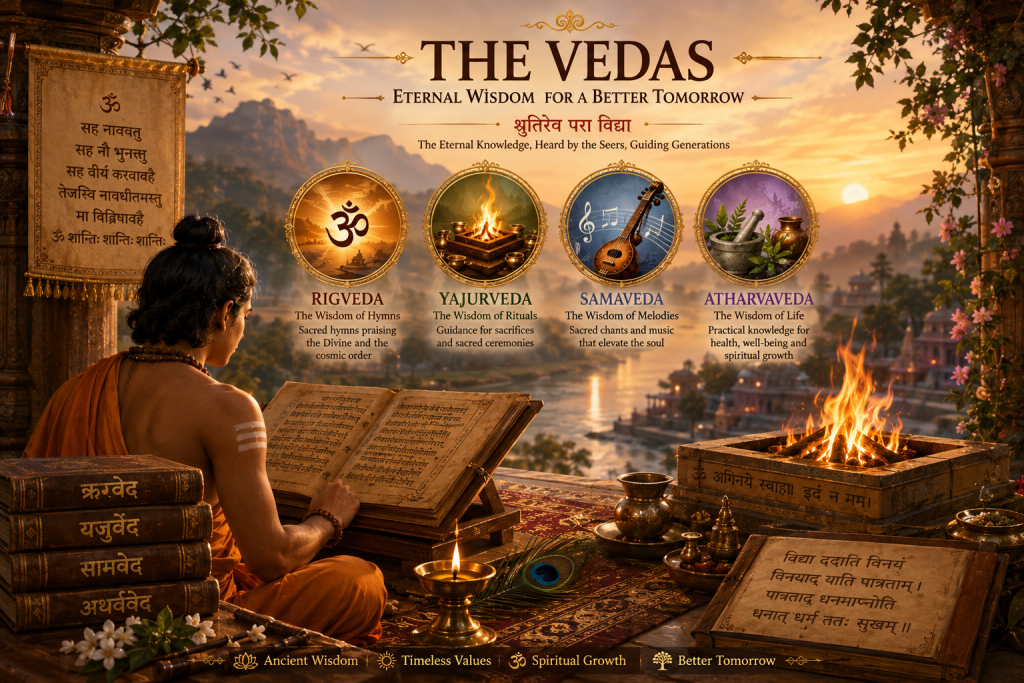
The Four Pillars of Vedic Knowledge
Although people often refer to the Vedas as a single body of sacred literature, they actually consist of four distinct collections, each with its own purpose, style, and subject matter. Together, they form the foundation of Hindu religious thought and preserve the spiritual, cultural, and intellectual heritage of ancient India.
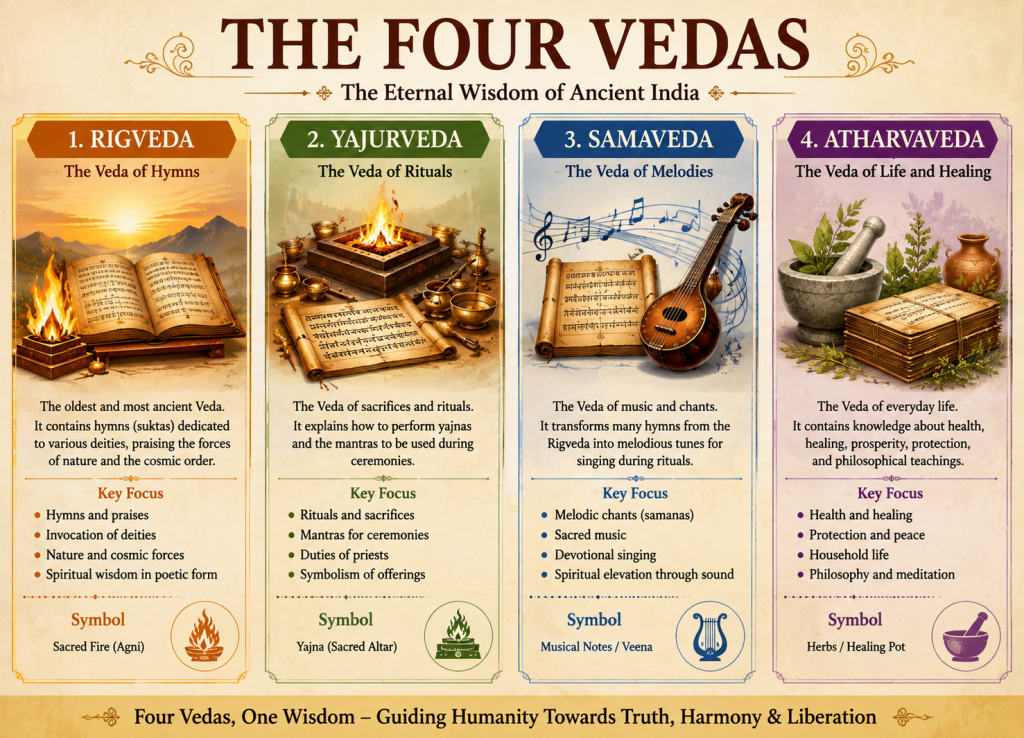
The four Vedas are:
- Rigveda – The Veda of hymns
- Yajurveda – The Veda of sacrifices
- Samaveda – The Veda of melodies
- Atharvaveda – The Veda of everyday life and spiritual knowledge
Each Veda complements the others. While the Rigveda provides poetic hymns, the Yajurveda explains ritual procedures, the Samaveda transforms many hymns into musical chants, and the Atharvaveda addresses practical life, healing, philosophy, and spiritual well-being.
Together, they present a comprehensive vision of religion, ethics, knowledge, and human existence.
1. Rigveda – The Oldest Veda
The Rigveda is the oldest and most important of the four Vedas. It is also regarded as one of the oldest surviving literary works in the world.
The Rigveda consists primarily of hymns dedicated to various deities representing the forces of nature and the cosmic order. These hymns were composed by different sages over many generations and reflect the spiritual experiences of the Vedic age.
Meaning of Rigveda
The word Rig (Ṛc) means “praise” or “hymn.”
Therefore, Rigveda literally means:
“The Knowledge of Hymns.”
Its verses praise divine powers, seek blessings, and express profound philosophical insights about the universe.
Structure of the Rigveda
The Rigveda contains:
- 10 Mandalas (Books)
- 1,028 Hymns (Suktas)
- Approximately 10,600 verses
Each Mandala contains hymns composed by different families of sages.
The Second through Seventh Mandalas are often known as the “Family Books” because they are associated with specific Rishi lineages.
Major Deities in the Rigveda
The Rigveda praises numerous deities, including:
Agni
The god of fire.
Agni is the first deity invoked in the opening hymn of the Rigveda because fire served as the sacred messenger between humans and the divine.
Indra
The king of the gods.
Indra is celebrated as the heroic warrior who defeats the serpent Vritra and releases life-giving waters, symbolizing the triumph of order over chaos.
Varuna
The guardian of Rta, the universal moral and cosmic order.
Varuna represents justice, truth, and moral discipline.
Soma
Associated with a sacred ritual drink and divine inspiration.
Soma symbolizes vitality, immortality, and spiritual ecstasy.
Surya
The Sun God.
Surya is praised as the source of light, energy, and life.
Ushas
Ushas is the goddess of dawn.
Her hymns beautifully describe the arrival of morning and the renewal of hope.
Vayu
Vayu is the god of wind and life-breath.
He represents movement, vitality, and invisible power.
Famous Hymns of the Rigveda
The Rigveda includes many celebrated hymns that continue to inspire scholars and devotees.
Some of the most famous include:
Nasadiya Sukta
Nasadiaya Sukta is often called the Hymn of Creation.
It reflects on profound questions:
- How did the universe begin?
- Who created it?
- Can anyone truly know?
Its philosophical depth continues to fascinate readers worldwide.
Purusha Sukta
Purusha Sukta describes the Cosmic Being (Purusha), whose symbolic sacrifice gives rise to the universe and the various aspects of creation.
It emphasizes the interconnectedness of all existence.
Gayatri Mantra
Gayatri Mantra is one of the most revered mantras in Hinduism, dedicated to Savitr, the solar deity.
It is widely recited for wisdom, clarity, and spiritual illumination.
Importance of the Rigveda
The Rigveda is invaluable because it:
- Preserves the earliest Sanskrit poetry.
- Documents ancient Vedic society.
- Introduces fundamental Hindu concepts.
- Inspires later philosophical traditions.
- Serves as the foundation for the other Vedas.
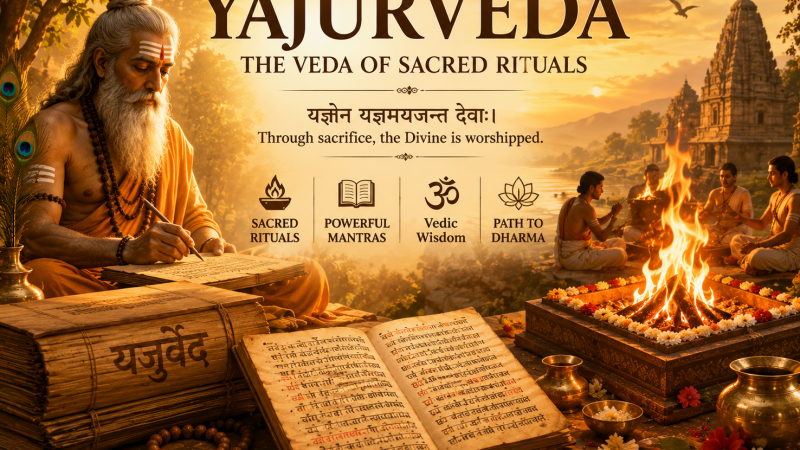
2. Yajurveda – The Veda of Sacred Rituals
The Yajurveda focuses on the practical performance of sacrifices and rituals.
While the Rigveda provides the hymns, the Yajurveda explains how those hymns should be used during ceremonies.
Its primary purpose is to guide priests in performing Yajnas, or sacred fire rituals.
Meaning of Yajurveda
The word Yajus refers to sacrificial formulas.
Thus,
Yajurveda means:
“The Knowledge of Sacrificial Rituals.”
Two Main Versions
The Yajurveda exists in two principal traditions:
Shukla (White) Yajurveda
- Organized systematically.
- Separates mantras from explanatory material.
- Closely associated with the Vajasaneyi Samhita.
Krishna (Black) Yajurveda
- Intermixes mantras and explanations.
- Preserves an older textual arrangement.
- Includes several important recensions.
Subjects Covered
The Yajurveda explains:
- Fire sacrifices
- Royal ceremonies
- Agricultural rituals
- Seasonal festivals
- Offerings
- Consecration ceremonies
- Symbolic meanings of rituals
It provides detailed instructions regarding every stage of ritual performance.
Philosophical Importance
Although famous for ritual instructions, the Yajurveda also explores deeper spiritual ideas.
Its later sections emphasize:
- Self-discipline
- Renunciation
- Meditation
- Duty
- Ethical conduct
Some of the most important Upanishads are connected with the Yajurveda.
Why the Yajurveda Matters
The Yajurveda demonstrates that rituals are not merely external acts.
Every sacrifice symbolizes:
- Gratitude
- Selflessness
- Harmony
- Cooperation
- Cosmic balance
Its teachings encourage individuals to transform daily actions into sacred offerings.
3. Samaveda – The Veda of Music
The Samaveda is often described as the musical Veda.
Instead of introducing many entirely new hymns, it adapts numerous verses from the Rigveda into melodic chants designed for ritual singing.
Music occupies a central place in Vedic worship, and the Samaveda preserves this sacred musical tradition.
Meaning of Samaveda
The Sanskrit word Saman means:
- Melody
- Sacred chant
- Musical recitation
Therefore,
Samaveda means:
“The Knowledge of Sacred Melodies.”
Structure of the Samaveda
The Samaveda contains approximately:
- 1,875 verses
Most of these are derived from the Rigveda, though arranged for musical performance.
Importance of Music
The Samaveda transformed spoken hymns into devotional music.
The chants were performed during:
- Soma sacrifices
- Temple ceremonies
- Community worship
- Royal rituals
Music was regarded as a means of connecting the human soul with the Divine.
Influence on Indian Classical Music
Many musicologists consider the Samaveda the earliest foundation of Indian classical music.
Its influence can be seen in:
- Musical scales
- Chanting traditions
- Rhythm
- Vocal discipline
- Sacred performance
The systematic use of melody in Vedic chanting shaped later musical developments across India.
Spiritual Significance
The Samaveda teaches that devotion is expressed not only through words but also through sound.
Its chants create an atmosphere of reverence, concentration, and spiritual elevation.
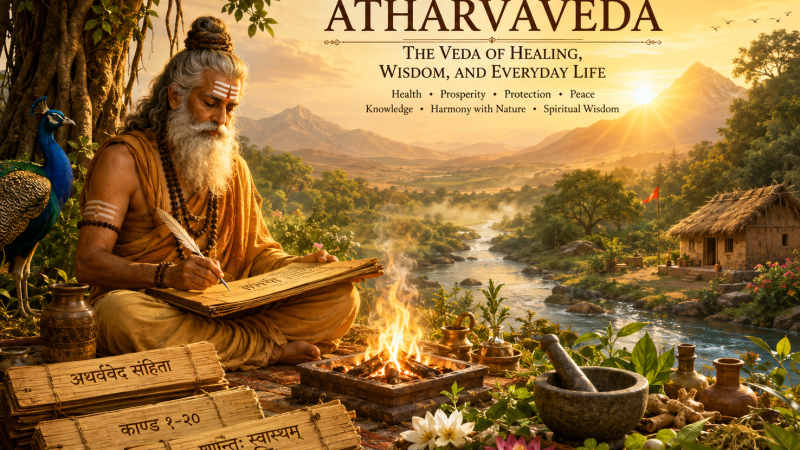
4. Atharvaveda – The Veda of Everyday Life
The Atharvaveda differs significantly from the other three Vedas.
Instead of focusing mainly on grand sacrificial rituals, it addresses practical aspects of human life.
It includes prayers for:
- Health
- Prosperity
- Family happiness
- Agriculture
- Protection
- Longevity
- Peace
Because of its broad scope, it offers a unique glimpse into the everyday concerns of ancient society.
Meaning of Atharvaveda
The Atharvaveda is named after the ancient sage Atharvan, traditionally associated with sacred fire and priestly knowledge.
It combines spiritual teachings with practical guidance.
Structure
The Atharvaveda contains:
- 20 Books
- About 730 Hymns
- Nearly 6,000 Mantras
Its language and themes differ from those of the earlier Vedas, reflecting a wider range of interests.
Topics Covered
The Atharvaveda discusses:
- Healing prayers
- Herbal remedies
- Domestic rituals
- Peace invocations
- Moral teachings
- Kingship
- Social harmony
- Prosperity
- Longevity
- Meditation
It reveals the close relationship between spirituality and daily life in the Vedic worldview.
Early Medical Knowledge
The Atharvaveda contains references to:
- Medicinal herbs
- Disease prevention
- Healing practices
- Physical well-being
These traditions later contributed to the development of Ayurveda, India’s classical system of medicine.
Philosophical Ideas
Beyond practical concerns, the Atharvaveda explores:
- The nature of consciousness
- The human soul
- Cosmic unity
- Prayer
- Inner peace
Its philosophical passages anticipate many ideas that are later developed in the Upanishads.
Comparing the Four Vedas
| Veda | Primary Focus | Distinctive Feature |
|---|---|---|
| Rigveda | Hymns and prayers | Oldest collection of sacred hymns |
| Yajurveda | Rituals and sacrifices | Practical guidance for ceremonies |
| Samaveda | Music and chanting | Foundation of sacred musical traditions |
| Atharvaveda | Daily life and philosophy | Healing, domestic life, and spiritual wisdom |
Together, these four Vedas provide a complete framework for understanding the spiritual, ritual, intellectual, and practical dimensions of ancient Indian life.
How the Four Vedas Complement One Another
Although each Veda has its own emphasis, they are deeply interconnected:
- The Rigveda provides the sacred hymns that praise the divine.
- The Yajurveda explains how those hymns are used in rituals and sacrifices.
- The Samaveda transforms many of the hymns into melodious chants for worship.
- The Atharvaveda extends Vedic wisdom into everyday life through prayers, healing traditions, and reflections on human well-being.
This integrated approach demonstrates that Vedic knowledge is not confined to one aspect of life. It embraces worship, philosophy, music, ethics, health, and social harmony as parts of a unified vision of existence.
The Internal Structure of the Vedas
Although each Veda has its own unique content, all four follow a similar structure consisting of four major sections. Together, these sections guide a seeker from external worship to inner spiritual realization.
1. Samhitas – The Collection of Sacred Hymns
The Samhitas form the oldest and most fundamental part of each Veda. They consist of hymns, prayers, invocations, and mantras dedicated to various deities.
These hymns were recited during religious ceremonies, fire sacrifices, and daily worship. They express gratitude to the Divine, seek protection and prosperity, and celebrate the harmony of the universe.
Some famous examples include the Gayatri Mantra, the Purusha Sukta, and the Nasadiya Sukta from the Rigveda.
2. Brahmanas – The Ritual Manuals
The Brahmanas explain the procedures, meanings, and symbolism of Vedic rituals. They describe how sacrifices should be performed, the responsibilities of priests, and the spiritual significance behind ceremonial acts.
Rather than treating rituals as mechanical practices, the Brahmanas emphasize that every offering represents devotion, discipline, and harmony between humanity and the cosmic order.
3. Aranyakas – The Forest Texts
The Aranyakas, meaning “forest books,” mark a transition from ritual to contemplation.
Traditionally, these texts were studied by sages and householders who had entered the later stage of life and retired to forests for spiritual reflection.
The Aranyakas encourage meditation, self-control, and the search for deeper truths beyond external ceremonies.
4. Upanishads – The Pinnacle of Vedic Philosophy
The Upanishads are often regarded as the philosophical culmination of the Vedas. They explore profound questions about existence and consciousness, including:
- Who am I?
- What is the soul?
- What is ultimate reality?
- What happens after death?
- How can one attain liberation?
These texts shift the focus from outward rituals to inner knowledge and spiritual realization. Their teachings later became the foundation of Vedanta, one of the most influential schools of Hindu philosophy.
The Core Philosophy of the Vedas
The Vedas present a holistic philosophy that combines spirituality, ethics, and practical living. Several key concepts appear repeatedly throughout Vedic literature.
Dharma – The Principle of Righteous Living
Dharma refers to the moral and ethical order that sustains individuals and society. It includes honesty, compassion, responsibility, justice, and respect for others.
The Vedas teach that living according to Dharma brings harmony to both personal life and the wider community.
Karma – The Law of Action
The idea of Karma emphasizes that every action has consequences. Good actions lead to positive outcomes, while harmful actions produce suffering.
Although the doctrine of Karma is more fully developed in later Hindu texts, its foundations can be traced to Vedic thought, where righteous conduct and moral responsibility are strongly encouraged.
Rta – The Cosmic Order
One of the earliest and most important Vedic concepts is Rta (pronounced “Rita”), the universal order that governs the cosmos.
Rta ensures:
- The movement of the planets
- The changing seasons
- The rising and setting of the sun
- Moral balance in society
Living in harmony with Rta means aligning one’s actions with truth, justice, and the natural order.
Brahman – The Supreme Reality
The later Vedic texts describe Brahman as the infinite, eternal, and all-pervading reality from which the universe originates.
Brahman is beyond form, time, and space. Everything in existence is ultimately connected to this supreme reality.
Atman – The Inner Self
The Atman is the eternal self or soul present within every living being.
The Upanishads teach that realizing the unity of Atman and Brahman is the highest form of knowledge and the path to liberation (Moksha).
Satya – Truth
Truthfulness is a central value in Vedic ethics. The Vedas encourage people to speak the truth, act honestly, and pursue wisdom with sincerity.
Truth is regarded not merely as a moral principle but as a reflection of the universal order.
Major Deities in the Vedas
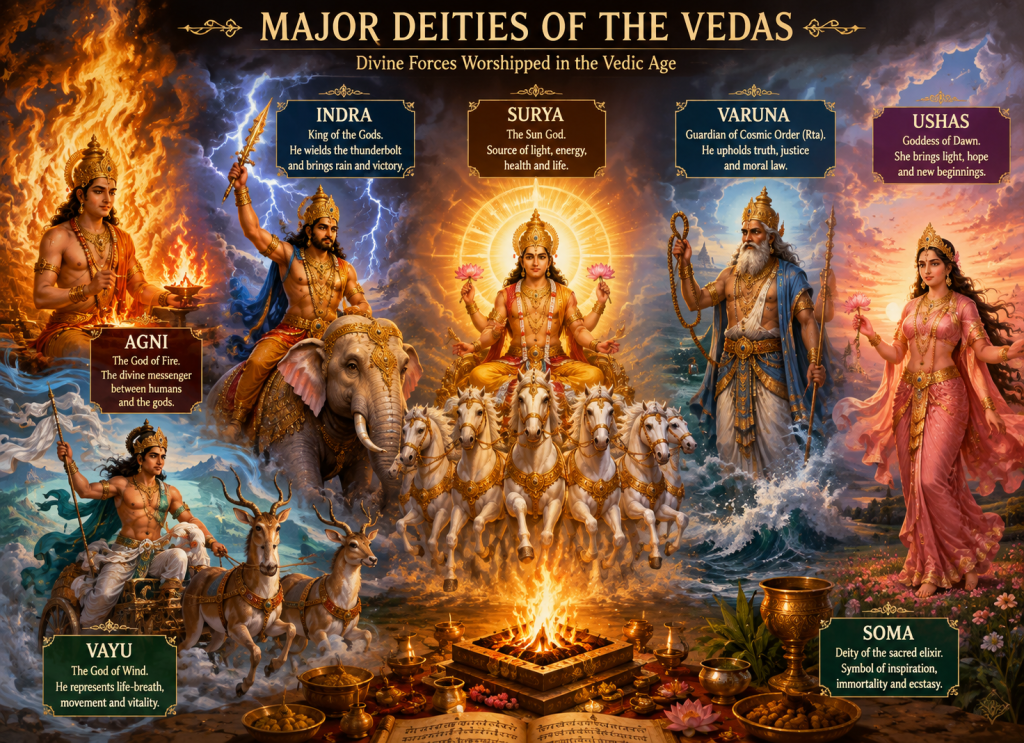
The Vedic hymns honor numerous deities, each symbolizing different aspects of nature, cosmic forces, and human experience.
Agni – The Sacred Fire
Agni is one of the most frequently praised deities in the Vedas.
He serves as:
- The divine messenger between humans and the gods
- The purifier of offerings
- The protector of sacred rituals
Fire symbolizes transformation, purity, and spiritual illumination.
Indra – The Heroic Protector
Indra is the king of the Vedic gods and the deity of thunder, rain, and victory.
He is celebrated for defeating the serpent Vritra, releasing rivers and bringing life-giving rain.
Indra represents courage, strength, and the triumph of order over chaos.
Varuna – Guardian of Moral Order
Varuna oversees Rta, the universal law.
He symbolizes:
- Justice
- Truth
- Compassion
- Moral responsibility
His hymns emphasize honesty and ethical conduct.
Soma – The Divine Elixir
Soma represents both a sacred ritual drink and a deity associated with inspiration and immortality.
The Soma hymns express spiritual joy, divine ecstasy, and the quest for higher consciousness.
Surya – The Sun
Surya is praised as the source of life, energy, health, and knowledge.
The rising sun symbolizes hope, enlightenment, and the victory of light over darkness.
Ushas – Goddess of Dawn
The hymns dedicated to Ushas are among the most poetic in the Rigveda.
She represents:
- New beginnings
- Beauty
- Renewal
- Hope
Each dawn is celebrated as a fresh opportunity for righteous living.
Vayu – Lord of the Wind
Vayu governs air, movement, and life-breath.
His invisible yet powerful presence reminds humanity of the unseen forces that sustain life.
The Evolution of Vedic Worship
One remarkable feature of the Vedas is the evolution of religious thought.
In the earliest hymns, many natural forces are praised as divine. Over time, the texts increasingly emphasize the unity underlying these diverse expressions of the sacred.
A famous Vedic statement captures this idea:
“Truth is One; the wise call It by many names.”
This inclusive perspective has profoundly influenced Hindu philosophy, encouraging respect for different paths to the Divine.
Vedic Rituals and Yajnas
Rituals played an important role in Vedic society, but they were understood as more than external ceremonies.
The central ritual was the Yajna, or sacred fire sacrifice.
During a Yajna:
- Offerings such as clarified butter, grains, herbs, and other symbolic items were placed into the sacred fire.
- Priests recited Vedic mantras.
- Participants prayed for harmony, prosperity, peace, and spiritual progress.
The fire symbolized the transformation of material offerings into divine blessings.
The Vedas emphasize that the true spirit of sacrifice lies in selflessness, gratitude, and dedication rather than in ritual alone.
The Importance of Mantras
A mantra is a sacred sound, word, or phrase believed to possess spiritual significance.
The Vedas contain thousands of mantras used for:
- Worship
- Meditation
- Healing
- Blessings
- Inner purification
Among the most revered is the Gayatri Mantra, traditionally recited to seek wisdom and enlightenment.
Correct pronunciation and disciplined recitation have always been considered essential in the Vedic tradition.
The Ancient Vedic Education System
Education held a place of great importance in Vedic society.
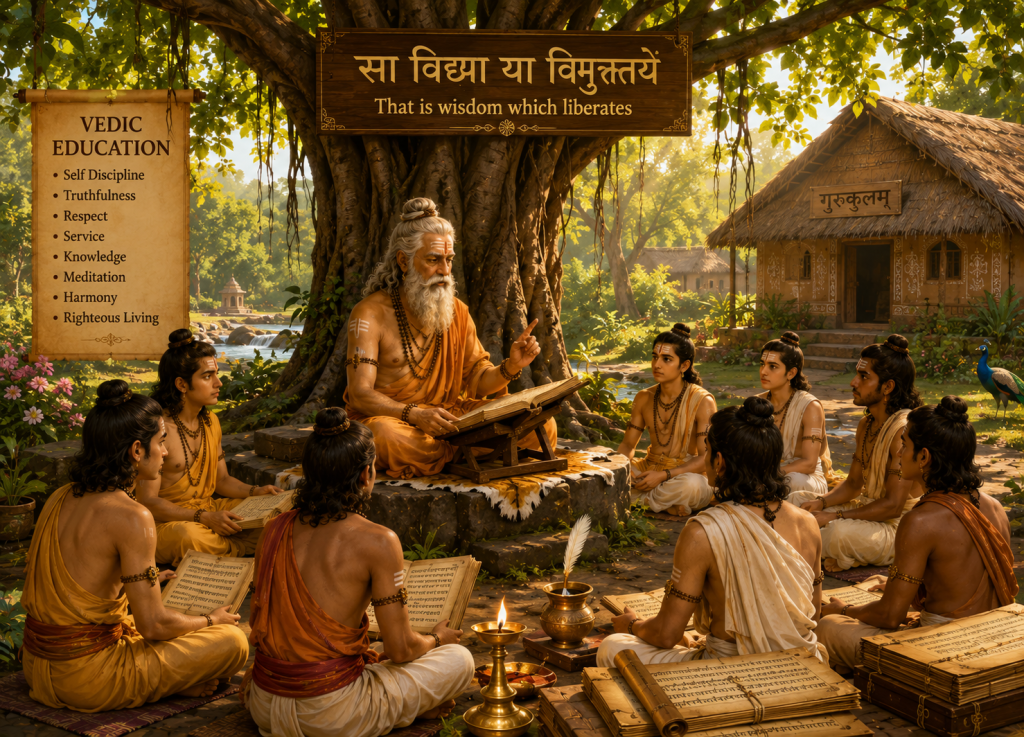
Students lived in Gurukulas, where they learned directly from their teachers (Gurus) in a disciplined and supportive environment.
The curriculum included:
- Vedic recitation
- Philosophy
- Ethics
- Grammar
- Mathematics
- Astronomy
- Music
- Medicine
- Martial arts
- Agriculture
Learning emphasized character, humility, and self-discipline as much as intellectual development.
The Role of the Rishis
The Rishis were the enlightened sages who perceived the Vedic mantras through deep meditation.
They were respected not only as spiritual teachers but also as philosophers, poets, scientists, and social guides.
Among the celebrated Vedic sages are:
Their insights continue to inspire spiritual seekers around the world.
The Vedas and Science
While the Vedas are primarily spiritual texts, they contain observations that influenced several branches of traditional Indian knowledge.
These include:
- Astronomy and the observation of celestial cycles
- Mathematics used in altar construction and rituals
- Linguistics and phonetics, especially the precise science of sound
- Agriculture and seasonal practices
- Herbal knowledge that later contributed to Ayurveda
It is important to appreciate these contributions within their historical context. The Vedas are not scientific textbooks in the modern sense, but they preserve valuable early insights into nature and human life.
The Vedas and Nature
One of the most inspiring features of the Vedas is their deep respect for the natural world.
The hymns express reverence for:
- Rivers
- Mountains
- Forests
- The Earth
- The Sun
- Rain
- Fire
- Wind
Nature is viewed not as something to exploit but as a sacred manifestation of the Divine. This ecological perspective remains highly relevant today, encouraging environmental responsibility and sustainable living.
The Lasting Influence of the Vedas
The Vedas have shaped the spiritual, cultural, intellectual, and social life of India for thousands of years. Their influence extends far beyond religion, touching philosophy, literature, music, education, ethics, and even modern discussions on environmental harmony and holistic living.
Many of the beliefs and practices associated with Hinduism today can be traced back to Vedic thought. Even after the composition of later scriptures such as the Upanishads, the Ramayana, the Mahabharata, and the Puranas, the Vedas continued to be regarded as the highest source of spiritual authority.
Their timeless wisdom has also inspired thinkers and seekers across the world, making them one of humanity’s most significant literary and philosophical treasures.
The Vedas and the Development of Hinduism
The Vedas form the bedrock of Sanatana Dharma, commonly known as Hinduism. Nearly every major branch of Hindu philosophy acknowledges the authority of the Vedas, although interpretations may differ.
Important Hindu concepts rooted in Vedic teachings include:
- Dharma (righteous duty)
- Karma (law of action and consequence)
- Moksha (liberation)
- Yajna (sacrifice)
- Meditation
- Mantra chanting
- Reverence for nature
- Pursuit of knowledge
The later Hindu scriptures expanded these ideas, but the Vedas remain their original source.
From Ritual to Philosophy
One of the most remarkable features of Vedic literature is its intellectual evolution.
The earliest hymns celebrate natural forces and divine powers through prayers and rituals. As the literature develops, especially in the Aranyakas and Upanishads, the focus gradually shifts toward profound philosophical inquiry.
Questions such as:
- What is the ultimate reality?
- Who am I?
- What is the purpose of life?
- What happens after death?
became central themes.
This transformation demonstrates that Vedic tradition encourages continuous reflection and spiritual growth rather than remaining limited to ritual practices.
The Vedas and the Upanishads
The Upanishads are often described as the philosophical heart of the Vedas.
While the Samhitas emphasize hymns and rituals, the Upanishads explore:
- Consciousness
- The nature of the soul
- The Supreme Reality
- Liberation
- Self-realization
Famous Upanishadic teachings include:
- “Tat Tvam Asi” (Thou Art That)
- “Aham Brahmasmi” (I Am Brahman)
These teachings inspired the development of Vedanta, one of India’s most influential philosophical traditions.
Influence on Indian Philosophy
Nearly all classical schools of Hindu philosophy draw inspiration from the Vedas.
These include:
Vedanta
Focuses on Brahman, Atman, and liberation through knowledge.
Yoga
Builds upon Vedic ideas of discipline, meditation, and self-control.
Mimamsa
Examines the interpretation and performance of Vedic rituals.
Nyaya
Develops systems of logic and reasoning while acknowledging Vedic authority.
Vaisheshika
Explores the nature of reality, matter, and categories of existence.
Sankhya
Although distinct in several respects, Sankhya shares important concepts with the broader Vedic tradition and influenced later Hindu thought.
The Vedas and Indian Classical Arts
The Vedas have significantly influenced India’s artistic traditions.
Music
The Samaveda laid the foundation for sacred chanting and contributed to the evolution of Indian classical music.
Dance
Many classical dance forms incorporate themes, stories, and devotional expressions rooted in Vedic and post-Vedic traditions.
Literature
Countless Sanskrit works, regional languages, devotional poetry, and philosophical commentaries draw inspiration from Vedic ideas.
Architecture
Temple design, sacred geometry, and ritual spaces often reflect principles found in Vedic tradition and later texts.
The Vedas and Ayurveda
Although Ayurveda developed into a distinct system over time, its roots are closely connected with Vedic knowledge, particularly the Atharvaveda.
Ayurveda emphasizes:
- Balance
- Prevention
- Healthy living
- Diet
- Herbal medicine
- Mental well-being
Its holistic approach reflects the Vedic understanding that physical, mental, and spiritual health are interconnected.
Environmental Wisdom in the Vedas
Long before modern environmental movements, the Vedas expressed deep respect for nature.
Natural elements such as:
- Earth
- Water
- Fire
- Air
- Space
- Rivers
- Mountains
- Trees
are treated with reverence.
The Vedas encourage humans to live responsibly, recognizing that nature is essential for sustaining life.
This ecological perspective continues to resonate in discussions about sustainability and environmental ethics.
The Global Influence of the Vedas
During the nineteenth and twentieth centuries, translations of the Vedas introduced their ideas to readers around the world.
Philosophers, scholars, and spiritual seekers became interested in Vedic concepts such as:
- Universal consciousness
- Meditation
- Self-realization
- Unity of existence
- Harmony between humanity and nature
Today, universities across the globe study the Vedas as important historical, literary, linguistic, and philosophical texts.
Common Misconceptions About the Vedas
Misconception 1: The Vedas are only about rituals.
Reality:
While rituals are important, the Vedas also contain philosophy, ethics, poetry, cosmology, music, and reflections on the meaning of life.
Misconception 2: The Vedas belong only to priests.
Reality:
The wisdom of the Vedas has inspired people from many backgrounds. Today, translations and scholarly studies make these texts accessible to readers worldwide.
Misconception 3: The Vedas teach blind faith.
Reality:
Many Vedic passages encourage inquiry, reflection, disciplined learning, and the pursuit of truth.
Misconception 4: The Vedas contradict modern life.
Reality:
Although composed in an ancient context, many Vedic values—such as truthfulness, compassion, respect for nature, lifelong learning, and ethical conduct—remain meaningful today.
Fascinating Facts About the Vedas
- The Vedas are among the oldest surviving religious texts in the world.
- They were preserved orally for centuries before being written down.
- The Rigveda contains more than one thousand hymns.
- The Samaveda is closely associated with the origins of Indian musical traditions.
- The Atharvaveda includes hymns related to health, family life, and social harmony.
- The Upanishads, which conclude the Vedic corpus, profoundly influenced Indian philosophy.
- Vedic Sanskrit differs from Classical Sanskrit and preserves some of the earliest forms of the language.
- Ancient methods of Vedic recitation ensured remarkable accuracy in preserving the texts across generations.
- The Vedas continue to be recited in traditional rituals and studied in academic institutions around the world.
- Their teachings have inspired countless commentaries, philosophical schools, and spiritual movements over the centuries.
Lessons We Can Learn from the Vedas
The Vedas offer practical guidance that remains relevant in contemporary life.
Seek Knowledge Throughout Life
Learning is presented as a lifelong journey. True wisdom comes through study, reflection, and experience.
Respect Nature
The Vedas encourage gratitude toward the natural world and remind us that human well-being depends on environmental balance.
Practice Truthfulness
Honesty and integrity are considered essential virtues for personal growth and social harmony.
Cultivate Self-Discipline
Whether through study, meditation, or ethical conduct, self-discipline is viewed as the foundation of lasting success.
Live in Harmony
The Vedas teach cooperation, compassion, and respect for all forms of life, fostering peaceful coexistence.
Frequently Asked Questions (FAQs)
Which is the oldest Veda?
The Rigveda is generally regarded as the oldest of the four Vedas and one of the oldest surviving literary works in the world.
How many Vedas are there?
There are four Vedas:
- Rigveda
- Yajurveda
- Samaveda
- Atharvaveda
Who wrote the Vedas?
According to Hindu tradition, the Vedas are Apaurusheya (not of human origin) and were revealed to ancient sages (Rishis). The sage Vyasa is traditionally credited with compiling and organizing them into four collections.
Which language are the Vedas written in?
The Vedas are composed in Vedic Sanskrit, an early form of the Sanskrit language.
What is the main message of the Vedas?
The Vedas emphasize the pursuit of knowledge, righteous living, harmony with nature, spiritual growth, and the search for ultimate truth.
Are the Vedas still relevant today?
Yes. Their teachings on ethics, self-discipline, environmental respect, lifelong learning, and spiritual inquiry continue to inspire people across cultures and generations.
What is the difference between the Vedas and the Upanishads?
The Vedas include hymns, rituals, philosophical texts, and other sections. The Upanishads are the concluding philosophical portions of the Vedic corpus, focusing on the nature of reality, the self, and liberation.
Conclusion
The Vedas are far more than ancient scriptures; they are a timeless repository of humanity’s search for truth, wisdom, and harmony. Composed over thousands of years ago and preserved through one of history’s most remarkable oral traditions, they continue to illuminate the spiritual and intellectual heritage of India.
From the poetic hymns of the Rigveda to the ritual guidance of the Yajurveda, the sacred melodies of the Samaveda, and the practical wisdom of the Atharvaveda, each Veda contributes a unique perspective while forming part of a unified vision of life.
Their teachings encourage us to pursue knowledge with humility, uphold truth in our actions, respect the natural world, and recognize the deeper unity that connects all beings. Rather than offering a single path, the Vedas invite thoughtful inquiry, disciplined practice, and continuous self-improvement.
Even in the modern age, when technology transforms the way we live, the enduring values of the Vedas—wisdom, compassion, responsibility, and inner realization—remain as relevant as ever. Whether approached as sacred scripture, historical literature, or philosophical exploration, the Vedas continue to inspire millions and stand as one of the greatest treasures of world civilization.
*Related Articles: 1. Rigveda – The Earliest and Most Sacred of the Four Vedas
2. Yajurveda – The Veda of Sacred Rituals
3. Samaveda – The Veda of Music, Chanting and Divine Wisdom
4. Atharvaveda – The Ancient Veda of Healing, Wisdom, and Daily Life
5. Gayatri Mantra – Analysis Of The Mahamantra
6. Devi Suktam – Meaning and Benefits
7. Apah Suktam – The Vedic Hymn to the Water Deity
8. Nasadiya Sukta – Exploring the Mysteries of Creation
9. Purusha Suktam -Sanskrit and English Verses with Meaning
10. Kshetrapati Suktam -The Vedic hymn to the Lord of the Soil