Yajurveda: The Veda of Sacred Rituals
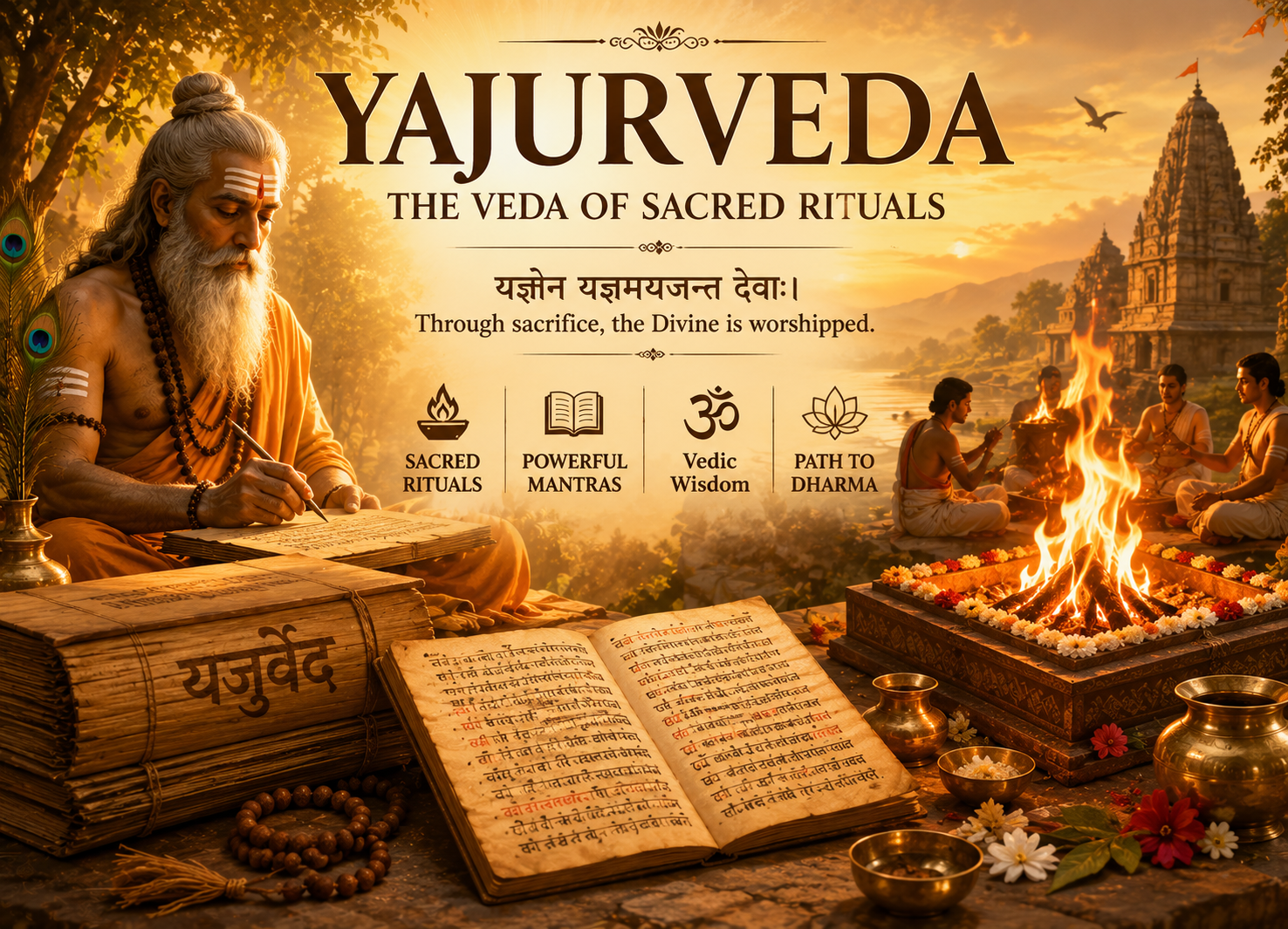
The Yajurveda is one of the four sacred Vedas of Hinduism and occupies a central place in the spiritual and ritual traditions of Sanatana Dharma. Revered as the “Veda of Sacrificial Formulas,” it provides the mantras and detailed instructions that priests recite while performing yajnas (Vedic sacrifices) and other sacred ceremonies. While the Rigveda focuses mainly on hymns of praise and the Samaveda transforms many of those hymns into melodies for chanting, the Yajurveda serves as a practical guide that explains how rituals should be performed with precision and devotion.
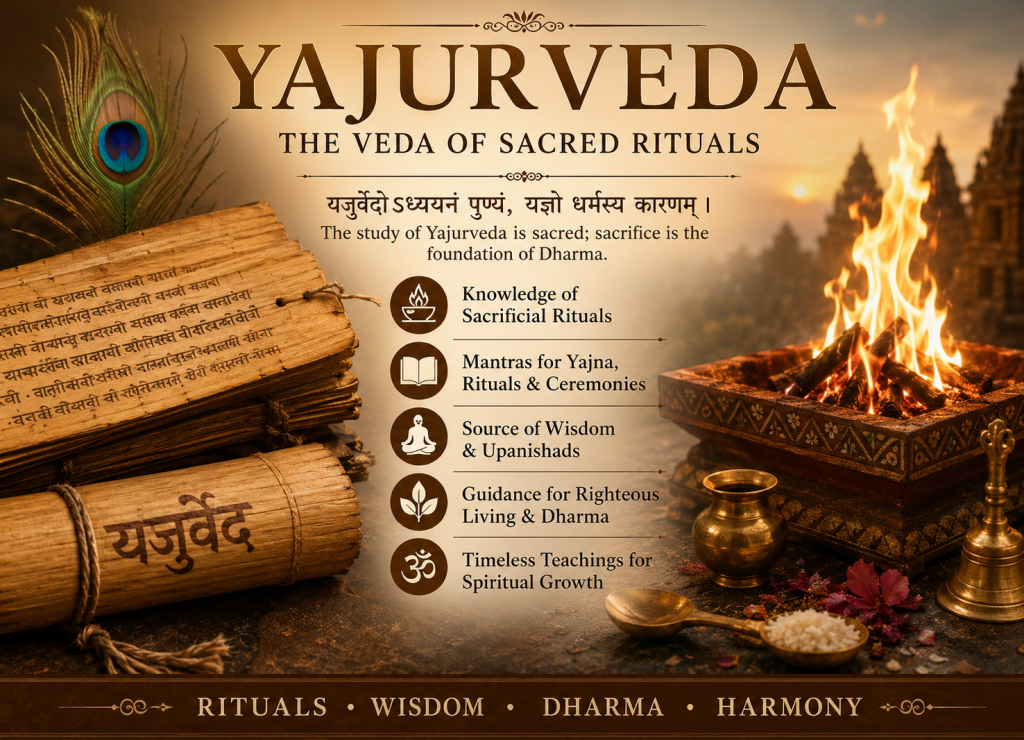
For thousands of years, the Yajurveda has guided kings, priests, sages, and householders in conducting ceremonies intended to promote harmony between humanity, nature, and the divine. Its teachings extend beyond ritual worship, offering profound insights into duty (dharma), self-discipline, gratitude, and the interconnectedness of all life. Even today, many Hindu rituals—including weddings, temple consecrations, homas, and yajnas—draw directly from the mantras and traditions preserved in the Yajurveda.
The Yajurveda is not merely a manual of rituals. Hidden within its verses are timeless philosophical ideas that later blossomed into the profound teachings of the Upanishads. It bridges the external act of worship with the inner quest for spiritual realization, showing that true sacrifice is not limited to offerings placed in a sacred fire but includes the cultivation of wisdom, compassion, and selflessness.
This article explores the Yajurveda in depth, including its history, composition, branches, philosophy, rituals, important mantras, and enduring influence on Hinduism. Whether you are a student of Vedic literature, a devotee seeking deeper understanding, or simply curious about one of the world’s oldest sacred scriptures, this comprehensive guide will introduce you to the remarkable legacy of the Yajurveda.
What Is the Yajurveda?
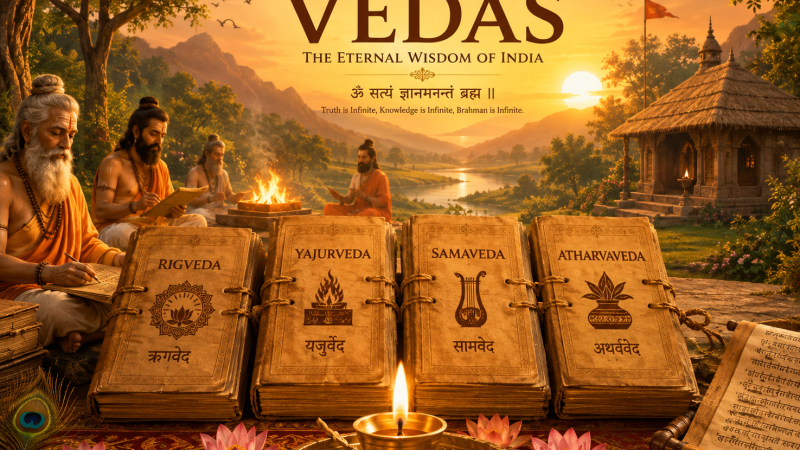
The Yajurveda is the second of the four Vedas, the foundational scriptures of Hinduism. The four Vedas are:
- Rigveda
- Yajurveda
- Samaveda
- Atharvaveda
Each Veda has a unique purpose.
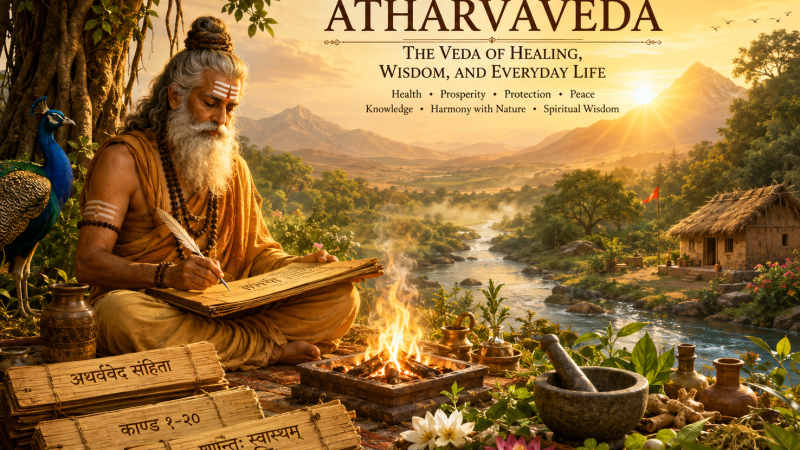
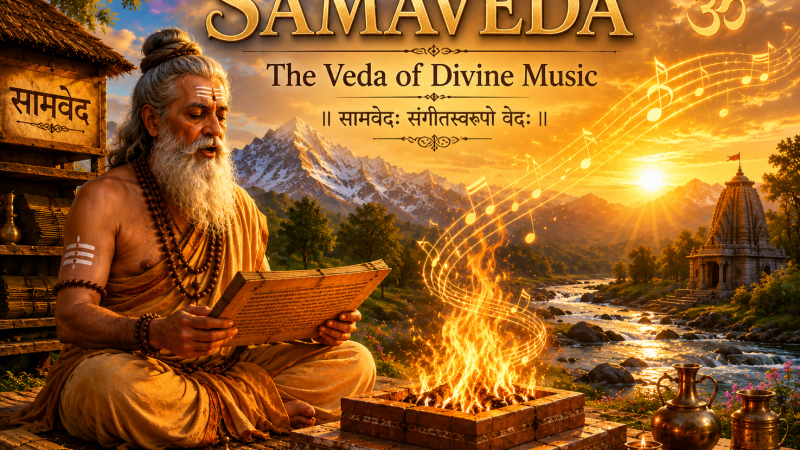
The Rigveda contains hymns dedicated to various deities. The Samaveda adapts many of these hymns into musical chants for ritual singing. The Atharvaveda includes prayers, philosophical reflections, healing practices, and hymns for daily life.
The Yajurveda, however, stands apart because it provides the ritual formulas and procedural instructions necessary for conducting Vedic sacrifices. It explains not only what should be recited but also when, where, and how each action should be performed.
In ancient India, sacrifices were considered sacred acts that sustained ṛta, the universal cosmic order. Every offering, gesture, and mantra had symbolic significance. The Yajurveda ensured that these rituals were performed correctly, preserving harmony between humans, the gods, and the natural world.
Unlike ordinary books, the Yajurveda was preserved through an extraordinary oral tradition. For countless generations, teachers transmitted every syllable to their students with meticulous accuracy. Special methods of recitation protected the text from alteration, making the Vedas among the best-preserved ancient literary works in human history.
Meaning of the Word “Yajurveda”
The word Yajurveda is derived from two Sanskrit terms:
- Yajus – sacrificial formula or ritual utterance
- Veda – knowledge or sacred wisdom
Thus, Yajurveda literally means:
“The Knowledge of Sacrificial Formulas.”
The Sanskrit root “yaj” means to worship, sacrifice, honor, or offer devotion. This same root gives rise to the word “yajna,” meaning a sacred sacrifice or fire ritual.
However, the concept of yajna extends beyond ritual offerings. Ancient sages understood sacrifice as an expression of gratitude, discipline, and selfless service. Every noble action performed for the welfare of others could be regarded as a form of yajna.
This broader understanding makes the Yajurveda relevant even today. Its teachings inspire people to dedicate their actions to higher ideals rather than personal gain alone.
Historical Background
The Yajurveda emerged during the later phase of the Vedic period, following the composition of much of the Rigveda. Scholars generally estimate its composition between 1200 BCE and 800 BCE, although traditional Hindu belief regards the Vedas as eternal knowledge revealed to ancient sages (rishis) rather than authored by humans.
According to Hindu tradition, the great sage Vedavyasa organized the vast body of Vedic knowledge into four collections and entrusted each to a principal disciple:
- Rigveda – Sage Paila
- Yajurveda – Sage Vaishampayana
- Samaveda – Sage Jaimini
- Atharvaveda – Sage Sumantu
This organization ensured that the sacred knowledge would be carefully preserved and transmitted across generations.
The Yajurveda reflects a period when Vedic rituals had become increasingly sophisticated. Royal ceremonies, agricultural rites, seasonal festivals, temple traditions, and domestic rituals all required standardized procedures. The Yajurveda provided this ritual framework.
Its influence extended beyond religion into ancient Indian society, shaping concepts of kingship, social responsibility, education, ethics, and community life.
Divine Origin According to Hindu Tradition
Hindu tradition teaches that the Vedas are Apaurusheya, meaning “not of human origin.” They were not composed like ordinary books but were revealed to enlightened sages during profound states of meditation.
These sages did not consider themselves authors. Instead, they were “seers” (rishis) who perceived eternal spiritual truths.
The Yajurveda therefore represents divine wisdom heard by the sages and faithfully transmitted through generations.
This belief distinguishes the Vedas from historical literary works. They are regarded as timeless revelations that exist beyond the limits of history and continue to guide seekers on the path of righteousness.
The Story of Sage Yajnavalkya
One of the most fascinating legends associated with the Yajurveda concerns the sage Yajnavalkya.
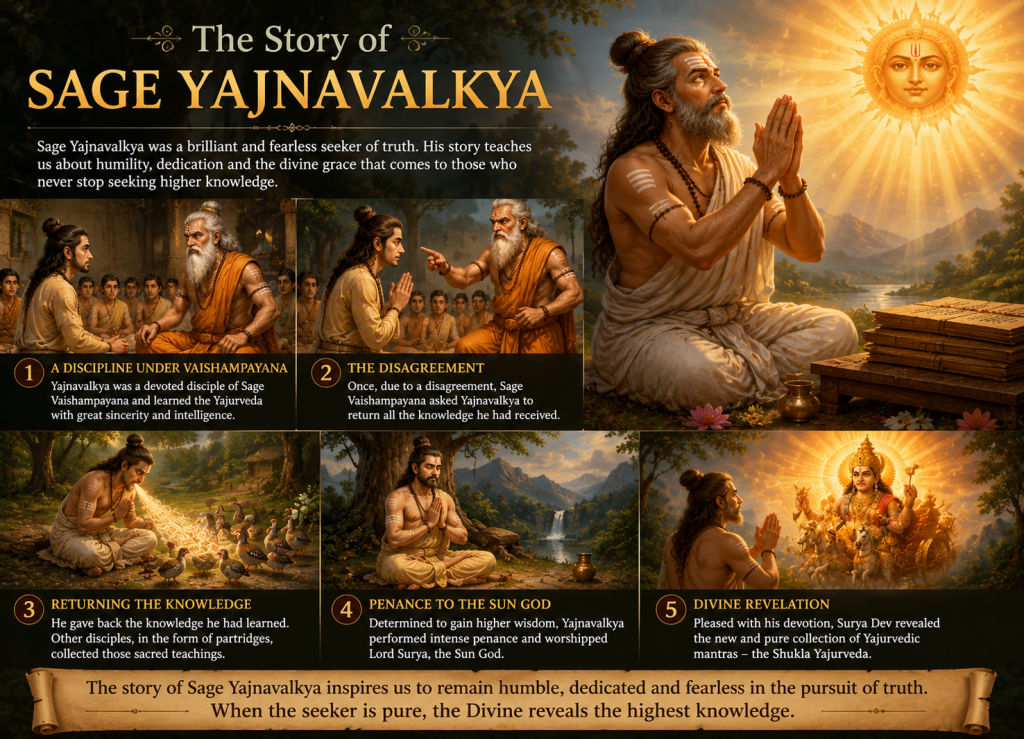
According to tradition, Yajnavalkya was a brilliant disciple of Sage Vaishampayana. Following a disagreement with his teacher, he was asked to return the Yajurvedic knowledge he had received. Through his spiritual power, he relinquished the mantras.
Other disciples assumed the form of partridges (tittiri birds) and gathered these sacred teachings. This collection later became associated with the Taittiriya branch of the Yajurveda.
Determined to obtain higher knowledge, Yajnavalkya undertook intense austerities and worshipped Surya, the Sun God. Pleased with his devotion, Surya revealed a new and more refined collection of Yajurvedic mantras.
This revelation became known as the Shukla (White) Yajurveda.
Although presented symbolically, this story illustrates the reverence with which the Vedic tradition views spiritual discipline, humility, and the continual pursuit of divine knowledge.
Place of the Yajurveda Among the Four Vedas
Each Veda complements the others, together forming the foundation of Vedic wisdom.
| Veda | Primary Focus |
|---|---|
| Rigveda | Hymns to the deities |
| Yajurveda | Ritual formulas and sacrificial procedures |
| Samaveda | Musical chanting of hymns |
| Atharvaveda | Daily life, healing, prayers, philosophy |
The Yajurveda functions as the practical guide for priests performing yajnas.
For example:
- The Rigveda provides a hymn to Agni, the fire deity.
- The Samaveda teaches how that hymn should be sung.
- The Yajurveda specifies when it should be recited, which offering accompanies it, how the altar is prepared, and what actions should be performed.
- The Atharvaveda expands spiritual life into healing, household rituals, and practical concerns.
Thus, the Yajurveda acts as the operational handbook of Vedic worship.
The Purpose of the Yajurveda
The Yajurveda was composed to achieve several important objectives:
1. Preserve Sacred Rituals
It standardized Vedic ceremonies so they could be performed accurately across generations.
2. Maintain Cosmic Order
Vedic sacrifices were believed to uphold ṛta, the universal order governing nature, morality, and the cosmos.
3. Promote Spiritual Discipline
Rituals required concentration, purity, humility, and devotion, cultivating virtues in both priests and participants.
4. Encourage Social Harmony
Many yajnas sought blessings for rainfall, prosperity, health, peace, and the welfare of the entire community rather than individual gain.
5. Connect Humans with the Divine
The Yajurveda emphasizes that sincere worship, gratitude, and righteous action strengthen humanity’s relationship with the Supreme Reality.
Literary Style of the Yajurveda
One distinctive feature of the Yajurveda is its combination of prose and poetic verses.
Unlike the Rigveda, which is predominantly poetic, the Yajurveda includes:
- Sacred mantras
- Ritual instructions
- Ceremonial dialogues
- Symbolic explanations
- Liturgical prose
- Philosophical reflections
This mixture makes it both a sacred scripture and a practical ritual manual.
Its language is concise yet profound. Many passages possess remarkable poetic beauty while simultaneously conveying detailed ceremonial instructions.
Oral Tradition and Preservation
For centuries, the Yajurveda was transmitted exclusively through oral recitation. Students memorized every word, accent, pause, and pronunciation under the guidance of experienced teachers.
Several sophisticated methods of recitation ensured perfect preservation, including:
- Samhita Patha – continuous recitation
- Pada Patha – word-by-word recitation
- Krama Patha – sequential pairing of words
- Jata Patha – woven repetition pattern
- Ghana Patha – one of the most advanced and intricate forms of Vedic chanting
These techniques made accidental changes almost impossible and preserved the text with extraordinary fidelity over millennia.
Why the Yajurveda Still Matters Today
Although composed thousands of years ago, the Yajurveda continues to influence Hindu religious life. Its mantras are recited in temples, homes, and sacred ceremonies across India and around the world.
Beyond ritual, its enduring message is that every action should be performed with sincerity, discipline, and a spirit of selfless offering. In this sense, the Yajurveda remains not only a guide to ancient sacrifices but also a timeless source of ethical and spiritual inspiration.
The Two Main Divisions of the Yajurveda
One of the most distinctive features of the Yajurveda is that it exists in two principal recensions (versions):
- Krishna Yajurveda (Black Yajurveda)
- Shukla Yajurveda (White Yajurveda)
The names “Black” and “White” do not refer to good and bad or to any spiritual superiority. Instead, they describe the arrangement of the text.
The Krishna Yajurveda combines the mantras with explanatory prose, making the text appear interwoven or “mixed.” The Shukla Yajurveda, on the other hand, separates the mantras from the explanatory material, giving it a clearer and more organized structure.
Both versions are equally sacred and have been preserved with great care through different lineages of Vedic scholars.
Krishna Yajurveda (Black Yajurveda)
The Krishna Yajurveda is generally regarded as the older recension.
Its defining characteristic is that the mantras and the Brahmana explanations are intermixed. Rather than presenting the hymns first and explanations later, both are woven together throughout the text.
This arrangement provides priests with immediate explanations of rituals as they proceed through the ceremonies.
The Krishna Yajurveda preserves numerous ancient traditions and remains an important source of Vedic ritual knowledge.
Its language often reflects an earlier stage of Vedic Sanskrit compared to the Shukla Yajurveda.
Major Samhitas of the Krishna Yajurveda
Several Samhitas belong to the Krishna Yajurveda tradition.
1. Taittiriya Samhita
The Taittiriya Samhita is the best-known and most widely preserved recension of the Krishna Yajurveda.
It contains:
- Ritual formulas
- Sacrificial procedures
- Symbolic interpretations
- Hymns
- Prayers
Even today, many Vedic schools continue to teach and recite this Samhita.
2. Maitrayani Samhita
The Maitrayani Samhita is another ancient recension.
Although less commonly studied today, it preserves valuable information about early Vedic rituals and linguistic traditions.
Scholars often compare it with the Taittiriya Samhita to understand the historical development of Vedic literature.
3. Katha Samhita
The Katha Samhita was once widely followed in northern India.
Although only portions survive today, it remains an important source for historians studying the evolution of Vedic ritual traditions.
4. Kapisthala-Katha Samhita
This recension survives only in fragments.
Despite its incomplete state, it provides valuable evidence regarding the diversity of ancient Vedic schools.
Shukla Yajurveda (White Yajurveda)
The Shukla Yajurveda is known for its systematic arrangement.
Unlike the Krishna Yajurveda, it presents:
- The mantras separately.
- The ritual explanations in an independent text called the Shatapatha Brahmana.
This organization makes the Shukla Yajurveda easier to study and follow.
According to traditional accounts, the Shukla Yajurveda was revealed by the Sun God to Sage Yajnavalkya after his intense spiritual austerities.
Whether understood historically or symbolically, this tradition highlights the importance of spiritual discipline in receiving divine wisdom.
The Vajasaneyi Samhita
The principal Samhita of the Shukla Yajurveda is the Vajasaneyi Samhita.
It derives its name from Vajasaneya, another name associated with Sage Yajnavalkya.
The Vajasaneyi Samhita contains 40 chapters (Adhyayas) and is one of the most influential Vedic texts.
It includes:
- Fire sacrifices
- Royal ceremonies
- Seasonal rituals
- Domestic rites
- Philosophical hymns
- Peace prayers
The famous Isha Upanishad forms the concluding chapter of this Samhita, making it unique among the Vedas.
Two Major Recensions of the Shukla Yajurveda
The Shukla Yajurveda survives mainly in two recensions.
Madhyandina Recension
The Madhyandina recension became especially influential in northern India.
It remains one of the most commonly studied versions today.
Kanva Recension
The Kanva recension spread widely across central and southern India.
Although similar to the Madhyandina recension, it differs slightly in arrangement and wording.
Both recensions preserve the same essential spiritual teachings.
Understanding the Shakhas (Branches)
Ancient India preserved the Vedas through numerous educational traditions called Shakhas, meaning “branches.”
Each Shakha represented a lineage of teachers who maintained their own precise method of:
- Pronunciation
- Chanting
- Ritual performance
- Textual arrangement
These branches ensured that Vedic knowledge remained vibrant across different regions.
Ancient sources mention that the Yajurveda once had over 100 Shakhas. Sadly, most have been lost over time.
Today, only a few remain active.
Surviving Branches of the Yajurveda
Some of the surviving branches include:
Krishna Yajurveda
- Taittiriya
- Maitrayani
- Katha
- Kapisthala-Katha (fragmentary)
Shukla Yajurveda
- Madhyandina
- Kanva
These surviving traditions continue to preserve ancient chanting methods that have remained remarkably unchanged for centuries.
The Internal Structure of the Yajurveda
Like the other Vedas, the Yajurveda consists of several layers of literature.
Each layer serves a distinct purpose.
1. Samhita
The Samhita is the foundational collection of sacred mantras.
These verses are recited during rituals and sacrifices.
2. Brahmana
The Brahmanas explain:
- Why rituals are performed.
- Symbolic meanings of ceremonies.
- Proper procedures.
- Religious significance.
The Shatapatha Brahmana is among the most extensive and influential Brahmana texts in all of Vedic literature.
3. Aranyaka
The Aranyakas, or “Forest Texts,” were intended for sages who had withdrawn from worldly life.
They gradually shift the emphasis from external rituals to inner contemplation.
These texts form a bridge between ritual practice and philosophical inquiry.
4. Upanishads
The Upanishads represent the philosophical culmination of the Vedas.
Instead of focusing primarily on sacrifice, they ask profound questions:
- Who am I?
- What is Brahman?
- What is the nature of reality?
- How can liberation (moksha) be attained?
Several of Hinduism’s most important Upanishads belong to the Yajurveda tradition.
These include:
- Isha Upanishad
- Brihadaranyaka Upanishad
- Taittiriya Upanishad
- Katha Upanishad
- Shvetashvatara Upanishad
- Maitri Upanishad
These works have influenced Hindu philosophy, Vedanta, Yoga, and spiritual traditions for over two thousand years.
The Priests of the Yajurveda
Vedic sacrifices involved four principal priests, each associated with one of the Vedas.
| Priest | Associated Veda | Primary Role |
|---|---|---|
| Hotri | Rigveda | Recites hymns |
| Adhvaryu | Yajurveda | Performs ritual actions |
| Udgatri | Samaveda | Sings hymns |
| Brahma | Atharvaveda | Supervises the sacrifice |
The Adhvaryu priest relied primarily on the Yajurveda.
His responsibilities included:
- Measuring the altar.
- Preparing sacrificial materials.
- Lighting the sacred fire.
- Offering oblations.
- Reciting Yajurvedic mantras.
- Coordinating the entire ceremony.
Without the Adhvaryu, a Vedic sacrifice could not proceed correctly.
Famous Mantras from the Yajurveda
The Yajurveda contains many mantras that continue to be recited throughout Hindu religious life.
The Gayatri Mantra
Although originally found in the Rigveda, the Gayatri Mantra is also included in Yajurvedic traditions and remains central to daily worship.
It is one of the most revered prayers in Hinduism, seeking divine illumination and wisdom.
The Mahamrityunjaya Mantra
One of the most famous mantras associated with the Yajurveda is the Mahamrityunjaya Mantra, dedicated to Lord Shiva.
The mantra begins:
Om Tryambakam Yajāmahe Sugandhim Puṣṭivardhanam…
This sacred prayer seeks:
- Spiritual strength
- Inner peace
- Healing
- Protection
- Liberation from fear
It is widely recited during worship, meditation, and special religious ceremonies.
Peace Invocation (Shanti Mantra)
A well-known peace prayer from the Yajurveda begins:
Om Saha Navavatu
Saha Nau Bhunaktu
Saha Viryam Karavavahai
This prayer expresses a beautiful ideal:
- May teacher and student be protected together.
- May they learn together.
- May they work together.
- May knowledge bring harmony rather than conflict.
Even today, this invocation is recited in many educational institutions and spiritual gatherings.
Rituals Described in the Yajurveda
The Yajurveda provides detailed guidance for numerous Vedic ceremonies.
Some important rituals include:
- Agnihotra
- Soma Yajna
- Rajasuya
- Vajapeya
- Ashvamedha
- Domestic fire rituals
- Seasonal sacrifices
- Agricultural ceremonies
- Royal consecration rituals
Each ceremony includes:
- Preparatory steps
- Sacred mantras
- Sequence of offerings
- Symbolic meanings
- Concluding prayers
The emphasis is not merely on external precision but also on the intention, purity, and devotion of the participants.
Symbolism of Fire in the Yajurveda
Fire (Agni) occupies a central place in the Yajurveda.
It is viewed as:
- A divine messenger carrying offerings to the gods.
- A symbol of purity.
- A representation of divine knowledge.
- A purifier of mind and heart.
- A bridge between humanity and the divine.
Every offering placed into the sacred fire symbolizes the surrender of selfishness, ignorance, and attachment.
Thus, the external ritual reflects an inner spiritual transformation.
The Enduring Legacy of the Yajurveda
The Yajurveda is much more than a collection of ritual formulas. Through its structured mantras, sacred ceremonies, and symbolic teachings, it has shaped Hindu worship for thousands of years. Its influence can still be seen in temple rituals, domestic ceremonies, Vedic chanting traditions, and philosophical schools across the world.
While many of its rituals originated in ancient times, their deeper message remains timeless: every action performed with sincerity, discipline, and dedication to the Divine becomes a sacred offering.
The Philosophy of the Yajurveda
Although the Yajurveda is often called the “Veda of Rituals,” its true significance goes far beyond ceremonial practices. Hidden within its mantras and ritual instructions is a profound philosophy that encourages human beings to cultivate self-discipline, righteousness, gratitude, and spiritual awareness.
The sages of the Yajurveda understood that rituals alone cannot lead to lasting fulfillment. A ritual performed without sincerity is considered incomplete. Therefore, the Yajurveda repeatedly emphasizes that external worship should be accompanied by inner purity, noble intentions, and moral conduct.
The text teaches that every action performed with selflessness becomes an offering to the Divine. This idea later became one of the foundational principles of Hindu philosophy and is echoed in texts such as the Bhagavad Gita.
Thus, the Yajurveda transforms the concept of sacrifice from a physical act into a spiritual discipline that can guide every aspect of daily life.
The Concept of Yajna (Sacrifice)
The word Yajna comes from the Sanskrit root “Yaj,” meaning “to worship,” “to sacrifice,” or “to honor.”
Many people associate Yajna only with fire rituals (Homa or Havan). However, the Yajurveda presents a much broader understanding.
A true Yajna involves three essential elements:
- Devotion
- Selflessness
- Gratitude
Offering clarified butter, grains, herbs, or other sacred substances into the fire symbolizes offering one’s ego, selfish desires, and ignorance to the Divine.
In this sense, every righteous action can become a Yajna.
Examples include:
- Serving parents with love.
- Helping those in need.
- Protecting nature.
- Speaking truthfully.
- Performing one’s duties honestly.
- Sharing knowledge.
- Practicing compassion.
The Yajurveda teaches that these noble actions contribute to the harmony of society and uphold Dharma, the moral order of the universe.
The Five Great Sacrifices (Pancha Mahayajnas)
Later Vedic tradition, rooted in Yajurvedic teachings, describes five daily duties known as the Pancha Mahayajnas.
1. Brahma Yajna
The study, preservation, and teaching of sacred knowledge.
Reading scriptures and sharing wisdom are considered offerings to the Divine.
2. Deva Yajna
Worship of the gods through prayers, offerings, and rituals.
This expresses gratitude for the forces of nature that sustain life.
3. Pitri Yajna
Honoring one’s ancestors.
Remembering previous generations strengthens the bond between family, tradition, and spiritual heritage.
4. Bhuta Yajna
Showing kindness to animals and caring for the environment.
Providing food to birds, protecting forests, and respecting nature are considered sacred acts.
5. Manushya (Atithi) Yajna
Serving fellow human beings, especially guests, the poor, and those in need.
Hospitality and charity are regarded as important expressions of Dharma.
These five duties demonstrate that sacrifice is not limited to rituals but extends into every dimension of ethical living.
Major Deities in the Yajurveda
The Yajurveda invokes numerous deities, each representing different aspects of cosmic order and divine power.
These deities are not merely mythological figures but also symbolize universal principles.
Agni – The Sacred Fire
Agni is one of the most frequently invoked deities.
He serves as:
- Messenger between humans and the gods.
- Carrier of sacrificial offerings.
- Symbol of purity.
- Divine witness to rituals.
- Source of spiritual illumination.
Every Vedic sacrifice begins by invoking Agni.
Indra – Lord of Strength
Indra appears as the powerful protector who overcomes darkness and obstacles.
He represents:
- Courage
- Victory
- Leadership
- Strength
- Protection
Kings often invoked Indra before important ceremonies.
Varuna – Guardian of Cosmic Order
Varuna symbolizes:
- Truth
- Justice
- Moral law
- Cosmic order (Rta)
He reminds humanity that every action carries moral consequences.
Surya – The Sun
Surya represents:
- Light
- Knowledge
- Life
- Energy
- Spiritual awakening
The famous story of Sage Yajnavalkya receiving the Shukla Yajurveda from Surya reflects the Sun’s role as the source of divine wisdom.
Rudra
The Yajurveda contains many hymns dedicated to Rudra, who later came to be widely identified with Lord Shiva.
Rudra is portrayed as:
- Powerful
- Compassionate
- Healer
- Protector
- Destroyer of evil
One of the most celebrated sections of the Yajurveda is the Sri Rudram, a devotional hymn that praises Rudra in his countless forms. It remains one of the most frequently recited Vedic hymns in Shiva temples and during Rudrabhisheka ceremonies.
Vishnu
Although Vishnu occupies a more prominent position in later Hindu literature, the Yajurveda already honors him as the one who strides across the universe and sustains cosmic order.
His “three strides” symbolize the all-pervading presence of the Divine.
Dharma in the Yajurveda
The Yajurveda consistently teaches the importance of Dharma, which may be understood as righteous living, moral responsibility, and harmony with the universal order.
Living according to Dharma means:
- Speaking truth.
- Respecting parents and teachers.
- Protecting nature.
- Practicing compassion.
- Being honest in one’s work.
- Controlling anger.
- Showing generosity.
- Honoring commitments.
Rather than viewing religion as mere ritual observance, the Yajurveda emphasizes ethical conduct as the true foundation of spiritual life.
The Importance of Truth
Truth (Satya) occupies a central place in Vedic thought.
The Yajurveda teaches that truth supports the universe just as the sun sustains life on Earth.
A truthful person develops:
- Inner peace
- Trustworthiness
- Wisdom
- Moral strength
Falsehood, by contrast, weakens both the individual and society.
This emphasis on truth profoundly influenced later Hindu philosophy and remains one of the enduring values of Indian civilization.
Self-Discipline and Inner Purity
The Yajurveda repeatedly stresses that rituals are meaningful only when performed with purity of mind and self-control.
Inner discipline includes:
- Control of speech.
- Control of desires.
- Moderation in food.
- Respect for all living beings.
- Humility.
- Patience.
- Contentment.
The sages believed that conquering one’s own mind is a greater achievement than conquering external enemies.
The Upanishads of the Yajurveda
One of the greatest contributions of the Yajurveda is its rich collection of Upanishads. These philosophical texts explore the nature of the Self (Atman), the Supreme Reality (Brahman), and the path to liberation (Moksha).
Isha Upanishad
The Isha Upanishad forms the final chapter of the Vajasaneyi Samhita of the Shukla Yajurveda.
Its opening verse teaches that the entire universe is pervaded by the Divine and encourages people to live with detachment, gratitude, and self-control.
Though brief, it is one of the most influential texts in Vedanta philosophy.
Brihadaranyaka Upanishad
The Brihadaranyaka Upanishad is among the largest and oldest of all Upanishads.
It discusses profound themes such as:
- The nature of consciousness.
- The identity of Atman and Brahman.
- Creation.
- Meditation.
- Liberation.
Many famous philosophical dialogues appear in this Upanishad, including those involving Sage Yajnavalkya.
Taittiriya Upanishad
Associated with the Krishna Yajurveda, the Taittiriya Upanishad explains the famous doctrine of the five koshas (sheaths) that cover the Self:
- Physical body (Annamaya Kosha)
- Vital energy (Pranamaya Kosha)
- Mind (Manomaya Kosha)
- Intellect (Vijnanamaya Kosha)
- Bliss (Anandamaya Kosha)
The Upanishad teaches that true realization comes by transcending these layers to recognize the eternal Self.
Katha Upanishad
The Katha Upanishad narrates the dialogue between the young seeker Nachiketa and Yama, the Lord of Death.
It addresses timeless questions:
- What happens after death?
- What is the Self?
- What is immortality?
- What is the highest goal of life?
Its teachings continue to inspire spiritual seekers around the world.
Shvetashvatara Upanishad
The Shvetashvatara Upanishad explores:
- The nature of God.
- Yoga.
- Devotion.
- Creation.
- The relationship between the individual soul and the Supreme.
It is especially important in later Shaiva and Vedantic traditions.
Environmental Awareness in the Yajurveda
The Yajurveda reflects a deep reverence for nature. Rivers, forests, mountains, animals, wind, rain, and the earth are all treated as sacred manifestations of the Divine.
The text encourages human beings to live in harmony with the natural world rather than exploit it.
This ecological outlook remains highly relevant in the modern age, reminding us that environmental stewardship is both a moral and spiritual responsibility.
Universal Prayer for Peace
Several renowned Shanti Mantras originate from the Yajurveda. These prayers seek peace not only for individuals but for all creation.
Their vision of peace extends to:
- Heaven
- Earth
- Waters
- Plants
- Animals
- Human beings
- The entire universe
This universal outlook reflects the Vedic ideal that genuine well-being is inseparable from the welfare of all living beings.
The Spiritual Message of the Yajurveda
The Yajurveda ultimately teaches that the highest sacrifice is the transformation of one’s own character. Rituals have value when they inspire truthfulness, compassion, humility, and devotion.
Its philosophy reminds us that every action—whether performed in a temple, at home, or in society—can become sacred when dedicated to the welfare of others and the realization of the Divine.
Influence of the Yajurveda on Hinduism
Few scriptures have shaped Hindu religious life as profoundly as the Yajurveda. Although composed thousands of years ago, its mantras continue to be recited in temples, homes, and sacred ceremonies across India and around the world.
The Yajurveda serves as the foundation for many rituals performed by Hindu priests. From birth to death, its verses accompany significant milestones in a person’s life, reminding devotees that every important event can become a sacred offering to the Divine.
Its influence extends far beyond ritual worship. The Yajurveda has shaped Hindu ethics, philosophy, temple traditions, festivals, and concepts of duty (Dharma). It has also inspired countless spiritual teachers, philosophers, and scholars who have drawn upon its wisdom to explain the deeper purpose of human life.
The Yajurveda and Hindu Samskaras
One of the greatest contributions of the Yajurveda is its role in the Samskaras, the sacred rites of passage that mark important stages of life.
Many of these ceremonies include mantras from the Yajurveda.
Garbhadhana
Prayers seeking divine blessings before conception.
Namakarana
The naming ceremony performed for a newborn child.
Annaprashana
The child’s first ceremonial feeding of solid food.
Upanayana
The sacred thread ceremony that marks the beginning of formal Vedic education.
Vivaha
The Hindu marriage ceremony, during which several Yajurvedic mantras are recited while the couple takes the sacred vows around the fire.
Antyeshti
The final rites performed after death, accompanied by prayers for the peaceful journey of the departed soul.
These ceremonies demonstrate that the Yajurveda is not merely a historical scripture but an integral part of Hindu life even today.
The Yajurveda in Temple Worship
Although elaborate Vedic sacrifices are less common today than in ancient times, the Yajurveda remains central to temple rituals.
Its mantras are regularly used during:
- Temple consecration (Kumbhabhishekam)
- Daily worship (Nitya Puja)
- Rudrabhisheka
- Homas and Havans
- Navagraha worship
- Housewarming ceremonies (Griha Pravesha)
- Installation of deity idols (Prana Pratishtha)
- Festival celebrations
Many priests memorize large portions of the Yajurveda through the traditional Guru-Shishya (teacher-disciple) system.
Contribution to Hindu Philosophy
Although the Yajurveda is often associated with rituals, its philosophical contributions are equally significant.
The Upanishads belonging to the Yajurveda laid the foundation for Vedanta, one of the most influential schools of Hindu philosophy.
These texts explore profound questions such as:
- Who am I?
- What is the ultimate reality?
- What is the relationship between the individual soul and the Supreme Being?
- What is liberation (Moksha)?
- How can true knowledge be attained?
The teachings of the Isha Upanishad, Brihadaranyaka Upanishad, Katha Upanishad, and Taittiriya Upanishad have inspired philosophers, monks, and seekers for centuries.
Influence on Yoga
The Yajurveda indirectly influenced the development of Yoga by emphasizing:
- Self-discipline
- Meditation
- Purity of mind
- Control of the senses
- Ethical living
- Devotion
Many concepts later elaborated in the Yoga Sutras of Patanjali and Vedantic traditions can be traced to the philosophical insights preserved in the Yajurveda and its Upanishads.
The Yajurveda and Ayurveda
The Vedic worldview sees the human body, mind, and environment as interconnected.
Although the Atharvaveda is more directly associated with healing practices, the Yajurveda contributed to the ritual and spiritual aspects of health by promoting:
- Purification
- Balanced living
- Respect for nature
- Proper diet during rituals
- Mental discipline
- Sacred chanting
Many traditional healing ceremonies continue to incorporate Yajurvedic mantras.
Relevance of the Yajurveda in the Modern World
Some readers may wonder whether a scripture composed over three thousand years ago still has relevance today.
The answer is undoubtedly yes.
While certain ancient rituals belong to their historical context, the core principles of the Yajurveda remain timeless.
Its teachings encourage:
Selfless Service
The highest offering is not wealth but sincere action performed for the welfare of others.
Environmental Responsibility
Nature is sacred and deserves respect, protection, and gratitude.
Truthfulness
Honesty remains the foundation of trust and peaceful coexistence.
Discipline
A disciplined life leads to clarity, inner strength, and lasting success.
Gratitude
Recognizing the gifts of nature, family, teachers, and society fosters humility and contentment.
Harmony
The Yajurveda reminds us that true prosperity arises when individuals, communities, and nature exist in balance.
These ideals are as valuable today as they were in the Vedic age.
Preservation Through Oral Tradition
One of the most remarkable achievements in human history is the preservation of the Vedas through oral transmission.
Long before the invention of printing, generations of Vedic scholars memorized the entire Yajurveda using highly sophisticated recitation methods.
These included:
- Samhita Patha
- Pada Patha
- Krama Patha
- Jata Patha
- Ghana Patha
The extraordinary precision of these techniques ensured that the text remained virtually unchanged over thousands of years.
Modern scholars often regard this oral tradition as one of humanity’s greatest intellectual achievements.
Interesting Facts About the Yajurveda
Here are some fascinating facts about this sacred scripture:
- The Yajurveda is the second of the four Vedas.
- Its name means “Knowledge of Sacrificial Formulas.”
- It exists in two main versions—the Krishna Yajurveda and the Shukla Yajurveda.
- The Vajasaneyi Samhita of the Shukla Yajurveda contains 40 chapters.
- The Isha Upanishad forms the final chapter of the Vajasaneyi Samhita.
- The famous Sri Rudram, one of the most important hymns dedicated to Lord Shiva, is found in the Yajurveda.
- The Mahamrityunjaya Mantra, widely chanted for spiritual strength and well-being, is preserved in the Yajurvedic tradition.
- Ancient sources mention that the Yajurveda once had more than 100 Shakhas, though only a few survive today.
- Many Hindu marriage ceremonies still include Yajurvedic mantras.
- The Yajurveda has influenced Hindu philosophy, ritual practice, temple traditions, and spiritual literature for more than three millennia.
Frequently Asked Questions (FAQs)
What is the Yajurveda?
The Yajurveda is one of the four Vedas of Hinduism. It contains sacred mantras and detailed instructions for performing Vedic sacrifices and religious rituals.
Why is it called the Yajurveda?
The name comes from the Sanskrit words “Yajus” (sacrificial formula) and “Veda” (knowledge), meaning “The Knowledge of Sacrificial Formulas.”
What is the difference between the Krishna and Shukla Yajurveda?
The Krishna Yajurveda combines mantras with explanatory prose, whereas the Shukla Yajurveda presents the mantras separately from the explanatory Brahmana texts.
Who compiled the Yajurveda?
According to Hindu tradition, Sage Vedavyasa organized the Vedic knowledge into four Vedas and entrusted the Yajurveda to his disciple Vaishampayana. The Shukla Yajurveda is traditionally associated with Sage Yajnavalkya.
Which Upanishads belong to the Yajurveda?
Important Upanishads associated with the Yajurveda include:
- Isha Upanishad
- Brihadaranyaka Upanishad
- Taittiriya Upanishad
- Katha Upanishad
- Shvetashvatara Upanishad
- Maitri Upanishad
Is the Yajurveda still relevant today?
Yes. Although many ancient rituals have evolved, its teachings on truth, discipline, gratitude, selfless service, and harmony with nature remain highly relevant in modern life.
Which deity is most closely associated with the Yajurveda?
The Yajurveda praises many deities, including Agni, Indra, Varuna, Surya, Rudra, and Vishnu. Among its most celebrated hymns is the Sri Rudram, dedicated to Lord Rudra (Shiva).
Conclusion
The Yajurveda is much more than an ancient manual of rituals. It is a timeless guide that unites sacred action with spiritual understanding. While it carefully explains how Vedic ceremonies should be performed, it also reveals that the highest sacrifice is the transformation of the human heart.
Its teachings inspire us to live with truthfulness, discipline, gratitude, compassion, and respect for all forms of life. Through its profound philosophy, inspiring mantras, and enduring ethical vision, the Yajurveda continues to illuminate the path of Dharma for seekers across generations.
From the sacred fires of the Vedic age to the temples and homes of modern devotees, the Yajurveda remains a living tradition. Its influence can be seen in Hindu rituals, philosophy, yoga, education, and spiritual practice. By studying its wisdom with sincerity and reverence, we gain not only historical knowledge but also practical guidance for leading a meaningful, balanced, and spiritually enriched life.
As one of the pillars of Sanatana Dharma, the Yajurveda continues to remind humanity that every noble thought, every selfless action, and every sincere prayer can become a sacred offering to the Divine.














One thought on “Yajurveda: The Veda of Sacred Rituals”