Bhagavad Gita Chapter 9: Raja Vidya Raja Guhya Yoga
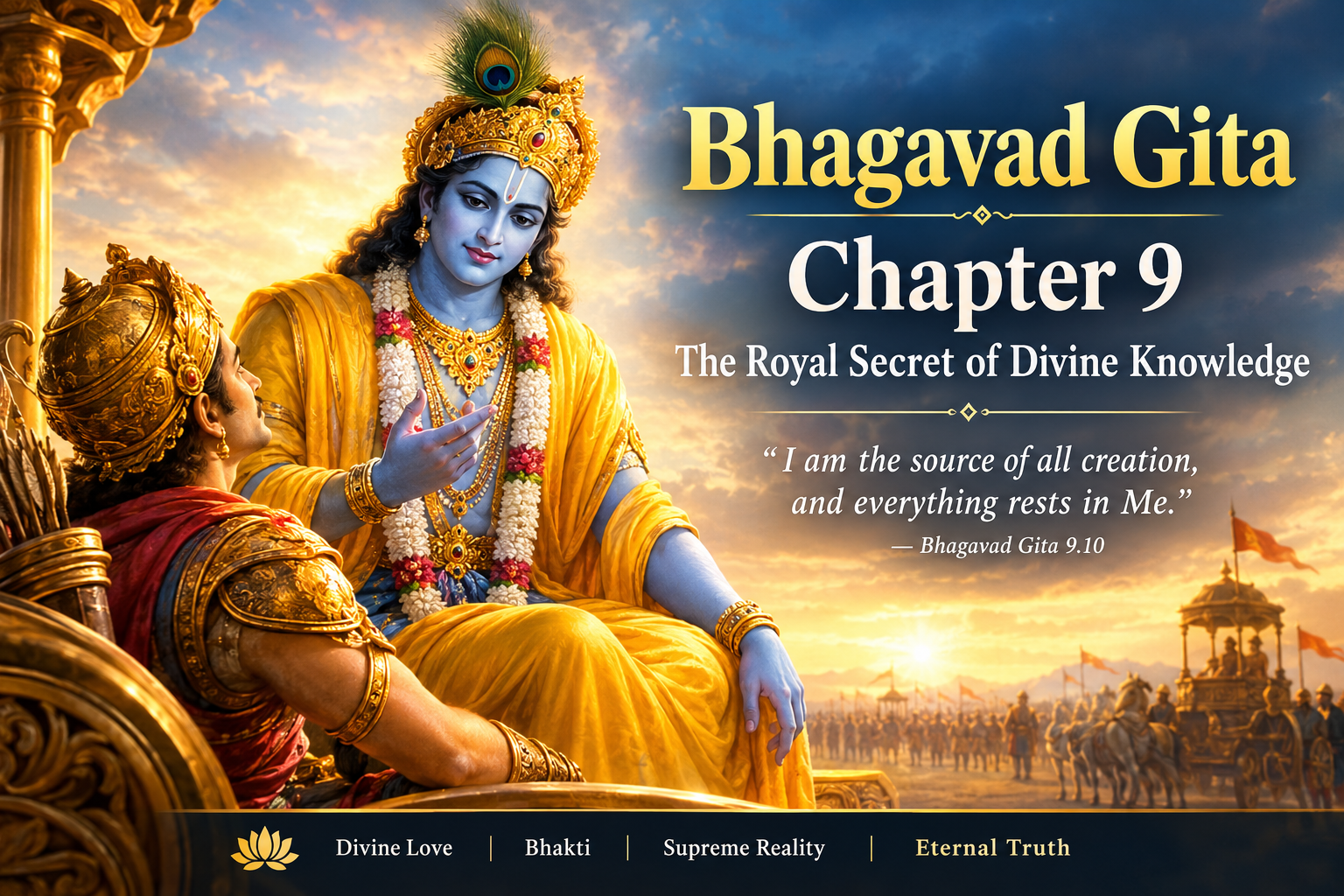
The Royal Knowledge and the Royal Secret
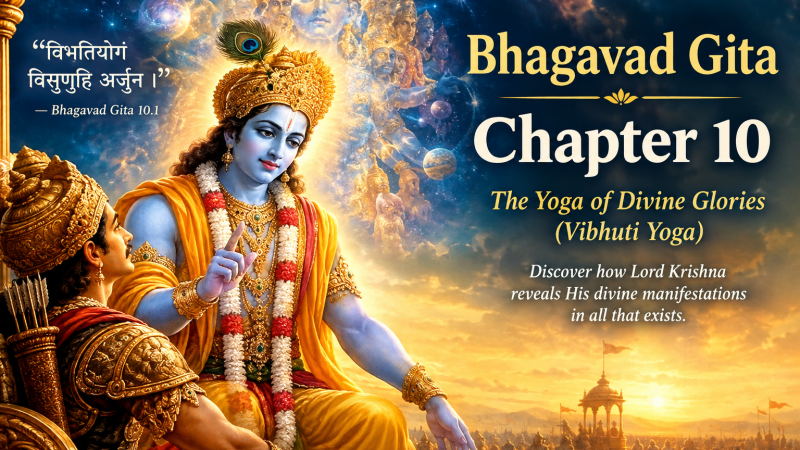
The Bhagavad Gita Chapter 9, known as Rāja Vidyā Rāja Guhya Yoga or The Yoga of Royal Knowledge and Royal Secret, is one of the most profound chapters of the Bhagavad Gita. In this chapter, Lord Krishna reveals to Arjuna a deeply spiritual teaching about the nature of God, the universe, devotion, karma, sacrifice, surrender, and liberation.
Chapter 9 contains 34 verses. Krishna describes this wisdom as rāja-vidyā, the king of knowledge, and rāja-guhya, the king of secrets. He explains that the Supreme Divine pervades the entire universe while remaining beyond its limitations. He also explains how creation operates through divine nature and why actions performed without attachment do not bind the Supreme.
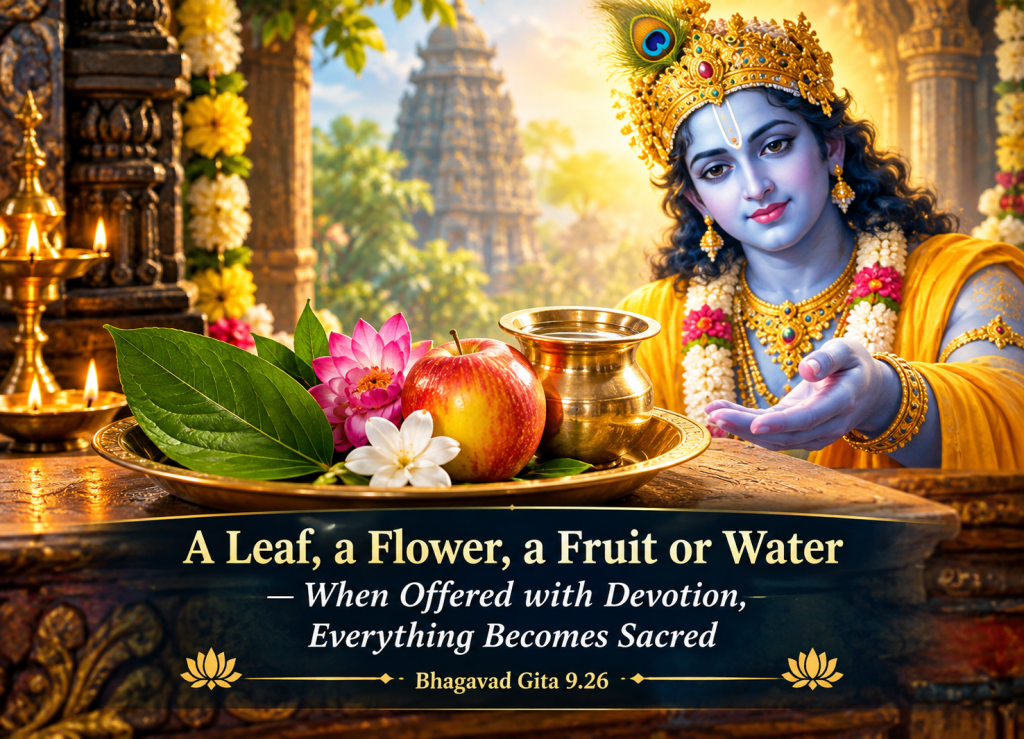
A major theme of this chapter is Bhakti Yoga, the path of loving devotion. Krishna teaches that devotion does not necessarily require elaborate possessions or complicated ceremonies. Even a leaf, flower, fruit, or water offered with sincere devotion is accepted by the Lord.
The chapter also contains several of the most beloved verses of the Bhagavad Gita, including Bhagavad Gita 9.22, concerning yoga-kṣema, Bhagavad Gita 9.26, concerning offerings made with devotion, and Bhagavad Gita 9.34, which summarizes the practice of remembering, worshipping, and surrendering oneself to the Divine.
What Does Raja Vidya Raja Guhya Yoga Mean?
The Sanskrit title Rāja Vidyā Rāja Guhya Yoga can be understood as:
- Rāja — royal or supreme
- Vidyā — knowledge
- Rāja Guhya — the greatest or royal secret
- Yoga — spiritual union or disciplined connection with the Divine
Thus, the title can be translated as “The Yoga of Royal Knowledge and Royal Secret.”
Krishna calls this teaching the king of knowledge because it addresses the highest spiritual reality, and the king of secrets because it reveals a profound truth about the relationship between the Divine, the individual soul, nature, and the universe.
The teaching combines jñāna, spiritual knowledge, with vijñāna, realized or experiential understanding. It is therefore not merely information to be memorized. Krishna presents it as knowledge that can transform one’s way of seeing life.
The Setting of Bhagavad Gita Chapter 9
The Bhagavad Gita is a dialogue between Lord Krishna and Arjuna on the battlefield of Kurukshetra. Arjuna is struggling with confusion concerning duty, action, family, morality, and the consequences of war.
Krishna gradually leads him from confusion toward spiritual understanding.
The preceding chapters have already introduced important ideas concerning action, knowledge, meditation, the nature of the Supreme, and devotion. In Chapter 9, Krishna goes deeper into the nature of divine reality and places special emphasis on loving devotion.
The chapter therefore serves as an important bridge between philosophical knowledge and practical devotion.
Bhagavad Gita Chapter 9: All 34 Sanskrit Slokas, Paraphrase and Explanation
Verse 9.1
Sanskrit
श्रीभगवानुवाच ।
इदं तु ते गुह्यतमं प्रवक्ष्याम्यनसूयवे ।
ज्ञानं विज्ञानसहितं यज्ज्ञात्वा मोक्ष्यसेऽशुभात् ॥९.१॥
Paraphrase
Lord Krishna said: Because you are free from envy and receptive to spiritual truth, I shall reveal to you this most profound knowledge together with realization. By understanding it, you can become free from the bondage and suffering of worldly existence.
Explanation
Krishna begins by emphasizing the importance of a receptive heart. Spiritual knowledge is not simply intellectual information. It becomes meaningful when knowledge is combined with realization.
The word vijñāna points toward experienced or realized knowledge. A person may read about compassion, devotion, or truth, but actually living those principles produces a deeper understanding.
Verse 9.2
Sanskrit
राजविद्या राजगुह्यं पवित्रमिदमुत्तमम् ।
प्रत्यक्षावगमं धर्म्यं सुसुखं कर्तुमव्ययम् ॥९.२॥
Paraphrase
This is the king of knowledge and the king of secrets. It is supremely pure, directly realizable, consistent with dharma, easy to practice, and imperishable.
Explanation
Krishna gives this teaching several extraordinary descriptions.
It is:
- Rāja-vidyā — the highest knowledge
- Rāja-guhya — the supreme secret
- Pavitram — purifying
- Dharmyam — harmonious with dharma
- Susukham kartum — joyful or easy to practice
- Avyayam — imperishable
The spiritual path described here is therefore not presented as something reserved only for scholars. Devotion can be practiced through ordinary life.
Verse 9.3
Sanskrit
अश्रद्दधानाः पुरुषा धर्मस्यास्य परन्तप ।
अप्राप्य मां निवर्तन्ते मृत्युसंसारवर्त्मनि ॥९.३॥
Paraphrase
Those who lack faith in this spiritual teaching do not attain the Supreme and continue along the path of worldly birth and death.
Explanation
Here Krishna highlights śraddhā, or sincere spiritual trust. Faith in the Gita does not mean abandoning thought. Rather, it means approaching spiritual knowledge with openness and willingness to practice.
The verse connects lack of spiritual commitment with continued involvement in saṃsāra, the cycle of worldly existence.
Verse 9.4
Sanskrit
मया ततमिदं सर्वं जगदव्यक्तमूर्तिना ।
मत्स्थानि सर्वभूतानि न चाहं तेष्ववस्थितः ॥९.४॥
Paraphrase
In My unmanifest form, I pervade the entire universe. All beings exist in Me, yet I am not limited or confined by them.
Explanation
This is one of the central philosophical statements of Chapter 9.
Krishna describes the Divine as all-pervading, yet not confined by creation. The relationship is therefore deeper than simply saying that God is one object among many objects in the universe.
The Divine sustains existence while remaining beyond ordinary material limitations.
Verse 9.5
Sanskrit
न च मत्स्थानि भूतानि पश्य मे योगमैश्वरम् ।
भूतभृन्न च भूतस्थो ममात्मा भूतभावनः ॥९.५॥
Paraphrase
And yet beings do not contain Me. Behold My divine mystery: I sustain and generate all beings, but My true nature is not confined within them.
Explanation
At first glance, verses 9.4 and 9.5 may appear contradictory. Krishna first says that all beings are in Him and then says that beings are not in Him.
This apparent paradox points toward a reality that cannot be completely described through ordinary physical relationships. The Divine supports existence but cannot be reduced to the collection of things that exist.
Verse 9.6
Sanskrit
यथाकाशस्थितो नित्यं वायुः सर्वत्रगो महान् ।
तथा सर्वाणि भूतानि मत्स्थानीत्युपधारय ॥९.६॥
Paraphrase
Just as the mighty wind moves everywhere while remaining within space, understand that all beings exist within Me.
Explanation
Krishna gives a beautiful analogy.
Air moves through space, but space itself is not carried away by the movement of air. Similarly, living beings arise and move within the Divine reality.
The analogy helps Arjuna understand how the Divine can pervade existence without becoming limited by individual forms.
Verse 9.7
Sanskrit
सर्वभूतानि कौन्तेय प्रकृतिं यान्ति मामिकाम् ।
कल्पक्षये पुनस्तानि कल्पादौ विसृजाम्यहम् ॥९.७॥
Paraphrase
At the end of a cosmic cycle, all beings enter My material nature. At the beginning of another cosmic cycle, I bring them forth again.
Explanation
Hindu cosmology views creation as involving vast cycles of manifestation and dissolution.
Krishna presents the Divine as the foundation of these cosmic processes. Creation is not described as a single isolated event but as part of a recurring cosmic rhythm.
Verse 9.8
Sanskrit
प्रकृतिं स्वामवष्टभ्य विसृजामि पुनः पुनः ।
भूतग्राममिमं कृत्स्नमवशं प्रकृतेर्वशात् ॥९.८॥
Paraphrase
Taking support of My own divine nature, I repeatedly bring forth the entire multitude of beings, which operates according to the forces of nature.
Explanation
The universe functions through prakṛti, or material nature. Beings participate in this process according to the qualities and forces of nature.
Krishna, however, describes Himself as the divine foundation behind this recurring manifestation.
Verse 9.9
Sanskrit
न च मां तानि कर्माणि निबध्नन्ति धनञ्जय ।
उदासीनवदासीनमसक्तं तेषु कर्मसु ॥९.९॥
Paraphrase
O Arjuna, these cosmic actions do not bind Me because I remain unattached to them, like one who stands apart from their results.
Explanation
This verse is closely connected with the Gita’s broader teaching of non-attachment.
Action itself is not necessarily the cause of bondage. Attachment to action and its fruits creates bondage. Krishna’s cosmic activity does not bind Him because He remains unattached.
This principle can also inspire human beings to perform their responsibilities without becoming consumed by personal attachment to results.
Verse 9.10
Sanskrit
मयाध्यक्षेण प्रकृतिः सूयते सचराचरम् ।
हेतुनानेन कौन्तेय जगद्विपरिवर्तते ॥९.१०॥
Paraphrase
Under My supervision, nature produces everything that moves and does not move. Through this process, the universe continues its cycles.
Explanation
Krishna describes prakṛti as the dynamic power through which the world operates, while the Divine is its supreme governing principle.
The verse therefore presents a relationship between divine consciousness and cosmic nature.
Verse 9.11
Sanskrit
अवजानन्ति मां मूढा मानुषीं तनुमाश्रितम् ।
परं भावमजानन्तो मम भूतमहेश्वरम् ॥९.११॥
Paraphrase
Those who fail to recognize My higher divine nature may regard Me merely as an ordinary human being when I appear in human form.
Explanation
Krishna distinguishes between His visible human appearance and His deeper divine nature.
In the devotional traditions of Hinduism, this verse is important for understanding the concept of Krishna as the Divine appearing in human form.
Verse 9.12
Sanskrit
मोघाशा मोघकर्माणो मोघज्ञाना विचेतसः ।
राक्षसीमासुरीं चैव प्रकृतिं मोहिनीं श्रिताः ॥९.१२॥
Paraphrase
Those who fail to recognize the Divine become driven by confused hopes, actions, and understanding, taking refuge in deluding and destructive tendencies.
Explanation
Krishna contrasts spiritual understanding with āsurī or destructive tendencies.
When desire, ego, confusion, and selfishness dominate the mind, one’s actions may become disconnected from higher spiritual purpose.
Verse 9.13
Sanskrit
महात्मानस्तु मां पार्थ दैवीं प्रकृतिमाश्रिताः ।
भजन्त्यनन्यमनसो ज्ञात्वा भूतादिमव्ययम् ॥९.१३॥
Paraphrase
Great souls take refuge in the divine nature and worship Me with an undivided mind, knowing Me as the imperishable source of all beings.
Explanation
The term mahātmā literally means “great soul.”
Krishna associates spiritual greatness with a daivī prakṛti, or divine disposition. Such people direct their mind toward the Supreme with devotion and recognize the Divine as the eternal source of existence.
Verse 9.14
Sanskrit
सततं कीर्तयन्तो मां यतन्तश्च दृढव्रताः ।
नमस्यन्तश्च मां भक्त्या नित्ययुक्ता उपासते ॥९.१४॥
Paraphrase
Always praising Me, striving with firm determination, bowing to Me with devotion, and remaining spiritually connected, My devotees worship Me continuously.
Explanation
This verse describes practical devotion.
Devotion includes:
- remembrance,
- praise,
- prayer,
- humility,
- determination,
- worship,
- continuous spiritual awareness.
Bhakti is therefore not limited to a particular ritual. It becomes a way of life.
Verse 9.15
Sanskrit
ज्ञानयज्ञेन चाप्यन्ये यजन्तो मामुपासते ।
एकत्वेन पृथक्त्वेन बहुधा विश्वतोमुखम् ॥९.१५॥
Paraphrase
Others worship Me through the sacrifice of knowledge, seeing the Divine as One, as manifest through many forms, or as the cosmic reality extending in every direction.
Explanation
This verse acknowledges different approaches to understanding and worshipping the Divine.
Some seekers emphasize unity, others divine manifestations, and others the cosmic form.
The verse therefore presents spiritual contemplation in several forms.
Krishna as the Reality Behind Sacrifice
The next group of verses expands the meaning of divine presence. Krishna identifies Himself with the elements of sacrifice, the natural world, and the various relationships through which beings understand the Divine.
Verse 9.16
Sanskrit
अहं क्रतुरहं यज्ञः स्वधाहमहमौषधम् ।
मन्त्रोऽहमहमेवाज्यमहमग्निरहं हुतम् ॥९.१६॥
Paraphrase
I am the ritual, the sacrifice, the offering to the ancestors, the healing herb, the sacred mantra, the clarified butter, the fire, and the act of offering.
Explanation
Krishna is not describing Himself as merely the recipient of worship. He declares that every essential element of sacred sacrifice ultimately has its foundation in the Divine.
The verse expands the meaning of worship: the worshipper, offering, ritual, and sacred process all depend upon the Supreme.
Verse 9.17
Sanskrit
पिताहमस्य जगतो माता धाता पितामहः ।
वेद्यं पवित्रमोङ्कार ऋक्साम यजुरेव च ॥९.१७॥
Paraphrase
I am the father, mother, sustainer, and grandsire of the universe. I am the object of knowledge, the purifier, the sacred syllable Om, and the Rig, Sama, and Yajur Vedas.
Explanation
Here Krishna uses several family relationships to describe the Divine.
God is described as:
- Father,
- Mother,
- Sustainer,
- Ancestor,
- Purifier,
- Object of knowledge.
The verse emphasizes that the Divine transcends any single human relationship.
Verse 9.18
Sanskrit
गतिर्भर्ता प्रभुः साक्षी निवासः शरणं सुहृत् ।
प्रभवः प्रलयः स्थानं निधानं बीजमव्ययम् ॥९.१८॥
Paraphrase
I am the ultimate goal, sustainer, Lord, witness, dwelling place, refuge, and selfless friend. I am the origin, dissolution, foundation, resting place, and imperishable seed.
Explanation
This is one of the richest descriptions of the Divine in the chapter.
Krishna presents the Supreme as both the beginning and destination of existence.
The word suhṛt, meaning a well-wisher or sincere friend, is especially beautiful. The Divine is presented not merely as an authority but also as a spiritual friend.
Verse 9.19
Sanskrit
तपाम्यहमहं वर्षं निगृह्णाम्युत्सृजामि च ।
अमृतं चैव मृत्युश्च सदसच्चाहमर्जुन ॥९.१९॥
Paraphrase
I give heat, send forth and withhold rain. I am immortality and death, existence and non-existence, O Arjuna.
Explanation
Krishna describes the Divine as encompassing the contrasting dimensions of existence.
Heat and rain, life and death, existence and non-existence are all included within the cosmic order.
This verse encourages a broader vision of reality rather than seeing the Divine only in pleasant or desirable experiences.
The Difference Between Temporary Rewards and Spiritual Liberation
Verses 9.20 and 9.21 distinguish between ritual actions performed for heavenly rewards and devotion directed toward the Supreme.
Verse 9.20
Sanskrit
त्रैविद्या मां सोमपाः पूतपापा यज्ञैरिष्ट्वा स्वर्गतिं प्रार्थयन्ते ।
ते पुण्यमासाद्य सुरेन्द्रलोकमश्नन्ति दिव्यान्दिवि देवभोगान् ॥९.२०॥
Paraphrase
Those who follow the ritual teachings of the three Vedas, perform sacrifices, and seek heaven may reach the heavenly realm and enjoy the pleasures associated with that realm.
Explanation
Krishna does not deny the existence of the heavenly reward described here. Instead, He points out its limitation.
A reward obtained through accumulated merit remains connected with the exhaustion of that merit.
Verse 9.21
Sanskrit
ते तं भुक्त्वा स्वर्गलोकं विशालं क्षीणे पुण्ये मर्त्यलोकं विशन्ति ।
एवं त्रयीधर्ममनुप्रपन्ना गतागतं कामकामा लभन्ते ॥९.२१॥
Paraphrase
After enjoying the heavenly realm, when their accumulated merit is exhausted, they return to the mortal world. Those who seek worldly or heavenly rewards therefore continue in the cycle of coming and going.
Explanation
This verse makes an important distinction between temporary reward and liberation.
Heavenly enjoyment may be desirable, but Krishna describes it as impermanent. Liberation is different because it is not dependent upon temporary merit and temporary enjoyment.
Bhagavad Gita 9.22: The Promise of Yoga-Kṣema
Verse 9.22
Sanskrit
अनन्याश्चिन्तयन्तो मां ये जनाः पर्युपासते ।
तेषां नित्याभियुक्तानां योगक्षेमं वहाम्यहम् ॥९.२२॥
Paraphrase
Those who constantly remember Me and worship Me with single-minded devotion, remaining spiritually united with Me, are cared for by Me in what they need and in what they already possess.
Explanation
This is one of the most famous verses of the Bhagavad Gita.
The expression yoga-kṣema is traditionally understood as referring to obtaining what is needed and preserving what has been attained.
The verse has inspired generations of devotees because it expresses the idea of divine care.
At the same time, the verse describes ananyabhakti—single-minded devotion. Krishna is not simply describing a wish-fulfillment formula. The emphasis is on continuous spiritual dedication.
Bhagavad Gita 9.23: Worship of Other Deities
Verse 9.23
Sanskrit
येऽप्यन्यदेवता भक्ता यजन्ते श्रद्धयान्विताः ।
तेऽपि मामेव कौन्तेय यजन्त्यविधिपूर्वकम् ॥९.२३॥
Paraphrase
Those who worship other deities with faith are, in a deeper sense, also worshipping Me, although Krishna says they do so without full understanding of the ultimate reality.
Explanation
This verse has been interpreted in different ways within Hindu philosophical traditions.
Its central point in the chapter is that the Supreme is ultimately the foundation and recipient of all worship. The verse also emphasizes the importance of understanding the deeper reality behind religious practice.
Verse 9.24
Sanskrit
अहं हि सर्वयज्ञानां भोक्ता च प्रभुरेव च ।
न तु मामभिजानन्ति तत्त्वेनातश्च्यवन्ति ते ॥९.२४॥
Paraphrase
I am the ultimate enjoyer and Lord of all sacrifices. Those who do not understand Me in truth do not fully realize the ultimate purpose of their worship.
Explanation
The outer form of a ritual is not the whole of spiritual practice.
Krishna directs Arjuna toward tattva, understanding reality as it truly is.
A ritual becomes spiritually meaningful when it is connected with knowledge, devotion, and surrender.
Verse 9.25
Sanskrit
यान्ति देवव्रता देवान्पितॄन्यान्ति पितृव्रताः ।
भूतानि यान्ति भूतेज्या यान्ति मद्याजिनोऽपि माम् ॥९.२५॥
Paraphrase
Those who worship the gods attain the realms associated with the gods; those devoted to ancestors go to the ancestors; those who worship other beings go to them; those who worship Me attain Me.
Explanation
The verse connects the object of one’s devotion with the destination one seeks.
Krishna’s message is that spiritual aspiration should be directed toward the Supreme if the ultimate goal is union with the Supreme.
Bhagavad Gita 9.26: The Power of Simple Devotion
Verse 9.26
Sanskrit
पत्रं पुष्पं फलं तोयं यो मे भक्त्या प्रयच्छति ।
तदहं भक्त्युपहृतमश्नामि प्रयतात्मनः ॥९.२६॥
Paraphrase
Whoever offers Me a leaf, a flower, a fruit, or water with sincere devotion, I accept that loving offering from the pure-hearted devotee.
Explanation
This is perhaps the most famous verse in Chapter 9.
Krishna does not emphasize the monetary value of an offering. He emphasizes bhakti, devotion.
A simple offering can become spiritually meaningful when it is given with love and sincerity.
This principle makes devotional worship accessible to everyone. One does not need enormous wealth or elaborate possessions to express devotion.
The verse teaches that the quality of the heart matters more than the material value of the offering.
Bhagavad Gita 9.27: Offering Every Action to God
Verse 9.27
Sanskrit
यत्करोषि यदश्नासि यज्जुहोषि ददासि यत् ।
यत्तपस्यसि कौन्तेय तत्कुरुष्व मदर्पणम् ॥९.२७॥
Paraphrase
Whatever you do, whatever you eat, whatever you offer, whatever you give, and whatever spiritual discipline you perform—do all of it as an offering to Me.
Explanation
This verse takes devotion beyond the temple or altar.
Krishna teaches that ordinary life itself can become an offering.
Work, food, charity, study, prayer, discipline, and daily responsibilities can all be performed with a spirit of dedication.
This transforms spirituality from something practiced occasionally into a continuous way of living.
Verse 9.28
Sanskrit
शुभाशुभफलैरेवं मोक्ष्यसे कर्मबन्धनैः ।
संन्यासयोगयुक्तात्मा विमुक्तो मामुपैष्यसि ॥९.२८॥
Paraphrase
By dedicating your actions to Me, you become free from the bondage created by both favorable and unfavorable results. Through this spirit of renunciation, you become liberated and come to Me.
Explanation
The Gita does not teach that people should simply stop acting.
Instead, it teaches a transformation in the attitude toward action.
When actions are offered to the Divine rather than performed purely for egoistic reward, attachment to results gradually decreases.
Bhagavad Gita 9.29: Divine Equality
Verse 9.29
Sanskrit
समोऽहं सर्वभूतेषु न मे द्वेष्योऽस्ति न प्रियः ।
ये भजन्ति तु मां भक्त्या मयि ते तेषु चाप्यहम् ॥९.२९॥
Paraphrase
I am equal toward all beings. I have no one as hateful or especially favored. Yet those who worship Me with devotion live in Me, and I live in them.
Explanation
Krishna begins with a profound statement of divine impartiality.
The Divine is not described as inherently biased toward particular beings.
The second part describes the special relationship created through devotion: the devotee consciously establishes a relationship with the Divine, and the Divine becomes deeply present in the devotee’s life.
Bhagavad Gita 9.30: Transformation Through Devotion
Verse 9.30
Sanskrit
अपि चेत्सुदुराचारो भजते मामनन्यभाक् ।
साधुरेव स मन्तव्यः सम्यग्व्यवसितो हि सः ॥९.३०॥
Paraphrase
Even if a person who has behaved very wrongly turns wholeheartedly toward Me with undivided devotion, that person should be regarded as rightly resolved because the direction of life has genuinely changed.
Explanation
This verse is about spiritual transformation.
Krishna does not say that harmful actions are irrelevant. Rather, He emphasizes the extraordinary possibility of genuine change.
A person’s past does not necessarily have to determine the direction of their future.
Sincere devotion can mark the beginning of moral and spiritual transformation.
Verse 9.31
Sanskrit
क्षिप्रं भवति धर्मात्मा शश्वच्छान्तिं निगच्छति ।
कौन्तेय प्रतिजानीहि न मे भक्तः प्रणश्यति ॥९.३१॥
Paraphrase
Such a person soon becomes righteous and attains lasting peace. O Arjuna, know with certainty that My devotee never perishes.
Explanation
The famous statement “na me bhaktaḥ praṇaśyati” means that the sincere devotee is never ultimately lost.
The verse gives hope to those who sincerely seek transformation.
Devotion is presented as a path that can redirect one’s entire life toward righteousness and peace.
Bhagavad Gita 9.32: Spiritual Refuge Is Open to All
Verse 9.32
Sanskrit
मां हि पार्थ व्यपाश्रित्य येऽपि स्युः पापयोनयः ।
स्त्रियो वैश्यास्तथा शूद्रास्तेऽपि यान्ति परां गतिम् ॥९.३२॥
Paraphrase
Those who take refuge in Me can attain the supreme goal, including people whom society has regarded as coming from disadvantaged or traditionally lower-status circumstances.
Explanation
This verse is important because Krishna emphasizes the accessibility of spiritual refuge.
Traditional translations sometimes preserve ancient social terminology literally. The central spiritual message is that devotion and refuge in the Divine are not restricted to a narrow elite.
The verse can therefore be read as a powerful affirmation of the universal accessibility of spiritual aspiration.
Verse 9.33
Sanskrit
किं पुनर्ब्राह्मणाः पुण्या भक्ता राजर्षयस्तथा ।
अनित्यमसुखं लोकमिमं प्राप्य भजस्व माम् ॥९.३३॥
Paraphrase
If those who come from difficult circumstances can attain the supreme goal through devotion, then certainly virtuous people and devoted spiritual rulers can do so as well. Having entered this temporary world, devote yourself to Me.
Explanation
Krishna reminds Arjuna that worldly existence is anitya, temporary.
Because life is impermanent, spiritual practice should not be endlessly postponed.
The verse encourages seekers to use human life as an opportunity for devotion and spiritual realization.
Bhagavad Gita 9.34: The Essence of Devotion
Sanskrit
मन्मना भव मद्भक्तो मद्याजी मां नमस्कुरु ।
मामेवैष्यसि युक्त्वैवमात्मानं मत्परायणः ॥९.३४॥
Paraphrase
Fix your mind on Me. Become My devotee. Worship Me and bow to Me. By dedicating yourself to Me and making Me your supreme goal, you will come to Me.
Explanation
The final verse summarizes the entire chapter.
Krishna gives four simple instructions:
- Keep the mind on the Divine.
- Become devoted.
- Worship the Divine.
- Offer respectful surrender.
The teaching concludes not with a complicated philosophical formula but with a simple path of loving remembrance and dedication.
Major Teachings of Bhagavad Gita Chapter 9
1. Divine Knowledge Is Also Experiential Knowledge
Chapter 9 begins by distinguishing ordinary knowledge from knowledge combined with realization.
A person may know many spiritual concepts intellectually, but the Gita encourages the seeker to transform knowledge into lived experience.
Understanding compassion and practicing compassion are different. Knowing that the Divine is everywhere and actually seeing life with reverence are also different.
2. God Pervades the Universe
One of the most important ideas in Chapter 9 is the Divine’s relationship with the entire universe.
Krishna says that the universe is pervaded by His unmanifest form. At the same time, He remains beyond the limitations of the created world.
This creates a profound vision of the relationship between immanence and transcendence.
The Divine is present throughout creation while also exceeding creation.
3. Bhakti Is Accessible
Chapter 9 gives extraordinary importance to devotion.
Bhakti does not require the devotee to possess great wealth. Verse 9.26 demonstrates this beautifully.
A leaf, flower, fruit, or water can become an offering when it is given with devotion.
The principle is simple:
The heart behind an offering is more important than its material value.
4. Everyday Life Can Become Worship
Verse 9.27 extends the idea of devotion to every part of life.
Eating can become mindful gratitude.
Work can become service.
Charity can become an offering.
Study can become a search for truth.
Prayer can become remembrance.
Even ordinary responsibilities can be performed with a spirit of dedication.
This is one reason Chapter 9 remains highly relevant to modern life.
5. Detachment Does Not Mean Inactivity
Krishna does not ask Arjuna to abandon all responsibilities.
Instead, He teaches detachment from selfish attachment to results.
A person can work sincerely while accepting that the final outcome is not completely under personal control.
This teaching can help reduce anxiety about results while encouraging sincere effort.
6. Temporary Rewards Are Not the Same as Liberation
Verses 9.20 and 9.21 describe the limitations of heavenly rewards obtained through desire-driven action.
Even great pleasure remains temporary if it depends upon finite merit.
The Gita therefore distinguishes between:
temporary enjoyment and ultimate liberation.
The spiritual goal is not merely to obtain a better temporary experience but to realize the Supreme.
7. Divine Grace and Devotion
Verse 9.22 is particularly significant for devotees.
Krishna promises divine care to those who worship Him with single-minded devotion.
The teaching emphasizes a relationship of trust between the devotee and the Divine.
This does not encourage passivity. Instead, it encourages the devotee to perform responsibilities while placing ultimate trust in God.
8. Sincere Transformation Is Possible
Verses 9.30 and 9.31 provide a powerful message of hope.
A person’s past mistakes do not necessarily have to become their permanent identity.
The Gita emphasizes genuine transformation through wholehearted spiritual commitment.
The important question becomes:
What direction is the person taking now?
Practical Lessons from Bhagavad Gita Chapter 9
Chapter 9 can be applied to everyday life in many ways.
Remember the Divine
Take a few moments each day to remember God. This can be through prayer, meditation, chanting, reading scripture, or silent contemplation.
Perform Work as Service
Instead of thinking only about personal reward, consider how your work can benefit others.
Offer What You Have
The teaching of verse 9.26 reminds us that devotion does not require expensive offerings. A simple flower, fruit, water, or prayer can express sincere love.
Reduce Attachment to Results
Give your best effort, but understand that outcomes depend on many factors beyond personal control.
Practice Gratitude
Food, nature, family, knowledge, and opportunities can all be viewed as gifts rather than possessions to be taken for granted.
Avoid Spiritual Pride
The deepest knowledge should make a person more humble, compassionate, and devoted rather than arrogant.
Allow Yourself to Change
If you have made mistakes, do not assume that your past has permanently defined you. Chapter 9 emphasizes the possibility of spiritual transformation.
Why Bhagavad Gita Chapter 9 Is Called the Royal Knowledge
The title Rāja Vidyā is significant because Chapter 9 brings together many central themes of the Bhagavad Gita.
It discusses:
- God and the universe
- Creation and dissolution
- Karma
- Non-attachment
- Sacrifice
- Devotion
- Divine grace
- Spiritual equality
- Transformation
- Liberation
The teaching is therefore both philosophical and practical.
It does not simply ask the seeker to understand God intellectually. It asks the seeker to develop a relationship with the Divine through remembrance, devotion, worship, surrender, and dedicated action.
Why Bhagavad Gita Chapter 9 Is Called the Royal Secret
The word guhya means something hidden or secret.
The secret here is not necessarily something deliberately concealed. Rather, it is a profound truth that may remain unnoticed because ordinary human attention is absorbed in temporary objects, desires, and achievements.
Chapter 9 reveals that the Divine is the foundation of everything while remaining beyond the limitations of individual forms.
It also reveals a simple spiritual principle:
Devotion can transform ordinary life into a path toward the Divine.
The Central Message of Chapter 9
The entire chapter can be summarized through a few connected ideas.
The Divine pervades the universe.
The Divine sustains creation.
Nature operates under divine supervision.
Human beings become bound when they act with attachment and selfish desire.
Devotion provides a direct relationship with the Divine.
Even simple offerings can become sacred when made with love.
Every action can be dedicated to God.
Spiritual transformation is possible.
The Divine is described as equally present toward all beings.
And the final instruction is to keep the mind centered upon the Supreme.
Bhagavad Gita Chapter 9 and the Path of Bhakti
Although the Bhagavad Gita presents several complementary spiritual paths, Chapter 9 gives especially strong emphasis to Bhakti Yoga.
Bhakti is more than emotional attachment.
It includes:
- remembrance,
- love,
- trust,
- surrender,
- worship,
- humility,
- dedication,
- service.
A devotee does not merely think about God during worship and then forget the Divine during ordinary activities. The ideal described in Chapter 9 is to bring remembrance of God into the whole of life.
This is why verse 9.27 is so important. It expands devotion beyond ritual and places it within everyday action.
The Beauty of Verse 9.26
Among all the verses in Chapter 9, verse 9.26 is especially beloved because of its simplicity:
“पत्रं पुष्पं फलं तोयं…”
A leaf.
A flower.
A fruit.
Water.
These are ordinary things. Yet Krishna says that when offered with devotion, they become meaningful.
The verse teaches a profound spiritual lesson: God is not impressed by material extravagance; sincere devotion is central.
For someone with limited resources, this is a message of hope. Spiritual life remains accessible.
The Meaning of Surrender in Chapter 9
Surrender does not necessarily mean abandoning responsibility.
The Gita’s teaching is better understood as surrendering egoistic ownership of action and its fruits.
A person can continue to work, teach, care for family, serve society, study, create, and fulfill responsibilities while remembering that life itself rests within a greater divine order.
This attitude can transform the inner quality of action.
Bhagavad Gita Chapter 9 and Modern Life
Modern life often creates pressure to achieve.
People may become deeply attached to:
- money,
- career,
- recognition,
- social status,
- possessions,
- success,
- popularity.
Chapter 9 offers another perspective.
It asks us to consider whether temporary achievements can provide permanent fulfillment.
The Gita does not necessarily ask people to abandon worldly responsibilities. Instead, it teaches people to perform them with a higher purpose.
A teacher can teach as service.
A doctor can treat patients as service.
A farmer can cultivate the earth with gratitude.
A student can study as a form of discipline.
A parent can care for children as an expression of love.
An artist can create as an offering.
In this way, ordinary life can become spiritual practice.
Conclusion
Bhagavad Gita Chapter 9, Rāja Vidyā Rāja Guhya Yoga, is a profound chapter on divine knowledge, devotion, surrender, and liberation.
Krishna reveals that the Divine is not distant from creation. The Supreme pervades the universe, sustains all beings, and remains beyond the limitations of material existence.
He teaches that actions performed with attachment can bind a person, while actions dedicated to the Divine can become a means of freedom.
The chapter also presents devotion as a path open to everyone. A devotee does not need great wealth to approach God. A simple leaf, flower, fruit, or water offered with sincere love is enough to express devotion.
Perhaps the most beautiful lesson is that spirituality does not have to remain separate from everyday life.
Whatever we do can become an offering.
Whatever we receive can inspire gratitude.
Whatever responsibilities we carry can become service.
And whatever difficulties we experience can become opportunities for deeper faith and spiritual growth.
Chapter 9 ultimately directs the seeker toward a life of remembrance, devotion, humility, and surrender.
Its final instruction is beautifully simple:
Keep the mind on the Divine.
Become devoted.
Worship with love.
Bow with humility.
Make the Divine the highest goal.
In this way, the royal knowledge and royal secret of Chapter 9 becomes not merely something to read, but something to practice.
*Related Article: Bhagavad Gita Chapter 8: Akshara Brahma Yoga