Bhagavad Gita Chapter 12: Bhakti Yoga
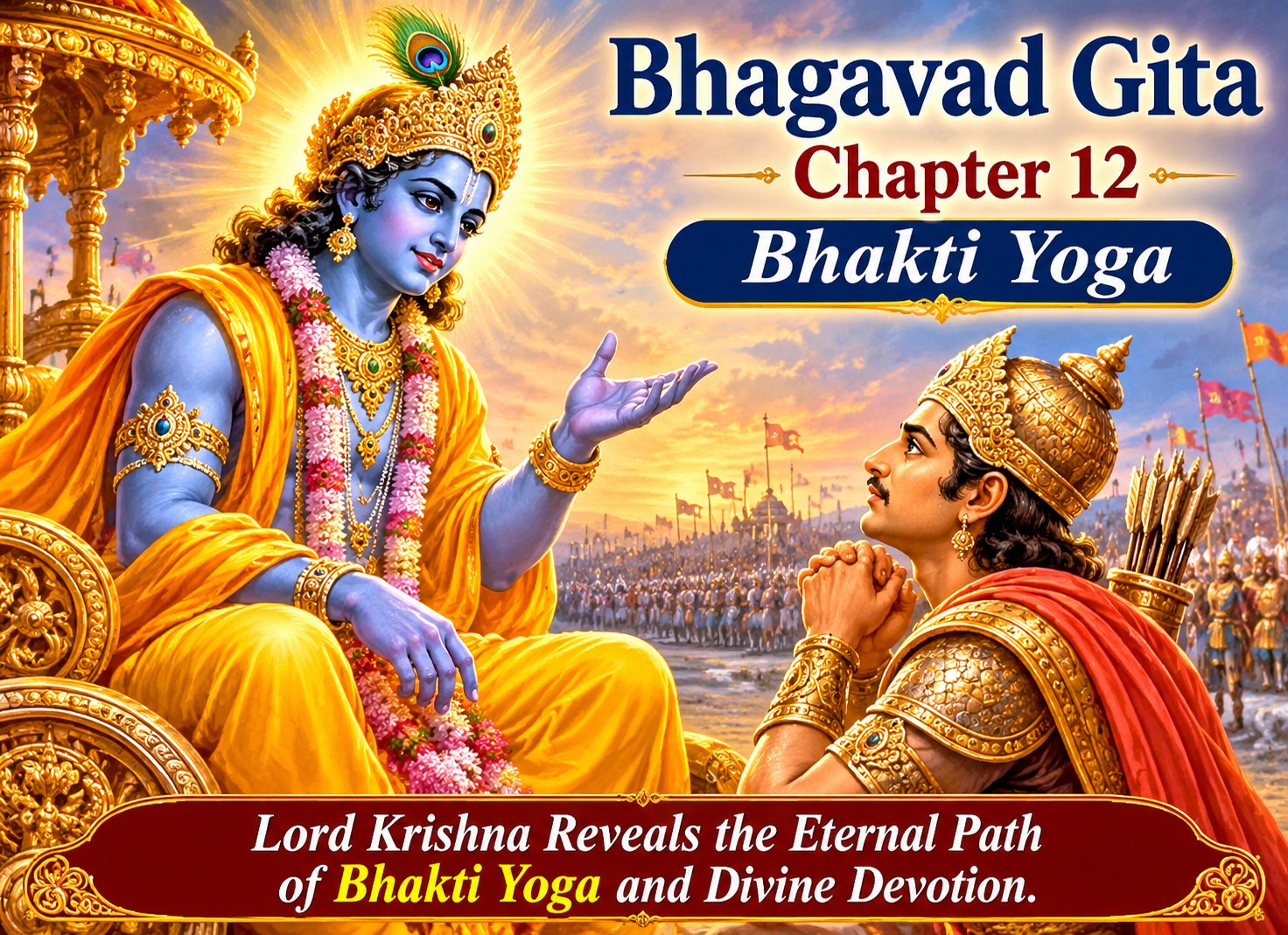
The Bhagavad Gita, one of the most revered spiritual texts of Hinduism, offers timeless wisdom about life, duty, devotion, knowledge, and the relationship between the human soul and the Supreme Divine. Among its eighteen chapters, Chapter 12, known as Bhakti Yoga, holds a special place because it presents devotion as a beautiful and accessible path toward spiritual realization.
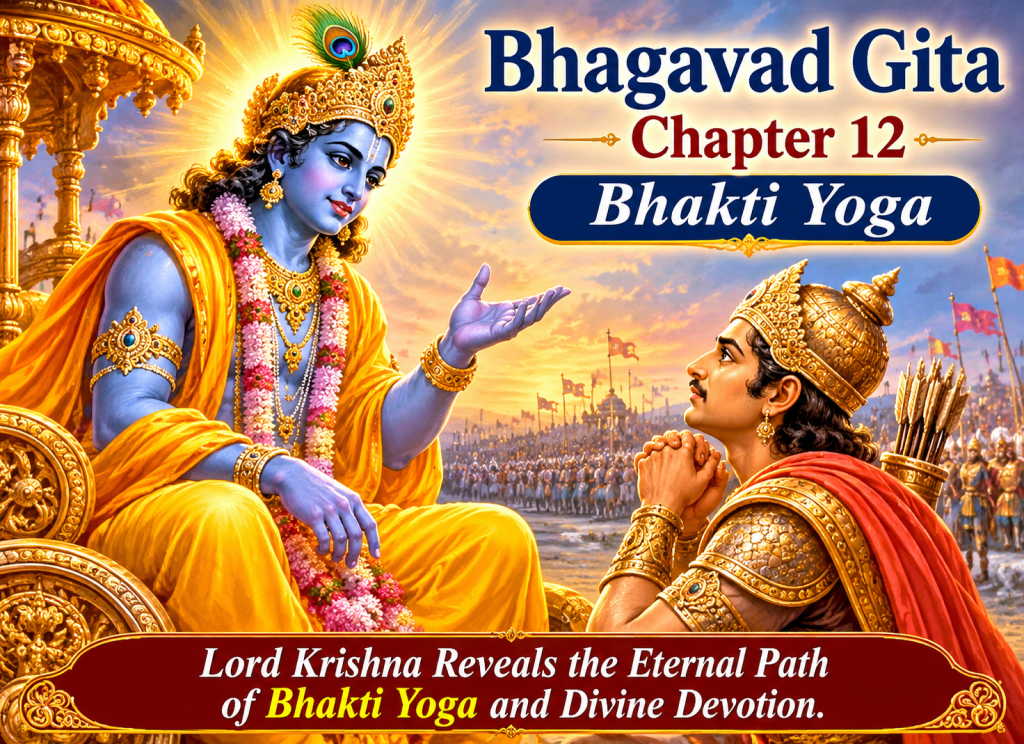
Bhagavad Gita Chapter 12 contains only twenty verses, yet its teachings are profound and practical. In this chapter, Lord Krishna explains the nature of devotion, the difference between worshipping the personal and impersonal aspects of the Divine, and the qualities that make a person dear to God.
The chapter begins with a question from Arjuna. He wants to understand which spiritual path is superior: worshipping the Supreme in a personal form or meditating upon the imperishable, unmanifest reality. Krishna answers this question with clarity and compassion. He acknowledges both paths but explains that devotion directed toward Him with a focused mind is especially suitable for embodied human beings.
The chapter then moves beyond religious practices and rituals. Krishna describes the character of a true devotee through qualities such as compassion, humility, forgiveness, contentment, self-control, and freedom from hatred. These teachings make Chapter 12 not merely a philosophical discussion but a practical guide to spiritual living.
In the modern world, where people often experience anxiety, competition, uncertainty, and emotional pressure, the message of Bhakti Yoga remains deeply relevant. It teaches that spiritual progress does not depend only on intellectual knowledge or complicated practices. It can begin with sincere love, a peaceful heart, and the willingness to dedicate one’s actions to the Divine.
What Is Bhagavad Gita Chapter 12 About?
Bhagavad Gita Chapter 12 is titled Bhakti Yoga, meaning the yoga or spiritual discipline of devotion.
The Sanskrit word bhakti is derived from a root associated with devotion, attachment, and loving dedication. In the spiritual context of the Bhagavad Gita, Bhakti Yoga means establishing a loving relationship with the Supreme Divine through faith, remembrance, surrender, and dedicated action.
The chapter can be divided into three major themes.
The first theme is the comparison between devotion to the personal form of God and meditation upon the unmanifest, imperishable reality. Krishna explains that both approaches can lead to spiritual realization, but the path of personal devotion is generally easier for embodied beings.
The second theme is the practical method of devotion. Krishna provides several approaches for those who find it difficult to concentrate their minds immediately. He encourages spiritual practice, dedicated action, and the renunciation of the fruits of work.
The third and most celebrated theme is the description of a true devotee. Krishna identifies the qualities of a person who is dear to Him. These qualities include friendliness, compassion, freedom from ego, equanimity, forgiveness, and a peaceful attitude toward the changing circumstances of life.
Thus, Chapter 12 presents devotion as both a spiritual relationship and a way of living.
Arjuna’s Question: Who Is the Greatest Yogi?
The chapter begins with Arjuna asking Lord Krishna a significant spiritual question.
Arjuna wants to know who is considered more spiritually advanced: those who worship Krishna in His personal form with faith and devotion, or those who meditate upon the imperishable, unmanifest, and indescribable Supreme Reality.
This question reflects an important philosophical discussion within Hindu spirituality. The Divine can be approached through different understandings. Some devotees worship God as a personal being with divine qualities, names, forms, and relationships. Others contemplate the Supreme as the formless, limitless, and unchanging reality beyond all material descriptions.
Arjuna’s question is not a rejection of either path. Rather, he seeks clarity about their spiritual value.
Krishna responds that those who fix their minds upon Him, worship Him with unwavering faith, and remain devoted to Him are considered by Him to be the most united with the Divine.
However, Krishna does not declare the unmanifest path invalid. He explains that those who meditate upon the imperishable and omnipresent reality also attain Him. The difficulty is that the unmanifest path can be challenging for people who identify with the body and live through physical and mental experiences.
This answer establishes the central message of the chapter: sincere spiritual dedication is essential, and the path of loving devotion offers a natural and accessible way for many people to approach the Supreme.
Personal and Impersonal Worship in the Bhagavad Gita
One of the most important philosophical teachings of Chapter 12 concerns the relationship between personal and impersonal worship.
In personal devotion, the devotee approaches God through a divine form, name, or relationship. In Hindu traditions, devotees may worship Krishna, Rama, Vishnu, Shiva, Devi, or other manifestations of the Divine according to their spiritual understanding and tradition.
Personal devotion allows the worshipper to develop love, trust, gratitude, and a sense of closeness with God. A devotee may remember the Divine as a loving protector, a compassionate teacher, a friend, or the ultimate refuge.
In impersonal contemplation, the spiritual seeker focuses on the unmanifest, eternal, and formless reality. This path often involves deep philosophical understanding, meditation, and the transcendence of attachment to the material world.
Krishna acknowledges the spiritual validity of both approaches. Yet He explains that concentrating upon the unmanifest can be difficult for embodied beings because human consciousness naturally relates to forms, relationships, and experiences.
The teaching should not be interpreted as a condemnation of all forms of impersonal meditation. Rather, Krishna highlights the practical accessibility of personal devotion.
For many people, love provides a natural bridge between ordinary life and spiritual realization. A person can remember God while working, caring for family, helping others, or facing difficulties. Devotion does not necessarily require withdrawal from society.
This makes Bhakti Yoga a path that can be practised by householders, students, teachers, workers, and spiritual seekers from different walks of life.
The Four Stages of Devotion: Krishna’s Practical Guidance
One of the most compassionate aspects of Bhagavad Gita Chapter 12 is that Krishna does not demand immediate perfection from every spiritual seeker.
He understands that the mind can be restless, concentration can be difficult, and people may have different levels of spiritual discipline. Therefore, He provides a gradual approach.
1. Fix the Mind on the Divine
Krishna first advises Arjuna to fix his mind upon Him and establish his intellect in the Divine.
This represents the highest and most direct form of devotion. The devotee constantly remembers God, develops deep faith, and allows spiritual awareness to guide thoughts and decisions.
When the mind becomes centred upon the Divine, everyday activities can acquire a spiritual purpose. Work becomes an opportunity to serve, relationships become opportunities to express compassion, and difficulties become opportunities to strengthen faith.
2. Practise Regular Spiritual Discipline
If a person cannot maintain constant concentration upon Krishna, He recommends the practice of spiritual discipline.
Regular remembrance, prayer, meditation, chanting, and worship can gradually train the mind. The purpose is not to force the mind through harshness but to develop consistency.
A few moments of sincere remembrance every day may become the foundation of a deeper spiritual life.
3. Dedicate Actions to the Divine
If regular meditation is difficult, Krishna advises performing actions for His sake.
This teaching brings spirituality into everyday responsibilities. A person may dedicate professional work, family duties, social service, education, and personal efforts to the Divine.
The spiritual value of an action is not determined only by its outward appearance. Its intention, honesty, and dedication also matter.
A teacher who educates students sincerely, a person who cares for an elderly family member, or a worker who performs duties honestly can transform ordinary responsibilities into devotional service.
4. Renounce the Fruits of Actions
Krishna further recommends renouncing attachment to the results of actions.
This does not mean abandoning responsibility or refusing to work toward meaningful goals. It means performing one’s duties sincerely without allowing personal desire, fear, or pride to control the mind.
People often become disturbed because they want complete control over outcomes. Yet many factors influence the results of any action.
By focusing on sincere effort rather than excessive attachment to success or failure, a person can develop greater peace and emotional balance.
This teaching is particularly valuable in modern life, where competition and the pressure to achieve can create constant stress.
The Meaning of Verse 12: Knowledge, Practice, Meditation, and Renunciation
Bhagavad Gita Chapter 12, Verse 12 presents a remarkable spiritual progression.
Krishna explains that knowledge is better than mechanical practice, meditation is better than knowledge, and renunciation of the fruits of action is better than meditation. Peace follows such renunciation.
The verse is often discussed because it appears to establish a hierarchy among spiritual disciplines. However, its deeper meaning is connected with the transformation of the mind.
Practice can begin a spiritual journey, but practice without understanding may remain mechanical. Knowledge provides clarity, while meditation allows that knowledge to become deeply absorbed in consciousness.
Renunciation of the fruits of action addresses the attachment that often disturbs the mind. When a person performs duties without being controlled by the desire for personal reward, inner peace becomes more attainable.
The verse does not suggest that knowledge, practice, or meditation are useless. Rather, it emphasizes the importance of moving beyond outward activity toward inner freedom.
The ultimate purpose of spiritual discipline is not merely to perform a ritual or accumulate information. It is to transform the heart and free the mind from excessive attachment.
The Qualities of a True Devotee in Bhagavad Gita Chapter 12
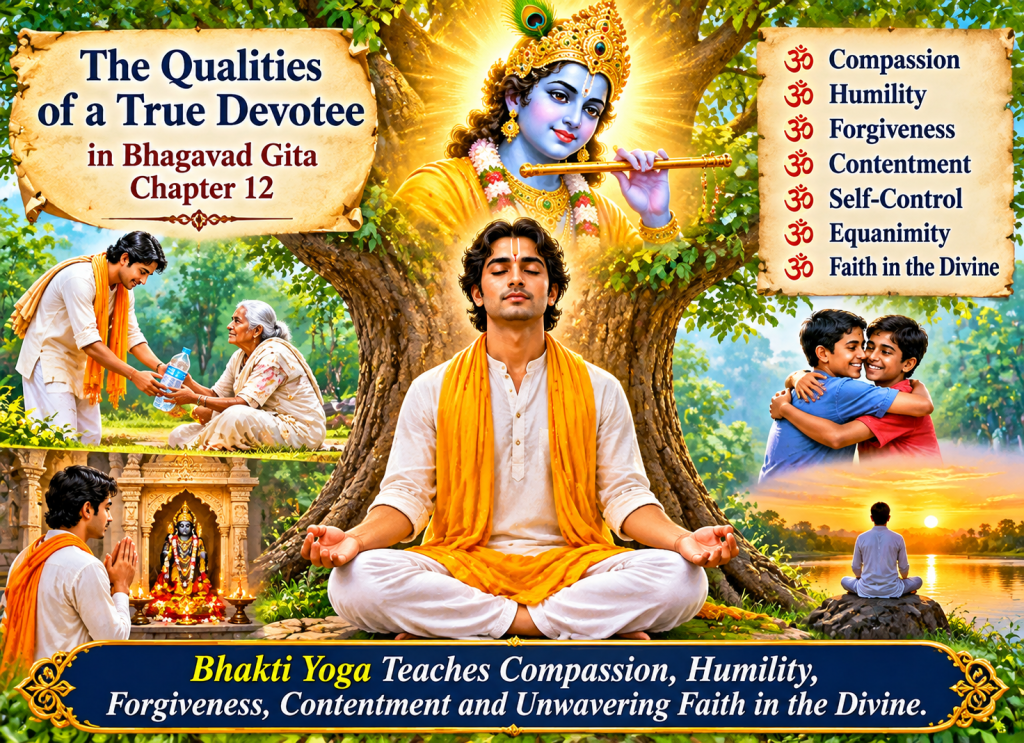
The most celebrated portion of Chapter 12 begins with Verse 13 and continues through Verse 19. Here, Krishna describes the qualities of a devotee who is dear to Him.
These verses provide a practical definition of spiritual maturity.
Freedom from Hatred
Krishna begins by describing a devotee who does not hate any living being.
This teaching encourages universal compassion. A spiritually developed person does not cultivate hatred as a permanent attitude toward others.
Freedom from hatred does not mean accepting injustice or remaining silent in the face of wrongdoing. It means responding to difficult situations without allowing hatred to dominate the heart.
A person can oppose harmful actions while maintaining a commitment to fairness, dignity, and compassion.
Friendliness and Compassion
A true devotee is friendly and compassionate toward all.
Compassion is more than feeling sympathy. It involves recognizing the suffering of others and responding with kindness whenever possible.
Friendliness encourages respect and cooperation. It helps people build relationships based on understanding rather than hostility.
These qualities are especially important in a world where disagreements can quickly become personal conflicts.
Freedom from Ego and Possessiveness
Krishna describes a devotee who is free from the excessive sense of “I” and “mine.”
Ego can create the belief that personal achievements, possessions, and status define one’s entire identity. Possessiveness can make people anxious about losing what they have.
Bhakti Yoga encourages humility and a deeper understanding of one’s relationship with the world.
A humble person can accept success without arrogance and failure without losing self-respect. Such a person recognizes that life involves cooperation, grace, and circumstances beyond individual control.
Equanimity in Pleasure and Pain
Krishna praises the devotee who remains balanced in happiness and distress.
Human life naturally includes favourable and unfavourable experiences. Success, illness, praise, criticism, gain, and loss are part of the changing conditions of existence.
Equanimity does not mean becoming emotionless. It means developing the ability to respond wisely without being completely overwhelmed by circumstances.
A spiritually balanced person can experience sadness without surrendering to despair and enjoy happiness without becoming excessively attached to it.
Forgiveness and Self-Control
The devotee described in Chapter 12 is forgiving, self-controlled, and firm in spiritual understanding.
Forgiveness helps release the burden of resentment. Self-control prevents temporary emotions from determining every decision.
These qualities require practice. Forgiveness may take time, and self-control develops gradually through awareness and discipline.
Krishna’s description encourages spiritual seekers to cultivate these qualities sincerely rather than expecting immediate perfection.
Contentment and Steadfastness
A true devotee remains content, mentally disciplined, and dedicated to spiritual practice.
Contentment does not mean giving up ambition or refusing to improve one’s circumstances. It means avoiding endless dissatisfaction and recognizing the value of what is already present.
Steadfastness allows a person to continue spiritual practice even when motivation changes.
Together, contentment and discipline create a stable foundation for devotion.
Why Krishna Values a Devotee Who Does Not Disturb Others
In Verse 15, Krishna describes a devotee who does not cause distress to the world and is not excessively disturbed by the world.
This teaching highlights the relationship between spirituality and social responsibility.
A person who follows Bhakti Yoga should not use religion as an excuse to hurt others, create unnecessary conflict, or behave arrogantly.
At the same time, the devotee should not allow every criticism, disagreement, or external disturbance to destroy inner peace.
The verse encourages a balanced attitude: live responsibly, avoid causing unnecessary suffering, and develop the strength to face life’s difficulties.
A spiritually mature person becomes a source of calm rather than confusion.
Freedom from Fear, Anxiety, and Excessive Expectations
Krishna describes a devotee who is free from excessive dependence on personal desires and who remains balanced in different circumstances.
The chapter praises qualities such as freedom from agitation, purity of intention, and the ability to remain peaceful amid uncertainty.
These teachings are particularly meaningful today.
Many people experience anxiety because they constantly compare themselves with others or fear losing their achievements. Others become distressed when reality does not match their expectations.
Bhakti Yoga encourages a different approach. A person should perform duties carefully, maintain ethical conduct, and trust the larger order of life without becoming obsessed with controlling every outcome.
Faith does not remove every difficulty. It can, however, provide strength and perspective while facing those difficulties.
The Devotee Who Is Dear to Krishna
Verses 17 and 18 describe a devotee who remains free from excessive attachment to joy, hatred, sorrow, and desire.
Krishna also praises the person who remains balanced in favourable and unfavourable situations, praise and criticism, honour and dishonour.
This is one of the most powerful teachings of Chapter 12.
People often depend on external approval to feel valuable. Praise makes them happy, while criticism can create anger or insecurity.
The Gita encourages a deeper source of stability. A person who acts according to truth, compassion, and duty does not need to change their character according to every external opinion.
Such a person can accept constructive criticism, learn from mistakes, and continue doing what is right.
The teaching is not about ignoring all feedback. It is about developing an inner foundation that is not completely controlled by public opinion.
The Importance of Simplicity and Detachment
Krishna describes a devotee who is satisfied with what comes naturally, remains unattached to a fixed place or possession, and maintains a steady mind.
This does not require every devotee to become a wandering ascetic.
Rather, the teaching encourages freedom from excessive dependence on material circumstances.
A person may live in a comfortable home, maintain a profession, and care for a family while practising detachment. The essential point is to avoid allowing possessions and status to become the centre of one’s identity.
Simplicity can help people recognize what is truly important. It can reduce unnecessary competition and encourage gratitude.
In this sense, detachment is not a rejection of life. It is a healthier relationship with life.
The Final Verse: Faith in the Path of Devotion
The final verse of Chapter 12, Verse 20, brings the chapter to a beautiful conclusion.
Krishna praises those who follow the immortal dharma of devotion with faith, accepting Him as their supreme goal.
The verse emphasizes faith, dedication, and spiritual commitment.
Faith in Bhakti Yoga is not merely a verbal declaration. It is expressed through conduct, compassion, discipline, and the willingness to live according to spiritual values.
The chapter concludes by reminding readers that devotion becomes meaningful when it shapes the way a person thinks, speaks, and acts.
A devotee’s relationship with God should inspire greater kindness toward living beings and greater sincerity in everyday responsibilities.
Bhagavad Gita Chapter 12: Practical Lessons for Daily Life
The teachings of Bhakti Yoga can be applied in simple and meaningful ways.
Begin the day with remembrance. A short prayer, meditation, or moment of gratitude can help establish a peaceful intention.
Perform duties sincerely. Whether at work, in education, or at home, perform responsibilities honestly and dedicate the effort to a higher purpose.
Practise compassion. Treat people with dignity, especially those who are vulnerable or experiencing difficulties.
Reduce excessive attachment to results. Work diligently, but understand that outcomes are influenced by many factors.
Avoid unnecessary hatred. Disagree with ideas or actions when necessary, but do not allow hostility to become a permanent attitude.
Cultivate forgiveness. Learn to release resentment while maintaining healthy boundaries and protecting yourself from harmful behaviour.
Remain balanced in praise and criticism. Accept useful feedback and avoid becoming dependent on constant approval.
Develop contentment. Appreciate what you have while continuing to work responsibly toward improvement.
Remember the Divine during ordinary activities. Spirituality need not be limited to a temple or a particular time of day.
These practices show that Bhakti Yoga can become a living spiritual discipline rather than a concept limited to scripture.
Bhakti Yoga and the Universal Message of the Bhagavad Gita
Bhagavad Gita Chapter 12 presents devotion as a path of love, discipline, humility, and inner transformation.
Its message is deeply rooted in the spiritual philosophy of the Bhagavad Gita, yet many of its ethical teachings can be appreciated by people from different backgrounds.
Compassion, forgiveness, contentment, self-control, and freedom from hatred are values that contribute to a more peaceful society.
The chapter also teaches that spiritual progress should not be measured only by outward appearance. A person’s inner qualities and conduct are essential.
A devotee who performs elaborate worship but behaves with cruelty contradicts the spirit of the qualities Krishna describes. Conversely, sincere devotion expressed through kindness and honest action reflects the practical meaning of Bhakti Yoga.
The chapter encourages a spiritual life that combines love for the Divine with responsibility toward the world.
Conclusion: The Eternal Path of Love and Devotion
Bhagavad Gita Chapter 12, Bhakti Yoga, is one of the most inspiring chapters of the Bhagavad Gita because it explains spirituality through the language of love and practical human qualities.
Lord Krishna acknowledges different approaches to the Supreme Reality while emphasizing the accessibility of personal devotion. He guides spiritual seekers through a gradual process of remembrance, practice, dedicated action, and renunciation of attachment to results.
Most importantly, He describes the qualities of a true devotee: compassion, friendliness, humility, forgiveness, contentment, self-control, and equanimity.
These qualities reveal that Bhakti Yoga is not simply about worshipping God through rituals. It is about transforming the heart and allowing devotion to influence every aspect of life.
The chapter’s message remains timeless. A person can begin the path of devotion through sincere faith, continue it through disciplined action, and deepen it through compassion toward all living beings.
The ultimate lesson of Bhagavad Gita Chapter 12 is that true devotion is expressed not only through love for God, but also through the peace, kindness, and humility that such love inspires in human life.