Atharvaveda: The Ancient Veda of Healing, Wisdom, and Daily Life

The Atharvaveda is the fourth and final Veda of Hinduism, standing alongside the Rigveda, Samaveda, and Yajurveda as one of the most sacred collections of ancient Indian knowledge. While the other three Vedas primarily focus on sacrificial rituals and hymns to the gods, the Atharvaveda is unique because it addresses the realities of everyday life. It contains prayers for health, prosperity, protection, family harmony, long life, and spiritual growth.
Often called the Veda of Everyday Living, the Atharvaveda bridges the gap between ritualistic religion and practical human needs. Its hymns discuss healing diseases, overcoming fears, ensuring success, protecting homes, and achieving inner peace. At the same time, it explores profound philosophical ideas about creation, the soul, the universe, and the Supreme Reality.
The Atharvaveda also played a significant role in shaping later Hindu traditions, Ayurveda, Yoga, Tantra, and various spiritual practices. Many scholars consider it one of the earliest sources of traditional Indian medicine and psychology.
This comprehensive guide explores the history, structure, teachings, philosophy, famous hymns, cultural influence, and lasting importance of the Atharvaveda.
Part 1
What Does Atharvaveda Mean?
The word Atharvaveda comes from two Sanskrit terms:
- Atharvan – an ancient sage associated with sacred fire, healing, and divine wisdom.
- Veda – knowledge or sacred wisdom.
Thus, Atharvaveda literally means:
“The Sacred Knowledge of Atharvan.”
Another traditional name for the Atharvaveda is:
Atharvangirasa
This combines the names of two groups of ancient sages:
- Atharvans
- Angirasas
Together they symbolize divine wisdom, sacred rituals, healing practices, and protective prayers.
Position Among the Four Vedas
The four Vedas are:
- Rigveda
- Samaveda
- Yajurveda
- Atharvaveda
Each Veda has a unique purpose.
Rigveda
Focuses on hymns praising the gods.
Samaveda
Specializes in musical chanting during sacrifices.
Yajurveda
Provides detailed instructions for performing rituals.
Atharvaveda
Concentrates on practical life, health, protection, philosophy, and spiritual well-being.
Because of its practical nature, the Atharvaveda became extremely popular among ordinary people as well as priests.
Historical Background
Scholars estimate that the Atharvaveda was composed between 1200 BCE and 900 BCE, although some hymns may be even older.
Initially, it was not universally accepted as one of the four Vedas. Some ancient ritualists regarded only the first three Vedas as authoritative.
Over time, however, the Atharvaveda gained equal recognition because of:
- its profound philosophy
- practical usefulness
- spiritual depth
- unique wisdom
Eventually, it became firmly established as the fourth Veda.
Why Is Atharvaveda Different?
The Atharvaveda stands apart because it deals with everyday concerns.
Its hymns include prayers for:
- good health
- protection against illness
- peace in the family
- successful farming
- prosperity
- victory
- long life
- protection from enemies
- childbirth
- education
- spiritual enlightenment
Unlike the elaborate sacrificial rituals described in other Vedas, many Atharvavedic hymns could be used in daily life.
This practical orientation made it especially valuable to common households.
The Structure of Atharvaveda
The Atharvaveda consists of:
- 20 Books (Kandas)
- approximately 730 hymns
- around 6,000 mantras
Different recensions contain slight variations.
The two surviving versions are:
- Shaunaka recension
- Paippalada recension
The Shaunaka version is the most widely studied today.
Main Subjects Covered
The Atharvaveda contains an extraordinary variety of topics.
These include:
Healing
Many hymns invoke herbs, water, sunlight, and divine blessings for curing diseases.
Protection
Numerous mantras seek protection from dangers, enemies, misfortune, and harmful influences.
Family Life
The text contains prayers for:
- marriage
- harmony
- fertility
- healthy children
- household prosperity
Agriculture
Several hymns bless crops, cattle, rainfall, and fertile land.
Kingship
Some sections describe the responsibilities of kings and rulers.
Philosophy
Later books contain profound discussions about:
- Brahman
- Atman
- creation
- cosmic order
These ideas later influenced the Upanishads.
Atharvaveda and Healing
One of the most remarkable features of the Atharvaveda is its emphasis on health.
The text frequently mentions:
- medicinal herbs
- healing plants
- clean water
- prayers for recovery
- mental peace
Many scholars believe these hymns laid the foundation for Ayurveda, India’s traditional medical system.
The Atharvaveda views illness as something that can be addressed through a combination of:
- natural remedies
- spiritual practices
- positive thinking
- divine blessings
This holistic approach remains relevant even today.
Herbs in the Atharvaveda
Plants occupy a sacred position in the Atharvaveda.
The hymns praise herbs as gifts from nature.
Medicinal plants are described as:
- protectors of life
- destroyers of disease
- divine creations
- sources of strength
The text teaches respect for nature long before environmental conservation became a global concern.
Atharvaveda and Ayurveda
Ayurveda literally means:
“The Science of Life.”
Although Ayurveda later developed into an independent discipline, many of its earliest concepts appear in the Atharvaveda.
These include:
- healing herbs
- disease prevention
- healthy lifestyle
- mental well-being
- longevity
For this reason, the Atharvaveda is often called the spiritual foundation of Ayurveda.
Daily Life in the Atharvaveda
Unlike many ancient religious texts that focus mainly on temple rituals, the Atharvaveda addresses common human experiences.
Examples include prayers for:
- buying land
- building homes
- safe travel
- healthy children
- successful studies
- business prosperity
- protection from fear
This practical wisdom continues to resonate with readers around the world.
Spiritual Philosophy
Although practical in nature, the Atharvaveda also explores profound spiritual questions.
It asks:
- What is the origin of the universe?
- Who created existence?
- What is the soul?
- What is eternal truth?
- What happens after death?
These questions later became central themes of the Upanishads and Hindu philosophy.
The Universal Spirit
The Atharvaveda teaches that one universal reality exists behind the diversity of creation.
This ultimate reality is known as:
- Brahman
- Supreme Truth
- Cosmic Consciousness
Everything in the universe is interconnected through this divine principle.
Respect for Nature
Nature occupies an honored place throughout the Atharvaveda.
The text praises:
- Earth
- Water
- Fire
- Wind
- Sky
- Mountains
- Rivers
- Trees
- Plants
- Animals
One of its most famous hymns, the Bhumi Sukta or Kshetrapati Sukta (Hymn to Earth), celebrates the Earth as a nurturing mother and urges people to live in harmony with nature.
The Major Deities in the Atharvaveda
Like the other Vedas, the Atharvaveda reveres many deities who represent different aspects of the universe and human life. However, its approach is often more personal and practical. The hymns invoke these divine powers not only during sacrifices but also in daily life for health, protection, peace, and prosperity.
Some of the most frequently mentioned deities include:
Agni (The God of Fire)
Agni is one of the most important Vedic deities. He acts as the divine messenger who carries human prayers and offerings to the gods.
In the Atharvaveda, Agni is associated with:
- Purification
- Sacred rituals
- Household prosperity
- Protection from evil
- Divine illumination
Agni symbolizes the inner spiritual fire that removes ignorance and leads individuals toward wisdom.
Indra (The King of the Gods)
Indra appears as the mighty protector of righteousness and destroyer of negative forces.
The Atharvaveda praises him for:
- Courage
- Victory in battles
- Strength
- Leadership
- Protection against enemies
His legendary defeat of the demon Vritra symbolizes the triumph of order over chaos.
Varuna (Guardian of Cosmic Order)
Varuna represents truth, justice, and the universal moral law known as Rta.
The Atharvaveda invokes Varuna for:
- Forgiveness
- Moral purity
- Harmony
- Justice
- Peace
His presence reminds humanity that ethical living is essential for spiritual progress.
Soma
Soma represents divine inspiration, vitality, and spiritual ecstasy.
Although Soma is often connected with sacred rituals in the Rigveda, the Atharvaveda also emphasizes its symbolic meaning:
- Inner bliss
- Mental clarity
- Divine consciousness
- Spiritual awakening
Surya (The Sun)
Surya symbolizes life, energy, wisdom, and health.
Several hymns pray to the Sun for:
- Good eyesight
- Long life
- Physical strength
- Prosperity
- Removal of darkness
The Sun is portrayed as a witness to all actions and a source of universal life.
Earth (Prithvi)
The Earth receives exceptional reverence in the Atharvaveda.
Rather than being viewed merely as land, Earth is honored as:
- Mother
- Provider
- Sustainer
- Protector
This respect reaches its highest expression in the famous Bhumi Sukta.
The Famous Bhumi Sukta (Hymn to Earth)
Among all the hymns in the Atharvaveda, the Bhumi Sukta (Book 12) is perhaps the most celebrated.
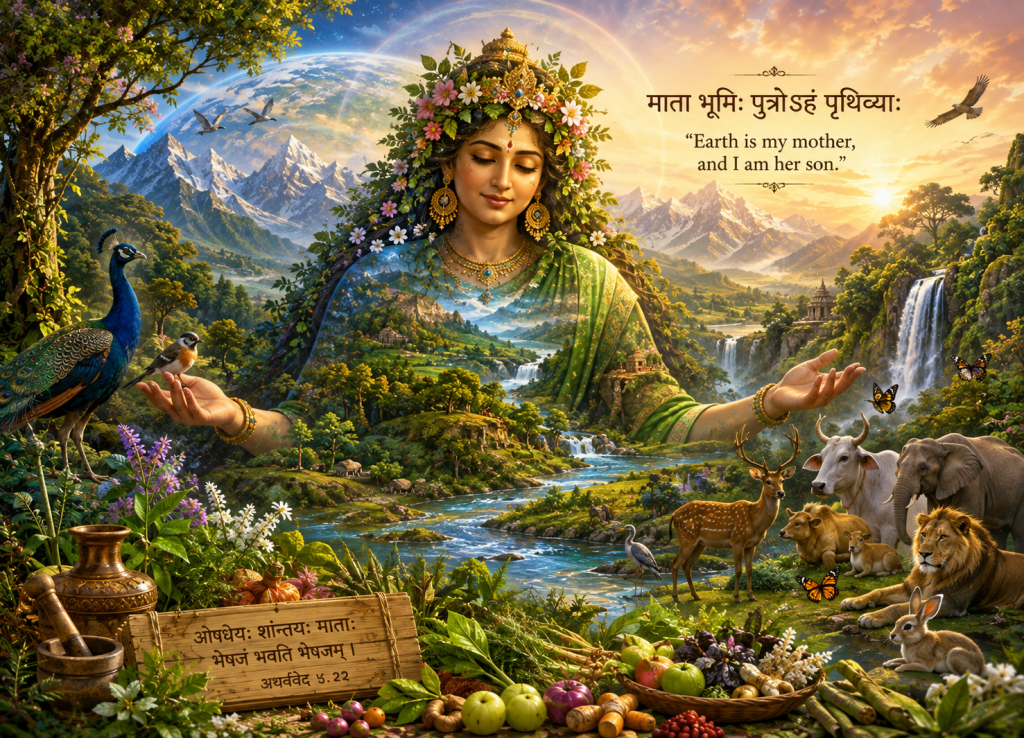
It is one of humanity’s earliest and most beautiful declarations of environmental ethics.
The hymn describes Earth as:
- Patient
- Compassionate
- Fertile
- Generous
- Sacred
It expresses gratitude for:
- Mountains
- Rivers
- Forests
- Animals
- Crops
- Rain
- Seasons
One famous idea from the hymn is often paraphrased as:
“Earth is my mother, and I am her child.”
This timeless message inspires respect for nature and responsible living.
Environmental Wisdom
Modern environmentalists frequently admire the Atharvaveda because it encourages humans to live harmoniously with nature rather than exploit it.
The text teaches that people should:
- Protect forests
- Respect rivers
- Preserve fertile soil
- Care for animals
- Use natural resources wisely
These ideas remain remarkably relevant in today’s world of climate change and environmental challenges.
Healing Hymns
Another distinctive feature of the Atharvaveda is its collection of healing prayers.
The hymns address:
- Fever
- Skin diseases
- Wounds
- Poisonous bites
- Mental distress
- Weakness
- Childbirth
- Longevity
Healing is viewed as a combination of:
- Nature
- Spiritual faith
- Positive intention
- Herbal medicine
- Divine grace
This holistic perspective continues to influence traditional Indian medicine.
The Power of Herbs
The Atharvaveda contains some of the world’s earliest recorded praise of medicinal plants.
Herbs are described as:
- Divine creations
- Mothers of healing
- Protectors of life
- Destroyers of disease
The text emphasizes that nature itself contains remedies for many human ailments.
This belief later became a central principle of Ayurveda.
Peace and Harmony
Many Atharvavedic hymns pray for peace rather than conflict.
They seek harmony in:
- Families
- Communities
- Kingdoms
- Nature
- Human relationships
The text encourages people to speak kindly, cooperate with one another, and avoid unnecessary hostility.
Marriage Hymns
The Atharvaveda contains beautiful prayers recited during ancient Hindu weddings.
These hymns bless the newly married couple with:
- Mutual respect
- Love
- Prosperity
- Healthy children
- Long life
- Family happiness
Many of these verses continue to be used in traditional Hindu marriage ceremonies today.
Hymns for Education
Knowledge occupies a sacred place throughout the Atharvaveda.
Students pray for:
- Sharp memory
- Wisdom
- Intelligence
- Success in learning
- Good teachers
Education is presented as a lifelong journey toward truth.
Royal Hymns
The Atharvaveda also contains prayers connected with kingship.
These hymns seek divine blessings for rulers so they may govern with:
- Justice
- Courage
- Compassion
- Wisdom
- Prosperity
An ideal king is expected to protect the weak and uphold Dharma.
Philosophy of Creation
Several Atharvavedic hymns ask profound questions about the origin of existence.
They explore topics such as:
- The birth of the universe
- Time
- Death
- Eternity
- Consciousness
Instead of giving simple answers, the text often encourages deep contemplation.
This philosophical spirit later blossomed in the Upanishads.
Brahman and Atman
The Atharvaveda introduces ideas that become central to Hindu philosophy.
These include:
Brahman
The infinite, eternal, universal reality behind all creation.
Atman
The inner Self or soul that exists within every living being.
The realization that Atman and Brahman are deeply connected becomes one of the foundational teachings of later Vedanta philosophy.
Atharvaveda and the Upanishads
Several important Upanishads belong to the Atharvaveda tradition.
Among them are:
- Mundaka Upanishad
- Mandukya Upanishad
- Prashna Upanishad
These philosophical works discuss:
- The nature of reality
- Meditation
- Liberation (Moksha)
- Om (Aum)
- Knowledge of the Self
They remain among the most influential texts in Hindu philosophy.
The Sacred Syllable Om
The Atharvavedic tradition places great importance on Om (Aum).
Om represents:
- Creation
- Preservation
- Dissolution
- Ultimate Reality
- Universal Consciousness
Meditation on Om is considered a powerful path toward spiritual realization.
The Mandukya Upanishad, associated with the Atharvaveda, offers one of the deepest explanations of this sacred syllable.
Ethics in the Atharvaveda
Beyond rituals and prayers, the Atharvaveda encourages moral living.
Its teachings promote:
- Truthfulness
- Compassion
- Charity
- Self-control
- Respect for parents
- Hospitality
- Gratitude
- Humility
The text emphasizes that genuine spirituality is reflected in one’s conduct.
Women in the Atharvaveda
The Atharvaveda acknowledges the important role of women in family and society.
Its marriage hymns portray wives as:
- Partners
- Protectors of the household
- Mothers
- Wise companions
The text also includes prayers for the health, happiness, and dignity of women.
Atharvaveda and Daily Spiritual Practice
Unlike texts focused solely on elaborate ceremonies, the Atharvaveda encourages spirituality in everyday life.
Daily practices inspired by its teachings include:
- Prayer
- Gratitude
- Respect for nature
- Charity
- Meditation
- Speaking truthfully
- Caring for family
- Maintaining physical and mental health
Its wisdom reminds us that spiritual growth is woven into ordinary living.
The Two Surviving Recensions of the Atharvaveda
Like the other Vedas, the Atharvaveda was transmitted through different recensions, or Shakhas (branches). Ancient tradition mentions that it once had nine Shakhas, but only two have survived in substantial form.
1. Shaunaka Shakha
The Shaunaka Shakha is the most widely preserved and studied recension of the Atharvaveda. Nearly all modern printed editions and English translations are based on this version.
Its features include:
- Well-organized arrangement of hymns
- Broad coverage of rituals, philosophy, healing, and daily life
- Extensive commentaries by later scholars
- Wide acceptance in Vedic studies
Because of its completeness and accessibility, the Shaunaka recension has become the standard text for researchers and students.
2. Paippalada Shakha
The Paippalada Shakha is another important recension that survived in manuscript form, particularly in parts of eastern India.
Although it was considered lost for many centuries, scholars rediscovered manuscripts that have significantly expanded our understanding of the Atharvaveda.
The Paippalada recension:
- Contains additional hymns and textual variations
- Preserves older readings in some passages
- Helps scholars compare ancient Vedic traditions
- Offers valuable insights into the development of Hindu thought
The survival of these two recensions demonstrates the remarkable efforts made by generations of Vedic teachers to preserve sacred knowledge.
Internal Structure of the Atharvaveda
The Atharvaveda consists of 20 Books (Kandas) that gradually move from practical concerns to profound philosophical reflections.
Books 1–7
These books mainly contain shorter hymns dealing with:
- Healing diseases
- Protection from dangers
- Prosperity
- Family welfare
- Agriculture
- Daily rituals
- Long life
Books 8–12
These sections include longer hymns discussing:
- Cosmology
- Nature
- Kingship
- Society
- Spiritual practices
- Earth and environmental harmony
The famous Bhumi Sukta (Hymn to Earth) appears in this portion.
Books 13–18
These books focus on:
- Marriage ceremonies
- Funeral rites
- Royal rituals
- Sacred vows
- Spiritual symbolism
- Moral teachings
Many traditional Hindu ceremonies still draw inspiration from these hymns.
Books 19–20
The final books contain:
- Additional hymns
- Philosophical discussions
- Ancient traditions
- Verses shared with the Rigveda
- Reflections on divine reality
Together, the twenty books create one of the most diverse collections in world religious literature.
The Oral Tradition of Preservation
Long before writing became common, the Atharvaveda was preserved through an extraordinary oral tradition.
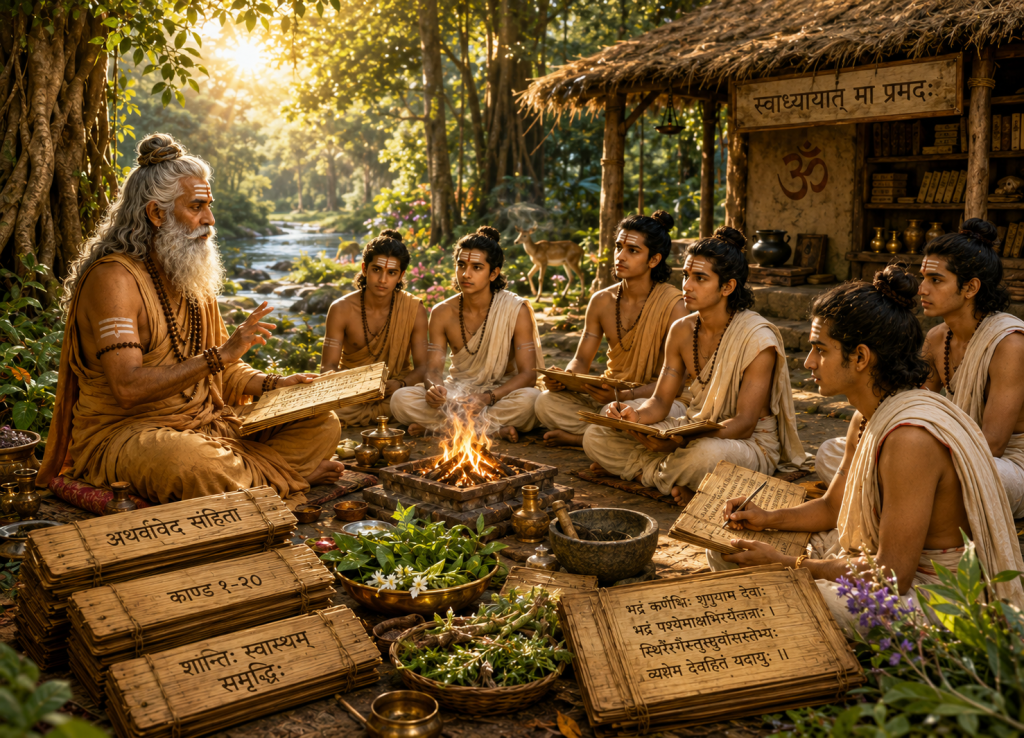
Students learned every hymn by:
- Listening carefully to their teacher
- Repeating each verse aloud
- Memorizing pronunciation
- Preserving accents and rhythm
- Practicing daily for years
This rigorous system ensured that the sacred text remained remarkably accurate across generations.
Even today, Vedic scholars continue this oral tradition in various parts of India.
Important Rishis Associated with the Atharvaveda
Many ancient sages contributed to or preserved the Atharvaveda.
Among the most important are:
Sage Atharvan
Atharvan is regarded as one of the earliest Vedic seers and the symbolic founder of the Atharvaveda tradition.
He is associated with:
- Sacred fire rituals
- Healing
- Divine wisdom
- Peaceful worship
Sage Angiras
Another prominent figure is Angiras.
He is remembered for:
- Spiritual knowledge
- Protective hymns
- Mystical insight
- Sacred chants
Because of these two great sages, the Atharvaveda is often called Atharvangirasa.
Other Vedic Seers
Numerous unnamed rishis composed individual hymns over many centuries.
Their contributions reflect the collective wisdom of ancient India rather than the work of a single author.
This collaborative nature is one of the defining characteristics of the Vedas.
Atharvaveda and Ayurveda
One of the Atharvaveda’s greatest contributions is its influence on Ayurveda, India’s traditional system of medicine.
Many principles later developed in Ayurveda can be traced to Atharvavedic ideas.
These include:
- Importance of medicinal herbs
- Holistic health
- Preventive care
- Mental well-being
- Balance between body and mind
- Harmony with nature
The Atharvaveda teaches that true health is not merely the absence of disease but a state of physical, mental, and spiritual balance.
Holistic View of Health
The Atharvaveda recognizes that illness can affect:
- Body
- Mind
- Emotions
- Social relationships
- Spiritual life
Therefore, healing involves multiple dimensions, including:
- Natural remedies
- Positive thoughts
- Prayer
- Healthy habits
- Community support
This holistic philosophy remains relevant in modern healthcare discussions.
Atharvaveda and Yoga
Although systematic Yoga philosophy developed later, the Atharvaveda contains ideas that resonate strongly with yogic traditions.
These include:
- Self-discipline
- Meditation
- Breath awareness
- Inner peace
- Concentration
- Control of the senses
Its emphasis on mental clarity and spiritual realization complements later Yoga teachings found in texts such as the Upanishads and the Bhagavad Gita.
Atharvaveda and Tantra
Some scholars view the Atharvaveda as one of the early influences on later Tantric traditions.
This is because the text contains:
- Protective mantras
- Ritual symbolism
- Sacred sounds
- Spiritual practices for inner transformation
However, it is important to note that the Atharvaveda itself is a Vedic scripture and should not be equated with the later Tantric texts, which developed centuries afterward.
Social Life Reflected in the Atharvaveda
The Atharvaveda offers a fascinating glimpse into everyday life in ancient India.
It contains references to:
- Farmers
- Physicians
- Teachers
- Students
- Kings
- Merchants
- Craftsmen
- Families
The hymns reveal a society deeply connected with nature, community, and spirituality.
Agriculture and Rural Life
Agriculture was central to Vedic civilization.
The Atharvaveda includes prayers for:
- Fertile fields
- Healthy cattle
- Abundant harvests
- Timely rainfall
- Protection from pests
These hymns show the intimate relationship between people and the natural environment.
Respect for Animals
Animals are frequently mentioned throughout the Atharvaveda.
The text recognizes their importance in:
- Agriculture
- Transportation
- Daily livelihood
- Religious symbolism
Many hymns encourage compassion and responsible care for living beings, reflecting the broader Hindu ideal of reverence for life.
The Atharvaveda and Education
Education in the Vedic age was considered sacred.
Students were encouraged to cultivate:
- Humility
- Discipline
- Truthfulness
- Curiosity
- Respect for teachers
- Lifelong learning
Knowledge was viewed not only as a means to earn a livelihood but also as a path to self-realization.
Ethical Lessons for Modern Society
Although composed thousands of years ago, many teachings of the Atharvaveda remain remarkably relevant.
Its ethical ideals include:
Truth
Honesty builds trust and strengthens society.
Compassion
Kindness toward all beings promotes peace and harmony.
Gratitude
Recognizing the gifts of nature and community fosters humility.
Responsibility
Every individual has duties toward family, society, and the environment.
Self-Control
Mastery over one’s thoughts and actions leads to inner freedom.
These timeless values continue to inspire people across cultures.
The Atharvaveda in Contemporary Hinduism
Even today, Atharvavedic hymns are recited during various ceremonies, including:
- Housewarming (Griha Pravesha)
- Marriage
- Naming ceremonies
- Blessings for health
- Prayers for peace
- Educational rituals
- Spiritual gatherings
Its influence extends beyond ritual into philosophy, ethics, and traditional healing.
Global Interest in the Atharvaveda
In recent decades, universities and research institutions around the world have shown growing interest in the Atharvaveda.
Scholars study it for its contributions to:
- Comparative religion
- Ancient history
- Linguistics
- Philosophy
- Environmental ethics
- Medical history
- Anthropology
Its interdisciplinary richness makes it a valuable source for understanding early human civilization.
Interesting Facts About the Atharvaveda
Here are some fascinating facts about this remarkable scripture:
- It is the fourth Veda of Hinduism.
- It contains approximately 730 hymns and around 6,000 mantras.
- It is often called the “Veda of Everyday Life.”
- The famous Bhumi Sukta is one of the world’s earliest hymns dedicated to environmental harmony.
- Many scholars consider it an important foundation for Ayurveda.
- It addresses both practical and philosophical aspects of human life.
- The Atharvaveda preserves valuable information about ancient Indian society, medicine, agriculture, and spirituality.
- It includes some of the earliest discussions on the relationship between humanity and nature.
- Several important Upanishads belong to the Atharvavedic tradition.
- It continues to be studied by scholars, spiritual seekers, and practitioners across the globe.
Why the Atharvaveda Still Matters Today
The Atharvaveda speaks to concerns that remain universal:
- Good health
- Peace of mind
- Strong families
- Respect for nature
- Ethical leadership
- Lifelong learning
- Spiritual growth
Its message reminds us that true prosperity comes not only from material wealth but also from wisdom, compassion, and harmony with the world around us.
As humanity faces challenges such as environmental degradation, mental stress, and social conflict, the Atharvaveda’s emphasis on holistic well-being and interconnectedness offers timeless guidance.
Famous Mantras from the Atharvaveda
The Atharvaveda contains thousands of mantras addressing health, peace, prosperity, protection, and spiritual realization. Many are still recited during Hindu rituals and daily prayers. Below are some of the best-known hymns and ideas associated with this Veda.
Note: The translations below are simplified explanations rather than literal word-for-word renderings.
1. Bhumi Sukta (Hymn to Mother Earth)
The Bhumi Sukta (Atharvaveda 12.1) is one of the longest and most celebrated hymns in the Atharvaveda.
A famous line expresses humanity’s deep relationship with nature:
“Mātā Bhūmiḥ Putro’ham Pṛthivyāḥ.”
Meaning:
“Earth is my mother, and I am her son.”
This profound declaration teaches that human beings are children of Mother Earth and should protect, respect, and nurture the natural world rather than exploit it.
The hymn praises:
- Mountains
- Rivers
- Forests
- Fertile soil
- Plants
- Animals
- Seasons
- Rainfall
Today, many environmental scholars regard the Bhumi Sukta as one of the earliest literary expressions of ecological consciousness.
2. Hymns for Peace
The Atharvaveda contains numerous prayers seeking harmony in all aspects of life.
These prayers ask for:
- Peace within the mind
- Harmony in families
- Prosperity in society
- Friendship among communities
- Balance in nature
The text teaches that lasting peace begins with purity of thought, speech, and action.
3. Healing Prayers
Many Atharvavedic mantras seek relief from:
- Disease
- Fear
- Anxiety
- Poison
- Weakness
- Misfortune
These hymns often invoke divine blessings while also recognizing the healing power of medicinal herbs and natural remedies.
Rather than treating physical and mental well-being separately, the Atharvaveda presents health as a holistic state of balance.
4. Prayers for Long Life
Longevity is a recurring theme throughout the Atharvaveda.
Its hymns ask for:
- Healthy aging
- Strong bodies
- Clear minds
- Happy families
- Meaningful lives
The emphasis is not merely on living longer but on living wisely and righteously.
Literary Style of the Atharvaveda
The Atharvaveda displays remarkable literary diversity.
Its hymns include:
- Poetry
- Philosophical reflections
- Blessings
- Dialogues
- Ritual instructions
- Symbolic imagery
- Nature descriptions
- Ethical teachings
Unlike many religious texts that focus on a single subject, the Atharvaveda combines practical advice with spiritual insight.
This variety makes it one of the richest literary works of ancient India.
Comparison of the Four Vedas
Although all four Vedas are sacred, each has its own emphasis.
| Veda | Primary Focus | Distinctive Feature |
|---|---|---|
| Rigveda | Hymns to the gods | Earliest collection of Vedic poetry |
| Samaveda | Musical chants | Foundation of Indian sacred music |
| Yajurveda | Ritual procedures | Manual for Vedic sacrifices |
| Atharvaveda | Daily life, healing, philosophy | Practical wisdom and spiritual guidance |
Together, the four Vedas form the foundation of Hindu religious thought and practice.
Influence on Later Hindu Literature
The Atharvaveda significantly influenced many later Hindu scriptures and traditions.
The Upanishads
Some of the most important Upanishads belong to the Atharvavedic tradition, including:
- Mundaka Upanishad
- Mandukya Upanishad
- Prashna Upanishad
These texts explore profound philosophical ideas about:
- Brahman (Ultimate Reality)
- Atman (The Self)
- Meditation
- Liberation (Moksha)
- The sacred syllable Om
Their teachings continue to shape Vedanta philosophy and spiritual practice.
Ayurveda
The Atharvaveda’s emphasis on herbs, health, and holistic well-being contributed to the development of Ayurveda.
Concepts such as:
- Preventive healthcare
- Herbal medicine
- Mental balance
- Healthy living
became central to India’s traditional medical system.
Yoga Philosophy
Although the Atharvaveda is not a Yoga manual, its teachings on:
- Meditation
- Self-discipline
- Mental purity
- Inner peace
helped influence later yogic traditions.
Environmental Ethics
Modern environmental movements often draw inspiration from the Atharvaveda’s reverence for nature.
Its teachings encourage people to:
- Protect forests
- Preserve rivers
- Respect wildlife
- Use natural resources responsibly
The Bhumi Sukta remains one of the earliest and most powerful expressions of ecological awareness.
Lessons We Can Learn Today
Despite being composed over three thousand years ago, the Atharvaveda offers timeless guidance.
Respect Nature
The Earth is not merely a resource but a sacred trust to be protected for future generations.
Value Good Health
Physical, mental, and spiritual well-being are deeply interconnected.
Live Ethically
Truthfulness, compassion, generosity, and self-control create a meaningful life.
Continue Learning
Knowledge is a lifelong journey toward wisdom and self-realization.
Seek Inner Peace
External success alone cannot bring lasting happiness without inner harmony.
Frequently Asked Questions (FAQs)
What is the Atharvaveda?
The Atharvaveda is the fourth Veda of Hinduism. It contains hymns on healing, protection, philosophy, daily life, ethics, and spiritual wisdom.
Why is the Atharvaveda unique?
Unlike the other three Vedas, it focuses extensively on practical aspects of everyday life while also exploring profound philosophical ideas.
Who composed the Atharvaveda?
The Atharvaveda is the collective work of many ancient sages (Rishis). It is traditionally associated with Sage Atharvan and Sage Angiras.
How many books are in the Atharvaveda?
The Atharvaveda contains 20 books (Kandas), approximately 730 hymns, and around 6,000 mantras.
Which Upanishads belong to the Atharvaveda?
The three principal Upanishads associated with the Atharvaveda are:
- Mundaka Upanishad
- Mandukya Upanishad
- Prashna Upanishad
Is the Atharvaveda connected to Ayurveda?
Yes. Many scholars consider the Atharvaveda an important foundation for Ayurveda because of its discussions on medicinal herbs, healing, and holistic health.
Why is the Bhumi Sukta famous?
The Bhumi Sukta celebrates Earth as a sacred mother and encourages humans to live in harmony with nature. It is regarded as one of the earliest expressions of environmental ethics.
Is the Atharvaveda still relevant today?
Absolutely. Its teachings on health, environmental responsibility, ethical living, education, and spiritual growth remain highly relevant in the modern world.
Conclusion
The Atharvaveda occupies a unique and indispensable place in the Vedic tradition. While the Rigveda celebrates divine hymns, the Samaveda transforms sacred verses into music, and the Yajurveda provides the framework for ritual worship, the Atharvaveda brings Vedic wisdom into the everyday lives of people. It speaks of health and healing, family and society, nature and the universe, as well as the eternal search for truth.
Its pages reveal a civilization that valued knowledge, respected the Earth, honored the healing power of nature, and sought harmony between the material and spiritual worlds. From prayers for peace and prosperity to profound reflections on the Self and the Supreme Reality, the Atharvaveda offers guidance that transcends time and culture.
The text’s influence extends far beyond the Vedic age. It contributed to the growth of Ayurveda, inspired the philosophical insights of the Upanishads, and continues to shape Hindu rituals and spiritual practices. Its celebrated Bhumi Sukta reminds humanity that caring for the Earth is both a moral duty and a sacred responsibility.
In an age marked by environmental challenges, mental stress, and the search for balanced living, the Atharvaveda’s holistic vision is more meaningful than ever. It teaches that true prosperity arises from wisdom, compassion, ethical conduct, respect for nature, and inner peace. By studying and reflecting on its timeless teachings, we gain not only a deeper understanding of one of the world’s oldest sacred scriptures but also valuable insights for leading healthier, more harmonious, and spiritually fulfilling lives.

















One thought on “Atharvaveda: The Ancient Veda of Healing, Wisdom, and Daily Life”