Bhagavad Gita Chapter 8: Akshara Brahma Yoga
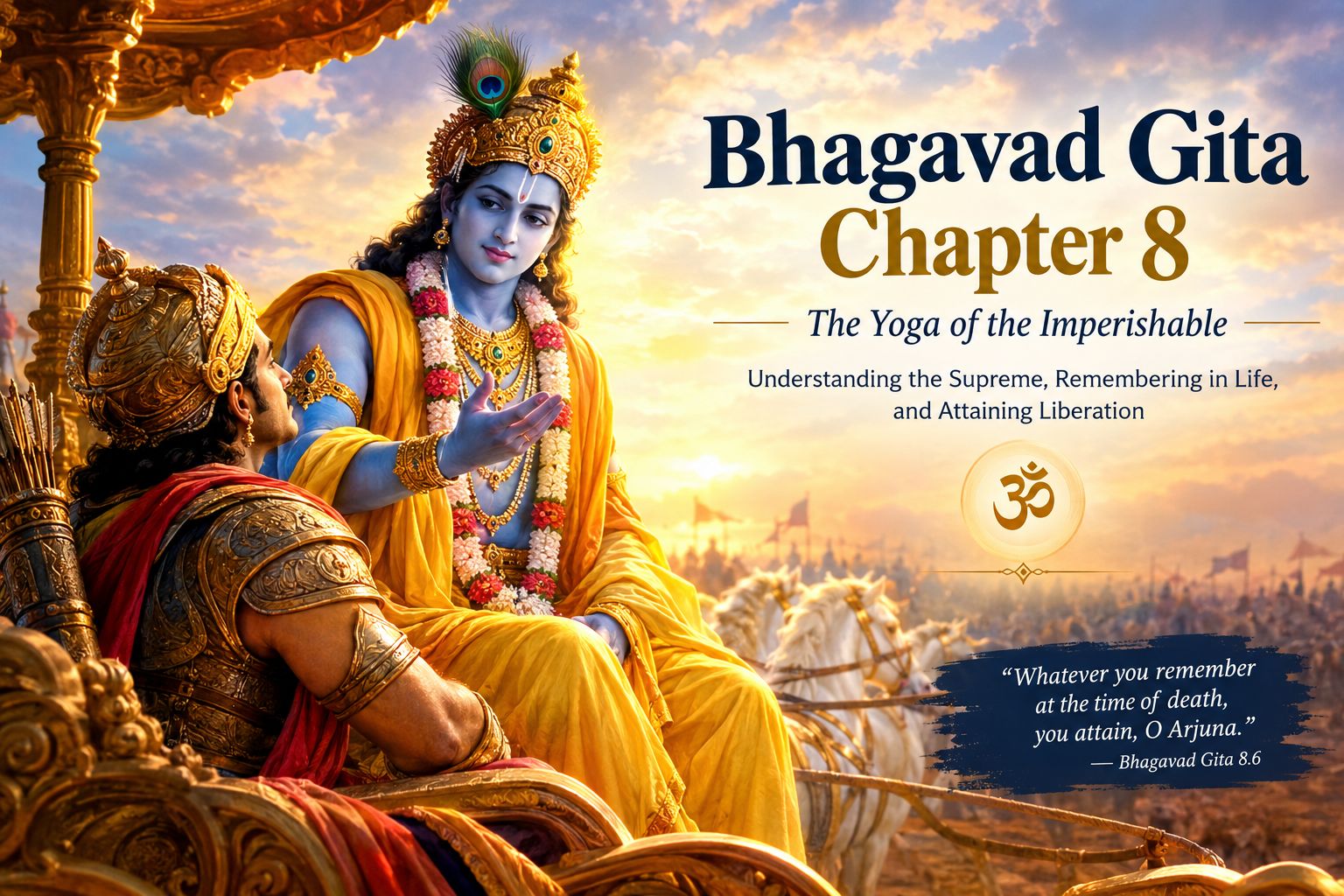
Bhagavad Gita Chapter 8, known in Sanskrit as Akshara Brahma Yoga (अक्षरब्रह्मयोग), is one of the most profound chapters of the Bhagavad Gita. The Sanskrit word Akshara means that which does not perish, while Brahman refers to the Supreme, eternal reality. Thus, this chapter explores the imperishable nature of the Supreme Reality, the Self, karma, the material world, devotion, death, rebirth, and the ultimate attainment of the Divine.
Chapter 8 contains 28 Sanskrit shlokas. The discussion begins when Arjuna asks Sri Krishna to explain several important spiritual concepts: Brahman, Adhyatma, Karma, Adhibhuta, Adhidaiva, and Adhiyajna. Krishna then explains what happens at the time of death, why remembrance of the Divine is important, the nature of rebirth, the vast cycles of cosmic creation and dissolution, and the two paths associated with departure from the world.
The central teaching of this chapter is beautifully connected with one simple spiritual principle: what fills the mind throughout life becomes especially important at the moment of death. Krishna therefore advises Arjuna not to abandon his worldly responsibilities, but to remember Him while performing those responsibilities.
The chapter ultimately points toward the Supreme Person, who is beyond the changing universe and attainable through unwavering devotion.
What Is Bhagavad Gita Chapter 8 Called?
The Sanskrit title of Chapter 8 is:
अक्षरब्रह्मयोगः — Akshara Brahma Yoga
It is commonly translated as “The Yoga of the Imperishable Brahman” or “The Yoga of the Imperishable Absolute.”
The chapter has 28 verses.
The word Akshara literally suggests something that does not decay or perish. Everything in the material world is subject to change: bodies are born, grow, age, and die; civilizations rise and disappear; even cosmic manifestations undergo cycles of creation and dissolution.
Krishna directs Arjuna’s attention toward that which remains beyond these changes.
Why Does Arjuna Ask These Questions?
At the end of the previous chapter, Krishna had spoken about the Supreme Reality and the importance of knowing Him. Arjuna therefore asks Krishna to clarify several terms that are essential for understanding spiritual life.
Arjuna is not merely asking philosophical questions for intellectual curiosity. He wants to understand the relationship between the eternal reality, the individual self, the material world, karma, sacrifice, and the Divine.
These questions lead naturally into one of the most important subjects of Chapter 8: the state of consciousness at the time of death.
Krishna’s answer is not simply a description of death. It is a teaching about how a person should live.
Bhagavad Gita Chapter 8 — All 28 Sanskrit Shlokas
Shloka 8.1 — Arjuna Asks About Brahman
Sanskrit
अर्जुन उवाच ।
किं तद् ब्रह्म किमध्यात्मं किं कर्म पुरुषोत्तम ।
अधिभूतं च किं प्रोक्तमधिदैवं किमुच्यते ॥ ८.१ ॥
Paraphrase
Arjuna asks Krishna: “O Supreme Person, what is Brahman? What is Adhyatma? What is Karma? What is called Adhibhuta, and what is known as Adhidaiva?”
Brief Explanation
Arjuna begins Chapter 8 by asking Krishna to define several profound spiritual concepts.
Brahman refers to the imperishable Supreme Reality.
Adhyatma concerns the Self or the inner spiritual principle.
Karma concerns action and the process through which beings become involved in material existence.
Adhibhuta relates to the perishable material realm.
Adhidaiva relates to the divine or cosmic principle.
Arjuna wants to understand how these different aspects of existence are connected.
Shloka 8.2 — What Is Adhiyajna?
Sanskrit
अधियज्ञः कथं कोऽत्र देहेऽस्मिन्मधुसूदन ।
प्रयाणकाले च कथं ज्ञेयोऽसि नियतात्मभिः ॥ ८.२ ॥
Paraphrase
Arjuna continues: “O Madhusudana, who is Adhiyajna within this body? How can disciplined and self-controlled people know You at the time of death?”
Brief Explanation
Arjuna’s questions now become more personal. He asks about Adhiyajna, the Divine principle associated with sacrifice and its presence within the body.
Most importantly, he asks how a disciplined person can know Krishna at the time of death.
This question prepares the way for Krishna’s teaching about remembrance. The subject is not simply physical death but the consciousness with which a person leaves the body.
Krishna Explains Brahman, Adhyatma and Karma
Shloka 8.3
Sanskrit
श्रीभगवानुवाच ।
अक्षरं ब्रह्म परमं स्वभावोऽध्यात्ममुच्यते ।
भूतभावोद्भवकरो विसर्गः कर्मसंज्ञितः ॥ ८.३ ॥
Paraphrase
Krishna says that the imperishable Supreme Reality is Brahman. The essential nature of the individual Self is called Adhyatma. The creative process through which beings come into existence is called Karma.
Brief Explanation
Krishna begins answering Arjuna’s questions directly.
The most important word here is Akshara — the imperishable.
The physical body changes, but the spiritual reality is not limited to the changing body. Krishna distinguishes the eternal from the temporary and introduces the deeper spiritual foundation behind individual existence.
The verse also presents karma as a force connected with the manifestation of beings.
Shloka 8.4
Sanskrit
अधिभूतं क्षरो भावः पुरुषश्चाधिदैवतम् ।
अधियज्ञोऽहमेवात्र देहे देहभृतां वर ॥ ८.४ ॥
Paraphrase
Krishna explains that the changing and perishable material existence is called Adhibhuta. The Divine Person is Adhidaiva. Krishna Himself is Adhiyajna within the body.
Brief Explanation
Here Krishna completes the definitions requested by Arjuna.
The material world is characterized by change and therefore belongs to the realm of the perishable.
The Divine Person represents the higher divine principle.
Then Krishna gives a particularly important teaching: He Himself is Adhiyajna within the body.
This means that the Divine is not merely somewhere distant in the universe. Krishna presents Himself as intimately connected with the living being and the sacred principle of sacrifice.
Remembering Krishna at the Time of Death
Shloka 8.5
Sanskrit
अन्तकाले च मामेव स्मरन्मुक्त्वा कलेवरम् ।
यः प्रयाति स मद्भावं याति नास्त्यत्र संशयः ॥ ८.५ ॥
Paraphrase
Krishna declares that whoever leaves the body while remembering Him alone at the final moment attains His nature or state. There is no doubt about this.
Brief Explanation
This is one of the best-known teachings of Chapter 8.
Krishna places great importance on remembrance of the Divine at the time of death.
However, this teaching should not be understood as merely remembering God for a few seconds at the end of life. The following verses explain that one’s final thought is connected with one’s established consciousness.
Therefore, spiritual practice throughout life becomes important.
Shloka 8.6
Sanskrit
यं यं वापि स्मरन्भावं त्यजत्यन्ते कलेवरम् ।
तं तमेवैति कौन्तेय सदा तद्भावभावितः ॥ ८.६ ॥
Paraphrase
Whatever state of consciousness a person remembers when leaving the body, that state is attained, O son of Kunti, because the person’s mind has been shaped by that consciousness throughout life.
Brief Explanation
This verse gives an important reason for Krishna’s teaching in the previous verse.
The final thought does not appear in isolation. A person’s mind is influenced by repeated thoughts, desires, habits, attachments, and spiritual practices.
If someone spends life cultivating devotion, remembrance of God, compassion, wisdom, and self-control, those qualities can shape the person’s consciousness.
The verse therefore encourages us to ask:
What are we repeatedly thinking about today?
Our repeated thoughts gradually influence who we become.
Remember God While Performing Your Duty
Shloka 8.7
Sanskrit
तस्मात्सर्वेषु कालेषु मामनुस्मर युध्य च ।
मय्यर्पितमनोबुद्धिर्मामेवैष्यस्यसंशयः ॥ ८.७ ॥
Paraphrase
Therefore, Krishna tells Arjuna, remember Him at all times and perform your duty. When the mind and intellect are dedicated to Him, one can attain Him.
Brief Explanation
This is one of the most practical teachings in the entire Bhagavad Gita.
Krishna does not tell Arjuna to abandon his responsibility. Arjuna is a warrior facing a difficult duty, and Krishna tells him to remember God while performing his duty.
The principle can be applied to ordinary life.
A person may work, study, raise a family, serve society, conduct business, teach, create art, or perform other responsibilities while maintaining spiritual remembrance.
The Gita therefore presents spirituality not necessarily as an escape from life, but as a transformation of the way life is lived.
Shloka 8.8
Sanskrit
अभ्यासयोगयुक्तेन चेतसा नान्यगामिना ।
परमं पुरुषं दिव्यं याति पार्थानुचिन्तयन् ॥ ८.८ ॥
Paraphrase
Through constant spiritual practice and a mind that does not continually wander toward other objects, a person who meditates upon the Supreme Divine Person can attain Him.
Brief Explanation
The key word here is Abhyasa — practice.
The mind naturally wanders. Krishna does not suggest that spiritual concentration becomes perfect immediately.
Instead, the seeker repeatedly brings the mind back toward the Divine.
This is why regular prayer, meditation, chanting, study of scripture, selfless service, and remembrance can be valuable spiritual disciplines.
Spiritual progress is presented as a process of repeated practice.
Meditation on the Supreme Person
Shloka 8.9
Sanskrit
कविं पुराणमनुशासितारम्
अणोरणीयांसमनुस्मरेद्यः ।
सर्वस्य धातारमचिन्त्यरूपम्
आदित्यवर्णं तमसः परस्तात् ॥ ८.९ ॥
Paraphrase
One should meditate upon the Supreme as the all-knowing Ancient One, the ruler of all, subtler than the smallest, the sustainer of everything, beyond ordinary conception, radiant like the sun, and beyond darkness.
Brief Explanation
Krishna now describes the Supreme through a series of powerful images.
The Supreme is:
- All-knowing
- Ancient
- The cosmic ruler
- Subtler than the smallest
- The supporter of all existence
- Beyond ordinary conception
- Radiant
- Beyond darkness
The contrast between light and darkness is especially meaningful. Darkness can symbolize ignorance, while divine radiance suggests spiritual knowledge.
Shloka 8.10
Sanskrit
प्रयाणकाले मनसाऽचलेन भक्त्या युक्तो योगबलेन चैव ।
भ्रुवोर्मध्ये प्राणमावेश्य सम्यक् स तं परं पुरुषमुपैति दिव्यम् ॥ ८.१० ॥
Paraphrase
At the time of departure, a person with an unwavering mind, united with devotion and strengthened by yoga, directs the life force with concentration and attains the Supreme Divine Person.
Brief Explanation
The verse describes an advanced yogic state at the time of death.
It combines several elements:
steadiness of mind, devotion, yogic discipline, and concentration.
The teaching should be understood within the larger spiritual discipline of the Gita rather than as a mechanical technique guaranteeing liberation.
The deeper message is that spiritual consciousness should be cultivated so deeply that it remains steady even at the final moment.
The Imperishable Goal and the Sacred Om
Shloka 8.11
Sanskrit
यदक्षरं वेदविदो वदन्ति विशन्ति यद्यतयो वीतरागाः ।
यदिच्छन्तो ब्रह्मचर्यं चरन्ति तत्ते पदं संग्रहेण प्रवक्ष्ये ॥ ८.११ ॥
Paraphrase
Krishna says He will briefly explain the imperishable goal described by those who know the Vedas, entered by detached sages, and sought by those who practice spiritual discipline.
Brief Explanation
Many different spiritual disciplines ultimately point toward the imperishable reality.
The verse connects Vedic knowledge, renunciation, discipline, and the search for the Supreme.
The goal is not merely intellectual knowledge. It is realization of the eternal.
Shloka 8.12
Sanskrit
सर्वद्वाराणि संयम्य मनो हृदि निरुध्य च ।
मूर्ध्न्याधायात्मनः प्राणमास्थितो योगधारणाम् ॥ ८.१२ ॥
Paraphrase
A disciplined yogi restrains the senses, gathers the mind inward, and establishes the life force in a state of yogic concentration.
Brief Explanation
The “doors” of the body can be understood as the channels through which the senses engage with the external world.
Krishna describes turning consciousness inward rather than allowing the mind to be completely controlled by external objects.
The verse emphasizes sense control, concentration, and inner steadiness.
Shloka 8.13
Sanskrit
ॐ इत्येकाक्षरं ब्रह्म व्याहरन्मामनुस्मरन् ।
यः प्रयाति त्यजन्देहं स याति परमां गतिम् ॥ ८.१३ ॥
Paraphrase
One who leaves the body while uttering the single sacred syllable Om and remembering Krishna attains the supreme destination.
Brief Explanation
Om (ॐ) occupies a central place in Hindu spiritual thought.
It is regarded as a sacred sound representing the Supreme Reality.
Krishna connects the remembrance of Om with remembrance of the Divine. The verse therefore joins sound, meditation, devotion, and spiritual realization.
For many Hindu traditions, chanting Om is an important spiritual practice.
Constant Remembrance Makes the Divine Accessible
Shloka 8.14
Sanskrit
अनन्यचेताः सततं यो मां स्मरति नित्यशः ।
तस्याहं सुलभः पार्थ नित्ययुक्तस्य योगिनः ॥ ८.१४ ॥
Paraphrase
Krishna says that He is easily accessible to the yogi who remembers Him constantly with an undivided mind and remains steadily united with Him.
Brief Explanation
This verse contains a beautiful expression: “I am easily attained.”
The path described here is not presented as dependent solely on intellectual scholarship or complicated ritual.
The essential quality is single-minded devotion.
When remembrance becomes a natural part of life, the Divine is no longer merely an occasional thought.
Freedom from Rebirth
Shloka 8.15
Sanskrit
मामुपेत्य पुनर्जन्म दुःखालयमशाश्वतम् ।
नाप्नुवन्ति महात्मानः संसिद्धिं परमां गताः ॥ ८.१५ ॥
Paraphrase
Those great souls who attain Krishna and reach the highest spiritual perfection do not undergo rebirth in this temporary world, which is described as a place of suffering.
Brief Explanation
Here Krishna connects devotion with liberation from samsara, the cycle of birth and death.
The material world is described as ashashvata — impermanent.
Everything that belongs exclusively to the changing material realm eventually passes away.
Moksha means freedom from this cycle and realization of the Supreme.
Shloka 8.16
Sanskrit
आब्रह्मभुवनाल्लोकाः पुनरावर्तिनोऽर्जुन ।
मामुपेत्य तु कौन्तेय पुनर्जन्म न विद्यते ॥ ८.१६ ॥
Paraphrase
Krishna tells Arjuna that all worlds, even those associated with Brahma, are subject to return and rebirth. But one who reaches Krishna does not return to rebirth.
Brief Explanation
This verse expands Krishna’s teaching beyond ordinary human existence.
Even extremely exalted cosmic realms remain within the cycle of time.
The message is that spiritual liberation is different from merely reaching a higher temporary realm.
The ultimate goal is beyond the entire cycle of conditioned existence.
The Vast Cosmic Day and Night
Shloka 8.17
Sanskrit
सहस्रयुगपर्यन्तमहर्यद्ब्रह्मणो विदुः ।
रात्रिं युगसहस्रान्तां तेऽहोरात्रविदो जनाः ॥ ८.१७ ॥
Paraphrase
Those who understand cosmic time know that Brahma’s day lasts for a thousand yugas and Brahma’s night also lasts for a thousand yugas.
Brief Explanation
The Gita presents an enormous vision of cosmic time.
Compared with ordinary human life, these periods are unimaginably long.
The teaching places human existence within a vast cosmic framework and emphasizes the extraordinary scale of creation and dissolution.
It also reminds the seeker that even enormous stretches of cosmic time remain within the realm of change.
Shloka 8.18
Sanskrit
अव्यक्ताद्व्यक्तयः सर्वाः प्रभवन्त्यहरागमे ।
रात्र्यागमे प्रलीयन्ते तत्रैवाव्यक्तसंज्ञके ॥ ८.१८ ॥
Paraphrase
When Brahma’s cosmic day begins, manifested beings emerge from the unmanifest. When the cosmic night begins, they dissolve back into the unmanifest.
Brief Explanation
The verse describes existence as cyclical.
Manifestation emerges from an unmanifest condition and eventually returns to it.
This is different from the idea of a single, permanently static creation.
The Gita describes the universe through cycles of manifestation and dissolution.
Shloka 8.19
Sanskrit
भूतग्रामः स एवायं भूत्वा भूत्वा प्रलीयते ।
रात्र्यागमेऽवशः पार्थ प्रभवत्यहरागमे ॥ ८.१९ ॥
Paraphrase
The multitude of beings repeatedly comes into manifestation and repeatedly dissolves. With the arrival of cosmic night they disappear, and with the arrival of cosmic day they appear again.
Brief Explanation
The repeated phrase “bhutva bhutva”, meaning “again and again becoming,” emphasizes cyclic existence.
From the perspective of the Gita, beings caught in this cosmic process remain within recurring cycles.
Krishna is gradually directing Arjuna toward a reality beyond this cycle.
The Eternal Reality Beyond the Unmanifest
Shloka 8.20
Sanskrit
परस्तस्मात्तु भावोऽन्योऽव्यक्तोऽव्यक्तात्सनातनः ।
यः स सर्वेषु भूतेषु नश्यत्सु न विनश्यति ॥ ८.२० ॥
Paraphrase
Beyond the unmanifest state of material existence there is another eternal unmanifest Reality that does not perish even when all manifested beings disappear.
Brief Explanation
This is one of the philosophical high points of Chapter 8.
Krishna distinguishes between:
- the manifest material universe,
- the unmanifest condition associated with cosmic dissolution, and
- an eternal reality beyond that changing cycle.
The ultimate spiritual reality is not destroyed when the material universe undergoes dissolution.
Shloka 8.21
Sanskrit
अव्यक्तोऽक्षर इत्युक्तस्तमाहुः परमां गतिम् ।
यं प्राप्य न निवर्तन्ते तद्धाम परमं मम ॥ ८.२१ ॥
Paraphrase
That eternal unmanifest and imperishable reality is called the Supreme Goal. Those who attain it do not return to the cycle of worldly existence; it is Krishna’s supreme abode.
Brief Explanation
The chapter now clearly identifies the ultimate destination.
It is not merely another temporary realm.
It is the state beyond return.
This is closely connected with the Hindu understanding of moksha, liberation from repeated birth and death.
The Supreme Person Is Attained Through Devotion
Shloka 8.22
Sanskrit
पुरुषः स परः पार्थ भक्त्या लभ्यस्त्वनन्यया ।
यस्यान्तःस्थानि भूतानि येन सर्वमिदं ततम् ॥ ८.२२ ॥
Paraphrase
Krishna tells Arjuna that the Supreme Person can be attained through unwavering devotion. All beings exist within Him, and the entire universe is pervaded by Him.
Brief Explanation
This verse brings bhakti directly into the center of Chapter 8.
The Supreme is not presented as merely an abstract philosophical principle.
Krishna describes the Supreme Person as the One in whom all beings exist and by whom the entire universe is pervaded.
Thus, devotion becomes a means of realizing the highest spiritual truth.
The Two Paths After Death
Shloka 8.23
Sanskrit
यत्र काले त्वनावृत्तिमावृत्तिं चैव योगिनः ।
प्रयाता यान्ति तं कालं वक्ष्यामि भरतर्षभ ॥ ८.२३ ॥
Paraphrase
Krishna now explains the circumstances or paths through which departing yogis attain a state of no return or return again to worldly existence.
Brief Explanation
The final section of Chapter 8 introduces two traditional paths.
They are commonly described as:
- the bright path, associated with non-return, and
- the dark path, associated with return.
These verses have been interpreted in different ways within Hindu philosophical traditions.
Some interpretations emphasize literal cosmic pathways, while others also understand them symbolically as representing different states of spiritual consciousness.
Shloka 8.24
Sanskrit
अग्निर्ज्योतिरहः शुक्लः षण्मासा उत्तरायणम् ।
तत्र प्रयाता गच्छन्ति ब्रह्म ब्रह्मविदो जनाः ॥ ८.२४ ॥
Paraphrase
Those who know Brahman and depart through the path associated with fire, light, daytime, the bright fortnight, and the northern course of the sun attain Brahman.
Brief Explanation
This is traditionally called the bright path.
The imagery is filled with light:
fire, radiance, day, the bright fortnight, and the northern course of the sun.
Light has long been an important spiritual symbol in Hindu thought.
It can represent knowledge, clarity, awakening, and transcendence.
Shloka 8.25
Sanskrit
धूमो रात्रिस्तथा कृष्णः षण्मासा दक्षिणायनम् ।
तत्र चान्द्रमसं ज्योतिर्योगी प्राप्य निवर्तते ॥ ८.२५ ॥
Paraphrase
The path associated with smoke, night, the dark fortnight, and the southern course of the sun leads the departing yogi to the lunar realm, from which the yogi eventually returns.
Brief Explanation
This is traditionally called the dark path.
Unlike the path described in the previous verse, this path ultimately leads back toward the cycle of return.
The contrast between light and darkness reinforces the chapter’s larger distinction between liberation and continued worldly existence.
Shloka 8.26
Sanskrit
शुक्लकृष्णे गती ह्येते जगतः शाश्वते मते ।
एकया यात्यनावृत्तिमन्यया वर्तते पुनः ॥ ८.२६ ॥
Paraphrase
These two paths — the bright and the dark — are regarded as enduring paths of the world. One leads to no return, while the other leads to return.
Brief Explanation
Krishna summarizes the two paths.
The important distinction is not simply the imagery of light and darkness. It is the destination:
one path leads beyond return; the other remains within the cycle of return.
This teaching is part of the Gita’s broader explanation of samsara and moksha.
The Wise Yogi Remains Steady
Shloka 8.27
Sanskrit
नैते सृती पार्थ जानन् योगी मुह्यति कश्चन ।
तस्मात्सर्वेषु कालेषु योगयुक्तो भवार्जुन ॥ ८.२७ ॥
Paraphrase
A yogi who understands these two paths is not confused by them. Therefore, Krishna tells Arjuna to remain established in yoga at all times.
Brief Explanation
The practical message becomes clear again.
Krishna does not want Arjuna to become obsessed with fear about death.
Instead, He tells him to remain established in Yoga.
The spiritual person should cultivate steady awareness rather than anxiety about what may happen at the final moment.
This connects Chapter 8 with one of the Gita’s most important themes:
Live rightly now rather than waiting until the end of life to seek spiritual realization.
The Supreme State Beyond All Merit
Shloka 8.28
Sanskrit
वेदेषु यज्ञेषु तपःसु चैव दानेषु यत्पुण्यफलं प्रदिष्टम् ।
अत्येति तत्सर्वमिदं विदित्वा योगी परं स्थानमुपैति चाद्यम् ॥ ८.२८ ॥
Paraphrase
The yogi who understands this truth goes beyond the limited fruits associated with Vedic study, sacrifice, austerity, and charity and attains the supreme, primordial state.
Brief Explanation
Krishna concludes the chapter by pointing toward the highest spiritual attainment.
This does not necessarily mean that study, sacrifice, austerity, or charity are worthless. Rather, Krishna places them within a larger spiritual perspective.
Their fruits remain limited when compared with realization of the Supreme.
The ultimate goal is the Supreme Primordial State — the eternal reality beyond temporary rewards.
The chapter therefore ends by directing the seeker beyond merely seeking good results and toward ultimate spiritual realization.
The Central Teachings of Bhagavad Gita Chapter 8
Bhagavad Gita Chapter 8 contains several profound teachings that can be understood even by a modern reader.
1. The Supreme Reality Is Imperishable
Everything we see around us changes.
Our bodies change.
Nature changes.
Societies change.
Civilizations change.
Even cosmic manifestations pass through cycles.
Krishna directs Arjuna toward Akshara, the imperishable reality beyond such change.
This teaches the seeker to distinguish between the temporary and the eternal.
2. The Mind Is Shaped by Repeated Thought
The teaching of verses 8.5 and 8.6 is especially significant.
A person’s final state of consciousness is connected with what has occupied the mind throughout life.
This means spiritual practice should not be postponed.
If we wish to cultivate peace, devotion, compassion, wisdom, and self-control, we should begin practicing them during ordinary life.
3. Remember God While Performing Your Duty
Verse 8.7 offers an important balance.
Krishna does not simply tell Arjuna to abandon the battlefield.
Instead, He tells him to:
remember Him and perform his duty.
This is one of the distinctive characteristics of the Bhagavad Gita.
Spiritual life can exist alongside responsible action.
A person does not necessarily need to abandon family, profession, society, or responsibility in order to cultivate devotion.
4. Spiritual Practice Requires Abhyasa
The mind is naturally restless.
That is why Krishna emphasizes Abhyasa, repeated practice.
Meditation becomes stronger through practice.
Prayer becomes deeper through practice.
Chanting becomes more natural through practice.
Remembrance of God becomes more continuous through practice.
Spiritual development is therefore not simply about having one extraordinary experience. It is also about consistently training the mind.
5. Om Is a Sacred Symbol of the Supreme
Verse 8.13 mentions the sacred syllable Om.
Om is one of the most revered sacred sounds in Hindu spirituality.
Its presence in the Gita connects sound, meditation, remembrance, and realization.
For many Hindu practitioners, chanting Om can be a way of centering the mind and turning awareness toward the Divine.
Bhagavad Gita Chapter 8 and Moksha
The ultimate theme of Chapter 8 is closely related to moksha — liberation.
The Gita describes ordinary existence as being caught within cycles of birth, death, manifestation, and dissolution.
Moksha represents freedom from this cycle.
Krishna repeatedly directs Arjuna toward the Supreme Reality that lies beyond temporary existence.
The chapter therefore moves through a logical spiritual progression:
Knowledge → Remembrance → Practice → Devotion → Liberation
A person learns about the eternal reality, trains the mind to remember it, develops devotion, and ultimately seeks freedom from repeated worldly existence.
What Does Chapter 8 Teach About Death?
One of the most striking features of this chapter is its focus on death.
Yet Krishna’s teaching is not intended merely to frighten people about what happens after death.
Instead, death becomes a reason to examine how one is living.
If the mind is constantly attached to possessions, fear, anger, status, or worldly desires, those tendencies may deeply influence consciousness.
If the mind is trained toward devotion, wisdom, self-control, and remembrance of the Divine, spiritual consciousness becomes stronger.
Thus, Chapter 8 indirectly asks an important question:
What are we training our minds to remember?
The Importance of Devotion in Chapter 8
Chapter 8 contains philosophical teachings about Brahman and cosmic existence, but it also repeatedly emphasizes bhakti, devotion.
Verse 8.14 teaches that Krishna is easily attainable by the yogi who constantly remembers Him with an undivided mind.
Verse 8.22 similarly states that the Supreme Person is attained through unwavering devotion.
Therefore, the chapter does not present spiritual realization as merely an intellectual achievement.
Knowledge and devotion work together.
A person may understand philosophical concepts, but realization requires transformation of consciousness.
Chapter 8 and the Hindu Concept of Cosmic Time
Another fascinating subject in this chapter is the immense scale of cosmic time.
Verse 8.17 speaks of Brahma’s day and night in terms of thousands of yugas.
The purpose of this teaching is not merely to provide a gigantic numerical measurement.
It places human existence within an enormous cosmic framework.
A human lifetime may appear long from an ordinary perspective, but within the Gita’s vision of cosmic time, it is extremely brief.
This perspective encourages humility.
The chapter reminds us that material existence is temporary regardless of how large or powerful it may appear.
The Meaning of the Two Paths
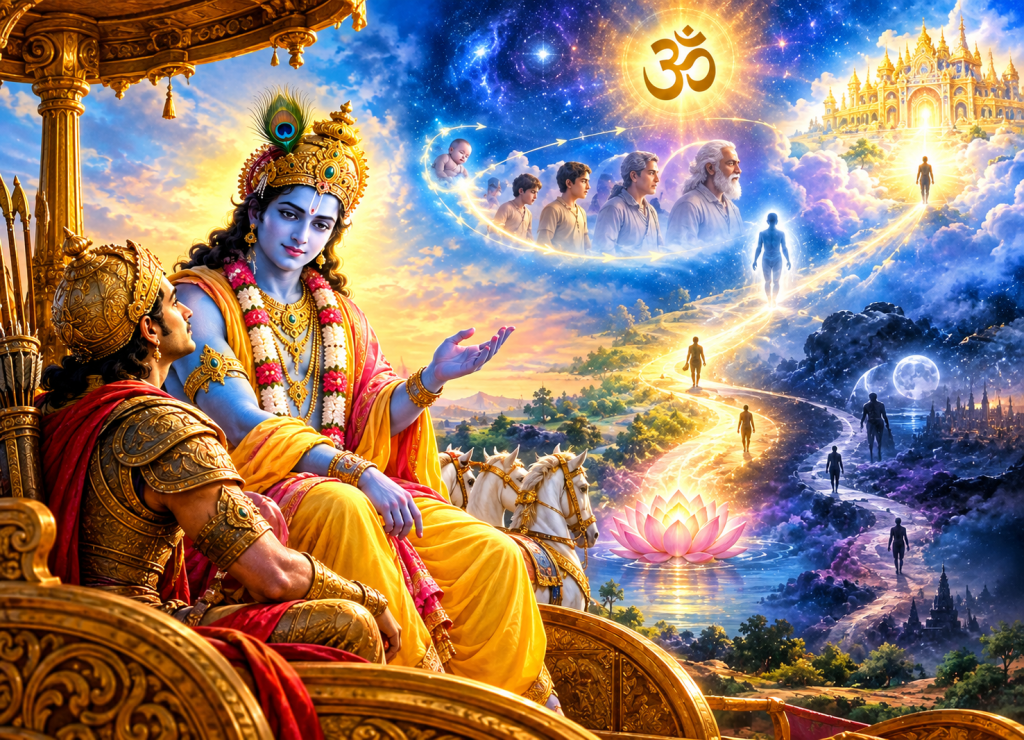
The bright and dark paths mentioned in verses 8.23–8.26 have been interpreted in Hindu traditions in different ways.
At the literal level, the verses describe distinctive cosmic pathways connected with light, darkness, day, night, the lunar cycle, and the solar course.
At a broader spiritual level, the imagery can also be contemplated as a contrast between illumination and return, or between realization of the Supreme and continued participation in samsara.
The important conclusion is given in verse 8.27:
The wise yogi understands these paths and remains established in yoga.
Therefore, the purpose is not simply to memorize the descriptions but to understand the larger spiritual message.
Practical Lessons from Bhagavad Gita Chapter 8
The teachings of this chapter can be incorporated into everyday life.
Begin the day with remembrance
A few moments of prayer, meditation, chanting, or reading sacred scripture can help establish the mind in a spiritual direction.
Practice what you want to remember
If we want divine remembrance to become natural, we should practice remembrance regularly.
Perform responsibilities sincerely
Krishna’s instruction to Arjuna shows that spiritual life does not have to mean escaping responsibility.
Control excessive attachment
Material objects have their practical value, but attachment to temporary things can dominate the mind.
Cultivate devotion
Devotion is not merely an emotion. In Chapter 8 it is connected with continuous remembrance and dedication.
Reflect on impermanence
Understanding that the material world is temporary can encourage a deeper search for what is eternal.
Develop inner steadiness
Meditation and disciplined attention help the mind become less easily disturbed.
Why Bhagavad Gita Chapter 8 Is Important
Chapter 8 connects several subjects that are sometimes studied separately:
Brahman, Atman, Karma, Adhyatma, Adhibhuta, Adhidaiva, Adhiyajna, meditation, Om, death, rebirth, cosmic time, devotion, and moksha.
Its strength lies in showing how these ideas are connected.
The chapter begins with Arjuna’s philosophical questions and ends with a vision of the highest spiritual destination.
The movement is from questions to realization.
Arjuna wants to know what Brahman is.
Krishna explains the imperishable.
Arjuna wants to know about the final moment.
Krishna explains remembrance.
Krishna then explains the nature of the Supreme, the cycles of creation and dissolution, the two paths, and the ultimate destination.
Finally, He directs Arjuna to remain established in Yoga.
Bhagavad Gita Chapter 8 in Simple Words
If the entire chapter had to be summarized in simple language, its teaching could be expressed like this:
The world around us is temporary, but the Supreme Reality is eternal. Train the mind throughout life to remember the Divine. Perform your responsibilities while keeping your consciousness connected with God. Through disciplined practice, devotion, and spiritual knowledge, seek the imperishable reality beyond birth and death.
This is the heart of Akshara Brahma Yoga.
A Deeper Reflection on the Final Thought
One of the most powerful ideas in Chapter 8 is that the end of life reflects the direction in which consciousness has been moving.
This can be understood as a spiritual lesson even before considering the literal question of what happens after death.
Every day, our thoughts create habits.
Repeated anger can make anger easier to express.
Repeated compassion can make compassion more natural.
Repeated remembrance of God can make remembrance more spontaneous.
Repeated meditation can make concentration stronger.
In this sense, Chapter 8 encourages us to practice today what we hope to realize ultimately.
Bhagavad Gita Chapter 8 and the Journey Toward Moksha
The concept of moksha is one of the most important ideas in Hindu philosophy.
Moksha is liberation from the cycle of samsara — repeated birth and death.
Chapter 8 presents the Supreme as the eternal destination beyond this cycle.
The seeker is encouraged to move beyond temporary rewards and recognize the imperishable.
This is why the chapter’s final verse is so important.
The yogi who understands the deeper truth goes beyond the limited fruits of religious merit and attains the supreme primordial state.
The teaching therefore moves beyond the pursuit of temporary heavenly rewards.
It points toward ultimate liberation.
Conclusion
Bhagavad Gita Chapter 8 — Akshara Brahma Yoga is a profound exploration of the eternal and the temporary.
Arjuna begins by asking Krishna about Brahman, Adhyatma, Karma, Adhibhuta, Adhidaiva, and Adhiyajna. Krishna answers these questions and then leads him toward a deeper understanding of life, death, remembrance, devotion, cosmic existence, and liberation.
The chapter teaches that the Supreme Reality is imperishable while the material world is subject to change. It emphasizes that the consciousness cultivated throughout life has profound spiritual significance. Krishna therefore advises Arjuna to remember Him at all times while continuing to perform his duty.
The chapter also presents the sacred syllable Om, the discipline of yoga, unwavering devotion, the vast cycles of cosmic time, and the two paths associated with departure from worldly existence.
Ultimately, Chapter 8 points beyond temporary existence toward the Supreme Person and the imperishable reality.
Its message is not simply about what happens at death. It is about how we should live before death.
We should cultivate remembrance rather than forgetfulness, devotion rather than excessive attachment, wisdom rather than ignorance, and spiritual steadiness rather than fear.
The final goal is not merely a better temporary existence, but freedom from the cycle of repeated birth and death — moksha, the realization of the eternal.
In this way, Akshara Brahma Yoga remains one of the Bhagavad Gita’s most profound teachings on the relationship between consciousness, devotion, death, and the eternal Supreme Reality.
ॐ तत् सत्
*Related Article: Bhagavad Gita Chapter 7: Jnana Vijnana Yoga