Kishkindha Kanda: Part Four Summary of the Ramayana
The Kishkindha Kanda is the fourth book of the great Hindu epic, the Ramayana, traditionally composed by Maharishi Valmiki. It is one of the most important sections of the epic because it transforms Lord Rama’s personal sorrow into a powerful mission supported by friendship, loyalty, courage and collective effort.
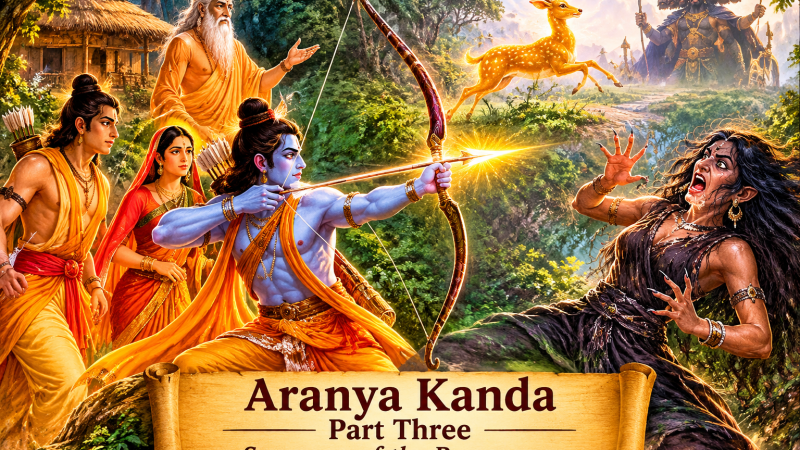
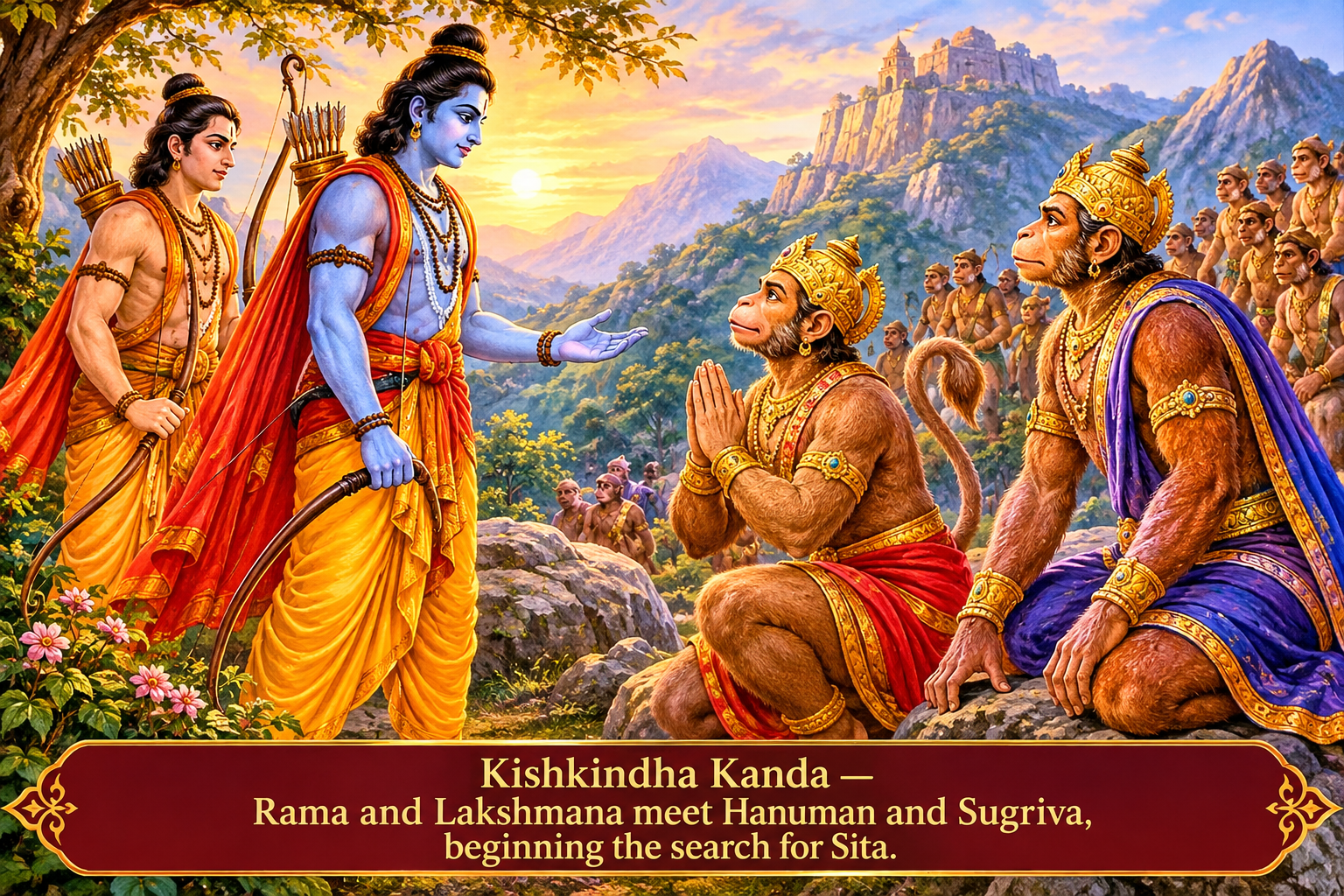
After Sita is abducted by Ravana (described in the Aranya Kanda: Part Three Summary of the Ramayana), the demon king of Lanka, Rama and his younger brother Lakshmana travel through the forests in search of her. Their journey brings them to the beautiful region of Kishkindha, the kingdom of the Vanaras. There, Rama meets Hanuman, the devoted servant of Sugriva, an exiled Vanara prince.
The meeting between Rama and Hanuman becomes one of the most memorable moments in the Ramayana. It leads to an alliance between Rama and Sugriva, the defeat of the mighty Vali, the restoration of Sugriva’s kingdom and the organisation of a vast search for Sita.
The Kishkindha Kanda also contains an important ethical discussion surrounding Rama’s killing of Vali. It explores the responsibilities of kingship, the meaning of justice, the importance of keeping promises and the consequences of forgetting one’s duties.
The book concludes with the Vanara search party reaching the southern ocean. There, they meet Sampati, the elder brother of Jatayu, who reveals that Sita is being held in Lanka. Finally, Jambavan reminds Hanuman of his extraordinary strength and abilities, preparing the way for the next book, the Sundara Kanda.
The Kishkindha Kanda is therefore not merely a story of battles and adventures. It is a narrative of hope returning after despair, friendship overcoming isolation and hidden strength awakening at the moment of greatest need.
1. Rama and Lakshmana Reach the Beautiful Pampa Lake
The Kishkindha Kanda begins with Rama and Lakshmana wandering through the forest after the abduction of Sita.
Rama is deeply distressed. He has lost his beloved wife and cannot find any reliable information about her whereabouts. Every beautiful sight in nature reminds him of Sita. The flowers, trees, birds, rivers and mountains intensify his sorrow.
When the brothers arrive near Pampa Lake, Rama is captivated by its natural beauty. The lake is surrounded by flowering trees, creepers, birds and peaceful woodland scenery. Yet the beauty of the landscape only increases his longing for Sita.
Rama remembers the happy moments he spent with her during their forest exile. He imagines how much she would have enjoyed the beautiful surroundings and becomes overwhelmed by grief.
Lakshmana tries to console his elder brother. He reminds Rama that sorrow cannot solve the problem and that they must continue their search with determination.
Lakshmana’s words are important because they introduce one of the central messages of this Kanda: suffering must not destroy one’s sense of responsibility.
Although Rama is the ideal hero and an incarnation of Lord Vishnu according to Hindu tradition, the epic portrays him experiencing the pain of separation in a deeply human way. His grief makes his determination to rescue Sita more meaningful.
2. Sugriva Becomes Afraid of the Two Princes
Meanwhile, on Mount Rishyamukha, Sugriva, the exiled prince of Kishkindha, lives in fear of his elder brother Vali.
Sugriva has been driven away from his kingdom and believes that Vali may still be searching for him. When he sees Rama and Lakshmana approaching with bows and arrows, he becomes frightened.
He suspects that the two strangers may have been sent by Vali to kill him.
Sugriva discusses the situation with his trusted ministers, including Hanuman. He asks Hanuman to discover the identity and intentions of the two armed men.
Hanuman is known for his intelligence, courage, humility and excellent communication skills. Sugriva trusts him to approach the strangers carefully and gather information.
This episode introduces Hanuman as more than a physically powerful hero. His wisdom and ability to understand people are equally important to his character.
3. Hanuman Meets Rama and Lakshmana
Hanuman approaches Rama and Lakshmana in the disguise of an ascetic.
He speaks politely and asks who they are, why they have entered the forest and what purpose has brought them to the region.
Rama is greatly impressed by Hanuman’s speech. Hanuman’s words are respectful, clear, intelligent and beautifully organised. His manner reveals his education, self-control and understanding of proper conduct.
Rama recognises that Hanuman is no ordinary messenger.
In the traditional narrative, Rama praises the quality of Hanuman’s speech, observing that a person who has mastered language and possesses such wisdom can communicate effectively with others.
Hanuman eventually reveals that he is the minister of Sugriva, the Vanara prince living in exile.
He explains Sugriva’s situation and offers to take the two brothers to meet him.
This meeting is one of the most celebrated episodes in the Ramayana because it marks the beginning of the relationship between Rama and Hanuman.
Hanuman’s devotion to Rama develops into one of the greatest examples of selfless service in Hindu religious tradition.
4. Hanuman Brings Rama and Lakshmana to Sugriva
After discovering the identity of Rama and Lakshmana, Hanuman carries them to the place where Sugriva is staying.
Sugriva welcomes the princes with respect and hospitality. He is relieved to learn that they have not been sent by Vali.
Rama and Sugriva begin to discuss their respective difficulties.
Rama explains that Ravana has abducted Sita and that he is searching for her. Sugriva, in turn, describes how Vali has deprived him of his kingdom and driven him into exile.
Both recognise that they are suffering from injustice and separation.
Rama has lost Sita, while Sugriva has lost his kingdom, his dignity and his place in society.
Their shared suffering creates a foundation for friendship.
5. Rama and Sugriva Form a Sacred Alliance
Rama and Sugriva decide to help one another.
Their friendship is traditionally solemnised before a sacred fire. They pledge to remain faithful to their agreement and support each other in overcoming their difficulties.
Rama promises to help Sugriva defeat Vali and regain the kingdom of Kishkindha.
Sugriva promises to use the strength and resources of the Vanaras to search for Sita.
The alliance is one of the central events of the Kishkindha Kanda.
It demonstrates that friendship is not merely an emotional connection. True friendship requires loyalty, responsibility and action.
Rama and Sugriva are both powerful figures, but neither can accomplish his immediate goal alone. Rama needs the knowledge and resources of the Vanaras, while Sugriva needs Rama’s strength and assistance.
Their alliance becomes a model of cooperation.
6. Sugriva Shows Rama the Ornaments of Sita
Sugriva tells Rama that he and his companions once witnessed a woman being carried through the sky by a powerful being.
The woman was crying for help. As she was carried away, she dropped some of her ornaments toward the earth.
Sugriva and the Vanaras collected the ornaments and preserved them.
When Sugriva presents the ornaments to Rama, he recognises them as belonging to Sita.
The sight of the ornaments deeply affects Rama. They provide evidence that Sita was carried away through the region and that the Vanaras may possess valuable information about her abduction.
Rama asks Lakshmana to identify the ornaments.
Lakshmana explains that he recognises the anklets because he regularly bowed at Sita’s feet. He does not claim to recognise all her other ornaments.
This moment expresses Lakshmana’s respect for Sita and the dignity of his relationship with her.
The ornaments also become an important symbol of hope. Although Sita is missing, the brothers now have evidence that their search is moving in the right direction.
7. Sugriva Explains the Conflict Between Vali and Sugriva
Sugriva tells Rama the story of his conflict with his elder brother Vali.
Vali was the powerful king of Kishkindha. He possessed extraordinary physical strength and was feared by many opponents.
The brothers once lived together in the kingdom. However, an incident involving a demon named Mayavi changed their relationship forever.
Mayavi challenged Vali to fight. Vali pursued the demon into a cave, and Sugriva waited outside.
As the fight continued, Sugriva heard terrible sounds from inside the cave. Eventually, blood flowed from its entrance.
Believing that Vali had been killed, Sugriva became frightened that the demon might emerge and threaten the kingdom.
He blocked the entrance with a large stone and returned to Kishkindha.
The Vanaras eventually made Sugriva their king.
However, Vali was not dead. He defeated Mayavi and emerged from the cave after a long struggle.
When Vali returned, he believed that Sugriva had deliberately abandoned him and taken his kingdom.
Vali became furious and drove Sugriva away. He also took Sugriva’s wife, Ruma, which was considered a serious violation of dharma.
Sugriva fled to Mount Rishyamukha, where Vali could not approach because of a curse associated with the sage Matanga.
This story explains why Sugriva is terrified of Vali and why he needs Rama’s help.
8. Rama Demonstrates His Strength to Sugriva
Although Sugriva has accepted Rama’s friendship, he remains uncertain whether Rama can defeat Vali.
Vali is famous for his extraordinary strength, and Sugriva has suffered defeat at his hands.
To reassure Sugriva, Rama demonstrates his power.
One of the most famous demonstrations involves the seven Sala trees.
Sugriva explains that Vali possesses tremendous strength and that only a warrior of exceptional ability could defeat him.
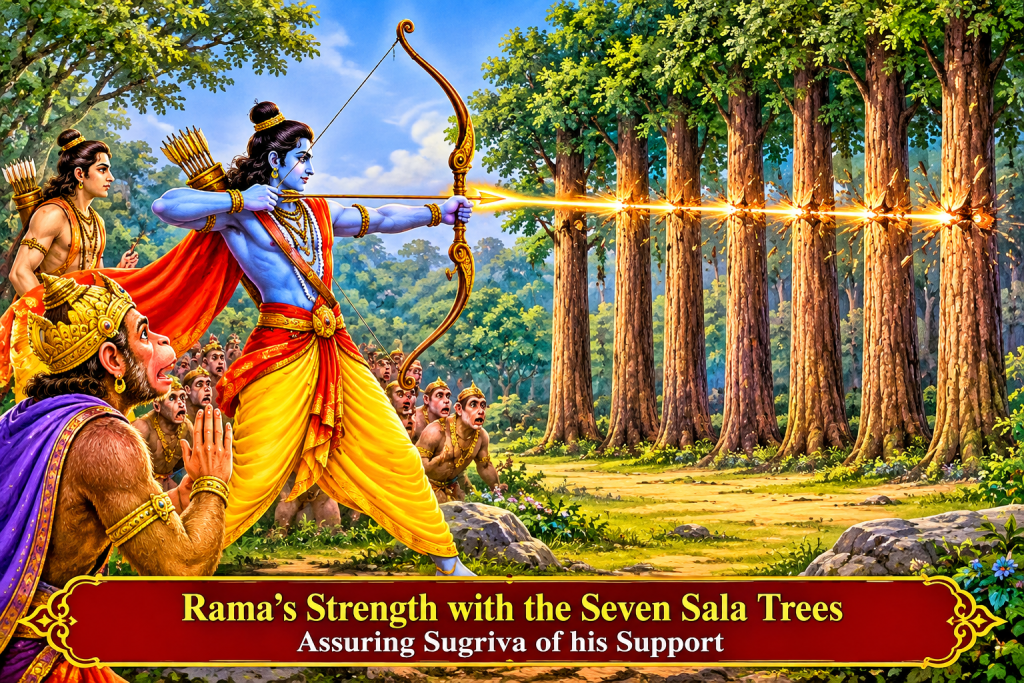
Rama takes his bow and releases an arrow that pierces the seven Sala trees.
In some traditional accounts, the arrow also passes through other objects before returning to Rama.
Sugriva is astonished by the demonstration.
He becomes confident that Rama can defeat Vali and restore his kingdom.
The seven Sala trees are remembered as a symbol of Rama’s extraordinary power and the certainty of his promise.
9. Sugriva Challenges Vali for the First Time
Rama and Sugriva travel toward Kishkindha.
Sugriva approaches the kingdom and loudly challenges Vali to come out and fight.
Vali hears the challenge and immediately becomes angry.
He rushes out of the palace and engages Sugriva in combat.
The two brothers are physically similar, and their fighting styles are difficult to distinguish.
Rama watches the battle but cannot clearly identify Sugriva.
Because the brothers look alike, Rama fears that he might accidentally strike Sugriva instead of Vali.
Sugriva is badly beaten and forced to retreat.
He becomes disappointed and questions why Rama did not help him.
Rama explains that he could not distinguish the two brothers during the battle.
To prevent the same mistake, Sugriva is given a garland or distinctive marker so that Rama can recognise him during the next fight.
The first duel teaches an important lesson about preparation. Even a powerful warrior must understand the circumstances before taking action.
10. Tara Warns Vali Not to Fight Sugriva
Before the second challenge, Vali’s wife Tara advises him not to fight Sugriva.
Tara is intelligent, wise and politically perceptive. She understands that Sugriva has returned with a powerful ally.
She suspects that the man accompanying Sugriva may be Rama, the renowned prince of Ayodhya.
Tara advises Vali to consider the danger carefully and avoid unnecessary conflict.
She suggests that Vali should make peace with Sugriva rather than risk his life.
However, Vali refuses to listen.
He is proud of his strength and believes that no opponent can defeat him.
Vali’s decision demonstrates the danger of arrogance. He ignores wise advice because he is confident in his own power.
Tara’s warning is one of the most important examples of wisdom being disregarded in the Ramayana.
11. Rama Kills Vali
Sugriva challenges Vali for the second time.
Vali emerges from Kishkindha and engages his younger brother in a fierce battle.
The two brothers fight with extraordinary strength. Their blows shake the surrounding forest, and the battle becomes increasingly intense.
Rama watches carefully from a concealed position.
When he identifies Vali, Rama releases a powerful arrow from his bow.
The arrow strikes Vali and causes a mortal wound.
Vali falls to the ground, shocked that he has been defeated.
This is one of the most dramatic and controversial episodes in the Ramayana.
Rama kills Vali while the latter is engaged in combat with Sugriva, rather than confronting him openly.
The circumstances of Vali’s death raise important questions about justice, kingship and the proper conduct of a warrior.
12. Vali Questions Rama’s Conduct
As Vali lies dying, he addresses Rama directly.
He questions why Rama killed him from concealment instead of challenging him openly.
Vali argues that he was not fighting Rama and that Rama had no direct personal quarrel with him.
He also questions whether Rama’s action was consistent with the principles of righteousness.
Vali’s criticism is significant because the epic does not simply ignore his objections.
Rama responds by explaining his understanding of royal duty and justice.
He argues that Vali has violated dharma by taking Sugriva’s wife and depriving him of his rightful position.
Rama also explains that a king has the responsibility to punish wrongdoing and protect the moral order.
The discussion remains one of the most debated ethical episodes in the Ramayana.
Different traditions and commentators have interpreted Rama’s action in different ways. Some emphasise the violation of dharma committed by Vali, while others focus on the unusual manner in which the killing takes place.
The episode encourages readers to reflect on the difficult relationship between justice, authority and the means used to achieve a righteous outcome.
13. Vali Entrusts Angada to Rama
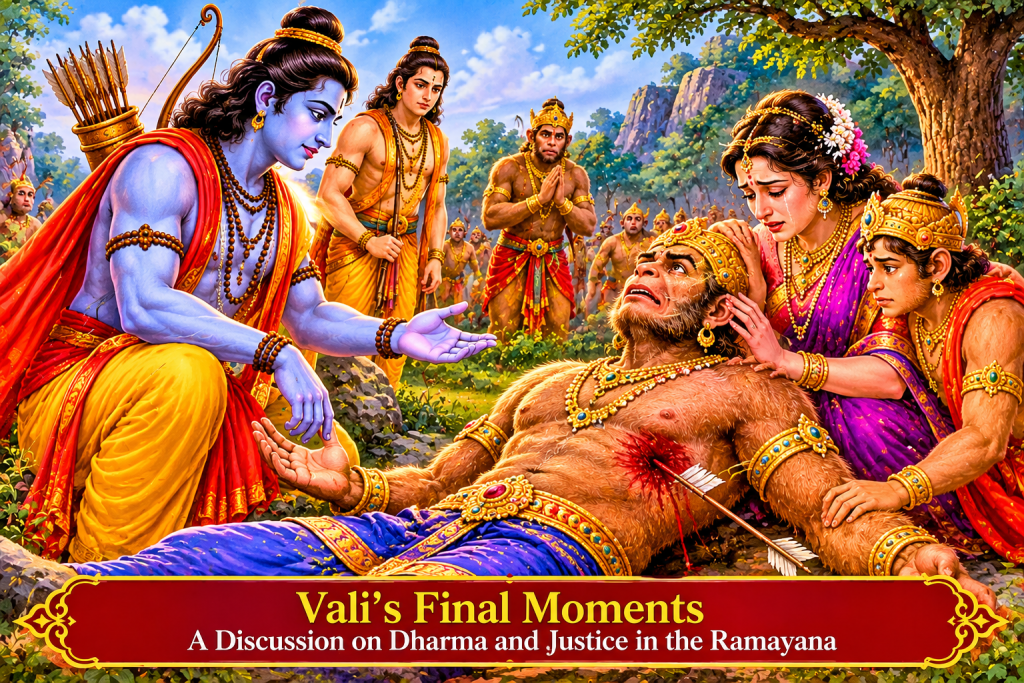
Before his death, Vali speaks to his son Angada.
He advises Angada to remain loyal to Sugriva and to behave with respect toward the new king.
Vali also asks Rama to protect Angada.
Rama accepts the responsibility.
This moment is deeply moving because Vali, despite his anger and disagreement with Rama, recognises the importance of his son’s future.
Vali’s final words reveal a change in his attitude. He no longer focuses only on his own suffering but also on the welfare of Angada.
The episode demonstrates the importance of responsibility toward the next generation.
14. Tara’s Grief and Vali’s Funeral
When Tara learns that Vali has been killed, she rushes to the battlefield.
She sees her husband lying on the ground and is overwhelmed by grief.
Tara mourns Vali and remembers his strength, courage and position as king.
Angada also mourns his father.
The Vanaras gather around Vali’s body, and the kingdom is filled with sorrow.
Rama and Lakshmana console Tara and encourage her to accept the reality of death.
Vali’s funeral is performed with appropriate rites.
The episode highlights the emotional consequences of conflict. Even when a political dispute is resolved, the loss of life brings suffering to families and communities.
Tara’s grief is one of the most powerful emotional moments in the Kishkindha Kanda.
15. Sugriva Becomes King of Kishkindha
After Vali’s death, Sugriva is restored to the throne of Kishkindha.
Angada is appointed heir apparent.
The Vanaras celebrate the restoration of their kingdom, and Sugriva receives the responsibilities of kingship.
Rama does not enter the city to enjoy the royal celebrations. Instead, he remains in the forest with Lakshmana.
He understands that the rainy season is approaching and that the search for Sita cannot proceed effectively during the heavy rains.
Rama asks Sugriva to remember his promise and begin the search when the season ends.
Sugriva agrees.
The restoration of Sugriva’s kingdom completes the first major objective of the alliance.
However, the rescue of Sita remains unfinished.
16. The Rainy Season and Rama’s Sorrow
Rama and Lakshmana spend the rainy season on Mount Prasravaṇa.
The Kishkindha Kanda contains beautiful descriptions of the monsoon.
Clouds gather over the mountains, rivers swell, forests become green and the earth is refreshed by rain.
The natural beauty contrasts with Rama’s emotional suffering.
He continues to think about Sita and wonders whether she is safe.
The rainy season also delays the movement of armies and the search for her.
Rama waits patiently for Sugriva to fulfil his promise.
This period represents the difficult experience of waiting when action is temporarily impossible.
The epic teaches that patience is sometimes necessary, but patience must not become an excuse for neglecting responsibility.
17. Sugriva Forgets His Promise
After becoming king, Sugriva begins enjoying the comforts of royal life.
He spends time in the palace and becomes distracted by pleasure and celebration.
As the rainy season ends, he fails to organise the search for Sita.
Rama becomes increasingly disappointed.
He has fulfilled his promise to Sugriva, but Sugriva has not yet fulfilled his own commitment.
Rama asks Lakshmana to go to Kishkindha and remind Sugriva of his duty.
Lakshmana is angry because he believes Sugriva has forgotten the friendship that helped him regain his kingdom.
18. Lakshmana Enters Kishkindha
Lakshmana approaches Kishkindha with great anger.
The Vanaras become frightened by his arrival because they know that he is a powerful warrior.
Sugriva’s ministers attempt to calm the situation.
Hanuman understands that Sugriva has made a serious mistake by delaying the search.
He advises Sugriva to approach Lakshmana respectfully and acknowledge his failure.
Tara also intervenes.
She speaks to Lakshmana with wisdom and courtesy, helping to reduce his anger.
Sugriva eventually meets Lakshmana and apologises.
He explains that he has not forgotten his promise and immediately begins arranging the search.
This episode shows the importance of keeping one’s word.
It also demonstrates the value of diplomacy. Tara and Hanuman prevent a disagreement from becoming a destructive conflict.
19. Sugriva Organises the Search for Sita
Sugriva sends messengers throughout the Vanara kingdom and summons large numbers of Vanara warriors.
The armies assemble from different regions.
Sugriva instructs the search parties to travel in the four directions: east, south, west and north.
They are ordered to explore mountains, forests, rivers, caves and distant lands.
The search parties are given a limited period to return with information.
Sugriva describes various geographical regions and landmarks that may help the warriors locate Sita.
The scale of the search demonstrates the importance of cooperation and organisation.
The rescue of Sita is no longer merely Rama’s personal mission. It has become a collective effort involving thousands of Vanaras.
20. Rama Gives His Ring to Hanuman
Among the search parties, the southern group receives particular importance.
It includes Angada, Hanuman, Jambavan and other experienced warriors.
Rama gives Hanuman his signet ring before the party departs.
The ring is a token of recognition.
If Hanuman finds Sita, he can show her the ring to prove that he has come as Rama’s messenger.
The ring becomes one of the most important symbols in the Ramayana.
It represents Rama’s love for Sita, his trust in Hanuman and the connection between the separated couple.
Hanuman accepts the ring with humility and devotion.
He understands the importance of the mission and prepares to fulfil it with complete dedication.
21. The Search Parties Explore the Four Directions
The Vanara search parties travel through different regions.
The eastern group explores forests, mountains and distant territories.
The western group searches coastal areas and unfamiliar landscapes.
The northern group travels through mountainous regions and places associated with snow and extreme conditions.
The southern group faces particularly difficult challenges.
Although the search parties are brave and determined, they initially fail to discover Sita’s location.
They encounter dangerous creatures, unfamiliar landscapes and numerous obstacles.
The search becomes increasingly difficult as the deadline approaches.
The episode demonstrates that success often requires patience, persistence and the ability to continue despite repeated failures.
22. The Southern Search Party Enters a Mysterious Cave
The southern search party, led by Angada, continues its journey through difficult terrain.
The warriors become exhausted and thirsty.
Eventually, they discover a mysterious cave filled with water, trees and extraordinary beauty.
The cave appears to contain a hidden world.
The Vanaras enter and discover that it is inhabited by a woman named Svayamprabha.
Svayamprabha explains that she is the guardian of the magical place.
She welcomes the exhausted warriors and provides them with food, water and rest.
After hearing about their mission, she decides to help them.
Using her extraordinary powers, she brings the Vanaras out of the cave.
The episode introduces a supernatural element into the search and shows that assistance can appear unexpectedly during difficult circumstances.
23. Angada Becomes Despondent
After leaving the cave, the Vanaras realise that they have lost valuable time.
They have not found Sita, and the deadline set by Sugriva is approaching.
Angada becomes deeply worried.
He fears that Sugriva will punish the search party for failing to complete the mission.
Angada also remembers his father’s death and the complicated relationship between himself and Sugriva.
He suggests that the warriors may have no choice but to remain in the forest and face death rather than return unsuccessful.
Some Vanaras become discouraged and consider giving up.
The situation appears hopeless.
However, Hanuman refuses to accept despair.
He reminds Angada that the mission is not yet complete and that they must continue searching.
Hanuman’s determination becomes a source of strength for the entire group.
24. Sampati Appears Before the Vanaras
While the Vanaras sit near the southern ocean, they discuss their failure and remember the story of Jatayu.
Their conversation attracts the attention of an old and weakened bird named Sampati.
Sampati is the elder brother of Jatayu, the noble bird who fought Ravana while he was carrying Sita away.
Sampati asks the Vanaras about Jatayu.
When he learns that Jatayu died while attempting to rescue Sita, he becomes deeply moved.
He mourns his brother and asks the Vanaras to explain what happened.
The story of Jatayu’s sacrifice provides Sampati with an opportunity to understand the fate of his brother.
25. Sampati Reveals That Sita Is in Lanka
Sampati possesses extraordinary eyesight.
Although he is unable to fly because his wings were burned, he can see great distances.
He looks across the ocean and identifies Lanka as the place where Sita is being held.
He explains that Ravana has carried her to the island and that she is living in captivity.
This revelation is a turning point in the Kishkindha Kanda.
Until this moment, the search party has been travelling without reliable information about Sita’s location.
Sampati’s knowledge provides the first clear direction toward the rescue mission.
The Vanaras finally know where they must go.
Sampati’s revelation also gives new meaning to the sacrifice of Jatayu.
Jatayu died while trying to save Sita, but his brother’s information now helps continue the same mission.
26. Sampati’s Story and the Return of His Wings
Sampati explains how he lost his ability to fly.
When he and Jatayu were young, they once flew toward the sun.
As they approached the sun’s intense heat, Sampati spread his wings to protect Jatayu.
His own wings were burned, and he fell to the earth.
He remained unable to fly for a long time.
Sampati also recalls a prophecy associated with the sage Nishakara.
According to the traditional story, Sampati would regain his wings when he helped the Vanaras in their search for Sita.
After revealing Sita’s location, Sampati experiences the fulfilment of that prophecy.
His wings are restored.
The episode is a powerful example of hope and redemption.
Sampati’s suffering does not make his life meaningless. His knowledge and sacrifice become essential to the larger mission.
27. The Vanaras Face the Vast Ocean
After learning that Sita is in Lanka, the Vanaras look across the ocean.
The distance appears enormous.
They understand that reaching Lanka will require someone capable of crossing the sea.
The warriors discuss their individual abilities.
Some believe they can leap a considerable distance but cannot guarantee that they will return.
Others admit that they cannot cross the ocean at all.
Angada is strong, but he is uncertain whether he can complete the entire journey.
The group becomes discouraged once again.
The ocean represents the final great obstacle between the search party and Sita.
It also symbolises the distance between hope and fulfilment.
The Vanaras need a warrior who possesses both extraordinary strength and unwavering confidence.
28. Jambavan Reminds Hanuman of His Strength
At this crucial moment, Jambavan, the wise king of the bears, turns to Hanuman.
Hanuman has remained humble throughout the journey.
Although he possesses extraordinary powers, he has not fully recognised the extent of his own abilities.
Jambavan reminds him of his childhood and the divine blessings he received.
He explains that Hanuman possesses immense strength, speed and the ability to change his size.
Jambavan encourages Hanuman to remember his true nature.
His words awaken Hanuman’s confidence.
Hanuman realises that he is capable of crossing the ocean and reaching Lanka.
This moment is one of the most inspirational episodes in the Ramayana.
It teaches that people sometimes fail to recognise their own potential until someone reminds them of their abilities.
Jambavan does not give Hanuman new powers. He helps him understand the powers he already possesses.
29. Hanuman Prepares for the Great Leap
Having regained confidence, Hanuman climbs Mount Mahendra.
He prepares himself for the extraordinary journey across the ocean.
His body expands, and his strength becomes visible to the surrounding Vanaras.
The mountain shakes under his powerful movements.
Hanuman takes a deep breath and focuses on his mission.
He remembers Rama, Sita and the responsibility entrusted to him.
The Vanaras watch with admiration as Hanuman prepares to leap.
The Kishkindha Kanda concludes with Hanuman standing ready to cross the ocean.
His journey toward Lanka will begin in the Sundara Kanda.
The final scene creates a powerful sense of anticipation.
The search has finally discovered Sita’s location, and the mission now rests on Hanuman’s courage, devotion and extraordinary abilities.
Important Episodes of Kishkindha Kanda at a Glance
| Episode | Importance |
|---|---|
| Rama meets Hanuman | Begins the relationship between Rama and his greatest devotee |
| Rama and Sugriva’s alliance | Establishes mutual friendship and cooperation |
| Sita’s ornaments are recognised | Provides evidence of her abduction route |
| Sugriva explains his exile | Reveals the conflict with Vali |
| The seven Sala trees | Demonstrates Rama’s extraordinary strength |
| Vali’s death | Raises important questions about dharma and justice |
| Sugriva’s coronation | Restores the kingdom of Kishkindha |
| Lakshmana confronts Sugriva | Emphasises the duty to keep promises |
| The search parties depart | Begins the organised search for Sita |
| Rama gives Hanuman his ring | Provides a token of recognition for Sita |
| Svayamprabha helps the Vanaras | Offers assistance during their difficult journey |
| Sampati reveals Lanka | Identifies Sita’s location |
| Jambavan encourages Hanuman | Awakens Hanuman’s confidence and strength |
| Hanuman prepares to leap | Leads directly into the Sundara Kanda |
Major Themes and Lessons of Kishkindha Kanda
Friendship and Mutual Responsibility
The friendship between Rama and Sugriva is based on mutual support.
Both have suffered loss, and both need help to overcome their difficulties.
Their relationship teaches that genuine friendship requires more than affection. It requires loyalty, commitment and the willingness to act when a friend is in need.
The Importance of Keeping Promises
Sugriva’s delay in organising the search creates a serious conflict.
Rama has fulfilled his promise, but Sugriva becomes distracted by royal pleasures.
The episode reminds readers that success and comfort should not make a person forget earlier responsibilities.
Wisdom and Humility
Hanuman’s first meeting with Rama shows the importance of intelligence, respectful speech and humility.
His greatest qualities are not limited to physical strength.
Hanuman becomes an ideal messenger because he combines courage with wisdom and devotion.
Justice and the Responsibilities of Kingship
The death of Vali raises difficult questions about the proper conduct of rulers and warriors.
The episode encourages readers to examine the relationship between justice, authority and moral responsibility.
Hope in Difficult Circumstances
The southern search party repeatedly faces failure.
However, the appearance of Svayamprabha and Sampati changes the situation.
The story teaches that perseverance can lead to unexpected opportunities.
Discovering Hidden Potential
Jambavan’s encouragement of Hanuman is one of the most important lessons of the book.
Hanuman’s abilities were always present, but he needed to recognise them.
The episode reminds readers that confidence, guidance and determination can help people overcome seemingly impossible challenges.
Conclusion: The Beginning of Hanuman’s Great Mission
The Kishkindha Kanda is a turning point in the Ramayana.
It begins with Rama wandering through the forest in sorrow and ends with Hanuman preparing to cross the ocean in search of Sita.
Between these two moments, the epic presents a remarkable journey of friendship, justice, loyalty, courage and self-discovery.
Rama meets Hanuman and forms an alliance with Sugriva. Sugriva regains his kingdom, but he must also learn the importance of keeping his promises. Vali’s death raises profound questions about dharma, while Tara’s wisdom and Angada’s sorrow reveal the human consequences of conflict.
The search for Sita becomes a collective mission involving the Vanaras and bears. After many difficulties, Sampati reveals that Sita is in Lanka.
Finally, Jambavan awakens Hanuman’s confidence and reminds him of his extraordinary abilities.
The Kishkindha Kanda ends at the threshold of one of the most celebrated adventures in Hindu literature.
Hanuman is ready to leap across the ocean.
His journey will lead to the discovery of Sita, the burning of Lanka and the preparation for the great battle against Ravana.
The message of Kishkindha Kanda remains timeless: when friendship is sincere, promises are honoured and hidden strength is awakened, even the greatest obstacles can be overcome.