Adi Kailash: Sacred Shiva Mountain, Mythology & Yatra Guide

High in the remote Kumaon Himalayas of Uttarakhand stands a majestic mountain surrounded by some of the most dramatic landscapes in northern India. Known as Adi Kailash, and popularly called Chhota Kailash, Shiva Kailash, or Baba Kailash, it is one of the most revered pilgrimage destinations associated with Lord Shiva.

Located in Pithoragarh district near the India–Tibet border, Adi Kailash combines towering Himalayan scenery with ancient religious traditions, local beliefs, sacred lakes and a demanding high-altitude journey. The district administration describes Adi Kailash as a mountain believed to resemble or be a replica of Mount Kailash in Tibet. At its foot are sacred water bodies including Parvati Lake and Gauri Kund, along with a temple dedicated to Lord Shiva.
For Hindu pilgrims, the journey is not simply a mountain excursion. It is an opportunity to enter a landscape traditionally associated with Shiva and Parvati, where snow-covered peaks, silent valleys and crystal-clear Himalayan waters create an atmosphere of extraordinary serenity.
At the same time, Adi Kailash is important beyond its religious dimension. The surrounding region is home to distinctive Himalayan communities, traditional villages, wildlife, rivers and challenging mountain routes. Uttarakhand Tourism identifies the wider Kumaon region as a destination for trekking, nature exploration, cultural experiences and spiritual journeys.
For anyone interested in Hindu sacred geography, Himalayan culture, mountain travel or Lord Shiva, Adi Kailash is a fascinating destination to explore.
Where Is Adi Kailash?
Adi Kailash is situated in Pithoragarh district of Uttarakhand, India, in the high Himalayan region close to the India–Tibet frontier.
The pilgrimage route is associated with the remote Vyas Valley, with important places such as Dharchula, Gunji, Kuti and Jolingkong appearing along the journey. Dharchula is an important gateway for both the Adi Kailash Yatra and the Kailash Mansarovar route. The Pithoragarh district administration identifies Dharchula as a base for the Adi Kailash Yatra.
The location is dramatically different from the more accessible hill stations of Uttarakhand. Roads become increasingly remote and mountainous as travellers approach the higher valleys. The surrounding terrain includes deep river gorges, high mountain passes, sparse alpine vegetation and snow-covered Himalayan peaks.
The official district tourism page lists Adi Kailash as an adventure destination and highlights its religious significance, Parvati Lake and Gauri Kund.
Because of its border location, travel is regulated. Pilgrims must pay attention to current administrative instructions, permits, road conditions and weather before beginning the journey.
What Does the Name Adi Kailash Mean?
The Sanskrit word Adi can mean first, primordial, original, or ancient, while Kailash refers to the sacred mountain associated with Lord Shiva.
The name therefore carries a profound spiritual suggestion: the primordial or ancient Kailash.
The mountain is also popularly called Chhota Kailash, meaning “Little Kailash,” because of its visual resemblance to Mount Kailash in Tibet. The Pithoragarh district administration itself describes Adi Kailash as being believed to be a replica of Mount Kailash.
However, visitors should distinguish between the two mountains geographically. Adi Kailash and Mount Kailash are not the same mountain. Mount Kailash lies in the Tibet Autonomous Region of China, whereas Adi Kailash is located in India’s Uttarakhand.
Adi Kailash is therefore particularly important to pilgrims who wish to experience a Kailash-associated sacred landscape without crossing the international border into Tibet.
Adi Kailash and Lord Shiva
The spiritual identity of Adi Kailash is closely connected with Lord Shiva, one of the principal deities of Hinduism.
Shiva is traditionally associated with mountains, meditation, silence, asceticism and the vast Himalayan wilderness. Mount Kailash occupies an especially important place in Shaiva traditions, and many Himalayan landscapes associated with Shiva have acquired sacred significance through centuries of worship and local tradition.
The Pithoragarh district administration specifically identifies Adi Kailash with Lord Shiva and Goddess Parvati and notes its strong Puranic and religious context. A temple dedicated to Shiva is located in the Adi Kailash area.
For devotees, the mountain’s importance is therefore not based merely on its physical appearance. The surrounding landscape is understood through a sacred worldview in which mountains, rivers, lakes and forests can become expressions of divine presence.
This makes the Adi Kailash journey different from an ordinary Himalayan sightseeing trip.
A traveller may arrive to see a mountain, but a pilgrim arrives to experience a sacred landscape.
Adi Kailash in Hindu Tradition and Local Belief
Many stories associated with Adi Kailash are preserved through religious traditions, local beliefs and pilgrimage narratives. These stories should be understood as matters of faith rather than as modern geographical or historical claims.
One widespread tradition associates the region with Lord Shiva and Goddess Parvati. Various pilgrimage narratives describe the divine couple’s connection with the Himalayan landscape and the sacred lakes around Adi Kailash.
The importance of these stories lies partly in how they connect physical places with spiritual ideas.
For example, a lake becomes more than a body of water when devotees associate it with Goddess Parvati. A mountain becomes more than rock and snow when it is understood as a sacred presence of Shiva.
This relationship between nature and divinity is particularly prominent in Hindu sacred geography.
The Pithoragarh district website notes the religious importance of Adi Kailash for Hindus and also records that the region has significance for Jain, Buddhist and Bon traditions.
Thus, Adi Kailash represents not only a Hindu pilgrimage destination but also part of the broader spiritual heritage of the Himalayan borderlands.
Parvati Sarovar: The Sacred Lake
One of the most beautiful features of the Adi Kailash pilgrimage area is Parvati Sarovar, also called Parvati Lake or Parvati Tal in different descriptions.
The lake lies near the foot of the sacred mountain and is closely connected with local religious traditions concerning Goddess Parvati.
The official Pithoragarh tourism description identifies Parvati Sarovar as a sacred lake associated with Goddess Parvati. The district’s older Adi Kailash route description also refers to the beautiful lake and its remarkable reflection of the mountain.
The scene can be especially striking when the water is calm.
The dark or snow-covered mountain rising behind the lake, reflected in clear Himalayan water, creates an image that explains why the area has inspired generations of pilgrims and travellers.
For devotees, the lake is a place of reverence.
For photographers, it is an extraordinary Himalayan landscape.
For nature lovers, it is a reminder of the delicate high-altitude environment.
For spiritual seekers, its silence can become part of the pilgrimage itself.
Gauri Kund and Its Spiritual Importance
Another sacred water body associated with Adi Kailash is Gauri Kund.
Gauri is one of the names of Goddess Parvati. In Hindu tradition, Parvati is worshipped in many forms and under many names, including Gauri.
The Pithoragarh district administration identifies Gauri Kund as a holy water body associated with Goddess Parvati and specifically includes it among the important religious attractions near Adi Kailash.
The presence of sacred water near a Shiva mountain creates a powerful symbolic connection.
In Hindu thought, water frequently represents purification, renewal and sacred transformation. Mountains, meanwhile, are associated with stability, spiritual elevation and the meeting of earth and heaven.
The combination of Shiva’s mountain and Parvati’s sacred water gives the Adi Kailash landscape a distinctive spiritual character.
Visitors should treat the area respectfully and follow local instructions concerning bathing, photography, waste disposal and access to sacred sites.
The Adi Kailash Temple
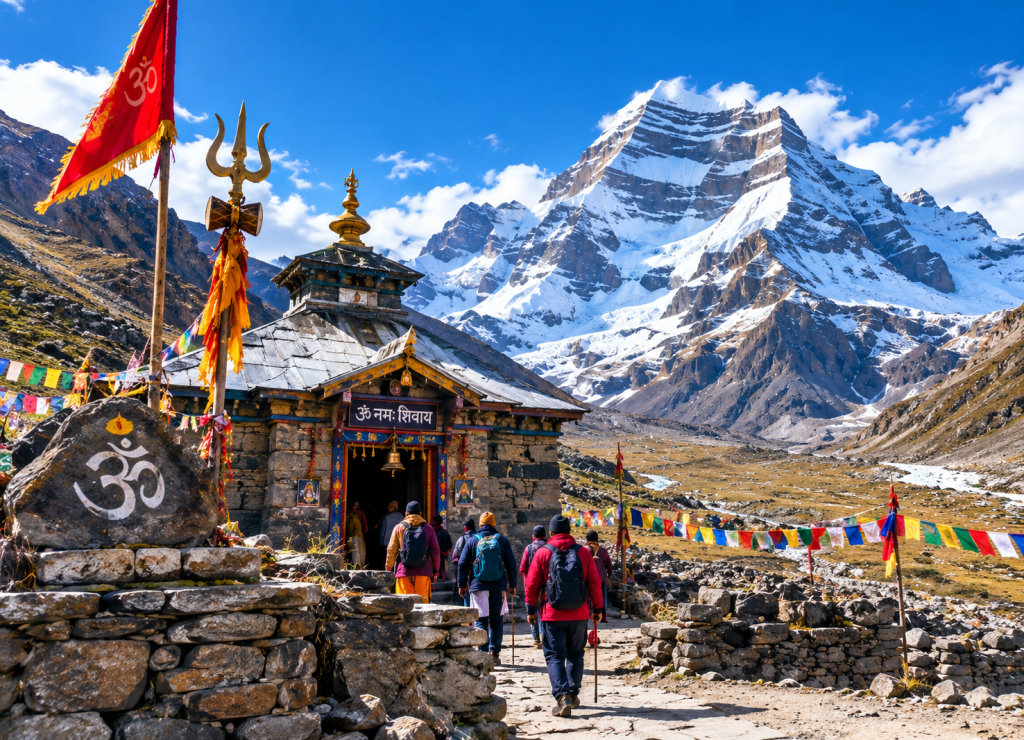
Near the sacred mountain is a temple dedicated to Lord Shiva.
The Pithoragarh district administration lists the Adi Kailash Temple among the principal attractions of the area and describes it as an important place of worship for pilgrims.
For many visitors, reaching the temple and offering prayers is one of the central moments of the journey.
A pilgrimage does not necessarily require elaborate ceremonies. Standing quietly before a sacred shrine, remembering Shiva, chanting a mantra or simply observing the Himalayan surroundings can become a deeply personal spiritual experience.
The temple also demonstrates how religious life in the Himalayas is integrated with the natural environment.
Adi Kailash and the Panch Kailash Tradition
Adi Kailash is frequently discussed in connection with the idea of Panch Kailash, or five sacred Kailash-associated mountains.
Different modern sources do not always present an identical list or hierarchy of these mountains, so it is better not to treat every popular list as a universally fixed scriptural classification.
Adi Kailash is nevertheless widely recognised as one of the important Kailash-associated pilgrimage destinations.
Its popular name, Chhota Kailash, directly reflects its relationship in devotional imagination with Mount Kailash.
The broader idea of sacred mountains is deeply rooted in Hinduism. Mountains are often portrayed as meeting points between the earthly and divine realms. Mount Meru, Kailash and numerous Himalayan peaks occupy important places in Hindu sacred imagination.
Adi Kailash belongs to this wider Himalayan tradition of sacred geography.
Adi Kailash and the Natural Beauty of Kumaon
The spiritual importance of Adi Kailash is inseparable from its natural environment.
The surrounding Kumaon Himalayas contain some of India’s most dramatic mountain scenery. Snow-covered summits, high valleys, rivers, waterfalls, alpine vegetation and isolated settlements create an environment very different from India’s crowded plains.
Uttarakhand Tourism describes the Kumaon Himalayas as a region of mountain peaks, alpine landscapes, trekking routes, cultural exploration and nature experiences.
The wider Pithoragarh area also contains several valleys with distinctive cultural and geographical identities.
One particularly important neighbouring region is Darma Valley, known for its villages, waterfalls, mountain scenery and trekking opportunities. Uttarakhand Tourism describes Darma Valley as being shaped by the Darma River and notes its traditional villages and homestay opportunities.
Together, these landscapes make the journey to Adi Kailash much more than a single destination visit.
The Kuti Village Connection
Kuti is one of the important settlements on the Adi Kailash route.
The official Pithoragarh route description lists Kuti and Jollingkong among the major stages of the journey and gives route distances between these locations.
Kuti is located in a remote Himalayan environment where traditional ways of life coexist with modern pilgrimage travel.
The village and surrounding valley provide an opportunity to understand the human dimension of the high Himalayas.
Travellers should remember that these are not simply tourist backdrops. People live and work in these communities, often under difficult geographical conditions. Respect for local customs, homes, religious sites and natural resources is therefore an essential part of responsible pilgrimage.
Jolingkong: The Gateway to Adi Kailash Darshan
Jolingkong is one of the most important locations on the modern Adi Kailash journey.
The official district route description places Jollingkong at roughly 4,770 metres in its route table and identifies it as the location from which travellers proceed to Adi Kailash. The same source describes the lake near the mountain and its remarkable reflection.
Other official Uttarakhand planning material describes the Adi Kailash area as part of an eco-ethno tourism circuit incorporating Jolingkong, Parvati Kund, Kuti, Gunji and surrounding valleys. That planning document lists Adi Kailash at 6,321 metres, illustrating why travellers may encounter different elevation figures in different sources.
This is worth noting because online travel pages frequently give different elevations for the mountain.
For a travel article, the safest approach is to distinguish the mountain’s summit elevation from the elevation of the pilgrimage or darshan point and to rely on current local administrative information when planning a journey.
How to Reach Adi Kailash
For most pilgrims, the journey begins by reaching Dharchula in Pithoragarh district.
The district administration identifies Dharchula as a base for the Adi Kailash Yatra.
A simplified route can be understood as:
Dharchula → Tawaghat → higher Himalayan route → Gunji → Kuti → Jolingkong → Adi Kailash
The exact route, road condition and accessible points can change according to weather, security requirements and administrative decisions.
The official district route page describes a traditional sequence including Tawaghat, Pangu, Sirkha, Galagad, Budhi, Gunji, Kuti and Jollingkong. It also records the journey from Jollingkong toward Adi Kailash.
Modern road development has changed the nature of the pilgrimage compared with older trekking routes. However, this should not be interpreted as meaning that the journey is easy. High altitude, unpredictable weather, narrow mountain roads and limited infrastructure continue to make the region demanding.
Is Adi Kailash a Trek or a Road Journey?
The answer depends on the route and current road conditions.
Older descriptions present Adi Kailash as a major Himalayan trek involving substantial walking. The official district route information includes several trekking stages and detailed distances between camps.
More recent road development has made significant sections accessible by vehicle.
Nevertheless, visitors should not think of Adi Kailash as an ordinary road-trip destination. The journey enters a high-altitude border region where roads may be affected by snow, landslides, rainfall, rockfall or other natural hazards.
Short walks may still be required at particular points, and physical preparation remains important.
Adi Kailash Inner Line Permit
Because the pilgrimage route lies in a sensitive border region, an Inner Line Permit (ILP) is required for travel into the regulated area.
The permit system is administered locally, and requirements and procedures can change. Recent reporting in 2026 confirmed that the Adi Kailash and Om Parvat routes have experienced temporary permit suspensions because of monsoon conditions and landslide risks.
The official Pithoragarh district administration maintains an Adi Kailash Yatra status page where travellers can check current batch-related information.
Therefore, anyone planning the pilgrimage should check the latest official instructions rather than relying solely on an old travel blog or social-media post.
Carry the required original identity documents and copies as instructed by the authorities or authorised travel organisers.
Best Time to Visit Adi Kailash
Weather is one of the most important considerations when planning an Adi Kailash Yatra.
The Himalayan route is highly sensitive to seasonal weather. During the monsoon, heavy rainfall can cause landslides, road damage and temporary closures.
This is not merely a theoretical concern. In July 2026, the Pithoragarh administration temporarily halted the Adi Kailash and Om Parvat pilgrimage and suspended fresh Inner Line Permit issuance because of heavy rainfall, landslide risk and road blockages.
The pilgrimage subsequently resumed after the monsoon interruption, with route conditions and administrative clearance determining when travel could safely restart.
In general, travellers commonly plan Adi Kailash journeys during the safer pilgrimage season outside the peak monsoon period. However, the actual opening dates and permitted travel windows can vary from year to year.
Always verify the current year’s conditions before booking transportation or accommodation.
Why Monsoon Travel Requires Extra Caution
The Himalayas are beautiful, but they are also geologically active and environmentally fragile.
Heavy monsoon rain can loosen rocks, trigger landslides, damage roads and bridges, and make river crossings dangerous.
The 2026 suspension demonstrates why pilgrimage dates cannot always be treated as fixed annual appointments. Authorities may close the route even after a pilgrimage season has officially begun when conditions deteriorate.
Therefore, flexibility is essential.
A traveller should keep additional days available in case a road becomes blocked or a permit is temporarily suspended.
Adi Kailash and Om Parvat: Are They the Same?
No.
Adi Kailash and Om Parvat are two different sacred Himalayan destinations, although many pilgrimage itineraries combine them into one journey.
Adi Kailash is associated with the mountain near Jolingkong and Parvati Sarovar.
Om Parvat is a separate mountain associated with the naturally appearing ॐ-shaped snow pattern on its face.
The Pithoragarh district administration lists them separately among its tourist destinations.
Because both destinations are in the same broad border region and are often included in pilgrimage packages, travellers sometimes assume they are the same place.
They are not.
A combined Adi Kailash–Om Parvat journey can therefore provide two distinct Himalayan religious experiences.
The Sacred Beauty of Om Parvat
Om Parvat is famous for the appearance of the sacred Om symbol in the snow on its mountain face.
For Hindu devotees, the sight is especially meaningful because Om, or Aum, is one of the most important sacred sounds and symbols in Hindu spirituality.
Although Om Parvat is not Adi Kailash, travellers often encounter information about it while researching the Adi Kailash Yatra.
This is one reason the two destinations are frequently discussed together.
However, a well-planned article or travel itinerary should maintain the distinction between them.
Spiritual Meaning of the Adi Kailash Journey
A pilgrimage to Adi Kailash can be understood on several levels.
At the most obvious level, it is a physical journey from the lower Himalayan foothills toward a remote sacred mountain.
At a deeper level, it can represent movement from the ordinary world toward silence and contemplation.
The mountain becomes a symbol of spiritual ascent.
The cold air, sparse vegetation and vast sky naturally reduce many of the distractions of everyday life. The traveller is surrounded by enormous landscapes rather than buildings and traffic.
This environment can encourage reflection on Shiva’s traditional qualities: meditation, detachment, stillness and transcendence.
For a Shaiva devotee, the journey can therefore become an act of remembrance.
The destination matters, but the journey itself also becomes part of the spiritual experience.
Shiva, Parvati and the Symbolism of the Landscape
Adi Kailash is especially fascinating because both Shiva and Parvati are represented through different elements of the landscape.
The mountain is associated with Shiva.
Parvati Sarovar and Gauri Kund are associated with Parvati.
Together, they evoke the complementary relationship between Shiva and Shakti.
In Hindu philosophy, Shiva and Shakti are frequently understood as inseparable principles of consciousness and divine power.
The Adi Kailash landscape can therefore be appreciated not merely as a collection of religious sites but as a symbolic sacred environment.
Mountain and water.
Stillness and movement.
Consciousness and energy.
Shiva and Shakti.
These themes give the pilgrimage a depth that extends beyond sightseeing.
The Rung Community and Himalayan Culture
The region around Adi Kailash is also culturally important because of its indigenous Himalayan communities, including the Rung people.
The Adi Kailash area is not an empty wilderness. For generations, communities have lived in these valleys, maintained trade connections, adapted to the difficult climate and preserved distinctive cultural traditions.
The wider Uttarakhand Tourism master plan identifies the Rung community, rural tourism, cultural heritage and local life as important elements of the region’s tourism potential.
A responsible pilgrim should therefore approach the region with cultural sensitivity.
Ask before photographing people.
Respect religious spaces.
Avoid disturbing homes or private property.
Do not leave plastic or other waste behind.
Purchase local products where possible.
Respect the mountain communities that make travel in this remote region possible.
Adi Kailash as a Nature Destination
Although the religious importance of Adi Kailash is central, the natural environment is equally remarkable.
The route offers opportunities to observe:
- Snow-covered Himalayan peaks
- High-altitude lakes
- Alpine landscapes
- Mountain rivers
- Deep valleys
- Waterfalls
- Remote villages
- High mountain passes
- Himalayan flora
- Dramatic sunrise and sunset views
The surrounding Kumaon region is promoted by Uttarakhand Tourism for trekking, nature exploration and cultural tourism.
For photographers, the changing light can transform the landscape throughout the day.
Early morning may reveal sharp mountain silhouettes.
Midday can produce brilliant blue skies and snow contrasts.
Evening light can turn the mountain ridges golden.
At high altitude, clear nights may also offer spectacular views of the stars.
What Makes Adi Kailash Different from Ordinary Mountain Tourism?
The difference lies primarily in meaning.
Many Himalayan destinations are visited for scenery.
Adi Kailash is visited for scenery and sacred association.
A traveller may admire a waterfall simply because it is beautiful. At Adi Kailash, a lake may simultaneously be understood as a sacred place associated with Goddess Parvati.
A mountain may be admired as a geological formation while also being revered as a manifestation of Shiva’s sacred landscape.
This combination of nature, mythology and pilgrimage makes Adi Kailash distinctive.
Physical Preparation for the Yatra
High altitude deserves serious attention.
The journey reaches elevations of several thousand metres, where the air contains considerably less oxygen than at sea level.
Even people who are physically active can experience altitude-related discomfort.
Travellers should therefore:
- Allow time for acclimatization.
- Avoid rushing to higher elevations.
- Stay hydrated.
- Follow instructions from local authorities and medical personnel.
- Inform the travel organiser about relevant medical concerns.
- Carry appropriate warm clothing.
- Protect themselves from strong sunlight.
- Keep essential medicines with them.
- Avoid unnecessary physical exertion after reaching high altitude.
- Follow the group’s safety instructions.
The goal should never be to prove physical toughness.
A pilgrimage is meaningful only when undertaken responsibly.
What to Pack for Adi Kailash
A practical packing list may include:
Warm clothing: thermal layers, fleece, insulated jacket, gloves, woollen socks and a warm cap.
Rain protection: waterproof jacket or poncho and a protective cover for luggage.
Footwear: strong trekking or mountain shoes with good grip.
Sun protection: sunglasses, sunscreen and lip balm.
Personal essentials: identification documents, copies of required documents, medicines, toiletries and a small first-aid kit.
Electronics: phone, power bank and necessary charging equipment.
Food and water: personal snacks and a reusable water bottle, according to current travel arrangements.
Avoid unnecessary luggage.
In remote Himalayan travel, compact and practical packing is usually much more useful than carrying many unnecessary items.
Responsible Pilgrimage at Adi Kailash
The Himalayan environment around Adi Kailash is fragile.
A responsible pilgrim should follow a simple principle:
Leave the sacred mountain as beautiful as you found it.
Do not throw plastic wrappers into rivers or lakes.
Do not leave bottles behind.
Do not carve names into rocks.
Do not damage plants.
Do not disturb wildlife.
Avoid loud music near temples and sacred water bodies.
Follow designated routes.
Respect local instructions.
The spiritual idea of pilgrimage is closely connected with humility and respect. Protecting the landscape is therefore not separate from the religious experience—it is part of it.
Adi Kailash: A Journey of Faith and Nature
Adi Kailash occupies a special place in the Himalayan imagination.
Its snow-covered mountain, sacred lakes, Shiva temple, remote villages and dramatic valleys together create a landscape where religion and nature are deeply intertwined.
For Hindus, the name of Shiva immediately gives the mountain spiritual significance.
For lovers of mythology, the legends surrounding Shiva and Parvati create an atmosphere of mystery.
For trekkers and adventure travellers, the remote Himalayan terrain provides a demanding journey.
For photographers, the mountain and Parvati Sarovar offer extraordinary visual possibilities.
For those interested in Himalayan culture, the villages and communities of the region provide a glimpse into a way of life shaped by altitude, geography and tradition.
This combination explains the growing interest in Adi Kailash.
Adi Kailash in 2026
Interest in the pilgrimage has increased significantly in recent years.
The pilgrimage received additional national attention after Prime Minister Narendra Modi visited Adi Kailash and Parvati Kund in October 2023. Subsequent visitor interest increased, although exact annual figures vary by reporting period and source.
The 2026 pilgrimage season also demonstrated an important reality: the journey remains dependent on Himalayan weather and local administrative clearance.
The pilgrimage began in 2026, but monsoon conditions later caused a temporary suspension. The route subsequently reopened after the necessary safety and infrastructure arrangements were restored.
This makes current information especially important for anyone planning a future journey.
The official Pithoragarh administration maintains a dedicated page for Kailash and Adi Kailash Yatra status, which should be consulted before departure.
Important Places Around the Adi Kailash Route
A journey through the region can involve several culturally and geographically important places.
Dharchula
Dharchula is an important gateway and base for the Adi Kailash pilgrimage. It is situated along the Kali River and has long been connected with Himalayan trade and border-region travel.
Gunji
Gunji is a major settlement and route point in the higher Himalayan region. The Adi Kailash and Kailash-associated routes pass through this important area.
Kuti
Kuti is another significant village on the route toward Jolingkong and Adi Kailash.
Jolingkong
Jolingkong is the high-altitude area associated with the sacred lake and the Adi Kailash darshan route.
Parvati Sarovar
This sacred lake is one of the most memorable features of the pilgrimage landscape and is traditionally associated with Goddess Parvati.
Gauri Kund
Gauri Kund is another sacred water body associated with Parvati and forms part of the religious landscape around Adi Kailash.
Om Parvat
Although separate from Adi Kailash, Om Parvat is often included in combined pilgrimage itineraries and is another major sacred Himalayan attraction in Pithoragarh district.
Is Adi Kailash Suitable for Everyone?
Adi Kailash is not an ordinary tourist destination.
The high altitude, remote location, unpredictable weather and regulated border environment mean that travellers should be prepared.
Families, older pilgrims and first-time visitors should consider their individual fitness, acclimatization needs and the current route conditions.
The fact that some sections can now be reached by road does not eliminate high-altitude risks.
Anyone with concerns about travelling at high altitude should seek appropriate medical advice before planning the journey.
A Spiritual Perspective on Visiting Adi Kailash
A pilgrimage does not need to be measured only by distance travelled.
The true value of a sacred journey may lie in what happens within the traveller.
The silence of the Himalayas can encourage introspection.
The sight of an enormous mountain can remind us of our small place in the natural world.
The cold waters of a sacred lake can evoke purity.
A temple can create a moment of prayer.
The journey through remote villages can inspire gratitude.
And the presence of Lord Shiva in the devotional imagination can remind pilgrims of stillness, detachment and inner awareness.
For this reason, Adi Kailash can be understood as both a destination and a spiritual journey.
Final Thoughts
Adi Kailash is one of the most remarkable sacred landscapes of the Indian Himalayas.
Known as Chhota Kailash or Baba Kailash, this majestic mountain in Pithoragarh district is traditionally associated with Lord Shiva and Goddess Parvati. Its surrounding landscape includes the sacred Parvati Sarovar, Gauri Kund and the Adi Kailash Temple, while nearby places such as Gunji and Kuti form important parts of the pilgrimage route.
The mountain’s importance comes from a combination of faith, mythology, natural beauty and Himalayan culture.
It is not the same as Mount Kailash in Tibet, but its resemblance to that sacred mountain and its association with Shiva have given Adi Kailash a distinctive place in Hindu pilgrimage traditions.
For travellers planning the journey, preparation is essential. The route is remote, the altitude is high and weather can change rapidly. Permits and route access are also subject to administrative and security requirements. Recent events in 2026 clearly demonstrate that monsoon weather can temporarily interrupt the pilgrimage.
Yet for those who are able to make the journey safely and respectfully, Adi Kailash offers something rare: the opportunity to experience a place where the grandeur of the Himalayas and the spiritual imagination of Hinduism meet.
Standing before the sacred mountain, looking across the quiet waters of Parvati Sarovar and remembering the timeless image of Shiva in meditation, a pilgrim may discover that the greatest part of the journey is not simply reaching the mountain.
It is becoming still enough to experience it.
Om Namah Shivaya.
*Related Article: 1.Mysterious Mount Kailash: The Sacred Abode of Lord Shiva