Jhinge Shashthi: Story, Rituals, Offerings and Significance
Jhinge Shashthi, also known in different Bengali traditions as Chapra Shashthi or Manthan Shashthi, is a traditional Hindu observance dedicated to Goddess Shashthi, the divine mother associated with childbirth, children, motherhood and the protection of young ones. It is observed on the Shukla Shashthi, or sixth lunar day of the bright fortnight, in the month of Bhadra according to the Bengali Hindu calendar.

The observance is particularly associated with Bengal and forms part of the traditional cycle of monthly Shashthi worship. In Bengali tradition, different Shashthi observances are associated with different months, names, foods, stories and customs. Bhadra Shashthi is popularly known as Jhinge Shashthi or Chapra Shashthi in some communities.
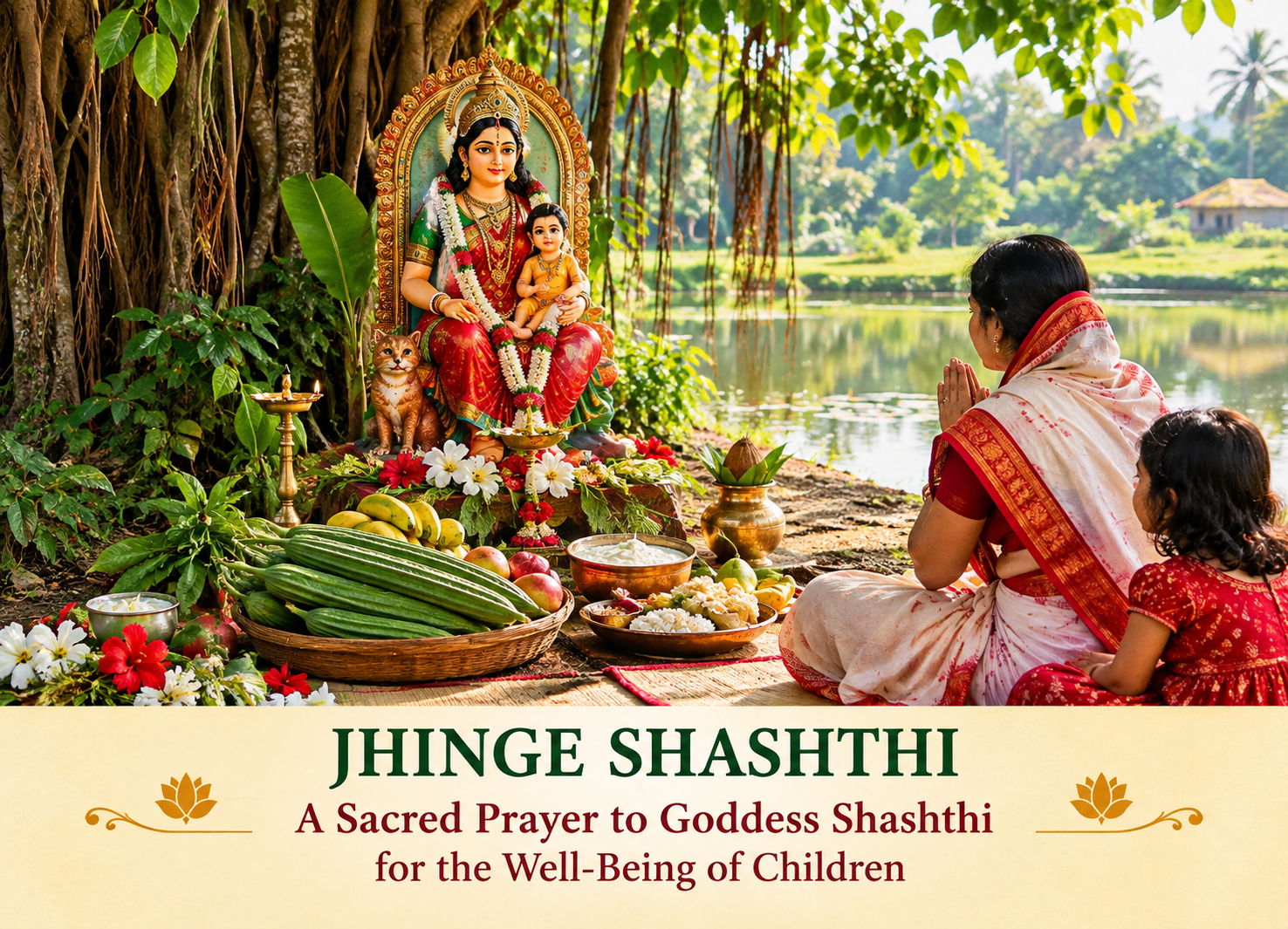
The word Jhinge refers to ridge gourd, an important seasonal vegetable in Bengal. During this observance, ridge gourd may be offered to Goddess Shashthi as a symbolic representation of the well-being and prosperity of the family’s children. In some traditions, the number of ridge gourds offered is associated with the number of children in the family.
The word Chapra is associated with a traditional ritual object or symbolic representation used in some versions of the observance. In certain Bengali traditions, a small symbolic figure made from pithuli or rice-flour material is prepared and incorporated into the ritual. However, customs vary considerably from one locality and family tradition to another.
At its heart, Jhinge Shashthi expresses a simple and deeply emotional prayer: may children remain healthy, safe, prosperous and blessed, and may the family receive the grace of Goddess Shashthi.
What Is Jhinge Shashthi?
Jhinge Shashthi is a traditional Shashthi vrata observed during the bright fortnight of Bhadra. It is primarily associated with mothers praying for the welfare, longevity and protection of their children.
Goddess Shashthi is widely revered in Bengali Hindu tradition as a motherly deity connected with fertility, childbirth and children’s welfare. Shashthi worship is therefore particularly prominent among women who observe different Shashthi vratas for the prosperity and protection of their families.
Unlike large temple festivals involving elaborate public celebrations, many Shashthi observances are intimate household or community traditions. Worship may take place near a pond, beneath a banyan tree, in a household courtyard or at another traditional Shashthi shrine, depending upon local custom. Accounts of Bengali Shashthi worship describe the banyan tree and water bodies as traditional settings for these observances.
Jhinge Shashthi is therefore not merely a festival centred on a particular vegetable. The ridge gourd becomes a symbolic element within a much broader religious tradition concerning motherhood, nourishment, fertility and the protection of children.
Why Is It Called Jhinge Shashthi?
The name Jhinge Shashthi comes from the Bengali word jhinge, meaning ridge gourd.
Ridge gourd is a seasonal crop that is particularly available during the period in which this observance takes place. Bengali folk tradition connects the vegetable with the idea of a child or offspring of the earth. A contemporary account of the observance describes the seasonal ridge gourd as being symbolically regarded as the “child” of the field, creating a parallel between agricultural fertility and human motherhood.
This symbolism is especially meaningful in an agrarian culture. Just as farmers hope that their crops will grow safely and yield a good harvest, parents pray that their children will grow in health, happiness and prosperity.
Thus, the humble ridge gourd takes on a sacred meaning during Jhinge Shashthi.
Why Is It Also Called Chapra Shashthi?
Another popular name is Chapra Shashthi.
The term is connected with traditional Bengali ritual customs associated with the observance. In some communities, a symbolic figure or representation is prepared from pithuli, a rice-flour or rice-based material, and incorporated into the offering. The symbolic figure represents a child within the traditional narrative of the vrata.
Because Bengali religious customs have developed through generations of oral tradition, the precise meaning and form of the word “Chapra” can differ between communities. Therefore, it is better to understand Chapra Shashthi as a regional name associated with Bhadra Shukla Shashthi rather than assuming that every Bengali household follows exactly the same ritual.
Manthan Shashthi and Jhinge Shashthi
Jhinge Shashthi is also referred to as Manthan Shashthi in some Bengali traditions.
Sources describing the Bengali cycle of Shashthi observances identify Bhadra’s Shashthi with names including Jhinge, Chapra and Manthan Shashthi.
The different names illustrate an important feature of Hindu religious culture: a single lunar observance can acquire different names and customs in different regions. The underlying devotional purpose can remain similar even when the food offerings, ritual objects or local stories change.
When Is Jhinge Shashthi Observed?
Jhinge Shashthi is traditionally observed on the Shukla Shashthi of Bhadra, the sixth lunar day of the waxing fortnight in the Bengali month of Bhadra.
The exact Gregorian date changes every year because Hindu festivals are calculated according to the lunar calendar. Therefore, devotees should consult the local Hindu panjika or a reliable regional calendar for the precise tithi.
It is important to distinguish the tithi from a fixed calendar date. A lunar tithi does not necessarily correspond to the same Gregorian date every year, and the beginning and ending of the Shashthi tithi can also vary according to location.
For this reason, an article or calendar listing should always verify the year’s actual tithi before publishing a specific date.
Jhinge Shashthi and the Twelve Monthly Shashthis
Jhinge Shashthi belongs to a broader Bengali tradition of observing different forms of Shashthi during the year.
Traditional lists vary somewhat by region, but a commonly cited Bengali sequence associates different Shashthi names with different months. One documented list gives the following examples:
- Baishakh: Dhula Shashthi or Chandani Shashthi
- Jyaistha: Jamai Shashthi or Aranya Shashthi
- Ashadha: Shankha or Palanka Shashthi
- Shravana: Lunthan or Lotan Shashthi
- Bhadra: Jhinge, Chapra or Manthan Shashthi
- Ashwin: Durga Shashthi or Bodhan Shashthi
- Kartik: Jamdani or Kusha Shashthi
- Agrahayana: Mula Shashthi
- Paush: Patai Shashthi
- Magha: Sheetla Shashthi
- Phalguna: Ashoka Shashthi
- Chaitra: Buri Shashthi or Nil Shashthi.
The exact list and terminology may differ between sources and regional traditions.
This monthly cycle demonstrates how deeply Shashthi worship is embedded in Bengali religious culture.
Who Is Goddess Shashthi?
Goddess Shashthi is a motherly Hindu goddess traditionally associated with children, childbirth, fertility and their protection.
In Bengali devotional tradition, she is often imagined as a compassionate mother who watches over children. Mothers therefore approach her with prayers for their children’s health, long life and welfare.
Her worship is particularly associated with the domestic religious life of Bengali families. Instead of being limited to grand temples, Shashthi worship can take place in courtyards, beside ponds, beneath trees or at local shrines.
The mother-child relationship is central to the devotional feeling surrounding Shashthi. Her worship is therefore not only about asking for blessings but also about expressing the profound concern and affection that parents feel for their children.
The Main Purpose of Jhinge Shashthi
The primary purpose of Jhinge Shashthi is the welfare of children.
Women traditionally observe the vrata with prayers for:
- Children’s health
- Long life
- Protection from harm
- Family prosperity
- Children’s happiness
- Peace within the household
- Protection of the family
- Blessings of motherhood
Traditional accounts describe Shashthi worship as being undertaken especially for children’s welfare, with devotees observing a vrata and listening to the associated vrata-katha before receiving the sacred offerings.
The observance therefore combines devotion, family affection and traditional Bengali folk culture.
The Significance of Ridge Gourd
The most distinctive feature of Jhinge Shashthi is the ridge gourd.
At first glance, offering an ordinary vegetable to a deity may seem unusual. Within the symbolic world of Hindu ritual, however, ordinary objects can acquire sacred meaning.
The ridge gourd represents agricultural fertility and nourishment. A growing vegetable is a product of the earth, water, sunlight and human care. Its growth can therefore be compared symbolically with the growth of a child.
In some Bengali traditions, mothers offer one ridge gourd for each child. A contemporary Bengali account records this practice and explains the symbolic relationship between the seasonal crop and the children of the household.
The practice also reflects the close relationship between Hindu religious customs and nature. The sacred is not always represented through elaborate objects. Sometimes a seasonal fruit, vegetable, leaf or flower becomes an offering precisely because it belongs to everyday life.
Traditional Offerings
The exact offerings used for Jhinge Shashthi vary according to family and locality.
Commonly described ritual elements may include:
- Ridge gourd or jhinge
- Whole seasonal fruits
- Curd
- Rice
- Pulses or soaked legumes
- Vegetables
- Turmeric
- Flowers
- Water
- Sacred thread
- Betel nut or similar ritual items
- Traditional sweets or pitha
Some traditions prepare chapra pitha using ingredients such as pithuli, sugar and grated coconut. Such practices are regional and should not be treated as mandatory rules for every devotee.
The important point is devotional intention rather than the expense or quantity of the offerings.
How Is Jhinge Shashthi Observed?
There is no single universal procedure followed by every Bengali Hindu family. Local traditions are important, and families often follow the method taught by their elders.
A general form of the observance may include the following steps.
1. Preparation
The household is cleaned and the required items for the vrata are gathered.
Women observing the vrata traditionally prepare themselves through bathing and wearing clean clothing. The place of worship is also cleaned.
2. Preparing the Offerings
The ridge gourds and other traditional offerings are arranged according to family custom.
In some traditions, one ridge gourd is associated with each child of the household. Other families may use a different arrangement.
3. Worship of Goddess Shashthi
Goddess Shashthi is invoked with devotion.
Depending on local practice, worship may take place beside a pond, under a banyan tree, at a Shashthi shrine or in another designated place. Traditional descriptions of Bengali Shashthi worship frequently mention water bodies and banyan trees as sacred settings.
4. Offering Flowers and Food
Flowers, fruits, ridge gourd and other traditional offerings are presented to the goddess.
The offerings represent gratitude and the devotee’s prayer for the family’s welfare.
5. Listening to the Vrata-Katha
An important part of the observance is listening to the Jhinge Shashthi or Chapra Shashthi vrata-katha.
The story conveys the moral and spiritual message associated with the vrata. Traditional accounts specifically describe the practice of hearing the vrata-katha before taking the sacred food.
6. Prayer for the Children
The devotee prays for the children’s health, longevity, happiness and protection.
This is perhaps the most meaningful part of the observance because the entire vrata is centred on parental love and concern.
7. Receiving the Prasad
After the worship and traditional observances are completed, the offerings are received as prasad according to family custom.
Fasting practices also vary. Some devotees observe a stricter fast, while others follow a traditional fruit-based or vegetarian diet. Individual family traditions should be respected.
The Traditional Jhinge Shashthi Vrata-Katha
Like many Bengali Shashthi vratas, Jhinge Shashthi is accompanied by a traditional story.
One widely circulated version tells of a wealthy merchant or prosperous householder who had a happy family with sons and grandchildren. Because of his wealth and prosperity, however, pride gradually entered his heart.
He became concerned that his family members had to perform Shashthi worship at another person’s pond. His pride led him to believe that, because he possessed wealth, he should not need to depend on others.
The traditional narrative then describes the consequences of this arrogance and the intervention of Goddess Shashthi.
In one version, the goddess makes the family understand that worldly security and wealth cannot guarantee the safety of children. The story uses the symbolic language of sacrifice and loss to demonstrate the seriousness of arrogance and the importance of humility before the divine.
The family ultimately recognises its mistake and turns again toward the goddess with devotion.
The story is therefore not simply about fear of divine punishment. Its deeper message concerns humility, parental responsibility and the limits of material wealth.
A contemporary Bengali retelling connects the story with the symbolic use of a pithuli figure, representing a child, and the offering of ridge gourd.
As with many Bengali vrata-kathas, versions can differ in details depending upon the community transmitting the story.
Symbolism of the Vrata-Katha
The story associated with Jhinge Shashthi contains several symbolic ideas.
Humility
Wealth and social position cannot protect a family from every difficulty. The story reminds devotees to remain humble.
Parental Love
The emotional centre of the story is the value of a child. The welfare of children is placed above material possessions.
Divine Protection
Goddess Shashthi represents the hope that divine grace will protect children and guide families.
Respect for Nature
The use of a seasonal vegetable as a sacred offering connects religious life with agriculture and nature.
Community Tradition
The observance has traditionally been transmitted through mothers, grandmothers and other family elders. The vrata-katha therefore serves as a way of preserving cultural memory from one generation to another.
Jhinge Shashthi and Bengali Culture
Jhinge Shashthi is an excellent example of the way Bengali Hindu culture combines religion, agriculture, family life and seasonal change.
Bengal has historically been an agricultural region where people’s lives were closely connected with rivers, ponds, fields, rain and seasonal crops. Religious customs naturally absorbed these elements.
The ridge gourd is not a rare or luxurious object. It is a familiar seasonal vegetable. Its presence in the ritual demonstrates how Hindu traditions can transform ordinary aspects of daily life into expressions of devotion.
This also explains why many Bengali vratas are closely connected with particular fruits, vegetables, flowers, trees and seasonal foods.
The Role of Mothers
The observance has a particularly strong association with mothers.
A mother’s prayer for her child’s safety is one of the most universal expressions of parental love. Jhinge Shashthi gives that emotion a traditional religious form.
Through the vrata, the mother expresses her hope that her child will:
- Grow safely
- Remain healthy
- Enjoy a long life
- Be protected from danger
- Receive prosperity
- Lead a righteous and happy life
The ritual therefore has an emotional dimension beyond its formal religious elements.
Jhinge Shashthi and Nature
One of the beautiful aspects of Jhinge Shashthi is its connection with the natural world.
The ritual may involve:
- Seasonal vegetables
- Fresh fruits
- Water from ponds or rivers
- Banyan trees
- Flowers
- Agricultural products
- Natural materials used for symbolic ritual objects
Traditional descriptions of Shashthi worship particularly mention the association with banyan trees and water bodies.
This relationship between nature and worship reflects a broader feature of Hindu culture: plants, rivers, mountains, animals and other elements of the natural world can be approached with reverence.
Is Jhinge Shashthi the Same as Chapra Shashthi?
In many Bengali traditions, yes, the names are used for the same Bhadra Shukla Shashthi observance, along with Manthan Shashthi.
However, it is important to add a qualification.
Hindu festivals and vratas often have strong regional variations. One family may call the observance Jhinge Shashthi, another may call it Chapra Shashthi, while another may use Manthan Shashthi. Their offerings and ritual details may also differ.
Therefore, the safest description is:
Jhinge Shashthi, Chapra Shashthi and Manthan Shashthi are regional names associated with the Bhadra Shukla Shashthi tradition of Goddess Shashthi worship in Bengal.
Sources documenting Bengali Shashthi traditions explicitly group these names under Bhadra’s Shashthi.
Do All Families Offer the Same Number of Jhinge?
No.
Some traditions associate the number of ridge gourds with the number of children in the family. This practice is documented in Bengali descriptions of Jhinge Shashthi.
However, Hindu household rituals often differ by region, family lineage and local custom. Therefore, there should not be an assumption that every family must use exactly the same number or arrangement.
The spiritual significance lies in the offering and prayer rather than in turning a regional custom into a universal rule.
Fasting on Jhinge Shashthi
Fasting is traditionally associated with many Shashthi vratas.
However, fasting practices differ. Some devotees may observe a full fast for part of the day, while others may take fruits or specific vegetarian foods. In some traditions, devotees complete the principal ritual and hear the vrata-katha before taking food.
Traditional Bengali descriptions specifically mention women observing the vrata and receiving the sacred offering after hearing the associated story.
Anyone undertaking a fast should follow their family tradition and consider their own health and circumstances.
Spiritual Meaning of Jhinge Shashthi
The deeper meaning of Jhinge Shashthi can be understood through four ideas: motherhood, protection, humility and gratitude.
Motherhood
The observance honours the emotional bond between mother and child.
Protection
Devotees seek the blessings of Goddess Shashthi for the safety and well-being of children.
Humility
The vrata-katha warns against allowing wealth and pride to become more important than family, compassion and devotion.
Gratitude
Offering seasonal food to the goddess expresses gratitude for nature’s abundance and the nourishment it provides.
Jhinge Shashthi in the Modern World
Modern lifestyles have changed many traditional religious practices. Families may live in cities, far from ancestral villages, ponds or traditional Shashthi shrines.
Nevertheless, Jhinge Shashthi continues to have cultural relevance.
A family living in an apartment may not be able to reproduce every village custom exactly. It can still remember the observance, offer seasonal food, pray to Goddess Shashthi and listen to the traditional story.
The value of a tradition does not necessarily depend on reproducing every external detail. Its values—love for children, gratitude, humility and respect for nature—can remain meaningful even when the setting changes.
Regional Variations Matter
It is worth remembering that Bengali Hindu customs are not completely uniform.
Jhinge Shashthi may be celebrated differently in:
- West Bengal
- Bangladesh
- Different districts of Bengal
- Rural and urban communities
- Different family traditions
- Different caste or community traditions
Even the ingredients, ritual location and vrata-katha may vary.
Therefore, when observing the vrata, devotees can follow the tradition preserved by their family, local priest or community rather than assuming that one internet description represents every household.
A Simple Devotional Understanding
For someone unfamiliar with Jhinge Shashthi, its meaning can be summarised simply:
A mother or devotee remembers Goddess Shashthi, offers traditional seasonal items including ridge gourd according to local custom, listens to the sacred story and prays for the welfare and protection of the children.
The ritual may be elaborate or simple. The central sentiment remains devotion and parental love.
Frequently Asked Questions
What is Jhinge Shashthi?
Jhinge Shashthi is a traditional Bengali Hindu observance dedicated to Goddess Shashthi and associated with the welfare, protection and longevity of children. It is observed on Bhadra Shukla Shashthi.
Why is it called Jhinge Shashthi?
It is called Jhinge Shashthi because ridge gourd, known as jhinge in Bengali, is an important traditional offering associated with the observance.
Is Jhinge Shashthi the same as Chapra Shashthi?
In many Bengali traditions, Jhinge Shashthi and Chapra Shashthi refer to the same Bhadra Shukla Shashthi observance. Manthan Shashthi is another name used in some traditions.
Which goddess is worshipped on Jhinge Shashthi?
Goddess Shashthi is worshipped. She is traditionally associated with childbirth, fertility and the protection and welfare of children.
When is Jhinge Shashthi observed?
It is traditionally observed on the Shukla Shashthi of Bhadra. The Gregorian date changes every year according to the lunar calendar.
What is offered on Jhinge Shashthi?
Ridge gourd, fruits, curd, rice, pulses, vegetables, flowers and other traditional items may be offered. The exact offerings differ according to local and family traditions.
Why is ridge gourd offered to Goddess Shashthi?
Ridge gourd is a seasonal crop and is symbolically connected with fertility, agricultural abundance and the growth of children in Bengali folk tradition.
Is fasting required?
Fasting is traditional, but the exact practice varies between families and communities. Devotees should follow their established tradition and take health considerations into account.
Is there a vrata-katha for Jhinge Shashthi?
Yes. A traditional Jhinge or Chapra Shashthi vrata-katha is associated with the observance. Different versions may vary in details.
Can Jhinge Shashthi be observed at home?
Yes. Shashthi worship has traditionally been practised in domestic and community settings as well as at local shrines. The precise method depends upon family tradition.
Conclusion
Jhinge Shashthi, Chapra Shashthi or Manthan Shashthi is a beautiful example of Bengal’s living Hindu heritage. Observed during Bhadra Shukla Shashthi, the vrata brings together devotion to Goddess Shashthi, parental love, seasonal agriculture and the traditional wisdom of Bengali households.
The humble jhinge, or ridge gourd, becomes more than a vegetable during the observance. It becomes a symbol of growth, nourishment and the preciousness of children. The vrata-katha adds another layer of meaning by reminding devotees that wealth and pride are temporary, while love, humility and family welfare remain deeply valuable.
For generations, mothers and families have turned to Goddess Shashthi with a simple prayer: may the children of the household remain safe, healthy, happy and blessed.
That prayer gives Jhinge Shashthi its enduring significance.
Whether celebrated beneath a traditional banyan tree beside a village pond or remembered within a modern urban home, the essence of the observance remains the same—faith in divine protection, gratitude for nature’s gifts, and a parent’s heartfelt wish for the well-being of the next generation.
*Related Articles: 1. Ashoka Shashthi Vrat: A Sacred Ritual in Bengal
2. Aranya Shashthi: The Festival of Nature and Fertility