Bhagavad Gita Chapter 13: Kshetra Kshetrajna Yoga
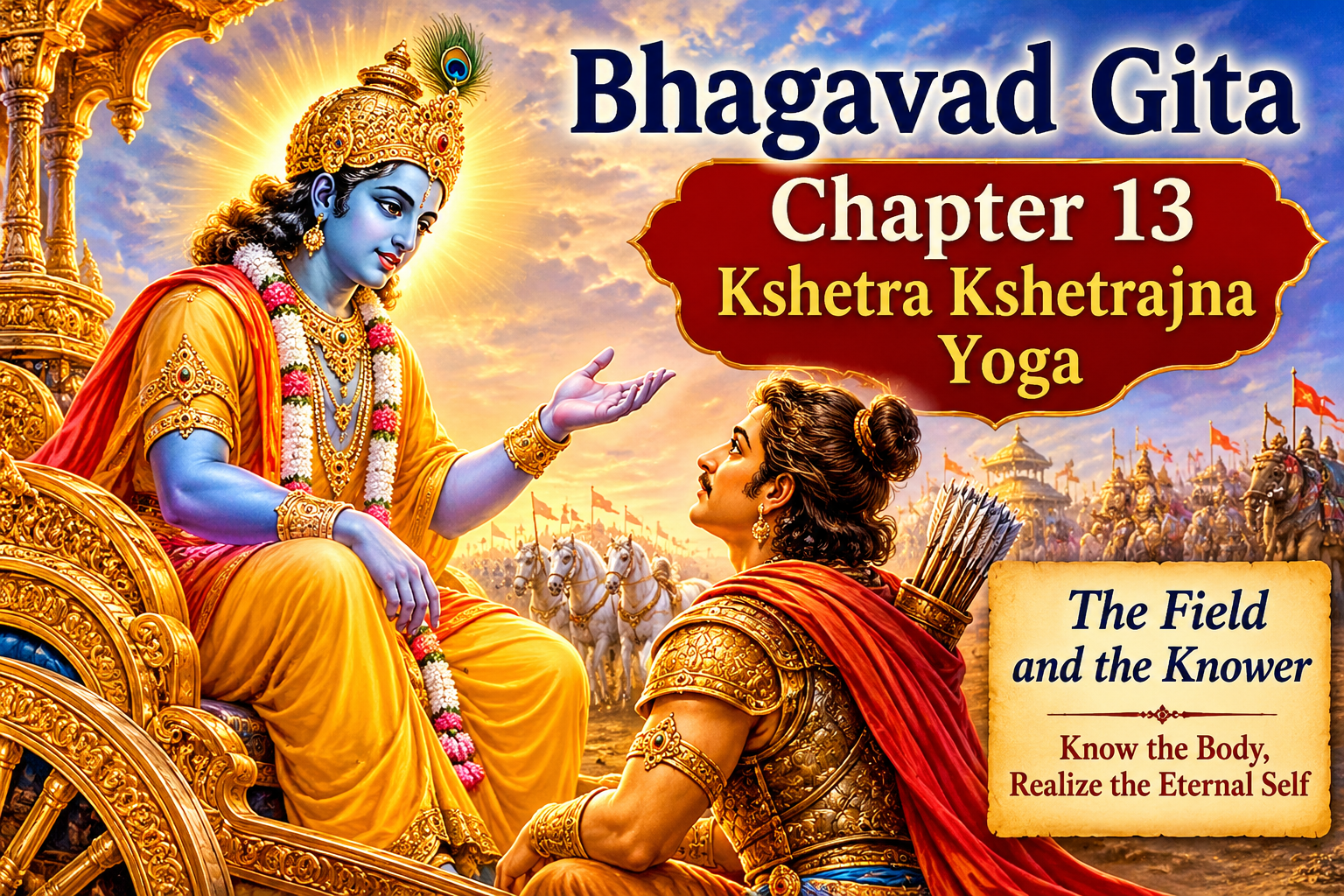
The Bhagavad Gita is a sacred dialogue between Lord Krishna and Arjuna, set on the battlefield of Kurukshetra. In Chapter 13, Arjuna asks Krishna to explain several essential philosophical concepts: Prakriti, Purusha, Kshetra, Kshetrajna, knowledge and the object of knowledge.
Krishna responds by explaining that the body is called the Kshetra, or field, while the conscious principle that knows the body is the Kshetrajna, or knower of the field. He further declares that He is the supreme Knower present in all fields.
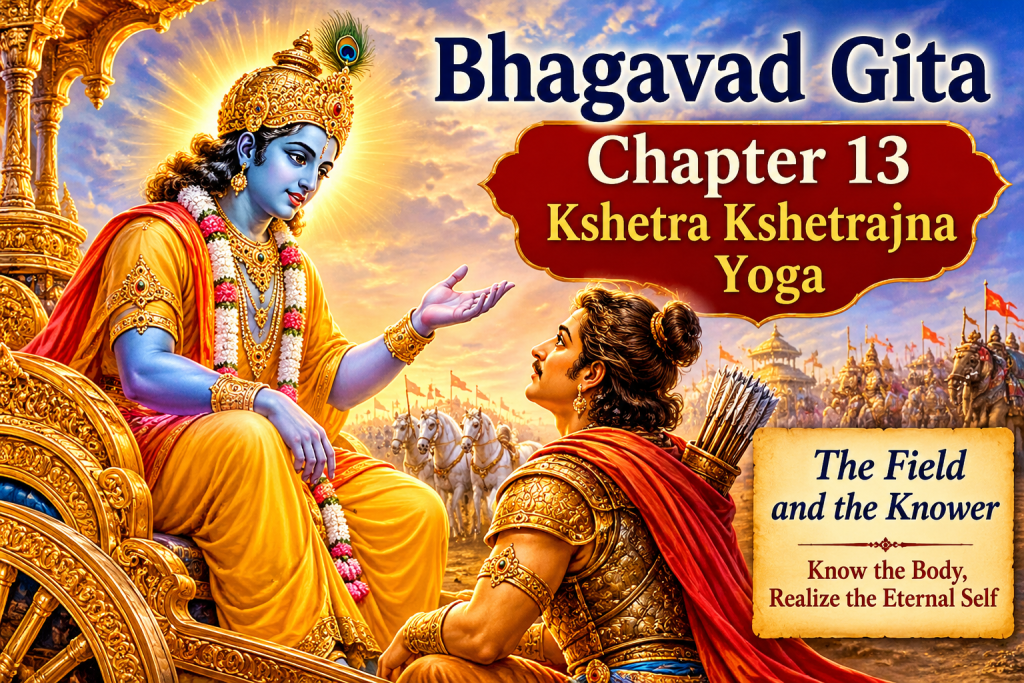
This teaching encourages a person to look beyond physical identity. The body changes from childhood to youth and old age, but the conscious self is the witness of these changes. Spiritual wisdom begins when we understand that the body, mind and senses are instruments of experience rather than the complete identity of the self.
The chapter also teaches that knowledge is not merely the accumulation of information. Humility, non-violence, patience, self-control, detachment and devotion are themselves expressions of genuine knowledge.
By understanding the field and its knower, a person can recognize the difference between temporary material nature and eternal spiritual reality.
All 35 Slokas with English Meaning and Explanation
Chapter title: Kṣetra Kṣetrajña Vibhāga Yoga
Sanskrit title: क्षेत्रक्षेत्रज्ञविभागयोग
The following verses are presented in English transliteration using the IAST system, followed by a clear English meaning and a brief explanation. The chapter is commonly presented as 35 verses when Arjuna’s opening question is included. Some editions number the opening question differently, resulting in a 34-verse count. Shri Bhagavad Gita+1
Verse 1: Arjuna asks about nature and the soul
Sloka (English transliteration)
arjuna uvāca
prakṛtiṃ puruṣaṃ caiva kṣetraṃ kṣetrajñam eva ca
etad veditum icchāmi jñānaṃ jñeyaṃ ca keśava
Meaning: Arjuna said: O Keshava, I wish to understand Prakriti (nature), Purusha (the conscious spirit), the field, the knower of the field, knowledge and that which is to be known.
Explanation: Arjuna begins by asking about the fundamental realities of existence. He wants to understand the difference between the material world and the conscious self, and how spiritual knowledge leads to the ultimate truth.
Verse 2: The body is the field
Sloka
śrībhagavān uvāca
idaṃ śarīraṃ kaunteya kṣetram ity abhidhīyate
etad yo vetti taṃ prāhuḥ kṣetrajña iti tadvidaḥ
Meaning: The Supreme Lord said: O son of Kunti, this body is called the field, and the one who knows this body is called the knower of the field by those who understand the truth.
Explanation: The body is compared to a field because it is the place where experiences, actions and their consequences take place. The conscious self observes the body and its changing conditions.
Verse 3: Krishna is the supreme knower
Sloka
kṣetrajñaṃ cāpi māṃ viddhi sarvakṣetreṣu bhārata
kṣetrakṣetrajñayor jñānaṃ yat taj jñānaṃ mataṃ mama
Meaning: O Bharata, know Me also as the Knower of the field in all fields. In My opinion, understanding the field and its knower is true knowledge.
Explanation: Krishna reveals that the Supreme Being is present as the universal Knower in all living beings. This verse connects individual consciousness with divine omnipresence and establishes the spiritual foundation of the chapter.
Verse 4: The nature of the field
Sloka
t tat kṣetraṃ yac ca yādṛk ca yad vikāri yataś ca yat
sa ca yo yat prabhāvaś ca tat samāsena me śṛṇu
Meaning: Hear from Me briefly what the field is, what its nature is, how it changes, from what it arises, who the knower is and what His powers are.
Explanation: Krishna promises a systematic explanation of the body, its components, its transformations and the conscious principle within it. Spiritual inquiry requires understanding both the changing world and the reality that knows it.
Verse 5: The truth described by sages
Sloka
ṛṣibhir bahudhā gītaṃ chandobhir vividhaiḥ pṛthak
brahmasūtrapadaiś caiva hetumadbhir viniścitaiḥ
Meaning: This truth has been described in many ways by sages, through various Vedic hymns and through the reasoned, conclusive teachings of the Brahma Sutras.
Explanation: Krishna explains that the distinction between matter and spirit is not an isolated idea. It is supported by the wisdom of sages, sacred texts and philosophical reasoning.
Verse 6: The fundamental elements of the field
Sloka
mahābhūtāny ahaṅkāro buddhir avyaktam eva ca
indriyāṇi daśaikaṃ ca pañca cendriyagocarāḥ
Meaning: The great elements, ego, intellect, the unmanifest, the eleven senses and the five objects of the senses are the components of the field.
Explanation: The field includes not only the physical body but also the subtle aspects of material existence. The five great elements are earth, water, fire, air and space; the eleven senses include the five organs of perception, five organs of action and the mind.
Verse 7: The field and its modifications
Sloka
icchā dveṣaḥ sukhaṃ duḥkhaṃ saṅghātaś cetanā dhṛtiḥ
etat kṣetraṃ samāsena sa-vikāram udāhṛtam
Meaning: Desire, aversion, pleasure, pain, the bodily aggregate, awareness and firmness—these, together with their modifications, are briefly described as the field.
Explanation: Human experience includes emotions, sensations, mental tendencies and bodily conditions. These are part of the field because they change and can be observed; they are not the unchanging spiritual self.
Verse 8: Humility and non-violence
Sloka
amānitvam adambhitvam ahiṃsā kṣāntir ārjavam
ācāryopāsanaṃ śaucaṃ sthairyam ātmavinigrahaḥ
Meaning: Humility, freedom from hypocrisy, non-violence, patience, straightforwardness, service to the teacher, purity, steadfastness and self-control are qualities of knowledge.
Explanation: Krishna begins describing the qualities that make a person truly wise. Knowledge is not merely intellectual achievement; it is reflected in character, conduct and the ability to control one’s ego.
Verse 9: Detachment from sense pleasures
Sloka
indriyārtheṣu vairāgyam anahaṅkāra eva ca
janma-mṛtyu-jarā-vyādhi-duḥkha-doṣānudarśanam
Meaning: Detachment from sense objects, freedom from ego and seeing the suffering inherent in birth, death, old age and disease are qualities of knowledge.
Explanation: A wise person understands that worldly pleasures are temporary and that embodied life involves inevitable change. This awareness encourages spiritual seriousness rather than despair.
Verse 10: Freedom from possessive attachment
Sloka
asaktir anabhiṣvaṅgaḥ putra-dāra-gṛhādiṣu
nityaṃ ca sama-cittatvam iṣṭāniṣṭopapattiṣu
Meaning: Non-attachment and freedom from possessive clinging to children, spouse and home, together with an even mind in favourable and unfavourable circumstances, are qualities of knowledge.
Explanation: Krishna does not teach neglect of family responsibilities. He teaches that love should not become possessiveness and that inner stability should not depend entirely on external events.
Verse 11: Steadfast devotion
Sloka
mayi cānanya-yogena bhaktir avyabhicāriṇī
vivikta-deśa-sevitvam aratir jana-saṃsadi
Meaning: Unwavering devotion to Me through exclusive yoga, a preference for quiet places and a lack of attraction to worldly crowds are qualities of knowledge.
Explanation: Devotion helps direct the mind toward the Supreme Being. Solitude is valued because it provides an opportunity for reflection, meditation and freedom from unnecessary distractions.
Verse 12: The purpose of spiritual knowledge
Sloka
adhyātma-jñāna-nityatvaṃ tattva-jñānārtha-darśanam
etaj jñānam iti proktam ajñānaṃ yad ato ‘nyathā
Meaning: Constant dedication to spiritual knowledge and insight into the purpose of truth are declared to be knowledge. Whatever is contrary to this is ignorance.
Explanation: Krishna defines knowledge as a way of life that continually seeks the truth of the self. Information that strengthens pride, attachment and confusion does not lead to spiritual wisdom.
Verse 13: The Supreme Reality to be known
Sloka
jñeyaṃ yat tat pravakṣyāmi yaj jñātvāmṛtam aśnute
anādimat paraṃ brahma na sat tan nāsad ucyate
Meaning: I shall explain that which is to be known, knowing which one attains immortality. It is the beginningless Supreme Brahman, which is said to be neither being nor non-being in the ordinary sense.
Explanation: Krishna introduces the nature of the ultimate reality. Brahman cannot be fully described through ordinary categories because it transcends the limited distinctions of material existence.
Verse 14: The Supreme Being is everywhere
Sloka
sarvataḥ pāṇipādaṃ tat sarvato ‘kṣiśiromukham
sarvataḥ śrutimal loke sarvam āvṛtya tiṣṭhati
Meaning: That Supreme Reality has hands and feet everywhere, eyes, heads and faces everywhere, and ears everywhere. It pervades the entire universe.
Explanation: The verse describes the all-pervading nature of the Supreme Being. Divine presence is not confined to one body, place or form; it sustains and encompasses all existence.
Verse 15: Beyond the senses, yet their source
Sloka
sarvendriya-guṇābhāsaṃ sarvendriya-vivarjitam
asaktaṃ sarvabhṛc caiva nirguṇaṃ guṇa-bhoktṛ ca
Meaning: The Supreme shines through the functions of all senses, yet is beyond all senses. It is unattached, sustains everything, is beyond the material qualities and yet is the experiencer of those qualities.
Explanation: The Supreme Being enables perception and experience without being limited by the senses. This verse expresses the paradox of divine transcendence and immanence: God is beyond the world and present within it.
Verse 16: Within and beyond all beings
Sloka
bahir antaś ca bhūtānām acaraṃ caram eva ca
sūkṣmatvāt tad avijñeyaṃ dūrasthaṃ cāntike ca tat
Meaning: The Supreme is outside and inside all beings, moving and unmoving. Because of its subtlety, it is difficult to know; it is far away and yet very near.
Explanation: The Divine is present within the heart of every being and also transcends the entire universe. Its subtle nature cannot be grasped by physical senses alone, but it can be approached through spiritual insight.
Verse 17: The undivided reality
Sloka
avibhaktaṃ ca bhūteṣu vibhaktam iva ca sthitam
bhūta-bhartṛ ca taj jñeyaṃ grasiṣṇu prabhaviṣṇu ca
Meaning: Though undivided, the Supreme appears to exist separately in all beings. It is the sustainer of all, and it is also the source of creation and dissolution.
Explanation: The one Supreme Reality appears in countless forms without losing its unity. The diversity of living beings does not mean that the underlying spiritual reality is fragmented.
Verse 18: The light beyond darkness
Sloka
jyotiṣām api taj jyotis tamasaḥ param ucyate
jñānaṃ jñeyaṃ jñānagamyaṃ hṛdi sarvasya viṣṭhitam
Meaning: The Supreme is the light of all lights and is beyond darkness. It is knowledge, the object of knowledge and that which is reached through knowledge; it dwells in the heart of everyone.
Explanation: The light of the sun illuminates the physical world, but spiritual consciousness illuminates the experience of existence itself. Krishna teaches that the Supreme is the inner source of awareness and wisdom.
Verse 19: A summary of the teaching
Sloka
iti kṣetraṃ tathā jñānaṃ jñeyaṃ coktaṃ samāsataḥ
mad-bhakta etad vijñāya mad-bhāvāyopapadyate
Meaning: Thus the field, knowledge and the object of knowledge have been briefly explained. My devotee, understanding this, becomes fit to attain My nature.
Explanation: Krishna brings together the central ideas of the chapter. Understanding the body, cultivating spiritual knowledge and realizing the Supreme Reality prepare a devotee for liberation.
Verse 20: Nature and spirit are beginningless
Sloka
prakṛtiṃ puruṣaṃ caiva viddhy anādī ubhāv api
vikārāṃś ca guṇāṃś caiva viddhi prakṛti-sambhavān
Meaning: Know that both Prakriti and Purusha are beginningless. The modifications and the qualities of material nature arise from Prakriti.
Explanation: Prakriti is the material principle, while Purusha is the conscious principle. The changing forms and qualities of the material world arise through nature, whereas consciousness is distinct from those changes.
Verse 21: Nature causes material action
Sloka
kārya-kāraṇa-kartṛtve hetuḥ prakṛtir ucyate
puruṣaḥ sukha-duḥkhānāṃ bhoktṛtve hetur ucyate
Meaning: Prakriti is said to be the cause of the body, its instruments and actions. Purusha is said to be the cause of experiencing pleasure and pain.
Explanation: The body and senses function through material nature, while the conscious self experiences the results of embodied life. This distinction helps explain how the self becomes associated with material experience.
Verse 22: The soul experiences nature’s qualities
Sloka
puruṣaḥ prakṛti-stho hi bhuṅkte prakṛti-jān guṇān
kāraṇaṃ guṇa-saṅgo ‘sya sad-asad-yoni-janmasu
Meaning: The Purusha, situated in Prakriti, experiences the qualities born of nature. Attachment to these qualities becomes the cause of birth in favourable and unfavourable forms.
Explanation: When consciousness identifies with material qualities and desires, it becomes bound to the cycle of birth and death. Attachment, rather than the mere presence of the body, is the central cause of bondage.
Verse 23: The Supreme within the body
Sloka
upadraṣṭānumantā ca bhartā bhoktā maheśvaraḥ
paramātmeti cāpy ukto dehe ‘smin puruṣaḥ paraḥ
Meaning: The Supreme Person within the body is the witness, the permitter, the sustainer, the experiencer and the great Lord. He is also called the Paramatma, the Supreme Self.
Explanation: Krishna distinguishes the individual conscious self from the Supreme Self, who witnesses and sustains all existence. The Paramatma is not merely a passive observer but the divine presence supporting life.
Verse 24: Knowing Purusha and Prakriti
Sloka
ya evaṃ vetti puruṣaṃ prakṛtiṃ ca guṇaiḥ saha
sarvathā vartamāno ‘pi na sa bhūyo ‘bhijāyate
Meaning: One who truly understands Purusha, Prakriti and the qualities of nature is not born again, regardless of how that person lives.
Explanation: Spiritual realization frees a person from ignorance and attachment. Such a person may continue performing worldly duties, but no longer identifies the self with material nature alone.
Verse 25: Realization through meditation
Sloka
dhyānenātmani paśyanti kecid ātmānam ātmanā
anye sāṃkhyena yogena karma-yogena cāpare
Meaning: Some perceive the self within themselves through meditation; others through the path of knowledge, and still others through the yoga of action.
Explanation: Krishna acknowledges different spiritual paths. Meditation, philosophical discernment and selfless action can all help a sincere seeker realize the nature of the self.
Verse 26: Realization through hearing and devotion
Sloka
anye tv evam ajānantaḥ śrutvānyebhya upāsate
te ‘pi cātitaranty eva mṛtyuṃ śruti-parāyaṇāḥ
Meaning: Others, not knowing these paths directly, worship after hearing from those who know. They too cross beyond death by faithfully following what they have heard.
Explanation: Not everyone begins with philosophical understanding or meditative experience. Sincere listening to spiritual teachings and following them with faith can also lead toward liberation.
Verse 27: The Divine in every living being
Sloka
yāvat sañjāyate kiñcit sattvaṃ sthāvara-jaṅgamam
kṣetra-kṣetrajña-saṃyogāt tad viddhi bharatarṣabha
Meaning: O best of the Bharatas, whatever being is born, whether moving or unmoving, arises through the union of the field and the knower of the field.
Explanation: All embodied life involves the relationship between material nature and consciousness. The body provides the field of experience, while the conscious principle makes experience possible.
Verse 28: The Supreme Lord dwells equally in all
Sloka
samaṃ sarveṣu bhūteṣu tiṣṭhantaṃ parameśvaram
vinaśyatsv avinaśyantaṃ yaḥ paśyati sa paśyati
Meaning: One who sees the Supreme Lord equally present in all beings, and sees the imperishable within the perishing, truly sees.
Explanation: True vision means recognizing the divine presence in every living being. Although bodies perish, the spiritual reality is not destroyed with them.
Verse 29: Equal vision leads to liberation
Sloka
samaṃ paśyan hi sarvatra samavasthitam īśvaram
na hinasty ātmanātmānaṃ tato yāti parāṃ gatim
Meaning: One who sees the Lord equally present everywhere does not harm the self through the self, and therefore reaches the supreme destination.
Explanation: Equal vision naturally inspires compassion, respect and non-violence. When a person recognizes the same divine presence in all beings, selfishness and harmful conduct begin to diminish.
Verse 30: Nature performs all actions
Sloka
prakṛtyaiva ca karmāṇi kriyamāṇāni sarvaśaḥ
yaḥ paśyati tathātmānam akartāraṃ sa paśyati
Meaning: One who sees that all actions are performed by Prakriti and that the self is not the material doer truly sees.
Explanation: The body, senses and mind operate through the qualities of nature. Spiritual wisdom helps a person understand that the eternal self is distinct from the changing mechanisms of material action.
This teaching does not encourage irresponsibility. It helps remove egoistic pride and the mistaken belief that the individual is the sole independent cause of everything.
Verse 31: Unity behind diversity
Sloka
yadā bhūta-pṛthag-bhāvam eka-stham anupaśyati
tata eva ca vistāraṃ brahma sampadyate tadā
Meaning: When one sees the diverse existence of beings as resting in the One and expanding from That alone, one attains Brahman.
Explanation: The world appears filled with separate beings, forms and identities. Yet spiritual insight reveals their common foundation in the Supreme Reality.
This realization does not necessarily mean that all individual differences disappear at the worldly level. Rather, it means that the seeker understands the deeper unity that supports all existence.
Verse 32: The eternal and unchanging Supreme Self
Sloka
anāditvān nirguṇatvāt paramātmāyam avyayaḥ
śarīrastho ‘pi kaunteya na karoti na lipyate
Meaning: Because the Supreme Self is beginningless and beyond the material qualities, it is imperishable. Although present in the body, O son of Kunti, it neither acts materially nor becomes tainted.
Explanation: The Supreme Self is not limited by the body in which it is present. Just as a witness can observe an event without becoming the event itself, the spiritual reality remains beyond material transformations.
Verse 33: The self is like space
Sloka
yathā sarvagataṃ saukṣmyād ākāśaṃ nopalipyate
sarvatra-vasthito dehe tathātmā nopalipyate
Meaning: Just as space, being subtle and all-pervading, is not tainted, the self, though present throughout the body, is not tainted.
Explanation: Space accommodates many objects but does not become permanently stained by them. Similarly, the self remains spiritually distinct from the body’s experiences, actions and changes.
The analogy encourages us to observe thoughts and emotions without allowing them to define our deepest identity.
Verse 34: The sun illuminates the world
Sloka
yathā prakāśayaty ekaḥ kṛtsnaṃ lokam imaṃ raviḥ
kṣetraṃ kṣetrī tathā kṛtsnaṃ prakāśayati bhārata
Meaning: Just as one sun illuminates the entire world, the knower of the field illuminates the whole field, O Bharata.
Explanation: Consciousness makes the body and mind’s experiences known, just as sunlight makes objects visible. Without awareness, the field of experience would not be known as experience.
The verse emphasizes the essential role of consciousness in understanding the body, mind and world.
Verse 35: The vision that leads to the Supreme
Sloka
kṣetra-kṣetrajñayor evam antaraṃ jñāna-cakṣuṣā
bhūta-prakṛti-mokṣaṃ ca ye vidur yānti te param
Meaning: Those who understand, through the eyes of knowledge, the distinction between the field and the knower of the field, and the freedom from the bondage of material nature, attain the Supreme.
Explanation: Krishna concludes the chapter by emphasizing spiritual discernment. When a person understands the body as the field, the self as the knower and the Supreme as the ultimate reality, the path to liberation becomes clear.
Summary of Bhagavad Gita Chapter 13
Chapter 13 teaches that the human body is not the whole of our identity. The body, senses, mind, intellect, emotions and material surroundings form the field of experience. The conscious self is the knower of that field.
Krishna further reveals that the Supreme Being is the universal Knower present in all fields. This teaching invites the seeker to recognize the divine presence in every living being and to cultivate equal vision.
The chapter’s definition of knowledge is especially important. True wisdom includes humility, non-violence, patience, self-control, detachment, devotion and a constant desire to understand the spiritual self.
The chapter also explains that Prakriti and Purusha are beginningless principles. Material nature produces the body and its activities, while the conscious self experiences the qualities of nature. Attachment to these qualities creates bondage, whereas spiritual realization brings freedom.
The final verses emphasize that the Supreme Self remains untainted by material changes, just as space remains untouched by the objects it accommodates and sunlight illuminates the world without becoming the objects it reveals.
Important teachings of Chapter 13
- The body is the field: It is the place where actions, experiences and changes occur.
- The soul is the knower: The conscious self observes the body and its experiences.
- The Supreme is the universal Knower: Divine consciousness is present in all beings.
- Knowledge is a way of life: Humility, patience, non-violence and self-control are essential qualities of wisdom.
- Prakriti and Purusha are distinct: Material nature changes, while consciousness is the principle that knows those changes.
- Equal vision is spiritual wisdom: Seeing the divine presence in all beings encourages compassion and respect.
- Liberation comes through discernment: Understanding the field, the knower and the Supreme helps a person transcend material bondage.
The spiritual significance of Kshetra and Kshetrajna
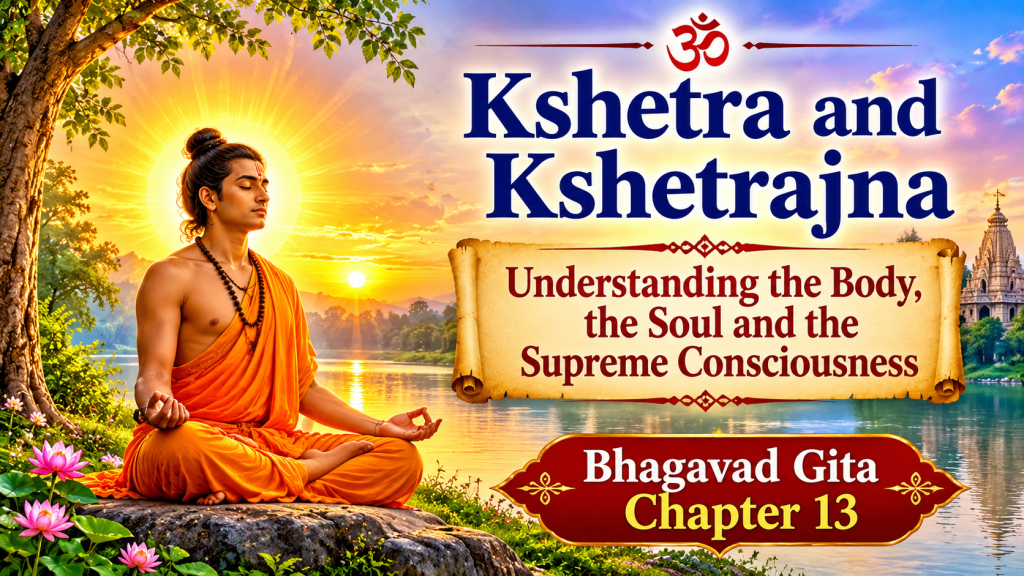
The relationship between Kshetra and Kshetrajna is central to the philosophy of the Bhagavad Gita. The word Kshetra literally means a field. In this chapter, it refers to the body and the wider structure of material experience.
The word Kshetrajna means the knower of the field. It refers to the conscious principle that experiences and observes the body.
A person ordinarily identifies with physical appearance, social position, possessions, emotions and thoughts. Krishna asks the seeker to examine this identification carefully. The body changes, thoughts arise and disappear, and emotions fluctuate. Yet there is an awareness that knows these changes.
This distinction is the beginning of self-knowledge.
The chapter also makes an important theological statement: Krishna is the supreme Knower in all fields. The individual self knows its own embodied experience, while the Supreme Being is the universal consciousness and divine presence sustaining all beings.
Different Hindu philosophical traditions explain the precise relationship between the individual soul and the Supreme Self in different ways. Nevertheless, the chapter’s central message is clear: spiritual wisdom requires understanding the distinction between material nature, individual consciousness and the Supreme Reality.
Conclusion
Bhagavad Gita Chapter 13, Kshetra Kshetrajna Vibhaga Yoga, offers a deep explanation of the body, the soul and the Supreme Being. It teaches that the physical body is a temporary field of experience, while the conscious self is the knower of that field.
The chapter encourages us to develop humility, compassion, self-control, devotion and spiritual discernment. It reminds us that the same divine presence exists in all beings and that true knowledge is expressed through equal vision and freedom from harmful attachment.
The ultimate message of Chapter 13 is that we should learn to see beyond the changing body and recognize the eternal spiritual reality within and beyond all existence. Through this understanding, a person can move beyond ignorance, overcome attachment and approach the supreme goal of liberation.
Published on 28 November, 2026