Why Do Hindus Believe in Rebirth? Spiritual and Scientific Explanations
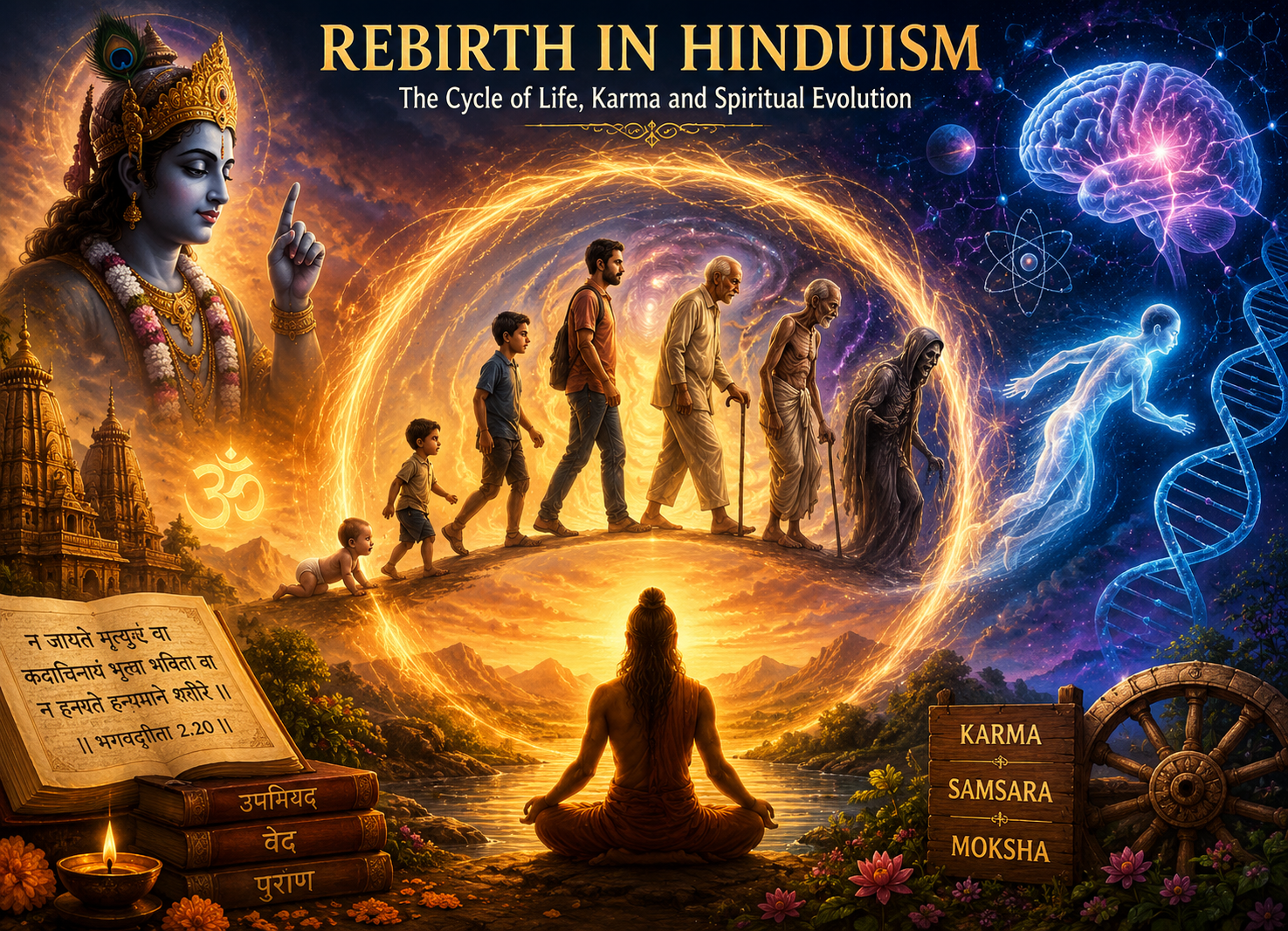
The idea of rebirth, also known as reincarnation, is one of the oldest and most influential beliefs in Hindu philosophy. For thousands of years, Hindus have believed that life does not end with death. Instead, the soul continues its journey by taking birth again in another body. This cycle of birth, death, and rebirth is called Samsara. According to Hindu teachings, every action performed in life influences future births through the law of karma.
To many people outside Hinduism, rebirth may appear to be only a religious belief. However, within Hindu philosophy, reincarnation is not merely mythology or blind faith. It is connected to ethics, consciousness, psychology, metaphysics, and the nature of existence itself. Modern scientific discussions about memory, consciousness, near-death experiences, and unexplained childhood memories have also reopened global curiosity about rebirth.
Understanding why Hindus believe in rebirth requires examining both spiritual teachings and scientific perspectives.
The Hindu Concept of the Soul
At the center of Hindu belief is the concept of the Atman, or soul. Hindu scriptures describe the soul as eternal, indestructible, and beyond physical death. The body changes, ages, and dies, but the soul continues to exist.
The Bhagavad Gita, one of Hinduism’s most important texts, explains this idea clearly. It compares the soul changing bodies to a person changing clothes. Just as old clothes are discarded and replaced with new ones, the soul leaves an old body and enters a new one.
According to Hindu philosophy:
- The body is temporary.
- The soul is eternal.
- Death is only a transition.
- Rebirth continues until spiritual liberation is achieved.
This belief forms the foundation of the Hindu understanding of life and existence.
Samsara: The Cycle of Birth and Death
Hindus believe that every living being moves through an endless cycle called Samsara. This cycle includes:
- Birth
- Life
- Death
- Rebirth
The soul repeatedly takes different forms of life based on past actions and spiritual development. Rebirth is not viewed as random. It follows moral and cosmic laws.
A person may be reborn into different conditions depending on their accumulated karma. Good actions may lead to favorable circumstances, while harmful actions may result in suffering or difficult experiences in future lives.
The ultimate goal in Hinduism is to escape this cycle entirely and achieve Moksha, or liberation. Moksha represents freedom from rebirth and union with the divine reality.
Karma and Rebirth
The doctrine of karma is deeply connected to reincarnation. Karma literally means “action,” but in Hindu philosophy it refers to the moral consequences of actions, thoughts, and intentions.
Every action creates an effect. These effects may appear immediately or later, even in future lifetimes.
Hindus believe:
- Positive actions create beneficial karma.
- Harmful actions create negative karma.
- Karma influences future experiences and rebirths.
This concept provides a moral explanation for inequalities in life. Questions such as why one person is born wealthy while another suffers extreme hardship are interpreted through the lens of karma accumulated over many lives.
Unlike the idea of eternal punishment or reward after one lifetime, Hinduism presents existence as a continuous process of learning and spiritual evolution.
Spiritual Explanation for Rebirth
From a spiritual perspective, rebirth exists because the soul has not yet completed its journey toward enlightenment.
Human life is viewed as a school for spiritual growth. Each birth provides opportunities to:
- Learn lessons
- Correct past mistakes
- Develop wisdom
- Reduce attachment
- Move closer to liberation
Desires and attachments are believed to bind the soul to material existence. As long as the soul remains attached to worldly pleasures, ego, anger, greed, or ignorance, rebirth continues.
Different Hindu traditions explain this process in slightly different ways, but the central idea remains consistent: the soul evolves gradually across many lifetimes.
Some spiritual teachers describe reincarnation as necessary because one lifetime is too short for complete spiritual development. Talents, fears, attractions, and deep emotional tendencies may carry forward from previous births.
This belief also encourages ethical living. Since actions influence future births, individuals are encouraged to live responsibly and compassionately.
Ancient Hindu Scriptures Supporting Rebirth
Belief in rebirth is strongly rooted in Hindu scriptures.
Bhagavad Gita
The Bhagavad Gita repeatedly describes the eternal nature of the soul. It states that weapons cannot cut the soul, fire cannot burn it, and death cannot destroy it.
The text explains that the soul repeatedly takes new bodies until liberation is achieved.
Upanishads
The Upanishads, philosophical texts within Hinduism, discuss rebirth extensively. They explain that individuals become what their desires and actions shape them to be.
The Brihadaranyaka Upanishad and Chandogya Upanishad both contain teachings about karma and reincarnation.
Garuda Purana
This text discusses what happens after death, the journey of the soul, and how karma influences future births.
These scriptures form the philosophical backbone of Hindu beliefs regarding rebirth.
Scientific Perspectives on Rebirth
Modern science has traditionally been skeptical about reincarnation because rebirth cannot be directly measured or experimentally verified in conventional ways. However, certain fields have explored phenomena that some people interpret as evidence supporting reincarnation.
While science has not officially proven rebirth, several areas continue to generate debate.
Childhood Past-Life Memories
One of the most discussed scientific investigations into reincarnation involves children who claim to remember previous lives.
Psychiatrist Dr. Ian Stevenson from the University of Virginia spent decades studying thousands of such cases worldwide. Many children reportedly described:
- Names of previous families
- Locations they had never visited
- Details of deaths
- Languages or habits unknown to them
Some cases included birthmarks corresponding to injuries from alleged previous lives.
Stevenson documented these reports carefully and avoided sensational conclusions. His work remains controversial but influential in discussions about reincarnation.
Later researchers, including Dr. Jim Tucker, continued similar studies.
Skeptics argue that these memories may result from suggestion, coincidence, false memories, or cultural influence. Supporters believe some cases are difficult to explain through ordinary means.
Near-Death Experiences
Near-death experiences (NDEs) have also contributed to discussions about consciousness beyond physical death.
People who experienced clinical death or severe trauma sometimes report:
- Leaving the body
- Observing surroundings externally
- Seeing light or spiritual beings
- Reviewing their life experiences
Some researchers interpret these experiences as evidence that consciousness may exist independently from the brain.
Although NDEs do not directly prove rebirth, they challenge purely materialistic explanations of consciousness.
Consciousness and Modern Science
The biggest scientific challenge related to rebirth involves consciousness itself.
Modern neuroscience generally views consciousness as a product of brain activity. Hindu philosophy, however, considers consciousness fundamental and independent of the body.
Interestingly, some scientists and philosophers now question whether consciousness can be fully explained through physical processes alone.
Fields such as quantum consciousness, cognitive science, and philosophy of mind continue exploring unresolved questions, including:
- What creates subjective awareness?
- Can consciousness survive death?
- Is memory entirely brain-dependent?
No scientific consensus currently supports reincarnation, but the topic remains open to philosophical and interdisciplinary debate.
Psychological Interpretation of Rebirth
Some modern thinkers interpret rebirth symbolically rather than literally.
According to this view:
- Rebirth represents psychological transformation.
- Karma reflects behavioral consequences.
- Samsara symbolizes repetitive emotional patterns.
In psychology, people often repeat cycles of suffering, attachment, and emotional conditioning throughout life. Some scholars compare this to the Hindu idea of repeated births driven by unresolved desires.
Carl Jung and other depth psychologists showed interest in Eastern philosophies because they addressed unconscious patterns and spiritual development.
Even when interpreted symbolically, reincarnation continues to provide meaning and ethical structure for millions of people.
Why Rebirth Remains Important in Hindu Society
Belief in reincarnation influences many aspects of Hindu culture and daily life.
Moral Responsibility
Karma encourages accountability. Actions are believed to have unavoidable consequences, whether immediate or delayed.
Acceptance of Life Circumstances
Many Hindus interpret suffering and success within the broader framework of multiple lifetimes. This can create patience, resilience, and spiritual reflection.
Respect for All Living Beings
Since souls may be reborn in different forms, Hinduism often promotes nonviolence and compassion toward animals and nature.
Focus on Spiritual Growth
Material success is considered temporary. Spiritual progress is viewed as more important than short-term achievements.
Criticism and Skepticism
Rebirth is not universally accepted, even among scientists, philosophers, or religious groups.
Critics argue:
- There is no conclusive scientific proof.
- Past-life memories may be fabricated or influenced by culture.
- Reincarnation theories often lack testable mechanisms.
Some also criticize karma-based interpretations for potentially justifying social inequality or discouraging action against suffering.
Despite criticism, reincarnation remains one of the most enduring spiritual ideas in human history.
Comparison with Other Religions
Hinduism is not alone in believing in rebirth.
Buddhism
Buddhism also teaches rebirth, though it rejects the idea of a permanent soul. Instead, consciousness continues through causal continuity.
Jainism
Jainism strongly emphasizes reincarnation and karma. Liberation from rebirth is a central spiritual goal.
Ancient Traditions
Beliefs resembling reincarnation existed in ancient Greece, Egypt, and among certain indigenous traditions.
Even today, interest in past lives and reincarnation exists globally, including among people with no Hindu background.
Conclusion
Hindus believe in rebirth because it offers a comprehensive explanation for existence, morality, suffering, and spiritual growth. According to Hindu philosophy, the soul is eternal and moves through repeated lifetimes guided by karma until liberation is achieved.
Spiritually, rebirth explains human evolution beyond a single lifetime. Scientifically, although reincarnation remains unproven, studies involving past-life memories, near-death experiences, and consciousness continue to fuel debate.
For Hindus, reincarnation is not merely about life after death. It is about understanding the deeper purpose of existence itself. Every action, thought, and experience becomes part of a larger spiritual journey extending beyond one lifetime.
The belief in rebirth continues to survive because it addresses questions humanity has asked for centuries: Who are we? Why do we suffer? What happens after death? And does consciousness truly end when the body dies?