Hindu Cremation Rituals: Meaning, Process, Spiritual Significance, and Cultural Traditions
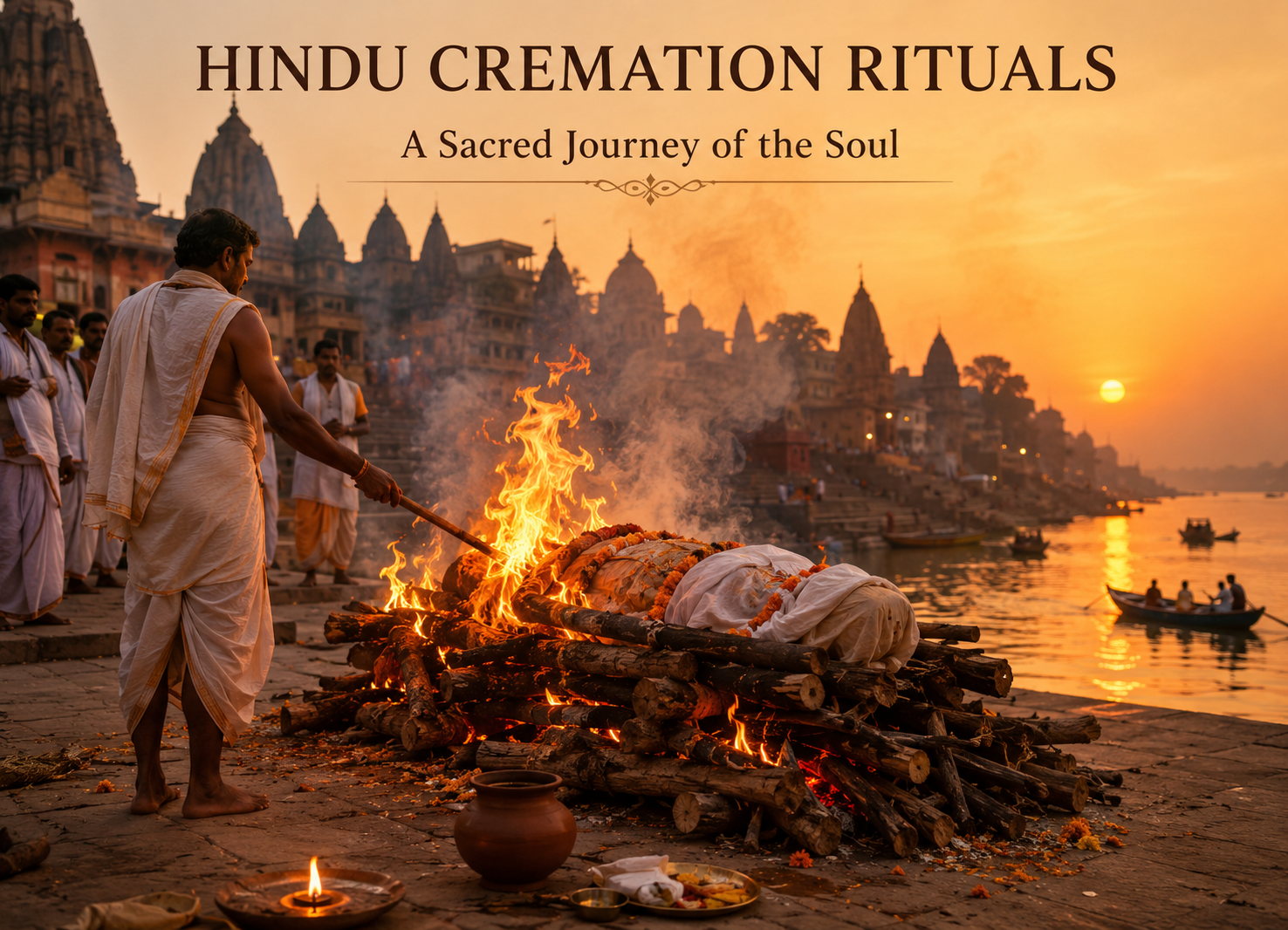
Death has always occupied a central place in Hindu philosophy. Unlike many belief systems that view death as an absolute end, Hinduism considers it a transition of the soul from one physical body to another. Hindu cremation rituals are therefore not merely funeral customs but deeply spiritual ceremonies intended to assist the departed soul in its onward journey toward rebirth or liberation, known as moksha.
Hindu cremation rituals, collectively called Antyesti Samskara or “the last rites,” are among the sixteen major samskaras, or sacraments, in Hindu tradition. These rites combine religious symbolism, philosophical concepts, social customs, and emotional closure for family members. Across India, Nepal, Bangladesh, and Hindu communities worldwide, cremation remains one of the most significant sacred rituals.
This article explores the origins, process, symbolism, variations, and spiritual significance of Hindu cremation rituals in detail.
The Hindu View of Death and the Soul
Hindu cremation rituals are rooted in the doctrine of reincarnation. According to Hindu philosophy, the physical body is temporary, while the soul (Atman) is eternal. The Bhagavad Gita explains that the soul neither dies nor can be destroyed. It merely changes bodies just as a person changes worn-out clothes.
The ultimate goal of human life in Hinduism is liberation from the endless cycle of birth, death, and rebirth, called samsara. Liberation or moksha is achieved through righteous living, spiritual realization, and detachment from worldly desires.
Because the body is viewed as a temporary vessel, cremation symbolizes the release of the soul from earthly attachment. Fire, considered sacred in Hinduism, acts as the purifier that returns the body’s five elements—earth, water, fire, air, and ether—to nature.
Historical Origins of Hindu Cremation
Cremation has existed in Hindu culture for thousands of years. Archaeological and textual evidence from the Vedic period indicates that funeral fires were an established tradition in ancient India. The Rig Veda contains hymns addressed to Agni, the fire god, requesting safe passage for the deceased soul into the spiritual realm.
Historically, cremation became associated with purification and transformation. Fire was believed to carry offerings to the gods, making it the ideal medium for returning the body to the universe.
While cremation became the dominant practice, burial also existed in certain Hindu communities and remains common for saints, infants, and spiritually realized ascetics.
What Is Antyesti Samskara?
The term Antyesti comes from Sanskrit:
- Antya means “last”
- Ishti means “sacrifice” or “offering”
Thus, Antyesti refers to the final offering made at the end of life. It is the last sacrament performed for an individual.
The primary objectives of Antyesti are:
- Honoring the deceased
- Assisting the soul’s journey
- Purifying the body through sacred fire
- Helping family members process grief
- Maintaining cosmic and social order
These rituals vary according to region, caste, sect, and local traditions, but the central spiritual principles remain consistent.
Preparations After Death
The cremation process usually begins immediately after death. Hindu tradition emphasizes that the funeral should ideally occur within 24 hours, especially in warm climates.
Washing and Purification
Family members bathe the body carefully with water, milk, or sacred substances such as Ganga water. The body is then dressed in clean clothes.
- Men are usually wrapped in white cloth.
- Married women may sometimes be dressed in red or traditional attire depending on local customs.
- Widows are generally dressed in white.
Sandalwood paste, turmeric, sacred ash, or holy basil leaves may be applied to the body.
Positioning the Body
The body is typically placed with the feet facing south, the symbolic direction of Yama, the god of death. A lamp may be kept burning near the head, representing spiritual guidance.
Family and friends gather to offer prayers and final respects.
Chanting and Religious Prayers
Sacred mantras play a major role in Hindu cremation rituals. Priests and family members recite verses from:
- The Bhagavad Gita
- The Garuda Purana
- The Upanishads
- Vedic hymns
One of the most common chants is:
“Om Namah Shivaya”
or
“Hare Rama Hare Krishna”
These chants are believed to calm the environment and assist the soul in detaching from the physical world.
The Funeral Procession
The body is traditionally carried to the cremation ground on a bamboo stretcher or bier. Male relatives often carry the body on their shoulders while chanting the name of God.
In many regions, the eldest son leads the procession. Historically, sons were expected to perform the last rites because they were believed responsible for ensuring the spiritual welfare of parents. However, modern Hindu families increasingly allow daughters and female relatives to participate fully.
The funeral procession symbolizes the final journey from worldly existence to spiritual transition.
The Cremation Ceremony
The Sacred Funeral Pyre
Traditional Hindu cremation occurs on an open-air wooden pyre. The body is placed on stacked wood, often including sandalwood or mango wood.
In modern cities, electric crematoriums are increasingly used due to environmental and practical considerations.
Circumambulation
Before lighting the pyre, family members may walk around the body counterclockwise. This movement symbolizes separation from earthly life.
Offerings such as rice, sesame seeds, flowers, clarified butter (ghee), and incense are placed on the body.
Lighting the Fire
The chief mourner, traditionally the eldest son, lights the funeral pyre. This act is considered both a sacred duty and an emotional farewell.
The fire represents:
- Purification
- Transformation
- Release of the soul
- Return of the body to nature
Kapal Kriya: Breaking the Skull
One of the most symbolic rituals in traditional Hindu cremation is kapal kriya. During cremation, the chief mourner may crack the skull using a bamboo stick.
Spiritually, this act is believed to release the soul from attachment to the physical body and facilitate its onward journey.
Although not universally practiced today, it remains significant in many traditional communities.
Collection of Ashes
After cremation, the ashes and remaining bone fragments are collected, usually on the third day.
The remains are immersed in a sacred river such as:
- The Ganges
- Yamuna
- Godavari
- Narmada
Varanasi, Haridwar, and Prayagraj are especially important pilgrimage destinations for ash immersion.
The immersion symbolizes the soul’s reunion with the cosmic universe.
Mourning Period in Hinduism
Hindu mourning customs vary widely, but the mourning period generally lasts between 10 and 13 days.
During this time:
- Family members may avoid celebrations and social gatherings.
- Simplicity in clothing and food is maintained.
- Daily prayers are performed for the deceased soul.
The mourning period is intended to:
- Honor the dead
- Purify the household
- Support emotional healing
- Assist the soul’s spiritual transition
Shraddha and Pind Daan Rituals
After cremation, Hindus perform rituals called Shraddha and Pind Daan.
Shraddha
Shraddha ceremonies are offerings made to ancestors. Food, prayers, and donations are offered in memory of the deceased.
These rituals are believed to nourish the soul in the afterlife and strengthen ancestral blessings.
Pind Daan
Rice balls called pinda are offered symbolically to help the soul gain a spiritual body for its onward journey.
Places like Gaya in Bihar are famous pilgrimage sites for Pind Daan rituals.
Symbolism of Fire in Hindu Cremation
Fire occupies a sacred position in Hinduism. Agni, the fire deity, serves as the divine messenger between humans and gods.
In cremation rituals, fire symbolizes:
- Purification of sins
- Liberation from material attachment
- Spiritual transformation
- Return to cosmic elements
The burning process represents impermanence and the temporary nature of physical existence.
Why Hindus Prefer Cremation Over Burial
Several religious and philosophical reasons explain the preference for cremation:
Release of the Soul
Cremation is believed to help the soul detach quickly from the physical body.
Purification
Fire purifies the body and dissolves earthly ties.
Return to Nature
The body’s elements return to the natural world through cremation.
Prevention of Attachment
Quick cremation reduces emotional and spiritual attachment between the soul and the material world.
Exceptions to Cremation in Hinduism
Although cremation is the norm, some groups are buried instead.
Infants and Children
Young children may be buried because they are considered spiritually pure and free from karmic burden.
Saints and Ascetics
Sadhus, saints, and spiritually realized individuals are often buried in a seated meditative posture. Their bodies are viewed as spiritually sanctified.
Certain Regional Traditions
Some Hindu communities historically practiced burial based on local customs.
Environmental Concerns and Modern Changes
Traditional cremation requires large quantities of wood, contributing to deforestation and air pollution.
Modern reforms include:
- Electric crematoriums
- Eco-friendly cremation systems
- Reduced wood consumption
- Alternative memorial practices
Environmental groups in India have promoted sustainable funeral methods while preserving religious traditions.
Despite modernization, many families continue to value traditional open-air cremation because of its spiritual symbolism.
Hindu Cremation Rituals Around the World
As Hindu communities spread globally, cremation practices adapted to local laws and cultural environments.
In countries such as:
- United States
- United Kingdom
- Canada
- Australia
- Bangladesh
Hindu families often use crematoriums while maintaining traditional prayers and rites.
Diaspora communities have preserved core rituals despite differences in infrastructure and legal regulations.
Psychological and Social Importance
Hindu cremation rituals also serve important emotional and social purposes.
Emotional Closure
Participating in funeral rites allows family members to process grief and say farewell.
Community Support
Funerals bring relatives and neighbors together during mourning.
Cultural Continuity
These rituals preserve ancient traditions and reinforce cultural identity across generations.
Philosophical Meaning of Hindu Cremation
At its deepest level, Hindu cremation teaches detachment from material existence. The body eventually returns to dust, but the soul continues its spiritual journey.
The rituals remind mourners that:
- Life is temporary
- Death is inevitable
- Actions create karma
- Spiritual growth transcends physical existence
This perspective reduces fear of death and frames it as part of a larger cosmic cycle.
Conclusion
Hindu cremation rituals represent one of the oldest continuously practiced funeral traditions in the world. Rooted in the doctrines of reincarnation, karma, and liberation, these ceremonies carry profound spiritual meaning beyond the physical act of cremation.
From washing the body and chanting sacred mantras to lighting the pyre and immersing ashes in holy rivers, every ritual symbolizes the soul’s transition from one state of existence to another. These practices not only honor the deceased but also provide comfort, continuity, and philosophical understanding for the living.
Even as modern technology and environmental concerns reshape funeral practices, the spiritual foundation of Hindu cremation remains deeply respected. The rituals continue to embody Hinduism’s enduring belief that death is not an end, but a sacred passage within the eternal cycle of life, death, and rebirth.