Aranya Kanda: Part Three Summary of the Ramayana
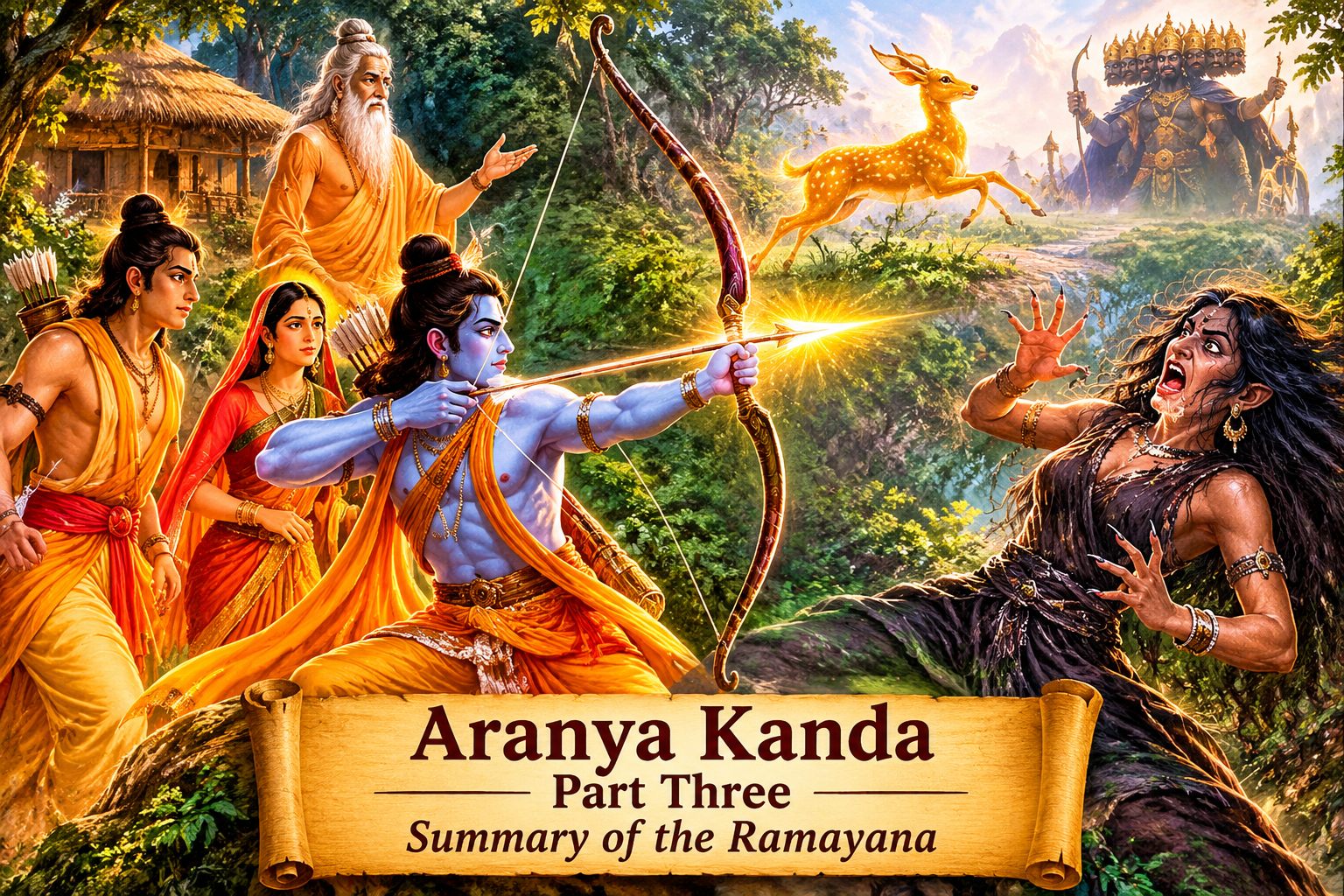
The Aranya Kanda, the third book of the great Hindu epic, the Valmiki Ramayana, is one of the most dramatic and emotionally powerful sections of the entire Ramayana. The word Aranya means forest, and this Kanda describes the life of Lord Rama, Goddess Sita and Lakshmana during their exile in the forests of Dandaka.
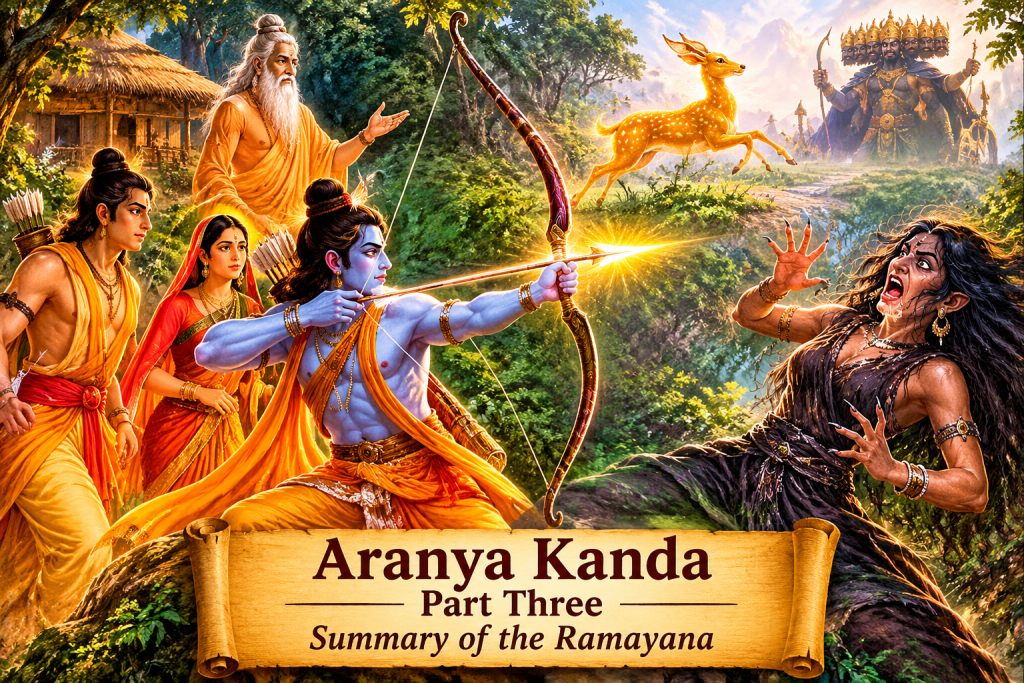
Following the events of the Ayodhya Kanda, Rama, Sita and Lakshmana leave the kingdom of Ayodhya and enter the wilderness to fulfil the promise made by King Dasharatha. Although their forest life initially appears peaceful, it gradually becomes filled with danger, encounters with sages and demons, divine revelations, sacrifice and tragedy.
The Aranya Kanda introduces several important characters and incidents that shape the remainder of the epic. Rama protects the sages from powerful rakshasas, encounters the mysterious demon Viradha, meets the great sage Agastya, and establishes a peaceful dwelling at Panchavati. However, the arrival of Shurpanakha, the sister of Ravana, changes the course of events. Her humiliation leads to a chain of conflicts that ultimately results in the abduction of Sita by Ravana, the king of Lanka.
This Kanda also introduces the unforgettable sacrifice of Jatayu, the devoted friendship of Rama and Lakshmana with the dying bird, and their encounter with the mysterious ascetic woman Shabari.
The Aranya Kanda is not merely a story of forest adventures. It explores devotion, courage, righteousness, temptation, loyalty and the consequences of uncontrolled desire. Most importantly, it marks the beginning of Rama’s determined search for Sita, setting the stage for the next great chapter of the Ramayana.
Rama Enters the Dandaka Forest
Ram Navami 2026: 6 AI prompts to create custom Lord Ram images using Google Gemini, ChatGPT and othersmoneycontrol.com
After leaving Ayodhya, Rama, Sita and Lakshmana continued their journey through different forests and hermitages. They eventually entered the vast Dandaka forest, a wilderness inhabited by sages, ascetics, wild animals and powerful rakshasas.
The forest was beautiful but dangerous. Many sages had established their hermitages there to perform meditation, prayers and religious ceremonies. However, their peaceful lives were frequently disturbed by rakshasas who attacked them, destroyed their sacrificial offerings and threatened their lives.
When Rama arrived, the sages welcomed him with great respect. They regarded him as a protector who could defend righteousness and restore peace to the forest. They explained how the rakshasas had been troubling them and requested his protection.
Rama listened carefully to their difficulties. He understood that protecting innocent people and defending those who followed the path of righteousness were among his important responsibilities. He promised to protect the sages from the evil creatures that threatened their lives.
The Encounter with Viradha
During their journey through the forest, Rama, Sita and Lakshmana encountered a terrifying rakshasa named Viradha. He was enormous in appearance and possessed extraordinary strength. As soon as he noticed the travellers, he attacked them and seized Sita.
Viradha declared that he intended to make Sita his wife and threatened the two brothers. Rama and Lakshmana immediately challenged him and attempted to rescue Sita. They attacked the demon with their weapons, but ordinary arrows and other weapons seemed ineffective against him because of a divine boon.
Realising that they could not defeat him through ordinary attacks, the brothers broke his arms and overpowered him. They then dug a large pit and buried him, bringing an end to his terrifying existence.
Before his death, Viradha revealed that he had once been a celestial being who had been cursed to live as a rakshasa. By receiving liberation through Rama, he regained his original divine form and departed for the heavenly realm.
This encounter demonstrated Rama’s courage and his ability to overcome even supernatural enemies.
Meeting Sage Sharabhanga
After defeating Viradha, Rama and his companions continued their journey and reached the hermitage of the great sage Sharabhanga.
At that time, Indra, the king of the gods, appeared before the sage in a celestial chariot. Indra had come to invite Sharabhanga to the heavenly world because of his spiritual achievements.
However, Sharabhanga wished to meet Rama before accepting the invitation. He therefore remained on Earth and welcomed the prince.
The sage recognised Rama’s divine nature and blessed him. After meeting Rama, Sharabhanga entered the sacred fire through a yogic act and left his mortal body. His spiritual achievements enabled him to attain a higher celestial state.
The Sages Request Rama’s Protection
Rama, Sita and Lakshmana subsequently visited several hermitages and met numerous sages who were practising spiritual disciplines in the forest.
The ascetics described the terrible behaviour of the rakshasas. They explained that many innocent sages had been killed while performing yajnas and meditation. They requested Rama to protect them from these attacks.
Rama promised to defend the hermitages and maintain peace in the forest.
However, Sita expressed a thoughtful concern about the use of weapons. She reminded Rama that unnecessary violence could lead even a righteous person away from the path of virtue. She advised him not to develop hostility towards anyone without a proper reason.
Rama appreciated Sita’s concern but explained that protecting innocent people was his duty. Since he had promised the sages that he would defend them, he could not abandon that responsibility.
This conversation highlights an important moral question in the Ramayana: the difference between unnecessary aggression and the use of force to protect righteousness.
The Hermitage of Sage Sutikshna
The three travellers later reached the hermitage of Sage Sutikshna, a respected ascetic who welcomed them warmly.
Rama discussed the difficulties of forest life and the responsibilities of protecting the sages. Sutikshna appreciated Rama’s commitment to righteousness and guided him towards other sacred places in the forest.
Rama, Sita and Lakshmana spent time visiting different hermitages and meeting spiritual personalities. Their journey through Dandaka became an opportunity to learn about the lives, beliefs and spiritual practices of the forest-dwelling sages.
Sage Agastya Gives Divine Weapons to Rama
V. On the Banks of the Godavariphotodharma.net
One of the most important encounters in the Aranya Kanda is Rama’s meeting with the great sage Agastya.
After spending considerable time travelling through the forest and visiting different hermitages, Rama decided to meet Agastya, whose spiritual reputation was widely known.
Agastya welcomed Rama, Sita and Lakshmana with great affection. He recognised Rama’s extraordinary qualities and understood the importance of his mission.
The sage presented Rama with several divine weapons. These included a magnificent bow associated with Vishnu, two inexhaustible quivers and a powerful sword. He also explained the importance of using these weapons responsibly.
Agastya advised Rama that his strength should always serve the protection of righteousness and innocent people.
Agastya Directs Rama to Panchavati
After presenting the divine weapons, Agastya suggested that Rama establish his residence at Panchavati, a beautiful location near the Godavari River.
The place was surrounded by trees, flowering plants, rivers and natural beauty. It offered a peaceful environment suitable for forest life while allowing Rama to remain close to the sages who needed his protection.
Agastya believed Panchavati would be an appropriate dwelling for Rama, Sita and Lakshmana.
Following the sage’s advice, the three travellers proceeded towards Panchavati.
Rama Meets Jatayu
On their way, Rama and his companions encountered a magnificent bird named Jatayu. He was a powerful vulture and a close friend of King Dasharatha.
Jatayu introduced himself and explained his relationship with Rama’s father. He expressed great affection for the young prince and promised to help protect Sita during Rama and Lakshmana’s absence.
Rama was delighted to meet someone who had been so closely associated with his father. He accepted Jatayu’s friendship and regarded him with affection and respect.
This meeting becomes especially significant later in the Aranya Kanda. Jatayu’s promise to protect Sita would lead him to make the ultimate sacrifice.
Rama, Sita and Lakshmana Settle at Panchavati
Panchavati became the new home of Rama, Sita and Lakshmana.Life at Panchavati – Sawan Bookssawanonlinebookstore.com
The location was filled with natural beauty. The Godavari River flowed nearby, while trees, flowering plants and birds created a peaceful atmosphere.
Lakshmana constructed a beautiful leaf hut for Rama and Sita. He carefully selected suitable materials and arranged the dwelling so that the family could live comfortably.
Rama appreciated Lakshmana’s dedication and affection. Although Lakshmana was a prince himself, he devoted his entire life during the exile to serving his elder brother and sister-in-law.
The three lived peacefully at Panchavati. They enjoyed the beauty of nature, performed their daily duties and spent time together.
During this period, Rama also spoke affectionately about his brother Bharata, appreciating his devotion, humility and commitment to the kingdom of Ayodhya.
Unfortunately, their peaceful existence would soon be disturbed by an unexpected visitor.
Shurpanakha’s Arrival and the Beginning of Conflict
Part 17: The Arrival of the Demoness Shurpanakha – Anugraha Kshetraanugrahakshetra.com
One day, a rakshasi named Shurpanakha arrived at Panchavati. She was the sister of Ravana, the powerful king of Lanka, and also the sister of Kumbhakarna and Vibhishana.
When Shurpanakha saw Rama, she became attracted to his handsome appearance and approached him. She asked about his identity and expressed her desire to marry him.
Rama explained that he was already married to Sita and could not accept her proposal. In a playful manner, he suggested that she approach Lakshmana instead.
Shurpanakha then approached Lakshmana and expressed her desire to marry him. Lakshmana also rejected her proposal, explaining that he was devoted to serving Rama and Sita.
Realising that neither brother would accept her, Shurpanakha became furious. She blamed Sita for preventing her from marrying Rama and attempted to attack her.
Seeing Sita in danger, Lakshmana intervened and cut off Shurpanakha’s nose and ears.
Humiliated and enraged, Shurpanakha fled from Panchavati and decided to seek revenge.
Shurpanakha Approaches Khara
Shurpanakha went to her brother Khara, who was a powerful rakshasa chief ruling over the region of Janasthana.
She described the incident and complained that Rama and Lakshmana had insulted her. She demanded that Khara punish the two princes.
At first, Khara sent fourteen powerful rakshasas to attack Rama. However, Rama defeated all fourteen attackers with his arrows.
Shurpanakha returned to Khara and became even more furious. She criticised his failure to protect his sister’s honour and challenged him to take immediate action.
Angered by her complaints, Khara decided to lead a much larger army against Rama.
Rama Destroys the Army of Khara and Dushana
Khara assembled a powerful army consisting of thousands of rakshasas. His chief commanders included Dushana and Trishira.
According to the Valmiki Ramayana, Khara marched towards Panchavati with fourteen thousand rakshasas to destroy Rama.
Before the battle began, several frightening omens appeared. These included unusual natural disturbances and signs that suggested disaster was approaching.
Rama recognised the seriousness of the situation. He instructed Lakshmana to take Sita to a safe place and remain with her while he faced the approaching army.
Lakshmana obeyed his brother’s instructions.
Rama then prepared himself for battle with his divine weapons.
The Great Battle
The rakshasa army attacked Rama from different directions. They used swords, spears, clubs, arrows and other powerful weapons.
Although Rama was alone against an enormous army, he remained calm and fearless.
He released a continuous shower of arrows, defeating the attacking rakshasas one after another. His extraordinary fighting skills overwhelmed the enemy forces.
Dushana led a major attack against Rama, but he was eventually killed along with many of his soldiers.
Trishira, another powerful commander, challenged Rama. However, Rama defeated him as well.
Finally, Khara himself entered the battlefield and confronted Rama.
The two warriors fought fiercely. Khara used powerful weapons and attempted to overpower Rama, but the prince successfully resisted his attacks.
After an intense battle, Rama killed Khara with his arrows.
The destruction of Khara, Dushana, Trishira and the fourteen thousand rakshasas became one of the most remarkable victories of the Aranya Kanda.
The gods praised Rama for defeating the powerful enemies and protecting the forest.
Shurpanakha Meets Ravana
After the destruction of Khara’s army, Shurpanakha travelled to Lanka to meet her brother Ravana.
Ravana was one of the most powerful rulers of his time. He possessed extraordinary strength, immense wealth and a magnificent kingdom.
Shurpanakha informed him about the destruction of Khara and his army. She also described Rama and Lakshmana, particularly praising Sita’s extraordinary beauty.
She encouraged Ravana to abduct Sita and make her his wife.
Ravana became interested in Sita after hearing the description. However, he understood that Rama was a formidable warrior and that directly confronting him could be dangerous.
He therefore decided to develop a deceptive plan.
Ravana Seeks Maricha’s Assistance
Ravana travelled to the hermitage of Maricha, a rakshasa who had previously encountered Rama.
Maricha was familiar with Rama’s extraordinary strength. During an earlier encounter, Rama had defeated him with a powerful arrow and thrown him far away.
Since that experience, Maricha had become fearful of Rama and preferred to live peacefully in the forest.
When Ravana explained his plan to abduct Sita, Maricha strongly advised him against it.
He warned Ravana that Rama was no ordinary human being and that provoking him would bring destruction upon Lanka.
Maricha explained that Rama possessed extraordinary abilities and that no one could easily defeat him.
However, Ravana refused to listen. He threatened Maricha and demanded that he assist in the plan.
Eventually, Maricha understood that he had no choice. He agreed to participate, knowing that the plan would probably lead to his own death.
The Golden Deer: Maricha’s Deception
Pin by Thirumalai Cumbum on RAMAYANA | Indian art paintings, Hindu art, Radha krishna artpinterest.com
Ravana and Maricha prepared a deceptive plan to separate Rama from Sita and Lakshmana.
Maricha possessed the ability to change his appearance. Following Ravana’s instructions, he transformed himself into an extraordinarily beautiful golden deer.
The deer had a shining golden body, attractive markings and glittering antlers. Its appearance was so unusual that it seemed to belong to a celestial world rather than an ordinary forest.
Maricha appeared near Rama’s hermitage at Panchavati and moved playfully among the trees.
When Sita noticed the beautiful creature, she became fascinated by it. She called Rama and Lakshmana and asked them to look at the magnificent deer.
Sita expressed her wish to have the deer. She believed that it would make a beautiful companion and would be a wonderful gift to take back to Ayodhya after their exile.
Rama initially suspected that the creature might be a rakshasa in disguise. Nevertheless, he decided to follow it and discover its true identity.
He instructed Lakshmana to remain with Sita and protect her while he pursued the deer.
Rama Pursues the Golden Deer
The golden deer began moving deeper into the forest, attracting Rama farther away from the hermitage.
Whenever Rama approached it, the creature moved away, making it difficult to capture. It repeatedly appeared within his sight and then disappeared among the trees.
Eventually, Rama realised that the deer was not an ordinary animal. He decided to kill it with an arrow.
Rama released a powerful arrow that struck Maricha. The demon immediately abandoned his golden appearance and returned to his original form.
As he lay dying, Maricha used his remaining strength to imitate Rama’s voice. He cried out loudly, calling for Lakshmana and asking for help.
His voice travelled through the forest and reached the hermitage.
Sita heard the cry and became extremely worried. She believed Rama was in danger and requested Lakshmana to go immediately and help him.
Sita Urges Lakshmana to Find Rama
Lakshmana, however, understood that Rama was powerful enough to defeat any ordinary enemy. He suspected that the cry was part of a rakshasa’s deception.
He tried to reassure Sita that Rama was safe and that no enemy could easily overcome him.
But Sita became increasingly anxious. In her distress, she spoke harshly to Lakshmana and questioned his intentions for not going to Rama’s assistance.
Lakshmana was deeply hurt by her accusations. Nevertheless, he could not ignore her distress.
He eventually decided to leave the hermitage to search for Rama, hoping to reunite with his brother and Sita as quickly as possible.
It is worth noting that the popular story of Lakshmana drawing a protective boundary, commonly known as the Lakshmana Rekha, is not narrated in the same way in the original Valmiki Ramayana. It became prominent in later retellings and regional traditions.
Ravana Abducts Sita
Kundli Tv- क्या वाकई रावण ने किया था सीता का हरण? – was ravana kidnap sitapunjabkesari.in
The moment Lakshmana left the hermitage, Ravana’s plan entered its final stage.
Ravana approached the cottage disguised as a wandering ascetic. He wore the appearance of a holy man and carried the traditional belongings of a religious mendicant.
Sita welcomed the visitor respectfully, following the traditional custom of offering hospitality to guests and ascetics.
Ravana began asking questions about her identity, her family and the reason for her living in the forest.
Sita explained that she was the wife of Rama, the prince of Ayodhya, and that they were living in the forest to fulfil their exile.
After learning about Sita, Ravana revealed his true identity. He introduced himself as the powerful king of Lanka and attempted to persuade her to become his queen.
Sita immediately rejected his proposal. She reminded Ravana that she was devoted to Rama and would never accept another man as her husband.
She also criticised his behaviour and warned him about the consequences of abducting another man’s wife.
Ravana became furious at her refusal. He abandoned his disguise, revealed his terrifying form and forcibly seized Sita.
Using his supernatural powers, he placed her in his aerial chariot, Pushpaka Vimana, and carried her towards Lanka.
Sita’s Desperate Calls for Help
As Ravana carried her away, Sita cried out for Rama and Lakshmana.
She called upon the trees, mountains, rivers and animals of the forest to inform Rama about her abduction.
She hoped that someone would witness the incident and communicate the news to her husband.
During the journey, she noticed a group of vanaras in the region below. Realising that they might be able to help Rama, she dropped some of her ornaments towards them.
These ornaments would later become important clues during Rama’s search for Sita.
Meanwhile, Ravana continued towards Lanka, ignoring Sita’s repeated pleas to release her.
Jatayu’s Heroic Battle Against Ravana
The Ramayana – Illustrated Booklet | Events | MoonShadow Storiesmoonshadowstories.com
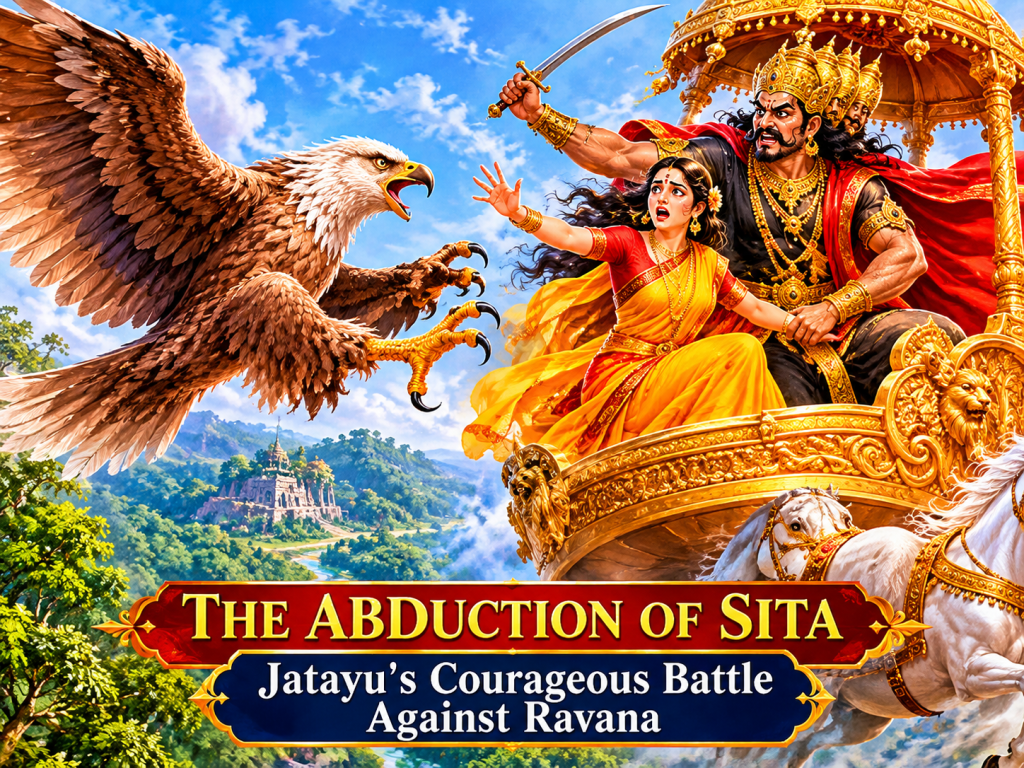
During Ravana’s journey, the elderly bird Jatayu noticed Sita being carried away.
He immediately recognised her and understood that Ravana was abducting her against her will.
Remembering his promise to protect Sita, Jatayu decided to confront Ravana despite knowing that he was much more powerful.
The brave bird approached Ravana and demanded that he release Sita.
Jatayu reminded Ravana that abducting another man’s wife was an act of unrighteousness. He warned him that Rama would certainly punish him for this terrible deed.
Ravana refused to listen.
The Fierce Battle
Jatayu attacked Ravana’s aerial chariot and attempted to prevent him from escaping.
He used his powerful wings, beak and claws to strike Ravana and damage his chariot. The bird fought with extraordinary courage, even though he was old and Ravana possessed immense supernatural strength.
During the battle, Jatayu managed to damage Ravana’s chariot and weapons. He also created serious difficulties for the king of Lanka.
However, Ravana eventually became furious and attacked Jatayu with his sword.
He cut off Jatayu’s wings, causing the brave bird to fall to the ground.
Badly wounded, Jatayu could no longer continue fighting. Ravana resumed his journey towards Lanka with Sita.
Although Jatayu failed to rescue Sita, his courageous resistance became one of the most inspiring acts of sacrifice in the Ramayana.
Sita Reaches Lanka
After arriving in Lanka, Ravana took Sita to his magnificent palace.
He attempted to impress her with his wealth, power and luxurious surroundings. However, Sita remained completely devoted to Rama and rejected every offer made by Ravana.
Unable to change her mind, Ravana confined her in the Ashoka Vatika, a beautiful garden within Lanka.
He ordered the rakshasis guarding the garden to watch over Sita and persuade her to accept him.
Sita refused to surrender to Ravana’s demands. She remained faithful to Rama and waited patiently for her husband to find her.
Ravana’s actions had now created a conflict that would eventually threaten the entire kingdom of Lanka.
Rama Returns and Discovers Sita’s Abduction
After killing Maricha, Rama began returning towards the hermitage.
On his way, he became increasingly concerned because Maricha’s final cry had sounded remarkably similar to his own voice. He feared that something might have happened to Sita and Lakshmana.
When Rama finally met Lakshmana, he questioned why his brother had left Sita alone.
Lakshmana explained that Sita had become extremely anxious after hearing the cry and had insisted that he go in search of Rama.
The brothers immediately hurried towards their cottage.
However, when they reached Panchavati, they discovered that Sita was missing.
Rama searched every corner of the hermitage and surrounding forest, but there was no sign of her.
Rama’s Deep Sorrow
Rama became overwhelmed with grief. He called out Sita’s name repeatedly and searched among the trees, bushes and nearby riverbanks.
He asked the animals and birds whether they had seen his beloved wife.
He questioned the trees and mountains as though they might provide information about her disappearance.
The usually calm and composed prince was now filled with sorrow and anxiety.
Lakshmana tried to comfort him and encouraged him to remain patient. He reminded Rama that they needed to search carefully rather than surrender to despair.
As they explored the surrounding area, they discovered signs of a violent struggle. Broken branches, scattered objects and other indications suggested that someone had forcibly taken Sita away.
Rama gradually realised that a powerful enemy must have abducted her.
The search for Sita now became the most important mission of his life.
Rama Meets the Wounded Jatayu
File:Rama Laxmana meets jatayu on death bed.jpg – Wikimedia Commonscommons.wikimedia.org
While searching through the forest, Rama and Lakshmana discovered Jatayu lying on the ground, severely wounded and unable to move.
At first, Rama suspected that the bird might have been responsible for Sita’s disappearance. However, Jatayu quickly explained what had happened.
He told Rama that Ravana, the king of Lanka, had abducted Sita and carried her away in his aerial chariot.
Jatayu also described how he had fought Ravana to protect her but had ultimately lost his wings.
He informed Rama about the direction in which Ravana had travelled.
Rama was deeply moved by Jatayu’s courage and sacrifice. He understood that the elderly bird had risked his life to fulfil his promise to protect Sita.
Jatayu had treated Dasharatha as a friend and considered Rama a member of his own family.
Jatayu’s Final Moments
After revealing everything he knew, Jatayu gradually lost his remaining strength.
He died in Rama’s presence.
Rama was heartbroken. He embraced the dying bird with affection and mourned him as though he were a member of his own family.
Rama and Lakshmana performed Jatayu’s funeral rites with great respect.
Rama considered Jatayu’s sacrifice an extraordinary example of loyalty, friendship and devotion.
The episode teaches that courage and righteousness are not determined by physical strength, age or social position. Even an elderly bird can demonstrate extraordinary bravery when protecting someone in need.
The Encounter with Kabandha
Manaku of Guler | Finally the demon Kabandha receives redemption (ca. 1775) | Artsyartsy.net
After performing Jatayu’s funeral rites, Rama and Lakshmana continued their search for Sita.
During their journey, they encountered a terrifying creature named Kabandha.
Kabandha was an unusual rakshasa with a huge body, no visible head and extremely long arms. His mouth and eyes were located in his torso, making him a frightening creature.
He used his enormous arms to capture animals and travellers from a distance.
When Rama and Lakshmana approached him, Kabandha seized both brothers with his long arms.
The two princes immediately realised that they needed to free themselves from his grasp.
They attacked him and cut off his arms, defeating his ability to capture them.
Kabandha Regains His Divine Form
After being defeated, Kabandha requested Rama to perform his funeral rites.
When his body was cremated, he regained his original celestial form.
He revealed that he had once been a divine being but had been cursed to live as a monstrous rakshasa.
Kabandha thanked Rama for freeing him from the curse.
Before departing, he provided Rama with important advice regarding the search for Sita.
He suggested that Rama establish a friendship with Sugriva, the exiled vanara king who lived near Mount Rishyamuka.
Kabandha explained that Sugriva possessed a large number of vanara followers and could help Rama locate Sita.
He also described the way towards the region of Lake Pampa and Rishyamuka Mountain.
Rama appreciated Kabandha’s advice and decided to follow his guidance.
This meeting is important because it prepares the way for Rama’s friendship with Sugriva and the eventual participation of Hanuman in the search for Sita.
Rama Meets Shabari
Sabari’s Story: The Greatest Devotee of Rama and the Power of Divine Patiencesanatangyan.com
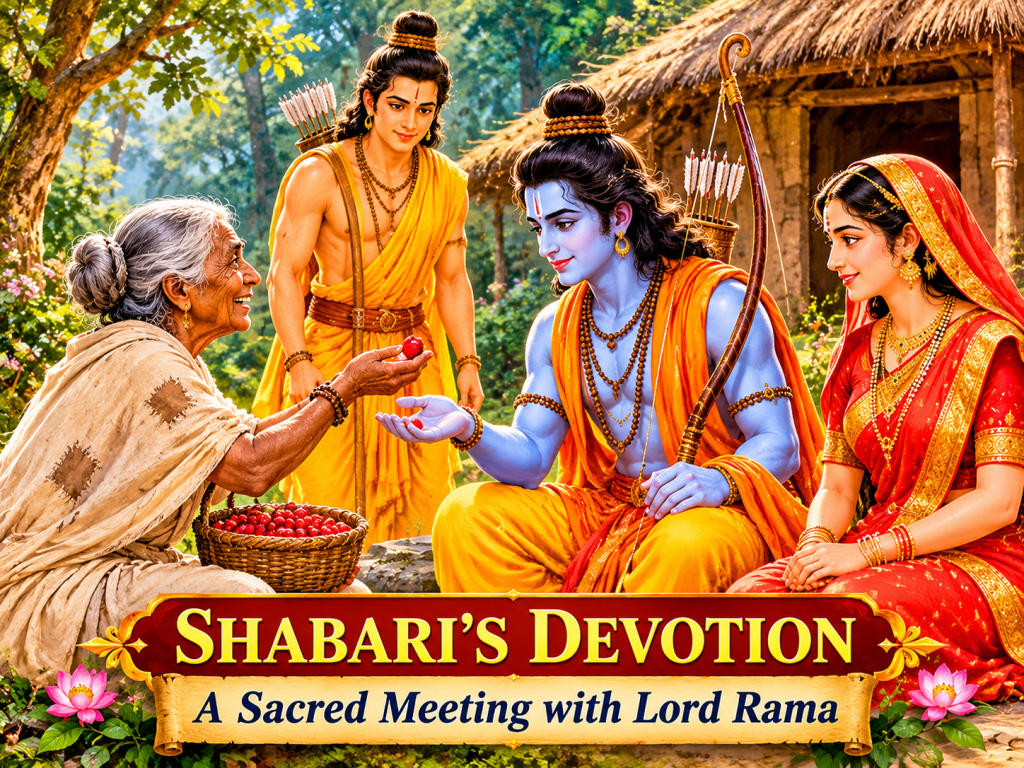
Following Kabandha’s advice, Rama and Lakshmana continued their journey towards the region of Lake Pampa.
On the way, they reached the hermitage of Shabari, an elderly woman devoted to spiritual life and the teachings of her guru.
Shabari had spent many years waiting for Rama’s arrival. Her spiritual teacher had promised that she would one day receive the blessing of meeting him.
She had remained in the hermitage with unwavering faith, patiently awaiting that sacred moment.
When Rama finally arrived, Shabari was filled with immense happiness.
She welcomed him and Lakshmana with great respect and offered them hospitality.
She explained that she had spent many years following the spiritual instructions of her guru and had waited eagerly for Rama’s arrival.
Rama appreciated her devotion and treated her with affection.
Shabari’s Devotion and Liberation
Shabari’s story highlights the importance of sincere devotion rather than wealth, social position or outward appearance.
She had no royal palace, expensive ornaments or grand possessions. Her greatest treasure was her unwavering faith in Rama.
In the Valmiki Ramayana, Shabari welcomes Rama, offers him hospitality and explains her spiritual journey. She subsequently attains liberation through her spiritual merit.
Some later devotional traditions describe Shabari tasting berries before offering them to Rama to ensure that they were sweet. This familiar episode is especially popular in regional and later retellings.
After meeting Shabari, Rama and Lakshmana continued towards Lake Pampa.
Rama and Lakshmana Reach Lake Pampa
The Aranya Kanda concludes as Rama and Lakshmana approach the beautiful Lake Pampa.
The region was filled with natural beauty, flowering trees, clear water and various birds and animals.
Although the surroundings were peaceful, Rama’s heart remained filled with sorrow because Sita was still missing.
Remembering Sita, he spoke about their earlier life together and expressed his determination to find her.
Lakshmana continued encouraging his elder brother and reminded him of the importance of remaining strong.
By following Kabandha’s advice, Rama now had a direction for his next journey. He would seek the assistance of Sugriva, who lived near Mount Rishyamuka.
This meeting would become the beginning of a new chapter in the Ramayana, introducing Hanuman and the powerful vanara army.
Thus, the Aranya Kanda ends with Rama and Lakshmana preparing to enter the next stage of their search for Sita.
Major Events of the Aranya Kanda
The Aranya Kanda contains several important events that influence the remaining story of the Ramayana.
- Rama, Sita and Lakshmana enter the Dandaka forest.
- Rama defeats the rakshasa Viradha.
- They meet the sages Sharabhanga and Sutikshna.
- Sita advises Rama about the responsible use of weapons.
- Sage Agastya presents Rama with divine weapons.
- Rama meets Jatayu, the devoted friend of King Dasharatha.
- The three establish their hermitage at Panchavati.
- Shurpanakha approaches Rama and Lakshmana and is disfigured by Lakshmana.
- Rama destroys Khara, Dushana, Trishira and their fourteen thousand rakshasa warriors.
- Shurpanakha encourages Ravana to abduct Sita.
- Maricha transforms himself into a magical golden deer.
- Rama pursues the golden deer, leaving Sita with Lakshmana.
- Ravana disguises himself as an ascetic and abducts Sita.
- Jatayu fights Ravana and sacrifices his life while attempting to rescue Sita.
- Rama discovers Sita’s disappearance and begins searching for her.
- Rama and Lakshmana meet the dying Jatayu and learn about Ravana.
- They defeat Kabandha, who advises them to seek Sugriva’s friendship.
- Rama meets the devoted Shabari and receives her hospitality.
- Rama and Lakshmana reach Lake Pampa, preparing for their next journey.
Spiritual and Moral Significance of the Aranya Kanda
The Aranya Kanda is an important section of the Ramayana because it explores the relationship between righteousness, responsibility, devotion and human emotions.
1. The importance of protecting righteousness
Rama’s promise to protect the forest sages demonstrates his commitment to dharma. He does not ignore the suffering of innocent people, even when protecting them requires facing powerful enemies.
2. The consequences of uncontrolled desire
Shurpanakha’s attraction towards Rama and Ravana’s desire to possess Sita create a chain of destructive events. Their inability to control their desires ultimately brings suffering to themselves and others.
3. The danger of deception
Maricha’s transformation into a golden deer demonstrates how attractive appearances can conceal dangerous intentions. The incident reminds readers to exercise wisdom and caution rather than being guided entirely by appearances.
4. Loyalty and sacrifice
Jatayu’s extraordinary courage is among the most memorable lessons of this Kanda. Although he knows that Ravana is more powerful, he refuses to remain silent when Sita is in danger. His sacrifice represents selfless friendship and devotion.
5. The power of devotion
Shabari’s meeting with Rama demonstrates that sincere devotion is more important than wealth, status or outward appearance. Her long wait for Rama represents patience, faith and spiritual dedication.
6. Courage during difficult times
Rama’s sorrow following Sita’s abduction reveals his emotional side. Nevertheless, he gradually gathers his strength and continues searching for her. His determination teaches the importance of courage and perseverance during difficult circumstances.
Conclusion
The Aranya Kanda is a turning point in the Valmiki Ramayana. What begins as a peaceful period of forest exile gradually becomes a dramatic struggle involving powerful demons, divine weapons, deception, sacrifice and separation.
Rama’s encounters with the forest sages, his victory over Khara and Dushana, and his confrontation with the consequences of Ravana’s actions reveal his commitment to dharma. Meanwhile, Sita’s abduction creates the central conflict that drives the remaining story of the epic.
The sacrifice of Jatayu, the guidance of Kabandha and the devotion of Shabari add profound spiritual and emotional dimensions to the narrative. These characters demonstrate that courage, wisdom and devotion can emerge from the most unexpected places.
Most importantly, the Aranya Kanda ends with Rama and Lakshmana reaching Lake Pampa, where their journey towards finding Sita is about to enter a new phase. Their forthcoming meeting with Sugriva and Hanuman will open the door to the next great adventure described in the Kishkindha Kanda.
Thus, the Aranya Kanda is not simply a story of forest adventures and battles. It is a profound account of love, loyalty, righteousness, sacrifice and the determination to overcome evil.
*Related Article: Valmiki Ramayana- Summary of the Ramayana Story