Why Lord Ganesha’s Head Was Replaced: The Fascinating Story Behind Hinduism’s Beloved Elephant-Headed God

Among all Hindu deities, Lord Ganesha is perhaps the most easily recognizable. His unique elephant head, large ears, curved trunk, and gentle appearance have made him one of the most worshipped gods not only in India but across the world. Known as the Remover of Obstacles, the Patron of Wisdom, and the Lord of Beginnings, Ganesha occupies a special place in Hindu tradition.
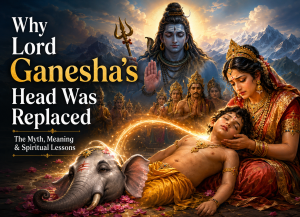
Yet one question continues to intrigue devotees, scholars, and curious readers alike: Why was Lord Ganesha’s head replaced with an elephant’s head?
The answer lies within one of the most fascinating stories in Hindu mythology. This ancient tale is much more than a dramatic myth. It contains profound spiritual lessons about obedience, sacrifice, transformation, wisdom, and the relationship between parents and children.
In this article, we will explore the story from various Hindu scriptures, examine its symbolism, and understand why Ganesha’s elephant head continues to hold deep significance even today.
The Birth of Lord Ganesha
The story begins with Goddess Parvati, the divine consort of Lord Shiva.
According to the most popular version found in the Puranas, Parvati desired a personal guardian who would remain loyal to her alone. One day, while preparing for a bath, she created a boy from the sandalwood paste, turmeric, or sacred clay taken from her own body.
Using her divine powers, she breathed life into the figure. The child became a living boy, radiant and strong.
Parvati instructed him:
“Guard the entrance while I bathe. Do not allow anyone to enter.”
The boy faithfully accepted his mother’s command. This child was Ganesha.
At this point, Ganesha did not possess an elephant head. He appeared as a handsome human boy.
Lord Shiva Returns Home
While Parvati was bathing, Lord Shiva returned to his abode on Mount Kailash.
As Shiva approached the entrance, the young guardian blocked his path.
Unaware of the boy’s identity, Shiva attempted to enter. However, Ganesha firmly refused.
The child said he was following his mother’s orders and would not permit anyone to enter.
Shiva was surprised. No one had ever dared stop him before.
The disagreement quickly escalated into a confrontation.
The Clash Between Shiva and Ganesha
Shiva’s attendants, known as the Ganas, attempted to remove the boy from the doorway. To their astonishment, Ganesha defeated them.
Despite being young, he possessed extraordinary divine strength.
Many celestial beings joined the battle but failed to overcome him.
The conflict grew larger and eventually involved gods from heaven.
The determined child remained steadfast, refusing to abandon his duty.
This aspect of the story highlights one of Ganesha’s most admired qualities: unwavering devotion to righteousness and responsibility.
Shiva Beheads Ganesha
Eventually, Shiva himself entered the battle.
Different scriptures describe the event in slightly different ways. In some versions, Shiva used his trident (Trishula). In others, he employed divine weapons granted by celestial powers.
The outcome remained the same.
In a moment of divine fury, Shiva severed the boy’s head.
The guardian collapsed.
The battle ended, but a far greater problem was about to begin.
Parvati’s Anger Shakes the Universe
When Goddess Parvati emerged and discovered what had happened, she was devastated.
The boy was not merely a guardian.
He was her son.
Overwhelmed by grief and anger, Parvati assumed a fierce form. Some texts describe her manifesting powerful energies and goddesses capable of destroying the universe.
The cosmic balance itself was threatened.
Gods, sages, and celestial beings became terrified.
They pleaded with Shiva to find a solution before Parvati’s wrath consumed creation.
Recognizing the gravity of the situation, Shiva promised to restore the child to life.
The Search for a New Head
Shiva instructed his attendants to travel north and bring back the head of the first living being they encountered lying with its head facing north.
The direction north holds special spiritual significance in Hindu tradition. It is associated with wisdom, spiritual ascent, and liberation.
The attendants soon discovered a young elephant.
Following Shiva’s command, they brought the elephant’s head back to Kailash.
The head was carefully placed upon the body of the child.
Using divine power, Shiva restored him to life.
The boy awakened transformed.
Thus emerged the elephant-headed deity known today as Lord Ganesha.
Why Was an Elephant Chosen?
A common question arises: Why specifically an elephant?
The choice was not random.
In Hindu symbolism, elephants embody several noble qualities:
1. Wisdom
Elephants are often associated with intelligence and memory.
By giving Ganesha an elephant’s head, the story symbolizes the importance of wisdom over physical appearance.
2. Strength
Elephants are among the strongest animals in nature.
Ganesha’s head represents both mental and spiritual strength.
3. Leadership
Elephants naturally lead and protect their herds.
Likewise, Ganesha guides devotees through life’s challenges.
4. Calmness
Despite their immense power, elephants are generally peaceful creatures.
This symbolizes controlled strength and emotional balance.
Shiva’s Blessings to Ganesha
After reviving him, Shiva granted Ganesha extraordinary blessings.
He declared that Ganesha would become:
- Leader of Shiva’s attendants.
- Remover of obstacles.
- God of wisdom and intellect.
- Patron of arts and learning.
- The first deity worshipped before all auspicious activities.
This last blessing explains why Hindus traditionally invoke Ganesha before:
- Weddings
- Business ventures
- Housewarming ceremonies
- Religious rituals
- Educational pursuits
- New beginnings of any kind
The phrase “Shri Ganesh” itself symbolizes the beginning of success.
Symbolic Meaning of Ganesha’s Elephant Head
Many Hindu scholars interpret the story symbolically rather than literally.
According to spiritual teachings, the replacement of Ganesha’s head represents transformation of consciousness.
Death of Ego
The human head symbolizes ego and limited self-identity.
Its removal signifies the destruction of pride and ignorance.
Birth of Wisdom
The elephant head represents higher awareness and enlightened understanding.
The transformation suggests that spiritual growth requires transcending the ego.
Obedience and Duty
Ganesha faithfully carried out his mother’s instructions despite overwhelming opposition.
His dedication demonstrates the importance of commitment to duty.
Divine Rebirth
The story illustrates how apparent destruction can become a pathway to greater spiritual evolution.
The Meaning of Ganesha’s Physical Features
Every aspect of Ganesha’s appearance carries symbolic significance.
Large Head
Think big and cultivate broad understanding.
Large Ears
Listen carefully and absorb knowledge.
Small Eyes
Maintain focus and concentration.
Long Trunk
Adaptability and efficiency in dealing with life’s challenges.
Single Tusk
Retention of good while letting go of unnecessary attachments.
Large Belly
Ability to peacefully absorb both pleasant and unpleasant experiences.
Together, these symbols create a powerful spiritual blueprint for living wisely.
Alternative Versions of the Story
Hindu mythology often preserves multiple versions of sacred narratives.
Some texts provide alternative explanations for Ganesha’s elephant head.
The Shani Story
In certain traditions, the deity Shani (Saturn) accidentally caused Ganesha’s head to be destroyed through his powerful gaze.
An elephant head was then attached to restore him.
The Gajasura Legend
Another story involves a demon named Gajasura who possessed elephant characteristics.
Following divine intervention, his head became associated with Ganesha.
These variations reflect the richness and diversity of Hindu storytelling traditions.
Historical and Cultural Interpretations
Scholars have also proposed historical explanations.
Some researchers suggest that the elephant symbolism may reflect ancient tribal traditions that later merged into mainstream Hindu worship.
Others argue that elephants were revered in early Indian civilization because of their intelligence, strength, and importance in royal life.
Over centuries, these cultural influences may have contributed to the development of Ganesha’s distinctive form.
While such interpretations are interesting, devotees generally view the story primarily through a spiritual and religious lens.
Lessons Modern Readers Can Learn
The story of Ganesha’s transformed head remains relevant today.
Adaptability
Life often changes unexpectedly.
Ganesha’s transformation teaches acceptance and resilience.
Humility
Wisdom grows when ego decreases.
Respect for Parents
The narrative highlights devotion and obedience toward one’s parents.
Duty Before Convenience
Ganesha remained committed to his responsibility despite immense pressure.
Inner Growth
True success comes through mental and spiritual development rather than external appearance.
These lessons continue to inspire millions worldwide.
Why Devotees Love Lord Ganesha
Ganesha’s popularity extends beyond religious boundaries.
People admire him because he combines wisdom with compassion.
He is approachable, gentle, and deeply connected to everyday life.
Students pray for academic success.
Business owners seek prosperity.
Families invoke his blessings for harmony and protection.
His unusual appearance also reminds devotees that true greatness lies not in outward perfection but in inner wisdom and character.
This universal message has helped Ganesha become one of the most beloved spiritual figures in the world.
Conclusion
The story of why Lord Ganesha’s head was replaced is one of Hinduism’s most meaningful and enduring narratives.
According to tradition, Ganesha was created by Goddess Parvati and tasked with guarding her privacy. His unwavering obedience led to a confrontation with Lord Shiva, who unknowingly beheaded him. To restore cosmic harmony and soothe Parvati’s grief, Shiva replaced the boy’s head with that of an elephant and granted him supreme blessings.
Beyond the mythological drama lies a profound spiritual message. The elephant head symbolizes wisdom, strength, patience, humility, and higher consciousness. The story teaches that personal transformation often arises through challenge, sacrifice, and the overcoming of ego.
For millions of devotees, Lord Ganesha remains far more than an elephant-headed deity. He is a timeless symbol of wisdom, new beginnings, and the power to remove obstacles from life’s path. His story continues to inspire people to approach life with courage, intelligence, devotion, and an open heart.