The Untold Story of Lord Shiva and the Origin of the Universe | Cosmic Secrets of Mahadev

Lord Shiva is one of the most mysterious and powerful deities in Hinduism. He is not only worshipped as a god of destruction but also as the source of creation, preservation, and ultimate transformation. According to Hindu scriptures, Shiva is not limited to a human-like form—he represents infinite cosmic energy that existed even before the universe itself was born.

But what is the deeper truth behind Shiva and the origin of the universe? Ancient texts, especially the Vedas, Puranas, and Upanishads, describe a reality far beyond ordinary understanding.
Before Creation: The State of Absolute Nothingness
Hindu cosmology describes that before the universe existed, there was only “Nirguna Brahman”—a formless, infinite, and timeless reality.
This state had:
- No time
- No space
- No matter
- No sound or light
It was pure consciousness, beyond human imagination.
In many interpretations, this infinite silence is associated with Lord Shiva in his highest form—Adi Yogi or Mahadeva, the one who exists beyond all duality.
Shiva as the Infinite Consciousness
Shiva is often described as:
- The beginningless beginning
- The endless end
- The silent observer of existence
In symbolic terms, Shiva is not a “creator” in the usual sense. Instead, he is the cosmic consciousness in which creation happens.
When nothing existed, Shiva alone “was”—not as a person, but as infinite awareness.
This idea is beautifully represented in Hindu philosophy:
“Shiva is everywhere, yet nowhere bound.”
The First Movement: Desire to Create
According to symbolic interpretations of Hindu mythology, creation begins when the stillness of consciousness vibrates.
This first vibration is often described as:
- A cosmic sound (Om / Aum)
- A divine spark of awareness
- The beginning of time and energy
From Shiva’s infinite stillness, this vibration gives rise to Shakti—the dynamic energy of creation.
Together, Shiva (consciousness) and Shakti (energy) become the foundation of the universe.
The Birth of the Universe: Cosmic Dance of Shiva
One of the most powerful symbolic representations of the universe’s creation is the Tandava—the cosmic dance of Shiva.
This dance represents:
- Creation (Srishti)
- Preservation (Sthiti)
- Destruction (Samhara)
- Illusion and liberation (Maya and Moksha)
In this cosmic rhythm:
- New universes are born
- Stars and galaxies form
- Time begins to flow
- Life emerges across dimensions
Modern science also echoes a similar idea: the universe is constantly expanding, evolving, and collapsing in cycles.
Shiva and the Concept of Cyclic Universe
Unlike linear theories of creation, Hindu cosmology describes a cyclic universe:
- Universe is created
- It expands and evolves
- It is destroyed
- It returns to pure consciousness
- The cycle repeats again
This cycle is known as Kalachakra (wheel of time).
Shiva represents the final stage—where everything dissolves back into infinite silence.
The Role of Destruction: Why Shiva is Called the Destroyer
In Western thinking, destruction often has a negative meaning. But in Hindu philosophy, destruction is essential.
Shiva’s destruction means:
- Removal of illusion
- End of ego and ignorance
- Transformation into higher consciousness
- Reset of cosmic balance
Without destruction, creation cannot renew itself.
Just like old cells must die for new ones to form, the universe also follows this sacred law.
The Symbolism Behind Shiva’s Form
Every aspect of Shiva’s appearance has deep meaning:
- Trishul (Trident): Past, present, future
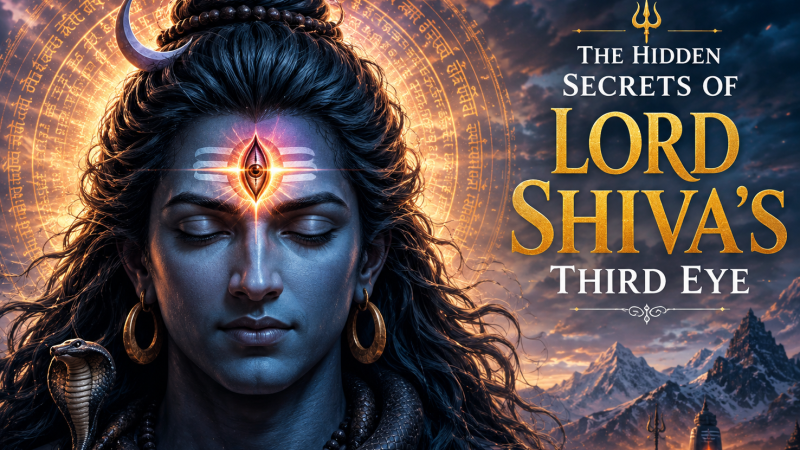
- Third Eye: Inner wisdom and cosmic vision
- Crescent Moon: Time and cycles
- Ganga flowing from hair: Flow of knowledge and life energy
- Serpent around neck: Control over fear and desire
- Ash-covered body: Detachment from material world
These are not literal ornaments—they are symbolic representations of universal principles.
Shiva and Modern Science: Strange Parallels
Interestingly, many modern scientific ideas align with ancient Hindu concepts:
1. Big Bang and Sound of Om
The universe began with a massive energy explosion—similar to the idea of Om, the first cosmic vibration.
2. Quantum Field Theory
Everything arises from an invisible energy field—similar to Shiva as pure consciousness.
3. Cyclic Universe Theory
Some physicists suggest the universe expands and contracts in cycles—just like Hindu cosmology.
While not scientifically proven in religious context, these parallels are fascinating.
Meditation and Shiva: Inner Universe Connection
Ancient yogis believed that the same universe exists within human consciousness.
When a person meditates deeply:
- Thoughts become silent
- Ego dissolves
- Awareness expands
This inner stillness is considered a direct experience of Shiva.
That is why Shiva is also known as Adi Yogi, the first yogi who taught meditation to humanity.
The Eternal Truth: Shiva is Not Outside, But Within
The deepest message of Shiva’s cosmic story is not just about the universe outside—but also within us.
Shiva represents:
- Awareness behind thoughts
- Silence behind sound
- Stillness behind motion
- Consciousness behind life
The universe is not separate from Shiva—it exists within Shiva.
And according to spiritual philosophy, we are also part of that same infinite consciousness.
Conclusion
The untold story of Lord Shiva and the origin of the universe is not just mythology—it is a profound symbolic explanation of existence itself. Shiva represents the infinite source from which everything arises and into which everything returns.
Whether viewed spiritually or philosophically, Shiva reminds us of one eternal truth:
The universe is not random—it is a cosmic rhythm of consciousness, energy, and transformation.