Lord Balarama: The Mighty Elder Brother of Krishna
When people hear the name Lord Krishna, they often think of the flute, Vrindavan, Radha, the Bhagavad Gita, and the great events of the Mahabharata. Yet standing beside Krishna throughout many important episodes of his divine life is another extraordinary personality—Lord Balarama, his elder brother.
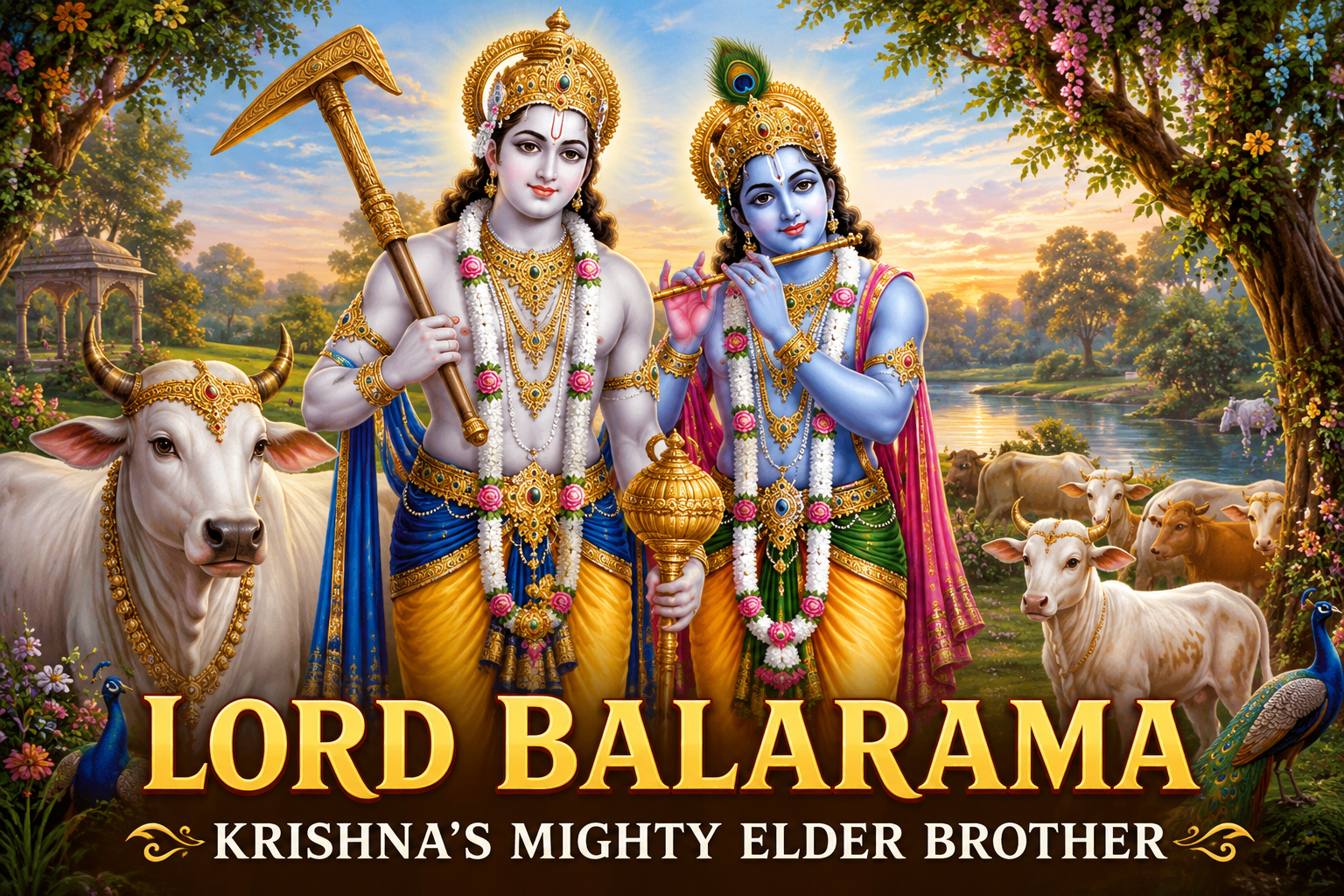
Balarama is one of the most powerful and fascinating figures in Hindu mythology. He is known for his enormous physical strength, courage, loyalty, straightforward nature, and deep affection for Krishna. Unlike Krishna, who is usually shown carrying a flute, conch, discus, and other royal symbols, Balarama is especially associated with the plough and mace. His plough connects him with agriculture and the earth, while his mace represents his unmatched strength and mastery of combat.
Balarama is known by several names, including Baladeva, Balabhadra, Sankarshana, Haladhara, and Halayudha. The names Haladhara and Halayudha are connected with his famous plough. The name Sankarshana is traditionally connected with the miraculous transfer of his unborn form from Devaki’s womb to Rohini’s womb.
In many Vaishnava traditions, Balarama is regarded as an incarnation or manifestation of Ananta Shesha(Sheshnag), the divine serpent associated with Lord Vishnu. Some traditions also include Balarama in particular lists of Vishnu’s avatars. The exact position of Balarama within the Dashavatara differs among traditions, so it is important not to treat every avatar list as identical.
His story is much more than a tale of physical power. Balarama represents strength guided by loyalty, courage balanced by responsibility, agricultural abundance, brotherly love, and the protection of righteousness.
Who Is Lord Balarama?
Balarama is the elder brother of Krishna and one of the central figures of the Krishna tradition. He was born into the Yadava family and became one of the most respected heroes of the Vrishni and Yadava clans.
His father was Vasudeva, while his mother was Rohini. His connection with Devaki is unusual because, according to the Bhagavata Purana(Srimad Bhagavatam) tradition, Balarama’s embryo was originally associated with Devaki but was divinely transferred to Rohini for protection. This miraculous event explains his name Sankarshana, which is associated with the idea of being drawn or transferred.
Balarama grew up alongside Krishna in the pastoral environment of Gokula and Vrindavan. Although Krishna was younger, Balarama often acted as his protector and elder brother. Their relationship is one of the most important sibling relationships in Hindu sacred literature.
Balarama is traditionally depicted with a fair or white complexion, contrasting with Krishna’s dark or blue complexion. His principal attributes are the hala, or plough, and the gada, or mace.
His personality is also different from Krishna’s. Krishna is frequently portrayed as playful, diplomatic, mysterious, and highly strategic. Balarama is more direct, powerful, honest, and sometimes quick-tempered.
This contrast makes the two brothers especially interesting. Krishna often solves problems through intelligence and diplomacy, while Balarama frequently represents straightforward strength and action.
The Birth of Balarama
The birth of Balarama is one of the most remarkable stories in Hindu mythology.
At the time, Kamsa, the tyrannical ruler of Mathura, had imprisoned his sister Devaki and her husband Vasudeva. A divine prophecy had warned Kamsa that Devaki’s eighth child would become the cause of his downfall.
Fearing the prophecy, Kamsa killed the children born to Devaki. According to the Bhagavata Purana tradition, Balarama was conceived before Krishna.
However, divine intervention protected him.
The unborn child was transferred from Devaki’s womb to the womb of Rohini, another wife of Vasudeva. Rohini was living away from Kamsa’s immediate control. The transfer was carried out through divine power associated with Yoga-Maya. Because of this miraculous event, Balarama became associated with both Devaki and Rohini in different aspects of his birth story.
The name Sankarshana is connected with this transfer.
Later, Krishna was born to Devaki and Vasudeva. Vasudeva secretly carried the newborn Krishna to Gokula, where he was raised by Nanda and Yashoda.
Balarama and Krishna eventually grew up together in Gokula and Vrindavan.
Their childhood became filled with extraordinary adventures.
Balarama and Krishna: The Divine Brothers
The relationship between Balarama and Krishna is central to understanding Balarama.
Krishna was the younger brother, but Balarama was often his protector, companion, and guide. Their personalities were different, but their purposes were closely connected.
Balarama participated in many of Krishna’s childhood adventures. He stood beside Krishna when dangerous demons threatened the people of Vraja.
The two brothers played with the cowherd boys, wandered through the forests, protected the cattle, and confronted supernatural enemies.
Balarama’s presence added a different dimension to Krishna’s childhood stories. Krishna often used cleverness and divine intelligence, while Balarama demonstrated extraordinary physical strength.
The two were therefore complementary.
Krishna represented divine wisdom, strategy, love, and spiritual mystery.
Balarama represented strength, stability, protection, and support.
This relationship is also reflected in Vaishnava theology. Balarama is frequently identified with Ananta Shesha, the cosmic serpent who serves as the divine support of Vishnu. In this theological understanding, Balarama’s role as Krishna’s elder brother reflects a deeper spiritual principle of divine support.
Why Is Balarama Called Baladeva?
The name Baladeva is one of Balarama’s most popular names.
The word bala means strength or power, while deva means divine being or deity.
Therefore, Baladeva can be understood as the divine embodiment of strength.
Balarama’s entire personality reflects this meaning.
He possesses enormous physical power, but his strength is not simply used for destruction. He protects his family, supports Krishna, defeats dangerous demons, teaches warriors, and protects people from injustice.
His strength also has an agricultural dimension.
The plough is one of his most important symbols. This makes Balarama different from many other warrior deities. His principal weapon is also a farmer’s tool.
This connection between strength and agriculture is an important part of Balarama’s identity. Traditional sources describe him as being strongly associated with farming and the plough.
Balarama and His Famous Plough
Perhaps the most recognizable symbol of Balarama is the plough, known in Sanskrit as hala.
Because he carries the plough, Balarama is called Haladhara, meaning “the bearer of the plough,” and Halayudha, meaning “the one whose weapon is the plough.”
The plough has a deep symbolic meaning.
A farmer uses a plough to prepare the earth for seeds. The soil must be opened before crops can grow. In this sense, Balarama’s plough can symbolize cultivation, fertility, nourishment, and the productive power of the earth.
At the same time, the plough becomes a divine weapon in Balarama’s hands.
This dual symbolism is remarkable.
It represents both:
- Agriculture and prosperity
- Physical strength
- Protection
- Control over nature
- Connection with the earth
- The transformation of difficult land into productive land
Balarama therefore has a special connection with ordinary farmers and rural life.
His image reminds devotees that spiritual life is not separated from the physical world. Food, agriculture, soil, water, work, and human effort are also essential parts of life.
Balarama’s Mace
Balarama is also associated with the mace, or gada.
The mace represents physical power and martial ability.
Balarama became one of the greatest experts in mace fighting. He taught the art to some of the most important warriors of the Mahabharata period, including Bhima and Duryodhana.
This places Balarama in a unique position.
He was connected to both sides of the great conflict.
Bhima fought for the Pandavas.
Duryodhana fought for the Kauravas.
Balarama had relationships with both, and this contributed to his complicated position during the Kurukshetra War.
His mastery of the mace also demonstrates that Balarama was not simply Krishna’s older brother. He was a great teacher, warrior, and independent personality in his own right.
Balarama and Dhenukasura
One of the famous childhood stories of Balarama concerns the demon Dhenukasura.
Dhenukasura had taken the form of a powerful donkey and was associated with the Talavana forest. The forest contained many delicious palm fruits, but people were afraid to enter because of the demon and his followers.
Balarama and Krishna went to the forest with their companions.
When Balarama began shaking the palm trees, the noise attracted Dhenukasura.
The demon attacked Balarama with great force.
But Balarama was not frightened.
He seized the demon and defeated him using his tremendous strength. Traditional accounts describe Balarama throwing the demon’s body against a tree.
The story became another demonstration of Balarama’s role as a protector.
Symbolically, the story can also be understood as the removal of obstacles that prevent people from enjoying the fruits of nature.
Balarama and the Yamuna
One of the most striking stories associated with Balarama concerns the Yamuna River.

According to traditional accounts, Balarama wanted the river to come closer to him. When the river did not respond to his command, Balarama became angry.
He took up his plough and pulled the Yamuna toward himself.
The story dramatically illustrates his supernatural strength.
The plough here is more than an agricultural instrument. It becomes an instrument capable of reshaping the landscape.
This story also reinforces Balarama’s close connection with rivers, agriculture, fertility, and the natural world.
The Yamuna is already deeply associated with Krishna’s childhood in Vrindavan. Balarama’s interaction with the river therefore adds another important layer to the sacred geography of the Krishna tradition.
Balarama and Revati
Balarama’s wife is Revati, the daughter of King Revata.
The story of Revati is unusual because it involves a fascinating concept of time.
According to the traditional story, King Revata took his daughter Revati to the realm of Brahma to seek advice about a suitable husband for her.
While they were there, time passed differently.
When they returned to the earthly world, many generations had passed.
The people of the earth had changed, and Revati was considered extraordinarily tall compared with the people of the later age.
Eventually, Revati married Balarama.
Their marriage connects Balarama to one of the most fascinating themes in Hindu mythology—the idea that time can pass differently in different realms.
Balarama and Revati are traditionally regarded as husband and wife, and their relationship forms an important part of Balarama’s later life.
Balarama as an Incarnation of Shesha
One of the most important theological questions about Balarama is his relationship with Ananta Shesha, the cosmic serpent.
In Vaishnava tradition, Ananta Shesha is the endless serpent upon whom Vishnu is traditionally depicted reclining in the cosmic ocean.
Shesha represents divine support, eternity, stability, and service.
Many Vaishnava traditions identify Balarama with Shesha or regard him as an incarnation or manifestation of Shesha.
This belief explains several features of Balarama’s identity.
He supports Krishna.
He protects Krishna.
He accompanies Krishna.
He serves Krishna.
And, in the theological symbolism of Shesha, he represents the eternal principle that supports the divine.
This makes Balarama’s role much deeper than simply being Krishna’s brother.
He can be understood as the divine support behind Krishna’s earthly mission.
Is Balarama an Avatar of Vishnu?
The answer depends on the Hindu tradition being followed.
In many Vaishnava traditions, Balarama is primarily regarded as an incarnation or manifestation of Ananta Shesha.
However, some traditional lists of Vishnu‘s avatars include Balarama among the Dashavatara, or ten principal incarnations. In such lists, the position of Balarama can vary depending on which tradition is being followed. Some lists include Balarama where other traditions include Buddha, while other traditions treat Krishna and Balarama differently within the theological framework.
Therefore, it is better to say:
Balarama is widely regarded as a divine manifestation of Ananta Shesha, and some Vaishnava traditions include him among Vishnu’s avatars.
This reflects the diversity of Hindu theology.
Hindu traditions do not always present one single universal list of divine incarnations. Different Puranic and Vaishnava traditions can emphasize different theological interpretations.
Balarama in the Mahabharata
Balarama also plays an important role in the Mahabharata tradition.
Although Krishna became deeply involved in the events of the Kurukshetra War, Balarama largely remained apart from the conflict between the Pandavas and Kauravas.
This was partly because he had relationships with both sides.
As a teacher of mace fighting, Balarama had taught both Bhima and Duryodhana.
This created a difficult situation.
He did not want to simply choose one student against another.
His decision demonstrates an important aspect of his character: he was not always willing to follow Krishna’s political choices.
Balarama was independent-minded.
He could disagree with Krishna.
He could become angry with people he believed had behaved improperly.
And he often preferred direct action to complicated diplomacy.
This makes him one of the more human-like personalities among the major divine figures of Hindu mythology.
Balarama and the Kurukshetra War
Balarama’s absence from the main battlefield is significant.
When the great war began, Balarama chose to undertake a pilgrimage rather than actively fight in the conflict.
This decision reflects his complicated position.
He had affection for the Pandavas.
He also had a connection with the Kauravas, especially Duryodhana, who had been his student.
His pilgrimage allowed him to remain outside the immediate political conflict.
However, Balarama later returned and became involved in events connected with the final mace battle between Bhima and Duryodhana.
The battle was fought according to the rules of mace combat, but Bhima eventually struck Duryodhana below the waist.
Balarama was angered by this because such a blow violated the traditional rules of mace fighting.
He was prepared to respond, but Krishna intervened and prevented the situation from becoming an even greater conflict.
The episode reveals an important characteristic of Balarama: he strongly valued rules, fairness, and martial discipline.
Even when the larger political circumstances were complicated, he could not easily ignore what he considered an injustice.
Balarama’s Personality
Balarama is not portrayed as a perfectly calm figure.
He can become angry.
He can be impulsive.
He enjoys worldly pleasures in some traditional accounts.
He can be strict.
But these characteristics make him a fascinating divine personality.
His anger is often connected with his strong sense of justice.
He does not easily tolerate disrespect.
He values loyalty.
He values honesty.
He values physical courage.
And he is deeply attached to his family.
Balarama’s personality therefore teaches an important lesson:
Strength without character can become destructive, but strength guided by responsibility can become protective.
Balarama represents the second kind.
Balarama as the God of Strength
The word bala itself is associated with strength.
Balarama therefore naturally became associated with physical power.
Wrestlers, warriors, farmers, and people seeking physical strength have traditionally found inspiration in him.
But Balarama’s strength can also be understood symbolically.
There are many kinds of strength:
- Physical strength
- Mental strength
- Emotional strength
- Moral strength
- Spiritual strength
- The strength to protect others
- The strength to remain loyal
- The strength to follow righteous principles
Balarama’s stories demonstrate many of these forms.
He is powerful enough to defeat demons, but he is also devoted enough to stand beside Krishna.
This combination of power and devotion is one of the most important features of his character.
Balarama as the Deity of Agriculture
Balarama’s relationship with agriculture deserves special attention.
His principal weapon is the plough.
A plough is not merely a weapon. It is one of the oldest tools of human civilization.
It prepares the soil.
It enables cultivation.
It makes food production possible.
Therefore, Balarama’s association with the plough connects him with farmers, fields, food, fertility, and rural life.
Some descriptions explicitly associate him with agriculture and farmers.
This makes Balarama particularly meaningful in societies where agriculture forms the foundation of life.
His plough can be seen as a symbol of the relationship between human beings and the earth.
It also offers a spiritual message.
Just as a field must be cultivated before it can produce crops, the human mind must be cultivated through discipline, knowledge, devotion, and good actions.
Balarama’s Other Names
Balarama has numerous names, and each name reveals something about his personality.
Baladeva
This name emphasizes his divine strength.
Balabhadra
This name is widely used in devotional and temple traditions and conveys the idea of an auspicious and powerful divine personality.
Sankarshana
This name is traditionally connected with the miraculous transfer of his unborn form from Devaki to Rohini.
Haladhara
It means the bearer or holder of the plough.
Halayudha
It refers to the plough as his weapon.
Dauji
In the Braj region, Balarama is affectionately known as Dauji, meaning elder brother. This name beautifully expresses the intimate relationship devotees feel toward him.
Each name highlights a different aspect of Balarama.
Together, they present him as warrior, farmer, protector, brother, teacher, and divine personality.
Balarama in the Jagannath Tradition
Balarama has a particularly important place in the Jagannath tradition of Odisha.
At the famous Jagannath Temple in Puri, Balarama is worshipped as Balabhadra, alongside Lord Jagannath and Subhadra.
The three form one of the most famous divine triads in Hindu worship.
This is particularly significant because Balarama’s identity in Puri is not merely that of Krishna’s elder brother. He is one of the principal deities of the sacred temple tradition.
The Puri tradition therefore demonstrates the broad reach of Balarama worship.
He is not limited to stories of Vrindavan or the Mahabharata. He has his own independent place in temple worship and devotional culture.
The three principal wooden images at Puri are ritually renewed during the traditional Nabakalebara ceremony at prescribed intervals, making the Jagannath tradition especially distinctive.
Balarama Jayanti
Balarama Jayanti is a festival dedicated to Lord Balarama.
It is traditionally observed on the full moon of the month of Shravana in many Hindu calendars, although regional traditions can differ.
Devotees remember Balarama’s birth, strength, devotion, and divine role.
Worship may include:
- Fasting
- Puja
- Recitation of sacred texts
- Offerings of fruits and traditional foods
- Singing devotional songs
- Visiting temples
- Prayers for strength and prosperity
The festival is especially meaningful to devotees who worship Krishna and Balarama together.
It is also associated with the agricultural symbolism of Balarama.
Because his primary symbol is the plough, the festival can be understood as an opportunity to express gratitude for the earth, food, farming, and the forces that sustain human life.
Spiritual Lessons from Lord Balarama
Balarama’s life contains many spiritual lessons.
1. Strength should protect, not oppress
Balarama’s enormous power is usually presented as a means of protection.
This teaches that true strength should be used responsibly.
2. Family loyalty is important
Balarama’s relationship with Krishna is one of the strongest examples of brotherly devotion in Hindu mythology.
He repeatedly stands beside his younger brother.
3. Agriculture deserves respect
The plough reminds us that food does not simply appear on a table.
It comes from soil, water, labor, farming, and nature.
4. Discipline creates strength
Balarama’s mastery of combat demonstrates the importance of training and discipline.
Natural talent alone is not enough.
5. Honesty has value
Balarama is known for his straightforward personality.
He does not always use complicated strategies.
His character teaches that directness and honesty can also be forms of strength.
6. Anger must be controlled
Balarama’s quick temper also provides a warning.
Even great strength can become dangerous if anger is not controlled.
7. Spiritual power can exist in ordinary work
The plough is an ordinary agricultural tool.
Yet in Balarama’s hands it becomes a divine symbol.
This suggests that ordinary work can also become sacred when performed with responsibility and devotion.
Balarama’s Importance in Hinduism
Balarama is important for several different reasons.
First, he is Krishna’s elder brother.
Second, he is a major figure in the Bhagavata Purana, Mahabharata, and Harivamsha traditions.
Third, he is associated with Ananta Shesha.
Fourth, he is a symbol of strength and agriculture.
Fifth, he is an important deity in the Jagannath tradition.
Sixth, he is remembered as a great teacher of martial arts.
Seventh, his stories offer valuable moral and spiritual lessons.
His importance is therefore much broader than his role as a supporting character in Krishna’s story.
Balarama has his own identity, his own symbols, his own worship traditions, and his own theological significance.
Balarama and the Meaning of Divine Strength
The most powerful message of Balarama may be found in the meaning of his strength.
In modern life, strength is often associated with physical power, wealth, authority, or influence.
Balarama presents a broader understanding.
A strong person is someone who can protect others.
A strong person can remain loyal.
A strong person can stand for justice.
A strong person can work hard.
A strong person can cultivate the earth.
A strong person can control fear.
And perhaps most importantly, a strong person can use power without becoming arrogant.
Balarama’s stories contain both his heroic qualities and his imperfections. That makes his character particularly valuable.
He is powerful, but sometimes angry.
He is divine, but closely connected with ordinary rural life.
He is a warrior, but his primary weapon is a farmer’s tool.
He is Krishna’s elder brother, but he also has his own independent identity.
These contrasts make Balarama one of the most interesting figures in Hindu mythology.
The Deeper Relationship Between Balarama and Krishna
The relationship between Balarama and Krishna can also be viewed spiritually.
Krishna is frequently associated with divine consciousness, wisdom, love, and the mysterious power of divine play.
Balarama is associated with support, strength, service, and foundation.
In Vaishnava theology, their relationship is therefore more than a biological sibling relationship.
Balarama as Shesha represents the principle that supports the divine.
This idea can be seen in the traditional image of Vishnu resting upon Ananta Shesha.
The theological symbolism is powerful.
Before anything can stand, there must be support.
Before spiritual knowledge can flourish, there must be discipline.
Before a crop can grow, the earth must be prepared.
Before a person can accomplish a great task, there must be strength and stability.
Balarama represents this foundation.
Balarama’s Legacy
Balarama’s legacy continues throughout Hindu religious culture.
He is remembered in temples, festivals, devotional literature, paintings, sculptures, folk traditions, and stories.
In Braj, the affectionate name Dauji reflects the intimate relationship devotees have with him.
In Odisha, Balabhadra is one of the central deities of the Jagannath tradition.
Among Vaishnava communities, Balarama is revered as a divine manifestation closely connected with Krishna.
His image remains recognizable because of the plough and mace.
His stories continue to inspire people who value strength, courage, agriculture, brotherhood, discipline, and devotion.
Although Krishna often receives greater attention in popular culture, Balarama should not be viewed merely as Krishna’s companion.
He is a powerful divine personality with a distinct theological and cultural identity.
Conclusion
Lord Balarama, the elder brother of Krishna, occupies a unique position in Hindu mythology.
He is the powerful Baladeva, the plough-bearing Haladhara, the mighty Halayudha, the divine Sankarshana, and the beloved Dauji of Braj.
His unusual birth connects him with both Devaki and Rohini. His childhood connects him with Krishna and the pastoral world of Vrindavan. His plough connects him with agriculture and the earth. His mace connects him with martial strength and discipline. His relationship with Revati adds another fascinating chapter to his life. His role in the Mahabharata connects him with the greatest warriors of the age.
Most importantly, many Vaishnava traditions identify Balarama with Ananta Shesha, the divine serpent who represents eternal support and service.
Balarama teaches that strength is not valuable simply because it is powerful. Its true value comes from how that strength is used.
His plough teaches us to cultivate the earth and our own minds.
His mace teaches discipline and courage.
His relationship with Krishna teaches loyalty and brotherly love.
His anger reminds us that even great strength must be controlled.
His devotion teaches humility.
And his association with Shesha reminds devotees of the importance of divine service and spiritual support.
For these reasons, Balarama remains an important and inspiring figure in Hinduism.
He is not merely the elder brother of Krishna.
He is the embodiment of strength, protection, service, agriculture, loyalty, and divine support.
*Related Articles: 1. Krishna: The Divine Playwright of Love and Wisdom
2. Radha: The Divine Consort of Krishna
3. Vrindavan: A Sacred Pilgrimage City in India
4. Sheshnag: Lord Vishnu’s Divine Serpent
[Updated on 30 August, 2026]