Bhishma Panchak: The Five Sacred Days of Lord Vishnu Worship
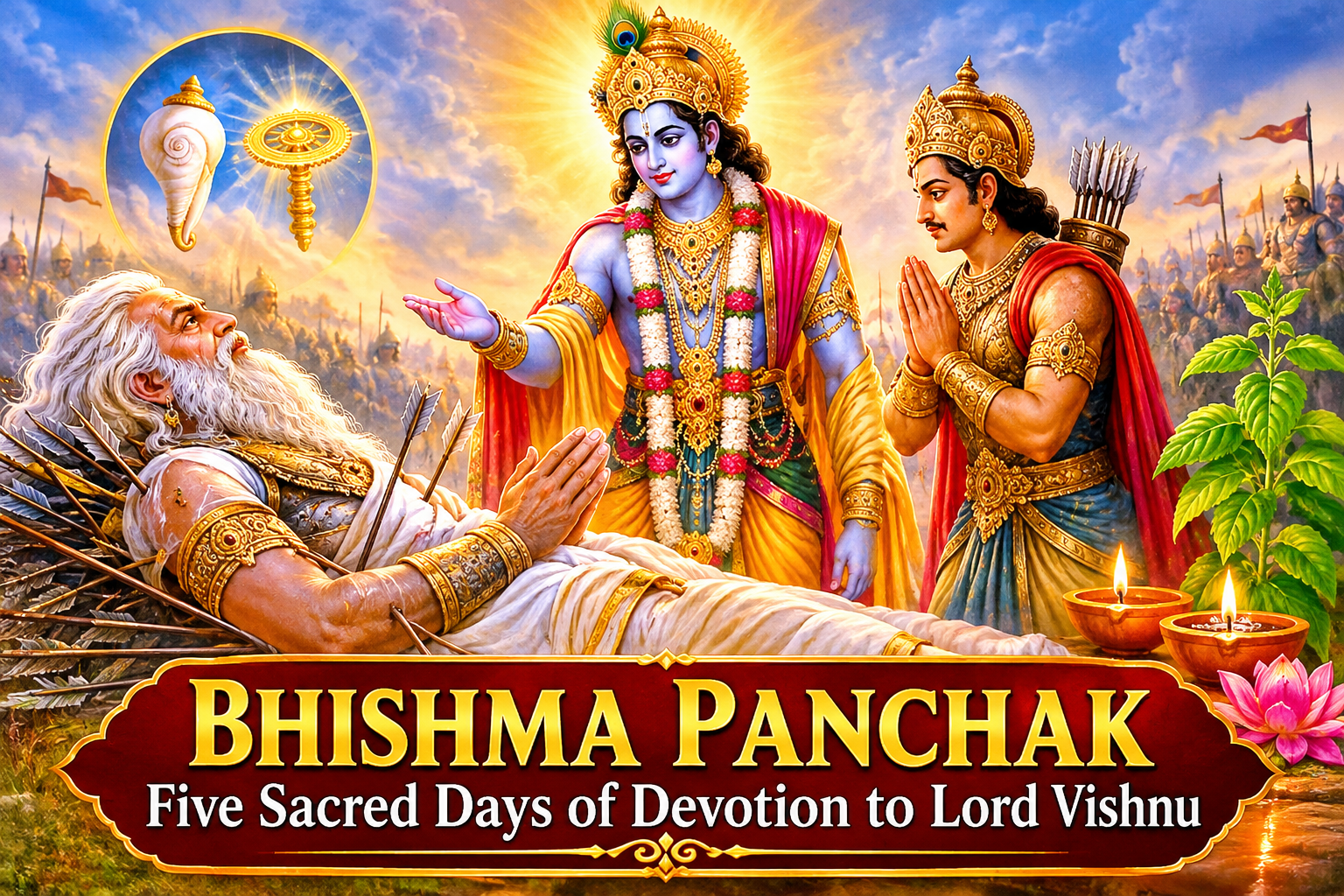
Among the many spiritually significant observances in Hinduism, Bhishma Panchak occupies a special position in the sacred month of Kartik. It is a five-day period traditionally dedicated to devotion, fasting, prayer, charity and the worship of Lord Vishnu. Observed from Kartik Shukla Ekadashi to Kartik Purnima, this period is regarded by many Vaishnava devotees as an especially auspicious opportunity to deepen their spiritual practices.
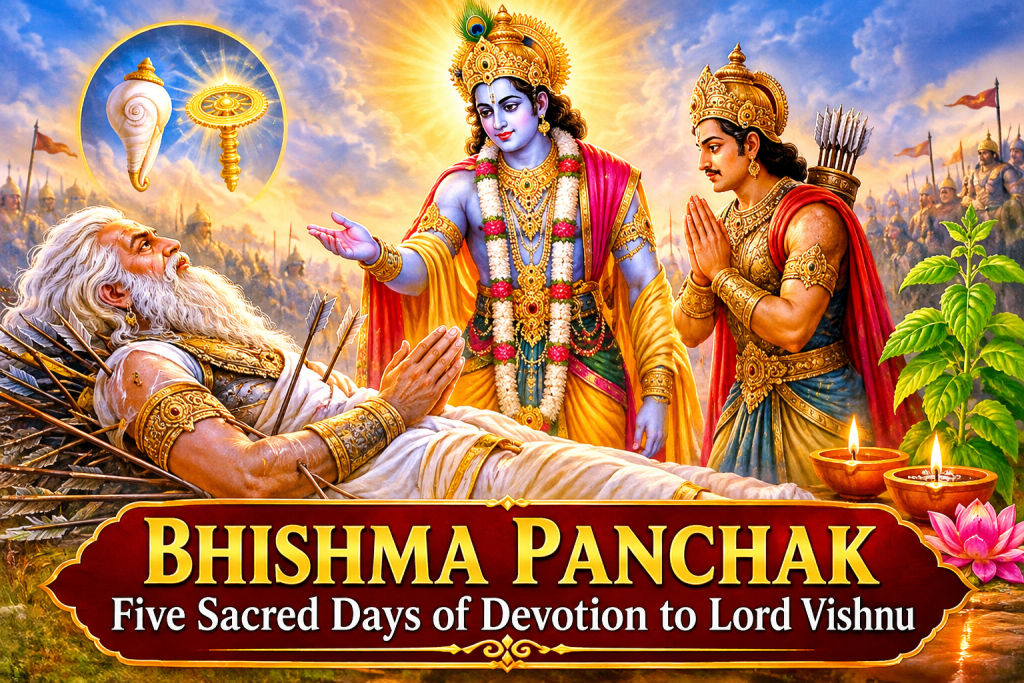
The name Bhishma Panchak is associated with Bhishma Pitamah, one of the most respected personalities in the Mahabharata. Known for his extraordinary vows, dedication to duty, wisdom and devotion, Bhishma represents self-discipline and commitment to righteousness. The five-day observance is traditionally connected with his name and spiritual legacy.
The period begins on Dev Uthana Ekadashi, also known as Prabodhini Ekadashi, when Lord Vishnu is ceremonially believed to awaken from his cosmic sleep. It concludes on Kartik Purnima, a full-moon day associated with sacred bathing, worship, charity and several important Hindu traditions.
For devotees, Bhishma Panchak is not simply a fasting period. It represents an opportunity to control the senses, reduce worldly distractions, cultivate compassion and dedicate one’s thoughts and actions to the Divine.
Although the observance is particularly important among Vaishnava communities, its broader message of self-restraint, devotion and spiritual purification has relevance for people following different Hindu traditions.
What Is Bhishma Panchak?
The Sanskrit word Panchak means a group of five or a period consisting of five units. Bhishma Panchak therefore refers to a sacred five-day observance associated with Bhishma Pitamah.
It takes place during the Shukla Paksha, or waxing fortnight, of Kartik. The observance begins on the eleventh lunar day, known as Ekadashi, and ends on the full-moon day, Purnima.
According to traditional Hindu religious literature, devotees observe this period through fasting, worship of Lord Vishnu, recitation of sacred mantras, charitable activities and the practice of self-restraint.
The Padma Purana and other Puranic traditions describe the importance of Bhishma Panchak and its religious procedures. These accounts associate the observance with the worship of Lord Vishnu and the offering of prayers and water oblations to Bhishma.
The observance is sometimes described as one of the most demanding religious vows because it calls for discipline throughout five consecutive days. However, practices differ among Hindu communities, families and religious institutions.
Some devotees undertake a strict fast, while others follow a simple vegetarian diet and maintain regular prayer. The central purpose is not merely abstaining from food but developing devotion, purity of conduct and control over one’s senses.
Bhishma Panchak 2026: Dates and Important Observances
In 2026, Bhishma Panchak falls during the second half of November. According to the published Dhaka and Khulna Hindu calendar listings, the five-day observance begins on Friday, 20 November, and concludes on Tuesday, 24 November 2026.
The dates are associated with Kartik Shukla Ekadashi through Kartik Purnima.
The following is the general five-day schedule:
| Date | Lunar Tithi | Important observance |
|---|---|---|
| 20 November 2026, Friday | Shukla Ekadashi | Bhishma Panchak begins; Dev Uthani Ekadashi |
| 21 November 2026, Saturday | Shukla Dwadashi | Tulsi Vivah observances in many traditions |
| 22 November 2026, Sunday | Shukla Trayodashi | Pradosh-related worship |
| 23 November 2026, Monday | Shukla Chaturdashi | Vaikuntha Chaturdashi |
| 24 November 2026, Tuesday | Kartik Purnima | Bhishma Panchak concludes; Dev Diwali |
Important calendar note: Hindu festivals follow lunar tithis rather than fixed Gregorian dates. Tithi commencement and conclusion can vary according to geographical location and the calendar tradition followed. Devotees in Bangladesh should consult a locally applicable Panchang and their family or temple tradition for exact fasting and worship timings.
Historical and Mythological Background of Bhishma Panchak
To understand the significance of Bhishma Panchak, it is necessary to understand the extraordinary personality of Bhishma Pitamah.
Bhishma was one of the central figures of the Mahabharata, the great Indian epic traditionally attributed to Maharishi Ved Vyasa. He was born as Devavrata, the son of King Shantanu and Goddess Ganga.
From childhood, Devavrata demonstrated exceptional intelligence, courage, military ability and knowledge of religious principles. He received education and training from distinguished teachers and became an accomplished warrior.
His life changed when his father, King Shantanu, wished to marry Satyavati, the daughter of a fisherman.
Satyavati’s father agreed to the marriage on the condition that Satyavati’s children would inherit the throne. However, Devavrata was already the legitimate heir to the kingdom.
To fulfil his father’s wish, Devavrata made an extraordinary promise. He renounced his claim to the throne and further vowed to remain celibate throughout his life so that he would never have descendants who could challenge the succession of Satyavati’s children.
This vow was so extraordinary that the gods and celestial beings are traditionally said to have praised him, and he came to be known as Bhishma, meaning one who has taken a terrible or formidable vow.
His commitment became one of the defining characteristics of his identity.
Bhishma’s Role in the Mahabharata
Bhishma served the Kuru dynasty for generations. He was a guardian of Hastinapura and played an important role in the political and military history of the kingdom.
He witnessed the development of the Pandavas and Kauravas and remained a central figure during their conflict.
Although he fought on the side of the Kauravas in the Kurukshetra War, his personal affection for the Pandavas remained significant. His position reflected the complicated relationship between personal feelings, royal obligations and the responsibilities he believed he had accepted.
Bhishma became the commander-in-chief of the Kaurava army during the early stages of the eighteen-day war.
He was almost impossible to defeat because of his extraordinary military skills and the boon associated with his death. He possessed Ichchha Mrityu, the ability to choose the time of his departure from the mortal world.
Eventually, Arjuna brought him down with the assistance of Shikhandi. Bhishma fell upon a bed of arrows, known as Shara Shaiya, but did not immediately leave his body.
He remained alive until the auspicious period of Uttarayana.
Bhishma’s Wisdom and Final Teachings
While lying on the bed of arrows, Bhishma shared his knowledge of politics, morality, governance, duty, spirituality and righteous conduct.
After the war, Yudhishthira approached him with questions concerning the responsibilities of a king and the principles of Dharma.
Bhishma explained various aspects of Raj Dharma, personal conduct, social responsibility and spiritual life.
The Mahabharata’s Shanti Parva and Anushasana Parva contain many of these teachings.
His final instructions are among the important philosophical portions of the epic. They demonstrate the value of knowledge, responsibility, self-discipline and devotion.
Bhishma’s connection with Lord Vishnu is also significant. The Vishnu Sahasranama, the celebrated thousand names of Lord Vishnu, is traditionally associated with his teachings to Yudhishthira.
This association provides an important religious and philosophical connection between Bhishma and Vishnu worship.
Why Is Bhishma Panchak Observed?
Bhishma Panchak is observed for several religious and spiritual reasons.
1. Devotion to Lord Vishnu
The principal religious focus of the observance is Lord Vishnu. Devotees believe that worshipping Vishnu during these five days is particularly auspicious.
They offer flowers, Tulsi leaves, incense, lamps, fruits and other devotional items. They also recite Vishnu Sahasranama, Vishnu mantras and other sacred texts.
2. Remembering Bhishma Pitamah
The observance also provides an opportunity to remember Bhishma’s extraordinary life and his commitment to his vows.
His character is traditionally associated with celibacy, discipline, loyalty, courage and knowledge.
Devotees offer water oblations and prayers in his honour according to their religious traditions.
3. Spiritual Purification
Fasting, prayer, meditation and charity are regarded as practices that help devotees develop spiritual discipline.
The five-day period encourages individuals to reduce unnecessary desires and focus on righteous conduct.
4. The Importance of Kartik Month
Kartik is considered an especially sacred month in many Vaishnava traditions. It is also known as Damodara Masa, referring to Lord Krishna in his Damodara form.
Daily worship, lighting lamps, reciting sacred texts and offering prayers to Lord Vishnu are common practices throughout this month.
Bhishma Panchak forms an important concluding observance within the Kartik religious calendar.
5. Charity and Service
Charitable activities are an important part of the observance. Traditional religious practices include providing food, clothing and other necessities to people in need.
The emphasis on charity reflects the principle that religious devotion should be accompanied by compassionate action.
The Five Days of Bhishma Panchak: Rituals and Worship
One of the distinctive features of Bhishma Panchak is its five-day structure. Each day has a particular religious significance.
A traditional Vaishnava worship sequence associates each day with a different part of the divine form of Lord Vishnu.
The worship proceeds from the feet towards the head, symbolically representing the complete divine form.
Day 1: Ekadashi – Worship of Lord Vishnu’s Feet
The first day begins on Kartik Shukla Ekadashi.
Ekadashi is itself an important fasting day in Hinduism, particularly among devotees of Lord Vishnu.
On this day, devotees take an early bath and begin their observance with a religious resolution, known as Sankalpa.
Lord Vishnu is worshipped with flowers, incense, lamps, fruits and Tulsi leaves.
In a traditional five-day offering sequence, lotus flowers are offered at the feet of Lord Vishnu.
Devotees may recite:
Om Namo Bhagavate Vasudevaya
This is one of the most widely used mantras dedicated to Lord Vishnu.
Some devotees observe a complete fast, while others consume fruits, milk or permitted fasting foods according to their tradition and physical capacity.
Day 2: Dwadashi – Worship of the Knees
The second day is Kartik Shukla Dwadashi.
Devotees continue their worship of Lord Vishnu and maintain the spiritual discipline established on the first day.
In the traditional body-part offering sequence, the knees or lower limbs of Lord Vishnu receive worship.
Bilva leaves are mentioned in certain traditional ritual sequences, although the exact offerings differ among religious sources and communities.
The day is also associated with Tulsi Vivah in many Hindu traditions, particularly where the ceremony is observed according to the local calendar.
Tulsi Vivah symbolically celebrates the marriage of the sacred Tulsi plant with Lord Vishnu or his Shaligram form.
Devotees decorate Tulsi plants, light lamps and offer prayers.
Day 3: Trayodashi – Worship of the Navel
The third day is Kartik Shukla Trayodashi.
The navel of Lord Vishnu receives attention in the traditional sequence of worship.
Sandalwood paste and fragrant offerings are mentioned in some ritual descriptions.
The navel has particular symbolic significance in Hindu cosmology because Lord Brahma is traditionally described as emerging from a lotus that grew from the navel of Lord Vishnu.
This imagery represents the relationship between the preservation of the universe and the process of creation.
Devotees continue chanting Vishnu mantras, reading sacred texts and maintaining their chosen fasting discipline.
Day 4: Chaturdashi – Worship of the Shoulders
The fourth day is Kartik Shukla Chaturdashi.
The shoulders of Lord Vishnu are worshipped according to the traditional five-part sequence.
Flowers, including varieties mentioned in particular ritual traditions, are offered.
Devotees may also observe Vaikuntha Chaturdashi, an important religious occasion associated with both Lord Vishnu and Lord Shiva.
In several Hindu traditions, this day symbolises the relationship between the two deities and the principle of unity in divine worship.
Prayers, lamp offerings and temple visits are common activities.
Day 5: Kartik Purnima – Worship of the Head
The fifth and final day is Kartik Purnima.
It marks the conclusion of Bhishma Panchak.
The head of Lord Vishnu receives worship in the traditional sequence. Malati and other fragrant flowers are mentioned in certain descriptions of the observance.
Devotees complete their prayers, offer lamps and perform charitable activities.
The full moon of Kartik is regarded as a sacred occasion for bathing, worship and giving donations.
After completing the prescribed religious procedures, devotees conclude their fasting according to their respective traditions.
The five-day sequence symbolically completes the worship of the entire divine form of Lord Vishnu.
Bhishma Panchak Vrat: Fasting Rules and Food Traditions
Fasting is one of the central features of Bhishma Panchak. However, the nature of fasting depends on the devotee’s religious tradition, personal capacity and family customs.
Some traditional descriptions prescribe strict dietary restrictions, while other devotees observe a simpler form of fasting.
Types of Fasting
The following are common approaches to fasting:
1. Nirjala Vrat
This is a strict form of fasting in which the devotee abstains from both food and water for a prescribed period. It is physically demanding and should not be undertaken without considering health and safety.
2. Phalahara Vrat
In this form of fasting, devotees consume fruits, milk and other permitted items while avoiding regular meals.
3. Partial Fasting
Some devotees avoid grains, pulses or selected foods while maintaining a simple vegetarian diet.
4. Sattvic Food
Many households follow a sattvic diet during the observance. This generally involves simple vegetarian food prepared without ingredients prohibited by their fasting tradition.
The purpose is to maintain simplicity and discipline.
Traditional Food Offerings
Traditional descriptions of Bhishma Panchak include references to five substances associated with Panchagavya:
- Gomaya – cow dung.
- Gomutra – cow urine.
- Dadhi – curd.
- Kshira – milk.
- Ghrita – clarified butter or ghee.
These substances appear in particular ritual descriptions and are associated with traditional ideas of purification.
However, ritual references should not be interpreted as a recommendation to consume unsafe or medically unsuitable substances. Devotees can follow the guidance of their religious authorities while prioritising food safety and personal health.
The precise fasting menu is not identical across all Hindu communities.
Worship of Lord Vishnu During Bhishma Panchak
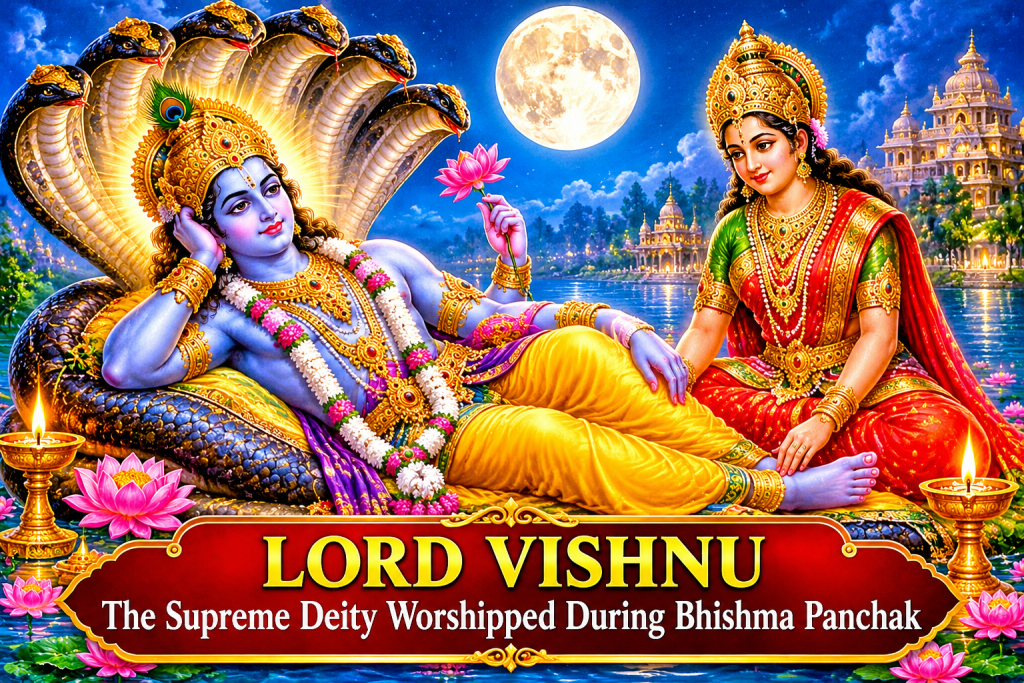
Lord Vishnu is the principal deity worshipped during Bhishma Panchak.
As the preserver of the universe in Hindu philosophy, Vishnu represents the maintenance of cosmic order and the protection of Dharma.
Devotees may worship Vishnu in several forms, including Narayana, Krishna, Damodara and other traditional manifestations.
Morning Worship
The day generally begins with a bath and preparation of the place of worship.
A clean area is arranged with an image or idol of Lord Vishnu. Flowers, Tulsi leaves, incense and a lamp are placed before the deity.
Devotees may offer water, fruits and other suitable food items.
Tulsi Offering
Tulsi occupies an important position in Vaishnava worship.
Tulsi leaves are traditionally offered to Lord Vishnu and Krishna. The plant is also worshipped independently in many Hindu households.
During Kartik, lighting a lamp near the Tulsi plant is a common religious practice.
Lighting of Lamps
Lighting a lamp is an important Kartik tradition.
Devotees light lamps in temples, homes and near sacred plants. The practice symbolises the removal of darkness and the presence of spiritual knowledge.
Some devotees maintain a lamp before Lord Vishnu during the observance, following their household or temple tradition.
Recitation of Sacred Texts
The following texts and prayers are commonly associated with Vishnu worship:
- Vishnu Sahasranama.
- Bhagavad Gita.
- Narayana Kavach.
- Vishnu Stotras.
- Damodarashtakam.
- Sacred passages from the Mahabharata and Puranas.
Recitation may be performed individually or collectively in temples.
Offering Water to Bhishma Pitamah
One of the distinctive aspects of Bhishma Panchak is the remembrance of Bhishma Pitamah through water offerings.
In traditional Hindu ritual practice, water oblations are known as Tarpana.
The observance may include offerings to ancestors, sages and Bhishma according to the relevant ritual instructions.
The Padma Purana describes the offering of water and respectful homage to Bhishma during this period.
A traditional offering recalls his identity as the son of Shantanu and his association with the Vasus.
The practice reflects gratitude and remembrance.
It also demonstrates how Hindu religious observances frequently combine devotion to a deity with respect for revered ancestors, teachers and exemplary personalities.
Those who wish to perform Bhishma Tarpana should follow the instructions of a knowledgeable priest because the procedure and mantras may vary according to tradition.
Bhishma Panchak and the Significance of Kartik Purnima
Kartik Purnima is the final day of Bhishma Panchak and has significance beyond this five-day observance.
It is celebrated in different parts of India and among Hindu communities worldwide.
The day is associated with sacred bathing, temple worship, charitable giving and the lighting of lamps.
Dev Diwali
Kartik Purnima is also associated with Dev Diwali, especially in Varanasi.
According to a popular Hindu tradition, the gods celebrate Diwali on this full-moon day to mark the victory of Lord Shiva over the demon Tripurasura.
The occasion is therefore also known as Tripurari Purnima.
The ghats of Varanasi are illuminated with thousands of lamps, creating a major religious and cultural gathering.
Sacred Bathing
Taking a holy bath on Kartik Purnima is an important practice.
Many devotees visit rivers and sacred water bodies to perform Kartik Snan.
The Ganga, Yamuna and other rivers hold special significance in Hindu religious traditions.
Those unable to visit a pilgrimage site may take a bath at home and offer prayers.
Charity and Donations
Giving food, clothing and other necessities is considered meritorious on Kartik Purnima.
The day is also associated with donations to temples, religious institutions and people in need.
Thus, the conclusion of Bhishma Panchak is connected with a broader culture of devotion, charity and community participation.
Spiritual Significance and Benefits of Bhishma Panchak
Hindu religious literature associates the observance of Bhishma Panchak with considerable spiritual merit.
The benefits are traditionally understood in religious and philosophical terms rather than as scientifically measurable outcomes.
1. Development of Self-Discipline
Observing a five-day religious vow requires consistency.
Devotees must regulate their eating habits, daily routines and personal activities.
This practice can encourage patience, restraint and determination.
2. Increased Devotion to Lord Vishnu
Regular prayer, mantra recitation and worship create opportunities for devotees to strengthen their relationship with Lord Vishnu.
The observance provides a structured period for spiritual reflection.
3. Remembrance of Dharma
Bhishma’s life illustrates the importance of commitment and responsibility.
His teachings encourage reflection on Dharma, ethical decisions and the consequences of personal actions.
4. Cultivation of Charity
The observance encourages donations and assistance to people who need support.
Food distribution, helping disadvantaged families and supporting religious activities are examples of charitable practices.
5. Spiritual Reflection
The five-day period offers time for meditation, reading sacred texts and examining personal conduct.
Many devotees use this opportunity to reduce unnecessary distractions and focus on spiritual priorities.
6. Traditional Belief in Liberation
Puranic descriptions associate the proper observance of Bhishma Panchak with spiritual merit and liberation.
In Hindu philosophy, Moksha refers to liberation from the cycle of birth and death.
Such descriptions express the religious importance of sincere devotion and spiritual discipline.
Bhishma Panchak in Different Hindu Communities
Although Bhishma Panchak is particularly prominent in Vaishnava traditions, its observance is not completely uniform.
Different regions and religious communities follow their own practices.
Some emphasise the worship of Lord Vishnu, while others give greater attention to Bhishma Tarpana and remembrance.
In certain Vaishnava institutions, devotees undertake a strict five-day vow. In other households, the observance consists of daily prayer, vegetarian food, lamp lighting and charitable activities.
Some communities place particular importance on the five-part worship of Vishnu’s divine form.
Others emphasise the conclusion of Kartik worship on Purnima.
This diversity reflects the broader character of Hindu religious life, in which shared scriptural foundations may be expressed through different regional and family traditions.
How Is Bhishma Panchak Observed in Bangladesh?
Hindu communities in Bangladesh maintain a variety of religious traditions throughout Kartik.
The month is associated with worship of Lord Vishnu, Krishna, Radha and Tulsi, alongside several important Ekadashi and Purnima observances.
Bhishma Panchak can be observed through household worship, temple programmes and individual religious practices.
Household Observances
Families may arrange a small altar with an image of Lord Vishnu or Krishna.
They offer flowers, Tulsi leaves, incense and lamps and recite devotional prayers.
Some families maintain a simple vegetarian diet throughout the five days.
Temple Worship
Temples may organise special Vishnu worship, Bhagavad Gita recitation, religious discussions and collective prayer.
Vaishnava temples and organisations may also conduct devotional programmes connected with the conclusion of Kartik month.
Charity and Community Activities
Food distribution and donations can form part of the observance.
Devotees may support poor families, provide meals or contribute to temple activities.
These practices make the observance a community-oriented religious occasion.
Observance in Rural Areas
In rural Bangladesh, many Hindu families maintain traditional practices associated with Kartik.
Lighting lamps, offering prayers and following family customs are common features of the religious calendar.
The exact form of Bhishma Panchak observance depends on local traditions and the availability of temple programmes.
The Connection Between Bhishma Panchak and Vishnu Sahasranama
One of the most important spiritual connections in this observance is the Vishnu Sahasranama.
The Vishnu Sahasranama consists of one thousand names of Lord Vishnu. It is included in the Anushasana Parva of the Mahabharata.
Yudhishthira asks Bhishma about the highest deity and the most effective means of attaining auspiciousness.
Bhishma responds by explaining the greatness of Lord Vishnu and reciting the thousand names.
The text has become one of the most widely respected devotional compositions in Hinduism.
Its recitation is particularly meaningful during Bhishma Panchak because it connects the observance with Bhishma’s final teachings.
Devotees may recite the entire Sahasranama or listen to its chanting.
The practice encourages concentration, remembrance of the Divine and reflection on the many attributes of Lord Vishnu.
Bhishma Panchak and the Philosophy of Self-Control
The spiritual meaning of Bhishma Panchak extends beyond the performance of external rituals.
Its central themes include discipline, commitment, devotion and righteous conduct.
Bhishma’s life provides an example of how a vow can shape an individual’s identity and responsibilities.
His decision to renounce the throne and remain celibate became central to the history of the Kuru dynasty.
However, his life also raises important philosophical questions about the relationship between personal promises, ethical responsibility and the wider consequences of decisions.
The Mahabharata does not present its characters as simple examples of perfection. Instead, it explores complex situations in which duty, loyalty and justice may come into conflict.
Remembering Bhishma during this five-day observance can therefore encourage devotees to consider not only the importance of keeping promises but also the wisdom required to understand Dharma.
The worship of Lord Vishnu adds another dimension to this reflection.
Vishnu represents the preservation of cosmic order, while Bhishma’s teachings emphasise the responsibilities of individuals within society.
Together, these associations provide the observance with a broader philosophical meaning.
Do All Devotees Need to Observe a Strict Fast?
No. The strictness of Bhishma Panchak fasting differs among traditions.
Some religious descriptions prescribe demanding fasting practices. However, household devotees may follow a simpler form of observance.
Individuals should consider their health, age, physical capacity and medical requirements before undertaking a fast.
Children, elderly people, pregnant women and people with medical conditions should not undertake severe dietary restrictions without appropriate medical advice.
The spiritual objective of the observance can also be pursued through prayer, meditation, charity, vegetarian meals and self-restraint.
A sincere devotional practice does not require a person to endanger their health.
Important Mantras for Bhishma Panchak
Devotees may recite different prayers during the five days. The following are widely used devotional mantras associated with Lord Vishnu.
1. Vishnu Mantra
Om Namo Bhagavate Vasudevaya.
2. Narayana Mantra
Om Namo Narayanaya.
3. Krishna Mantra
Hare Krishna Hare Krishna, Krishna Krishna Hare Hare,
Hare Rama Hare Rama, Rama Rama Hare Hare.
4. Vishnu Sahasranama
Devotees may recite the thousand names of Lord Vishnu as presented in the Mahabharata.
5. Damodara Prayer
During Kartik, many Vaishnava devotees recite Damodarashtakam, a devotional prayer dedicated to Lord Krishna in his Damodara form.
Regular recitation of these prayers is a way of maintaining devotion throughout the observance.
Frequently Asked Questions About Bhishma Panchak
1. What is Bhishma Panchak?
Bhishma Panchak is a five-day Hindu religious observance during Kartik Shukla Paksha. It begins on Ekadashi and concludes on Kartik Purnima. It is associated with Bhishma Pitamah and the worship of Lord Vishnu.
2. Why is it called Bhishma Panchak?
The observance is associated with Bhishma Pitamah, the respected warrior and teacher of the Mahabharata. Panchak refers to the five-day period.
3. When is Bhishma Panchak in 2026?
According to the published Dhaka and Khulna calendar listings, it begins on 20 November 2026 and concludes on 24 November 2026.
4. Which deity is worshipped during Bhishma Panchak?
Lord Vishnu is the principal deity worshipped during this period. Devotees may worship him as Narayana, Krishna or Damodara.
5. How many days is Bhishma Panchak?
It lasts five lunar days, from Kartik Shukla Ekadashi to Kartik Purnima.
6. Can women observe Bhishma Panchak?
Yes. Women may observe the vow according to their religious traditions, personal circumstances and physical capacity.
7. Is fasting compulsory during Bhishma Panchak?
Fasting is an important traditional feature, but the form of fasting differs. Devotees may follow a strict fast or a simpler dietary observance.
8. What should devotees offer to Lord Vishnu?
Common offerings include Tulsi leaves, flowers, fruits, incense, lamps, sandalwood paste and suitable vegetarian food.
9. What is the significance of Bhishma Tarpana?
Bhishma Tarpana is a traditional water offering made in remembrance of Bhishma Pitamah. It expresses respect and gratitude towards the great figure of the Mahabharata.
10. When does Bhishma Panchak end?
It ends on Kartik Purnima, the full-moon day of Kartik.
11. What is the relationship between Bhishma Panchak and Dev Diwali?
Both conclude on Kartik Purnima. Dev Diwali is particularly associated with the celebration of Lord Shiva’s victory over Tripurasura and the lighting of lamps in Varanasi.
12. Which sacred text describes Bhishma Panchak?
The Padma Purana and other Puranic traditions describe the observance and its religious procedures.
Conclusion: A Five-Day Journey Towards Devotion and Discipline
Bhishma Panchak is an important five-day religious observance that brings together the spiritual traditions of Kartik, devotion to Lord Vishnu and remembrance of Bhishma Pitamah.
Beginning on Ekadashi and concluding on Kartik Purnima, it encourages devotees to practise fasting, prayer, charity, meditation and self-restraint.
Its connection with Bhishma gives the observance a distinctive place in Hindu religious culture. His life, extraordinary vow, teachings and association with the Vishnu Sahasranama provide important examples for reflection on Dharma and personal responsibility.
The five-day worship of Lord Vishnu, from his feet to his head, also represents the completion of a devotional journey.
Ultimately, the significance of Bhishma Panchak lies not only in its rituals but also in the values it encourages: devotion, discipline, compassion, knowledge and righteous living.
For devotees observing the sacred month of Kartik, Bhishma Panchak provides an opportunity to conclude the month with prayer, charitable action and renewed spiritual commitment.
*Related Article: Bhishma: The Grandsire of the Mahabharata
*Updated on 20 November, 2026