Science Behind Jagannath Rath: Engineering, Physics & Ancient Wisdom
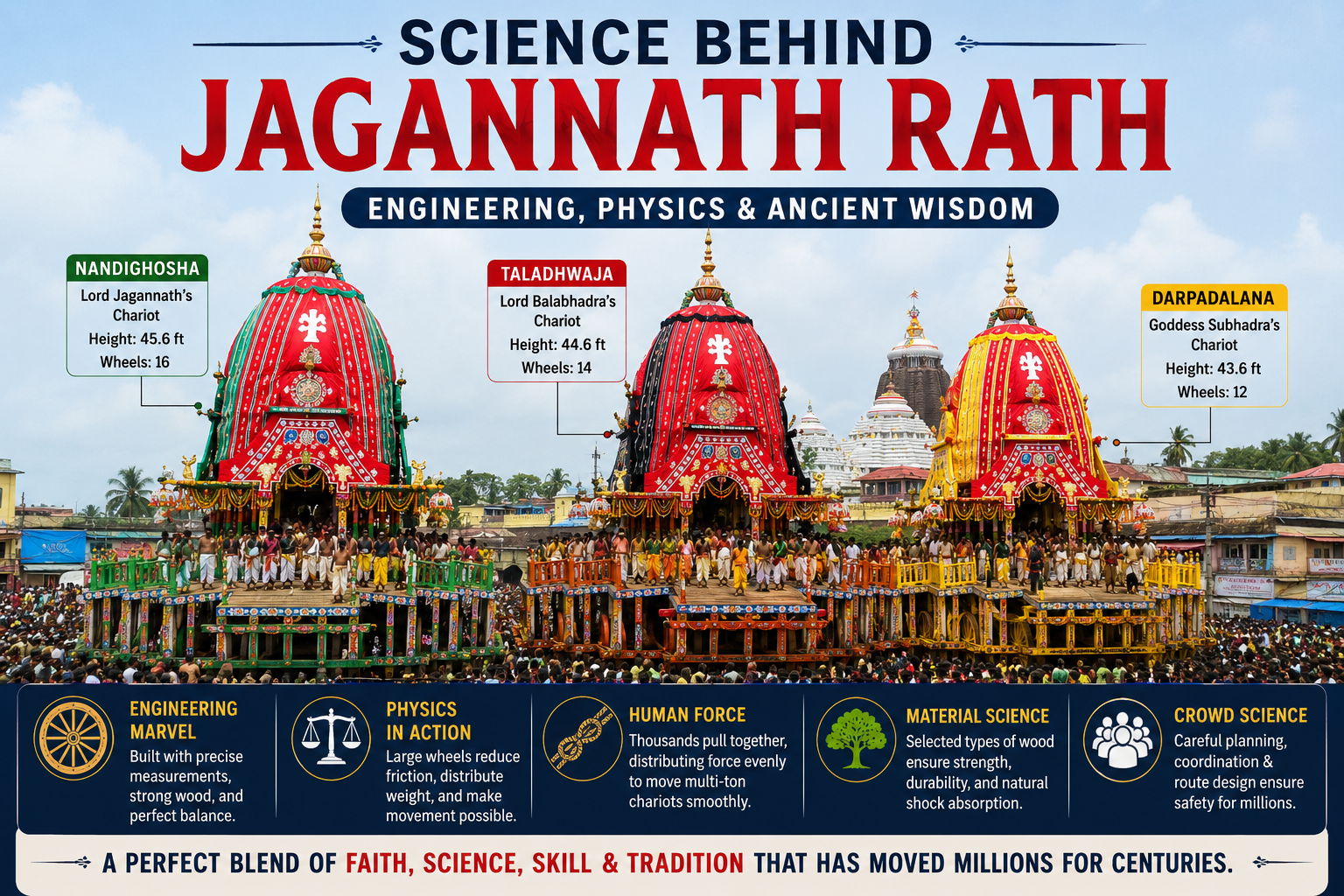
Every year, millions of devotees gather in Puri to witness the grand Jagannath Rath Yatra. While the festival is deeply spiritual, the construction and movement of the three massive chariots also reveal remarkable scientific and engineering principles. The Jagannath Temple, Puri has preserved a tradition that combines craftsmanship, physics, material science, and crowd management in a way that continues to amaze modern observers.
Why the Rath Is a Scientific Wonder
The chariots of Lord Jagannath, Balabhadra, and Subhadra are rebuilt every year using traditional measurements and selected wood. Each chariot weighs several tons and is pulled by thousands of people. Moving such a heavy structure without modern machinery requires a deep understanding of balance, friction, and force.
Ancient builders may not have used modern scientific terminology, but their methods show practical knowledge developed through centuries of observation and experience.
Wheel Design and Physics
One of the most important scientific aspects is the wheel system. Large wooden wheels reduce rolling resistance compared with dragging a structure directly on the ground.
Scientific Principle
Physics
- Large diameter wheels help the chariot roll more smoothly over uneven roads.
- Multiple wheels distribute the enormous weight across a wider area, reducing pressure on the ground.
- Thick wooden hubs and axles absorb shocks and prevent sudden structural failure.
From a physics perspective, the wheels convert sliding friction into rolling friction, which requires much less force to overcome.
Weight Distribution and Stability
The chariots are extremely tall, yet they rarely topple during normal movement. This is possible because of careful weight distribution.
- The heaviest components are placed lower in the structure.
- The wheelbase is made wide enough to support the tall superstructure.
- Symmetrical construction keeps the center of mass near the middle.
Modern engineers recognize this as a classic method for improving stability in large mobile structures.
The Science of Wood Selection

Specific types of wood are chosen for different parts of the chariot. This reflects an understanding of material properties:
| Part | Desired Property |
|---|---|
| Wheels | Hardness and wear resistance |
| Axles | Strength under repeated stress |
| Upper framework | Light weight with adequate strength |
Different woods expand and contract differently with humidity. Traditional craftsmen select timber that performs reliably during the monsoon season when the festival takes place.
Rope Mechanics and Human Force
Thousands of devotees pull the chariot using enormous ropes. Scientifically, this is an example of distributed force application.
Instead of one machine pulling with extreme tension, the load is shared among many people. This reduces stress on any single section of the rope and allows smoother acceleration. The long ropes also help maintain directional control of the chariot.
Road Interaction and Friction Control
The route of the Rath Yatra is carefully prepared before the festival. A relatively smooth surface minimizes energy loss due to friction and vibration. Even today, engineers understand that road quality directly affects the force required to move heavy wheeled vehicles.
Crowd Movement and Safety Logic
Another overlooked scientific aspect is crowd management. The procession follows a predictable route and timing pattern. This helps:
- Prevent chaotic movement around the wheels.
- Maintain safe pulling distances.
- Allow coordinated stopping and restarting of the chariot.
Modern event planners use similar principles when managing very large public gatherings.
Ancient Engineering Without Modern Machines
Perhaps the most fascinating question is how such massive structures were designed long before modern engineering tools existed. The answer lies in cumulative knowledge. Generation after generation of craftsmen recorded measurements, observed failures, improved designs, and preserved successful methods.
What we see today is not a random tradition but a highly refined engineering system developed over centuries.
Faith and Science Together
The Jagannath Rath is often viewed only as a religious symbol. However, its construction demonstrates practical applications of physics, mechanics, material science, structural engineering, and human coordination. The festival shows that ancient Indian traditions frequently combined spiritual purpose with empirical knowledge.
Understanding the science behind the Jagannath Rath does not reduce its spiritual significance. Instead, it reveals how devotion and intelligent design worked together to create one of the world’s most extraordinary moving wooden structures.
Conclusion
The Jagannath Rath is much more than a religious chariot. It is a living example of ancient Indian engineering, demonstrating principles of physics, mechanics, structural stability, material science, and logistics that remain relevant today.
Its massive wheels illustrate the advantages of rolling friction. Its balanced design reflects careful weight distribution. The choice of wood reveals an understanding of material properties, while the use of ropes and coordinated human effort demonstrates practical mechanics and force distribution.
For millions of devotees, the Rath Yatra is a celebration of divine grace. For scientists and engineers, it is also a remarkable lesson in how observation, craftsmanship, and traditional knowledge can produce an enduring masterpiece of engineering.
The science behind the Jagannath Rath reminds us that ancient traditions often preserved practical knowledge alongside spiritual values. Appreciating both perspectives allows us to understand why this magnificent festival continues to inspire the world year after year.