Manasa Devi-The Mother Of Serpents
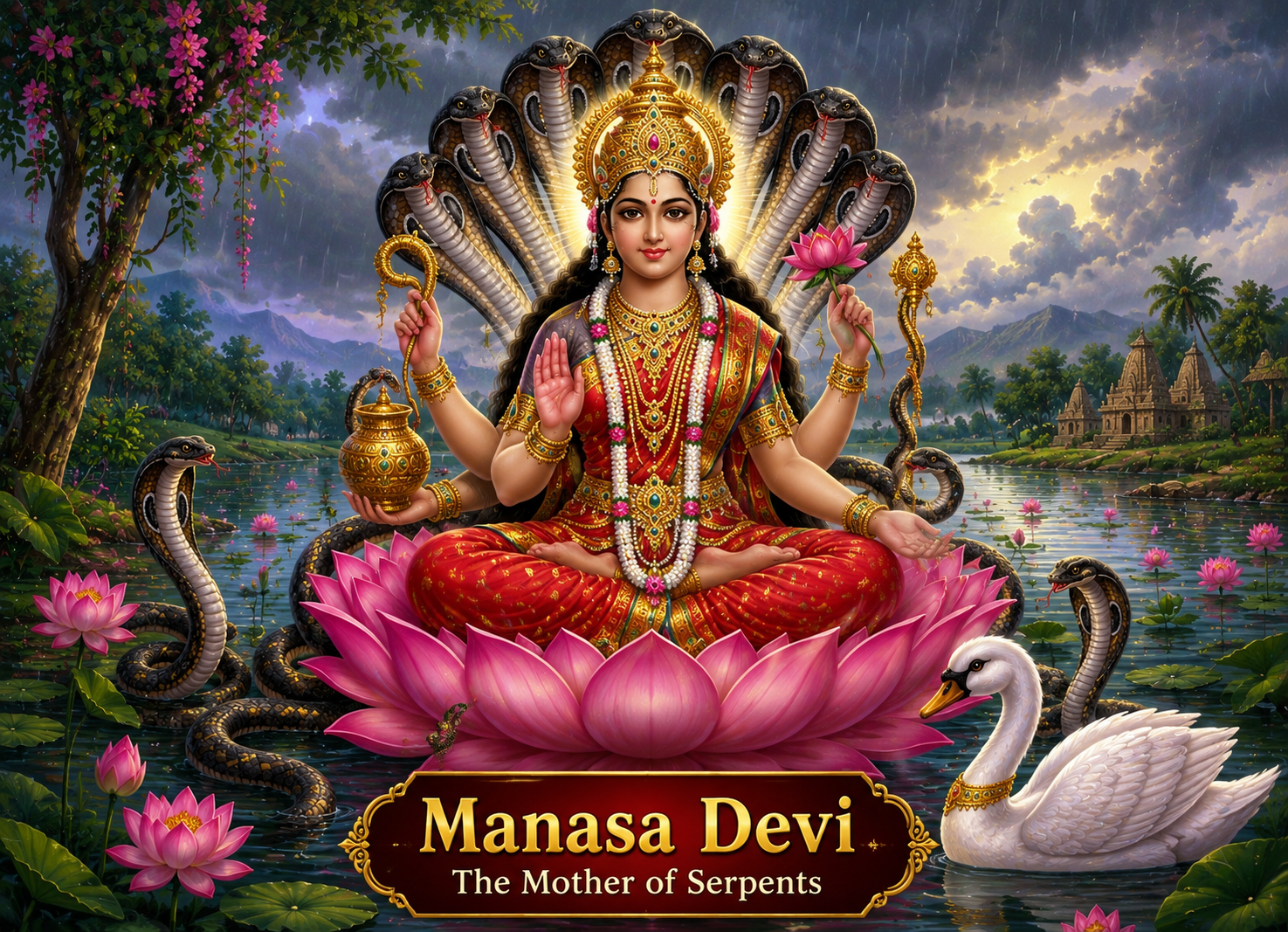
Manasa Devi is one of the most fascinating goddesses of the Hindu religious and folk traditions of Bengal and eastern India. Revered as the goddess of serpents, she is traditionally associated with protection from snakebite, fertility, prosperity, and the mysterious powers of nature. Her worship has a particularly strong presence in Bengal, Bangladesh, Assam, Bihar, Odisha and other parts of eastern and northeastern South Asia. The British Museum similarly describes Manasa as a Hindu folk goddess principally worshipped in eastern India and notes her characteristic association with snakes.
In Bengal, however, Manasa Devi is much more than a serpent goddess. She is a central figure in a vast body of devotional folklore, poetry, songs, paintings and performances. Her story is inseparably connected with Chand Sadagar, Behula, Lakshindar and Astika, and especially with the medieval Bengali literary tradition known as Manasamangal Kavya.
The story of Manasa is remarkable because it brings together several layers of Hindu tradition. Some Sanskritic and Puranic traditions describe her as connected with Sage Kashyapa, while later Bengali Mangalkavya traditions give her a close relationship with Lord Shiva. Rather than treating these accounts as one single biography, it is more accurate to understand them as different strands of a long and evolving religious tradition.
Who Is Manasa Devi?
Manasa Devi is traditionally regarded as the goddess of serpents and snake protection. She is also associated in different regional traditions with fertility, prosperity, healing and protection from poisonous creatures.
Her importance becomes especially clear in Bengal, where the rainy season has historically been closely associated with snakes, rivers, wetlands and agricultural life. In such an environment, a deity connected with serpents naturally became an important part of popular religious culture.
Manasa is often called Vishahari, meaning the remover or destroyer of poison. Other traditional names include Padmavati, Nageshwari, Nagabhagini, Jagadgauri, Vaishnavi, Shaivi, Siddhayogini and Astikamata.
Her iconography usually presents a beautiful female deity surrounded by serpents. Some representations show several snakes forming a canopy over her head. A swan is traditionally associated with her as a vehicle in some iconographic descriptions.
The British Museum’s collection includes historical Manasa sculptures and paintings, including examples from Bengal, demonstrating the goddess’s long artistic and devotional history in the region.
Why Is Manasa Called the Mother of Serpents?
The title “Mother of Serpents” reflects Manasa’s close relationship with the naga world.
In Hindu mythology, nagas are supernatural serpent beings who occupy an important place in Indian religious literature. They are not simply ordinary snakes. They are often described as powerful beings connected with rivers, underground realms, fertility and hidden treasures.
Manasa’s association with the nagas is particularly strong in the traditions surrounding Vasuki, the serpent king, and Astika, her famous son.
The Mahabharata tradition connects Manasa with the sage Jaratkaru and her son Astika. Astika later becomes an important figure in the story of the Sarpa Satra, the great serpent sacrifice conducted by King Janamejaya. According to the traditional narrative, Astika intervened and helped prevent the destruction of the naga race.
This association helps explain why Manasa became such an important protective goddess in communities where snakes were a real part of everyday life.
The Appearance of Manasa Devi
Traditional descriptions of Manasa Devi vary according to region and text.
She is commonly portrayed as a graceful goddess with a serene face, often seated or standing amid serpents. Snakes may appear around her body or rise above her head like a protective hood.
Some traditional descriptions associate her with:
- Four arms
- A beautiful and peaceful face
- Golden ornaments
- Red or brightly coloured clothing
- A swan as her vehicle
- Several serpents surrounding her
- A lotus association
- A serpent canopy over her head
Her serpent imagery is not intended merely to create fear. In Hindu symbolism, the serpent can represent mystery, hidden power, transformation, fertility and the forces of nature.
Therefore, Manasa’s image represents both the danger and the protective power associated with the serpent.
The Twelve Names of Manasa Devi
Traditional devotional literature gives Manasa several sacred names. A commonly recited list includes:
- Jaratkaru
- Jaratkarupriya
- Jagadgauri
- Manasa
- Siddhayogini
- Vaishnavi
- Nagabhagini
- Shaivi
- Nageshwari
- Astikamata
- Vishahari
- Mahajnanayuta
These names reflect different aspects of the goddess.
Vishahari emphasizes her association with poison and protection from snakes.
Nageshwari connects her with the serpent world.
Astikamata means the mother of Astika.
Vaishnavi reflects her connection with Vaishnava devotional traditions.
Shaivi reflects her association with Shiva in traditions where Shiva is regarded as her father or teacher.
These multiple names demonstrate how Manasa’s identity developed across different religious and regional traditions.
Manasa Devi in the Puranic Tradition
One of the important points to understand about Manasa is that different Hindu texts and traditions describe her origin differently.
The Puranic tradition associates Manasa with Sage Kashyapa. Later Bengali Mangalkavya traditions, meanwhile, give her a close relationship with Shiva.
The Puranic account is therefore different from the later popular Bengali stories.
According to a traditional account associated with the Devi Bhagavata Purana, Manasa emerged through the mind of Kashyapa. Her name is therefore connected with manas, meaning mind.
This account gives her a particularly interesting symbolic identity: she is associated not only with serpents but also with knowledge, spiritual power and the mind.
It is important, however, not to combine every version into one supposedly identical story. Hindu mythology contains many regional and textual traditions, and Manasa is an excellent example of how a deity’s mythology can develop over centuries.
Manasa and Lord Krishna
Some traditions connected with the Devi Bhagavata narrative describe Manasa as performing intense devotion and obtaining divine favour.
In these accounts, her devotion eventually leads to her recognition and worship among gods, sages, nagas and human beings.
This is an important theme in Hindu religious literature: divine status is sometimes expressed through tapasya, devotion, knowledge and divine blessing.
Manasa’s story therefore does not focus only on snakes. It also presents a goddess associated with spiritual accomplishment.
Manasa Devi and Jaratkaru
Manasa’s husband is traditionally identified as Sage Jaratkaru, and their son is Astika.
The story of Jaratkaru is particularly important because it connects Manasa’s family with the preservation of the naga lineage.
According to the Mahabharata tradition, Jaratkaru was a powerful ascetic who had initially decided not to marry. He later learned that his ancestors were suffering because his family line was in danger of ending.
He therefore agreed to marry under specific conditions.
Manasa became connected with this story through her marriage to Jaratkaru, and their son Astika later played a crucial role in saving the serpents.
Astika – The Son of Manasa
Astika is one of the most important figures associated with Manasa Devi.
He is traditionally described as the son of Jaratkaru and Manasa.
His importance becomes especially clear during the reign of King Janamejaya.
Janamejaya is said to have conducted a massive serpent sacrifice known as the Sarpa Satra. The sacrifice was intended to destroy the naga race.
Astika intervened and persuaded the king to stop.
Thus, Manasa’s son became the protector of the very serpent beings with whom his mother was associated.
This story adds another dimension to Manasa’s identity. She is not merely a goddess who controls snakes; through Astika, her family becomes connected with the preservation of the naga world.
Manasa in Shaivite and Bengali Traditions
The Bengali folk tradition tells a different and much more dramatic story of Manasa’s origin.
In various Mangalkavya traditions, Manasa is presented as a daughter of Lord Shiva. She is also associated with the naga king Vasuki and with the lotus, giving rise to the name Padmavati in some traditions.
These stories should be understood as part of the rich Bengali literary and folk tradition rather than simply treated as identical to the Puranic account.
This distinction is important.
The Puranic traditions associate Manasa with Kashyapa, while Manasamangal traditions develop a strong Shaivite genealogy for her. Such variations are common in Hindu mythology, where regional traditions often develop alongside Sanskritic scriptures.
Manasa and the Manasamangal Kavya
Perhaps nowhere is Manasa Devi’s personality more vividly portrayed than in Manasamangal Kavya.
Manasamangal is part of the medieval Bengali Mangalkavya literary tradition. These works celebrated regional deities and presented their power through stories, poetry and devotional narratives.
The Manasamangal tradition is particularly famous for the story of:
- Manasa Devi
- Chand Sadagar
- Behula
- Lakshindar
- Astika
The literature developed through numerous poets and regional versions rather than through a single fixed text. Scholarship on Manasamangal has identified many textual and performance traditions across Bengal.
The result is one of the richest mythological traditions in Bengali culture.
The Story of Chand Sadagar and Manasa Devi
The most famous story connected with Manasa begins with Chand Sadagar, a wealthy merchant and devoted worshipper of Lord Shiva.
Chand Sadagar refuses to worship Manasa.
His refusal becomes the central conflict of the story.
Manasa wants recognition as a powerful goddess, while Chand remains determined to worship Shiva alone.
The conflict is therefore not simply a story about a snake goddess and a merchant. At a deeper literary level, it explores themes of pride, devotion, divine authority, human resistance and eventual reconciliation.
According to the Manasamangal tradition, Manasa’s power brings disaster upon Chand’s family.
Several of his sons die through snakebite, and eventually his youngest son Lakshindar becomes the centre of the tragedy.
Behula and Lakshindar
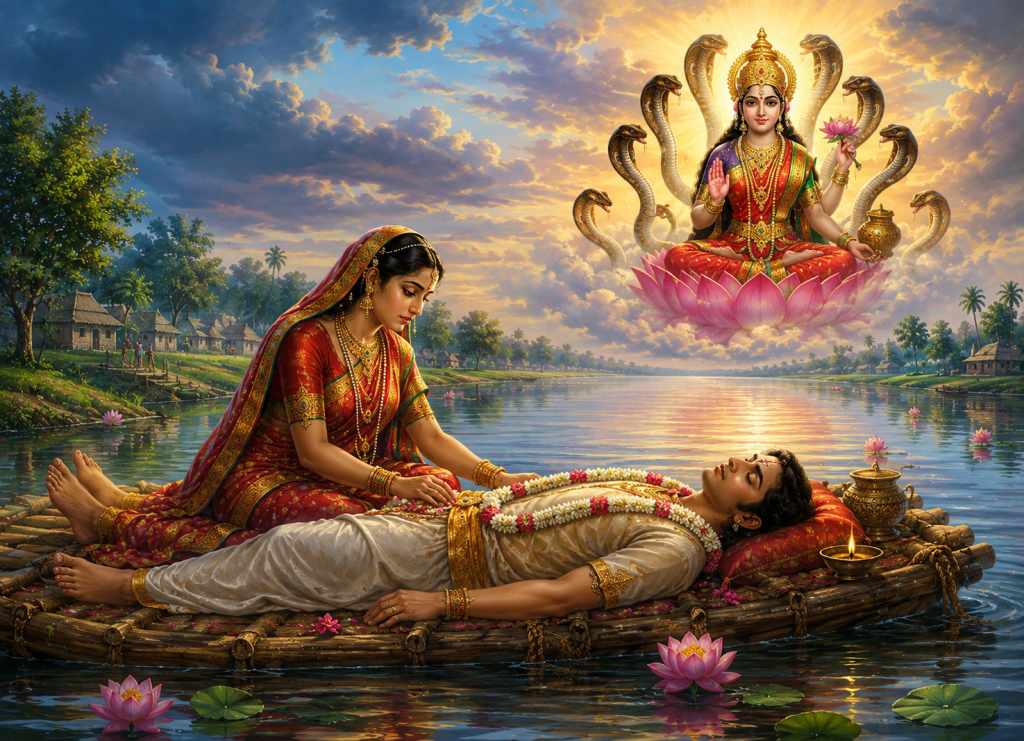
Lakshindar marries Behula, one of the most celebrated heroines of Bengali folklore.
Chand knows that Lakshindar’s life is in danger, so extraordinary precautions are taken to protect him.
An iron or fortified bridal chamber is prepared to prevent a snake from entering.
But the protective measures fail.
Lakshindar is bitten by a snake on his wedding night.
The event changes the entire direction of the story.
Behula refuses to accept the loss of her husband.
Instead, she begins one of the most famous journeys in Bengali literature.
Behula’s Journey
Behula places Lakshindar’s body on a raft and begins a difficult journey along the river.
Her journey is not simply a search for supernatural help. It has become a powerful cultural symbol of:
- Love
- Determination
- Faith
- Courage
- Patience
- Devotion
- Hope
Eventually, Behula reaches the divine realm and pleads for her husband’s life.
She promises that Chand Sadagar will finally acknowledge Manasa.
Her devotion succeeds.
According to the Manasamangal tradition, Lakshindar is restored, and Manasa’s worship ultimately gains recognition.
Banglapedia describes Behula as one of the principal figures of Manasamangal and emphasizes her extraordinary determination to recover Lakshindar and secure the restoration of her husband and his brothers.
Why Is Behula So Important?
Although Manasa is the goddess at the centre of the narrative, Behula often becomes the emotional heart of the story.
She is remembered not because she possesses supernatural power but because of her courage and unwavering determination.
Her river journey has become one of the most recognizable images of Bengali folklore.
For generations, the story has been performed through songs, theatre, scroll paintings, folk performances and oral storytelling.
It is one of the clearest examples of how Hindu mythology becomes part of everyday cultural memory.
Gokul Medh and the Legend of Behula-Lakshindar
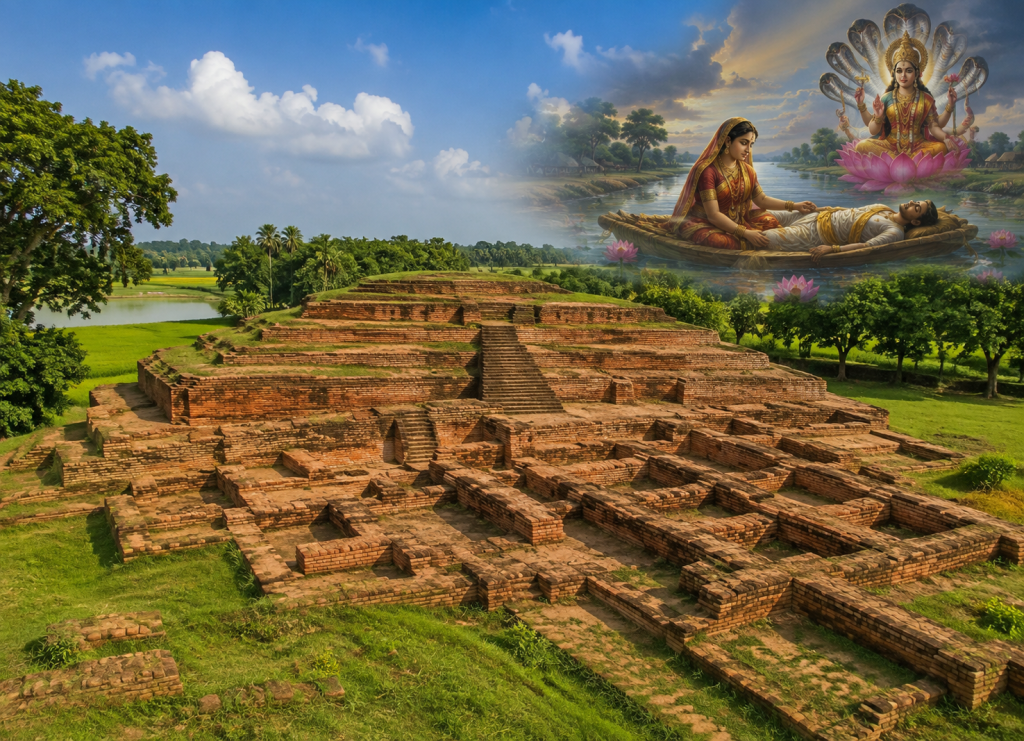
One of the most interesting places associated with the Behula-Lakshindar story is Gokul Medh in Bogura, Bangladesh.
The site is popularly known as Lakshindarer Medh or Behula-Lakshindar’s Basar Ghar.
Local tradition associates the archaeological mound with the bridal chamber of Behula and Lakshindar.
However, it is important to distinguish folklore from archaeology.
According to Banglapedia, excavations conducted in 1934–36 revealed a large terraced structure containing 172 rectangular cells. The archaeological evidence points to an ancient religious complex, with the earliest structure dating to approximately the sixth or seventh century CE. A later structure was also built on the site.
Therefore, while Gokul Medh remains strongly associated with Behula and Lakshindar in popular tradition, the archaeological remains themselves should not be presented as conclusively proven to be their historical bridal chamber.
This distinction makes the site even more fascinating: archaeology and folklore meet at the same landscape.
Manasa Worship in Bengal
Manasa worship has a particularly strong connection with the rainy season.
The monsoon traditionally brought increased contact with snakes, especially in rural areas, wetlands, agricultural fields and riverine settlements.
In such an environment, devotion to a goddess associated with serpent protection naturally became deeply rooted.
Manasa Puja is observed on different dates according to regional custom and calendar traditions. In Bengal, observances may be connected with Nag Panchami, Shravan Sankranti and other local ritual occasions.
The exact date and customs vary from place to place.
This regional diversity is an important feature of Manasa worship.
The Ashta Nagas
Some traditions connect Manasa with the Ashta Nagas, or eight great serpent beings.
Names commonly associated with the group include:
- Ananta
- Vasuki
- Padma
- Mahapadma
- Takshaka
- Kulika
- Karkotaka
- Shankha
Different texts and regional traditions may give variations in the names.
The naga tradition is important because serpents occupy a major symbolic position throughout Hindu mythology.
They appear in stories connected with Vishnu, Shiva, Krishna, the Mahabharata and many other sacred narratives.
Manasa’s special role is to bring these serpent traditions together under the identity of a goddess.
Manasa Devi in Bengali Folk Culture
Manasa Devi has had a profound influence on Bengali folk culture.
Her stories have appeared in:
Palagan:
Traditional narrative songs and performances have kept the story of Manasa and Behula alive among rural communities.
Pattachitra:
Artists have depicted Manasa, Behula, Lakshindar, Chand Sadagar and serpent imagery in scroll and folk painting traditions.
Putul Nach:
Puppet performances have also presented episodes from the Manasa story.
Folk Fairs:
Manasa Puja is associated with local fairs and community gatherings in many parts of Bengal and Bangladesh.
Manasar Bhasan:
Traditional performance forms connected with Manasa worship remain part of Bengali folk culture in several regions.
Academic research also documents continuing Manasamangal performance traditions in Bangladesh and elsewhere in Bengal, showing that the tradition is not merely an ancient literary subject but a living cultural form.
Manasa Devi Temples
Manasa worship does not depend on one single central temple. Numerous shrines and temples dedicated to her can be found across eastern India and Bangladesh.
Among the better-known places associated with Manasa worship are:
- Goila Manasa Temple in Barishal, Bangladesh
- Manasa Devi temples in the Jashore region of Bangladesh
- Manasa Devi Temple, Haridwar
- Mata Mansa Devi Mandir, Panchkula
- Various regional Mansa or Manasa shrines in Jharkhand, Assam, Odisha and other parts of India
Temple traditions vary significantly from region to region.
Some shrines have formal stone or metal images, while others may feature simple serpent symbols, clay images, pots, branches or sacred representations connected with local customs.
How Is Manasa Devi Worshipped?
Manasa Puja differs according to local tradition, family custom and temple practice.
A household or temple observance may include:
- Cleaning the worship area.
- Preparing an altar.
- Installing or placing an image or symbolic representation of Manasa Devi.
- Making a sankalpa, or devotional intention.
- Offering water and other traditional offerings.
- Offering flowers, fruits and devotional items according to local custom.
- Reciting prayers or mantras associated with Manasa.
- Performing arati.
- Concluding the worship with prayers and, where customary, immersion or ceremonial departure of the deity.
Specific rituals should follow the customs of one’s family, temple or local priest rather than assuming that every Manasa Puja is performed identically.
A Traditional Manasa Prayer
A well-known traditional prayer associated with Manasa is:
Astikasya Muner Mata
Bhagini Vasukes Tatha
Jaratkaror Muneh Patni
Manasa Devi Namostute
A simple meaning is:
“I bow to Goddess Manasa, the mother of Astika, the sister of Vasuki, and the wife of Sage Jaratkaru.”
The verse emphasizes three important relationships that define Manasa’s mythology: Astika, Vasuki and Jaratkaru.
Manasa Devi and Snakebite: Faith and Modern Safety
Historically, worship of Manasa developed partly in communities where snakebite was a serious danger.
People prayed to the goddess for protection and healing at a time when access to modern medical treatment was limited.
However, religious devotion should not replace modern medical care.
If someone is bitten by a snake, the appropriate response is to seek urgent medical treatment from qualified healthcare professionals. Traditional prayers may be meaningful as an expression of faith, but they should never be treated as a substitute for emergency medical care.
This distinction is especially important because snakebite can be a medical emergency.
What Does Manasa Devi Symbolize?
Manasa Devi can be understood on several symbolic levels.
1. Protection
She represents protection from the dangers associated with snakes and poisonous creatures.
2. Nature
Her mythology reflects the relationship between human communities and the natural environment.
3. Fertility
In some traditions, Manasa is connected with fertility and prosperity.
4. Knowledge
Her association with spiritual practice and the mind gives her a dimension beyond physical protection.
5. Transformation
The serpent is a powerful symbol of transformation in Hindu religious imagination.
6. Divine Recognition
The story of Chand Sadagar explores the tension between human pride and recognition of divine power.
7. Female Strength
Through Behula’s story, the Manasamangal tradition also presents an enduring image of feminine courage and determination.
Manasa Devi – A Goddess of Bengal’s Rivers and Rain
The popularity of Manasa cannot be separated from the geography of Bengal.
Bengal is a land of rivers, wetlands, rice fields, monsoon rains and abundant vegetation.
For rural communities living close to nature, snakes were not distant mythical creatures. They were part of the surrounding environment.
Manasa therefore became a goddess who stood at the meeting point of religion, ecology, agriculture and everyday life.
Her worship can be understood as part of a broader human attempt to establish a respectful relationship with forces of nature that could provide both life and danger.
Manasa Devi in Modern Bengali Culture
Manasa continues to appear in Bengali religious and cultural life.
Her stories are retold in books, television programmes, folk theatre, devotional performances, paintings and social media.
The story of Behula and Lakshindar remains particularly popular because it combines romance, tragedy, devotion and supernatural mythology.
At the same time, Manasa’s story offers researchers an important example of how folk religion and classical Hindu traditions influence one another.
She demonstrates that Hindu religious culture cannot always be divided neatly into “scripture” and “folklore.” Many traditions have interacted and evolved over long periods.
Manasa Devi: Scripture, Folklore and Living Tradition
One of the most important lessons from the mythology of Manasa Devi is that there is no need to force every tradition into a single version.
In one tradition, she is associated with Kashyapa.
In Bengali Mangalkavya, she is closely connected with Shiva.
In the Mahabharata tradition, her story is connected with Jaratkaru and Astika.
In Bengali folk literature, she becomes the powerful goddess at the centre of the dramatic story of Chand Sadagar, Behula and Lakshindar.
These traditions developed in different literary and cultural environments.
Rather than seeing these differences as a problem, they reveal the extraordinary diversity of Hindu mythology.
Conclusion
Manasa Devi, the Mother of Serpents, is one of the most remarkable goddesses of Bengal and eastern South Asia.
She is a goddess of snakes, protection, fertility, prosperity and the mysterious forces of nature. Her mythology connects ancient religious traditions with the living folk culture of Bengal.
Her relationship with Jaratkaru and Astika connects her with the Mahabharata’s naga traditions. Her different origin stories demonstrate the diversity of Hindu mythology. And through Manasamangal Kavya, her story became deeply embedded in Bengali literature.
The unforgettable story of Chand Sadagar, Behula and Lakshindar transformed Manasa into one of Bengal’s most beloved and complex mythological figures. Behula’s journey, in particular, remains a powerful symbol of determination, devotion and hope.
The archaeological site of Gokul Medh in Bogura further shows how mythology and landscape can become intertwined. Although archaeology does not establish the mound as the literal bridal chamber of Behula and Lakshindar, its traditional identification with the legendary story has given the site a special place in Bengali cultural memory.
Ultimately, Manasa Devi represents more than the fear of snakes. She represents humanity’s relationship with nature, the power of devotion, the importance of humility and the ability of stories to survive across generations.
For millions of devotees and admirers of Bengali culture, Manasa Devi remains the Mother of Serpents—a powerful guardian goddess whose story continues to live in temples, homes, poetry, songs, festivals and the collective memory of Bengal.
*Related Articles: 1. Nag Panchami: A Comprehensive Exploration
2. Kashyapa: A Great Sage of Saptarshi
[Updated on 18 August, 2026]