Jhulan Yatra: The Sacred Festival of Radha-Krishna
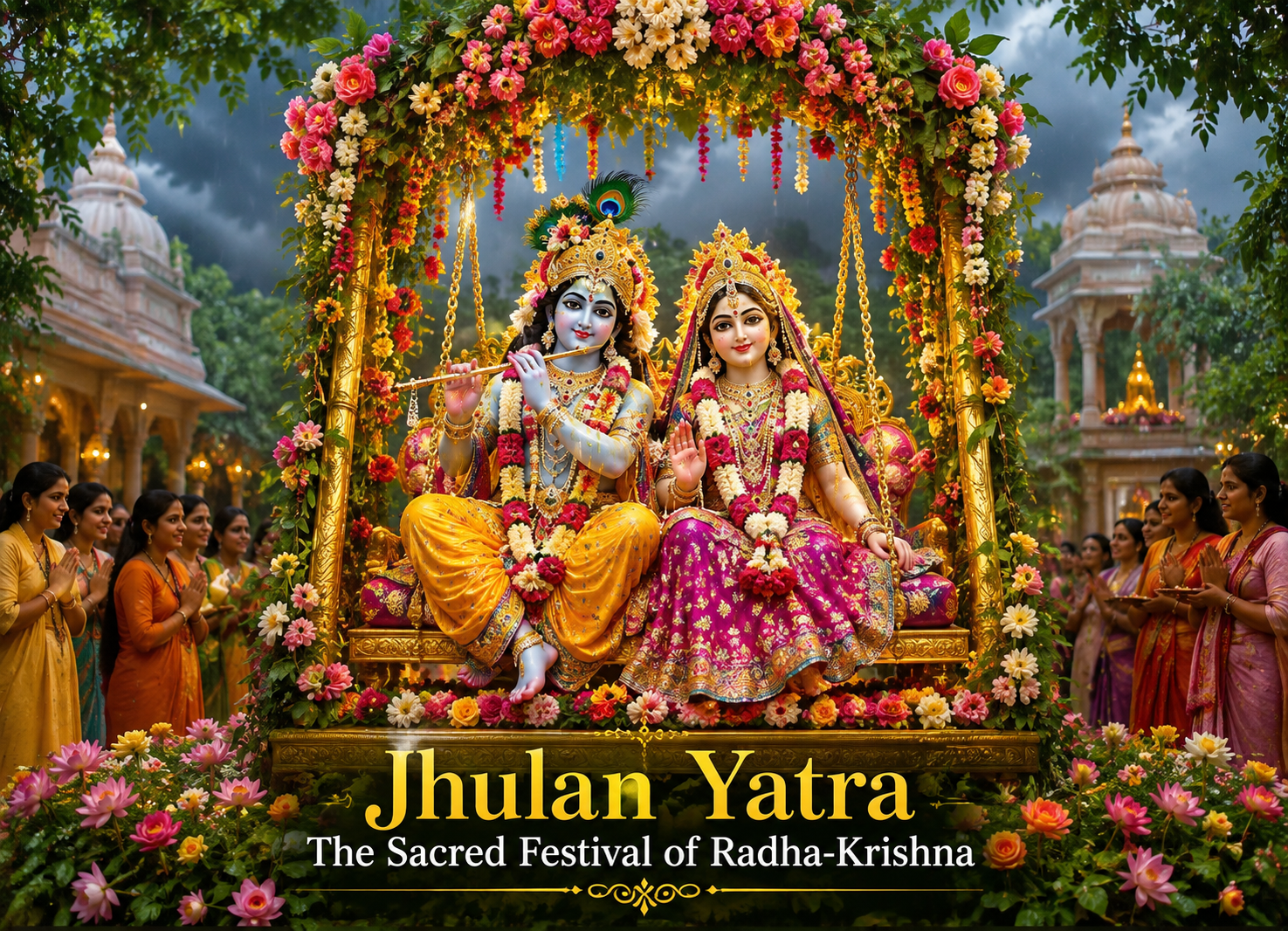
Jhulan Yatra, also known as Jhulan Purnima or Jhulan Utsav, is one of the most beautiful and joyful festivals dedicated to Lord Krishna and Srimati Radharani. The festival is especially important in the Vaishnava tradition and is celebrated with great devotion in temples and homes in India, Bangladesh, and many other parts of the world.
The word Jhulan means swing, while Yatra means festival, procession, or journey. Thus, Jhulan Yatra literally refers to the sacred festival in which the divine forms of Radha and Krishna are placed on a beautifully decorated swing and gently rocked by devotees.
The festival is associated with the pleasant rainy season of Shravan, when nature becomes green and beautiful. According to Vaishnava devotional traditions, the festival recalls the loving pastimes of Radha and Krishna in Vrindavan, where Krishna and Radha enjoyed intimate and playful moments with the gopis and gopas.
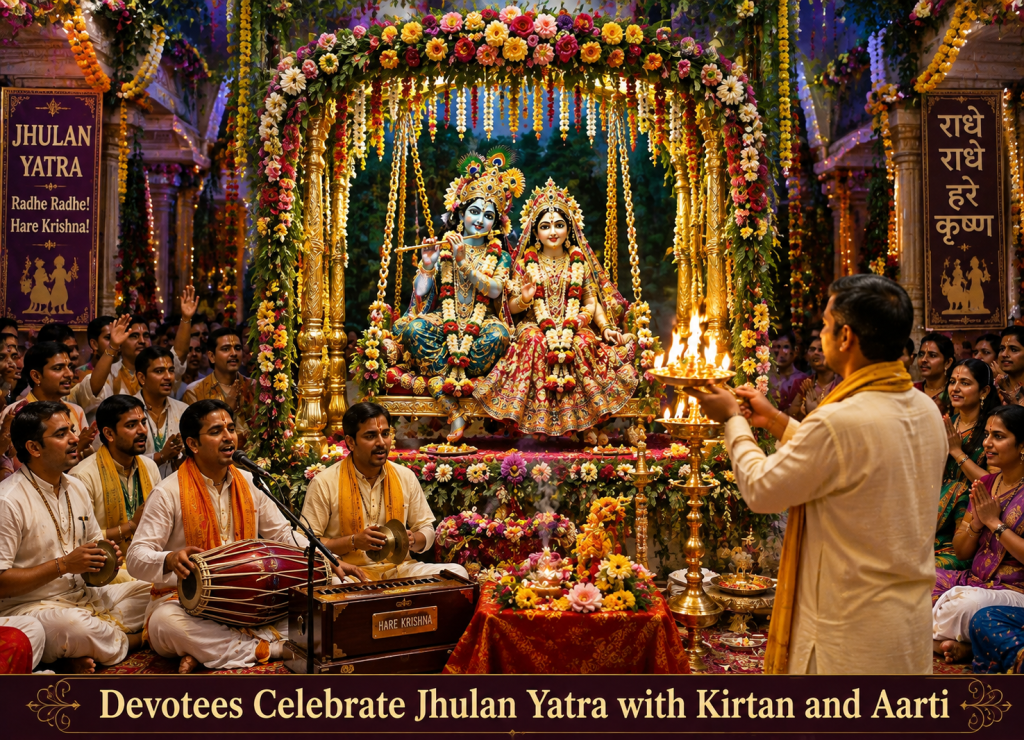
Jhulan Yatra is not merely a festival of decorating a swing. It is a celebration of divine love, devotion, beauty, humility, and surrender. Devotees decorate the temple with flowers, leaves, creepers, lights, and other ornaments. Radha and Krishna are dressed in beautiful clothes and placed on a decorated swing. Devotees then sing devotional songs, perform kirtan and aarti, and offer special food to the deities.
For many Vaishnavas, Jhulan Yatra is regarded as one of the most important festivals of the year. In many places, it is celebrated with particular grandeur after Rath Yatra.
What Is Jhulan Yatra?
Jhulan Yatra is a festival celebrating the divine swinging pastime of Radha and Krishna.
During the festival, the deities of Radha and Krishna are placed on a swing known as a dolna or jhulan. The swing is decorated with flowers, fragrant leaves, colorful fabrics, ornaments, and lights. Devotees take turns gently swinging the divine couple while singing devotional songs.
The festival is particularly associated with the rainy season. The cool atmosphere, cloudy skies, fresh greenery, flowers, and gentle breeze create a natural setting that devotees associate with the beautiful environment of Vrindavan.
The central devotional idea is simple but profound: devotees imagine themselves participating in the loving service of Radha and Krishna by decorating Their swing, singing for Them, offering food, and gently rocking the swing.
When Is Jhulan Yatra Celebrated?
Jhulan Yatra is celebrated during the Hindu month of Shravan, which generally falls during July and August in the Gregorian calendar.
The exact dates vary from year to year because Hindu festivals follow the lunar calendar.
In many Vaishnava traditions, Jhulan Yatra begins around Pavitropana Ekadashi and continues until Shravan Purnima, the full-moon day of Shravan.
Shravan Purnima is also associated with several other important Hindu observances, including Raksha Bandhan.
However, the duration of Jhulan Yatra is not identical everywhere. Some temples celebrate it for only one day, while others observe the festival over several days. In some temples, the celebrations continue from Ekadashi to Purnima.
Therefore, the precise dates and duration may differ according to regional customs, temple traditions, and Vaishnava calendars.
The Origin and History of Jhulan Yatra
The spiritual roots of Jhulan Yatra are connected with the divine pastimes of Radha and Krishna in Vrindavan.
Vaishnava literature describes Vrindavan as the sacred land where Krishna spent His childhood and youth and performed numerous loving pastimes with Radha, the gopis, and His friends.
The rainy season was particularly beautiful in Vrindavan. The forests became covered with fresh leaves, vines, and flowers. The Yamuna flowed through the beautiful landscape, and the atmosphere was filled with the sounds of birds and nature.
Against this beautiful setting, devotees remember the swinging pastimes of Radha and Krishna.
The festival therefore developed as a devotional observance through which devotees could remember these divine pastimes and offer loving service to the Divine Couple.
Over time, Jhulan Yatra became an important festival in Vaishnava temples. Different communities developed their own customs regarding the decoration of swings, duration of celebrations, devotional songs, offerings, and rituals.
Today, Jhulan Yatra is celebrated not only in traditional temples of India but also in Vaishnava communities throughout the world.
Jhulan Yatra and the Divine Pastimes of Vrindavan
The heart of Jhulan Yatra is the remembrance of Vrindavan lila, the divine activities of Radha and Krishna.
According to Vaishnava devotional traditions, Krishna’s presence transformed Vrindavan into a land of extraordinary beauty. The forests, flowers, rivers, trees, birds, and animals all became part of His divine pastimes.
Radha and Krishna are often depicted enjoying the beauty of the monsoon season. The gopis decorate swings and prepare a beautiful environment for the Divine Couple.
Devotees participating in Jhulan Yatra try to spiritually remember this atmosphere.
The swing becomes more than an ordinary object. It becomes a symbol of loving devotional service.
When devotees gently move the swing, they do so with the feeling that they are serving Radha and Krishna.
Why Is the Swing Important?
The swing is the central symbol of Jhulan Yatra.
A swing naturally moves backward and forward. In devotional symbolism, this movement can remind devotees of the intimate and joyful divine pastimes of Radha and Krishna.
The swing is also a practical expression of seva, or loving service.
Devotees do not simply watch the deities on the swing. They participate by:
- Decorating the swing.
- Decorating the temple.
- Preparing offerings.
- Dressing the deities.
- Singing devotional songs.
- Performing kirtan.
- Offering aarti.
- Gently swinging the deities.
- Remembering the divine pastimes of Radha and Krishna.
Thus, the festival transforms devotion into active participation.
How Is the Jhulan Prepared?
One of the most attractive parts of Jhulan Yatra is the preparation of the swing.
The swing may be made of wood or metal and can range from a simple household swing to a highly elaborate temple structure. In some temples, the swing is decorated with precious metals or ornate designs.
Flowers are particularly important.
Fresh flowers of different colors and varieties may be used to decorate:
- The swing.
- The temple doors.
- The walls.
- The altar.
- The surrounding areas.
Leaves, vines, garlands, colorful fabrics, decorative umbrellas, lights, and other ornaments may also be used.
Some temples create elaborate scenes representing the forests of Vrindavan. The entire temple may be transformed into a beautiful garden-like environment.
Worship of Radha and Krishna
During Jhulan Yatra, devotees worship Radha and Krishna with great love and devotion.
The deities are often dressed in special festival clothing. Their garments may be decorated with flowers, jewelry, crowns, and other ornaments.
The devotees then place the divine forms on the decorated swing.
After the swing ceremony begins, devotees sing devotional songs and chant the holy names of Krishna.
Aarti is performed, and various foods are offered to the deities.
The exact rituals differ from temple to temple. Vaishnava traditions are diverse, and local customs often influence the way Jhulan Yatra is observed.
Jhulan Yatra Rituals
Although the details vary, the following practices are commonly associated with Jhulan Yatra.
1. Temple Decoration
The temple is cleaned and beautifully decorated before the festival.
Flowers, leaves, garlands, lights, fabrics, and other decorative items are used to create a festive atmosphere.
2. Decorating the Swing
The swing is decorated especially for Radha and Krishna.
Flowers and garlands are commonly used, although some temples create extremely elaborate designs using traditional ornaments and artistic decorations.
3. Special Dressing of the Deities
Radha and Krishna receive special festival attire.
Devotees carefully decorate the divine forms with beautiful clothes, jewelry, crowns, flowers, and other ornaments.
4. Offering Food
Special preparations are offered to the deities as bhoga.
After the offering, the food becomes prasada and is distributed among devotees.
5. Kirtan and Devotional Music
Devotees sing Krishna bhajans, kirtans, and songs describing the divine love of Radha and Krishna.
Musical instruments such as mridanga, kartals, harmonium, and other traditional instruments may accompany the singing.
6. Aarti
A special aarti is performed before the deities.
Devotees gather around the altar, sing devotional songs, and offer prayers.
7. Swinging the Deities
The most important ritual is gently swinging Radha and Krishna.
Devotees may take turns pulling the decorated swing.
The atmosphere is usually filled with singing, chanting, bells, and devotional joy.
Jhulan Yatra in Vrindavan
Vrindavan holds a particularly important place in the celebration of Jhulan Yatra because the festival is directly connected with the divine pastimes of Radha and Krishna in the sacred land of Vraja.
During the monsoon season, Vrindavan becomes especially attractive. Temples organize special decorations and devotional programs.
Many temples construct elaborate swings for Radha and Krishna. Some use flowers extensively, while others create artistic representations of Vrindavan forests.
Devotees visit temples, participate in kirtans, take darshan of the beautifully decorated deities, and enjoy the devotional atmosphere.
For Vaishnava pilgrims, experiencing Jhulan Yatra in Vrindavan can be a deeply meaningful spiritual experience.
Jhulan Yatra in Other Parts of India
Jhulan Yatra is celebrated in many regions of India.
In West Bengal, the festival has a strong connection with Vaishnava devotional culture. Temples and homes may arrange swings for Radha and Krishna and organize devotional singing.
In Odisha, Vaishnava traditions also give importance to Jhulan Yatra.
In Assam, Bihar, Uttar Pradesh, Rajasthan, Maharashtra, and other regions, devotees observe the festival according to local customs.
The appearance of the celebration may differ, but the central theme remains the same: loving devotion to Radha and Krishna.
Jhulan Yatra in Vaishnava Temples
Vaishnava temples around the world celebrate Jhulan Yatra with different programs.
Some temples observe the festival for a single day. Others celebrate it for several days.
During an extended celebration, the swing may be decorated differently each day.
Devotees may organize:
- Bhajan programs.
- Kirtans.
- Religious discourses.
- Aarti.
- Cultural programs.
- Special prasada distribution.
- Children’s devotional activities.
- Flower decoration competitions.
- Special darshan arrangements.
The festival therefore becomes both a spiritual and community celebration.
Jhulan Yatra and ISKCON
The International Society for Krishna Consciousness (ISKCON) is one of the well-known Vaishnava organizations that celebrates Jhulan Yatra in many countries.
In ISKCON temples, Radha-Krishna deities are often placed on beautifully decorated swings during the festival.
Devotees participate in kirtan, worship, aarti, and other devotional activities.
The celebration allows devotees to remember Krishna’s Vrindavan pastimes and cultivate a mood of loving service.
Because ISKCON has temples and communities across many countries, Jhulan Yatra has become familiar to devotees far beyond the Indian subcontinent.
Spiritual Significance of Jhulan Yatra
The greatest importance of Jhulan Yatra lies in its spiritual meaning.
Remembering Radha and Krishna
The festival encourages devotees to remember the divine relationship of Radha and Krishna.
In Vaishnava philosophy, remembrance of the Lord is an important part of devotional practice.
Developing Bhakti
Jhulan Yatra provides an opportunity to practice bhakti, or loving devotion.
The devotee does not simply pray for material benefits. Instead, the devotee attempts to serve the Lord with love.
Performing Seva
Decorating the swing, preparing food, singing devotional songs, cleaning the temple, making flower arrangements, and assisting other devotees can all become forms of seva.
Creating Joy in Devotion
Hindu festivals often combine spirituality with joy, music, art, food, and community participation.
Jhulan Yatra is a particularly beautiful example of this tradition.
The atmosphere is joyful, but the underlying purpose is spiritual remembrance and devotion.
The Symbolism of Radha-Krishna Worship
Radha and Krishna occupy a central position in many Vaishnava traditions.
Krishna represents the Supreme Divine Personality, while Radha is revered as His supreme devotee and the embodiment of divine love in Gaudiya Vaishnava theology.
The worship of Radha and Krishna therefore emphasizes the ideal of pure and selfless love for God.
Jhulan Yatra gives devotees a visual and emotional way to remember this principle.
When devotees decorate the swing and gently rock Radha and Krishna, the action represents loving service.
Jhulan Yatra and the Monsoon Season
Jhulan Yatra has a special connection with the rainy season.
Shravan arrives when much of the Indian subcontinent experiences monsoon rains.
The landscape becomes green. Trees grow new leaves, flowers bloom, rivers and ponds fill with water, and the weather becomes cooler after the intense summer.
This natural transformation provides a beautiful background for remembering Krishna’s Vrindavan pastimes.
Traditional devotional poetry often describes the monsoon atmosphere of Vrindavan in connection with Radha and Krishna.
The swing itself is also naturally associated with the rainy season because traditional swings are often hung from large trees during this period.
Thus, Jhulan Yatra combines the beauty of nature with the beauty of devotional remembrance.
Special Food During Jhulan Yatra
Food offerings form an important part of Hindu worship, and Jhulan Yatra is no exception.
Devotees prepare different vegetarian dishes and sweets and offer them to Radha and Krishna.
The specific dishes vary according to region and family tradition.
Common offerings may include:
- Fruits.
- Sweets.
- Milk preparations.
- Rice dishes.
- Vegetable preparations.
- Homemade sweets.
- Traditional festival foods.
After the offering, the food is distributed as prasada.
For devotees, prasada is not merely food. It is considered sacred because it has first been offered to the deity.
Devotional Songs and Kirtan
Music is an essential part of Jhulan Yatra.
Devotees sing songs describing the beauty of Radha and Krishna, Their pastimes, the monsoon season, Vrindavan, and the loving service of devotees.
Kirtan can continue for a long period, especially in temples where the festival is celebrated on a large scale.
The singing creates a devotional atmosphere and encourages collective participation.
Children, elderly devotees, families, and visitors can all participate.
Jhulan Yatra at Home
Jhulan Yatra does not have to be limited to large temples.
Many devotees celebrate the festival at home.
A small swing can be prepared for Radha-Krishna deities or devotional images.
The swing can be decorated with flowers, leaves, cloth, and simple ornaments.
Families may then:
- Clean the worship area.
- Decorate a small swing.
- Dress Radha and Krishna in special clothes.
- Place the deities on the swing.
- Offer flowers and incense.
- Sing bhajans or chant Krishna’s holy names.
- Offer vegetarian food.
- Perform aarti.
- Gently swing the deities.
- Distribute prasada among family members.
The simplicity of the celebration does not reduce its devotional value.
In bhakti traditions, the sincerity of the devotee is more important than the material richness of the decoration.
Jhulan Yatra in Bangladesh
Jhulan Yatra is also celebrated among Hindu and Vaishnava communities in Bangladesh.
Temples and homes may organize Radha-Krishna worship, swings, bhajans, kirtans, aarti, and prasada distribution.
The festival has special cultural significance in regions where Vaishnava traditions have historically flourished.
In Bangladesh, Jhulan Yatra can be both a religious and community event, bringing devotees together through worship, music, cultural traditions, and shared celebration.
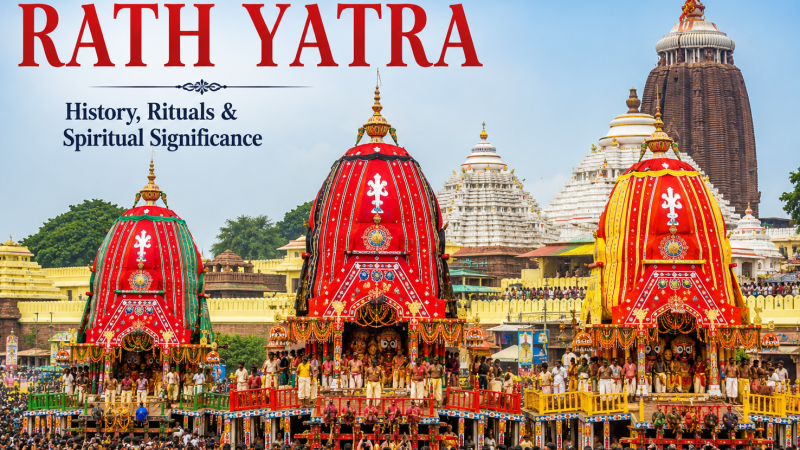
Jhulan Yatra and Rath Yatra
Jhulan Yatra and Rath Yatra are both important Vaishnava festivals, but they commemorate different devotional themes.
Rath Yatra is associated particularly with Lord Jagannath, Balabhadra, and Subhadra and is famous for the grand chariot procession.
Jhulan Yatra centers on Radha and Krishna and their divine swinging pastimes.
Both festivals attract large numbers of devotees and are celebrated with music, worship, offerings, and public participation.
In many Vaishnava traditions, Jhulan Yatra is considered one of the major festivals following Rath Yatra.
Jhulan Yatra and Shravan Purnima
The festival reaches its culmination in many traditions around Shravan Purnima.
Shravan Purnima is an important full-moon day in the Hindu calendar and is associated with several religious observances.
Because Jhulan Yatra is closely connected with the month of Shravan, the full moon often marks the conclusion of the extended festival period.
The connection between Jhulan Yatra and Shravan Purnima also adds to the festival’s importance in the Hindu religious calendar.
The Deeper Message of Jhulan Yatra
Behind the beautiful flowers, music, swings, and celebrations lies a deeper spiritual message.
Jhulan Yatra teaches devotees that devotion can be expressed through loving service.
A devotee does not need to perform something extraordinary. Even a simple act performed with genuine devotion can become meaningful.
Decorating a swing can become seva.
Singing a bhajan can become seva.
Preparing food for the deity can become seva.
Cleaning the temple can become seva.
Helping another devotee can become seva.
In this way, Jhulan Yatra encourages people to bring devotion into everyday actions.
Jhulan Yatra as a Celebration of Divine Love
One of the most beautiful aspects of Jhulan Yatra is its emphasis on divine love.
Radha and Krishna are worshipped together as the Divine Couple. Their relationship is central to many Vaishnava devotional traditions.
The festival invites devotees to remember a spiritual ideal in which love is not based on selfish desire but on service, surrender, and dedication.
The swing becomes a beautiful representation of this devotional mood.
As the swing gently moves, devotees sing and remember Radha and Krishna.
The physical movement is simple, but its spiritual meaning is profound.
Environmental Beauty and the Festival
Traditional Jhulan Yatra decorations often make extensive use of flowers, leaves, vines, and natural materials.
This reflects the close relationship between Krishna’s Vrindavan pastimes and nature.
Modern celebrations can also use sustainable and reusable decorations.
Devotees can reduce plastic waste by choosing natural flowers, reusable fabrics, traditional lamps, and environmentally friendly materials.
In this way, the beauty of the festival can be preserved while respecting the natural world.
How Devotees Can Celebrate Jhulan Yatra Meaningfully
A meaningful Jhulan Yatra celebration does not require an expensive swing or elaborate decoration.
Devotees can focus on the central spiritual practices:
Remember Krishna: Spend time reading or listening to Krishna-related devotional literature.
Chant: Recite the Hare Krishna maha-mantra or other traditional Krishna mantras according to one’s spiritual practice.
Sing: Participate in bhajans and kirtans.
Serve: Help clean and decorate the temple or worship area.
Offer Food: Prepare simple vegetarian food and offer it to Radha and Krishna.
Practice Kindness: Extend the spirit of devotion through service to others.
Avoid Waste: Use simple, natural, and reusable decorations.
The essence of the festival is devotion rather than extravagance.
Conclusion
Jhulan Yatra is a beautiful festival that combines devotion, music, art, nature, community, and the remembrance of Radha-Krishna’s divine pastimes.
Celebrated during the month of Shravan, the festival brings the atmosphere of Vrindavan into temples and homes. Beautiful swings are decorated with flowers and other ornaments, Radha and Krishna are placed upon them, and devotees gently swing the divine couple while singing devotional songs.
In some places, Jhulan Yatra is celebrated for a single day. In others, the festivities continue for several days, beginning around Pavitropana Ekadashi and ending on Shravan Purnima.
The external beauty of the festival is certainly captivating, but its deeper purpose is spiritual. Jhulan Yatra reminds devotees of loving service, devotion, surrender, and remembrance of God.
The gentle movement of the swing, the fragrance of flowers, the sound of kirtan, the glow of lamps, and the sight of beautifully decorated Radha and Krishna together create an atmosphere of divine joy.
For devotees, Jhulan Yatra is therefore much more than a festival of swings. It is an opportunity to remember the sacred land of Vrindavan, contemplate the divine love of Radha and Krishna, and offer one’s heart in humble service.
As devotees gather before the decorated swing and chant the holy names of Krishna, the festival expresses a simple but powerful message: true devotion is loving service offered with a sincere heart.
Hare Krishna! Radhe Radhe!
*Related Articles: 1. Holi-Legend and Significance
[Updated on 25 August, 2026]