Kaushiki Amavasya: The Sacred Night of Goddess Tara
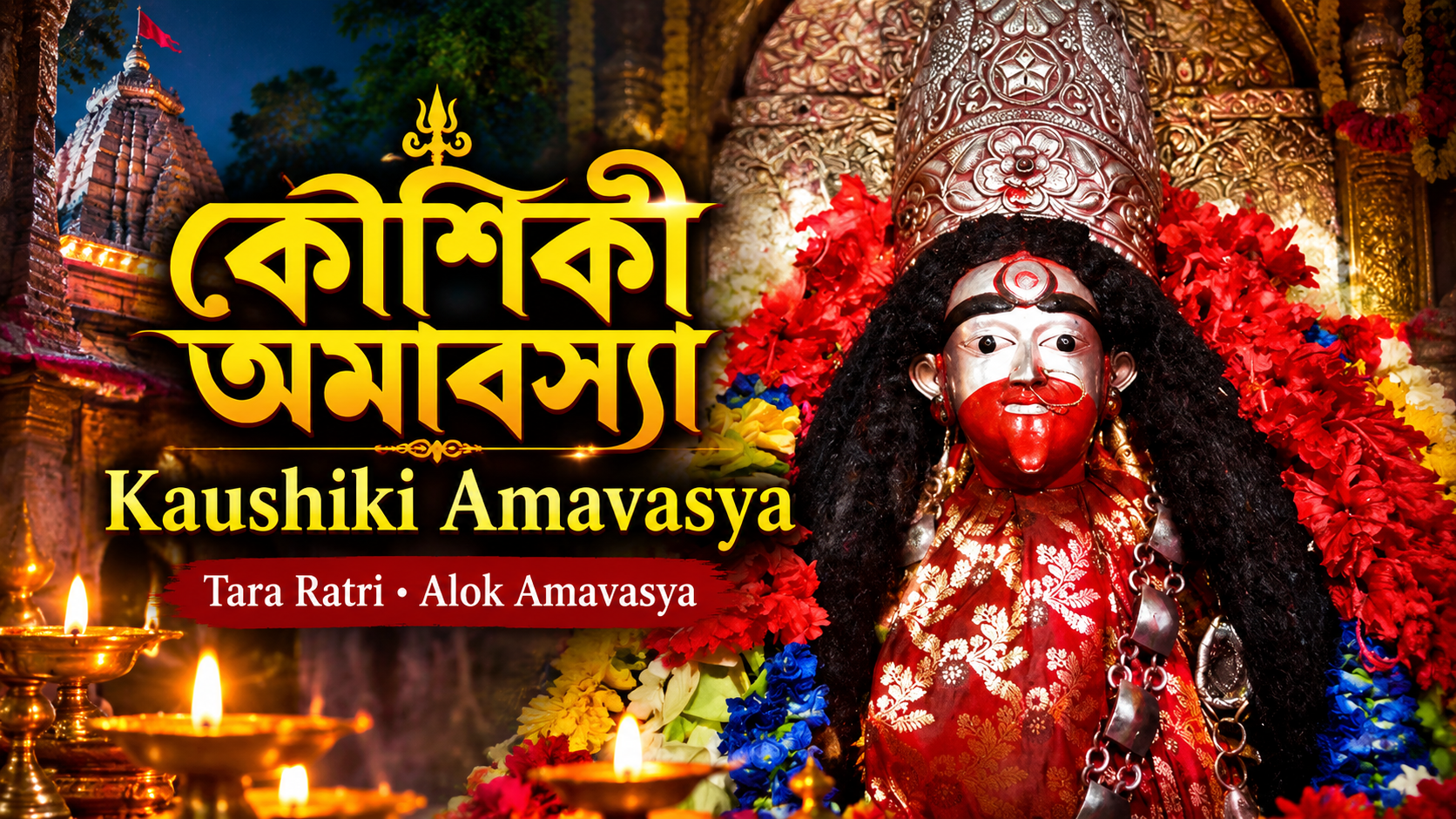
Amavasya, the new moon night, has a special place in Hindu spiritual traditions. Throughout the Hindu calendar, different Amavasya observances carry different religious, ancestral, ritualistic and spiritual meanings. Among them, Kaushiki Amavasya, observed during the month of Bhadra, occupies a particularly mysterious and important position, especially within the Shakta and Tantric traditions.
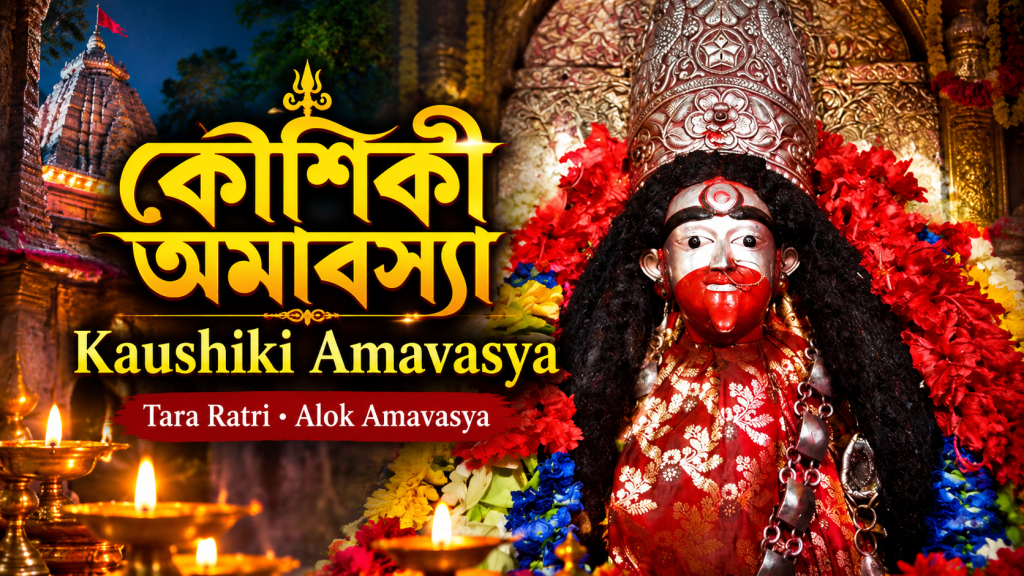
Unlike ordinary Amavasya observances, Kaushiki Amavasya is associated with Goddess Kaushiki, Goddess Tara, Tantric sadhana and the spiritual traditions of Bengal. In Tantric traditions, the night is also known as Tara Ratri, or the Night of Goddess Tara. It is also popularly described as Alok Amavasya, the “Amavasya of Light,” because of its association with the emergence of divine knowledge and the symbolic triumph of spiritual illumination over ignorance.
The apparent contradiction is fascinating. Amavasya represents a night when the moon is not visible in the sky, yet Kaushiki Amavasya is traditionally connected with light. The darkness of the night becomes a metaphor for the darkness of ignorance, while the worship of the Goddess represents the awakening of knowledge, consciousness and divine wisdom.
The day is particularly revered in Bengal, where Shakta and Tantric traditions have developed a distinctive spiritual character over centuries. The sacred pilgrimage centre of Tarapith becomes especially significant on this occasion. Thousands of devotees traditionally gather there to worship Maa Tara, visit the temple, bathe in the sacred Dwarka River and experience the unique spiritual atmosphere of the Tarapith Mahashmashan.
But what makes Kaushiki Amavasya so special? Who is Goddess Kaushiki? Why is the night called Tara Ratri? And why is Tarapith so closely connected with this particular Amavasya?
To understand the importance of Kaushiki Amavasya, one must enter the fascinating world of Hindu mythology, Shakta philosophy and Bengal’s Tantric heritage.
What Is Kaushiki Amavasya?
Kaushiki Amavasya occurs on the Amavasya tithi of the Bhadra month in the Hindu lunar calendar. The exact Gregorian date changes from year to year because Hindu religious dates are determined according to lunar calculations.
The word “Kaushiki” is associated with the Sanskrit term Kosha, meaning a sheath, covering, layer or enclosure. According to a famous Puranic tradition, Goddess Kaushiki manifested from the divine body of Goddess Durga. Because she emerged from the divine “sheath” or outer covering of the Goddess, she came to be known as Kaushiki.
This association makes Kaushiki Amavasya more than simply another new moon observance. It becomes a celebration of divine manifestation, spiritual awakening and the destruction of evil.
In the Shakta tradition, the Goddess is understood as the supreme divine feminine power—Shakti. She may manifest in different forms according to the needs of the universe and her devotees. Durga, Kali, Tara, Kaushiki and other forms are therefore understood within a broad theological framework of divine feminine power.
Kaushiki Amavasya is particularly important because of its connection with the Goddess’s victory over demonic forces and its later association with Tantric spirituality.
Why Is Kaushiki Amavasya Called Alok Amavasya?
One of the most beautiful interpretations of Kaushiki Amavasya is its association with light.
The word “Alok” refers to light, illumination or radiance. Although Amavasya itself is traditionally associated with the darkness of the moonless night, Kaushiki Amavasya symbolically reverses this meaning.
According to the traditional understanding, the manifestation of Goddess Kaushiki brought an end to a kind of cosmic and spiritual darkness. The Goddess’s appearance represents the emergence of knowledge from ignorance and righteousness from oppression.
Devotees therefore associate the occasion with the lighting of lamps or pradeep. The lamp is not merely an external source of illumination. In Hindu spiritual symbolism, a lamp represents the light of consciousness.
A small flame can therefore carry a profound spiritual message:
May the light of knowledge remove the darkness of ignorance.
This is why Kaushiki Amavasya is traditionally associated with the idea of Alok Amavasya—the moonless night that becomes a night of divine illumination.
The symbolism is especially powerful. The sky may be dark, but the human heart can be illuminated by devotion. The moon may disappear, but spiritual knowledge can shine within consciousness.
The Story of Goddess Kaushiki
The mythology surrounding Kaushiki Amavasya is closely connected with the famous story of Shumbha and Nishumbha, two powerful demons who created immense suffering among the gods and other beings.
According to Puranic tradition, Shumbha and Nishumbha became extremely powerful and challenged the authority of the gods. Their power and arrogance allowed them to oppress the divine beings and disturb the established order.
Unable to overcome them, the gods turned to Goddess Durga, or Mahamaya, for protection.
The Goddess responded to their prayers.
From the divine body of Durga emerged a radiant feminine form. This beautiful and powerful manifestation was Goddess Kaushiki.
The Goddess Kaushiki then confronted the demonic forces. Her appearance represented the manifestation of divine Shakti in response to adharma.
The subsequent battle between the Goddess and the demons became an important part of Shakta mythology. Ultimately, the forces of Shumbha and Nishumbha were defeated, and righteousness was restored.
The story carries a deeper philosophical meaning beyond the literal battle.
The demons can be interpreted symbolically as representing negative qualities such as arrogance, greed, ignorance, uncontrolled desire and the misuse of power. The Goddess represents divine consciousness and Shakti, which overcome these forces.
Thus, Kaushiki’s victory is not merely a mythological victory over two demons. It can also be understood as a symbolic victory of Dharma over Adharma, knowledge over ignorance and divine consciousness over destructive tendencies.
Kaushiki and the Spiritual Meaning of Light
The story of Kaushiki provides a natural connection with the concept of Alok Amavasya.
Darkness is frequently used in Hindu philosophy as a metaphor for ignorance. Light, on the other hand, represents knowledge, consciousness and truth.
The Goddess’s manifestation therefore becomes a symbolic moment of illumination.
This interpretation is consistent with one of the most enduring ideas of Indian spirituality: the human journey is a movement from darkness toward light.
The physical lamp lit during worship can consequently be understood as an outward representation of an inward aspiration.
The devotee is not simply lighting a lamp outside.
The deeper prayer is:
Let divine wisdom illuminate my mind and heart.
This is one reason the spiritual symbolism of Kaushiki Amavasya remains meaningful even for devotees who approach the festival primarily as a devotional occasion.
Tara Ratri: The Tantric Dimension of Kaushiki Amavasya
In Tantric traditions, Kaushiki Amavasya is also known as Tara Ratri.
The name connects the night with Goddess Tara, one of the most important forms of the Divine Mother in Shakta and Tantric traditions.
Tara is traditionally understood as a compassionate and powerful Goddess who helps devotees cross difficulties and move toward spiritual liberation. The Sanskrit root associated with “Tara” carries the sense of crossing or helping someone cross over.
In different Hindu and Buddhist Tantric traditions, Tara has developed rich and sometimes distinct theological interpretations. In Bengal’s Shakta tradition, Maa Tara is especially associated with the sacred pilgrimage centre of Tarapith.
Kaushiki Amavasya is therefore an important occasion for devotees who follow the worship of Tara.
The night is traditionally regarded as spiritually powerful for sadhana, meditation, mantra practice and worship. Tantric practitioners may observe particular disciplines and rituals according to their lineage and spiritual initiation.
It is important to recognize that Tantric practice is a highly specialized spiritual tradition. Not every Tantric practice is intended for the general public, and authentic Tantric traditions generally emphasize the importance of a qualified spiritual teacher or guru.
Kaushiki Amavasya and Tantric Sadhana
One of the reasons this Amavasya has such a mysterious reputation is its connection with difficult forms of spiritual practice.
According to traditional Tantric belief, certain nights and lunar phases are particularly suitable for specific forms of sadhana. Kaushiki Amavasya is considered one such spiritually charged occasion.
Traditional accounts describe the night as particularly favorable for practices involving mantra, meditation, worship of the Goddess and the awakening of inner spiritual power.
Some traditions associate such practices with Kundalini, the latent spiritual energy described in yogic and Tantric philosophy.
The expression “Kundalini” is commonly associated with a spiritual power symbolically described as residing at the base of the subtle body. Through disciplined spiritual practice, meditation and guidance, practitioners seek to awaken and elevate this energy.
The material you provided describes a saint as conquering or mastering the “Kulkundalini chakra.” More broadly, this can be understood within the traditional idea of Kundalini awakening and mastery of the subtle spiritual centres, rather than as a literal physical chakra that can be scientifically measured.
The deeper purpose of such practices is spiritual transformation.
The Mystical Belief About the Opening of Heaven and Hell
Kaushiki Amavasya is surrounded by several esoteric beliefs within Tantric traditions.
One traditional belief describes a particular moment during the night when the boundaries between different spiritual realms become exceptionally thin. In popular descriptions, it is sometimes said that the gates of heaven and hell open momentarily.
According to this belief, spiritually advanced practitioners can interact with or absorb subtle positive or negative energies according to their spiritual capacity and intention.
This should be understood as an esoteric religious belief, not as a scientifically established phenomenon.
Within the symbolic language of Tantra, however, the idea has an important meaning. It suggests that Kaushiki Amavasya represents a moment when the practitioner confronts the deepest dimensions of existence—light and darkness, creation and destruction, attachment and liberation.
Tantric spirituality traditionally does not always reject darkness. Instead, it attempts to understand and transcend it.
The cremation ground, darkness of Amavasya and fierce forms of the Goddess therefore acquire profound symbolic significance.
They remind the practitioner of impermanence and the need to overcome fear.
Tarapith: The Spiritual Heart of Kaushiki Amavasya
Among all places associated with Kaushiki Amavasya, Tarapith in Birbhum, West Bengal, occupies a special position.
Tarapith is one of the most famous Shakta pilgrimage centres of Bengal. The temple is dedicated to Maa Tara, and the area has a long association with Bengali Tantra.
The spiritual atmosphere of Tarapith is inseparable from the presence of its sacred cremation ground, known as Mahashmashan.
For many visitors, the combination of temple worship, the Goddess Tara, the cremation ground and the traditions of saints creates an atmosphere unlike that of ordinary pilgrimage centres.
During Kaushiki Amavasya, this atmosphere becomes particularly intense.
As the new moon approaches, devotees traditionally gather in large numbers. Worshippers seek the blessings of Maa Tara, perform devotional practices and participate in the special religious observances associated with the occasion.
Bamakshyapa and Kaushiki Amavasya
The connection between Tarapith and Kaushiki Amavasya becomes even more significant through the life of Saint Bamakshyapa, popularly known as Bamakhepa.
Bamakshyapa was one of the most celebrated spiritual figures associated with Tarapith and Maa Tara. His life has become deeply embedded in the devotional and Tantric traditions of Bengal.
According to traditional accounts, on the special tithi of Kaushiki Amavasya, Bamakshyapa attained a profound state of spiritual realization through his worship of Maa Tara beneath the sacred Shimul tree of the Tarapith Mahashmashan.
The story has made Kaushiki Amavasya particularly sacred to devotees of Maa Tara.
The saint’s life is remembered not simply because of his unusual spiritual practices, but because of his intense devotion to the Mother.
For devotees, the story demonstrates the power of complete surrender to the Divine Mother.
Bamakhepa’s relationship with Maa Tara is often described as intimate and childlike. He regarded the Goddess as his Mother, and his devotion transcended conventional social boundaries.
Because of this powerful spiritual legacy, many devotees believe that worshipping Maa Tara at Tarapith on Kaushiki Amavasya can bring the fulfillment of sincere wishes.
This is a matter of faith and devotion rather than a guarantee of a particular worldly outcome.
The Sacred Dwarka River
Another important part of the Tarapith tradition is the Dwarka River, which flows near the pilgrimage centre.
According to traditional belief, bathing in the river during Kaushiki Amavasya, combined with sincere worship of Maa Tara, carries immense spiritual merit.
Traditional accounts even describe the merit of such an observance as equivalent to that accumulated over many births.
Such descriptions are common in Hindu sacred traditions, where the spiritual importance of particular pilgrimage places, festivals and sacred bathing rituals is expressed through powerful symbolic language.
For devotees, the river represents purification.
Water itself holds enormous importance in Hindu spirituality. Bathing before worship can symbolize the cleansing of physical impurities while simultaneously expressing the desire to purify the mind and heart.
During Kaushiki Amavasya, the sacred river, temple and Mahashmashan together create a unique spiritual landscape.
Kaushiki Amavasya at Tarapith Mahashmashan
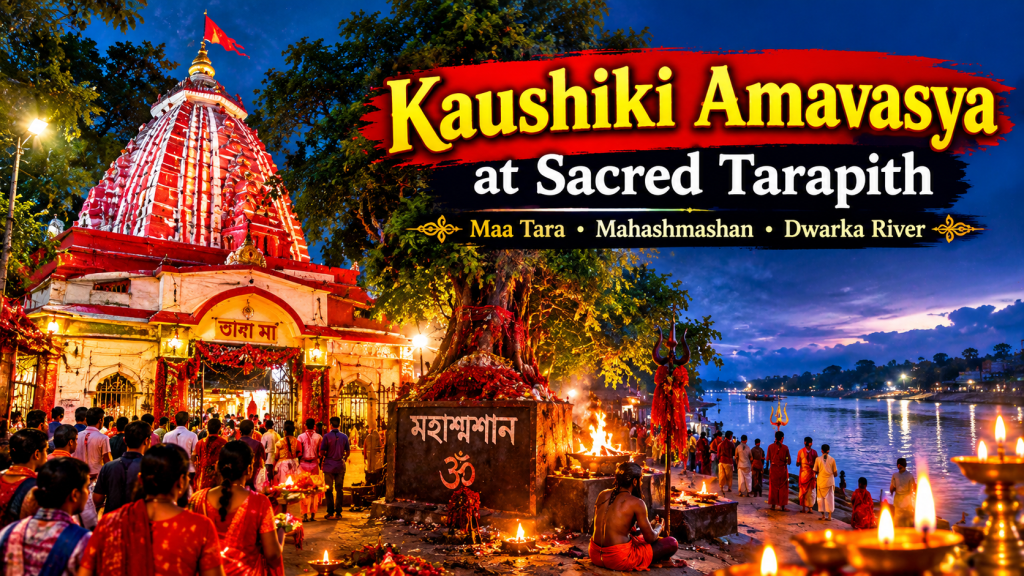
The Tarapith Mahashmashan is perhaps the most mysterious feature of the pilgrimage centre.
A cremation ground may appear frightening from an ordinary perspective. But in Tantric philosophy, the cremation ground can become a powerful place of meditation.
It reminds the practitioner that the physical body is temporary and that worldly attachment ultimately comes to an end.
The Goddess worshipped at such a place is therefore not merely associated with beauty and prosperity. She is also connected with death, transformation, liberation and the destruction of illusion.
On Kaushiki Amavasya, when the night itself is moonless, the atmosphere of the Mahashmashan becomes especially evocative.
The darkness of the night, the silence of the cremation ground, the worship of Maa Tara and the traditions of generations of practitioners combine to create an extraordinary spiritual setting.
For Tantric practitioners, such surroundings may help confront fear and attachment.
For ordinary devotees, the experience can become a powerful reminder of life’s impermanence and the importance of devotion.
Why Thousands of Devotees Visit Tarapith
Kaushiki Amavasya attracts large numbers of devotees to Tarapith because of the belief that Maa Tara is especially accessible and compassionate on this sacred occasion.
Devotees come with different hopes.
Some pray for peace and happiness.
Some seek blessings for their families.
Some come to express gratitude.
Others seek spiritual progress.
Many simply wish to experience the sacred atmosphere of Tarapith and offer their prayers to Maa Tara.
This diversity is one of the most beautiful aspects of pilgrimage.
People may arrive with different personal circumstances, but the central aspiration is the same: to seek the grace of the Divine Mother.
The Spiritual Message of Kaushiki Amavasya
Beyond mythology and ritual, Kaushiki Amavasya offers a profound spiritual message.
Its central theme can be expressed through a simple contrast:
Darkness and Light.
The darkness of Amavasya symbolizes ignorance, fear, attachment and uncertainty.
The emergence of Kaushiki symbolizes divine knowledge.
The defeat of Shumbha and Nishumbha represents the destruction of destructive forces.
The worship of Tara represents divine protection and the crossing of worldly difficulties.
The lighting of lamps represents spiritual illumination.
The meditation of the practitioner represents the search for inner consciousness.
Seen this way, Kaushiki Amavasya becomes an invitation to look inward.
Every person carries both light and darkness within the mind. Anger, greed, jealousy, arrogance and fear can obscure the inner light. Spiritual practice seeks to overcome these tendencies.
The Goddess, therefore, is not only worshipped outside.
She can also be experienced as the divine power awakening within consciousness.
How Devotees May Observe Kaushiki Amavasya
The precise rituals followed on Kaushiki Amavasya differ according to region, family tradition and spiritual lineage.
For ordinary devotees, the observance may include:
- Taking a ritual bath and maintaining personal purity.
- Worshipping Goddess Durga, Kaushiki or Maa Tara.
- Lighting lamps or pradeep.
- Offering flowers, incense and devotional food according to one’s tradition.
- Reciting appropriate prayers, stotras or mantras.
- Spending time in meditation and prayer.
- Practicing charity and helping those in need.
- Visiting a temple, where possible.
- Observing the Amavasya night with devotion and spiritual reflection.
People should follow the customs of their own family or spiritual tradition.
Specialized Tantric practices should not be attempted casually or without proper guidance. Traditional Tantra is a disciplined spiritual path with specific rules, initiations and lineages.
The Meaning of Lighting a Lamp on Alok Amavasya
Perhaps the simplest and most universal practice associated with the festival is lighting a lamp.
The lamp has a special place in Hindu worship.
When a devotee lights a lamp, the small flame becomes a symbol of the divine presence.
On Alok Amavasya, this symbolism becomes particularly meaningful.
The devotee may pray:
May the darkness of ignorance disappear.
May wisdom arise.
May fear be removed.
May Dharma prevail.
May the Divine Mother illuminate my path.
A single lamp may appear small against the darkness of night, but that is precisely what makes the symbolism powerful.
One does not need an enormous light to defeat darkness.
Even a small flame can illuminate the space around it.
Likewise, even a small awakening of spiritual awareness can begin to transform a person’s life.
Kaushiki Amavasya and the Triumph of Dharma
The story of Kaushiki ultimately returns to the universal Hindu theme of Dharma.
Shumbha and Nishumbha represent forces that disturb balance and righteousness. The Goddess appears when the forces of adharma become overwhelming.
Her victory restores order.
This pattern appears repeatedly in Hindu mythology. Whenever destructive forces become dominant, divine power manifests to restore balance.
Kaushiki’s story therefore teaches that evil may become powerful, but it cannot ultimately destroy Dharma.
The Goddess is the embodiment of this assurance.
Her presence tells devotees that spiritual courage is possible even in the darkest circumstances.
Kaushiki Amavasya: A Meeting Point of Myth, Devotion and Tantra
What makes Kaushiki Amavasya unique is the way several different spiritual traditions meet on one night.
It is connected with Puranic mythology through the story of Goddess Kaushiki.
It is connected with Shakta devotion through worship of the Divine Mother.
It is connected with Tantra through Tara Ratri and specialized spiritual practices.
It is connected with Bengal’s spiritual heritage through Tarapith and Bamakhepa.
It is connected with pilgrimage through the Tarapith temple and Dwarka River.
It is connected with spiritual symbolism through the idea of light overcoming darkness.
And it is connected with human experience through the universal desire for protection, knowledge, peace and liberation.
Few religious observances bring all these dimensions together so vividly.
The Enduring Appeal of Kaushiki Amavasya
In today’s rapidly changing world, ancient festivals continue to survive because they offer people something deeper than ritual alone.
Kaushiki Amavasya invites people to pause.
It asks them to confront darkness rather than simply fear it.
It encourages devotion when life feels uncertain.
It celebrates the power of the Divine Mother.
It reminds devotees that knowledge is greater than ignorance and Dharma is stronger than adharma.
For followers of the Shakta tradition, it is a sacred opportunity to worship the Goddess.
For devotees of Maa Tara, it is an especially important night.
For visitors to Tarapith, it is a chance to experience one of Bengal’s most distinctive spiritual landscapes.
For those interested in Hindu philosophy, it offers a fascinating example of how mythology, symbolism and spiritual practice can merge together.
Conclusion: When the Darkest Night Becomes a Night of Light
Kaushiki Amavasya is far more than a moonless night in the Hindu lunar calendar.
It is a celebration of Goddess Kaushiki, the divine manifestation of Shakti who destroyed the forces of Shumbha and Nishumbha and restored righteousness.
It is Tara Ratri, a sacred night associated with Maa Tara and the Tantric traditions of Bengal.
It is Alok Amavasya, the Amavasya of divine light, reminding humanity that even the deepest darkness can be overcome by knowledge.
And at Tarapith, the story becomes even more powerful. The temple of Maa Tara, the Dwarka River, the Mahashmashan and the spiritual legacy of Saint Bamakshyapa all combine to give the occasion a unique character.
For devotees, Kaushiki Amavasya is a time to pray, meditate, worship and seek the grace of the Mother.
Its deepest message can perhaps be summarized in one simple thought:
When the outer world becomes dark, seek the divine light within.
The darkness of Amavasya is temporary. The light of spiritual knowledge, according to Hindu wisdom, can illuminate the path far beyond a single night.
And that is why Kaushiki Amavasya continues to hold such a mysterious, sacred and enduring place in the spiritual traditions of Hinduism.
Jai Maa Kaushiki. Jai Maa Tara. Jai Maa Durga.
*Related Article: 1.Tarapith: A Famous Pilgrimage Site
2. Tarapith Temple Travel Guide: A Spiritual Journey to Bengal’s Sacred Shakti Peetha
[Updated on 10 September, 2026]