Devi Paksha: The Sacred Fortnight of Goddess Durga
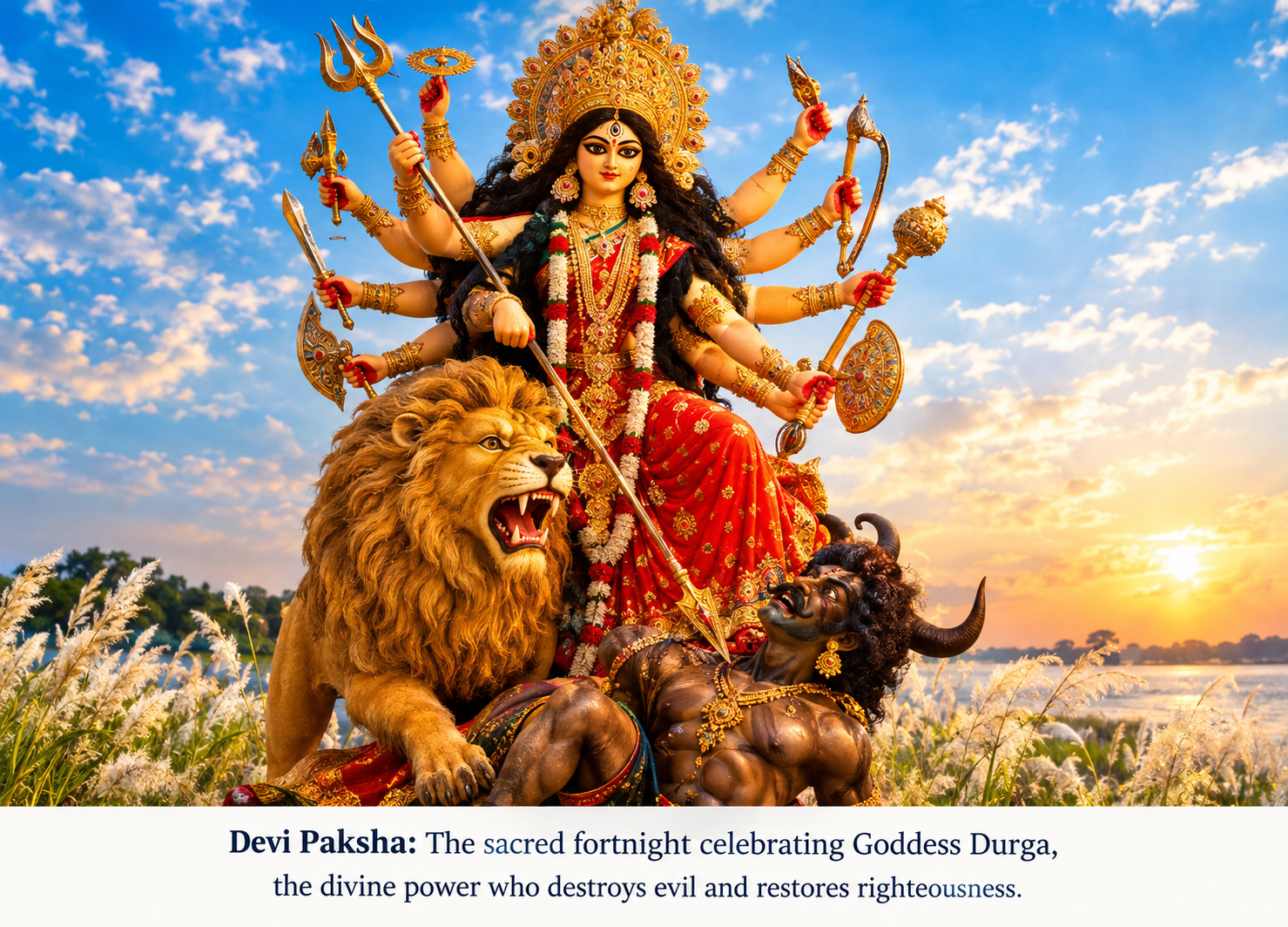
Hinduism celebrates the divine in many forms, each representing a particular aspect of the eternal power that sustains the universe. Among these divine manifestations, Goddess Durga holds a special place as the embodiment of Shakti, the supreme feminine power. She represents courage, protection, righteousness, compassion, and the victory of good over evil.
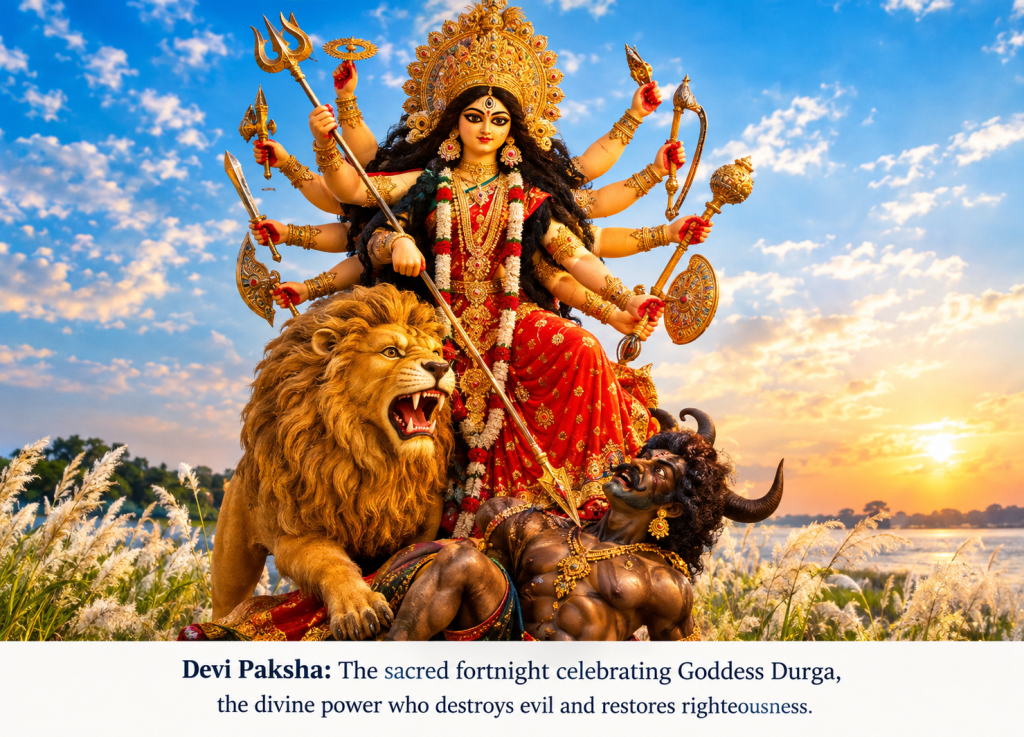
One of the most spiritually significant periods dedicated to the Divine Mother is Devi Paksha, a sacred lunar fortnight associated with the worship of Goddess Durga and other manifestations of the Divine Feminine. In Bengal and many other parts of eastern India, Devi Paksha carries a particularly deep emotional and cultural meaning because it marks the arrival of the season of Sharadiya Durga Puja.
The word Devi means goddess, while Paksha means a lunar fortnight, traditionally comprising approximately fifteen lunar days. Devi Paksha is therefore understood as the sacred fortnight of the Goddess. It is associated with devotion, spiritual awakening, the invocation of divine feminine energy, and preparations for the grand celebration of Durga Puja.
For millions of Hindus, the arrival of Devi Paksha brings a feeling of joy, hope, renewal, and divine presence. The sound of devotional songs, the fragrance of autumn flowers, the beauty of white kash grass, and the anticipation of Durga Puja create an atmosphere that is deeply connected with Bengali Hindu culture.
However, Devi Paksha is not merely a seasonal festival period. Its deeper meaning lies in the recognition that divine power protects the righteous, destroys destructive forces, and helps human beings overcome ignorance, fear, and negativity.
This article explores the meaning, religious significance, traditional observances, mythological background, relationship with Mahalaya and Durga Puja, and cultural importance of Devi Paksha.
1. What Is Devi Paksha?
Devi Paksha is a sacred period in the Hindu lunar calendar associated with the worship and celebration of the Divine Mother. In the Bengali religious tradition, it is especially connected with the annual autumnal worship of Goddess Durga.
A paksha is one half of a lunar month. Hindu lunar months are traditionally divided into two fortnights:
- Shukla Paksha: The bright fortnight, during which the Moon waxes from the new moon toward the full moon.
- Krishna Paksha: The dark fortnight, during which the Moon wanes from the full moon toward the new moon.
In the traditional Bengali understanding of the autumnal festival season, Devi Paksha begins after the conclusion of Pitru Paksha and is associated with the invocation of the Goddess before Durga Puja.
The precise calendar boundaries and observances can vary according to regional calendars and religious traditions. In particular, the period commonly called Devi Paksha in Bengal should not always be treated as an identical, universally defined lunar interval across all Hindu communities.
Nevertheless, its central religious meaning remains clear: it is a time devoted to the Divine Mother and the spiritual ideals represented by her.
For Bengali Hindus, the name Devi Paksha immediately evokes Mahalaya, the approaching Durga Puja, the triumph of Goddess Durga over Mahishasura, and the joyful arrival of the Goddess at her earthly home.
2. The Meaning of the Divine Feminine in Hinduism
To understand Devi Paksha, it is helpful to understand the concept of Shakti in Hindu philosophy.
Shakti means power, energy, or dynamic creative force. In Shakta traditions, the Divine Mother is worshipped as the supreme reality from which the universe emerges, by which it is sustained, and into which it eventually returns.
The Goddess is not simply a divine figure associated with one particular activity. She may be understood as the universal power behind creation, preservation, transformation, knowledge, prosperity, and liberation.
Different forms of the Goddess express different dimensions of this power.

Goddess Durga — Courage and Protection
Durga represents the power that confronts evil, protects the innocent, and restores righteousness. Her many arms symbolize her ability to overcome numerous challenges simultaneously.

Goddess Lakshmi — Prosperity and Well-being
Lakshmi represents prosperity, auspiciousness, generosity, and the responsible enjoyment of material and spiritual blessings.

Goddess Saraswati — Knowledge and Wisdom
Saraswati symbolizes learning, music, eloquence, creativity, and the pursuit of wisdom that helps human beings distinguish truth from ignorance.

Goddess Kali — Transformation and Liberation
Kali represents the power that destroys destructive forces, confronts the limitations of the ego, and reminds devotees of the impermanence of worldly existence.
These forms are understood differently among Hindu traditions. Some regard them as distinct deities with their own identities, while many Shakta traditions see them as manifestations of one supreme Goddess.
Devi Paksha offers an opportunity to reflect on these aspects of the Divine Feminine and recognize their spiritual significance in everyday life.
The Goddess’s power is not limited to temples, sacred images, or religious ceremonies. Symbolically, it is also reflected in courage during hardship, wisdom in decision-making, compassion toward others, and the determination to stand against injustice.
3. The Mythological Background of Devi Paksha
The religious significance of Devi Paksha is closely associated with the stories of Goddess Durga found in Hindu sacred literature, especially the Devi Mahatmya, also known as the Durga Saptashati or Chandi Path.
The Devi Mahatmya forms part of the Markandeya Purana and contains thirteen chapters celebrating the supremacy of the Goddess. It describes her divine manifestations and her victories over powerful demonic forces that threaten cosmic order.
According to one of its most famous narratives, a mighty asura named Mahishasura obtained a boon that made him extremely difficult to defeat. Becoming arrogant through his power, he challenged the gods and drove them from their heavenly realm.
The gods realized that ordinary efforts could not overcome the growing threat. Their combined divine energies manifested as the magnificent Goddess Durga, who received celestial weapons from different deities.
Mounted on a lion, Durga confronted Mahishasura and fought a tremendous battle against his forces. Finally, she defeated the demon and restored order to the universe.
This story forms one of the central religious foundations of Durga Puja.
The deeper meaning of Durga’s victory
The battle between Durga and Mahishasura is not only a mythological account of a divine conflict. It also conveys a profound moral and spiritual message.
Mahishasura can be interpreted symbolically as the destructive tendencies that grow within human beings: arrogance, uncontrolled desire, anger, greed, cruelty, and the misuse of power.
Durga represents the divine strength required to overcome these tendencies. Her victory reminds devotees that negative forces, however powerful they appear, can be defeated through courage, wisdom, discipline, and righteousness.
The Goddess’s lion represents strength and fearless determination, while her weapons symbolize the many means by which destructive forces can be confronted.
Her many arms also convey the idea that divine power is not restricted to one particular function. The Goddess protects, nourishes, destroys evil, and restores balance.
During Devi Paksha, devotees remember this message and seek the strength to overcome difficulties in their own lives.
4. Devi Paksha and the Story of Akal Bodhan
An important tradition associated with autumnal Durga Puja is known as Akal Bodhan, meaning the untimely or unconventional awakening of the Goddess.
In many traditional accounts, the gods’ principal worship of Durga is associated with spring. The autumnal worship of the Goddess is therefore remembered as a special invocation outside the customary season.
The story of Lord Rama‘s worship of Durga before his battle against Ravana is particularly famous in Bengal.
According to the popular Bengali narrative, Rama sought the blessings of Goddess Durga before fighting Ravana, the powerful king of Lanka who had abducted Sita. Rama performed the worship in autumn, invoking the Goddess’s assistance for the difficult battle ahead.
One well-known version of the story says that Rama needed 108 blue lotuses for the worship. When one lotus could not be found, he prepared to offer one of his own eyes, which were often compared to lotus petals. Moved by his devotion, the Goddess appeared and blessed him.
This episode is celebrated in the devotional imagination as an expression of extraordinary faith and determination.
The story is especially important in Bengali traditions because it provides a mythological explanation for the autumnal celebration of Durga Puja.
The Ramayana exists in numerous regional and literary versions, and details of this episode differ between traditions. Akal Bodhan is particularly prominent in Bengali retellings of the Rama story.
Why is this story important during Devi Paksha?
Akal Bodhan teaches that sincere devotion is not confined to a particular season or ritual schedule. When righteousness faces a serious challenge, devotees may turn to the Divine Mother for courage and guidance.
The story also emphasizes that the Goddess is worshipped not simply to obtain victory over external enemies, but to strengthen the inner qualities necessary for overcoming adversity.
For many Bengali Hindus, the arrival of Devi Paksha brings these traditional narratives to mind and marks the beginning of the long-awaited annual celebration of the Divine Mother.
5. The Relationship Between Pitru Paksha and Devi Paksha
Pitru Paksha and Devi Paksha occupy important places in the traditional Hindu calendar, particularly in Bengali religious culture.
Pitru Paksha is a period associated with remembrance and offerings for departed ancestors. Families may perform tarpana, shraddha, and other observances according to their traditions and family customs.
Its spiritual emphasis is on gratitude, remembrance, and the recognition of one’s connection with previous generations.
Devi Paksha, by contrast, is associated with the worship of the Divine Mother and the celebration of divine protection, courage, and renewal.
In the Bengali festival calendar, the conclusion of Pitru Paksha is followed by the anticipation of Devi Paksha and the approach of Durga Puja.
This transition carries an emotional significance. The solemn atmosphere of ancestral remembrance gives way to the joyful anticipation of the Goddess’s arrival.
Mahalaya Amavasya is especially important because it marks the conclusion of Pitru Paksha in many traditional calendar calculations and is closely associated with the beginning of the Durga Puja season in Bengal.
However, it is important to distinguish religious observance from popular cultural convention. The precise beginning of Devi Paksha and the formal commencement of Durga Puja rites are not necessarily the same date in every calendar or tradition.
The transition nevertheless offers a meaningful reflection on two essential dimensions of Hindu life: gratitude toward those who came before us and devotion toward the divine power that sustains life.
6. Mahalaya: The Beginning of the Durga Puja Atmosphere

Mahalaya is one of the most emotionally significant occasions associated with Devi Paksha, especially in Bengal and among Bengali communities around the world.
The word Mahalaya is traditionally connected with the concluding period of Pitru Paksha and the invocation of the Goddess before Durga Puja. It is observed on the new-moon day of Ashwin, subject to the Hindu lunar calendar.
For many Bengali households, Mahalaya is much more than a date. It is an experience that brings memories of childhood, family traditions, devotional music, and the arrival of autumn.
Mahalaya and the invocation of the Goddess
Mahalaya is associated with the Chandi Path, hymns dedicated to the Goddess, and the recitation or broadcast of devotional programmes celebrating her divine power.
The famous Bengali radio presentation Mahishasuramardini, traditionally associated with Birendra Krishna Bhadra’s narration and devotional music, has become an enduring cultural symbol of the occasion.
Many people listen to this programme in the early hours of Mahalaya morning. For generations, its recitation of sacred verses, songs, and dramatic narration has helped establish the emotional atmosphere of Durga Puja.
Mahalaya programmes often evoke the story of the Goddess’s manifestation and her battle against Mahishasura. They remind listeners that the festival celebrates the victory of divine power over destructive forces.
Mahalaya and ancestral remembrance
Mahalaya also retains its association with the remembrance of ancestors. Many families perform tarpana on this occasion, although the precise customs differ among communities.
This combination of ancestral remembrance and devotion to the Goddess gives Mahalaya a distinctive place in the Bengali religious calendar.
It is a day of reflection, reverence, and anticipation.
Is Mahalaya the day Durga arrives on Earth?
In popular Bengali belief, Mahalaya is often described as the beginning of the Goddess’s journey to her earthly home. Images of Durga, her children, autumn skies, and devotional songs reinforce this understanding.
However, the formal ritual invocation of Durga, known as Bodhan, is generally performed later according to the prescribed Durga Puja calendar. Thus, the cultural beginning of the festival season and the formal beginning of the main worship are related but distinct concepts.
7. Devi Paksha and Sharadiya Durga Puja
The most prominent celebration associated with Devi Paksha in Bengal is Sharadiya Durga Puja, the autumnal worship of Goddess Durga.
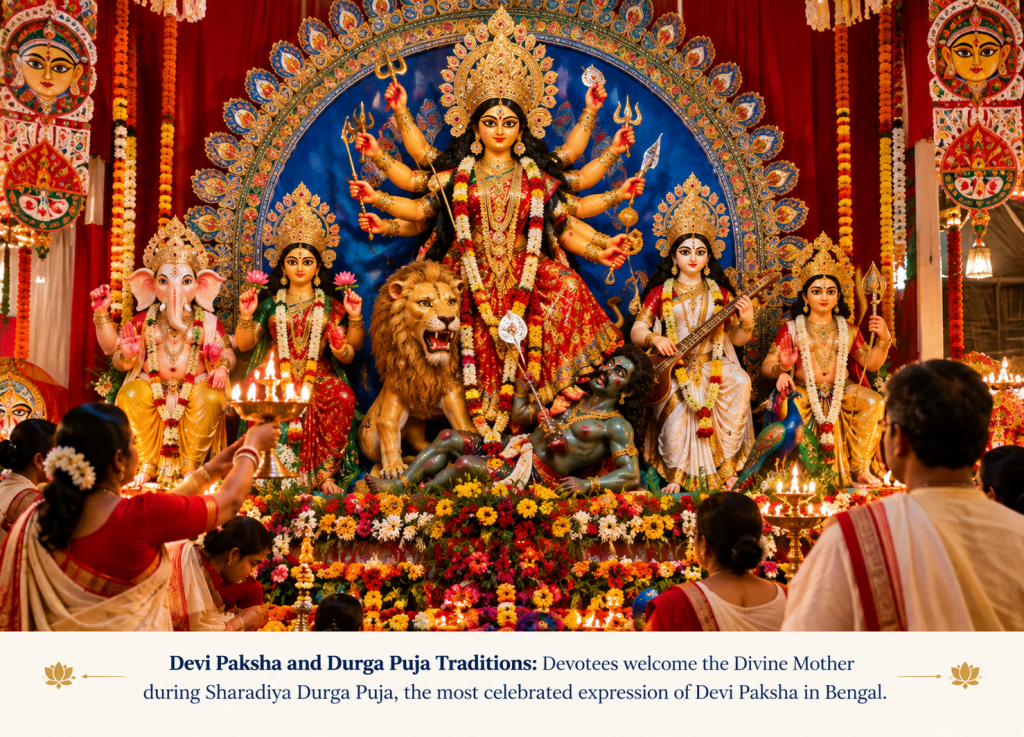
Durga Puja is celebrated with particular enthusiasm in West Bengal, Bangladesh, Tripura, Assam, and Bengali communities throughout India and the world.
The festival brings together religious devotion, artistic expression, family reunions, community participation, music, and cultural programmes.
For many devotees, it is a time when the Goddess is welcomed as a beloved daughter returning to her parental home.
This emotional understanding is especially powerful in Bengali culture. Durga is worshipped as the supreme divine power, yet she is also imagined as a daughter accompanied by her children, Ganesha, Kartikeya, Lakshmi, and Saraswati.
The making of Durga idols

Preparations for Durga Puja often begin long before Devi Paksha arrives.
In traditional idol-making centres such as Kumartuli in Kolkata, artisans create clay images of the Goddess using established artistic methods. Clay, straw, bamboo structures, paints, ornaments, and elaborate decorations gradually transform simple materials into magnificent religious images.
The process represents a remarkable combination of craftsmanship, inherited knowledge, and devotion.
Many traditional practices also attach symbolic significance to the materials used in making the idols. Particular customs concerning sacred soil and other ingredients vary by region and community and should not be assumed to be universal.
As Devi Paksha approaches, completed idols are transported to temples, community pandals, and household shrines.
The sight of these images marks the visible transformation of the autumn landscape into a festival environment.
The significance of pandals
Temporary structures known as pandals are created to house the Goddess during public celebrations. Some follow traditional temple designs, while others feature innovative architecture, artistic themes, or representations of historical and cultural landmarks.
These pandals provide spaces for worship, community gatherings, cultural programmes, and the sharing of food and hospitality.
The artistic creativity surrounding Durga Puja has become one of its most recognizable features.
Yet the heart of the festival remains the worship of the Goddess and the message of divine protection, righteousness, and compassion.
The spiritual significance of Durga Puja
Durga Puja celebrates the victory of the Goddess over Mahishasura. Through this story, devotees remember that arrogance and cruelty cannot ultimately prevail over divine righteousness.
The festival also encourages people to recognize strength and dignity in women, show compassion toward vulnerable people, and resist injustice.
In this sense, Devi Paksha provides an opportunity to connect religious devotion with ethical responsibility.
8. Important Days Associated With Devi Paksha
Devi Paksha is associated with several significant observances. Their exact dates depend on the lunar calendar and regional customs.
Mahalaya Amavasya
Mahalaya Amavasya marks the new-moon day associated with the conclusion of Pitru Paksha in the Bengali tradition. It is observed through ancestral remembrance and is widely regarded as the emotional beginning of the Durga Puja season.
Bodhan
Bodhan means awakening or invocation. During autumnal Durga Puja, the Goddess is ceremonially invoked according to prescribed traditions. In the Bengali calendar, this observance is commonly associated with the evening of Shashthi, although specific rites and timings follow the relevant year’s calendar.
Kalparambha and Adhivas
These rites are associated with the preparation and ceremonial establishment of the worship. Their precise procedures vary according to the traditions followed by priests, temples, and families.
Shashthi
Shashthi marks an important stage in the main Durga Puja celebrations. In Bengal, it is associated with the formal beginning of the public festival atmosphere and the observances surrounding the Goddess’s arrival.
Saptami
On Saptami, worship continues with special rituals. In Bengali Durga Puja, the Nabapatrika ceremony is a notable tradition. A group of nine plants is ritually prepared and worshipped in association with the Goddess.
The ceremony has regional interpretations and is sometimes popularly described as the worship of Kola Bou, or the banana bride.
Ashtami
Maha Ashtami is among the most important days of Durga Puja. Devotees offer prayers, flowers, and other traditional offerings to the Goddess.
Many communities observe fasting or special devotional practices on this day.
The Sandhi Puja, associated with the transition between Ashtami and Navami, is another especially significant observance in Bengali Durga Puja traditions.
Navami
Maha Navami continues the worship of Durga and commemorates the culmination of the Goddess’s battle against demonic forces in popular religious understanding.
Special prayers, offerings, and community celebrations are held according to local traditions.
Dashami
Vijaya Dashami, or Bijoya Dashami in Bengali usage, marks the conclusion of the principal Durga Puja celebrations in Bengal.
The Goddess is ceremonially bid farewell, and her image is traditionally immersed in water during visarjan, subject to local customs and environmental regulations.
Dashami carries an emotional mixture of joy, gratitude, and sadness. Devotees celebrate the Goddess’s victory while preparing to wait another year for her return.
Not every day listed above necessarily falls within Devi Paksha under every calendar convention. These observances describe the wider Durga Puja season most commonly associated with it.
9. Devi Paksha and Sharadiya Navratri
Devi Paksha in Bengal and Sharadiya Navratri in many other parts of India are closely connected through their devotion to the Divine Mother. However, their customs, emphasis, and calendar observances may differ.
Sharadiya Navratri means the nine nights dedicated to the Goddess during the autumn season. It is celebrated in northern, western, and other regions of India through fasting, devotional singing, temple worship, and community gatherings.
In many traditions, devotees worship nine forms of Durga, collectively known as Navadurga:
- Shailaputri
- Brahmacharini
- Chandraghanta
- Kushmanda
- Skandamata
- Katyayani
- Kalaratri
- Mahagauri
- Siddhidatri
Each form represents a different quality of the Goddess and provides devotees with an opportunity to reflect on spiritual discipline, courage, purity, and divine wisdom.
In Bengal, Durga Puja places particular emphasis on the magnificent image of Durga defeating Mahishasura, the worship of the Goddess with her divine family, and the artistic and cultural celebrations surrounding the festival.
In Gujarat, Navratri is especially famous for Garba and Dandiya Raas. In northern India, Ramlila performances and the celebration of Dussehra highlight the victory of Rama over Ravana. In southern India, traditions such as Golu displays and special temple worship are prominent in several communities.
Although these celebrations differ, they share a common theme: the triumph of righteousness over destructive forces and the recognition of the Divine Mother’s power.
Devi Paksha can therefore be understood as part of a wider Hindu tradition that celebrates the Goddess through different regional expressions.
10. How Is Devi Paksha Observed?
There is no single compulsory method of observing Devi Paksha that applies to every Hindu family. Religious practices depend on regional traditions, personal devotion, family customs, and the guidance of priests.
Nevertheless, several practices are commonly associated with this sacred period.
Worship of Goddess Durga
Devotees may worship Durga at home or visit temples dedicated to the Goddess. Traditional offerings can include flowers, incense, lamps, fruits, sweets, and water.
Many people recite hymns such as the Durga Chalisa, Devi Mahatmya, or selected names and mantras of the Goddess according to their tradition.
Reading sacred texts
The Devi Mahatmya is an important scripture for many Shakta devotees. Reading or listening to its accounts of the Goddess’s manifestations helps deepen understanding of her spiritual significance.
Some families also read passages from the Ramayana, Devi Bhagavata Purana, or other devotional works associated with the Divine Mother.
Fasting and personal discipline
Some devotees observe fasts during Navratri or on particular days dedicated to Durga. Fasting practices vary considerably, ranging from avoiding particular foods to undertaking more restrictive observances.
Fasting is a personal religious practice and should be undertaken in a manner appropriate to one’s circumstances and well-being.
Charity and compassionate service
Offering food, clothing, educational support, or other assistance to people in need is a meaningful way to express devotion.
The spiritual significance of worship becomes deeper when it is accompanied by kindness, generosity, and respect for others.
Maintaining a peaceful atmosphere
Many devotees use Devi Paksha as an opportunity to reduce unnecessary conflict, practise self-control, and devote more time to prayer and reflection.
The purpose is not simply to complete religious ceremonies, but to cultivate the virtues that the Goddess represents.
11. The Spiritual Meaning of Devi Paksha
Beyond its festivals and ceremonies, Devi Paksha carries several important spiritual messages.
The victory of good over evil: The story of Durga and Mahishasura reminds devotees that destructive forces must be confronted rather than allowed to dominate life.
The importance of courage: Durga symbolizes the strength required to face difficulties, defend the vulnerable, and stand firmly for what is right.
The power of knowledge: The Goddess’s various forms remind devotees that wisdom is essential for overcoming ignorance and making responsible choices.
The value of compassion: Divine strength does not mean cruelty. The Mother protects her devotees and represents the importance of caring for those who need help.
The possibility of renewal: Just as autumn brings a change in the natural environment, Devi Paksha encourages people to renew their intentions, correct mistakes, and begin again with greater determination.
These teachings can be applied to family life, education, work, social relationships, and community service.
For students, the period can inspire discipline and perseverance. For teachers, it can reinforce the responsibility of sharing knowledge. For families, it can encourage harmony and mutual respect. For society, it can serve as a reminder to oppose injustice without abandoning compassion.
In this way, the spiritual significance of Devi Paksha extends beyond a particular festival or religious community.
12. The Cultural Importance of Devi Paksha in Bengal
In Bengal, Devi Paksha is deeply woven into the cultural identity of Bengali Hindus.
The arrival of autumn is associated with a distinctive landscape: blue skies, drifting white clouds, fields of kash flowers, and the changing light of the season.
These natural features have become familiar symbols of the approaching Durga Puja.
For many people, the first emotional signs of Devi Paksha appear through songs, radio programmes, new clothes, the construction of pandals, and conversations about plans for the festival.
Families living far from their ancestral homes may travel to reunite with relatives. Friends arrange gatherings, artisans complete their work, and communities prepare to welcome visitors.
The celebrations also support a broad network of artisans, decorators, musicians, flower sellers, transport workers, food vendors, and small businesses.
Durga Puja is therefore not only a religious occasion but also an important cultural and economic event.
Devi Paksha in Bangladesh
Durga Puja is celebrated by Hindu communities throughout Bangladesh. Temples and community organizations arrange worship, cultural programmes, and gatherings during the autumn festival season.
For Bangladeshi Hindus, Devi Paksha can carry a strong sense of faith, family, community, and cultural continuity.
The celebration also provides opportunities for people of different religious backgrounds to appreciate the artistic and cultural traditions associated with the festival.
Respectful participation, peaceful coexistence, and protection of places of worship are important expressions of the broader values of religious harmony.
Devi Paksha around the world
Bengali communities in countries such as the United States, the United Kingdom, Canada, Australia, and elsewhere organize Durga Puja celebrations in temples, community centres, and public venues.
Although the scale and arrangements may differ from those in Bengal, the underlying emotions remain familiar: devotion to the Goddess, reunion with community, and the celebration of cultural heritage.
Devi Paksha thus connects people across generations and geographical boundaries.
13. The Symbolism of Autumn During Devi Paksha
Autumn has a special place in the Bengali imagination because it accompanies the approach of Durga Puja.
The clear sky, soft sunlight, white kash flowers, and gentle movement of the wind create a natural setting that many devotees associate with the arrival of the Goddess.
Although the seasonal experience varies from year to year, nature remains a powerful source of inspiration during this period.
The connection between Devi Paksha and the natural world also offers a broader spiritual reflection.
Hindu traditions frequently recognize the sacredness of nature. Rivers, mountains, trees, animals, and the elements are associated with divine manifestations and religious symbolism.
The lion of Durga represents strength and courage, while the lotus associated with several goddesses represents purity and spiritual unfolding. Flowers and leaves used in worship express reverence for the natural world.
Devi Paksha can therefore inspire devotees to care for the environment, avoid unnecessary waste, and celebrate festivals in ways that respect nature.
Eco-friendly idol materials, responsible immersion practices, reduced plastic use, and proper waste management can help communities preserve both religious traditions and the environment.
14. Devi Paksha 2026: What Should Devotees Know?
In 2026, Devi Paksha will again be associated with the autumnal worship of the Goddess and the Durga Puja season. The exact dates of Mahalaya, Navratri, and Durga Puja should be checked against a reliable regional Hindu calendar for the place where the observances will take place.
This is important because lunar dates can vary according to geographical location, local sunrise, time zone, and the calendar tradition followed.
For devotees in Bangladesh, it is advisable to consult a recognized local panjika or the official festival schedule published by the relevant Durga Puja organizing authority.
The principal observances to look for include:
- Mahalaya Amavasya: Ancestral remembrance and the traditional beginning of the Durga Puja atmosphere.
- Bodhan and Shashthi: Important observances associated with the invocation of the Goddess and the beginning of the main Bengali Durga Puja celebrations.
- Maha Saptami, Maha Ashtami, and Maha Navami: The central days of worship.
- Vijaya Dashami: The ceremonial conclusion of Durga Puja and the farewell to the Goddess.
The spiritual message remains the same regardless of the precise calendar dates. Devi Paksha invites devotees to welcome the Goddess with faith, cultivate virtuous qualities, and seek the strength to overcome difficulties.
15. Why Is Devi Paksha Important in Modern Life?
Modern life brings many challenges, including economic uncertainty, social conflict, environmental problems, and the pressure of competing responsibilities.
The teachings associated with Devi Paksha can provide a meaningful framework for responding to these difficulties.
Durga’s courage can inspire people to confront injustice. Saraswati’s wisdom encourages learning and thoughtful decision-making. Lakshmi’s symbolism reminds devotees that prosperity is most meaningful when accompanied by generosity and responsibility. Kali’s association with transformation encourages people to confront harmful habits and accept necessary change.
These interpretations do not require devotees to abandon the traditional religious meaning of the Goddess. Instead, they show how devotion can be connected with daily conduct.
Devi Paksha also provides an opportunity to reflect on the dignity and strength of women. The worship of the Divine Mother can inspire greater respect for women’s rights, education, safety, and equal participation in society.
At the same time, religious devotion should be expressed through peaceful conduct and respect for people of different beliefs.
A meaningful celebration is one that combines worship with compassion, community participation, and responsibility toward others.
Conclusion
Devi Paksha is one of the most meaningful periods in the Hindu religious calendar, particularly for Bengali Hindus who associate it with Mahalaya and the arrival of Sharadiya Durga Puja.
It celebrates the Divine Mother as the embodiment of Shakti, the power that protects the universe, confronts destructive forces, and restores righteousness. Its mythological foundation includes the victory of Durga over Mahishasura and the traditional account of Akal Bodhan, the autumnal invocation of the Goddess.
The period also connects ancestral remembrance, sacred literature, temple worship, artistic traditions, family reunions, and community celebrations.
Yet the deepest message of Devi Paksha goes beyond ceremonies and festivities. It encourages people to cultivate courage, wisdom, compassion, generosity, and moral responsibility.
When devotees welcome Goddess Durga, they celebrate not only her divine victory but also the possibility of overcoming the negative forces within themselves and the world around them.
May the blessings of the Divine Mother bring peace, wisdom, prosperity, and strength to all. May Devi Paksha inspire humanity to overcome ignorance, protect the innocent, respect women, and uphold truth and righteousness.
Jai Maa Durga!