Vishwakarma: The Divine Architect of Hinduism
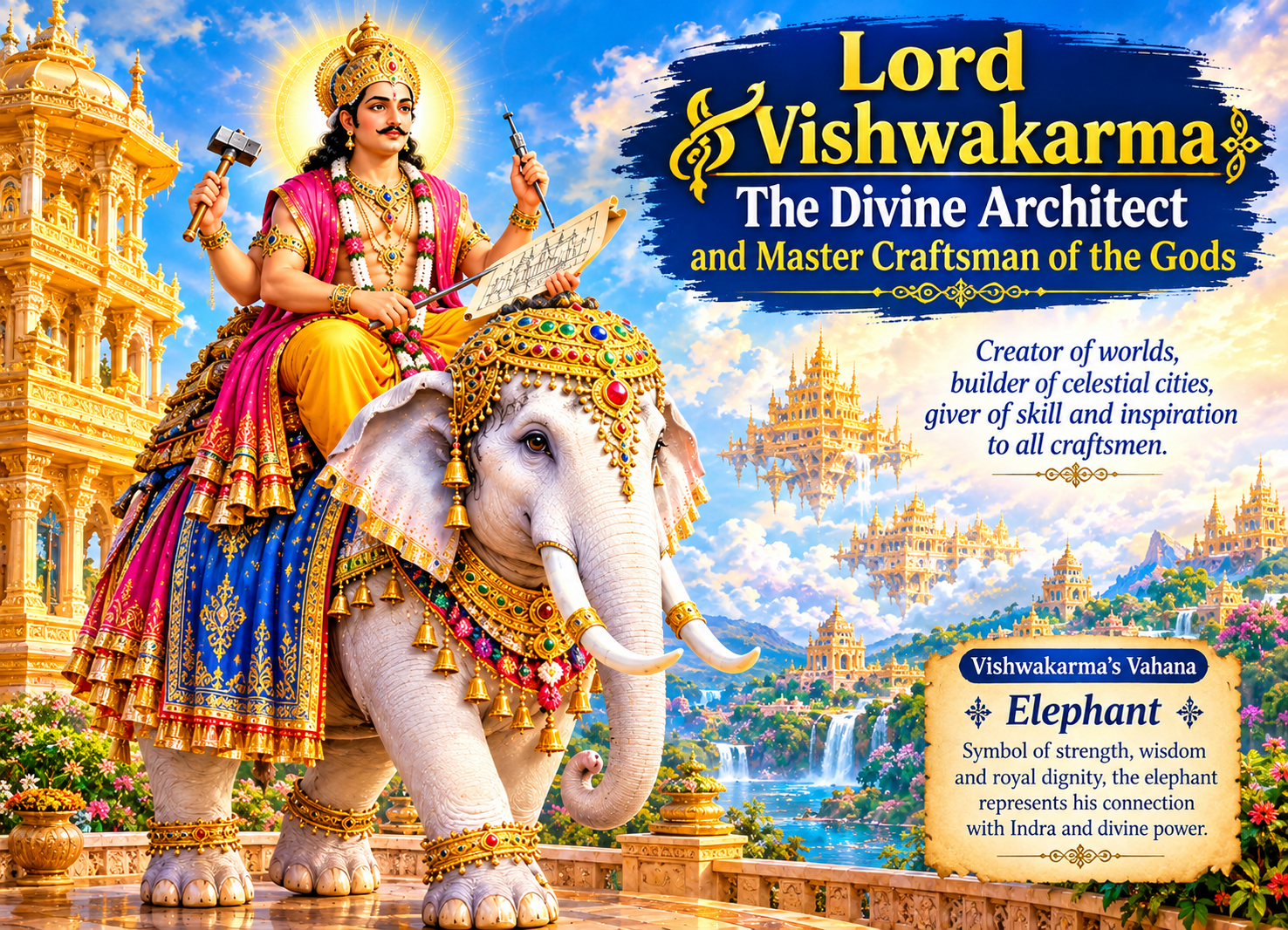
Who designed the magnificent cities of the gods? Who crafted their extraordinary weapons, palaces and celestial vehicles? And who, according to Hindu sacred traditions, possesses the skill to transform imagination into divine architecture?

The answer is Vishwakarma.
Vishwakarma, also spelled Vishvakarma or Vishwakarman, is one of the most fascinating divine figures in Hindu tradition. He is regarded as the divine architect, master craftsman and celestial engineer who creates extraordinary structures, weapons, ornaments and flying chariots for the gods.
His importance goes far beyond architecture in the modern sense. Vishwakarma represents the sacred power of skill, craftsmanship, creativity, design, construction and technological knowledge.
For this reason, artisans, craftsmen, engineers, architects, mechanics, factory workers and people associated with machines and tools have traditionally regarded Vishwakarma with great reverence.
His stories are spread across different layers of Hindu literature. His character and genealogy also vary from one scripture or tradition to another. Yet one idea remains remarkably consistent: Vishwakarma is the master creator of magnificent works.
His legendary creations include heavenly realms, magnificent cities and extraordinary divine weapons. Among the places traditionally associated with him are Swarna Lanka, Dwarka, Hastinapur and Indraprastha.
Every year, his devotees celebrate Vishwakarma Puja, particularly in eastern and northern parts of the Indian subcontinent. The occasion is closely connected with workshops, factories, tools, machines and, in some regions, the joyful tradition of kite flying.
But who exactly is Vishwakarma? What do Hindu scriptures say about him? What did he create? And why is he worshipped by craftsmen and engineers?
Let us explore the fascinating world of Vishwakarma.
Who Is Vishwakarma?
Vishwakarma is traditionally regarded as the divine architect and master craftsman of the gods.
The Sanskrit name Vishvakarman can broadly be understood in relation to one who creates or accomplishes all things. In Hindu thought, this makes Vishwakarma an appropriate name for a divine figure associated with universal craftsmanship and creation.
He is described in Hindu traditions as a master of many forms of craftsmanship. He can construct magnificent palaces, design celestial cities, create weapons of extraordinary power and fashion beautiful ornaments.
He is also associated with the creation of vimanas, the legendary flying vehicles mentioned in Hindu literature.
Thus, Vishwakarma is not merely a divine carpenter or builder. He represents the highest ideal of creative craftsmanship.
An architect imagines a structure before constructing it. An engineer transforms an idea into a working design. A craftsman turns raw materials into something useful or beautiful.
Vishwakarma embodies all these abilities in their divine form.
For this reason, he is often described as the architect of the gods.
Vishwakarma in the Rigveda
Vishwakarma’s roots extend deep into ancient Hindu literature.
His name appears in the Rigveda, one of the oldest surviving collections of Indo-Aryan sacred hymns. His presence there shows that the concept of Vishwakarma is much older than many of the later stories associated with him.
The name Vishwakarma occurs several times in the tenth book of the Rigveda, where the hymns explore profound questions concerning creation, existence and the origin of the universe.
The Vedic conception of Vishwakarma is especially interesting because it connects craftsmanship with cosmic creation.
In this context, the divine craftsman is not simply someone who constructs houses or buildings. The very universe can be imagined as a magnificent work of divine craftsmanship.
This is one reason Vishwakarma later became associated with the creation of the universe and the extraordinary structures of the gods.
The idea also gives a deeper philosophical meaning to his worship: creation itself is a form of divine craftsmanship.
Vishwakarma in the Mahabharata
Vishwakarma also occupies an important place in the wider body of Hindu epic tradition.
The Mahabharata presents him as an extraordinary divine artisan. A famous description portrays him as the master of arts and crafts, the maker of ornaments and the carpenter of the gods.
His abilities are represented as almost limitless.
He is associated with the construction of magnificent cities and buildings and with the creation of objects possessing extraordinary beauty and power.
This image of Vishwakarma as the supreme craftsman became especially influential in later Hindu traditions.
Vishwakarma as the Divine Architect
The title Divine Architect is perhaps the most recognizable description of Vishwakarma.
Architecture is more than putting bricks together. It involves imagination, measurement, proportion, planning, engineering and artistic vision.
In Hindu mythology, Vishwakarma possesses these abilities at a supernatural level.
He is said to have designed and constructed:
- Celestial palaces
- Divine cities
- Sacred buildings
- Weapons of the gods
- Flying chariots or vimanas
- Magnificent ornaments
- Royal structures
- Extraordinary halls and chambers
These stories have made Vishwakarma an enduring symbol of innovation and craftsmanship.
His mythology therefore has a surprisingly modern appeal. An architect designing a building, an engineer developing a machine, a carpenter making furniture, a sculptor carving an image or a mechanic repairing an engine can all see something of Vishwakarma’s ideal in their work.
Vishwakarma and the Four Yugas
Hindu cosmology describes time as moving through four great ages or Yugas:
- Satya Yuga
- Treta Yuga
- Dvapara Yuga
- Kali Yuga
Traditional accounts associate Vishwakarma with remarkable constructions across these ages.
Among the cities and places connected with him are Swarga, Swarna Lanka, Dwarka, Hastinapur and Indraprastha.
These stories demonstrate the enormous scale of Vishwakarma’s legendary craftsmanship.
Let us look at some of the most famous examples.
Swarga: The Abode of the Gods
In Hindu mythology, Swarga Loka is a celestial realm associated with the gods and divine beings.
Traditional accounts connect Vishwakarma with the construction of magnificent heavenly architecture.
The heavenly world is frequently imagined as a place of incomparable beauty, filled with splendid palaces, gardens and celestial structures.
Vishwakarma’s association with this realm reinforces his identity as the architect capable of creating environments suitable for divine beings.
The image is symbolic as well as mythological: the architect of the gods creates a world where beauty, order and harmony are brought together.
Swarna Lanka: The Golden City
One of the most famous architectural stories associated with Vishwakarma is the story of Swarna Lanka, or Golden Lanka.
According to traditions connected with the Ramayana, Lanka was an extraordinarily magnificent city associated with King Ravana.
One popular account says that Vishwakarma constructed a magnificent golden palace for Lord Shiva and Goddess Parvati.
After its completion, a housewarming ceremony was arranged. Ravana, who was highly learned in sacred matters and was associated with devotion to Shiva, was invited to perform the ceremony.
After the ceremony, Shiva is traditionally said to have offered the golden palace to Ravana as dakshina.
Ravana accepted the magnificent city, and Lanka became his celebrated kingdom.
The story is particularly interesting because it combines architecture, devotion, ritual and royal power in a single narrative.
The image of a city of gold has also made Swarna Lanka one of the most memorable architectural wonders of Hindu mythology.
Dwarka: The City of Lord Krishna
Another magnificent city associated with Vishwakarma is Dwarka, the legendary city of Lord Krishna.
According to Hindu tradition, Krishna established Dwarka as his capital after leaving Mathura.
The city is described in the Mahabharata, Harivamsha and Puranic literature as an extraordinary settlement associated with Lord Krishna and the Yadavas.
Traditional accounts describe Vishwakarma as the divine architect responsible for constructing this remarkable city.
Dwarka was therefore not simply a political capital. In Vaishnava tradition, it became an important sacred place connected with Krishna’s earthly activities.
Even today, Dwarka is one of the most important pilgrimage destinations associated with Lord Krishna.
The story of Vishwakarma and Dwarka demonstrates how architecture itself can become part of sacred history. A city can become more than a collection of buildings; it can become a place of memory, devotion and pilgrimage.
Hastinapur: The Capital of the Kuru Dynasty
Hastinapur occupies an important position in the Mahabharata.
It was the great capital of the Kuru dynasty and the political centre of the Kauravas and Pandavas.
Traditional accounts also associate Vishwakarma with the construction of Hastinapur.
The city is closely connected with some of the most important events of the Mahabharata, including the rivalry between the Pandavas and Kauravas and the events leading to the Kurukshetra war.
After the war, Yudhishthira became king.
Thus, in the legendary history of the Mahabharata, Vishwakarma’s architectural work becomes connected with one of the greatest political and dynastic stories in Hindu tradition.
Indraprastha: The City of the Pandavas
Perhaps the most spectacular architectural story in the Mahabharata is connected with Indraprastha.
According to the epic, the Pandavas were given the difficult and undeveloped region known as Khandavaprastha.
The land was transformed into a magnificent capital.
Tradition associates the divine architect Vishwakarma with this transformation.
Indraprastha became a great city under Yudhishthira.
The Mahabharata also describes the extraordinary Maya Sabha, a magnificent assembly hall constructed by the divine architect Maya for the Pandavas after the burning of the Khandava forest.
The story illustrates an important feature of Hindu epic literature: cities and architecture often represent political power, prosperity and the transformation of a difficult landscape into an organized civilization.
Vishwakarma and the Bride Chamber of Behula and Lakhindar
Vishwakarma also appears in the famous Bengali tradition surrounding Behula and Lakhindar.
The story is closely associated with the worship of Manasa Devi, the serpent goddess.
According to the traditional story, Chand Sadagar was a wealthy merchant who refused to worship Manasa.
His sons became victims of a tragic series of events involving snakebite. When his youngest son Lakhindar married Behula, elaborate precautions were taken to prevent another tragedy.
Vishwakarma was said to have constructed a specially protected bridal chamber.
The chamber was designed so carefully that no snake or insect was expected to enter it.
Yet destiny could not be avoided.
The serpent Kaal Nagin eventually entered the chamber and bit Lakhindar, causing his death.
Behula refused to accept the loss of her husband.
She undertook an extraordinary journey, carrying her dead husband with her on a raft and travelling toward the realm of the gods.
Through her devotion and determination, she ultimately succeeded in restoring Lakhindar’s life.
The Behula-Lakhindar story remains one of the best-known folk narratives of Bengal, and Vishwakarma’s role in constructing the protective bridal chamber adds another dimension to his identity as a master builder.
The Family of Vishwakarma
The genealogy of Vishwakarma is not identical in every Hindu text.
Different scriptures and traditions provide different accounts of his parentage and family relationships.
Some traditions describe him as the son of Brahma, while other textual traditions give different names for his father.
The Nirukta and Brahmana literature contain one tradition, while the Mahabharata and Harivamsha offer another. Puranic traditions also provide different genealogical accounts.
This variation is not unusual in Hindu mythology.
Hindu sacred literature developed over a very long period, and different scriptures, regions and traditions often preserve different versions of the same divine genealogy.
Vishwakarma is associated in various traditions with daughters including Varhishmati, Samjna and Chitrangada.
Some traditions also identify him with Tvastar, another important divine craftsman figure of Vedic literature. In traditions where this identification is made, Vishvarupa is described as his son.
The Vishwakarma community also preserves its own important traditions concerning his descendants.
The Five Sons and the Vishwakarma Community
According to traditions associated with the Vishwakarma or Vishwabrahmin community, Vishwakarma had five sons:
- Manu
- Maya
- Tvastar
- Shilpi
- Visvajna
These figures are traditionally associated with different branches of craftsmanship.
The community has historically included groups associated with occupations such as:
- Carpentry
- Blacksmithing
- Bronze and metal work
- Goldsmithing
- Stone masonry
These traditions have helped establish Vishwakarma as an important divine ancestor and patron of skilled craftsmanship.
The relationship between mythology, occupation and community identity is particularly visible during Vishwakarma Puja, when tools and instruments of work become objects of reverence.
Iconography of Vishwakarma
Vishwakarma does not have one universally fixed appearance.
His iconography varies considerably across different parts of the Indian subcontinent.
In some regions, especially parts of western and northwestern India, Vishwakarma is depicted as an aged and wise man.
He may have:
- Four arms
- A long white beard
- A calm and dignified appearance
- A royal or divine throne
- A hamsa or swan-like vehicle
- His sons standing nearby
This form has sometimes been interpreted as reflecting an association with Brahma, the creator deity.
In eastern India, however, Vishwakarma is often represented quite differently.
There he may appear as a young, strong and handsome man with a black moustache.
An elephant may be shown as his vehicle, connecting him symbolically with Indra, the king of the gods.
These regional differences make Vishwakarma’s iconography particularly fascinating.
They also demonstrate how Hindu religious imagery develops through local traditions while retaining a common divine identity.
What Does Vishwakarma Hold?
Depending on the regional artistic tradition, Vishwakarma may be shown holding or surrounded by objects associated with craftsmanship.
These can include:
- Tools
- Measuring instruments
- Architectural implements
- Weapons
- Sacred objects
- Craftsman’s equipment
The exact representation varies.
The tools are particularly significant because they symbolize the dignity of skilled work.
A tool in the hands of a craftsman is not merely a piece of metal or wood. It is an instrument through which human creativity becomes reality.
In this sense, the worship of Vishwakarma also becomes a celebration of work itself.
Vishwakarma and Divine Weapons
Vishwakarma is not remembered only for buildings and cities.
Hindu mythology also connects him with the creation of powerful weapons and divine objects.
As the master craftsman of the gods, he is associated with producing objects that possess extraordinary power and beauty.
This aspect of his mythology is important because ancient Hindu literature often presents divine weapons as highly sophisticated objects requiring extraordinary craftsmanship.
Thus, Vishwakarma represents both art and technology.
His creations can be beautiful, functional and powerful at the same time.
Vishwakarma and Vimanas
The legendary flying vehicles of Hindu literature are commonly known as vimanas.
Vimanas appear in different forms and contexts throughout Hindu literature. Some are described as celestial vehicles, while others have distinctive mythological functions.
Vishwakarma’s association with divine vehicles further strengthens his image as a celestial engineer.
One of the most famous flying vehicles in Hindu mythology is the Pushpaka Vimana, associated with Kubera and later with Ravana in the Ramayana tradition.
Different texts provide different accounts of its origin and ownership, so the traditions surrounding the Pushpaka Vimana should not be treated as a single uniform account.
Nevertheless, the broader association between Vishwakarma and celestial craftsmanship remains a fascinating feature of Hindu mythology.
Why Is Vishwakarma Worshipped by Craftsmen?
Vishwakarma’s importance is particularly strong among people whose livelihoods depend on skilled work.
Architects, engineers, mechanics, carpenters, metalworkers, goldsmiths, sculptors, factory workers and other craftsmen traditionally regard him as their divine patron.
The reason is simple.
Vishwakarma represents the ideal craftsman who combines:
Knowledge + Skill + Creativity + Precision + Discipline
These qualities are necessary for almost every form of skilled work.
A poorly designed building can be dangerous. A badly made machine can fail. An inaccurate measurement can ruin an entire project.
The Vishwakarma tradition therefore gives spiritual dignity to technical and practical knowledge.
It teaches, symbolically, that good work deserves respect.
Vishwakarma Puja
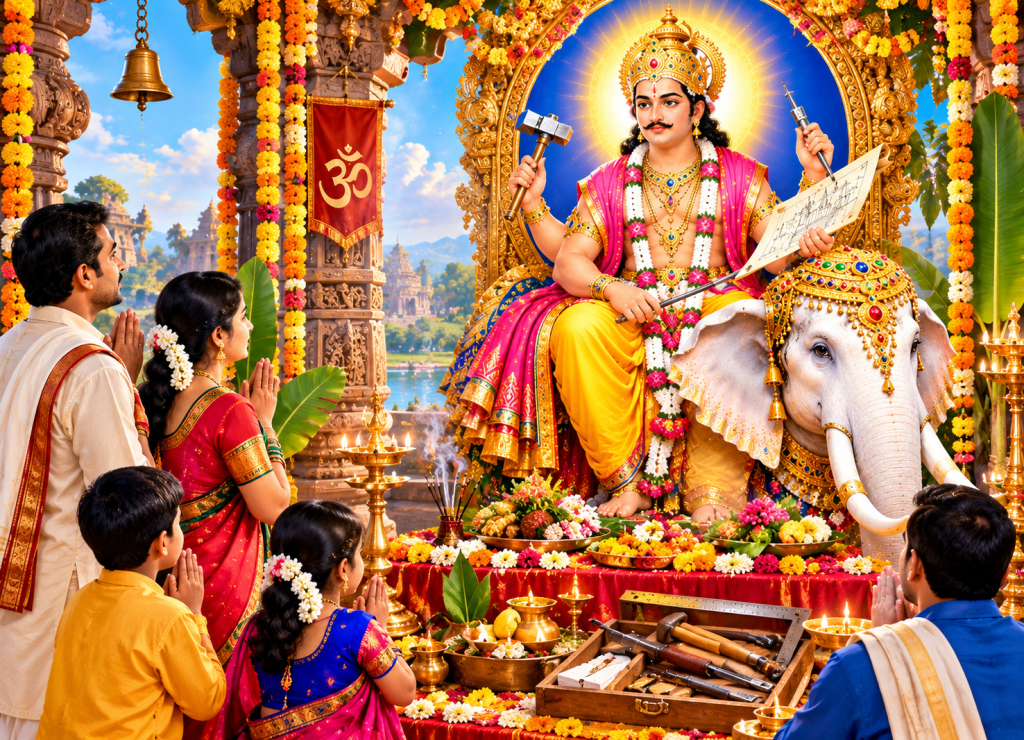
Vishwakarma Puja is the principal annual celebration dedicated to Vishwakarma.
It is generally observed around the middle of September and is especially popular in eastern and northern parts of the Indian subcontinent.
The date is traditionally connected with the solar calendar and is commonly observed around Kanya Sankranti.
Factories, workshops, garages, construction sites, engineering establishments, offices and shops may organize Vishwakarma Puja.
Workers and business owners clean their workplaces and tools before placing them in front of the deity.
Machines and instruments that are normally used every day may temporarily become part of the sacred environment.
This creates a striking contrast: the ordinary tools of daily work become objects of reverence.
Why Are Tools Worshipped During Vishwakarma Puja?
One of the most meaningful aspects of Vishwakarma Puja is the worship of tools and machinery.
A carpenter may worship a saw or hammer.
A mechanic may worship mechanical equipment.
A factory may decorate its machines.
An engineer may participate in prayers alongside workers.
The underlying message is profound.
Human civilization advances through knowledge and skilled labour.
The tools themselves may be made of wood, metal or modern materials, but they become meaningful because human intelligence knows how to use them.
Vishwakarma Puja therefore honours not only the tools but also the knowledge, skill and labour behind them.
Vishwakarma Puja and Kite Flying
In several parts of eastern India and Bangladesh, Vishwakarma Puja is traditionally associated with kite flying.
On the day of the celebration, colourful kites can fill the sky, creating a joyful atmosphere.
The tradition of kite flying is especially visible in urban areas where families and friends gather on rooftops.
The connection between Vishwakarma Puja and kite flying has become an important part of the cultural atmosphere surrounding the festival.
Kite flying is also associated with Makar Sankranti in many parts of India, although the traditions and meanings differ by region.
Thus, Vishwakarma Puja is not only a religious observance. In many communities, it has also developed into a lively cultural occasion.
Vishwakarma Puja in Factories and Workplaces
A particularly distinctive feature of Vishwakarma Puja is its connection with the workplace.
Unlike many Hindu celebrations that are primarily centred on temples or homes, Vishwakarma Puja is often organized directly where people work.
A factory floor can become a temporary place of worship.
Machines may be cleaned and decorated.
Tools may be placed before an image of Vishwakarma.
Workers may gather together for prayers and offerings.
After the puja, food may be distributed among workers, colleagues and visitors.
This gives the celebration a strong communal character.
It also creates a symbolic relationship between faith and work.
The Deeper Meaning of Vishwakarma
Vishwakarma’s mythology has a deeper meaning that extends beyond stories of golden cities and divine weapons.
At its heart is the idea that creation requires skill.
A thought becomes a design.
A design becomes a structure.
A structure becomes a living part of society.
This transformation from imagination into reality is one of the defining characteristics of human civilization.
Vishwakarma therefore represents an important principle:
Creativity becomes powerful when combined with knowledge and disciplined craftsmanship.
The stories of Vishwakarma encourage respect for people who build, repair, design and create.
A temple, bridge, machine, house, vehicle, piece of jewellery or work of art may look completely different, but all require some combination of imagination, skill and effort.
Vishwakarma symbolizes this creative force in its divine form.
Vishwakarma and Modern Engineering
It is tempting to describe Vishwakarma as a “modern engineer” or to interpret his mythical creations as evidence of ancient technological knowledge identical to modern engineering.
Such claims should be approached carefully.
Hindu mythology uses extraordinary imagery to express divine power and creativity. Ancient descriptions of celestial vehicles, weapons and cities belong to their respective literary and religious traditions and should not automatically be treated as literal descriptions of modern machines.
However, Vishwakarma’s symbolism remains highly relevant to modern engineering.
Engineers today design:
- Bridges
- Buildings
- Roads
- Aircraft
- Machines
- Factories
- Energy systems
- Digital infrastructure
- Spacecraft
The tools have changed dramatically, but the fundamental human qualities of planning, measurement, creativity and problem-solving remain.
In this symbolic sense, Vishwakarma continues to have a powerful place in the modern world.
Vishwakarma: A Symbol of Skilled Labour
There is another important lesson in Vishwakarma’s worship.
Society often celebrates the finished product while forgetting the people who made it.
We admire a beautiful building but may not think about the architect, engineer, mason, carpenter, electrician and countless workers who contributed to it.
We enjoy a machine but may overlook the people who designed, manufactured and maintain it.
Vishwakarma Puja brings attention to this hidden world of craftsmanship.
It reminds devotees that work has dignity.
A skilled worker is not merely performing a job. Through knowledge and labour, that person participates in the act of creation.
This is one reason Vishwakarma remains relevant even in an age of advanced technology.
Vishwakarma in Hindu Culture Today
Today, Vishwakarma continues to be worshipped across many parts of India and Bangladesh.
His images can be found in factories, workshops, garages, engineering establishments and business premises during the annual celebration.
The festival also brings together people from different professions.
The carpenter, mechanic, engineer, factory worker and business owner may all stand before the same deity.
This creates a beautiful cultural message:
Different skills can serve the same purpose—creation.
Vishwakarma’s mythology therefore connects the spiritual world with the practical world.
Vishwakarma’s Legacy
From the cosmic realm to the workshop floor, Vishwakarma’s legacy is remarkably wide.
He is remembered as:
- The divine architect
- The master craftsman
- The architect of the gods
- The creator of magnificent cities
- The maker of divine weapons
- The designer of celestial structures
- The patron of craftsmen
- The inspiration behind skilled work
His stories connect different eras of Hindu sacred literature and different regions of the Indian subcontinent.
His architectural wonders include some of Hindu mythology’s most famous cities and structures.
His festival connects ancient mythology with modern workplaces.
And his symbolism remains relevant to anyone who creates something with knowledge, patience and skill.
Frequently Asked Questions About Vishwakarma
Who is Vishwakarma in Hinduism?
Vishwakarma is traditionally regarded as the divine architect and master craftsman of the gods. He is associated with the creation of divine cities, palaces, weapons, ornaments and celestial vehicles.
Is Vishwakarma the creator of the universe?
Some Hindu traditions associate Vishwakarma with cosmic creation and describe him as a universal craftsman. However, Hindu scriptures contain different theological descriptions of creation, and Brahma is also traditionally known as the creator deity in many Hindu traditions.
What is Vishwakarma famous for?
Vishwakarma is famous for his divine craftsmanship and architecture. He is traditionally associated with places such as Swarna Lanka, Dwarka, Hastinapur and Indraprastha, as well as various celestial objects and weapons.
Why is Vishwakarma worshipped?
Vishwakarma is worshipped as the patron deity of craftsmen, artisans, architects, engineers, mechanics, factory workers and people associated with tools and machines.
When is Vishwakarma Puja celebrated?
Vishwakarma Puja is generally celebrated around the middle of September, traditionally associated with Kanya Sankranti. The exact date can vary according to the calendar and regional practice.
Why do people fly kites on Vishwakarma Puja?
In several parts of eastern India and Bangladesh, kite flying has become a popular cultural tradition associated with Vishwakarma Puja. The festival atmosphere often includes colourful kites filling the sky.
What is Vishwakarma’s vehicle?
Vishwakarma’s vehicle varies according to regional iconographic traditions. In some representations he is associated with the hamsa, while eastern Indian representations may depict him with an elephant.
Who are the five sons of Vishwakarma?
According to traditions associated with the Vishwakarma or Vishwabrahmin community, his five sons are Manu, Maya, Tvastar, Shilpi and Visvajna.
Is Vishwakarma mentioned in the Rigveda?
Yes. The name Vishwakarma occurs in the Rigveda, including several references in the tenth book, where the hymns deal with profound questions concerning creation and the cosmic order.
Conclusion
Vishwakarma is far more than a legendary builder of magnificent cities.
He is a powerful symbol of creation, craftsmanship, knowledge and skill.
From the celestial architecture of the gods to the tools of an ordinary workshop, his name represents the human desire to transform ideas into reality.
The stories of Swarna Lanka, Dwarka, Hastinapur and Indraprastha have preserved the image of Vishwakarma as the supreme divine architect. His varying iconography across India demonstrates how different communities have interpreted and celebrated him in their own cultural settings.
And Vishwakarma Puja keeps his tradition alive in a particularly meaningful way.
On this day, machines, tools and instruments of work are cleaned, decorated and worshipped. Workers gather together, prayers are offered and the workplace itself becomes a place of celebration.
The message is simple yet profound:
Creation is sacred, and skilled work deserves respect.
Whether one looks at Vishwakarma as a Vedic figure, a Puranic deity, the divine architect of Hindu mythology or a cultural symbol of craftsmanship, his legacy remains deeply connected with one of the most fundamental human activities—the ability to imagine, design and create.
That is why Vishwakarma continues to inspire architects, engineers, craftsmen, artisans and workers even today.
And that is also why, every year, when colourful kites rise into the autumn sky during Vishwakarma Puja, an ancient tradition continues to celebrate the divine craftsman who, according to Hindu mythology, gave form to the extraordinary worlds of the gods.
*Related Articles: Makar Sankranti: A Grand Celebration
[Updated on 16 September, 2026]