Sharadiya Navratri: Nine Nights of Goddess Durga
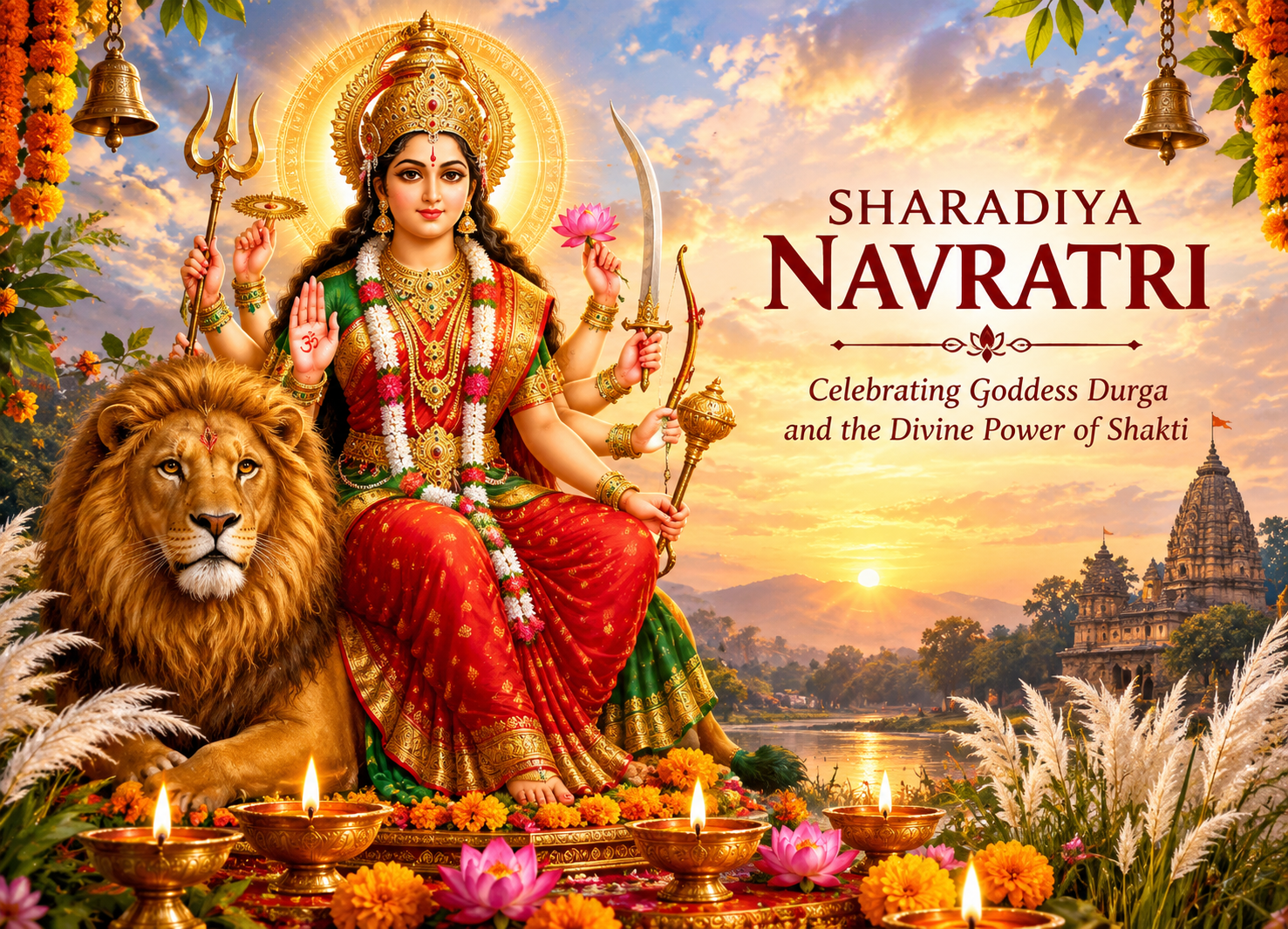
Sharadiya Navratri is one of the most sacred and spiritually significant periods in Hinduism. Celebrated during the bright half of the month of Ashwin, this nine-night festival is dedicated to the worship of Goddess Durga and her various manifestations. The word Sharadiya refers to the autumn season, distinguishing this Navratri from other Navratri observances celebrated during different times of the year.
For millions of devotees across India, Bangladesh, Nepal, and other parts of the world, Sharadiya Navratri is a time of prayer, fasting, meditation, devotion, cultural celebration, and spiritual renewal. The festival culminates in Vijayadashami, the tenth day, which symbolizes the victory of good over evil.
Although the festival is celebrated in different ways in different regions, its central message remains remarkably universal: divine power protects righteousness, destroys evil, and guides humanity toward truth, courage, compassion, and spiritual awakening.
During the nine nights, devotees worship nine principal manifestations of Goddess Durga, collectively known as Navadurga. Each form represents a particular aspect of Shakti, or divine feminine energy. Together, these nine forms portray the journey from spiritual discipline and purity to wisdom, courage, accomplishment, and ultimate liberation.
What Is Sharadiya Navratri?
The Sanskrit word Navratri is formed from two words: nava, meaning “nine,” and ratri, meaning “night.” Thus, Navratri literally means nine nights.
Sharadiya Navratri generally begins on the Pratipada, or first lunar day, of the bright fortnight of the month of Ashwin and continues for nine nights and ten days. The exact dates change every year according to the Hindu lunar calendar.
The ninth day is known as Maha Navami, while the tenth day is celebrated as Vijayadashami or Dussehra in many traditions.
The nine nights are devoted to the Divine Mother in her different manifestations. Devotees may observe fasting, perform daily puja, chant mantras, read sacred texts, visit temples, offer flowers and fruits, and participate in community celebrations.
In eastern India, including West Bengal, Assam, Odisha and parts of Bangladesh, the period is closely associated with Durga Puja. In northern and western India, Navratri is widely celebrated through elaborate worship, fasting, Garba, Dandiya and other devotional traditions. In southern India, traditions such as Golu or Bommai Kolu are associated with Navratri.
Despite these differences, the underlying spiritual idea is the same: the worship of Shakti and the triumph of righteousness.
Why Is It Called Sharadiya Navratri?
There are several Navratri observances in the Hindu calendar. The best-known are Chaitra Navratri, celebrated in spring, and Sharadiya Navratri, celebrated in autumn.
Sharadiya Navratri is called so because it occurs during Sharad, the autumn season.
Autumn has traditionally been regarded as a spiritually important period. Nature begins to change after the monsoon, the skies become clearer, and the atmosphere takes on a distinctive beauty. In eastern India, the arrival of autumn is deeply connected with the celebration of Goddess Durga.
The sight of white clouds, blue skies, autumn flowers and Kash flowers has become culturally associated with Durga Puja in Bengal and surrounding regions.
The Story Behind Sharadiya Navratri
The most famous theological background of Durga worship comes from the Devi Mahatmya, a celebrated portion of the Markandeya Purana.
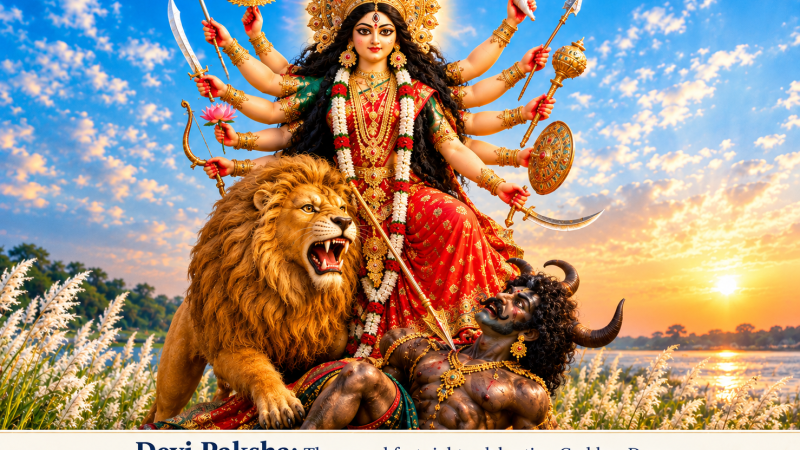
According to the narrative, the powerful buffalo demon Mahishasura received a boon that made him extremely difficult to defeat. Empowered by this blessing, he created havoc in the worlds and challenged the gods.
The gods became unable to defeat him individually. Their divine energies combined, and from this collective Shakti manifested the magnificent Goddess Durga.
The gods gave her their divine weapons. She rode upon a lion and entered into battle against Mahishasura.
The battle symbolizes the struggle between Dharma and Adharma, righteousness and unrighteousness, divine wisdom and destructive arrogance.
After a great battle, Goddess Durga defeated Mahishasura.
Her victory became one of the most powerful symbols of the triumph of divine righteousness over evil.
This story is particularly important during the autumn worship of Durga.
Another Important Meaning of Navratri
Navratri is not only a celebration of a mythological victory. It can also be understood as a period of inner transformation.
The enemies represented in Hindu spiritual literature are not always external enemies. Human beings also struggle with anger, greed, jealousy, attachment, arrogance, ignorance and uncontrolled desires.
The worship of the Divine Mother during Navratri reminds devotees to overcome these inner weaknesses.
In this sense, Mahishasura can also be understood symbolically as the darkness within the human mind, while Durga represents the divine strength needed to overcome it.
Therefore, Navratri can become a period of self-discipline, prayer and spiritual purification.
The Nine Forms of Goddess Durga
The nine principal forms of Goddess Durga worshipped during Navratri are collectively known as Navadurga.
They are:
Each form has a distinctive iconography and spiritual significance.
Day 1 – Maa Shailaputri
The first day of Sharadiya Navratri is dedicated to Maa Shailaputri.
The name Shailaputri means “daughter of the mountain.” According to tradition, she is associated with the daughter of the Himalaya and is identified with Parvati, the divine consort of Lord Shiva.
She is generally depicted riding a bull and holding a trident and lotus.
Shailaputri represents purity, stability and the beginning of spiritual consciousness.
The first day of Navratri can therefore be viewed as the beginning of a spiritual journey.
Devotees seek the blessings of the Goddess for strength, peace and a firm foundation in life.
Day 2 – Maa Brahmacharini
The second day is dedicated to Maa Brahmacharini.
The word Brahmacharini is associated with spiritual discipline, austerity and devotion.
She is traditionally depicted walking barefoot and carrying a rosary and a water pot.
Her form represents penance, determination, devotion and self-control.
According to Hindu tradition, Parvati performed severe austerities to attain Lord Shiva as her husband. Brahmacharini therefore symbolizes the power of dedication and perseverance.
Her worship reminds devotees that meaningful spiritual progress requires patience and discipline.
Day 3 – Maa Chandraghanta
The third form is Maa Chandraghanta.
She is often depicted with a crescent moon shaped like a bell on her forehead, from which her name is derived.
Chandraghanta is a powerful and warrior-like manifestation of the Goddess. She is associated with courage, protection and the destruction of negative forces.
Her form teaches that spiritual life does not mean weakness.
True spirituality can also produce courage, confidence and the ability to stand against injustice.
Devotees worship Chandraghanta for peace, protection and inner strength.
Day 4 – Maa Kushmanda
The fourth day is dedicated to Maa Kushmanda.
Her name is traditionally interpreted through the idea of cosmic creation. She is associated with the creative power of the universe.
In popular tradition, Kushmanda is said to have brought cosmic energy and light into existence through her divine smile.
She is therefore associated with creation, vitality, radiance and cosmic energy.
Her worship reminds devotees that divine Shakti is not merely destructive. The Goddess is also the creative force that sustains life and the universe.
Day 5 – Maa Skandamata
The fifth form is Maa Skandamata.
She is traditionally depicted holding her son Skanda, also known as Kartikeya, in her lap.
Because she is the mother of Skanda, she is called Skandamata.
Her form represents motherhood, compassion, protection and unconditional love.
She reminds devotees that the Divine Mother is not only a powerful warrior but also the embodiment of maternal affection.
Worshipping Skandamata can inspire devotees to cultivate compassion, kindness and care for others.
Day 6 – Maa Katyayani
The sixth day is dedicated to Maa Katyayani.
She is one of the powerful warrior forms of the Goddess.
According to traditional accounts, she manifested to destroy evil forces and is particularly associated with the destruction of demonic powers.
Katyayani represents courage, determination and righteous action.
Her worship teaches that when injustice threatens Dharma, one must have the courage to act.
The Goddess therefore represents strength guided by righteousness rather than anger or hatred.
Day 7 – Maa Kalaratri
The seventh night is dedicated to Maa Kalaratri, one of the most powerful and awe-inspiring forms of Durga.
Her name is associated with darkness and time. She is depicted in a fierce form and is believed to destroy fear, darkness and negative forces.
Although her appearance can seem frightening, she is considered a compassionate protector of devotees.
Her fierce appearance symbolizes the destruction of ignorance, fear and evil.
Kalaratri teaches an important spiritual lesson: what appears frightening can sometimes be the force that protects us from greater danger.
Day 8 – Maa Mahagauri
The eighth form is Maa Mahagauri.
The name Mahagauri means “extremely radiant” or “greatly luminous.”
She represents purity, peace, serenity and spiritual illumination.
After the fierce energy associated with Kalaratri, Mahagauri provides an image of tranquility and purity.
The eighth day, Maha Ashtami, is one of the most important days of Navratri.
Devotees often perform special pujas, offer flowers and sweets, and participate in community worship.
Day 9 – Maa Siddhidatri
The ninth and final form is Maa Siddhidatri.
The word Siddhidatri can be understood as “the giver of siddhis,” or spiritual accomplishments.
She represents wisdom, perfection, spiritual attainment and divine grace.
The worship of Siddhidatri marks the completion of the nine-day journey.
The progression from Shailaputri to Siddhidatri can therefore be understood symbolically as a journey from spiritual beginning to higher realization.
The Spiritual Journey of Navadurga
The nine forms of Durga are not merely nine separate images.
They can be viewed as different stages of spiritual development.
Shailaputri represents the beginning.
Brahmacharini represents discipline.
Chandraghanta represents courage.
Kushmanda represents creative energy.
Skandamata represents compassion.
Katyayani represents righteous strength.
Kalaratri represents the destruction of darkness.
Mahagauri represents purity and peace.
Siddhidatri represents spiritual accomplishment.
Thus, Navratri can be understood as a symbolic journey in which a devotee gradually develops strength, discipline, wisdom, compassion and spiritual awareness.
Sharadiya Navratri Rituals
The rituals of Navratri vary according to region, family tradition and religious school.
However, several practices are common among devotees.
Kalash Sthapana
Many devotees begin Navratri with Kalash Sthapana, also known as Ghatasthapana.
A sacred vessel or kalash is installed in a clean and sanctified place.
The kalash is traditionally associated with auspiciousness, abundance and divine presence.
Different communities follow different procedures, so devotees generally observe the customs prescribed by their family tradition or local priest.
Daily Puja
Devotees may worship the Goddess every morning and evening.
Common offerings include:
- Flowers
- Fruits
- Incense
- Lamps
- Water
- Sweets
- Coconut
- Betel leaves
- Devotional food
The exact offerings differ according to local tradition.
A simple and sincere prayer is also considered meaningful. Hindu worship emphasizes bhakti, or devotion, rather than external display alone.
Lighting a Diya
Lighting a lamp is an important part of many Hindu rituals.
During Navratri, devotees commonly light an oil or ghee lamp before the image or murti of the Goddess.
The flame symbolizes divine light overcoming darkness.
It can also represent knowledge overcoming ignorance.
Chanting Mantras
Devotees may chant different mantras dedicated to Durga and Shakti.
One widely known mantra is:
ॐ दुं दुर्गायै नमः
Om Dum Durgayai Namah
It is commonly understood as an invocation to Goddess Durga.
Devotees may also recite the Durga Saptashati, Devi Mahatmya, Devi Kavach, Argala Stotram, Keelaka Stotram, or other sacred texts according to their tradition.
Navratri Fasting
Fasting is an important part of Navratri for many devotees.
However, fasting practices vary greatly.
Some devotees observe a complete fast, while others eat only once a day. Many follow a fruit-based or sattvic diet.
Foods commonly consumed during Navratri fasting may include:
- Fruits
- Milk
- Yogurt
- Potatoes
- Sweet potatoes
- Sabudana
- Nuts
- Certain permitted grains or flours
- Rock salt
The rules differ among communities, so there is no single universal Navratri fasting menu.
The spiritual purpose of fasting is not simply to avoid particular foods. It is traditionally intended to encourage self-control, simplicity, prayer and purification.
People with medical conditions, children, elderly people and those who need regular nutrition should not undertake restrictive fasting without appropriate medical advice.
Maha Ashtami
The eighth day of Navratri is known as Maha Ashtami.
It is one of the most important days of the festival.
Special pujas are performed in temples and homes. In many communities, devotees offer flowers, fruits, sweets and other traditional offerings to the Goddess.
In Bengal, the eighth day is an especially significant part of Durga Puja.
The famous Sandhi Puja is performed at the transition between Ashtami and Navami. It has deep significance in Bengali Durga Puja traditions and is associated with the powerful moment described in the Devi Mahatmya when the Goddess defeats the forces of evil.
Maha Navami
The ninth day is known as Maha Navami.
It marks the completion of the principal nine-day worship period.
In many traditions, special offerings and ceremonies are performed on Navami.
Some communities also perform Kanya Puja or Kumari Puja, in which young girls are respectfully worshipped as manifestations of the Divine Mother.
The practice varies according to region and tradition.
The young girls may be offered food, gifts, flowers and respectful greetings.
The underlying idea is to recognize the sacred feminine principle in its pure and innocent form.
Kanya Puja
Kanya Puja is particularly associated with the concluding days of Navratri.
A group of young girls may be invited and respectfully worshipped.
Their feet may be washed, flowers may be offered, and they may be served a traditional meal.
A young boy may also be included in some traditions and symbolically associated with Bhairava.
Kanya Puja reflects the Hindu understanding that Shakti is present in all forms of life.
It also emphasizes respect toward girls and women.
The ritual, however, should always be performed respectfully and according to appropriate local customs.
Vijayadashami: The Tenth Day
After nine nights comes the tenth day, Vijayadashami.
The word Vijaya means victory, while Dashami refers to the tenth lunar day.
Vijayadashami therefore represents the victory of righteousness.
In many parts of India, it is associated with Lord Rama’s victory over Ravana.
In the context of Durga worship, it is associated with the Goddess’s victory over Mahishasura and the triumph of divine power over evil.
In Bengal and several eastern regions, Vijayadashami is the day when the Durga image is ceremonially taken for immersion, marking the conclusion of Durga Puja.
The Goddess is bid farewell with prayers and emotional devotion, with the understanding that the Divine Mother returns to her cosmic abode and will continue to protect her devotees.
Sharadiya Navratri and Durga Puja
Sharadiya Navratri and Durga Puja are closely connected, but the way they are celebrated differs across regions.
In many northern, western and central Indian traditions, the nine days focus strongly on the worship of the Navadurga.
In Bengal and parts of eastern India, the central focus is the worship of Goddess Durga with her children and divine family, especially during the final days of the festival.
The Bengali tradition famously celebrates:
- Shashthi
- Saptami
- Ashtami
- Navami
- Dashami
The cultural expression includes beautifully decorated puja pandals, artistic Durga images, devotional music, dhak drums, traditional food, gatherings and community celebrations.
Thus, Sharadiya Navratri has developed into a festival with both profound spiritual meaning and rich cultural diversity.
Why Does Goddess Durga Have Many Forms?
One of the beautiful philosophical ideas of Hinduism is that the one Divine Reality can be approached through many forms.
The Goddess may be worshipped as Durga, Kali, Lakshmi, Saraswati, Parvati, Jagaddhatri, Annapurna and in many other manifestations.
These forms do not necessarily represent unrelated deities.
They can be understood as different manifestations or expressions of Shakti, the divine feminine power.
Durga represents protective and warrior-like Shakti.
Lakshmi represents prosperity and abundance.
Saraswati represents knowledge and wisdom.
Kali represents the fierce destruction of negativity and the limitations of ego.
Through these different forms, Hinduism provides devotees with many ways to approach the Divine.
The Symbolism of Goddess Durga
The image of Goddess Durga contains numerous symbolic elements.
The Lion
The lion represents power, courage and royal strength.
Durga riding the lion symbolizes the mastery of powerful forces.
At a deeper level, the lion can also represent uncontrolled passions that must be governed by divine wisdom.
The Weapons
Durga is often depicted holding several weapons.
These weapons were traditionally given to her by different gods.
They represent different divine powers and qualities.
The trident, discus, sword, bow, arrow and other weapons symbolize the many tools available for destroying ignorance and evil.
The Lotus
The lotus represents purity and spiritual awakening.
The lotus grows in muddy water but remains beautiful and relatively untouched by it.
It therefore provides a powerful symbol for spiritual life: a person can live in the world without becoming completely attached to its negativity.
Mahishasura
Mahishasura represents destructive arrogance and the forces that oppose Dharma.
Durga’s victory over him symbolizes the triumph of righteousness over arrogance and injustice.
The Deeper Message of Navratri
The greatest message of Navratri is not simply that good will defeat evil in some distant mythological story.
It is also a reminder that every human being must fight an inner battle.
Anger can become an inner Mahishasura.
Greed can become an inner Mahishasura.
Arrogance can become an inner Mahishasura.
Hatred, jealousy and ignorance can also become destructive forces.
The worship of Durga encourages devotees to develop the courage to recognize these weaknesses and overcome them.
Thus, the real victory of Navratri begins within the human heart.
Navratri and Women
Navratri places the Divine Feminine at the center of worship.
This is one of the most distinctive features of the festival.
The Goddess is not presented merely as a passive divine consort. She is the independent source of power capable of defeating the greatest demonic forces.
Durga is simultaneously mother, protector, warrior, creator and source of divine energy.
Her worship therefore carries an important message about the sacredness of feminine power.
The festival can also inspire society to respect women, protect their dignity and recognize their strength and contribution.
Spiritual worship becomes more meaningful when it is reflected in everyday behavior.
Navratri and Nature
Hindu religious traditions often connect spirituality with nature.
Sharadiya Navratri arrives during the beautiful autumn season.
The changing landscape, clear skies, seasonal flowers and harvest-related activities create a natural atmosphere for celebration.
The Goddess herself is often understood as Prakriti, the divine principle of nature.
This gives Navratri an ecological dimension.
Respecting the Divine Mother can also mean respecting the Earth, rivers, forests, animals and all living beings.
A spiritually meaningful celebration should therefore avoid unnecessary pollution and encourage environmentally responsible practices.
Navratri in Different Parts of India
Sharadiya Navratri is celebrated with remarkable diversity.
West Bengal
The festival becomes the grand celebration of Durga Puja, especially from Shashthi through Vijayadashami.
Gujarat
Garba and Dandiya Raas are major cultural expressions of Navratri. People gather in large numbers for devotional and traditional dances.
Maharashtra
Navratri is observed with religious ceremonies, community events and cultural programs, followed by Vijayadashami celebrations.
Uttar Pradesh and Bihar
Devotees observe fasting and worship Durga, while Ramlila and Vijayadashami traditions are also prominent.
Himachal Pradesh
Various local traditions celebrate the Goddess and culminate in important religious gatherings.
Karnataka
Mysuru is particularly famous for its grand Dasara traditions.
Tamil Nadu
Navratri is celebrated through traditions such as Golu, where dolls and figurines are arranged in carefully decorated displays.
Kerala
The concluding days of Navratri have a strong association with Saraswati worship, learning and the Vidyarambham ceremony in many communities.
This diversity demonstrates the remarkable cultural richness of Hinduism.
Navratri in Bangladesh
Sharadiya Navratri and Durga Puja hold an important place among Hindu communities in Bangladesh.
Temples and community puja mandaps become centers of devotion and cultural activity.
Devotees gather for prayers, pushpanjali, arati and other ceremonies.
The festival is also a time for families and communities to come together.
In many places, the atmosphere of autumn, the sound of devotional music, dhak, conch shells and evening arati creates a distinctive spiritual environment.
Durga Puja in Bangladesh is therefore not only a religious observance but also an important expression of Hindu cultural heritage.
What Should Devotees Do During Navratri?
There is no single requirement that applies to every Hindu.
However, devotees may use the nine days to cultivate positive habits.
1. Pray regularly
Spend some quiet time every day in prayer.
2. Practice self-control
Try to reduce anger, unnecessary arguments and harmful habits.
3. Read sacred texts
Reading the Devi Mahatmya, Bhagavad Gita or other spiritual texts can make the period more meaningful.
4. Help others
Charity, feeding people and helping those in need can express the spirit of devotion.
5. Respect women
The worship of the Divine Mother should be reflected in genuine respect for women and girls.
6. Protect nature
Avoid unnecessary plastic, pollution and environmentally harmful practices during celebrations.
7. Cultivate gratitude
Thank the Divine for family, health, food, nature and the opportunity to live and learn.
A Simple Navratri Prayer
Devotees who cannot perform elaborate rituals can still pray sincerely.
A simple prayer may be:
“O Divine Mother Durga, give me strength to overcome fear, wisdom to choose the right path, compassion to help others, and courage to stand for Dharma. Remove ignorance from my heart and guide me toward truth, peace and spiritual realization.”
The essence of Hindu worship is bhakti, sincere devotion.
A simple prayer performed with genuine faith can be deeply meaningful.
Navratri as a Time of Self-Discipline
Modern life is often filled with distractions.
People are constantly surrounded by information, entertainment, social media and material desires.
Navratri provides an opportunity to pause.
For nine days, devotees can consciously reduce unnecessary distractions and spend more time in prayer, meditation, family and community service.
Fasting can teach moderation.
Silence can teach awareness.
Prayer can teach humility.
Charity can teach compassion.
The festival therefore has the potential to become a practical spiritual retreat within ordinary life.
The Meaning of Victory
The word Vijaya, victory, is central to the conclusion of Navratri.
But what exactly should be conquered?
Not another human being.
The deeper spiritual goal is to conquer the negative tendencies within ourselves.
Victory means:
- Truth over falsehood
- Knowledge over ignorance
- Courage over fear
- Compassion over hatred
- Self-control over uncontrolled desire
- Humility over arrogance
- Dharma over Adharma
- Divine awareness over spiritual ignorance
This makes Vijayadashami a deeply meaningful conclusion to the nine-day spiritual journey.
Why Navratri Remains Relevant Today
Although Navratri has ancient roots, its message remains relevant in modern society.
People still experience fear, anxiety, conflict, greed, injustice and uncertainty.
The symbolism of Durga reminds us that strength should be used to protect righteousness.
Her motherhood reminds us to show compassion.
Her weapons remind us to develop the tools needed to overcome difficulties.
Her victory over Mahishasura reminds us never to surrender to destructive forces.
Her divine beauty reminds us that strength and compassion can coexist.
In this way, Navratri is not merely an ancient festival. It continues to offer a spiritual framework for modern life.
Sharadiya Navratri and the Universal Message of Shakti
One of the most profound ideas behind Navratri is Shakti.
Shakti means divine power or energy.
Without Shakti, the universe cannot function.
Creation, preservation and transformation all require energy.
The Goddess represents this dynamic divine power.
This philosophy also helps explain why Hinduism has such a rich tradition of Goddess worship.
The Divine is not understood only through a masculine image. The feminine aspect of divinity is equally powerful and sacred.
Sharadiya Navratri celebrates this divine feminine energy in its many forms.
Conclusion
Sharadiya Navratri is a celebration of Goddess Durga, Shakti, devotion and the victory of Dharma. Across nine sacred nights, devotees worship the Navadurga and seek blessings for strength, wisdom, purity, courage and spiritual progress.
From Maa Shailaputri, who represents the beginning of the spiritual journey, to Maa Siddhidatri, who represents spiritual accomplishment, the nine forms of Durga offer a profound symbolic path of transformation.
The festival reaches its culmination in Vijayadashami, reminding humanity that righteousness ultimately triumphs over destructive forces.
Yet the deepest victory is not merely the defeat of a mythological demon. It is the victory achieved when a person overcomes anger, greed, fear, arrogance, ignorance and hatred within the self.
Sharadiya Navratri therefore invites devotees to look both outward and inward.
Outwardly, it is a beautiful celebration filled with lamps, flowers, music, worship, temples and community gatherings.
Inwardly, it is a journey toward greater self-control, courage, compassion, wisdom and devotion.
The Divine Mother is worshipped as the protector of the righteous, the destroyer of evil, the compassionate mother of creation and the eternal source of Shakti.
As devotees light lamps during the nine nights, they can also remember the deeper symbolism of that light: may divine knowledge remove the darkness of ignorance; may courage overcome fear; may compassion overcome hatred; and may Dharma always prevail over Adharma.
Jai Maa Durga.
*Related Articles:
1. Navratri: A Nine Day Festival Dedicated to Goddess Durga
2.Chaitra Navratri-A Grand Hindu Festival
[Updated on: 07 October, 2026]