Rakhi Bandhan: History, Rituals, Stories and Significance
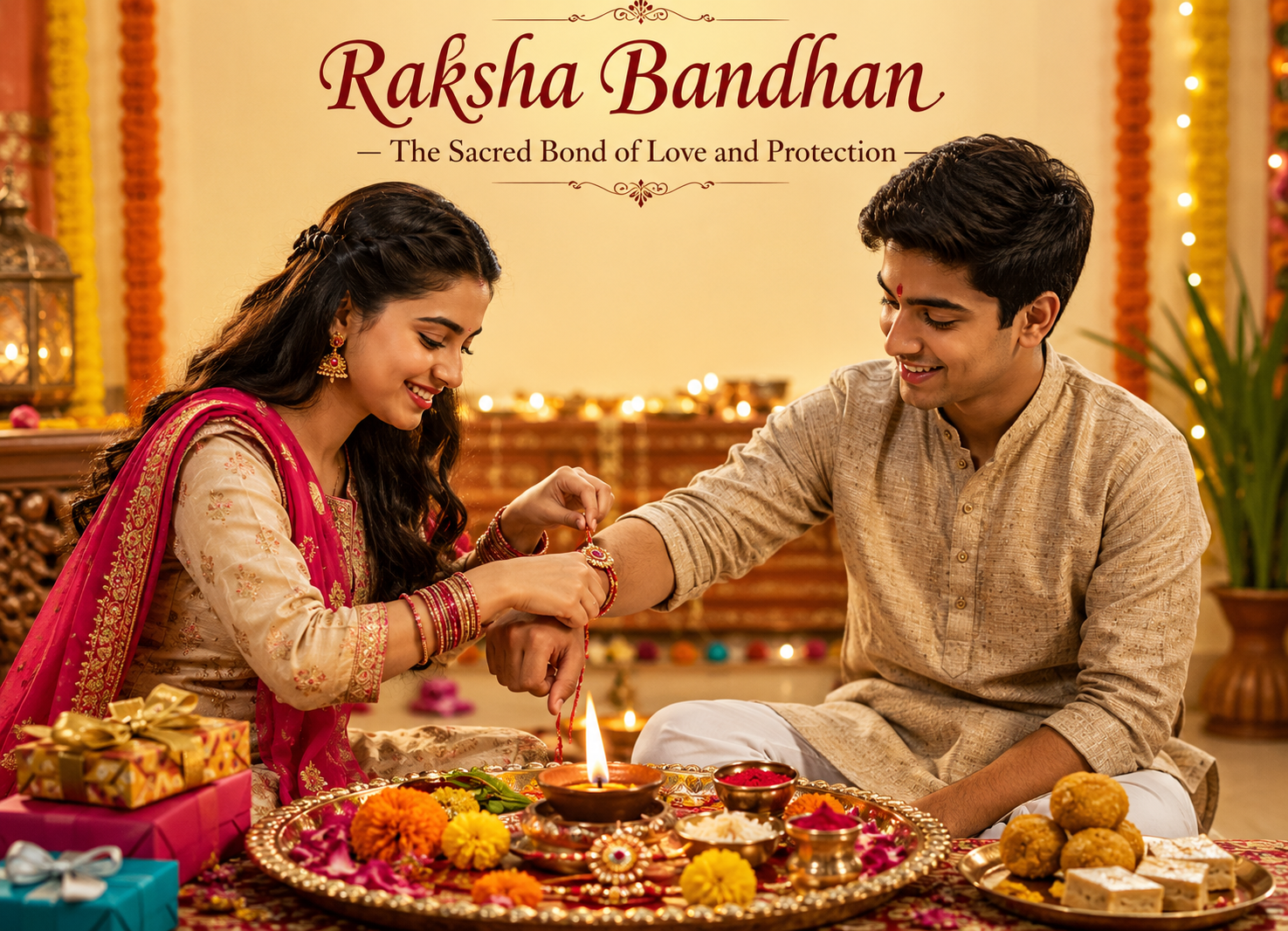
Rakhi Bandhan, more commonly known as Raksha Bandhan, is one of the most beautiful festivals celebrating love, affection, trust, and family relationships. The festival is especially associated with the bond between brothers and sisters. On this auspicious day, a sister ties a sacred thread called a rakhi around her brother’s wrist and prays for his health, happiness, prosperity, and long life. The brother, in return, expresses his love and promises to stand beside his sister through the challenges of life.
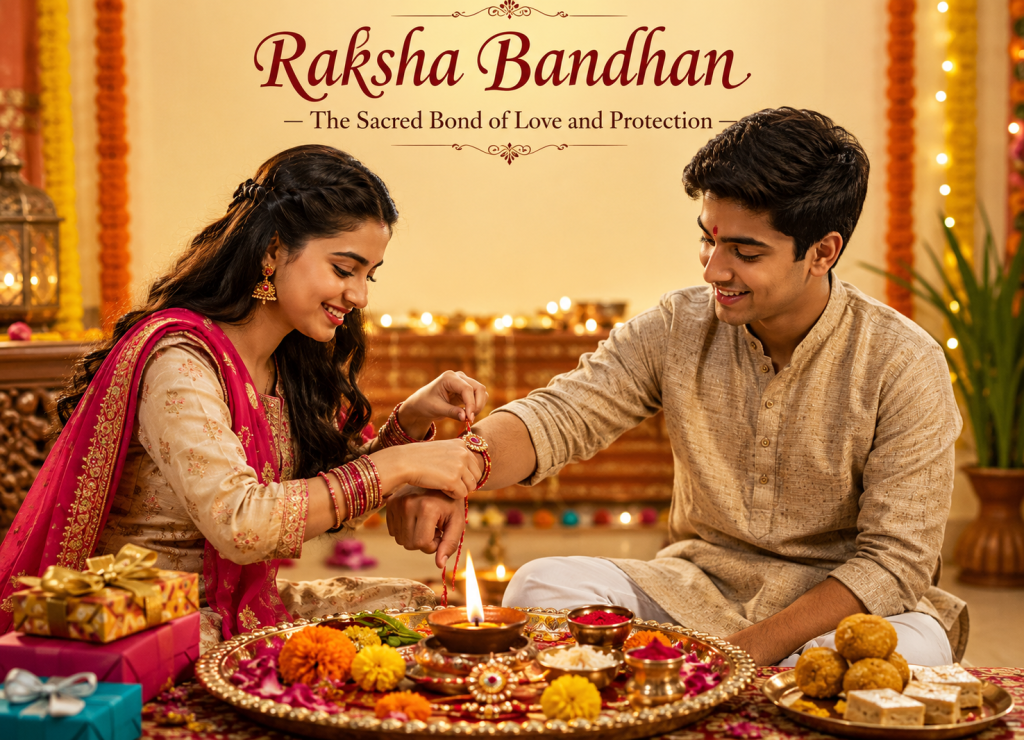
The word Raksha Bandhan comes from two Sanskrit words: raksha, meaning protection, and bandhan, meaning bond or tying. Thus, Raksha Bandhan can be understood as the bond of protection. The rakhi is not merely a colorful thread or decorative bracelet. Traditionally, it represents affection, responsibility, blessings, mutual care, and a sacred promise.
Raksha Bandhan is celebrated on the full moon day, or Purnima, of the Hindu month of Shravana. It generally falls during July or August. In 2026, Raksha Bandhan falls on Friday, August 28. Panchang calculations for Bangladesh place the Shravana Purnima across August 27–28, with the festival observed on August 28.
Although the festival is traditionally known as a celebration between brothers and sisters, its deeper meaning is much wider. Raksha Bandhan reminds people that family relationships are strengthened through love, respect, responsibility, forgiveness, and mutual support.
What Is Rakhi Bandhan?
Rakhi Bandhan is a Hindu festival devoted primarily to the sacred relationship between siblings. The central ritual is simple: the sister prepares a ceremonial plate, performs a small worship ritual, applies a tilak to her brother’s forehead, and ties a rakhi around his wrist.
The brother then gives his sister a gift and expresses his commitment to support and care for her. In modern families, the relationship is often understood as mutual rather than one-sided. A sister also supports and protects her brother emotionally, while a brother supports his sister in countless ways.
The rakhi itself can be made from cotton thread, silk, beads, decorative materials, or other traditional and contemporary designs. Some rakhis are simple and handmade, while others are highly decorated.
The important thing is not the price or appearance of the rakhi. Its real value lies in the emotion behind it.
A simple thread tied with love can carry a much deeper meaning than an expensive gift.
When Is Raksha Bandhan Celebrated?
Raksha Bandhan is observed on Shravana Purnima, the full moon day of the Hindu month of Shravana. Since the Hindu lunar calendar differs from the Gregorian calendar, the festival usually falls in July or August.
For 2026, Raksha Bandhan is observed on August 28. For Khulna, Bangladesh, a Panchang calculation gives the rakhi-tying window from approximately 5:43 AM to 10:18 AM, while exact timings can vary according to location and the Panchang followed by a family.
Devotees who follow a particular family tradition, temple calendar, or regional Panchang may therefore check the local timings before performing the ceremony.
The Meaning of the Word Raksha Bandhan
The name of the festival itself explains much of its spiritual meaning.
Raksha means protection.
Bandhan means bond, connection, or tying.
Together, Raksha Bandhan means a bond associated with protection and care.
Traditionally, the rakhi represents a prayer for protection from difficulties and harmful influences. The brother’s promise to care for his sister is an important part of the modern understanding of the festival.
However, protection should not be understood only in a physical sense.
A brother can protect his sister by supporting her education, career, dignity, independence, and emotional well-being. Similarly, a sister can protect and support her brother through encouragement, advice, affection, and companionship.
Therefore, Raksha Bandhan can be viewed as a celebration of mutual responsibility.
Historical Background of Raksha Bandhan
The history of Raksha Bandhan is complex because the festival has developed through different religious, cultural, and regional traditions.
The protective thread has a long history in Hindu religious culture. Ancient traditions describe sacred threads, protective amulets, and ritual wristbands used during religious ceremonies.
Over time, the brother-sister form of Raksha Bandhan became especially prominent. Regional traditions gave the festival different names and customs. Historical descriptions also show that the rakhi could symbolize protection, respect, friendship, and a special social relationship.
The modern festival therefore represents the blending of ancient ritual traditions with regional family customs.
It is important to understand that not every story associated with Raksha Bandhan comes from the same scripture. Several popular legends are told to explain the spirit of the festival, and different communities may emphasize different stories.
Mythological Stories Associated With Raksha Bandhan
Hindu tradition contains several fascinating stories connected with the idea of the sacred protective thread. These stories help explain why the rakhi has such a powerful symbolic meaning.
1. Krishna and Draupadi
One of the most popular stories associated with Raksha Bandhan concerns Lord Krishna and Draupadi.
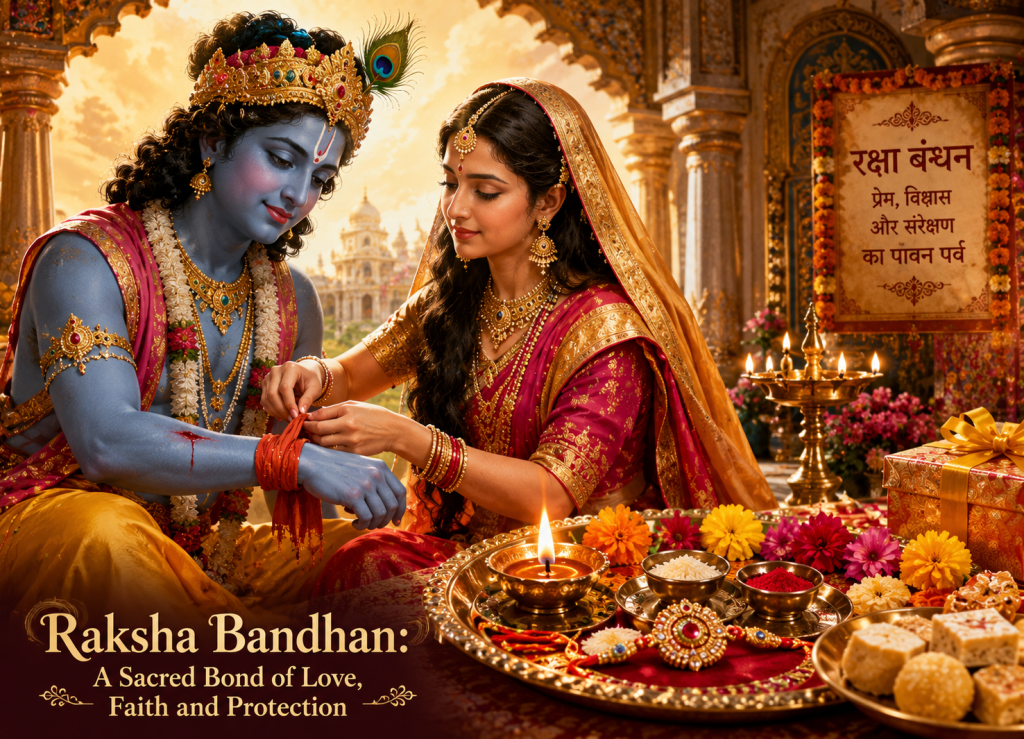
According to the popular traditional account, Krishna once injured his finger. Seeing blood coming from his hand, Draupadi immediately tore a piece of cloth from her sari and tied it around Krishna’s finger to stop the bleeding.
Krishna was deeply touched by her affection and care.
Later, when Draupadi faced humiliation in the royal assembly of Hastinapura, Krishna protected her through his divine power. The story is therefore often remembered as an example of love and reciprocal protection.
The important lesson is not simply that one person protects another. It is that an act of sincere affection creates a bond of responsibility.
Draupadi did not perform a formal Raksha Bandhan ceremony in the story. Rather, the episode is popularly connected with the festival because it expresses the same underlying principle of affection, devotion, and protection.
2. Indra and Indrani
Another traditional story connects the protective thread with Lord Indra and Indrani.
According to a tradition associated with the Bhavishya Purana, the gods were engaged in a difficult struggle against the forces of the demons. Before a battle, Indrani, the wife of Indra, tied a sacred protective thread around his wrist.
The thread was associated with divine protection and blessings.
Indra then went into battle with renewed confidence.
This story emphasizes an important aspect of Raksha Bandhan: the sacred thread is not merely an ornament. It represents prayer, faith, courage, and divine protection. The story is also cited in traditional accounts of the origins of the protective-thread ceremony.
3. Goddess Lakshmi and King Bali
Another well-known story connects Raksha Bandhan with Goddess Lakshmi, Lord Vishnu, and King Bali.
According to the traditional legend, Lord Vishnu had promised to protect King Bali and remained in Bali’s kingdom. Goddess Lakshmi wished to have Lord Vishnu return to Vaikuntha.
She approached King Bali and tied a rakhi on his wrist, establishing a sacred brother-sister relationship. When Bali learned who she was and understood her wish, he accepted her as a sister and allowed Lord Vishnu to return with her.
This story highlights the idea that a sacred relationship can be created through affection and trust, even when two people are not biological siblings. The legend is associated with Raksha Bandhan in several traditional accounts.
4. Kunti and Abhimanyu
Some traditional accounts also associate the protective-thread tradition with Kunti and Abhimanyu.
According to one traditional narrative, Kunti tied a protective thread for her grandson Abhimanyu before battle.
The story again emphasizes the prayer for the safety of a loved one.
These stories have different textual and regional backgrounds, but they share a common theme: a sacred thread becomes a symbol of prayer, affection, courage, and protection.
Spiritual Significance of Raksha Bandhan
The spiritual meaning of Raksha Bandhan goes beyond the exchange of gifts.
At its heart, the festival teaches people to value relationships.
In today’s fast-moving world, family members often live far away from one another. Brothers and sisters may move to different cities or countries for education, employment, or marriage. Raksha Bandhan provides an opportunity to reconnect.
The festival reminds us that relationships require care.
A relationship becomes strong when people:
- respect each other,
- listen to each other,
- forgive mistakes,
- provide emotional support,
- celebrate each other’s achievements,
- stand together during difficult times,
- and remain connected despite distance.
The rakhi therefore becomes a physical symbol of an invisible emotional bond.
Traditional Raksha Bandhan Rituals
The rituals of Raksha Bandhan vary from family to family and region to region. However, several customs are widely practiced.
1. Preparing the Puja Thali
A sister traditionally prepares a puja thali for the ceremony.
The plate may contain:
- Rakhi
- Kumkum or vermilion
- Rice grains
- Sandalwood paste
- Sweets
- Diya
- Incense
- Flowers
- Water
- Fruits
The exact items vary according to family customs.
A decorated thali creates a beautiful and devotional atmosphere.
2. Offering Prayer
The ceremony may begin with prayer to the family deity or chosen deity.
The sister prays for the well-being of her brother.
Some families also pray together for the health, peace, prosperity, and happiness of the entire family.
3. Applying Tilak
The sister applies a tilak to her brother’s forehead.
The tilak is traditionally associated with auspiciousness, blessing, and spiritual awareness.
Rice grains may then be placed over the tilak.
4. Performing Aarti
In many families, the sister performs aarti for her brother.
A lit diya is moved in a circular motion before him as a traditional expression of prayer and auspiciousness.
The aarti ceremony is an important part of many Hindu celebrations and symbolizes the removal of darkness and the invocation of divine blessings.
5. Tying the Rakhi
The most important ritual is tying the rakhi.
The sister ties the sacred thread around her brother’s wrist while praying for his health, happiness, prosperity, and protection.
The brother accepts the rakhi as a symbol of their relationship.
The ritual is simple, but emotionally powerful.
6. Offering Sweets
After the rakhi is tied, the sister traditionally feeds her brother sweets.
The brother may also offer sweets to his sister.
Popular festive sweets can include laddoo, rasgulla, sandesh, peda, barfi, or homemade desserts depending on regional traditions.
Sharing sweets represents the sharing of happiness.
7. Giving Gifts
The brother traditionally gives his sister a gift.
Today, gifts can include clothes, books, jewelry, accessories, flowers, sweets, handmade items, or digital gifts.
However, the most meaningful gift is often something chosen thoughtfully according to the sister’s personality and interests.
The festival is not meant to become a competition over expensive gifts.
The emotion behind the gift matters more than its monetary value.
Raksha Bandhan in Modern Times
Raksha Bandhan has changed considerably in the modern world.
In earlier generations, brothers and sisters often lived in the same village or town. Today, siblings may live thousands of kilometers apart.
Yet technology has made it possible to celebrate together even from a distance.
A sister living abroad may send a rakhi through the post. A brother living in another country may send flowers or a gift online. Families may also organize video calls so that everyone can participate in the ceremony.
In this way, technology has changed the method of celebration but not its emotional purpose.
The central message remains the same:
“You are important to me, and I will always care about you.”
Raksha Bandhan Is More Than a Brother-Sister Festival
Although Raksha Bandhan is commonly described as a brother-sister festival, its broader meaning is about sacred bonds and mutual care.
In different communities and periods, protective threads have been associated with relationships beyond biological siblings.
A rakhi may be tied to a cousin, close friend, spiritual teacher, or another person with whom someone shares a meaningful bond.
The festival can therefore be understood as a celebration of relationships based on trust and responsibility.
This broader interpretation is particularly meaningful today.
True protection does not mean controlling another person. It means helping another person feel safe, respected, valued, and supported.
Raksha Bandhan and Women’s Dignity
Raksha Bandhan can also be viewed from the perspective of respect for women.
The traditional promise of a brother to protect his sister should not mean that women are incapable of protecting themselves or making their own decisions.
In a modern interpretation, the brother’s promise can represent a commitment to respect his sister’s dignity, freedom, choices, education, career, and happiness.
Similarly, sisters also stand beside their brothers during difficult times.
Thus, the ideal relationship is not based on dependence but on mutual strength.
A brother should be proud of his sister’s independence, and a sister should celebrate her brother’s achievements.
Rakhi Bandhan in India and Bangladesh
Raksha Bandhan is celebrated in many parts of India and among Hindu communities in Bangladesh and other countries.
Regional customs differ considerably.
In some places, Raksha Bandhan is strongly associated with brothers and sisters. In other areas, the day is connected with broader religious ceremonies involving sacred threads and prayers.
In Bangladesh, the festival carries special emotional importance for many Hindu families. Brothers and sisters gather at home, visit relatives, exchange sweets, and perform the rakhi ceremony according to family traditions.
The festival also provides an opportunity for families separated by distance to reunite.
How to Celebrate Raksha Bandhan in a Meaningful Way
A beautiful Raksha Bandhan celebration does not require a large budget.
Here are some simple ideas.
Make a Handmade Rakhi
A handmade rakhi can be more meaningful than an expensive decorative rakhi.
Children can make rakhis using colorful threads, beads, paper decorations, and flowers.
Prepare Homemade Sweets
Instead of buying expensive sweets, families can prepare traditional desserts at home.
Cooking together can become part of the celebration.
Exchange Meaningful Gifts
Choose a gift based on the person’s interests.
A book, plant, handmade card, family photograph, or useful accessory can carry more emotional value than an expensive but impersonal gift.
Take Family Photographs
Raksha Bandhan is a wonderful opportunity to create family memories.
A photograph of siblings tying the rakhi can become a treasured memory for many years.
Visit Elderly Family Members
The festival can also be used as an opportunity to visit parents, grandparents, uncles, aunts, and other relatives.
Family celebrations become more meaningful when elderly members are included.
Share Memories
Brothers and sisters can spend time remembering childhood experiences.
Stories about school days, childhood games, family trips, and funny incidents often make Raksha Bandhan especially joyful.
The Environmental Side of Raksha Bandhan
Modern celebrations can also become more environmentally responsible.
Many decorative rakhis contain plastic, synthetic materials, and non-biodegradable decorations.
Families can choose rakhis made from:
- cotton thread,
- jute,
- natural fibers,
- paper,
- wood,
- seeds,
- flowers,
- or other environmentally friendly materials.
A simple eco-friendly rakhi can carry the same emotional significance as an elaborate one.
After all, the true beauty of Raksha Bandhan lies in the relationship, not in the decoration.
Raksha Bandhan for Children
Raksha Bandhan is an excellent festival for teaching children about family values.
Parents can explain why the rakhi is tied and what it represents.
Children can participate by:
- making handmade rakhis,
- decorating the puja thali,
- preparing greeting cards,
- helping prepare sweets,
- learning traditional prayers,
- and sharing gifts.
The festival can teach children that love is not merely about receiving something. It is also about giving, caring, respecting, and supporting others.
The Importance of Forgiveness on Raksha Bandhan
Brothers and sisters often have many childhood arguments.
They may fight over toys, food, television programs, school matters, or countless other small things.
But adulthood often reveals how precious sibling relationships really are.
Raksha Bandhan can be a day to forgive old misunderstandings.
A rakhi can become a symbolic reminder:
Let the old arguments end, and let love continue.
The festival gives siblings an opportunity to reconnect and begin again.
Raksha Bandhan and Long-Distance Relationships
One of the greatest challenges of modern family life is physical distance.
A sister may be studying abroad. A brother may work in another city. Marriage may take siblings to different countries.
Distance, however, does not have to destroy affection.
A rakhi can be sent by mail.
A virtual ceremony can be arranged through a video call.
A personalized message can be sent.
A gift can be delivered.
A family photograph can be shared.
Even when the wrist is far away, the emotion behind the rakhi can remain close.
What Does the Rakhi Symbolize?
The rakhi can symbolize many things at once.
Love
It represents the affection between siblings.
Protection
It traditionally represents the prayer and promise of protection.
Responsibility
It reminds siblings that relationships carry responsibilities.
Trust
A strong sibling relationship is built on trust.
Respect
Raksha Bandhan encourages siblings to respect each other’s lives and choices.
Family Unity
The festival brings family members together.
Blessings
The ceremony is accompanied by prayers for health, prosperity, and happiness.
Memories
Every Raksha Bandhan can become a memory that remains with siblings throughout life.
Raksha Bandhan as a Celebration of Mutual Support
The traditional description of Raksha Bandhan often focuses on a brother protecting his sister.
But relationships have evolved.
Today, sisters also protect their brothers in many ways.
A sister may encourage her brother during a difficult period, help him make an important decision, support his career, care for him during illness, or simply listen when he needs someone to talk to.
A brother may do the same for his sister.
Therefore, the deepest modern interpretation of Raksha Bandhan is mutual support.
The rakhi can be seen as a reminder that siblings should stand beside one another—not only when life is easy, but also when life becomes difficult.
Raksha Bandhan and the Universal Message of Love
Although Raksha Bandhan comes from Hindu tradition, its central values are universal.
Every human being needs affection, trust, support, and family connection.
The festival therefore offers a message that goes beyond one day.
It tells us to value the people who have shared our childhood.
It tells us to appreciate those who have supported us.
It reminds us that material possessions disappear, but loving relationships can remain throughout life.
A rakhi may be a small thread, but it can carry a very large emotional meaning.
Frequently Asked Questions About Rakhi Bandhan
What is Rakhi Bandhan?
Rakhi Bandhan, commonly called Raksha Bandhan, is a Hindu festival celebrating the bond between brothers and sisters. The central ritual involves tying a rakhi around the brother’s wrist.
When is Raksha Bandhan celebrated?
Raksha Bandhan is celebrated on Shravana Purnima, the full moon day of the Hindu month of Shravana. In 2026, it falls on Friday, August 28.
What does Raksha Bandhan mean?
Raksha Bandhan means a bond of protection. Raksha means protection, while bandhan means bond or tying.
Why is a rakhi tied?
The rakhi symbolizes affection, prayer, protection, trust, and responsibility between siblings.
What does a sister give her brother on Raksha Bandhan?
Traditionally, a sister ties a rakhi and offers sweets. She may also give a small gift, although this varies by family.
What does a brother give his sister?
A brother traditionally gives his sister a gift and expresses his commitment to support and care for her.
Is Raksha Bandhan only for biological brothers and sisters?
Not necessarily. Different traditions have extended the idea of the sacred protective bond to cousins, adopted siblings, friends, and other meaningful relationships.
What should be included in a Raksha Bandhan thali?
A traditional thali may include a rakhi, tilak, rice grains, sweets, flowers, diya, incense, and other items according to family tradition.
Conclusion
Rakhi Bandhan, or Raksha Bandhan, is much more than a festival of tying a colorful thread.
It is a celebration of love, trust, family, responsibility, prayer, and mutual support.
The rakhi placed around the wrist may remain for only a few days, but the relationship it represents can last a lifetime.
The stories of Krishna and Draupadi, Indra and Indrani, Goddess Lakshmi and King Bali, and other traditional narratives remind devotees of the sacred value of protection and affection. At the same time, the modern celebration teaches us that protection should be based on respect, equality, understanding, and mutual care.
On Raksha Bandhan, siblings may exchange gifts, enjoy sweets, perform aarti, take photographs, and share happy memories. But the most important part of the celebration is not the rakhi, the gift, or the sweets.
It is the promise behind them.
A promise to care.
A promise to respect.
A promise to remain connected.
A promise to stand together.
That is the true spirit of Rakhi Bandhan.
*Related Article: Bhai Dooj