Bhagavad Gita Chapter 5: Karma Sannyasa Yoga
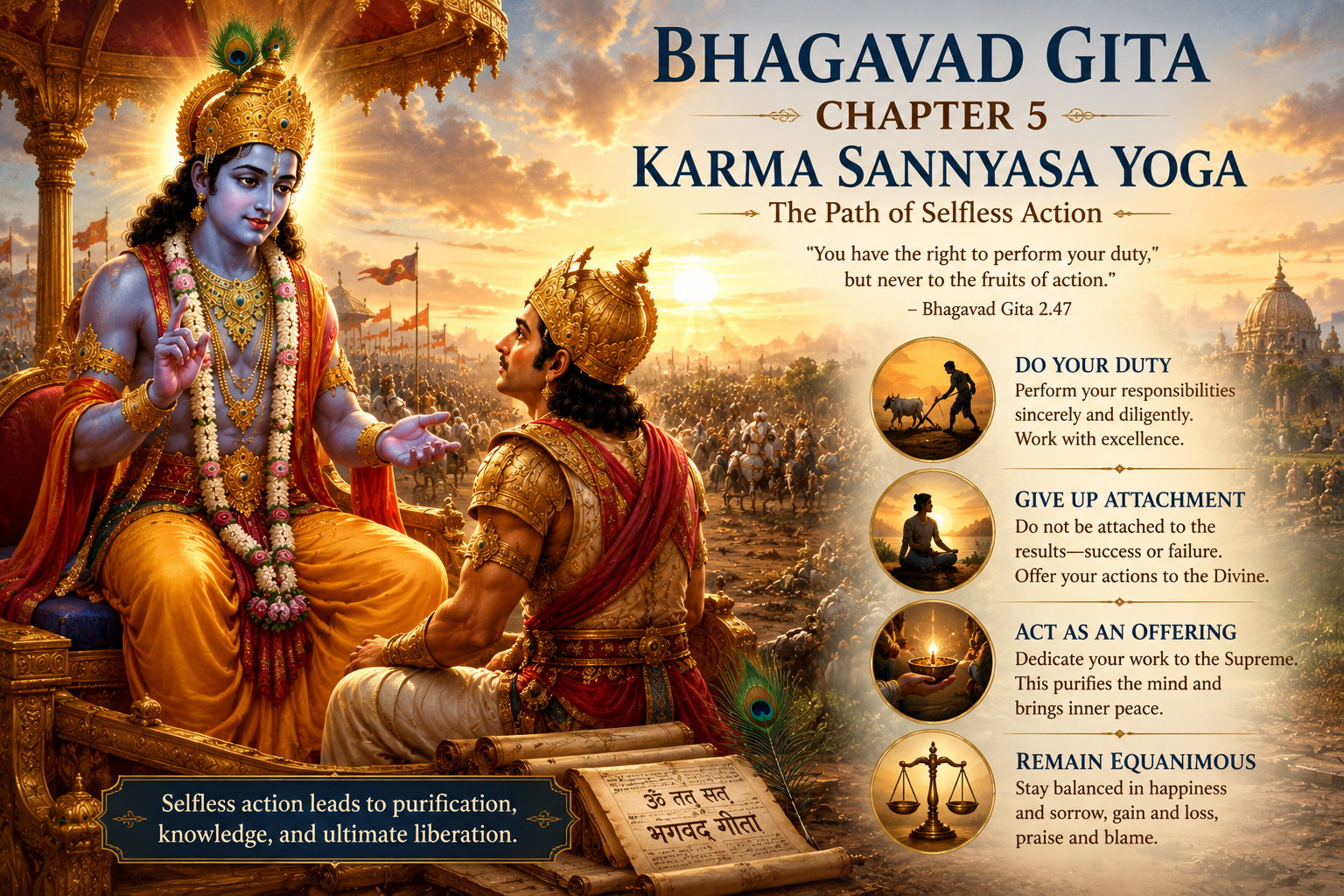
The Bhagavad Gita Chapter 5 is known as Karma Sannyasa Yoga, which is often translated as the Yoga of Renunciation of Action. It is the fifth chapter of the Bhagavad Gita and contains 29 verses.
This chapter continues an important discussion between Lord Krishna and Arjuna. Arjuna is confused about two spiritual paths: the path of renunciation and the path of selfless action. He wants to know which path is better for reaching spiritual freedom.
Krishna explains that both paths can lead to the same ultimate goal when practiced correctly. However, for most people, performing one’s duties without attachment to the results is often more practical than completely renouncing worldly activities.
This is one of the central ideas of the Bhagavad Gita:
A person does not necessarily become spiritually free by simply giving up action. True renunciation means giving up attachment to the fruits of action.
Chapter 5 therefore brings together several important themes:
- Karma Yoga
- Sannyasa or renunciation
- Selfless action
- Detachment
- Knowledge
- Meditation
- Equality
- Control of the senses
- Peace
- Liberation
- Realization of Brahman
Krishna teaches Arjuna that a spiritually awakened person can live and work in the world while remaining inwardly detached. Such a person performs necessary duties but does not become trapped by success, failure, praise, blame, pleasure, or pain.
The chapter is especially meaningful for people who want to understand how spirituality can be practiced while living an active life.
What Is Bhagavad Gita Chapter 5 About?
Bhagavad Gita Chapter 5 is primarily about the relationship between renunciation and action.
Arjuna asks Krishna whether renouncing actions is better than performing actions through Karma Yoga. Krishna explains that both Sannyasa and Karma Yoga can lead to liberation, but selfless action is generally easier for a person who still has worldly responsibilities.
The chapter teaches that the real problem is not action itself. The problem is attachment.
A person may perform many actions and still remain spiritually free if those actions are performed without selfish desire. Another person may physically withdraw from society but continue thinking about worldly pleasures and personal desires. External renunciation alone does not produce true freedom.
Krishna therefore presents a deeper definition of renunciation.
True renunciation is an inner state of consciousness.
A person who performs duty without selfish attachment can be considered a true renunciant, even while actively participating in life.
The Context of Chapter 5
The Bhagavad Gita takes place on the battlefield of Kurukshetra. Arjuna stands between two armies and faces a deep moral and spiritual crisis.
He does not know whether he should fight or withdraw from the conflict. Krishna begins teaching him about duty, the eternal nature of the Self, knowledge, action, devotion, and spiritual freedom.
In earlier chapters, Krishna introduced Karma Yoga, the path of selfless action.
He explained that human beings cannot completely avoid action. Life itself requires action. Therefore, the better approach is to perform one’s responsibilities without becoming attached to the results.
Arjuna, however, still has doubts.
If attachment to action is a problem, should he simply give up action?
This question leads directly into Chapter 5.
Arjuna’s Question: Renunciation or Action?
At the beginning of Chapter 5, Arjuna asks Krishna about two approaches:
- Renouncing actions.
- Performing actions through Karma Yoga.
Arjuna wants a clear answer about which path is superior.
His question is natural because spiritual traditions often speak about renunciation. A person may assume that becoming detached from the world means leaving worldly responsibilities behind.
Krishna gives a more subtle answer.
He says that both Sannyasa and Karma Yoga can lead to liberation. But Karma Yoga is generally easier for a person who remains active in the world.
This distinction is extremely important.
Krishna does not say that renunciation is meaningless. Instead, he explains that genuine renunciation must be based on freedom from desire and attachment.
What Is Sannyasa?
The Sanskrit term Sannyasa is commonly translated as renunciation.
In a simple sense, it means giving up attachment to worldly actions and their results.
However, Krishna’s teaching goes deeper than merely abandoning one’s occupation, family, possessions, or social responsibilities.
A person can leave external activities while still carrying strong desires in the mind.
Such external withdrawal does not automatically create spiritual freedom.
True renunciation involves giving up:
- selfish desire,
- attachment to results,
- egoistic identification,
- possessiveness,
- hatred,
- excessive attraction,
- and the belief that personal happiness depends entirely on external outcomes.
Therefore, renunciation is primarily an inner transformation.
What Is Karma Yoga?
Karma Yoga is the path of selfless action.
The basic principle is simple:
Perform your duty sincerely, but do not become attached to the result.
This does not mean that a person should become careless.
A Karma Yogi should perform work with discipline, intelligence, sincerity, and responsibility.
The difference is that the person does not allow the final result to completely control the mind.
For example, a student may study sincerely for an examination. The student should make a genuine effort, but should not allow fear of the result to destroy inner peace.
Similarly, a teacher should teach sincerely without constantly seeking praise.
A farmer should cultivate the land carefully without becoming consumed by anxiety over every possible outcome.
A worker should perform duties responsibly without making personal identity completely dependent on promotion, salary, or recognition.
This is the practical spirit of Karma Yoga.
Bhagavad Gita Chapter 5: Verse-by-Verse Themes
Chapter 5 contains 29 verses. The verses form a connected philosophical discussion.
Below is an accessible explanation of the major teaching of each verse. Each verse begins with a Sanskrit transliteration, followed by a brief original English paraphrase, and then an explanation of its teaching.
Verse 1: Arjuna Asks About Renunciation
Verse — Sanskrit transliteration:
arjuna uvāca
sannyāsaṁ karmaṇāṁ kṛṣṇa punar yogaṁ ca śaṁsasi
yac chreya etayor ekaṁ tan me brūhi suniścitam
Brief paraphrase:
Arjuna asks Krishna to clearly explain whether renouncing action or practicing Karma Yoga is the better path to spiritual liberation.
Explanation:
Arjuna is confused between giving up worldly actions and performing actions without attachment. He asks Krishna to clearly explain which path is superior.
This opening question establishes the main subject of the chapter.
Verse 2: Both Paths Can Lead to Liberation
Verse — Sanskrit transliteration:
śrī-bhagavān uvāca
sannyāsaḥ karma-yogaś ca niḥśreyasa-karāv ubhau
tayos tu karma-sannyāsāt karma-yogo viśiṣyate
Brief paraphrase:
Krishna says that both renunciation and Karma Yoga can lead to the highest spiritual good, but Karma Yoga is generally more practical than merely abandoning action.
Explanation:
Krishna explains that both renunciation and Karma Yoga can lead to liberation, but selfless action is generally easier to practice while remaining active.
This is an important practical teaching.
Spiritual growth does not always require physical withdrawal from the world.
Verse 3: The True Renunciant
Verse — Sanskrit transliteration:
jñeyaḥ sa nitya-sannyāsī yo na dveṣṭi na kāṅkṣati
nirdvandvo hi mahā-bāho sukhaṁ bandhāt pramucyate
Brief paraphrase:
A true renunciant neither hates nor excessively desires; by becoming free from these opposing reactions, one moves toward freedom from bondage.
Explanation:
True renunciation means becoming free from excessive attraction and hatred. Such inner detachment leads toward liberation.
Verse 4: Knowledge and Action Are Connected
Verse — Sanskrit transliteration:
sāṅkhya-yogau pṛthag bālāḥ pravadanti na paṇḍitāḥ
ekam apy āsthitaḥ samyag ubhayor vindate phalam
Brief paraphrase:
Only the uninformed see the paths of knowledge and action as completely separate; a person who truly follows either can reach the deeper result of both.
Explanation:
Knowledge and selfless action ultimately lead toward the same spiritual goal.
Verse 5: The Same Goal
Verse — Sanskrit transliteration:
yat sāṅkhyaiḥ prāpyate sthānaṁ tad yogair api gamyate
ekaṁ sāṅkhyaṁ ca yogaṁ ca yaḥ paśyati sa paśyati
Brief paraphrase:
The spiritual goal reached through knowledge can also be reached through Karma Yoga; one who understands their essential unity truly sees.
Explanation:
The paths of knowledge and selfless action ultimately lead to the same realization.
Verse 6: Renunciation Without Discipline Is Difficult
Verse — Sanskrit transliteration:
sannyāsas tu mahā-bāho duḥkham āptum ayogataḥ
yoga-yukto munir brahma nacireṇādhigacchati
Brief paraphrase:
Renunciation is difficult without disciplined Yoga, while a person established in Karma Yoga can progress toward Brahman.
Explanation:
True renunciation requires spiritual discipline. Selfless action helps prepare the mind for realization of Brahman.
Verse 7: Purity Through Selfless Action
Verse — Sanskrit transliteration:
yoga-yukto viśuddhātmā vijitātmā jitendriyaḥ
sarva-bhūtātma-bhūtātmā kurvann api na lipyate
Brief paraphrase:
A disciplined Karma Yogi, purified and master of the senses, sees the Self in all beings and is not bound by actions.
Explanation:
A disciplined person who acts selflessly and recognizes the spiritual unity of beings is not trapped by the consequences of action.
Verse 8: Acting Without Ego
Verse — Sanskrit transliteration:
naiva kiñcit karomīti yukto manyeta tattva-vit
paśyan śṛṇvan spṛśañ jighrann aśnan gacchan svapan śvasan
Brief paraphrase:
The knower of truth understands that bodily and sensory activities occur naturally and does not identify the deeper Self as the personal doer.
Explanation:
The enlightened person understands that bodily and sensory activities occur through nature and the instruments of the body, without egoistic identification.
Verse 9: The Senses and Their Objects
Verse — Sanskrit transliteration:
pralapan visṛjan gṛhṇann unmiṣan nimiṣann api
indriyāṇīndriyārtheṣu vartanta iti dhārayan
Brief paraphrase:
While speaking, releasing, grasping, opening and closing the eyes, the wise person understands that the senses are simply interacting with their objects.
Explanation:
The wise person observes the activities of the senses without thinking, “I am the ultimate doer.”
Verse 10: Offering Actions to Brahman
Verse — Sanskrit transliteration:
brahmaṇy ādhāya karmāṇi saṅgaṁ tyaktvā karoti yaḥ
lipyate na sa pāpena padma-patram ivāmbhasā
Brief paraphrase:
One who performs actions as an offering to Brahman, abandoning attachment, remains untouched by the binding effects of action, like a lotus leaf untouched by water.
Explanation:
Actions performed as an offering, without selfish attachment, do not bind the person.
Verse 11: Action Without Attachment
Verse — Sanskrit transliteration:
kāyena manasā buddhyā kevalair indriyair api
yoginaḥ karma kurvanti saṅgaṁ tyaktvātma-śuddhaye
Brief paraphrase:
Karma Yogis perform actions through the body, mind, intellect, and senses while giving up attachment, using action as a means of inner purification.
Explanation:
A Karma Yogi continues to work through the body, mind, intellect, and senses, but does so without selfish attachment. Such action purifies the mind.
Verse 12: Peace Through Renunciation of Results
Verse — Sanskrit transliteration:
yuktaḥ karma-phalaṁ tyaktvā śāntim āpnoti naiṣṭhikīm
ayuktaḥ kāma-kāreṇa phale sakto nibadhyate
Brief paraphrase:
A disciplined person who gives up attachment to the fruits of action attains peace, while one driven by desire for results becomes bound by them.
Explanation:
When we give up excessive attachment to results, the mind becomes peaceful. When we constantly crave specific results, those desires create bondage and anxiety.
Verse 13: The Peaceful Person
Verse — Sanskrit transliteration:
sarva-karmāṇi manasā sannyasyāste sukhaṁ vaśī
nava-dvāre pure dehī naiva kurvan na kārayan
Brief paraphrase:
The self-controlled person mentally relinquishes attachment to actions and dwells peacefully within the body without identifying the Self as the ultimate doer.
Explanation:
A spiritually disciplined person may continue living and functioning in the world, but inwardly remains detached from the sense of personal ownership and doership.
Verse 14: The Supreme and Individual Action
Verse — Sanskrit transliteration:
na kartṛtvaṁ na karmāṇi lokasya sṛjati prabhuḥ
na karma-phala-saṁyogaṁ svabhāvas tu pravartate
Brief paraphrase:
The Supreme does not simply create individual doership, actions, or their results; these arise through the workings of nature.
Explanation:
Krishna explains that the Supreme does not simply impose every action and result on an individual. Actions arise through the interaction of nature, circumstances, senses, and the individual.
Verse 15: Knowledge and Ignorance
Verse — Sanskrit transliteration:
nādatte kasyacit pāpaṁ na caiva sukṛtaṁ vibhuḥ
ajñānenāvṛtaṁ jñānaṁ tena muhyanti jantavaḥ
Brief paraphrase:
The Supreme does not arbitrarily take on anyone’s good or bad actions; ignorance covers spiritual knowledge and causes beings to become confused.
Explanation:
The Divine does not arbitrarily assign a person’s good or bad actions. Ignorance covers spiritual knowledge, causing people to misunderstand their true nature.
Verse 16: Knowledge Removes Ignorance
Verse — Sanskrit transliteration:
jñānena tu tad ajñānaṁ yeṣāṁ nāśitam ātmanaḥ
teṣām āditya-vaj jñānaṁ prakāśayati tat param
Brief paraphrase:
For those whose ignorance has been destroyed by knowledge of the Self, that knowledge shines like the sun and reveals the Supreme Reality.
Explanation:
When spiritual knowledge removes ignorance, reality becomes clear, just as sunlight removes darkness.
Verse 17: Absorption in the Supreme
Verse — Sanskrit transliteration:
tad-buddhayas tad-ātmānas tan-niṣṭhās tat-parāyaṇāḥ
gacchanty apunar-āvṛttiṁ jñāna-nirdhūta-kalmaṣāḥ
Brief paraphrase:
Those whose minds and understanding are firmly directed toward the Supreme, whose impurities are removed through knowledge, move beyond the bondage of repeated worldly existence.
Explanation:
A person who completely directs the mind toward spiritual truth and the Supreme moves beyond ignorance and the cycle of bondage.
Verse 18: Equality of Vision
Verse — Sanskrit transliteration:
vidyā-vinaya-sampanne brāhmaṇe gavi hastini
śuni caiva śva-pāke ca paṇḍitāḥ sama-darśinaḥ
Brief paraphrase:
The wise person sees with equal spiritual vision a learned and humble person, a cow, an elephant, a dog, and a person regarded as socially outcast.
Explanation:
A spiritually wise person sees the same deeper spiritual reality in all beings, even though their bodies, abilities, and social circumstances may differ.
Verse 19: Equality and Liberation
Verse — Sanskrit transliteration:
ihaiva tair jitaḥ sargo yeṣāṁ sāmye sthitaṁ manaḥ
nird doṣaṁ hi samaṁ brahma tasmād brahmaṇi te sthitāḥ
Brief paraphrase:
Those whose minds are established in equality rise above worldly bondage, because Brahman is impartial and they become established in Brahman.
Explanation:
When a person develops true spiritual equality, that person rises above many forms of worldly attachment and becomes established in Brahman.
Verse 20: Freedom From Excessive Joy and Sorrow
Verse — Sanskrit transliteration:
na prahṛṣyet priyaṁ prāpya nodvijet prāpya cāpriyam
sthira-buddhir asammūḍho brahma-vid brahmaṇi sthitaḥ
Brief paraphrase:
The knower of Brahman does not become excessively excited by pleasant things or disturbed by unpleasant ones, but remains steady and clear-minded.
Explanation:
The wise person remains balanced in both favorable and unfavorable circumstances instead of allowing external events to control inner peace.
Verse 21: Inner Happiness
Verse — Sanskrit transliteration:
bāhya-sparśeṣv asaktātmā vindaty ātmani yat sukham
sa brahma-yoga-yuktātmā sukham akṣayam aśnute
Brief paraphrase:
A person who is not dependent on external pleasures discovers happiness within and, through union with Brahman, experiences a deeper and lasting joy.
Explanation:
Lasting happiness does not depend entirely on external objects. A spiritually mature person discovers a deeper source of happiness within.
Verse 22: The Limits of Sense Pleasure
Verse — Sanskrit transliteration:
ye hi saṁsparśajā bhogā duḥkha-yonaya eva te
ādy-antavantaḥ kaunteya na teṣu ramate budhaḥ
Brief paraphrase:
Pleasures arising from contact with external objects have beginnings and endings, and therefore the wise do not depend on them for lasting happiness.
Explanation:
External pleasures are temporary. Therefore, depending on them for permanent happiness eventually leads to disappointment.
Verse 23: Mastery Over Desire and Anger
Verse — Sanskrit transliteration:
śaknotīhaiva yaḥ soḍhuṁ prāk śarīra-vimokṣaṇāt
kāma-krodhodbhavaṁ vegaṁ sa yuktaḥ sa sukhī naraḥ
Brief paraphrase:
A person who can withstand the powerful impulses of desire and anger while living in the world becomes disciplined and truly happy.
Explanation:
A person who learns to control powerful impulses such as desire and anger develops genuine inner strength and peace.
Verse 24: Inner Joy
Verse — Sanskrit transliteration:
yo ‘ntaḥ-sukho ‘ntar-ārāmas tathāntar-jyotir eva yaḥ
sa yogī brahma-nirvāṇaṁ brahma-bhūto ‘dhigacchati
Brief paraphrase:
One who finds happiness, contentment, and inner illumination within becomes established in Brahman and reaches spiritual liberation.
Explanation:
The spiritually awakened person finds happiness and illumination within rather than depending completely on the outside world.
Verse 25: Freedom From Doubt and Harm
Verse — Sanskrit transliteration:
labhante brahma-nirvāṇam ṛṣayaḥ kṣīṇa-kalmaṣāḥ
chinna-dvaidhā yatātmānaḥ sarva-bhūta-hite ratāḥ
Brief paraphrase:
Those whose impurities and doubts have been removed, who have mastered themselves and work for the welfare of all beings, attain spiritual liberation.
Explanation:
Spiritual realization is connected with purity, freedom from doubt, self-control, and genuine concern for the welfare of others.
Verse 26: Peace for the Self-Controlled
Verse — Sanskrit transliteration:
kāma-krodha-vimuktānāṁ yatīnāṁ yata-cetasām
abhito brahma-nirvāṇaṁ vartate viditātmanām
Brief paraphrase:
Those who are free from desire and anger, disciplined in mind, and aware of the Self move toward the peace of Brahman.
Explanation:
Freedom from excessive desire and anger, combined with self-knowledge and discipline, leads to deep spiritual peace.
Verse 27: Meditation and Control of the Mind
Verse — Sanskrit transliteration:
sparśān kṛtvā bahir bāhyāṁś cakṣuś caivāntare bhruvoḥ
prāṇāpānau samau kṛtvā nāsābhyantara-cāriṇau
Brief paraphrase:
The practitioner withdraws attention from external objects, steadies the gaze, and regulates the inward and outward movements of the breath.
Explanation:
Krishna describes a meditative discipline in which the practitioner withdraws attention from external distractions and steadies the body, breath, senses, and mind.
Verse 28: Freedom From Desire, Fear, and Anger
Verse — Sanskrit transliteration:
yatendriya-mano-buddhir munir mokṣa-parāyaṇaḥ
vigatecchā-bhaya-krodho yaḥ sadā mukta eva saḥ
Brief paraphrase:
The sage who has mastered the senses, mind, and intellect and is free from desire, fear, and anger is devoted to liberation and is truly free.
Explanation:
A person who masters the senses and mind and becomes free from desire, fear, and anger moves toward lasting spiritual freedom.
Verse 29: The Final Teaching of Chapter 5
Verse — Sanskrit transliteration:
bhoktāraṁ yajña-tapasāṁ sarva-loka-maheśvaram
suhṛdaṁ sarva-bhūtānāṁ jñātvā māṁ śāntim ṛcchati
Brief paraphrase:
Knowing Krishna as the Supreme recipient of sacrifice and austerity, the great Lord of all worlds, and the true friend of every being, one attains peace.
Explanation:
Krishna concludes the chapter by teaching that the Supreme is the ultimate Lord, the recipient of spiritual offerings, and the benevolent friend of all beings. Understanding this brings profound peace.
The Difference Between Effort and Attachment
The Gita does not teach people to stop caring about their work.
There is an important difference between effort and attachment.
Effort means giving your best.
Attachment means allowing the desired result to control your emotional stability.
A person can have goals without becoming mentally imprisoned by them.
A student should study seriously.
An athlete should train responsibly.
A professional should work carefully.
An artist should create sincerely.
But none of these people should believe that one success or failure determines their entire worth.
The Gita’s philosophy encourages sincere effort combined with inner balance.
Verse 5 and the Unity of Spiritual Paths
Chapter 5 explains that different spiritual approaches can ultimately lead toward the same higher realization.
The path of knowledge emphasizes understanding reality.
The path of Karma Yoga emphasizes disciplined and selfless action.
These approaches should not necessarily be treated as enemies.
Knowledge can transform action.
Action can purify the mind and prepare it for knowledge.
Therefore, the Gita presents spiritual development as a process in which different disciplines support one another.
The Difference Between External and Internal Renunciation
This is perhaps the most important distinction in Chapter 5.
External Renunciation
External renunciation may involve withdrawing from certain activities or possessions.
Internal Renunciation
Internal renunciation means giving up attachment, selfishness, and possessiveness.
Krishna’s teaching strongly emphasizes the second.
A person may live a simple life but remain deeply attached to status.
Another person may have responsibilities and possessions but remain inwardly detached.
Therefore, external appearance alone cannot determine spiritual maturity.
The Enlightened Person According to Chapter 5
Chapter 5 gives a picture of the spiritually wise person.
Such a person:
- performs duties,
- remains detached,
- controls the senses,
- has knowledge,
- sees spiritual unity,
- remains balanced,
- is free from excessive desire,
- is free from excessive anger,
- avoids egoistic identification,
- treats beings with equal vision,
- seeks inner happiness,
- practices meditation,
- and experiences deep peace.
This is not an image of someone who escapes life.
It is an image of someone who lives with wisdom.
The Teaching of Equal Vision
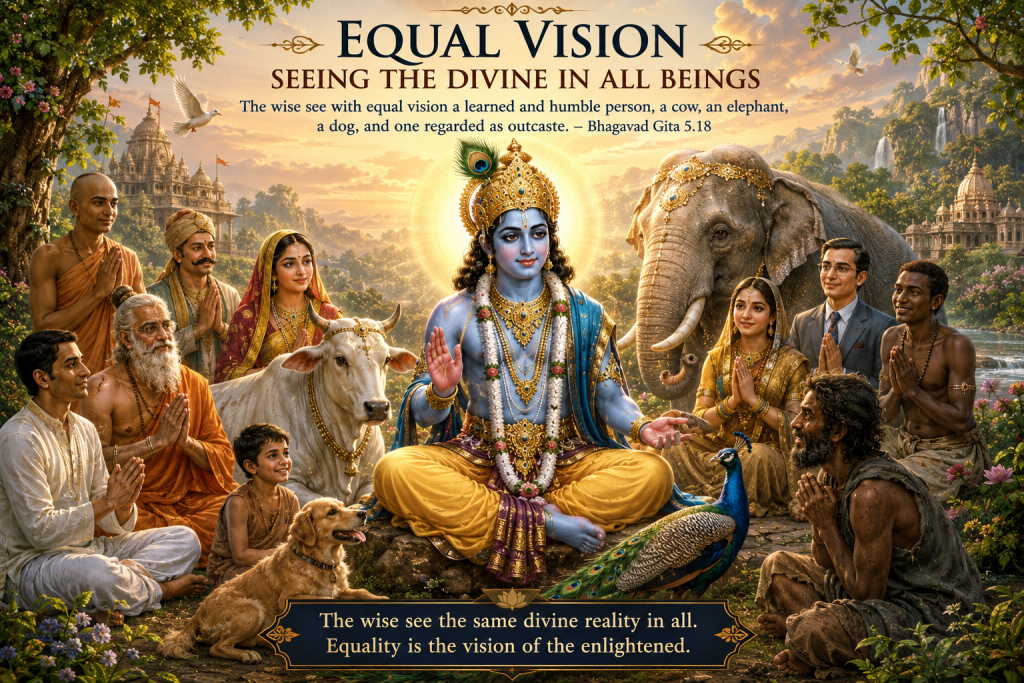
Equal vision is especially important.
The wise person sees beyond superficial differences.
People differ in:
- education,
- wealth,
- profession,
- appearance,
- social position,
- abilities,
- culture,
- and circumstances.
Yet the Gita teaches that deeper spiritual reality is not limited by these external distinctions.
This teaching encourages humility.
A person should not become arrogant because of social position.
Likewise, a person should not lose all self-respect because of temporary circumstances.
The spiritual Self is deeper than social labels.
Brahman in Bhagavad Gita Chapter 5
The concept of Brahman is central to the chapter.
Brahman refers to the ultimate spiritual reality in the philosophical tradition of the Upanishads and the Gita.
Chapter 5 repeatedly points toward realization of this higher reality.
The person who becomes established in spiritual knowledge gradually moves beyond the limited identification of “I” and “mine.”
Instead of seeing life only through individual desires, the person recognizes a deeper unity.
This realization produces peace.
Why the Gita Says the Wise Person Is Peaceful
The ordinary mind is often pulled in many directions.
One moment it wants something.
The next moment it fears losing something.
Then it becomes angry.
Then it seeks praise.
Then it compares itself with others.
Then it worries about the future.
This constant movement creates psychological disturbance.
The teachings of Chapter 5 offer a way out.
Perform duty.
Give up excessive attachment.
Develop knowledge.
Control the senses.
Meditate.
See others with equal vision.
Recognize the Supreme.
The result is inner stability.
Peace as the Goal of Spiritual Life
The final message of Chapter 5 is strongly connected with peace.
Peace does not simply mean the absence of external conflict.
A person can live in a peaceful environment and still experience mental turmoil.
Similarly, someone facing difficult circumstances can sometimes remain inwardly calm.
The Gita therefore focuses on inner peace.
True peace arises when the mind becomes less dependent on changing circumstances.
Bhagavad Gita Chapter 5 and Modern Life
The teachings of Chapter 5 can be applied to many modern challenges.
Today, people often experience pressure from:
- examinations,
- careers,
- social media,
- competition,
- financial concerns,
- relationships,
- public opinion,
- and constant comparison.
Much of this pressure comes from attachment to outcomes.
Social media can intensify the desire for approval.
Career culture can intensify the desire for status.
Academic competition can intensify the fear of failure.
Consumer culture can intensify the desire for possessions.
Chapter 5 offers a different perspective.
It encourages people to focus on meaningful action while developing inner independence.
Karma Yoga and Social Media
Social media provides a useful modern example.
A person may create something valuable and then constantly check how many people liked it.
If the number is high, the person feels happy.
If the number is low, the person feels disappointed.
The activity itself may be meaningful, but emotional dependence on public reaction can create anxiety.
Karma Yoga suggests a healthier attitude:
Create sincerely.
Share responsibly.
Learn from feedback.
Improve your work.
But do not allow numbers to determine your entire sense of worth.
This is a modern application of an ancient principle.
Karma Yoga and Education
Students can also benefit from this philosophy.
Education is not merely about obtaining grades.
Grades matter, but learning should also be valued.
A student who focuses only on results may experience intense fear.
A student who focuses on learning, discipline, and effort can develop a healthier relationship with education.
The Gita’s message can therefore be summarized as:
Give your best effort without allowing the final outcome to control your mind.
Karma Yoga and Professional Life
In professional life, attachment can take many forms.
A person may become attached to:
- salary,
- promotion,
- recognition,
- authority,
- popularity,
- competition,
- or professional status.
These things are not inherently wrong.
The problem occurs when they become the only sources of identity and happiness.
Karma Yoga teaches that work should be performed with excellence, but inner peace should not depend entirely on external rewards.
The Meaning of “Do Your Duty”
The phrase “do your duty” is often associated with the Bhagavad Gita.
Duty does not mean blindly following every expectation.
It means recognizing one’s legitimate responsibilities and acting with wisdom.
Duty should be combined with:
- morality,
- discernment,
- compassion,
- self-control,
- and spiritual understanding.
Arjuna’s situation itself shows why duty can sometimes be complicated.
The Gita is not simply saying, “Always do whatever society tells you.”
It asks people to understand their responsibilities deeply and act with wisdom.
The Importance of Intention
In Karma Yoga, intention matters greatly.
Two people can perform the same external action but have completely different inner motivations.
One may act from greed.
Another may act from service.
One may seek recognition.
Another may perform the work quietly.
One may become proud after success.
Another may remain humble.
Therefore, spiritual practice is not only about what we do.
It is also about why we do it.
Action Without Ego
Chapter 5 teaches a subtle idea about the ego.
Ordinary consciousness often says:
“I am doing everything.”
“My success proves my greatness.”
“My failure proves my worthlessness.”
“My possessions define me.”
“My status defines me.”
The Gita challenges this narrow identification.
Human action depends on many factors:
- body,
- senses,
- mind,
- intelligence,
- environment,
- other people,
- circumstances,
- and the laws of nature.
Recognizing this can make a person more humble.
Why Knowledge Is Necessary
Karma Yoga alone should not be understood as mechanical work.
Knowledge gives direction to action.
Without wisdom, even hard work can become selfish or harmful.
Knowledge helps a person understand:
- Who am I?
- What is the purpose of life?
- What creates bondage?
- What creates freedom?
- What is temporary?
- What is lasting?
- What is the nature of the Self?
- What is the relationship between the individual and the Supreme?
Thus, action and knowledge support each other.
Meditation in Chapter 5
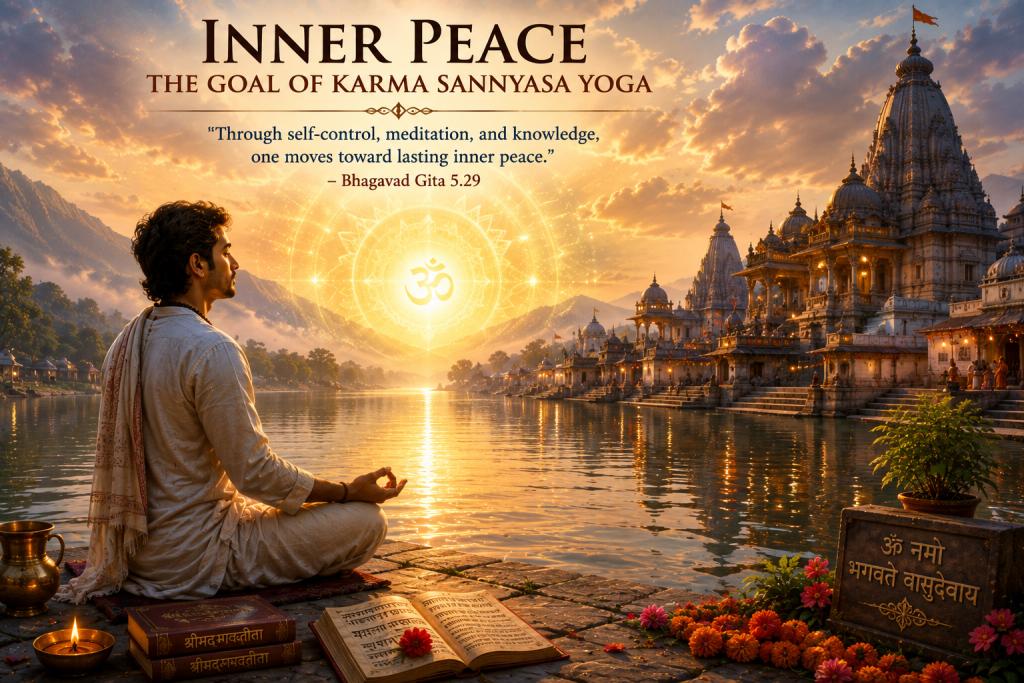
Near the end of the chapter, Krishna discusses meditation and control of the mind.
Meditation helps the practitioner withdraw attention from uncontrolled external stimulation.
The breath becomes regulated.
The senses become calm.
The mind becomes focused.
Desire, fear, and anger lose their power.
Meditation therefore supports Karma Yoga by helping the practitioner maintain inner balance.
The Role of Breath and Mind
The Gita’s meditation teaching includes awareness and regulation of breathing.
Breath and mind are closely connected in many Indian spiritual traditions.
When the mind is disturbed, breathing may become irregular.
When breathing becomes calm, mental activity can also settle.
The larger purpose, however, is not merely physical relaxation.
It is control and purification of consciousness.
The Supreme as the Friend of All Beings
The final verse presents the Supreme as the friend of all beings.
This is a deeply compassionate vision.
The Supreme is not presented merely as a distant cosmic power.
The divine is also described in terms of friendship and relationship with all beings.
This idea can transform the way a person sees the world.
If the Divine is understood as present as the friend of all beings, then compassion toward others becomes a natural part of spiritual life.
The Three Great Ideas of Chapter 5
The entire chapter can be understood through three major ideas.
1. Selfless Action
Perform your responsibilities sincerely.
2. Inner Renunciation
Give up attachment to the fruits of action.
3. Spiritual Knowledge
Understand the Self, Brahman, and the deeper nature of existence.
Together, these create a path toward peace and liberation.
Bhagavad Gita Chapter 5 vs Chapter 4
Chapter 4 and Chapter 5 are closely connected.
Chapter 4 explains divine action, knowledge, sacrifice, and the importance of understanding action properly.
Chapter 5 takes the discussion further by comparing renunciation and Karma Yoga.
Chapter 4 places strong emphasis on knowledge.
Chapter 5 emphasizes how knowledge and action can work together.
Together, they help explain why action does not necessarily produce bondage.
Bhagavad Gita Chapter 5 vs Chapter 6
Chapter 5 ends with meditation and inner control.
Chapter 6 continues this theme and develops the subject of meditation in greater detail.
Therefore, Chapter 5 acts as an important bridge between:
Karma Yoga → Inner Renunciation → Meditation → Self-realization
This progression shows the structure of Krishna’s teaching.
Important Lessons From Bhagavad Gita Chapter 5
Here are some of the most practical lessons from the chapter.
Lesson 1: Do not run away from responsibility
Avoiding action does not automatically produce spiritual freedom.
Lesson 2: Give up attachment, not necessarily action
A person can live an active life while practicing inner renunciation.
Lesson 3: Focus on sincere effort
Work carefully without allowing the final result to dominate your mind.
Lesson 4: Control desire
Unlimited desire can create anxiety and dissatisfaction.
Lesson 5: Control anger
Anger can disturb judgment and destroy inner peace.
Lesson 6: Develop equal vision
Look beyond superficial differences among living beings.
Lesson 7: Seek inner happiness
External pleasures are temporary.
Lesson 8: Develop spiritual knowledge
Knowledge removes ignorance.
Lesson 9: Practice meditation
A disciplined mind is essential for spiritual progress.
Lesson 10: Seek peace
The ultimate purpose is freedom from inner bondage and realization of the Supreme.
Bhagavad Gita Chapter 5 in Simple Words
If Chapter 5 had to be explained in very simple language, its message could be summarized like this:
You do not have to escape from life to become spiritually free. Live responsibly, perform your duties sincerely, and avoid excessive attachment to the results. Control your desires and anger, develop spiritual knowledge, see all beings with compassion and equality, and seek happiness within. When you understand the Supreme and become free from selfish attachment, you can attain lasting peace.
This simple summary captures much of the spirit of Karma Sannyasa Yoga.
Frequently Asked Questions About Bhagavad Gita Chapter 5
How many verses are there in Bhagavad Gita Chapter 5?
Bhagavad Gita Chapter 5 contains 29 verses.
What is the name of Bhagavad Gita Chapter 5?
The fifth chapter is called Karma Sannyasa Yoga, commonly translated as the Yoga of Renunciation of Action.
Who speaks in Bhagavad Gita Chapter 5?
The main dialogue is between Arjuna and Lord Krishna. Arjuna asks questions, and Krishna provides spiritual guidance.
What is the main message of Chapter 5?
The main message is that both renunciation and Karma Yoga can lead to liberation, but selfless action is generally a practical path for people who remain active in the world.
Is Karma Yoga better than Sannyasa?
Krishna explains that both can lead to the highest goal. However, Karma Yoga is generally easier for most people who have worldly responsibilities.
Does Krishna tell everyone to renounce the world?
No. Chapter 5 emphasizes that a person can perform duties while remaining inwardly detached.
What does true renunciation mean?
True renunciation means giving up selfish attachment and the craving for the fruits of action.
What is the importance of equal vision?
Equal vision means recognizing the deeper spiritual reality of all beings rather than judging them solely by external differences.
What does Chapter 5 say about happiness?
It teaches that external pleasures are temporary and that deeper happiness comes from inner spiritual realization.
What does Chapter 5 teach about anger?
It teaches that freedom from desire and anger is important for inner peace and spiritual progress.
Does Chapter 5 discuss meditation?
Yes. The final portion of the chapter describes meditation, control of the senses, regulation of breath, and freedom from desire, fear, and anger.
What is the final message of Chapter 5?
The chapter concludes by describing the Supreme as the ultimate enjoyer of sacrifice and austerity, the Lord of all worlds, and the friend of all beings. Knowing this leads to peace.
Why Bhagavad Gita Chapter 5 Is Still Relevant
The world has changed dramatically since the Bhagavad Gita was composed, but many human problems remain familiar.
People still struggle with:
- desire,
- fear,
- anger,
- ambition,
- attachment,
- jealousy,
- anxiety,
- competition,
- and the search for happiness.
Chapter 5 addresses these problems at their roots.
It does not promise that life will become free from difficulty.
Instead, it teaches people how to change their relationship with difficulty.
A person cannot control every result.
A person cannot control everyone’s opinion.
A person cannot control every external event.
But a person can gradually learn to control intention, effort, attitude, and response.
That is where Karma Yoga becomes powerful.
The Deeper Meaning of Karma Sannyasa Yoga
The title Karma Sannyasa Yoga combines two ideas that may initially seem contradictory.
Karma means action.
Sannyasa means renunciation.
Yoga means union, discipline, or spiritual path.
Together, the title points toward a profound idea:
Renunciation can be practiced through action.
A person does not necessarily need to stop acting.
Instead, the person changes the inner relationship with action.
Work becomes service.
Duty becomes spiritual practice.
Effort becomes an offering.
Success becomes something received without pride.
Failure becomes an opportunity to learn without despair.
This is one of the most beautiful aspects of the Gita’s teaching.
A Practical Daily Practice Based on Chapter 5
The teachings of Chapter 5 can be turned into a simple daily discipline.
Morning
Begin the day with a clear intention:
“I will perform my responsibilities sincerely and remain balanced in success and failure.”
During Work
Focus on the task in front of you.
Avoid constantly worrying about the final outcome.
When Anger Appears
Pause before reacting.
Observe the emotion instead of immediately obeying it.
When Success Comes
Accept success with gratitude rather than arrogance.
When Failure Comes
Learn from the experience without allowing it to define your entire identity.
Before Sleep
Reflect on the day.
Ask:
“Did I act sincerely?”
“Was I unnecessarily attached?”
“Did I allow anger to control me?”
“Did I treat others with respect?”
“Did I remember the deeper purpose of life?”
This kind of reflection can gradually transform ordinary activity into spiritual practice.
Bhagavad Gita Chapter 5 and the Path to Liberation
The ultimate goal discussed in Chapter 5 is not merely better worldly success.
The deeper goal is liberation(Moksha).
Liberation means freedom from spiritual ignorance and bondage.
The person who identifies completely with the temporary body, possessions, status, desires, and results remains vulnerable to constant change.
The person who realizes the deeper Self moves toward freedom.
Karma Yoga prepares the mind.
Knowledge removes ignorance.
Meditation steadies consciousness.
Self-control reduces disturbance.
Equal vision develops compassion.
Recognition of the Supreme leads to peace.
These ideas come together in Chapter 5.
Final Summary of Bhagavad Gita Chapter 5
Bhagavad Gita Chapter 5, Karma Sannyasa Yoga, presents one of the most important teachings of the Bhagavad Gita: spiritual freedom does not necessarily require abandoning action.
Arjuna asks Krishna whether renunciation or action is the better path. Krishna explains that both can lead to liberation, but selfless action is often more practical for people who continue to live active lives.
The essential teaching is to perform one’s responsibilities without selfish attachment to the results.
The wise person understands that external pleasures are temporary. Such a person does not allow success or failure, pleasure or pain, praise or criticism to completely control the mind.
Chapter 5 also emphasizes spiritual knowledge, self-control, meditation, freedom from desire and anger, and equal vision toward all beings.
One of its most powerful teachings is that a person can live in the world without becoming spiritually bound by the world.
True renunciation happens within.
The person does not have to abandon every responsibility. Instead, the person abandons excessive attachment, selfishness, ego, and dependence on external results.
The chapter finally teaches that the Supreme is the ultimate Lord, the enjoyer of sacrifice and austerity, the ruler of all worlds, and the friend of all beings.
Understanding this truth leads to peace.
Conclusion
Bhagavad Gita Chapter 5 offers a practical philosophy for living a meaningful and spiritually conscious life.
Its message is not simply to work or not to work. It asks us to examine the attitude behind our actions.
We can work with greed or with service.
We can act from fear or from wisdom.
We can seek results obsessively or perform our duties sincerely.
We can allow success to inflate our ego or receive it with humility.
We can allow failure to destroy our confidence or use it as an opportunity for growth.
Karma Sannyasa Yoga teaches the middle path of responsible action with inner detachment.
The ideal person described by Krishna remains active but inwardly free. Such a person controls desire, overcomes anger, develops spiritual knowledge, practices meditation, sees beyond superficial differences, and seeks happiness within.
The deepest message of Chapter 5 can therefore be expressed in one sentence:
Perform your duties sincerely, surrender attachment to their results, cultivate spiritual knowledge, and seek lasting peace in the Supreme.
This is why the teachings of Bhagavad Gita Chapter 5 remain relevant not only as an ancient spiritual philosophy but also as a practical guide for modern life.