Bhagavad Gita Chapter 2: Sankhya Yoga — The Path of Wisdom and Selfless Action
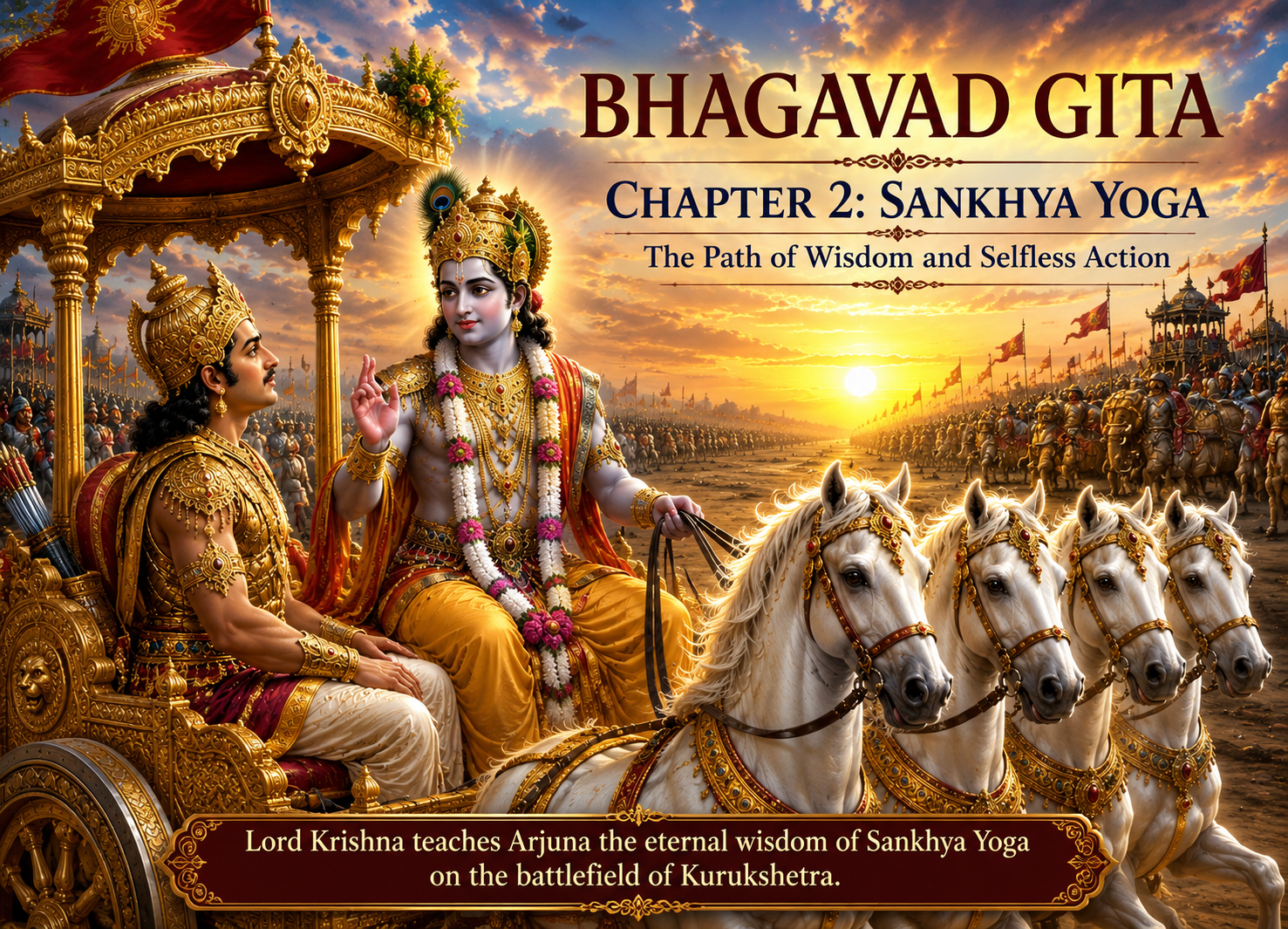
The Bhagavad Gita Chapter 2, traditionally known as Sankhya Yoga, is one of the most important chapters in the entire Bhagavad Gita. It contains 72 verses and introduces many of the central teachings that Lord Krishna develops throughout the remaining chapters.
The first chapter ends with Arjuna overwhelmed by grief and moral confusion. He looks across the battlefield of Kurukshetra and sees people he loves and respects—teachers, relatives, friends, and elders. His courage disappears. His famous bow, Gandiva, slips from his hand, and he becomes unwilling to fight.
Chapter 2 begins at this critical moment.
Krishna does not immediately give Arjuna a simple command. Instead, He begins a profound spiritual teaching. He explains the difference between the temporary body and the eternal Self. He teaches Arjuna about dharma, karma, detachment, equanimity, wisdom, discipline of the senses, and finally the state of Sthitaprajna, the person whose wisdom is steady.
Chapter 2 therefore moves from grief to knowledge, from confusion to clarity, and from attachment to selfless action.
The chapter can broadly be understood through four major themes:
- Arjuna’s surrender and spiritual crisis — Verses 1–10
- The eternal Self and the temporary body — Verses 11–30
- Dharma, Karma Yoga, and detached action — Verses 31–53
- The characteristics of a person of steady wisdom — Verses 54–72
The chapter is also famous for verses such as 2.13, which compares the stages of bodily life; 2.20, which describes the eternal Self; 2.22, which compares changing bodies to changing clothes; 2.47, the celebrated teaching on action and its results; and 2.55–72, which describe the person of steady wisdom.
Below are all 72 verses, with Sanskrit, English transliteration, and an accessible explanation.
Bhagavad Gita Chapter 2 — Sankhya Yoga
Verse 2.1 — Sanjaya Describes Arjuna’s Condition
Sanskrit
तं तथा कृपयाविष्टमश्रुपूर्णाकुलेक्षणम् ।
विषीदन्तमिदं वाक्यमुवाच मधुसूदनः ॥ २.१ ॥
English Transliteration
taṁ tathā kṛpayāviṣṭam aśru-pūrṇākulekṣaṇam
viṣīdantam idaṁ vākyam uvāca madhusūdanaḥ
Explanation
Sanjaya begins Chapter 2 by describing Arjuna’s emotional condition. Arjuna is overwhelmed by compassion and sorrow. His eyes are filled with tears, and he is deeply distressed.
This is an important moment because Krishna’s teaching begins only after Arjuna’s emotional crisis becomes complete. Arjuna is no longer confident that he knows what is right.
The verse reminds us that even a strong and capable person can become confused during a difficult moral situation. Spiritual wisdom often begins when a person honestly recognizes the limits of his or her own understanding.
Verse 2.2 — Krishna Questions Arjuna’s Despair
Sanskrit
श्रीभगवानुवाच ।
कुतस्त्वा कश्मलमिदं विषमे समुपस्थितम् ।
अनार्यजुष्टमस्वर्ग्यमकीर्तिकरमर्जुन ॥ २.२ ॥
English Transliteration
śrī-bhagavān uvāca
kutas tvā kaśmalam idaṁ viṣame samupasthitam
anārya-juṣṭam asvargyam akīrti-karam arjuna
Explanation
Krishna asks Arjuna where this despair has come from at such a critical moment. He tells him that this weakness does not suit someone who understands his responsibilities.
Krishna’s response is deliberately challenging. He does not encourage Arjuna to remain trapped in despair. Instead, He wants Arjuna to rise above emotional confusion and see the situation through wisdom.
The teaching is not that emotions are worthless. Rather, emotions alone should not be allowed to determine an important decision.
Verse 2.3 — Rise Above Weakness
Sanskrit
क्लैब्यं मा स्म गमः पार्थ नैतत्त्वय्युपपद्यते ।
क्षुद्रं हृदयदौर्बल्यं त्यक्त्वोत्तिष्ठ परन्तप ॥ २.३ ॥
English Transliteration
klaibyaṁ mā sma gamaḥ pārtha naitat tvayy upapadyate
kṣudraṁ hṛdaya-daurbalyaṁ tyaktvottiṣṭha parantapa
Explanation
Krishna tells Arjuna not to surrender to weakness of heart. He asks him to overcome his discouragement and rise.
The essential lesson is courage—not reckless courage, but the courage to face one’s responsibilities with clarity.
There are moments in life when fear and uncertainty make us want to escape from difficult responsibilities. Krishna teaches that such moments require inner strength and discrimination.
Verse 2.4 — Arjuna’s Moral Question
Sanskrit
अर्जुन उवाच ।
कथं भीष्ममहं सङ्ख्ये द्रोणं च मधुसूदन ।
इषुभिः प्रतियोत्स्यामि पूजार्हावरिसूदन ॥ २.४ ॥
English Transliteration
arjuna uvāca
kathaṁ bhīṣmam ahaṁ saṅkhye droṇaṁ ca madhusūdana
iṣubhiḥ pratiyotsyāmi pūjārhāv arisūdana
Explanation
Arjuna asks how he can fight against Bhishma and Drona, people whom he deeply respects.
His question is not simply about winning or losing a war. He is struggling with a moral conflict. The people standing before him are also his teachers and elders.
Arjuna’s question reveals an important human experience: sometimes two responsibilities appear to conflict with each other. In such moments, emotional instinct alone may not provide the answer.
Verse 2.5 — Better to Live Humbly Than Kill Revered Teachers
Sanskrit
गुरूनहत्वा हि महानुभावान्
श्रेयो भोक्तुं भैक्ष्यमपीह लोके ।
हत्वार्थकामांस्तु गुरूनिहैव
भुञ्जीय भोगान् रुधिरप्रदिग्धान् ॥ २.५ ॥
English Transliteration
gurūn ahatvā hi mahānubhāvān
śreyo bhoktuṁ bhaikṣyam apīha loke
hatvārtha-kāmāṁs tu gurūn ihaiva
bhuñjīya bhogān rudhira-pradigdhān
Explanation
Arjuna says that it might be better to live by begging than to gain worldly pleasures by defeating revered teachers.
The verse expresses his deep moral discomfort. What good is worldly success if the price of that success destroys the very people he respects?
Arjuna is therefore questioning the meaning of victory itself. Krishna’s later teaching will help him understand that a meaningful life cannot be judged only by immediate pleasure, loss, or gain.
Verse 2.6 — Arjuna Does Not Know Which Choice Is Better
Sanskrit
न चैतद्विद्मः कतरन्नो गरीयो
यद्वा जयेम यदि वा नो जयेयुः ।
यानेव हत्वा न जिजीविषामस्
तेऽवस्थिताः प्रमुखे धार्तराष्ट्राः ॥ २.६ ॥
English Transliteration
na caitad vidmaḥ kataran no garīyo
yad vā jayema yadi vā no jayeyuḥ
yān eva hatvā na jijīviṣāmas
te ‘vasthitāḥ pramukhe dhārtarāṣṭrāḥ
Explanation
Arjuna admits that he cannot determine which outcome is better. Should he conquer them, or should they conquer him?
This is the point where Arjuna recognizes that his ordinary judgment is insufficient. He is facing a dilemma that he cannot solve by himself.
The verse prepares the way for surrender to Krishna’s guidance.
Verse 2.7 — Arjuna Becomes Krishna’s Disciple
Sanskrit
कार्पण्यदोषोपहतस्वभावः
पृच्छामि त्वां धर्मसम्मूढचेताः ।
यच्छ्रेय एतन्निश्चितं ब्रूहि तन्मे
शिष्यस्तेऽहं शाधि मां त्वां प्रपन्नम् ॥ २.७ ॥
English Transliteration
kārpaṇya-doṣopahata-svabhāvaḥ
pṛcchāmi tvāṁ dharma-sammūḍha-cetāḥ
yac chreya etan niścitaṁ brūhi tan me
śiṣyas te ‘haṁ śādhi māṁ tvāṁ prapannam
Explanation
This is one of the turning points of the Gita.
Arjuna openly admits that his understanding of dharma has become confused. He asks Krishna to tell him what is truly beneficial. Most importantly, he declares, “I am Your disciple.”
Spiritual learning begins with humility. Arjuna does not pretend that he knows everything. He asks for guidance.
This verse teaches that asking for wisdom is not a sign of weakness. Recognizing one’s limitations can be the beginning of genuine understanding.
Verse 2.8 — Arjuna’s Sorrow Seems Impossible to Remove
Sanskrit
न हि प्रपश्यामि ममापनुद्याद्
यच्छोकमुच्छोषणमिन्द्रियाणाम् ।
अवाप्य भूमावसपत्नमृद्धं
राज्यं सुराणामपि चाधिपत्यम् ॥ २.८ ॥
English Transliteration
na hi prapaśyāmi mamāpanudyād
yac chokam ucchoṣaṇam indriyāṇām
avāpya bhūmāv asapatnam ṛddhaṁ
rājyaṁ surāṇām api cādhipatyam
Explanation
Arjuna says that he cannot see anything capable of removing his sorrow—not even an unrivaled earthly kingdom or sovereignty over the gods.
The lesson is profound: external success does not automatically produce inner peace.
A person may possess wealth, status, achievements, or power and still experience deep confusion. Krishna therefore takes Arjuna beyond external circumstances and begins teaching him about the Self.
Verse 2.9 — Arjuna Says, “I Will Not Fight”
Sanskrit
सञ्जय उवाच ।
एवमुक्त्वा हृषीकेशं गुडाकेशः परन्तप ।
न योत्स्य इति गोविन्दमुक्त्वा तूष्णीं बभूव ह ॥ २.९ ॥
English Transliteration
sañjaya uvāca
evam uktvā hṛṣīkeśaṁ guḍākeśaḥ parantapa
na yotsya iti govindam uktvā tūṣṇīṁ babhūva ha
Explanation
After speaking to Krishna, Arjuna says that he will not fight and becomes silent.
His surrender is now complete. He has reached a point where argument and emotion cannot take him further.
Silence here becomes the doorway to listening. Arjuna has spoken his doubts; now Krishna will speak.
Verse 2.10 — Krishna Begins His Teaching
Sanskrit
तमुवाच हृषीकेशः प्रहसन्निव भारत ।
सेनयोरुभयोर्मध्ये विषीदन्तमिदं वचः ॥ २.१० ॥
English Transliteration
tam uvāca hṛṣīkeśaḥ prahasann iva bhārata
senayor ubhayor madhye viṣīdantam idaṁ vacaḥ
Explanation
Krishna speaks to the sorrowful Arjuna while they stand between the two armies.
The gentle expression associated with Krishna in this verse contrasts with Arjuna’s despair. Krishna sees a deeper truth that Arjuna cannot yet see.
The spiritual teacher does not merely respond to the surface problem. Krishna addresses the root of Arjuna’s confusion.
The Immortal Self — Verses 2.11–2.30
Verse 2.11 — The Wise Do Not Grieve for the Eternal Self
Sanskrit
श्रीभगवानुवाच ।
अशोच्यानन्वशोचस्त्वं प्रज्ञावादांश्च भाषसे ।
गतासूनगतासूंश्च नानुशोचन्ति पण्डिताः ॥ २.११ ॥
English Transliteration
aśocyān anvaśocas tvaṁ prajñā-vādāṁś ca bhāṣase
gatāsūn agatāsūṁś ca nānuśocanti paṇḍitāḥ
Explanation
Krishna tells Arjuna that he is grieving over something that should not be the source of ultimate grief, even while speaking words that sound wise.
The wise understand that the deepest Self is not destroyed when the body changes.
Krishna is not dismissing compassion. Rather, He is teaching Arjuna to distinguish between temporary physical existence and the eternal spiritual Self.
Verse 2.12 — The Self Is Beyond Time
Sanskrit
न त्वेवाहं जातु नासं न त्वं नेमे जनाधिपाः ।
न चैव न भविष्यामः सर्वे वयमतः परम् ॥ २.१२ ॥
English Transliteration
na tv evāhaṁ jātu nāsaṁ na tvaṁ neme janādhipāḥ
na caiva na bhaviṣyāmaḥ sarve vayam ataḥ param
Explanation
Krishna teaches that there was never a time when He, Arjuna, or these rulers simply did not exist, nor will their existence simply cease in the ultimate spiritual sense.
This introduces one of the Gita’s central teachings: the Self is not identical with the temporary body.
The physical form changes, but spiritual existence belongs to a deeper dimension of reality.
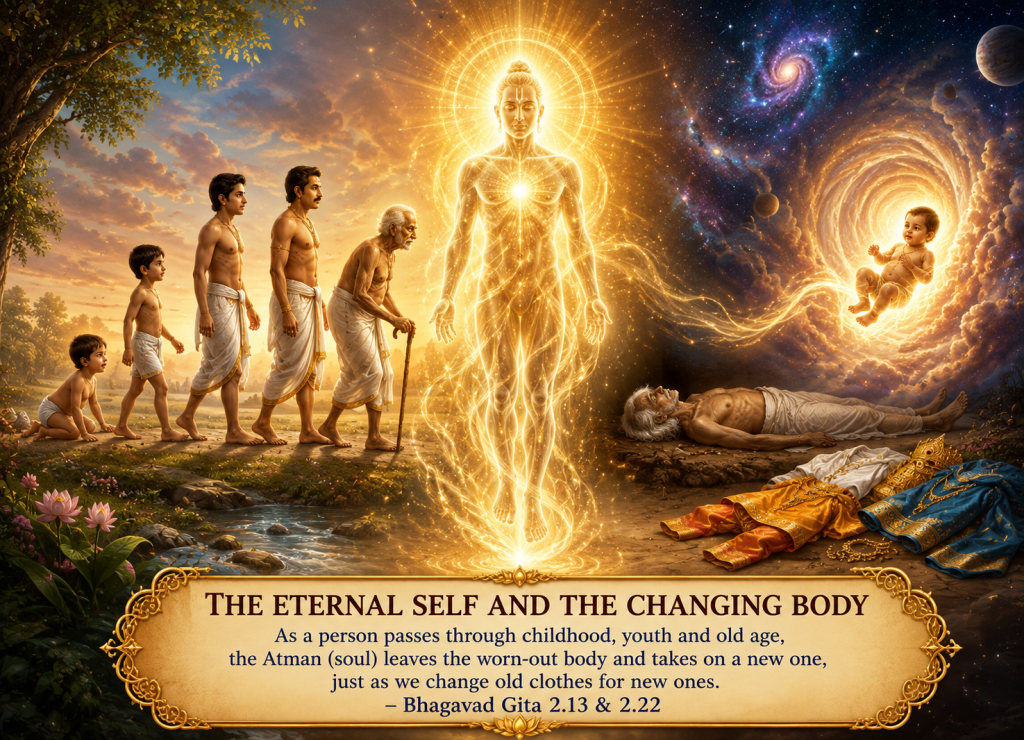
Verse 2.13 — Childhood, Youth, and Old Age
Sanskrit
देहिनोऽस्मिन्यथा देहे कौमारं यौवनं जरा ।
तथा देहान्तरप्राप्तिर्धीरस्तत्र न मुह्यति ॥ २.१३ ॥
English Transliteration
dehino ‘smin yathā dehe kaumāraṁ yauvanaṁ jarā
tathā dehāntara-prāptir dhīras tatra na muhyati
Explanation
A person experiences childhood, youth, and old age while remaining the same conscious individual. Krishna says that similarly, the embodied Self passes from one body to another.
This is one of the most accessible teachings of the chapter.
Our body changes continuously. Yet we naturally feel that there is a continuing “I” throughout those changes. Krishna uses this observation to introduce the deeper concept of the eternal Self.
Verse 2.14 — Temporary Experiences of Pleasure and Pain
Sanskrit
मात्रास्पर्शास्तु कौन्तेय शीतोष्णसुखदुःखदाः ।
आगमापायिनोऽनित्यास्तांस्तितिक्षस्व भारत ॥ २.१४ ॥
English Transliteration
mātrā-sparśās tu kaunteya śītoṣṇa-sukha-duḥkha-dāḥ
āgamāpāyino ‘nityās tāṁs titikṣasva bhārata
Explanation
Sensory experiences such as heat and cold, pleasure and pain come and go. Krishna therefore encourages Arjuna to develop endurance.
This does not mean that we should ignore genuine suffering. It means that temporary experiences should not completely control our judgment.
Everything experienced through the senses changes. Wisdom involves recognizing this impermanence and maintaining inner balance.
Verse 2.15 — Equanimity Leads Toward Immortality
Sanskrit
यं हि न व्यथयन्त्येते पुरुषं पुरुषर्षभ ।
समदुःखसुखं धीरं सोऽमृतत्वाय कल्पते ॥ २.१५ ॥
English Transliteration
yaṁ hi na vyathayanty ete puruṣaṁ puruṣarṣabha
sama-duḥkha-sukhaṁ dhīraṁ so ‘mṛtatvāya kalpate
Explanation
The person who remains steady amid pleasure and pain is described as spiritually mature.
Equanimity does not mean becoming emotionless. It means not allowing changing circumstances to destroy one’s inner stability.
Krishna connects this stability with spiritual realization because the person begins to identify with something deeper than temporary experiences.
Verse 2.16 — The Real and the Unreal
Sanskrit
नासतो विद्यते भावो नाभावो विद्यते सतः ।
उभयोरपि दृष्टोऽन्तस्त्वनयोस्तत्त्वदर्शिभिः ॥ २.१६ ॥
English Transliteration
nāsato vidyate bhāvo nābhāvo vidyate sataḥ
ubhayor api dṛṣṭo ‘ntas tv anayos tattva-darśibhiḥ
Explanation
Krishna distinguishes between that which is ultimately real and that which is temporary.
Things that constantly appear and disappear cannot possess the same kind of permanence as eternal reality. Those who see truth understand this distinction.
The verse encourages us to ask a profound question: What in our experience is permanent, and what is constantly changing?
Verse 2.17 — The Indestructible Reality
Sanskrit
अविनाशि तु तद्विद्धि येन सर्वमिदं ततम् ।
विनाशमव्ययस्यास्य न कश्चित्कर्तुमर्हति ॥ २.१७ ॥
English Transliteration
avināśi tu tad viddhi yena sarvam idaṁ tatam
vināśam avyayasyāsya na kaścit kartum arhati
Explanation
Krishna tells Arjuna to know that the underlying reality pervading existence is indestructible.
The Self cannot be destroyed by ordinary physical processes.
This teaching shifts Arjuna’s attention from the visible body to the invisible spiritual principle that gives life and consciousness.
Verse 2.18 — Bodies Are Temporary, the Embodied Self Is Eternal
Sanskrit
अन्तवन्त इमे देहा नित्यस्योक्ताः शरीरिणः ।
अनाशिनोऽप्रमेयस्य तस्माद्युध्यस्व भारत ॥ २.१८ ॥
English Transliteration
antavanta ime dehā nityasyoktāḥ śarīriṇaḥ
anāśino ‘prameyasya tasmād yudhyasva bhārata
Explanation
The physical bodies are temporary, but the embodied Self is described as eternal and indestructible.
Krishna therefore asks Arjuna to perform his duty without confusing the temporary body with the eternal Self.
The verse establishes an important foundation for the Gita’s teaching of detached action.
Verse 2.19 — The Self Is Not Truly the Killer or the Killed
Sanskrit
य एनं वेत्ति हन्तारं यश्चैनं मन्यते हतम् ।
उभौ तौ न विजानीतो नायं हन्ति न हन्यते ॥ २.१९ ॥
English Transliteration
ya enaṁ vetti hantāraṁ yaś cainaṁ manyate hatam
ubhau tau na vijānīto nāyaṁ hanti na hanyate
Explanation
Krishna says that one who thinks the eternal Self kills or is killed does not understand its true nature.
The teaching concerns the eternal Self, not a denial of the consequences of physical actions. At the bodily level, actions have real consequences. Krishna’s point is that the deepest spiritual Self is beyond physical destruction.
Verse 2.20 — The Self Is Never Born and Never Dies
Sanskrit
न जायते म्रियते वा कदाचिन्
नायं भूत्वा भविता वा न भूयः ।
अजो नित्यः शाश्वतोऽयं पुराणो
न हन्यते हन्यमाने शरीरे ॥ २.२० ॥
English Transliteration
na jāyate mriyate vā kadācin
nāyaṁ bhūtvā bhavitā vā na bhūyaḥ
ajo nityaḥ śāśvato ‘yaṁ purāṇo
na hanyate hanyamāne śarīre
Explanation
This is one of the most famous verses in the Bhagavad Gita.
Krishna explains that the Self is unborn, eternal, ancient, and everlasting. When the physical body is destroyed, the Self is not destroyed.
This teaching is central to Hindu understanding of Atman. Human identity is presented as deeper than the body alone.
Verse 2.21 — Knowing the Self Changes One’s Understanding
Sanskrit
वेदाविनाशिनं नित्यं य एनमजमव्ययम् ।
कथं स पुरुषः पार्थ कं घातयति हन्ति कम् ॥ २.२१ ॥
English Transliteration
vedāvināśinaṁ nityaṁ ya enam ajam avyayam
kathaṁ sa puruṣaḥ pārtha kaṁ ghātayati hanti kam
Explanation
If a person truly understands the Self as unborn, eternal, and indestructible, that person’s understanding of life changes.
Krishna is asking Arjuna to look beyond the surface appearance of events. Spiritual knowledge changes the way one understands action, death, and identity.
Verse 2.22 — Changing Bodies Like Changing Clothes
Sanskrit
वासांसि जीर्णानि यथा विहाय
नवानि गृह्णाति नरोऽपराणि ।
तथा शरीराणि विहाय जीर्णान्य्
अन्यानि संयाति नवानि देही ॥ २.२२ ॥
English Transliteration
vāsāṁsi jīrṇāni yathā vihāya
navāni gṛhṇāti naro ‘parāṇi
tathā śarīrāṇi vihāya jīrṇāny
anyāni saṁyāti navāni dehī
Explanation
Krishna gives one of the Gita’s most memorable comparisons.
Just as a person removes old clothes and puts on new ones, the embodied Self is said to leave an old body and take another.
The comparison makes a profound philosophical idea easier to understand. Clothes cover the person but are not the person. Similarly, the body is the temporary covering of the deeper Self.
Verse 2.23 — The Self Cannot Be Destroyed by Weapons or Fire
Sanskrit
नैनं छिन्दन्ति शस्त्राणि नैनं दहति पावकः ।
न चैनं क्लेदयन्त्यापो न शोषयति मारुतः ॥ २.२३ ॥
English Transliteration
nainaṁ chindanti śastrāṇi nainaṁ dahati pāvakaḥ
na cainaṁ kledayanty āpo na śoṣayati mārutaḥ
Explanation
The Self cannot be cut by weapons, burned by fire, soaked by water, or dried by wind.
These images are poetic descriptions of the Self’s transcendence of physical processes.
The verse emphasizes that spiritual identity cannot be destroyed by material forces.
Verse 2.24 — The Self Is Beyond Material Change
Sanskrit
अच्छेद्योऽयमदाह्योऽयमक्लेद्योऽशोष्य एव च ।
नित्यः सर्वगतः स्थाणुरचलोऽयं सनातनः ॥ २.२४ ॥
English Transliteration
acchedyo ‘yam adāhyo ‘yam akledyo ‘śoṣya eva ca
nityaḥ sarva-gataḥ sthāṇur acalo ‘yaṁ sanātanaḥ
Explanation
Krishna continues describing the Self as eternal, all-pervading, stable, immovable, and everlasting.
The repeated descriptions are meant to remove Arjuna’s fear that physical change can destroy the deepest spiritual reality.
The verse invites us to shift our attention from what changes to what is described as unchanging.
Verse 2.25 — The Self Is Beyond Ordinary Thought
Sanskrit
अव्यक्तोऽयमचिन्त्योऽयमविकार्योऽयमुच्यते ।
तस्मादेवं विदित्वैनं नानुशोचितुमर्हसि ॥ २.२५ ॥
English Transliteration
avyakto ‘yam acintyo ‘yam avikāryo ‘yam ucyate
tasmād evaṁ viditvainaṁ nānuśocitum arhasi
Explanation
The Self is described as unmanifest, beyond ordinary thought, and unchanging.
Because its true nature is beyond physical perception, it cannot be understood merely through the senses.
Krishna therefore asks Arjuna to overcome grief through spiritual understanding.
Verse 2.26 — Even Another View of Life Leads to the Same Conclusion
Sanskrit
अथ चैनं नित्यजातं नित्यं वा मन्यसे मृतम् ।
तथापि त्वं महाबाहो नैवं शोचितुमर्हसि ॥ २.२६ ॥
English Transliteration
atha cainaṁ nitya-jātaṁ nityaṁ vā manyase mṛtam
tathāpi tvaṁ mahā-bāho naivaṁ śocitum arhasi
Explanation
Krishna considers another possible philosophical viewpoint. Even if Arjuna believed that life is simply a cycle of birth and death, excessive grief would still not solve the situation.
Everything that is born eventually changes and passes away.
Thus Krishna approaches the problem from more than one philosophical direction.
Verse 2.27 — Birth and Death Are Certain for the Embodied
Sanskrit
जातस्य हि ध्रुवो मृत्युर्ध्रुवं जन्म मृतस्य च ।
तस्मादपरिहार्येऽर्थे न त्वं शोचितुमर्हसि ॥ २.२७ ॥
English Transliteration
jātasya hi dhruvo mṛtyur dhruvaṁ janma mṛtasya ca
tasmād aparihārye ‘rthe na tvaṁ śocitum arhasi
Explanation
For whatever is born, death is certain; and according to the Gita’s teaching of rebirth, the deceased is destined for another birth.
This verse points toward the unavoidable nature of change.
Krishna does not ask Arjuna to become careless about life. Instead, He teaches him not to become paralyzed by something that belongs to the natural cycle of embodied existence.
Verse 2.28 — Beings Move from the Unmanifest to the Manifest
Sanskrit
अव्यक्तादीनि भूतानि व्यक्तमध्यानि भारत ।
अव्यक्तनिधनान्येव तत्र का परिदेवना ॥ २.२८ ॥
English Transliteration
avyaktādīni bhūtāni vyakta-madhyāni bhārata
avyakta-nidhanāny eva tatra kā paridevanā
Explanation
Living beings are unmanifest before birth, manifest during life, and unmanifest again after death.
Krishna asks why one should become overwhelmed by grief over this natural process.
The verse encourages a wider perspective. Human beings normally see only the middle portion of existence—the visible period of life. Krishna asks Arjuna to consider the larger spiritual picture.
Verse 2.29 — The Self Is Wonderous
Sanskrit
आश्चर्यवत्पश्यति कश्चिदेनम्
आश्चर्यवद्वदति तथैव चान्यः ।
आश्चर्यवच्चैनमन्यः शृणोति
श्रुत्वाप्येनं वेद न चैव कश्चित् ॥ २.२९ ॥
English Transliteration
āścarya-vat paśyati kaścid enam
āścarya-vad vadati tathaiva cānyaḥ
āścarya-vac cainam anyaḥ śṛṇoti
śrutvāpy enaṁ veda na caiva kaścit
Explanation
Krishna says that the Self is a wonder. Some people perceive it as extraordinary, others speak about it with wonder, and others listen to teachings about it with wonder. Yet even after hearing about it, many do not truly understand it.
The verse acknowledges the difficulty of spiritual knowledge.
The Self is not merely an intellectual idea. Realization requires deeper insight.
Verse 2.30 — The Embodied Self Cannot Be Destroyed
Sanskrit
देही नित्यमवध्योऽयं देहे सर्वस्य भारत ।
तस्मात्सर्वाणि भूतानि न त्वं शोचितुमर्हसि ॥ २.३० ॥
English Transliteration
dehī nityam avadhyo ‘yaṁ dehe sarvasya bhārata
tasmāt sarvāṇi bhūtāni na tvaṁ śocitum arhasi
Explanation
Krishna concludes this section by reminding Arjuna that the embodied Self is eternal and cannot be destroyed.
The first major lesson of Chapter 2 is therefore complete: the body is temporary, but the Self is eternal.
This knowledge becomes the philosophical foundation for Krishna’s later teaching about duty and action.
Dharma and the Call to Action — Verses 2.31–2.38
Verse 2.31 — Follow Your Dharma
Sanskrit
स्वधर्ममपि चावेक्ष्य न विकम्पितुमर्हसि ।
धर्म्याद्धि युद्धाच्छ्रेयोऽन्यत्क्षत्रियस्य न विद्यते ॥ २.३१ ॥
English Transliteration
svadharmam api cāvekṣya na vikampitum arhasi
dharmyād dhi yuddhāc chreyo ‘nyat kṣatriyasya na vidyate
Explanation
Krishna now speaks about svadharma, one’s appropriate duty.
Arjuna belongs to the warrior class and is facing a battle that Krishna describes within the context of his duty. Therefore, abandoning his responsibility merely because he is emotionally distressed would be problematic.
The broader lesson is that spiritual life does not mean escaping responsibility. Wisdom must be expressed through responsible action.
Verse 2.32 — A Righteous Opportunity
Sanskrit
यदृच्छया चोपपन्नं स्वर्गद्वारमपावृतम् ।
सुखिनः क्षत्रियाः पार्थ लभन्ते युद्धमीदृशम् ॥ २.३२ ॥
English Transliteration
yadṛcchayā copapannaṁ svarga-dvāram apāvṛtam
sukhinaḥ kṣatriyāḥ pārtha labhante yuddham īdṛśam
Explanation
Krishna describes the righteous battle as an opportunity for a warrior to fulfill his duty.
The verse belongs to the specific setting of the Mahabharata. Its deeper principle is that when an important responsibility comes to us, we should not automatically run away from it simply because it is difficult.
Verse 2.33 — Avoiding Dharma Has Consequences
Sanskrit
अथ चेत्त्वमिमं धर्म्यं सङ्ग्रामं न करिष्यसि ।
ततः स्वधर्मं कीर्तिं च हित्वा पापमवाप्स्यसि ॥ २.३३ ॥
English Transliteration
atha cet tvam imaṁ dharmyaṁ saṅgrāmaṁ na kariṣyasi
tataḥ sva-dharmaṁ kīrtiṁ ca hitvā pāpam avāpsyasi
Explanation
Krishna warns Arjuna that refusing to perform his rightful duty would mean abandoning his dharma.
The lesson is about responsibility. A difficult task does not become unnecessary simply because it is uncomfortable.
At the same time, the Gita emphasizes that duty must be understood through wisdom rather than personal desire.
Verse 2.34 — Reputation and Responsibility
Sanskrit
अकीर्तिं चापि भूतानि कथयिष्यन्ति तेऽव्ययाम् ।
सम्भावितस्य चाकीर्तिर्मरणादतिरिच्यते ॥ २.३४ ॥
English Transliteration
akīrtiṁ cāpi bhūtāni kathayiṣyanti te ‘vyayām
sambhāvitasya cākīrtir maraṇād atiricyate
Explanation
Krishna tells Arjuna that abandoning his duty would damage the reputation he had earned.
In the context of the warrior culture of the epic, honor was deeply connected with responsibility.
For modern readers, the deeper message should not be reduced to worrying about popularity. Rather, it encourages us to consider how our choices reflect our principles and responsibilities.
Verse 2.35 — Others Will Misunderstand His Retreat
Sanskrit
भयाद्रणादुपरतं मंस्यन्ते त्वां महारथाः ।
येषां च त्वं बहुमतो भूत्वा यास्यसि लाघवम् ॥ २.३५ ॥
English Transliteration
bhayād raṇād uparataṁ maṁsyante tvāṁ mahā-rathāḥ
yeṣāṁ ca tvaṁ bahu-mato bhūtvā yāsyasi lāghavam
Explanation
Krishna tells Arjuna that great warriors may interpret his withdrawal as fear.
The verse continues the discussion of honor and responsibility. Arjuna has a reputation for courage, but reputation alone is not the ultimate foundation of Krishna’s teaching.
The deeper teaching is that a person should act according to dharma rather than being controlled by fear.
Verse 2.36 — Harsh Words from Opponents
Sanskrit
अवाच्यवादांश्च बहून् वदिष्यन्ति तवाहिताः ।
निन्दन्तस्तव सामर्थ्यं ततो दुःखतरं नु किम् ॥ २.३६ ॥
English Transliteration
avācyavādāṁś ca bahūn vadiṣyanti tavāhitāḥ
nindantas tava sāmarthyaṁ tato duḥkhataraṁ nu kim
Explanation
Krishna says that opponents would speak harshly about Arjuna’s courage and ability.
This verse shows another human weakness: concern about what others think.
A person who lives only for approval can easily lose inner freedom. Krishna will later teach Arjuna a better foundation—acting without attachment to praise or blame.
Verse 2.37 — Perform Your Duty Without Fear of the Outcome
Sanskrit
हतो वा प्राप्स्यसि स्वर्गं जित्वा वा भोक्ष्यसे महीम् ।
तस्मादुत्तिष्ठ कौन्तेय युद्धाय कृतनिश्चयः ॥ २.३७ ॥
English Transliteration
hato vā prāpsyasi svargaṁ jitvā vā bhokṣyase mahīm
tasmād uttiṣṭha kaunteya yuddhāya kṛta-niścayaḥ
Explanation
Krishna presents two possible outcomes and tells Arjuna to rise and perform his duty with determination.
The important principle is not attachment to either result. Arjuna should focus on performing his responsibility properly.
This prepares the way for one of the most important teachings of the Gita: action should be performed with dedication, while attachment to the result should be surrendered.
Verse 2.38 — Equanimity in Success and Failure
Sanskrit
सुखदुःखे समे कृत्वा लाभालाभौ जयाजयौ ।
ततो युद्धाय युज्यस्व नैवं पापमवाप्स्यसि ॥ २.३८ ॥
English Transliteration
sukha-duḥkhe same kṛtvā lābhālābhau jayājayau
tato yuddhāya yujyasva naivaṁ pāpam avāpsyasi
Explanation
Krishna tells Arjuna to remain balanced in happiness and sorrow, gain and loss, victory and defeat.
This is a central principle of the Gita.
We naturally become excited when things go well and deeply discouraged when they do not. Krishna teaches a more stable approach: give your best effort without allowing the result to control your inner state.
Karma Yoga and the Wisdom of Action — Verses 2.39–2.53
Verse 2.39 — Krishna Introduces the Yoga of Action
Sanskrit
एषा तेऽभिहिता सांख्ये बुद्धिर्योगे त्विमां शृणु ।
बुद्ध्या युक्तो यया पार्थ कर्मबन्धं प्रहास्यसि ॥ २.३९ ॥
English Transliteration
eṣā te ‘bhihitā sāṅkhye buddhir yoge tv imāṁ śṛṇu
buddhyā yukto yayā pārtha karma-bandhaṁ prahāsyasi
Explanation
Krishna has explained spiritual knowledge and now turns toward the practical discipline of action.
The goal is freedom from karma-bandha, the bondage created by attachment to action and its results.
The Gita does not teach that we should stop acting. Instead, it teaches us how to act without becoming enslaved by the psychological consequences of our actions.
Verse 2.40 — No Effort on the Spiritual Path Is Lost
Sanskrit
नेहाभिक्रमनाशोऽस्ति प्रत्यवायो न विद्यते ।
स्वल्पमप्यस्य धर्मस्य त्रायते महतो भयात् ॥ २.४० ॥
English Transliteration
nehābhikrama-nāśo ‘sti pratyavāyo na vidyate
svalpam apy asya dharmasya trāyate mahato bhayāt
Explanation
Krishna says that spiritual effort is never wasted. Even a small step on this path can protect a person from great fear.
This is a deeply encouraging teaching.
Progress in spiritual life does not require perfection from the beginning. Every sincere effort toward wisdom, discipline, compassion, and selfless action has value.
Verse 2.41 — One-Pointed Intelligence
Sanskrit
व्यवसायात्मिका बुद्धिरेकेह कुरुनन्दन ।
बहुशाखा ह्यनन्ताश्च बुद्धयोऽव्यवसायिनाम् ॥ २.४१ ॥
English Transliteration
vyavasāyātmikā buddhir ekeha kuru-nandana
bahu-śākhā hy anantāś ca buddhayo ‘vyavasāyinām
Explanation
Krishna praises focused intelligence.
A determined mind has a clear direction. An indecisive mind constantly moves between competing desires.
Modern life offers countless distractions. The teaching remains relevant: meaningful progress requires clarity about what truly matters.
Verse 2.42 — The Attraction of Flowery Promises
Sanskrit
यामिमां पुष्पितां वाचं प्रवदन्त्यविपश्चितः ।
वेदवादरताः पार्थ नान्यदस्तीति वादिनः ॥ २.४२ ॥
English Transliteration
yām imāṁ puṣpitāṁ vācaṁ pravadanty avipaścitaḥ
veda-vāda-ratāḥ pārtha nānyad astīti vā dinaḥ
Explanation
Krishna warns against people who become fascinated by attractive promises of worldly rewards.
The criticism is directed at attachment to ritualistic or materialistic results rather than genuine spiritual understanding.
Religious practice becomes deeper when it transforms consciousness rather than simply becoming a means of obtaining temporary benefits.
Verse 2.43 — Desire for Pleasure and Heaven
Sanskrit
कामात्मानः स्वर्गपरा जन्मकर्मफलप्रदाम् ।
क्रियाविशेषबहुलां भोगैश्वर्यगतिं प्रति ॥ २.४३ ॥
English Transliteration
kāmātmānaḥ svarga-parā janma-karma-phala-pradām
kriyā-viśeṣa-bahulāṁ bhogaiśvarya-gatiṁ prati
Explanation
Krishna describes people whose spiritual activities are motivated mainly by pleasure, prosperity, and heavenly rewards.
The Gita encourages a higher spiritual goal: freedom from dependence on external rewards.
The problem is not simply enjoying good things. The deeper problem is allowing desire for rewards to become the central purpose of life.
Verse 2.44 — Attachment to Pleasure Disturbs the Mind
Sanskrit
भोगैश्वर्यप्रसक्तानां तयापहृतचेतसाम् ।
व्यवसायात्मिका बुद्धिः समाधौ न विधीयते ॥ २.४४ ॥
English Transliteration
bhogaiśvarya-prasaktānāṁ tayāpahṛta-cetasām
vyavasāyātmikā buddhiḥ samādhau na vidhīyate
Explanation
When the mind becomes absorbed in pleasure and material prosperity, its ability to remain focused becomes weakened.
The Gita is not simply condemning prosperity. It is warning against attachment.
When the mind constantly asks, “What will I get?” it becomes difficult to experience genuine inner freedom.
Verse 2.45 — Rise Above the Three Gunas
Sanskrit
त्रैगुण्यविषया वेदा निस्त्रैगुण्यो भवार्जुन ।
निर्द्वन्द्वो नित्यसत्त्वस्थो निर्योगक्षेम आत्मवान् ॥ २.४५ ॥
English Transliteration
trai-guṇya-viṣayā vedā nistrai-guṇyo bhavārjuna
nirdvandvo nitya-sattva-stho niryoga-kṣema ātmavān
Explanation
Krishna refers to the three gunas—sattva, rajas, and tamas—and encourages Arjuna to rise beyond their influence.
He also teaches freedom from pairs of opposites and excessive concern about acquisition and preservation.
The spiritual person gradually becomes less controlled by changing moods, desires, fears, and circumstances.
Verse 2.46 — The Wise Person Understands the Greater Purpose
Sanskrit
यावानर्थ उदपाने सर्वतः सम्प्लुतोदके ।
तावान्सर्वेषु वेदेषु ब्राह्मणस्य विजानतः ॥ २.४६ ॥
English Transliteration
yāvān artha udapāne sarvataḥ samplutodake
tāvān sarveṣu vedeṣu brāhmaṇasya vijānataḥ
Explanation
Krishna compares limited ritual purposes to the usefulness of a small well when a vast body of water is available.
The analogy suggests that a person who realizes the highest spiritual truth understands the deeper purpose behind religious teachings.
Spiritual knowledge should lead toward realization, not remain limited to external forms.
Verse 2.47 — The Most Famous Teaching on Action
Sanskrit
कर्मण्येवाधिकारस्ते मा फलेषु कदाचन ।
मा कर्मफलहेतुर्भूर्मा ते सङ्गोऽस्त्वकर्मणि ॥ २.४७ ॥
English Transliteration
karmaṇy evādhikāras te mā phaleṣu kadācana
mā karma-phala-hetur bhūr mā te saṅgo ‘stv akarmaṇi
Explanation
This is perhaps the most widely quoted verse of the Bhagavad Gita.
Krishna teaches that our responsibility is toward action, not ownership of the result. We should not make the fruit of action the sole motivation, nor should we become attached to avoiding action altogether.
This does not mean that results are irrelevant. Results matter, and responsible people should plan wisely. The teaching concerns our psychological attachment to results.
Do your duty carefully. Give your best effort. Learn from the outcome. But do not allow success or failure to determine your entire sense of self.
This principle is especially powerful in study, work, relationships, creative activities, and personal development.
Verse 2.48 — Perform Action with Equanimity
Sanskrit
योगस्थः कुरु कर्माणि सङ्गं त्यक्त्वा धनञ्जय ।
सिद्ध्यसिद्ध्योः समो भूत्वा समत्वं योग उच्यते ॥ २.४८ ॥
English Transliteration
yoga-sthaḥ kuru karmāṇi saṅgaṁ tyaktvā dhanañjaya
siddhy-asiddhyoḥ samo bhūtvā samatvaṁ yoga ucyate
Explanation
Krishna defines yoga as equanimity.
Perform your responsibilities while remaining balanced in success and failure.
This is not passive indifference. It is disciplined engagement. A person works sincerely but does not allow the result to control the mind.
Yoga therefore becomes a way of living, not merely a physical practice.
Verse 2.49 — Wisdom Is Higher Than Attachment-Driven Action
Sanskrit
दूरेण ह्यवरं कर्म बुद्धियोगाद्धनञ्जय ।
बुद्धौ शरणमन्विच्छ कृपणाः फलहेतवः ॥ २.४९ ॥
English Transliteration
dūreṇa hy avaraṁ karma buddhi-yogād dhanañjaya
buddhau śaraṇam anviccha kṛpaṇāḥ phala-hetavaḥ
Explanation
Krishna asks Arjuna to take refuge in wisdom rather than becoming obsessed with the fruits of action.
Action driven entirely by reward keeps the mind dependent on circumstances.
Action guided by wisdom produces inner freedom.
Verse 2.50 — Yoga Makes Action Skillful
Sanskrit
बुद्धियुक्तो जहातीह उभे सुकृतदुष्कृते ।
तस्माद्योगाय युज्यस्व योगः कर्मसु कौशलम् ॥ २.५० ॥
English Transliteration
buddhi-yukto jahātīha ubhe sukṛta-duṣkṛte
tasmād yogāya yujyasva yogaḥ karmasu kauśalam
Explanation
Krishna says that one established in wisdom transcends attachment to both favorable and unfavorable consequences.
The famous phrase “yogaḥ karmasu kauśalam” is often translated as “Yoga is skill in action.”
Skill in action means more than technical ability. It means acting with clarity, discipline, balance, and freedom from selfish attachment.
Verse 2.51 — The Wise Become Free from the Bondage of Results
Sanskrit
कर्मजं बुद्धियुक्ता हि फलं त्यक्त्वा मनीषिणः ।
जन्मबन्धविनिर्मुक्ताः पदं गच्छन्त्यनामयम् ॥ २.५१ ॥
English Transliteration
karma-jaṁ buddhi-yuktā hi phalaṁ tyaktvā manīṣiṇaḥ
janma-bandha-vinirmuktāḥ padaṁ gacchanty anāmayam
Explanation
Those established in wisdom relinquish attachment to the fruits of action and become free from the bondage associated with repeated worldly existence.
The verse connects Karma Yoga with liberation.
The goal is not simply to perform tasks efficiently. The deeper goal is freedom from the ego-centered cycle of desire, action, attachment, and disappointment.
Verse 2.52 — Crossing the Ocean of Delusion
Sanskrit
यदा ते मोहकलिलं बुद्धिर्व्यतितरिष्यति ।
तदा गन्तासि निर्वेदं श्रोतव्यस्य श्रुतस्य च ॥ २.५२ ॥
English Transliteration
yadā te moha-kalilaṁ buddhir vyatitariṣyati
tadā gantāsi nirvedaṁ śrotavyasya śrutasya ca
Explanation
When Arjuna’s intelligence crosses the confusion of delusion, he will become less disturbed by competing opinions and teachings.
Spiritual maturity brings clarity.
Instead of endlessly collecting information, a wise person begins to understand what truly matters.
Verse 2.53 — A Steady Mind
Sanskrit
श्रुतिविप्रतिपन्ना ते यदा स्थास्यति निश्चला ।
समाधावचला बुद्धिस्तदा योगमवाप्स्यसि ॥ २.५३ ॥
English Transliteration
śruti-vipratipannā te yadā sthāsyati niścalā
samādhāv acalā buddhis tadā yogam avāpsyasi
Explanation
When the mind becomes steady and no longer constantly pulled in different directions, one attains yoga.
A peaceful mind is not produced merely by having more information. It develops through clarity, discipline, and inner realization.
Sthitaprajna — The Person of Steady Wisdom
Verse 2.54 — Arjuna Asks About the Wise Person
Sanskrit
अर्जुन उवाच ।
स्थितप्रज्ञस्य का भाषा समाधिस्थस्य केशव ।
स्थितधीः किं प्रभाषेत किमासीत व्रजेत किम् ॥ २.५४ ॥
English Transliteration
arjuna uvāca
sthita-prajñasya kā bhāṣā samādhi-sthasya keśava
sthita-dhīḥ kiṁ prabhāṣeta kim āsīta vrajeta kim
Explanation
Arjuna now asks an important practical question: What does a person of steady wisdom look like?
How does such a person speak? How does such a person sit, walk, and behave?
Arjuna wants to understand spiritual realization not as an abstract theory but as a way of life.
Verse 2.55 — Freedom from Excessive Desire
Sanskrit
श्रीभगवानुवाच ।
प्रजहाति यदा कामान्सर्वान्पार्थ मनोगतान् ।
आत्मन्येवात्मना तुष्टः स्थितप्रज्ञस्तदोच्यते ॥ २.५५ ॥
English Transliteration
prajahāti yadā kāmān sarvān pārtha mano-gatān
ātmany evātmanā tuṣṭaḥ sthita-prajñas tadocyate
Explanation
Krishna says that a person of steady wisdom gives up the restless desires arising in the mind and becomes inwardly content in the Self.
This does not mean that a wise person has no practical needs or emotions. It means that inner happiness is no longer completely dependent on obtaining external objects.
The person discovers a deeper source of contentment.
Verse 2.56 — Calm in Sorrow and Free from Craving
Sanskrit
दुःखेष्वनुद्विग्नमनाः सुखेषु विगतस्पृहः ।
वीतरागभयक्रोधः स्थितधीर्मुनिरुच्यते ॥ २.५६ ॥
English Transliteration
duḥkheṣv anudvigna-manāḥ sukheṣu vigata-spṛhaḥ
vīta-rāga-bhaya-krodhaḥ sthita-dhīr munir ucyate
Explanation
A person of steady wisdom is not overwhelmed by sorrow, excessively attached to pleasure, or controlled by attachment, fear, and anger.
This is one of the Gita’s clearest descriptions of emotional maturity.
The ideal is not emotional numbness. It is freedom from being dominated by emotions.
Verse 2.57 — Equal-Minded in Good and Bad Fortune
Sanskrit
यः सर्वत्रानभिस्नेहस्तत्तत्प्राप्य शुभाशुभम् ।
नाभिनन्दति न द्वेष्टि तस्य प्रज्ञा प्रतिष्ठिता ॥ २.५७ ॥
English Transliteration
yaḥ sarvatrānabhisnehas tat tat prāpya śubhāśubham
nābhinandati na dveṣṭi tasya prajñā pratiṣṭhitā
Explanation
The wise person does not become excessively attached to favorable circumstances or consumed by hatred when unfavorable circumstances arise.
Such a person receives life’s changing experiences without losing inner balance.
This is equanimity in practice.
Verse 2.58 — Like a Tortoise Withdrawing Its Limbs
Sanskrit
यदा संहरते चायं कूर्मोऽङ्गानीव सर्वशः ।
इन्द्रियाणीन्द्रियार्थेभ्यस्तस्य प्रज्ञा प्रतिष्ठिता ॥ २.५८ ॥
English Transliteration
yadā saṁharate cāyaṁ kūrmo ‘ṅgānīva sarvaśaḥ
indriyāṇīndriyārthebhyas tasya prajñā pratiṣṭhitā
Explanation
Krishna gives another memorable image.
A tortoise withdraws its limbs when necessary. Similarly, a wise person can withdraw the senses from objects when those objects threaten inner balance.
The teaching is about self-control.
True freedom does not mean being unable to enjoy life. It means having the ability to choose rather than being controlled by every impulse.
Verse 2.59 — External Restraint Is Not Enough
Sanskrit
विषया विनिवर्तन्ते निराहारस्य देहिनः ।
रसवर्जं रसोऽप्यस्य परं दृष्ट्वा निवर्तते ॥ २.५९ ॥
English Transliteration
viṣayā vinivartante nirāhārasya dehinaḥ
rasa-varjaṁ raso ‘py asya paraṁ dṛṣṭvā nivartate
Explanation
Simply avoiding an object does not necessarily remove one’s desire for it.
Deep transformation occurs when a person experiences something higher.
This is an important psychological insight. Lasting change usually comes not merely from suppression, but from developing a deeper purpose that makes old attachments less attractive.
Verse 2.60 — The Senses Can Be Powerful
Sanskrit
यततो ह्यपि कौन्तेय पुरुषस्य विपश्चितः ।
इन्द्रियाणि प्रमाथीनि हरन्ति प्रसभं मनः ॥ २.६० ॥
English Transliteration
yatato hy api kaunteya puruṣasya vipaścitaḥ
indriyāṇi pramāthīni haranti prasabhaṁ manaḥ
Explanation
Even a thoughtful person can find the senses powerful and distracting.
This is why spiritual discipline requires continuous awareness.
Knowing what is right is not always enough. We must also develop the discipline necessary to live according to that knowledge.
Verse 2.61 — Discipline the Senses Through Higher Awareness
Sanskrit
तानि सर्वाणि संयम्य युक्त आसीत मत्परः ।
वशे हि यस्येन्द्रियाणि तस्य प्रज्ञा प्रतिष्ठिता ॥ २.६१ ॥
English Transliteration
tāni sarvāṇi saṁyamya yukta āsīta mat-paraḥ
vaśe hi yasyendriyāṇi tasya prajñā pratiṣṭhitā
Explanation
Krishna recommends controlling the senses while keeping the mind centered on the Divine.
The Gita’s approach is not merely “do not want.” It is “place your attention on something higher.”
When the mind has a higher purpose, self-control becomes more meaningful.
How Attachment Creates Anger and Confusion
Verse 2.62 — From Thinking to Attachment
Sanskrit
ध्यायतो विषयान्पुंसः सङ्गस्तेषूपजायते ।
सङ्गात्सञ्जायते कामः कामात्क्रोधोऽभिजायते ॥ २.६२ ॥
English Transliteration
dhyāyato viṣayān puṁsaḥ saṅgas teṣūpajāyate
saṅgāt sañjāyate kāmaḥ kāmāt krodho ‘bhijāyate
Explanation
Krishna describes a psychological chain.
Repeatedly thinking about an object can create attachment. Attachment develops into desire. When desire is frustrated, anger can arise.
This is one of the Gita’s most practical teachings about the mind.
What we repeatedly focus on can influence what we desire. Therefore, mental discipline begins with awareness of what we allow to dominate our attention.
Verse 2.63 — Anger Leads to Confusion
Sanskrit
क्रोधाद्भवति सम्मोहः सम्मोहात्स्मृतिविभ्रमः ।
स्मृतिभ्रंशाद् बुद्धिनाशो बुद्धिनाशात्प्रणश्यति ॥ २.६३ ॥
English Transliteration
krodhād bhavati sammohaḥ sammohāt smṛti-vibhramaḥ
smṛti-bhraṁśād buddhi-nāśo buddhi-nāśāt praṇaśyati
Explanation
Krishna continues the psychological chain:
Desire → frustration → anger → confusion → loss of clear memory and judgment → destruction of wisdom.
When anger becomes overwhelming, a person may forget values that were previously important.
This teaching remains remarkably relevant. Before making an important decision while angry, it is wise to pause and regain clarity.
Verse 2.64 — Freedom from Attachment and Aversion
Sanskrit
रागद्वेषवियुक्तैस्तु विषयानिन्द्रियैश्चरन् ।
आत्मवश्यैर्विधेयात्मा प्रसादमधिगच्छति ॥ २.६४ ॥
English Transliteration
rāga-dveṣa-viyuktais tu viṣayān indriyaiś caran
ātma-vaśyair vidheyātmā prasādam adhigacchati
Explanation
A disciplined person can interact with the world without being controlled by attachment and hatred.
Such a person experiences prasada, a state of inner clarity and serenity.
The goal is not necessarily to abandon the world. The goal is to live in the world without allowing attraction and aversion to control every decision.
Verse 2.65 — Inner Serenity Removes Suffering
Sanskrit
प्रसादे सर्वदुःखानां हानिरस्योपजायते ।
प्रसन्नचेतसो ह्याशु बुद्धिः पर्यवतिष्ठते ॥ २.६५ ॥
English Transliteration
prasāde sarva-duḥkhānāṁ hānir asyopajāyate
prasanna-cetaso hy āśu buddhiḥ paryavatiṣṭhate
Explanation
When the mind becomes serene, clarity returns.
A disturbed mind struggles to see reality clearly. A peaceful mind can think more carefully, respond rather than react, and make wiser decisions.
This is why Krishna repeatedly connects spiritual discipline with mental clarity.
Verse 2.66 — Without Inner Discipline There Is No Peace
Sanskrit
नास्ति बुद्धिरयुक्तस्य न चायुक्तस्य भावना ।
न चाभावयतः शान्तिरशान्तस्य कुतः सुखम् ॥ २.६६ ॥
English Transliteration
nāsti buddhir ayuktasya na cāyuktasya bhāvanā
na cābhāvayataḥ śāntir aśāntasya kutaḥ sukham
Explanation
A person without inner discipline cannot maintain steady wisdom. Without such wisdom, meditation and contemplation become difficult. Without inner peace, lasting happiness is impossible.
Krishna therefore presents a sequence:
Discipline → clarity → contemplation → peace → happiness.
External possessions alone cannot create this chain.
Verse 2.67 — The Mind Follows the Senses
Sanskrit
इन्द्रियाणां हि चरतां यन्मनोऽनुविधीयते ।
तदस्य हरति प्रज्ञां वायुर्नावमिवाम्भसि ॥ २.६७ ॥
English Transliteration
indriyāṇāṁ hi caratāṁ yan mano ‘nuvidhīyate
tad asya harati prajñāṁ vāyur nāvam ivāmbhasi
Explanation
Krishna compares the uncontrolled mind to a boat carried away by wind on water.
When the mind follows every sensory attraction, wisdom becomes unstable.
The metaphor is powerful: a boat requires direction and control. Likewise, the mind needs a steady purpose.
Verse 2.68 — Controlled Senses Bring Steady Wisdom
Sanskrit
तस्माद्यस्य महाबाहो निगृहीतानि सर्वशः ।
इन्द्रियाणीन्द्रियार्थेभ्यस्तस्य प्रज्ञा प्रतिष्ठिता ॥ २.६८ ॥
English Transliteration
tasmād yasya mahā-bāho nigṛhītāni sarvaśaḥ
indriyāṇīndriyārthebhyas tasya prajñā pratiṣṭhitā
Explanation
Krishna concludes this discussion by emphasizing sense discipline.
A person whose senses are under control is able to maintain steady wisdom.
Self-control is therefore not presented as punishment. It is presented as a means of preserving freedom.
The Wisdom of the Sthitaprajna — Verses 2.69–2.72
Verse 2.69 — The Wise See Differently
Sanskrit
या निशा सर्वभूतानां तस्यां जागर्ति संयमी ।
यस्यां जाग्रति भूतानि सा निशा पश्यतो मुनेः ॥ २.६९ ॥
English Transliteration
yā niśā sarva-bhūtānāṁ tasyāṁ jāgarti saṁyamī
yasyāṁ jāgrati bhūtāni sā niśā paśyato muneḥ
Explanation
What appears important to ordinary people may appear insignificant to the spiritually disciplined person, while what the wise value may remain unnoticed by the worldly mind.
The verse describes a reversal of perspective.
The wise person is “awake” to spiritual reality while others may remain absorbed in temporary concerns.
Verse 2.70 — Like the Ocean Receiving Rivers
Sanskrit
आपूर्यमाणमचलप्रतिष्ठं
समुद्रमापः प्रविशन्ति यद्वत् ।
तद्वत्कामा यं प्रविशन्ति सर्वे
स शान्तिमाप्नोति न कामकामी ॥ २.७० ॥
English Transliteration
āpūryamāṇam acala-pratiṣṭhaṁ
samudram āpaḥ praviśanti yadvat
tadvat kāmā yaṁ praviśanti sarve
sa śāntim āpnoti na kāma-kāmī
Explanation
Krishna compares the steady person to an ocean.
Many rivers enter the ocean, yet the ocean remains established in its own nature. Similarly, countless experiences and desires may arise, but the wise person remains inwardly stable.
The person who constantly runs after desires cannot find lasting peace.
Peace comes when desires no longer control consciousness.
Verse 2.71 — Abandoning Possessiveness and Ego
Sanskrit
विहाय कामान्यः सर्वान्पुमांश्चरति निःस्पृहः ।
निर्ममो निरहङ्कारः स शान्तिमधिगच्छति ॥ २.७१ ॥
English Transliteration
vihāya kāmān yaḥ sarvān pumāṁś carati niḥspṛhaḥ
nirmamo nirahaṅkāraḥ sa śāntim adhigacchati
Explanation
Krishna describes the person who abandons excessive desire and lives without possessiveness and ego-centered attachment.
The words nirmama and nirahaṅkāra are important. They point toward freedom from the constant sense of “this is mine” and “I am the center.”
Such freedom leads to peace.
Verse 2.72 — The State of Brahman
Sanskrit
एषा ब्राह्मी स्थितिः पार्थ नैनां प्राप्य विमुह्यति ।
स्थित्वास्यामन्तकालेऽपि ब्रह्मनिर्वाणमृच्छति ॥ २.७२ ॥
English Transliteration
eṣā brāhmī sthitiḥ pārtha naināṁ prāpya vimuhyati
sthitvāsyām anta-kāle ‘pi brahma-nirvāṇam ṛcchati
Explanation
Krishna concludes Chapter 2 by describing Brahmi Sthiti, the state of abiding in Brahman.
A person who reaches this state is no longer overwhelmed by delusion. The chapter ends by connecting this realization with Brahma-nirvana, liberation through realization of the highest spiritual reality.
Thus, the chapter begins with Arjuna confused and grieving, but ends with a description of the highest state of spiritual stability.
Major Teachings of Bhagavad Gita Chapter 2
1. The Self Is Different From the Body
One of the most important teachings of Chapter 2 is the distinction between the temporary body and the eternal Self.
The body is born, grows, changes, ages, and dies. The Self, according to Krishna’s teaching, is unborn and eternal.
This idea is developed especially in verses 2.13–2.25.
The famous clothing analogy of verse 2.22 makes the idea accessible: just as a person changes old clothes for new ones, the embodied Self is described as moving from one body to another.
2. Change Is an Essential Part of Life
Chapter 2 repeatedly reminds us that sensory experiences change.
Pleasure changes.
Pain changes.
Youth changes.
Health changes.
Circumstances change.
Success changes.
Failure changes.
Because these experiences are temporary, Krishna teaches Arjuna not to build his entire identity around them.
This does not mean that we should become careless about our lives. Instead, it means that we should develop an inner center that is deeper than temporary circumstances.
3. Dharma Means Responsible Living
Krishna’s teaching to Arjuna is deeply connected with dharma.
Dharma can have several meanings depending on context, including duty, righteousness, moral order, and one’s appropriate responsibility.
For Arjuna, Krishna presents his duty as a warrior within the specific circumstances of the Mahabharata.
For modern readers, the broader lesson is that spiritual growth does not mean escaping responsibility.
A student should study sincerely.
A teacher should teach responsibly.
A parent should care for a family.
A citizen should act responsibly.
A person should perform appropriate duties with integrity.
The Gita teaches that ordinary responsibilities can become part of spiritual practice when performed with the right attitude.
4. Karma Yoga: Work Without Attachment
Karma Yoga is one of the most important ideas introduced in Chapter 2.
The essential principle is:
Act sincerely, but do not become psychologically enslaved to the result.
This does not mean ignoring results.
If you are studying for an examination, you should prepare carefully. If you are working on a project, you should try to do it well. If you are writing an article, you should make it accurate and useful.
But after doing your best, you should not allow the result to completely determine your peace of mind.
This is the deeper meaning of the famous teaching in verse 2.47.
5. Equanimity Is Yoga
Verse 2.48 gives a beautiful definition:
“samatvaṁ yoga ucyate” — equanimity is called yoga.
A balanced mind does not collapse when something goes wrong, nor does it become intoxicated with success.
This is difficult, but it is a powerful spiritual practice.
When we become less dependent on external results for our happiness, we become more emotionally resilient.
6. Desire Can Lead to Anger
Verses 2.62 and 2.63 give a remarkable analysis of the mind.
The sequence is:
Repeated thought → attachment → desire → frustration → anger → confusion → loss of judgment.
This teaching can be applied to everyday life.
If we repeatedly think about something, we may become attached to it. Once attachment becomes strong, we may feel that we must have it.
If we cannot obtain it, frustration can appear.
If frustration becomes intense, anger may follow.
Therefore, controlling the mind begins before anger appears. It begins by becoming aware of what repeatedly occupies our attention.
7. Control Does Not Mean Suppression
Verse 2.59 teaches an important principle.
Simply avoiding something does not automatically eliminate our attraction toward it.
True transformation requires a higher purpose.
For example, when a person discovers a meaningful goal, many distractions naturally become less attractive.
Therefore, spiritual discipline is not merely about saying “no.” It is also about discovering something more valuable to say “yes” to.
8. The Sthitaprajna — A Person of Steady Wisdom
The final section of Chapter 2 gives one of the clearest descriptions of an enlightened or spiritually mature person.
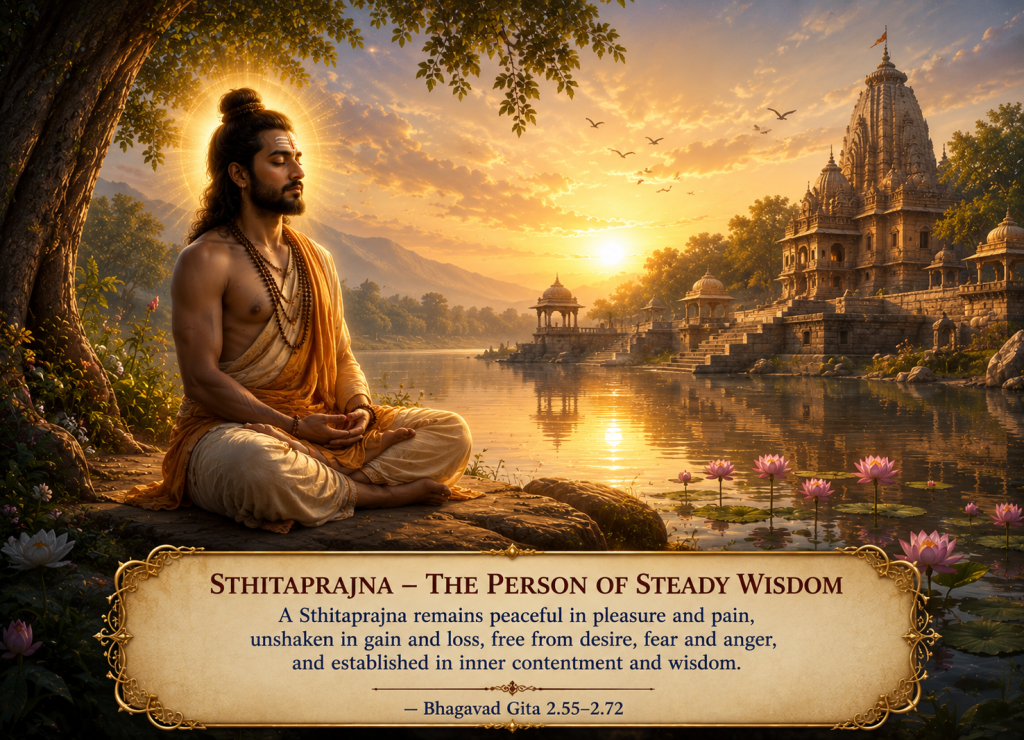
A Sthitaprajna is someone whose wisdom is steady.
Such a person:
- remains balanced in pleasure and pain,
- is not controlled by excessive desire,
- does not become dominated by fear and anger,
- controls the senses,
- is not excessively attached to possessions,
- does not depend on praise,
- does not collapse under criticism,
- remains inwardly peaceful,
- acts with wisdom,
- and has a deep spiritual understanding of the Self.
This is not a description of an emotionless person.
It is a description of someone who has freedom from emotional slavery.
Bhagavad Gita Chapter 2 and Modern Life
The teachings of Sankhya Yoga remain relevant because human beings still experience the same basic struggles.
People worry about the future.
They fear failure.
They become attached to success.
They compare themselves with others.
They become angry when their desires are frustrated.
They struggle with uncertainty.
They sometimes confuse temporary circumstances with their entire identity.
Chapter 2 addresses these struggles at their root.
When Krishna tells Arjuna to remain balanced in success and failure, the teaching can apply to examinations, careers, relationships, creative work, and personal goals.
When Krishna teaches control of the senses, the principle can apply to modern distractions.
When Krishna teaches action without attachment, it can help us approach work with greater focus.
When Krishna describes the chain from desire to anger, it provides a powerful framework for understanding emotional reactions.
And when Krishna teaches the eternal Self, He offers Hindu philosophy’s deeper answer to the question:
“Who am I?”
The Most Famous Verses of Chapter 2
Several verses from Chapter 2 have become especially famous.
Bhagavad Gita 2.13
Teaches the continuity of the Self through childhood, youth, and old age.
Bhagavad Gita 2.20
Teaches that the Self is unborn, eternal, and indestructible.
Bhagavad Gita 2.22
Uses the analogy of changing clothes to explain the changing body.
Bhagavad Gita 2.47
Teaches that one’s responsibility is to action rather than ownership of its fruits.
Bhagavad Gita 2.48
Defines yoga through equanimity.
Bhagavad Gita 2.50
Connects yoga with skillful action.
Bhagavad Gita 2.62–2.63
Explains how attachment can develop into desire, anger, confusion, and loss of judgment.
Bhagavad Gita 2.70
Compares the steady person with an ocean that remains full despite rivers flowing into it.
Bhagavad Gita 2.71
Describes freedom from desire, possessiveness, and ego as a path to peace.
Bhagavad Gita 2.72
Concludes the chapter with the state of Brahman realization.
What Bhagavad Gita Chapter 2 Teaches Us
The entire chapter can be summarized through a few fundamental principles.
First: Do not mistake the temporary body for the eternal Self.
Second: Accept that change is part of embodied existence.
Third: Do your rightful duty with sincerity.
Fourth: Do not allow fear or attachment to paralyze you.
Fifth: Work without becoming obsessed with the result.
Sixth: Maintain balance in success and failure.
Seventh: Control the senses instead of allowing them to control the mind.
Eighth: Watch the chain from thought to attachment, desire, anger, and confusion.
Ninth: Cultivate inner peace rather than depending entirely on external circumstances.
Tenth: Seek steady wisdom and spiritual realization.
Conclusion: From Arjuna’s Confusion to Spiritual Wisdom
Bhagavad Gita Chapter 2, Sankhya Yoga, is the foundation of the Gita’s spiritual philosophy.
At the beginning of the chapter, Arjuna is overwhelmed. He is confused about dharma, frightened by the consequences of action, and unable to make a decision.
By the end of Krishna’s teaching, we are given a completely different vision of life.
Krishna teaches that the Self is eternal.
The body is temporary.
Pleasure and pain come and go.
Duty should be performed with wisdom.
Action should not be abandoned.
The fruits of action should not become objects of unhealthy attachment.
The senses must be disciplined.
The mind must be trained.
Desire can lead to anger and confusion.
Inner balance produces peace.
And the highest spiritual goal is the realization of the eternal Self and the state of Brahman.
The journey of Chapter 2 can therefore be expressed in a simple sequence:
Confusion → Surrender → Knowledge → Duty → Selfless Action → Equanimity → Sense Control → Steady Wisdom → Inner Peace.
That is why Sankhya Yoga remains one of the most profound chapters of the Bhagavad Gita.
Arjuna begins by saying that he does not know what to do.
Krishna begins by teaching him who he truly is.
And that is the deeper message of the chapter: before we can understand what we should do, we must learn to understand ourselves.
The teachings of Chapter 2 invite us to live responsibly, act sincerely, remain balanced, control our desires, and look beyond temporary circumstances toward the deeper reality of the Self.
In this way, the battlefield of Kurukshetra becomes more than an ancient setting. It becomes a symbol of the inner conflicts that every human being faces.
Fear versus courage.
Attachment versus freedom.
Confusion versus wisdom.
Desire versus discipline.
Ego versus surrender.
And finally, restlessness versus peace.
The Bhagavad Gita’s answer is not to escape life’s challenges.
It is to meet them with knowledge, dharma, selfless action, equanimity, and spiritual wisdom.
Om Tat Sat.
*Related Article: 1. Bhagavad Gita Chapter 1: Arjuna Vishada Yoga
2. Bhagavad Gita Chapter 3: Karma Yoga
3. Bhagavad Gita Chapter 5: Karma Sannyasa Yoga
[Updated on 19 August, 2026]