Bhagavad Gita Chapter 1:Arjuna Vishada Yoga
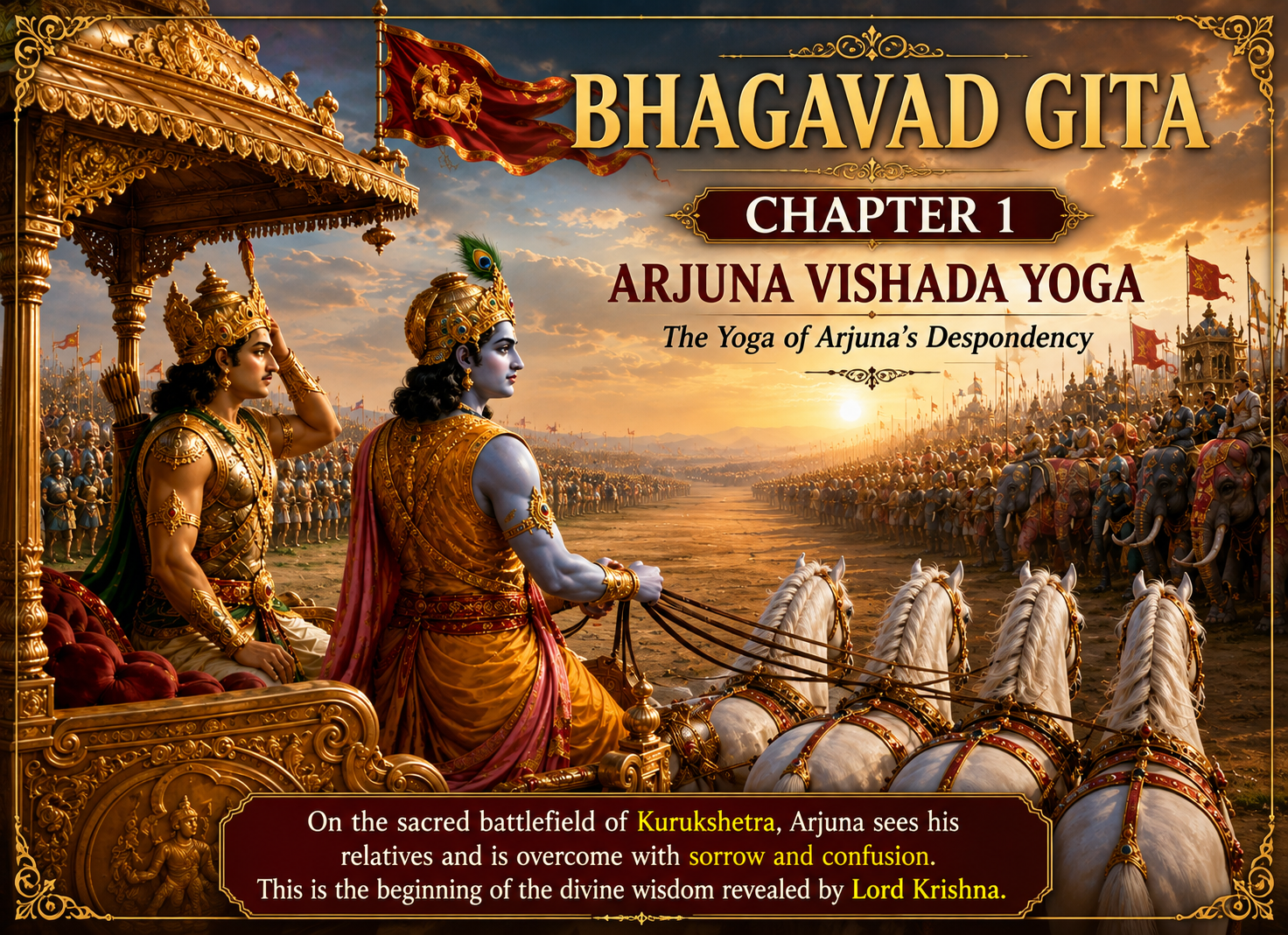
The Bhagavad Gita is one of the most important spiritual texts of Hinduism. It presents a profound conversation between Lord Krishna and Arjuna on the battlefield of Kurukshetra.
The Bhagavad Gita contains 18 chapters and 700 verses in its commonly transmitted form. Each chapter explores important questions about life, duty, action, knowledge, devotion, the self, and liberation.
The first chapter is especially important because it establishes the emotional and philosophical situation that leads to Krishna’s teachings.
The traditional title of Chapter 1 is Arjuna Viṣāda Yoga, often translated as The Yoga of Arjuna’s Despondency, The Yoga of Arjuna’s Grief, or The Yoga of Arjuna’s Dejection.
At first, the title may seem surprising. Why would sorrow be called “Yoga”?
Yoga generally means union, discipline, or a path toward spiritual realization. In this chapter, however, Arjuna’s crisis becomes the starting point of a deeper spiritual journey. His confusion forces him to confront questions that human beings continue to face:
- What is my duty?
- What should I do when every choice seems painful?
- Should personal relationships come before duty?
- What happens when morality becomes difficult to understand?
- Is avoiding action always the right thing to do?
- How should a person respond to grief and confusion?
- What is more important: temporary relationships or eternal truth?
Arjuna is not an ordinary warrior in the story. He is a highly skilled archer, a member of the Pandava family, and a central hero of the Mahabharata. Yet when he sees relatives, teachers, elders, friends, and loved ones standing before him, his confidence disappears.
His physical strength remains, but his inner certainty collapses.
That moment creates the setting for the entire Bhagavad Gita.
Gita Supersite preserves the Sanskrit text of Chapter 1 and its traditional commentarial material, including the final verse in which Sanjaya describes Arjuna casting aside his bow and sitting down overwhelmed by sorrow.
This article presents all 47 verses of Bhagavad Gita Chapter 1, with:
- Sanskrit text
- English transliteration
- Brief paraphrase
- Detailed explanation
- Philosophical significance
- Practical lessons
The aim is not merely to summarize the chapter but to understand why Arjuna’s crisis is essential to the spiritual teaching that follows.
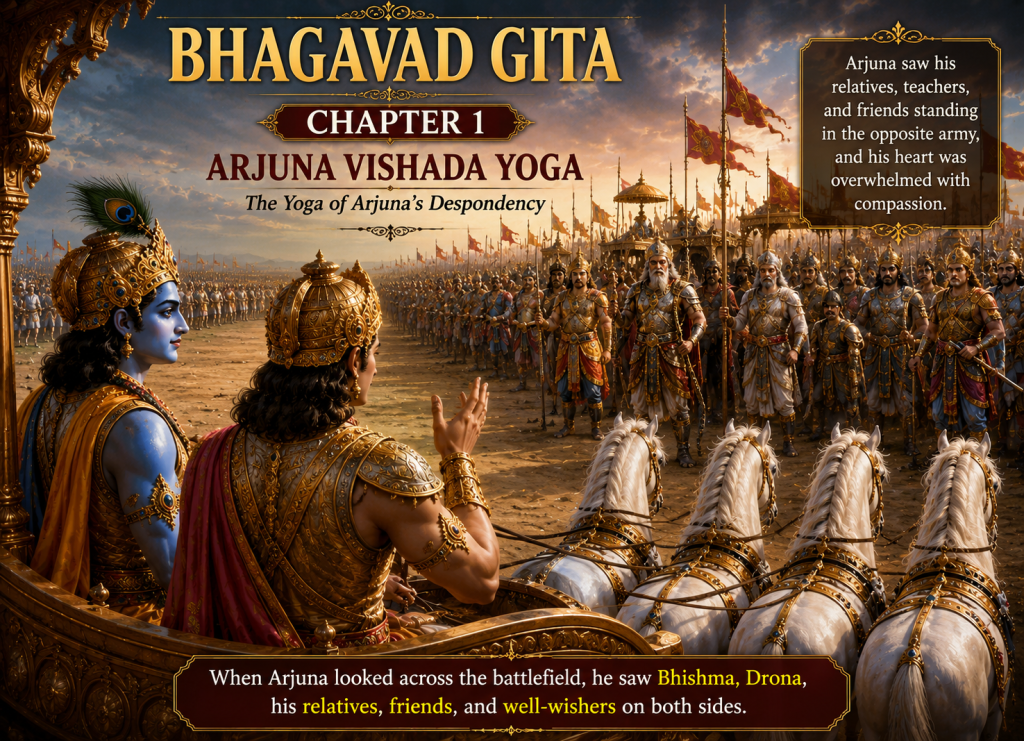
What Is Bhagavad Gita Chapter 1 About?
Bhagavad Gita Chapter 1 describes the events immediately before the great battle of Kurukshetra.
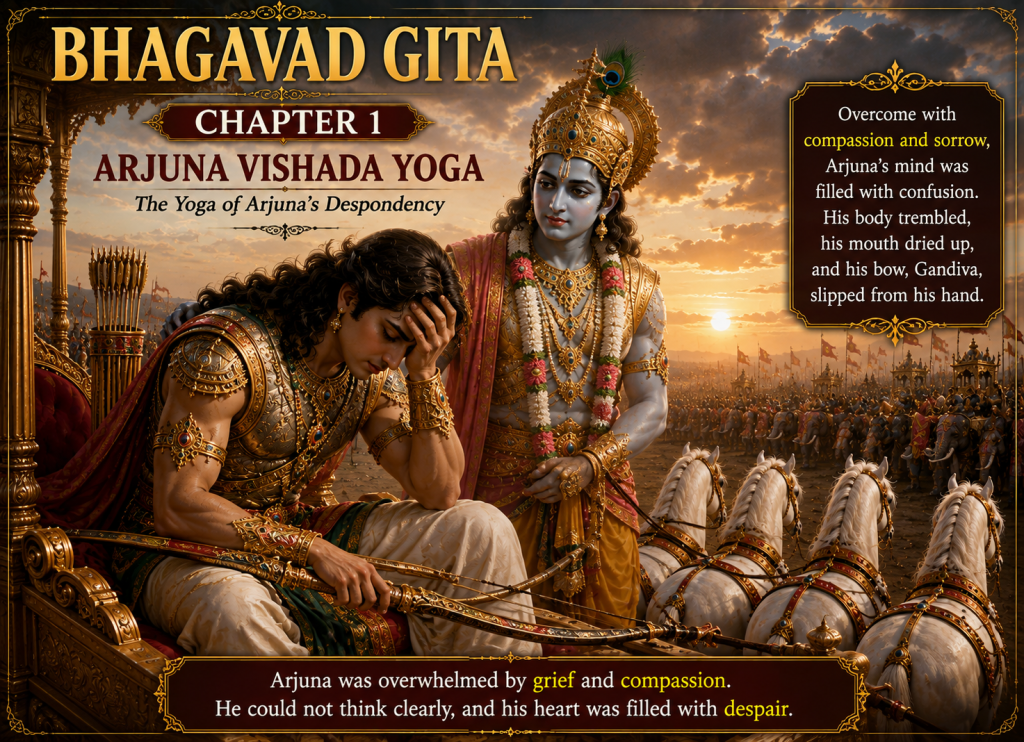
The chapter begins with King Dhritarashtra, the blind king of the Kuru dynasty, asking his minister and narrator Sanjaya what is happening on the battlefield.
Sanjaya has been given divine vision and can describe the events of the battlefield to Dhritarashtra.
The armies of the Pandavas and Kauravas have assembled.
Duryodhana, leader of the Kaurava side, observes the Pandava army and speaks to his teacher Drona. He names several important warriors on both sides.
Then the conches and war instruments are sounded.
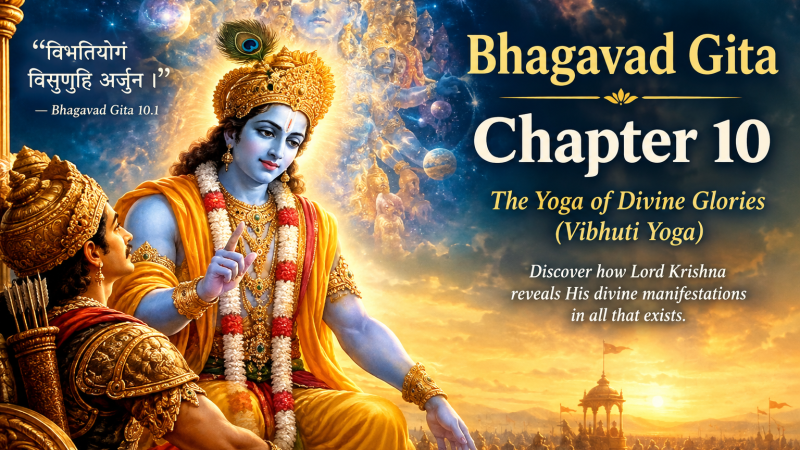
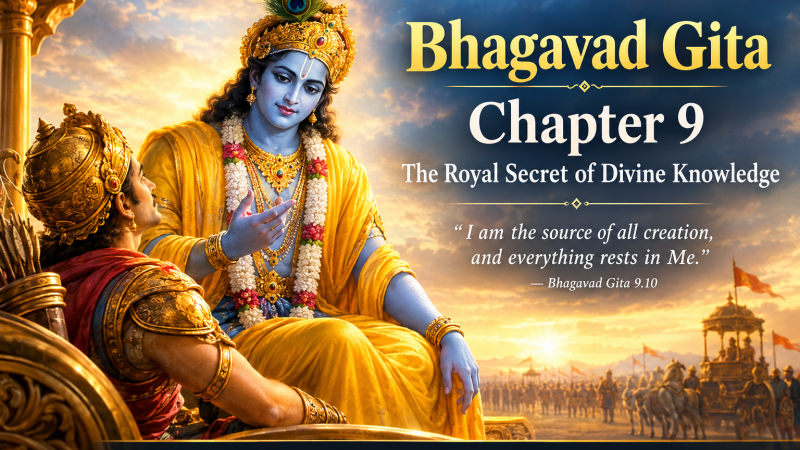
Lord Krishna, serving as Arjuna’s charioteer, drives the chariot between the two armies at Arjuna’s request.
Arjuna asks Krishna to place the chariot where he can see the warriors with whom he is about to fight.
When Arjuna sees his relatives, teachers, friends, and elders, he becomes overwhelmed by compassion and grief.
His body begins to tremble. His mouth becomes dry. His famous bow, Gandiva, slips from his hand.
He begins to question the purpose of the war.
He argues that victory, kingdom, and pleasure have little meaning if they are gained through the destruction of one’s own relatives.
He fears the destruction of families and social order.
Eventually, Arjuna declares that he does not want to fight and sits down in sorrow.
This is where Chapter 1 ends.
It is also where the real philosophical journey of the Bhagavad Gita begins.
The Main Themes of Chapter 1
Before examining each verse, it is useful to understand the major themes.
1. Moral Conflict
Arjuna faces a conflict between different responsibilities.
He is a warrior expected to fight for justice, but the opposing army contains people he loves and respects.
His dilemma demonstrates that moral decisions are not always simple.
2. Attachment
Arjuna’s judgment becomes heavily influenced by his emotional attachment to family members, teachers, and friends.
The Gita later examines how attachment affects human judgment.
3. Compassion
Arjuna’s sorrow is not simply selfish fear.
He feels compassion toward those who stand before him.
However, the Gita later explores the difference between genuine spiritual compassion and emotional attachment that prevents a person from performing necessary duty.
4. Fear of Consequences
Arjuna worries about what will happen after the battle.
He considers the destruction of families, social traditions, and future generations.
This shows that ethical decisions require consideration of consequences.
5. Crisis as the Beginning of Wisdom
Arjuna’s confusion creates the opportunity for spiritual teaching.
His crisis is therefore not meaningless.
It becomes the doorway to knowledge.
Bhagavad Gita Chapter 1: Verse-by-Verse Explanation
Verse 1 — Dhritarashtra Asks Sanjaya
Sanskrit
धृतराष्ट्र उवाच ।
धर्मक्षेत्रे कुरुक्षेत्रे समवेता युयुत्सवः ।
मामकाः पाण्डवाश्चैव किमकुर्वत सञ्जय ॥ १.१ ॥
Transliteration
dhṛtarāṣṭra uvāca
dharma-kṣetre kuru-kṣetre samavetā yuyutsavaḥ
māmakāḥ pāṇḍavāś caiva kim akurvata sañjaya
Brief Paraphrase
Dhritarashtra asks Sanjaya what his sons and the sons of Pandu did after assembling on the sacred battlefield of Kurukshetra, prepared to fight.
Explanation
The Bhagavad Gita begins with a question.
Dhritarashtra is blind physically, but the opening verse also introduces a deeper form of blindness: attachment.
He refers to the Kauravas as “my sons” and the Pandavas as the sons of Pandu. His language reflects his emotional attachment to his own family.
The battlefield is called Dharma-kṣetra, the field of dharma or righteousness, as well as Kurukshetra.
This is significant.
The entire Gita takes place in a situation where questions of righteousness and duty are central.
Dhritarashtra’s question also creates the narrative framework. Sanjaya will describe what happens on the battlefield.
The first verse therefore introduces three important ideas:
dharma, attachment, and moral conflict.
Verse 2 — Duryodhana Sees the Pandava Army
Sanskrit
सञ्जय उवाच ।
दृष्ट्वा तु पाण्डवानीकं व्यूढं दुर्योधनस्तदा ।
आचार्यमुपसङ्गम्य राजा वचनमब्रवीत् ॥ १.२ ॥
Transliteration
sañjaya uvāca
dṛṣṭvā tu pāṇḍavānīkaṁ vyūḍhaṁ duryodhanas tadā
ācāryam upasaṅgamya rājā vacanam abravīt
Brief Paraphrase
Sanjaya says that after seeing the Pandava army arranged in battle formation, King Duryodhana approached his teacher Drona and spoke.
Explanation
Duryodhana immediately notices the organization of the opposing army.
Although he is powerful and commands a large army, the sight of the Pandava forces causes him concern.
Instead of remaining completely calm, he approaches Drona.
This suggests that the presence of the Pandava army has an emotional effect on him.
The verse also introduces the relationship between Duryodhana and Drona.
Drona is both a teacher and an important warrior on the Kaurava side.
The battlefield is therefore filled with complicated relationships.
Verse 3 — Duryodhana Points Out the Pandava Warriors
Sanskrit
पश्यैतां पाण्डुपुत्राणामाचार्य महतीं चमूम् ।
व्यूढां द्रुपदपुत्रेण तव शिष्येण धीमता ॥ १.३ ॥
Transliteration
paśyaitāṁ pāṇḍu-putrāṇām ācārya mahatīṁ camūm
vyūḍhāṁ drupada-putreṇa tava śiṣyeṇa dhīmatā
Brief Paraphrase
Duryodhana tells Drona to look at the great army of the sons of Pandu, skillfully arranged by Dhrishtadyumna, Drona’s intelligent student.
Explanation
Duryodhana deliberately reminds Drona that the Pandava army has been organized by one of Drona’s own students.
Dhrishtadyumna is particularly significant because he was born with the purpose of opposing Drona.
Duryodhana’s words therefore contain psychological pressure.
He is not merely describing the army.
He is reminding Drona that his own training contributed to the strength of the opposing side.
This illustrates how people can use words strategically during moments of tension.
Verse 4 — The Great Warriors of the Pandava Army
Sanskrit
अत्र शूरा महेष्वासा भीमार्जुनसमा युधि ।
युयुधानो विराटश्च द्रुपदश्च महारथः ॥ १.४ ॥
Transliteration
atra śūrā maheṣv-āsā bhīmārjuna-samā yudhi
yuyudhāno virāṭaś ca drupadaś ca mahā-rathaḥ
Brief Paraphrase
Duryodhana points out great warriors in the Pandava army who are powerful and formidable in battle, including Yuyudhana, Virata, and Drupada.
Explanation
Duryodhana continues listing the prominent warriors on the opposing side.
The purpose is partly strategic.
He wants Drona and the Kaurava forces to recognize the strength of their opponents.
The verse emphasizes the magnitude of the coming conflict.
This is not a minor dispute.
The greatest warriors of the age are assembled.
Verse 5 — More Powerful Warriors
Sanskrit
धृष्टकेतुश्चेकितानः काशिराजश्च वीर्यवान् ।
पुरुजित्कुन्तिभोजश्च शैब्यश्च नरपुङ्गवः ॥ १.५ ॥
Transliteration
dhṛṣṭaketuś cekitānaḥ kāśirājaś ca vīryavān
purujit kuntibhojaś ca śaibyaś ca nara-puṅgavaḥ
Brief Paraphrase
Duryodhana continues naming powerful warriors among the Pandava allies.
Explanation
The long list of warriors emphasizes the scale of the conflict.
Many kingdoms and powerful individuals have joined the Pandava side.
The battlefield represents more than a family disagreement.
The struggle has expanded into a massive political and military conflict.
Verse 6 — Other Heroes
Sanskrit
युधामन्युश्च विक्रान्त उत्तमौजाश्च वीर्यवान् ।
सौभद्रो द्रौपदेयाश्च सर्व एव महारथाः ॥ १.६ ॥
Transliteration
yudhāmanyuś ca vikrānta uttamaujāś ca vīryavān
saubhadro draupadeyāś ca sarva eva mahā-rathāḥ
Brief Paraphrase
Duryodhana identifies more powerful warriors, including Abhimanyu and the sons of Draupadi, describing them as great chariot warriors.
Explanation
The mention of Abhimanyu is particularly meaningful because he is young and closely connected to Arjuna.
The sons of Draupadi are also part of the Pandava family.
This reminds readers that the battlefield contains several generations of people connected by family relationships.
The tragedy of the coming conflict is therefore deeply personal.
Verse 7 — Warriors on the Kaurava Side
Sanskrit
अस्माकं तु विशिष्टा ये तान्निबोध द्विजोत्तम ।
नायका मम सैन्यस्य संज्ञार्थं तान्ब्रवीमि ते ॥ १.७ ॥
Transliteration
asmākaṁ tu viśiṣṭā ye tān nibodha dvijottama
nāyakā mama sainyasya saṁjñārthaṁ tān bravīmi te
Brief Paraphrase
Duryodhana now tells Drona to take note of the important leaders of his own army.
Explanation
Duryodhana shifts attention from the Pandava forces to his own commanders.
This change reflects a desire to strengthen confidence.
He reminds Drona that the Kaurava army also contains powerful leaders.
The verse also demonstrates how leaders attempt to motivate themselves and others during difficult circumstances.
Verse 8 — Bhishma, Karna and Other Warriors
Sanskrit
भवान्भीष्मश्च कर्णश्च कृपश्च समितिञ्जयः ।
अश्वत्थामा विकर्णश्च सौमदत्तिस्तथैव च ॥ १.८ ॥
Transliteration
bhavān bhīṣmaś ca karṇaś ca kṛpaś ca samitiñ-jayaḥ
aśvatthāmā vikarṇaś ca saumadattis tathaiva ca
Brief Paraphrase
Duryodhana names Drona, Bhishma, Karna, Kripa, Ashvatthama, Vikarna, and Somadatta among the important warriors on his side.
Explanation
The Kaurava army contains some of the most famous warriors in the Mahabharata.
Bhishma is especially important because he is an elder of the Kuru dynasty and deeply respected.
Karna is another legendary warrior and a close supporter of Duryodhana.
Drona is both teacher and warrior.
The battlefield is therefore filled with people whose personal histories are intertwined.
Verse 9 — Many Other Warriors
Sanskrit
अन्ये च बहवः शूरा मदर्थे त्यक्तजीविताः ।
नानाशस्त्रप्रहरणाः सर्वे युद्धविशारदाः ॥ १.९ ॥
Transliteration
anye ca bahavaḥ śūrā mad-arthe tyakta-jīvitāḥ
nānā-śastra-praharaṇāḥ sarve yuddha-viśāradāḥ
Brief Paraphrase
Duryodhana says that many other brave warriors are ready to sacrifice their lives for his cause and are highly skilled in battle.
Explanation
Duryodhana emphasizes loyalty.
His supporters are prepared to risk everything for his side.
The verse demonstrates the power of allegiance and political loyalty.
However, the Gita later encourages a deeper examination of what motivates action.
Is loyalty enough to make an action righteous?
The first chapter does not answer this question.
It presents the problem.
Verse 10 — The Two Armies
Sanskrit
अपर्याप्तं तदस्माकं बलं भीष्माभिरक्षितम् ।
पर्याप्तं त्विदमेतेषां बलं भीमाभिरक्षितम् ॥ १.१० ॥
Transliteration
aparyāptaṁ tad asmākaṁ balaṁ bhīṣmābhirakṣitam
paryāptaṁ tv idam eteṣāṁ balaṁ bhīmābhirakṣitam
Brief Paraphrase
Duryodhana compares the strength of his army, protected by Bhishma, with the Pandava army, protected by Bhima.
Explanation
This verse has been interpreted in different ways because of the words aparyāptam and paryāptam.
Depending on interpretation, Duryodhana may be expressing confidence in his army or concern about its adequacy.
The important point is that the comparison reveals psychological tension.
Even before the battle begins, the minds of the leaders are occupied with strength, protection, and victory.
Verse 11 — Protect Bhishma
Sanskrit
अयनेषु च सर्वेषु यथाभागमवस्थिताः ।
भीष्ममेवाभिरक्षन्तु भवन्तः सर्व एव हि ॥ १.११ ॥
Transliteration
ayaneṣu ca sarveṣu yathā-bhāgam avasthitāḥ
bhīṣmam evābhirakṣantu bhavantaḥ sarva eva hi
Brief Paraphrase
Duryodhana instructs the warriors to remain in their positions and protect Bhishma from all sides.
Explanation
Bhishma is the central pillar of the Kaurava army.
Duryodhana therefore emphasizes the importance of protecting him.
This also reveals an interesting truth about military strength: even powerful individuals depend on others.
No person functions completely independently.
Verse 12 — Bhishma Blows His Conch
Sanskrit
तस्य सञ्जनयन्हर्षं कुरुवृद्धः पितामहः ।
सिंहनादं विनद्योच्चैः शङ्खं दध्मौ प्रतापवान् ॥ १.१२ ॥
Transliteration
tasya sañjanayan harṣaṁ kuru-vṛddhaḥ pitāmahaḥ
siṁha-nādaṁ vinadyo cchaiḥ śaṅkhaṁ dadhmau pratāpavān
Brief Paraphrase
Bhishma, the great elder of the Kuru dynasty, blows his conch loudly like a lion’s roar to encourage Duryodhana.
Explanation
The sound of the conch is a declaration that the battle is beginning.
Bhishma’s action also has a psychological purpose.
He wants to inspire confidence.
The battlefield is not only a physical environment. It is also a psychological environment where sounds, speeches, symbols, and gestures influence the participants.
Verse 13 — The Battlefield Resounds
Sanskrit
ततः शङ्खाश्च भेर्यश्च पणवानकगोमुखाः ।
सहसैवाभ्यहन्यन्त स शब्दस्तुमुलोऽभवत् ॥ १.१३ ॥
Transliteration
tataḥ śaṅkhāś ca bheryaś ca paṇavānaka-gomukhāḥ
sahasaivābhyahanyanta sa śabdas tumulo ‘bhavat
Brief Paraphrase
Then conches, drums, kettledrums, horns, and other instruments sound together, creating a tremendous noise.
Explanation
The battlefield becomes filled with sound.
The noise represents the energy and tension immediately before the conflict.
The Mahabharata describes the scene dramatically because the reader is being brought into the emotional atmosphere of Kurukshetra.
Verse 14 — Krishna and Arjuna Sound Their Conches
Sanskrit
ततः श्वेतैर्हयैर्युक्ते महति स्यन्दने स्थितौ ।
माधवः पाण्डवश्चैव दिव्यौ शङ्खौ प्रदध्मतुः ॥ १.१४ ॥
Transliteration
tataḥ śvetair hayair yukte mahati syandane sthitau
mādhavaḥ pāṇḍavaś caiva divyau śaṅkhau pradadhmatuḥ
Brief Paraphrase
Krishna and Arjuna, seated in their magnificent chariot drawn by white horses, blow their divine conches.
Explanation
The focus now shifts toward Krishna and Arjuna.
Krishna is called Madhava, while Arjuna is referred to as Pandava.
Their chariot occupies a central symbolic position.
Krishna is the charioteer.
Arjuna is the warrior.
This relationship becomes one of the most important teacher-student relationships in spiritual literature.
Verse 15 — Krishna and Arjuna’s Conches
Sanskrit
पाञ्चजन्यं हृषीकेशो देवदत्तं धनञ्जयः ।
पौण्ड्रं दध्मौ महाशङ्खं भीमकर्मा वृकोदरः ॥ १.१५ ॥
Transliteration
pāñcajanyaṁ hṛṣīkeśo devadattaṁ dhanañjayaḥ
pauṇḍraṁ dadhmau mahā-śaṅkhaṁ bhīma-karmā vṛkodaraḥ
Brief Paraphrase
Krishna blows Panchajanya, Arjuna blows Devadatta, and Bhima blows the great conch Paundra.
Explanation
The conches have names, emphasizing the importance of their owners.
Krishna is called Hrishikesha, often understood as the Lord or master of the senses.
This name becomes philosophically important later because the Gita teaches the discipline of the senses and mind.
Arjuna is called Dhananjaya, meaning one who has gained wealth or victory.
Bhima is described through his extraordinary strength.
Verse 16 — Other Pandava Warriors Sound Their Conches
Sanskrit
अनन्तविजयं राजा कुन्तीपुत्रो युधिष्ठिरः ।
नकुलः सहदेवश्च सुघोषमणिपुष्पकौ ॥ १.१६ ॥
Transliteration
anantavijayaṁ rājā kuntī-putro yudhiṣṭhiraḥ
nakulaḥ sahadevaś ca sughoṣa-maṇipuṣpakau
Brief Paraphrase
Yudhishthira blows Anantavijaya, while Nakula and Sahadeva blow their respective conches.
Explanation
The Pandava brothers are presented together.
Yudhishthira represents righteousness and responsibility.
Bhima represents strength.
Arjuna represents exceptional skill and later becomes the student of Krishna.
Nakula and Sahadeva complete the group.
Their unity is an important feature of the Pandava side.
Verse 17 — Other Allies Sound Their Conches
Sanskrit
काश्यश्च परमेष्वासः शिखण्डी च महारथः ।
धृष्टद्युम्नो विराटश्च सात्यकिश्चापराजितः ॥ १.१७ ॥
Transliteration
kāśyaś ca parameṣvāsaḥ śikhaṇḍī ca mahā-rathaḥ
dhṛṣṭadyumno virāṭaś ca sātyakiś cāparājitaḥ
Brief Paraphrase
Other great warriors, including the king of Kashi, Shikhandi, Dhrishtadyumna, Virata, and Satyaki, sound their conches.
Explanation
The verse continues emphasizing the powerful alliance supporting the Pandavas.
The many names also remind readers that the conflict involves numerous kingdoms and leaders.
Verse 18 — The Sons of Draupadi and Abhimanyu
Sanskrit
द्रुपदो द्रौपदेयाश्च सर्वशः पृथिवीपते ।
सौभद्रश्च महाबाहुः शङ्खान्दध्मुः पृथक्पृथक् ॥ १.१८ ॥
Transliteration
drupado draupadeyāś ca sarvaśaḥ pṛthivī-pate
saubhadraś ca mahā-bāhuḥ śaṅkhān dadhmuḥ pṛthak pṛthak
Brief Paraphrase
Drupada, the sons of Draupadi, and mighty-armed Abhimanyu each blow their own conches.
Explanation
The battlefield now becomes filled with the sounds of the Pandava alliance.
Abhimanyu’s presence is particularly meaningful because he is Arjuna’s son.
The family connections make Arjuna’s later emotional crisis understandable.
Verse 19 — The Sound Reaches Everywhere
Sanskrit
स घोषो धार्तराष्ट्राणां हृदयानि व्यदारयत् ।
नभश्च पृथिवीं चैव तुमुलो व्यनुनादयन् ॥ १.१९ ॥
Transliteration
sa ghoṣo dhārtarāṣṭrāṇāṁ hṛdayāni vyadārayat
nabhaś ca pṛthivīṁ caiva tumulo vyanunādayan
Brief Paraphrase
The tremendous sound of the Pandava conches reverberates through the earth and sky and strikes fear into the hearts of Dhritarashtra’s sons.
Explanation
The verse describes the psychological effect of the sound.
The Kauravas are now confronted with the reality of the opposing army.
The battle is no longer an abstract political conflict.
It is about to become real.
Verse 20 — Arjuna Raises His Bow
Sanskrit
अथ व्यवस्थितान्दृष्ट्वा धार्तराष्ट्रान्कपिध्वजः ।
प्रवृत्ते शस्त्रसम्पाते धनुरुद्यम्य पाण्डवः ।
हृषीकेशं तदा वाक्यमिदमाह महीपते ॥ १.२० ॥
Transliteration
atha vyavasthitān dṛṣṭvā dhārtarāṣṭrān kapi-dhvajaḥ
pravṛtte śastra-sampāte dhanur udyamya pāṇḍavaḥ
hṛṣīkeśaṁ tadā vākyam idam āha mahī-pate
Brief Paraphrase
Seeing the Kaurava warriors prepared for battle, Arjuna raises his bow and speaks to Krishna.
Explanation
Arjuna initially appears ready to fight.
This is important.
His crisis does not begin because he is naturally cowardly.
He is a great warrior.
The problem emerges when he personally confronts the human beings standing on the opposite side.
This distinction is essential for understanding Chapter 1.
Verse 21 — Arjuna Asks Krishna to Place the Chariot
Sanskrit
अर्जुन उवाच ।
सेनयोरुभयोर्मध्ये रथं स्थापय मेऽच्युत ॥ १.२१ ॥
Transliteration
arjuna uvāca
senayor ubhayor madhye rathaṁ sthāpaya me ‘cyuta
Brief Paraphrase
Arjuna asks Krishna to place his chariot between the two armies.
Explanation
Arjuna wants to see who has gathered to fight.
The request appears simple, but it becomes the turning point of the chapter.
Sometimes seeing a situation directly changes our understanding of it.
Arjuna has been preparing for battle.
But when he actually looks at the people involved, his emotional response changes everything.
Verse 22 — Arjuna Wants to See the Warriors
Sanskrit
यावदेतान्निरीक्षेऽहं योद्धुकामानवस्थितान् ।
कैर्मया सह योद्धव्यमस्मिन् रणसमुद्यमे ॥ १.२२ ॥
Transliteration
yāvad etān nirīkṣe ‘haṁ yoddhu-kāmān avasthitān
kair mayā saha yoddhavyam asmin raṇa-samudyame
Brief Paraphrase
Arjuna wants to look at those assembled to fight and see with whom he must engage in battle.
Explanation
Arjuna is seeking information.
But his request has an emotional dimension.
He wants to know exactly who stands before him.
The coming realization will transform his confidence into grief.
Verse 23 — Who Supports Duryodhana?
Sanskrit
योत्स्यमानानवेक्षेऽहं य एतेऽत्र समागताः ।
धार्तराष्ट्रस्य दुर्बुद्धेर्युद्धे प्रियचिकीर्षवः ॥ १.२३ ॥
Transliteration
yotsyamānān avekṣe ‘haṁ ya ete ‘tra samāgatāḥ
dhārtarāṣṭrasya durbuddher yuddhe priya-cikīrṣavaḥ
Brief Paraphrase
Arjuna wants to see those who have gathered to fight in support of Duryodhana.
Explanation
Arjuna describes Duryodhana as misguided.
This reflects the moral position from which Arjuna enters the battlefield.
He believes the Pandavas are fighting against injustice.
Yet the complexity of the conflict becomes overwhelming once he sees the individuals involved.
This illustrates how a political or moral conflict can become much harder when personal relationships are involved.
Verse 24 — Krishna Places the Chariot
Sanskrit
सञ्जय उवाच ।
एवमुक्तो हृषीकेशो गुडाकेशेन भारत ।
सेनयोरुभयोर्मध्ये स्थापयित्वा रथोत्तमम् ॥ १.२४ ॥
Transliteration
sañjaya uvāca
evam ukto hṛṣīkeśo guḍākeśena bhārata
senayor ubhayor madhye sthāpayitvā rathottamam
Brief Paraphrase
Sanjaya says that Krishna, addressed by Arjuna, places the magnificent chariot between the two armies.
Explanation
Krishna does not immediately give a philosophical lecture.
First, he allows Arjuna to see.
This is an important teaching method.
Before offering advice, Krishna permits Arjuna to encounter the reality of his situation.
Arjuna must face the problem before he can understand the solution.
Verse 25 — Krishna Tells Arjuna to Observe the Kuru Elders
Sanskrit
भीष्मद्रोणप्रमुखतः सर्वेषां च महीक्षिताम् ।
उवाच पार्थ पश्यैतान्समवेतान्कुरूनिति ॥ १.२५ ॥
Transliteration
bhīṣma-droṇa-pramukhataḥ sarveṣāṁ ca mahī-kṣitām
uvāca pārtha paśyaitān samavetān kurūn iti
Brief Paraphrase
Krishna places the chariot before Bhishma, Drona, and the other kings and tells Arjuna to look at the assembled Kurus.
Explanation
Krishna’s words are simple: Look.
That instruction is powerful.
Arjuna must confront the truth of what is happening.
The people he must face are not strangers.
They include his grandfather Bhishma and teacher Drona.
This is the moment when the external battlefield becomes an internal battlefield.
Verse 26 — Arjuna Sees His Relatives
Sanskrit
तत्रापश्यत्स्थितान्पार्थः पितॄनथ पितामहान् ।
आचार्यान्मातुलान्भ्रातॄन्पुत्रान्पौत्रान्सखींस्तथा ।
श्वशुरान्सुहृदश्चैव सेनयोरुभयोरपि ॥ १.२६ ॥
Transliteration
tatrāpaśyat sthitān pārthaḥ pitṝn atha pitāmahān
ācāryān mātulān bhrātṝn putrān pautrān sakhīṁs tathā
śvaśurān suhṛdaś caiva senayor ubhayor api
Brief Paraphrase
Arjuna sees fathers, grandfathers, teachers, uncles, brothers, sons, grandsons, friends, in-laws, and well-wishers standing on both sides.
Explanation
This is one of the most emotionally important verses in Chapter 1.
Arjuna does not see armies anymore.
He sees people.
He sees relationships.
The word “warrior” is replaced in his mind by “grandfather,” “teacher,” “brother,” “son,” and “friend.”
This change in perception causes his crisis.
The verse explains why his response becomes so intense.
Verse 27 — Arjuna Is Overcome by Compassion
Sanskrit
तान्समीक्ष्य स कौन्तेयः सर्वान्बन्धूनवस्थितान् ।
कृपया परयाविष्टो विषीदन्निदमब्रवीत् ॥ १.२७ ॥
Transliteration
tān samīkṣya sa kaunteyaḥ sarvān bandhūn avasthitān
kṛpayā parayāviṣṭo viṣīdann idam abravīt
Brief Paraphrase
Seeing all his relatives standing there, Arjuna becomes overwhelmed by deep compassion and sorrow.
Explanation
The word viṣāda is central to the chapter.
Arjuna becomes deeply distressed.
His emotions are not superficial.
He is experiencing a profound conflict between duty and affection.
This is the beginning of Arjuna Viṣāda Yoga.
Verse 28 — Arjuna’s Body Reacts
Sanskrit
अर्जुन उवाच ।
दृष्ट्वेमं स्वजनं कृष्ण युयुत्सुं समुपस्थितम् ।
सीदन्ति मम गात्राणि मुखं च परिशुष्यति ॥ १.२८ ॥
Transliteration
arjuna uvāca
dṛṣṭvemaṁ sva-janaṁ kṛṣṇa yuyutsuṁ samupasthitam
sīdanti mama gātrāṇi mukhaṁ ca pariśuṣyati
Brief Paraphrase
Arjuna tells Krishna that seeing his own people ready for battle makes his limbs weak and his mouth dry.
Explanation
Arjuna’s emotional crisis produces physical symptoms.
This is an important human dimension of the Gita.
Extreme emotional conflict can affect the body.
Arjuna’s body reflects the turmoil of his mind.
He is no longer thinking like the confident warrior who entered the battlefield.
Verse 29 — Trembling and Physical Distress
Sanskrit
वेपथुश्च शरीरे मे रोमहर्षश्च जायते ।
गाण्डीवं स्रंसते हस्तात्त्वक्चैव परिदह्यते ॥ १.२९ ॥
Transliteration
vepathuś ca śarīre me roma-harṣaś ca jāyate
gāṇḍīvaṁ sraṁsate hastāt tvak caiva paridahyate
Brief Paraphrase
Arjuna says that his body trembles, his hair stands on end, his bow slips from his hand, and his skin burns.
Explanation
Arjuna’s distress has reached a critical level.
Gandiva is not an ordinary bow.
It symbolizes Arjuna’s identity as a warrior.
When it slips from his hand, the event symbolizes the collapse of his confidence in his role.
The problem is no longer simply external.
Arjuna is experiencing an identity crisis.
Verse 30 — Arjuna Cannot Stand
Sanskrit
न च शक्नोम्यवस्थातुं भ्रमतीव च मे मनः ।
निमित्तानि च पश्यामि विपरीतानि केशव ॥ १.३० ॥
Transliteration
na ca śaknomy avasthātuṁ bhramatīva ca me manaḥ
nimittāni ca paśyāmi viparītāni keśava
Brief Paraphrase
Arjuna says he can no longer stand steadily, his mind seems to be spinning, and he sees unfavorable signs everywhere.
Explanation
Arjuna’s judgment has become dominated by fear and sorrow.
He no longer sees the battlefield with confidence.
His perception has changed.
This is a key psychological lesson: when a person becomes overwhelmed by emotion, even familiar circumstances may appear entirely different.
Verse 31 — Arjuna Sees No Good in the Battle
Sanskrit
न च श्रेयोऽनुपश्यामि हत्वा स्वजनमाहवे ।
न काङ्क्षे विजयं कृष्ण न च राज्यं सुखानि च ॥ १.३१ ॥
Transliteration
na ca śreyo ‘nupaśyāmi hatvā sva-janam āhave
na kāṅkṣe vijayaṁ kṛṣṇa na ca rājyaṁ sukhāni ca
Brief Paraphrase
Arjuna says that he sees no good in killing his own people. He no longer desires victory, kingdom, or pleasure.
Explanation
This is a profound change.
Earlier, the Pandavas fought for justice and their rightful kingdom.
Now Arjuna says that even victory has lost its value.
Why?
Because he believes that the people who would enjoy the kingdom are the very people who may die in the conflict.
This raises an important philosophical question:
What is the value of success if the success destroys everything we value?
The Gita will eventually offer a deeper answer by distinguishing temporary outcomes from duty and spiritual knowledge.
Verse 32 — What Is the Value of Kingdom?
Sanskrit
किं नो राज्येन गोविन्द किं भोगैर्जीवितेन वा ।
येषामर्थे काङ्क्षितं नो राज्यं भोगाः सुखानि च ॥ १.३२ ॥
Transliteration
kiṁ no rājyena govinda kiṁ bhogair jīvitena vā
yeṣām arthe kāṅkṣitaṁ no rājyaṁ bhogāḥ sukhāni ca
Brief Paraphrase
Arjuna asks Krishna what use kingdom, pleasures, or life itself would be when the people for whom those things are desired are standing before them.
Explanation
Arjuna is questioning the meaning of worldly success.
Kingdom, wealth, pleasure, and even life are normally considered valuable.
But their value depends partly on relationships.
Arjuna therefore asks a fundamental question about happiness:
Can external success provide happiness if one’s loved ones are lost?
This question remains relevant today.
People often pursue achievement, wealth, status, and recognition.
The Gita asks us to consider what these achievements ultimately mean.
Verse 33 — The People He Does Not Want to Kill
Sanskrit
त एवैतेऽवस्थिता युद्धे प्राणांस्त्यक्त्वा धनानि च ।
आचार्याः पितरः पुत्रास्तथैव च पितामहाः ॥ १.३३ ॥
Transliteration
ta evaitē ‘vasthitā yuddhe prāṇāṁs tyaktvā dhanāni ca
ācāryāḥ pitaraḥ putrās tathaiva ca pitāmahāḥ
Brief Paraphrase
The very people for whom Arjuna desires wealth and happiness are now standing in battle, ready to risk their lives.
Explanation
Arjuna’s argument becomes stronger.
He is not merely worried about killing strangers.
He sees teachers, fathers, sons, and grandfathers.
The emotional contradiction is enormous.
Verse 34 — Brothers, Relatives and Friends
Sanskrit
मातुलाः श्वशुराः पौत्राः श्यालाः सम्बन्धिनस्तथा ।
एतान्न हन्तुमिच्छामि घ्नतोऽपि मधुसूदन ॥ १.३४ ॥
Transliteration
mātulāḥ śvaśurāḥ pautrāḥ śyālāḥ sambandhinas tathā
etān na hantum icchāmi ghnato ‘pi madhusūdana
Brief Paraphrase
Arjuna says that he does not want to kill his uncles, fathers-in-law, grandsons, brothers-in-law, and other relatives, even if they are prepared to fight.
Explanation
Arjuna’s compassion extends beyond his immediate family.
The war threatens the entire social network surrounding him.
He is struggling to reconcile personal affection with his warrior responsibility.
Verse 35 — Arjuna Does Not Want Victory
Sanskrit
अपि त्रैलोक्यराज्यस्य हेतोः किं नु महीकृते ।
निहत्य धार्तराष्ट्रान्नः का प्रीतिः स्याज्जनार्दन ॥ १.३५ ॥
Transliteration
api trailokya-rājyasya hetoḥ kiṁ nu mahī-kṛte
nihatya dhārtarāṣṭrān naḥ kā prītiḥ syāj janārdana
Brief Paraphrase
Arjuna says that even rulership over the three worlds would not justify killing the sons of Dhritarashtra, much less ruling merely over the earth.
Explanation
Arjuna places human life above political power.
He argues that no kingdom is worth the destruction of one’s own family.
This is a powerful rejection of material ambition.
However, the later teachings of Krishna will challenge Arjuna’s reasoning by showing that emotional attachment can sometimes distort one’s understanding of duty.
Verse 36 — Sin and Consequences
Sanskrit
पापमेवाश्रयेदस्मान्हत्वैतानाततायिनः ।
तस्मान्नार्हा वयं हन्तुं धार्तराष्ट्रान्सबान्धवान् ।
स्वजनं हि कथं हत्वा सुखिनः स्याम माधव ॥ १.३६ ॥
Transliteration
pāpam evāśrayed asmān hatvaitān ātatāyinaḥ
tasmān nārhā vayaṁ hantuṁ dhārtarāṣṭrān sa-bāndhavān
sva-janaṁ hi kathaṁ hatvā sukhinaḥ syāma mādhava
Brief Paraphrase
Arjuna believes that killing the sons of Dhritarashtra and their relatives would bring sin, and he asks how they could be happy after killing their own people.
Explanation
Arjuna is now thinking in terms of dharma and adharma.
He is concerned not simply about emotional pain but about moral consequences.
The problem is becoming philosophical.
What is the right action?
What is wrong action?
Can an action be justified by a larger political goal?
These questions prepare the way for Krishna’s teaching in Chapter 2.
Verse 37 — Why Kill Our Own People?
Sanskrit
यद्यप्येते न पश्यन्ति लोभोपहतचेतसः ।
कुलक्षयकृतं दोषं मित्रद्रोहे च पातकम् ॥ १.३७ ॥
Transliteration
yady apy ete na paśyanti lobhopahata-cetasaḥ
kula-kṣaya-kṛtaṁ doṣaṁ mitra-drohe ca pātakam
Brief Paraphrase
Arjuna says that even if the others, blinded by greed, fail to see the wrong involved in destroying families and betraying friends, the Pandavas should understand it.
Explanation
Arjuna believes that greed has clouded the judgment of his opponents.
He does not want to respond to their wrongdoing by committing what he sees as another wrong.
This raises a timeless ethical question:
Should a person abandon moral principles because others have already abandoned them?
Arjuna believes the answer should be no.
Verse 38 — Greed Can Destroy Moral Understanding
Sanskrit
कथं न ज्ञेयमस्माभिः पापादस्मान्निवर्तितुम् ।
कुलक्षयकृतं दोषं प्रपश्यद्भिर्जनार्दन ॥ १.३८ ॥
Transliteration
kathaṁ na jñeyam asmābhiḥ pāpād asmān nivartitum
kula-kṣaya-kṛtaṁ doṣaṁ prapaśyadbhir janārdana
Brief Paraphrase
Arjuna asks why they should not turn away from the wrongdoing of destroying their own family when they can clearly see its consequences.
Explanation
Arjuna believes awareness creates responsibility.
If a person recognizes that an action may cause serious harm, that person must consider whether to proceed.
The verse emphasizes moral reflection before action.
Verse 39 — Destruction of Families
Sanskrit
कुलक्षये प्रणश्यन्ति कुलधर्माः सनातनाः ।
धर्मे नष्टे कुलं कृत्स्नमधर्मोऽभिभवत्युत ॥ १.३९ ॥
Transliteration
kula-kṣaye praṇaśyanti kula-dharmāḥ sanātanāḥ
dharme naṣṭe kulaṁ kṛtsnam adharmo ‘bhibhavaty uta
Brief Paraphrase
Arjuna argues that when families are destroyed, their traditions and duties are lost, and disorder may replace righteousness.
Explanation
Family traditions played a major role in ancient Indian society.
Arjuna fears that war will not merely kill individuals.
It will damage the institutions through which cultural and moral values are passed from one generation to another.
The verse therefore expands the consequences of war from individual suffering to social disruption.
Verse 40 — Social Disorder
Sanskrit
अधर्माभिभवात्कृष्ण प्रदुष्यन्ति कुलस्त्रियः ।
स्त्रीषु दुष्टासु वार्ष्णेय जायते वर्णसङ्करः ॥ १.४० ॥
Transliteration
adharmābhibhavāt kṛṣṇa praduṣyanti kula-striyaḥ
strīṣu duṣṭāsu vārṣṇeya jāyate varṇa-saṅkaraḥ
Brief Paraphrase
Arjuna argues that when social order collapses, family structures may be disrupted, leading to wider social confusion.
Explanation
This verse reflects the social ideas of the ancient world.
It should be understood in its historical context rather than simply projected onto modern society.
Arjuna’s larger concern is social stability.
He fears that large-scale violence can damage institutions, families, customs, and the transmission of values.
Verse 41 — Consequences for Future Generations
Sanskrit
सङ्करो नरकायैव कुलघ्नानां कुलस्य च ।
पतन्ति पितरो ह्येषां लुप्तपिण्डोदकक्रियाः ॥ १.४१ ॥
Transliteration
saṅkaro narakāyaiva kula-ghnānāṁ kulasya ca
patanti pitaro hy eṣāṁ lupta-piṇḍodaka-kriyāḥ
Brief Paraphrase
Arjuna says that social disorder harms both the destroyers of families and the families themselves, including the performance of traditional rites for ancestors.
Explanation
Ancient Hindu society placed strong importance on ancestral rites.
Arjuna fears that if families are destroyed, these practices will disappear.
His concern is therefore spiritual, cultural, and social.
The verse shows how deeply interconnected individual actions can be with community traditions.
Verse 42 — Family Duties Are Forgotten
Sanskrit
दोषैरेतैः कुलघ्नानां वर्णसङ्करकारकैः ।
उत्साद्यन्ते जातिधर्माः कुलधर्माश्च शाश्वताः ॥ १.४२ ॥
Transliteration
doṣair etaiḥ kula-ghnānāṁ varṇa-saṅkara-kārakaiḥ
utsādyante jāti-dharmāḥ kula-dharmāś ca śāśvatāḥ
Brief Paraphrase
Arjuna believes that such social disruption would destroy established family and community duties.
Explanation
Arjuna’s argument is now focused on social continuity.
He believes civilization depends partly on the preservation of responsibilities and traditions.
The chapter therefore moves from personal sorrow to social philosophy.
Verse 43 — The Consequences of Destroying Family Duties
Sanskrit
उत्सन्नकुलधर्माणां मनुष्याणां जनार्दन ।
नरके नियतं वासो भवतीत्यनुशुश्रुम ॥ १.४३ ॥
Transliteration
utsanna-kula-dharmāṇāṁ manuṣyāṇāṁ janārdana
narake niyataṁ vāso bhavatīty anuśuśruma
Brief Paraphrase
Arjuna says that they have heard that those whose family duties are destroyed suffer grave consequences.
Explanation
Arjuna bases part of his argument on teachings he has received.
This is important because he is not simply expressing emotion.
He is trying to construct a philosophical argument from his understanding of dharma.
Yet Krishna will later show that Arjuna’s reasoning, although compassionate, is incomplete.
Verse 44 — A Heavy Moral Burden
Sanskrit
अहो बत महत्पापं कर्तुं व्यवसिता वयम् ।
यद्राज्यसुखलोभेन हन्तुं स्वजनमुद्यताः ॥ १.४४ ॥
Transliteration
aho bata mahat pāpaṁ kartuṁ vyavasitā vayam
yad rājya-sukha-lobhena hantuṁ sva-janam udyatāḥ
Brief Paraphrase
Arjuna laments that they are prepared to commit a great wrong because of their desire for royal power and happiness.
Explanation
Arjuna now turns his criticism toward himself and his own side.
He fears that the desire for kingdom has corrupted their motives.
This is one of the strongest expressions of his self-doubt.
The warrior who was ready for battle now questions whether the entire struggle is morally justified.
Verse 45 — Arjuna Would Rather Be Killed
Sanskrit
यदि मामप्रतीकारमशस्त्रं शस्त्रपाणयः ।
धार्तराष्ट्रा रणे हन्युस्तन्मे क्षेमतरं भवेत् ॥ १.४५ ॥
Transliteration
yadi mām apratīkāram aśastraṁ śastra-pāṇayaḥ
dhārtarāṣṭrā raṇe hanyus tan me kṣemataraṁ bhavet
Brief Paraphrase
Arjuna says that he would consider it better to be killed without resistance than to kill his relatives in the battle.
Explanation
Arjuna has reached the height of his emotional crisis.
He no longer wants victory.
He would rather surrender than participate in what he believes is a terrible moral wrong.
This is the final stage before Krishna begins his philosophical teaching in Chapter 2.
Verse 46 — Arjuna Drops His Weapons
Sanskrit
सञ्जय उवाच ।
एवमुक्त्वार्जुनः सङ्ख्ये रथोपस्थ उपाविशत् ।
विसृज्य सशरं चापं शोकसंविग्नमानसः ॥ १.४६ ॥
Transliteration
sañjaya uvāca
evam uktvārjunaḥ saṅkhye rathopastha upāviśat
visṛjya sa-śaraṁ cāpaṁ śoka-saṁvigna-mānasaḥ
Brief Paraphrase
Sanjaya says that after speaking this way, Arjuna casts aside his bow and arrows and sits down in the chariot, overwhelmed by sorrow.
Explanation
Arjuna’s transformation is complete.
At the beginning of the chapter, he is a powerful warrior ready for battle.
Now he has abandoned his weapons.
The physical action represents his inner collapse.
The bow symbolizes his warrior role.
Putting it down symbolizes his inability to reconcile his duty with his emotions.
The first chapter has reached its climax.
Verse 47 — Arjuna Sits in Grief
Sanskrit
सञ्जय उवाच ।
एवमुक्त्वाऽर्जुनः सङ्ख्ये रथोपस्थ उपाविशत् ।
विसृज्य सशरं चापं शोकसंविग्नमानसः ॥ १.४७ ॥
Transliteration
sañjaya uvāca
evam uktvā ‘rjunaḥ saṅkhye rathopastha upāviśat
visṛjya sa-śaraṁ cāpaṁ śoka-saṁvigna-mānasaḥ
Brief Paraphrase
Sanjaya concludes that Arjuna, overwhelmed with grief, casts aside his bow and arrows and sits down on the chariot.
Explanation
Verse 47 is traditionally recognized as the closing verse of Chapter 1.
The first chapter therefore ends not with a victory, but with a crisis.
Arjuna does not know what to do.
His weapons are set aside.
His confidence has disappeared.
His mind is overwhelmed.
This is precisely where Krishna’s teaching must begin.
Gita Supersite gives the closing verse and identifies the first discourse as Arjuna Viṣāda Yoga, the Yoga of Arjuna’s despondency.
Why Is Arjuna’s Sorrow Called Yoga?
This is one of the most interesting questions about Bhagavad Gita Chapter 1.
Why call grief “Yoga”?
The answer becomes clearer when we understand what happens to Arjuna.
Before the crisis, Arjuna believes he knows what he should do.
He is confident.
He is prepared for battle.
But after seeing the people before him, his certainty collapses.
He begins asking deeper questions.
He wants to understand:
- What is righteousness?
- What is my duty?
- What makes an action morally right?
- Is personal attachment affecting my judgment?
- What is the purpose of life?
- What is worth sacrificing?
- What is the relationship between duty and spiritual truth?
These questions create the conditions for spiritual knowledge.
His sorrow therefore becomes a doorway.
He does not remain permanently trapped in confusion.
In the following chapters, Krishna teaches him about the eternal self, karma, duty, knowledge, meditation, devotion, and liberation.
Thus, Arjuna’s crisis becomes the beginning of his transformation.
The Psychological Journey of Arjuna
Chapter 1 can also be understood as a study of human psychology.
Arjuna moves through several stages.
Stage 1: Confidence
He begins as a capable warrior.
He is ready to fight.
Stage 2: Observation
He asks Krishna to place the chariot between the armies.
He wants to see his opponents.
Stage 3: Recognition
He realizes that the opposing army contains his relatives, teachers, and friends.
Stage 4: Emotional Shock
His body reacts.
He trembles.
His mouth becomes dry.
His bow slips.
Stage 5: Moral Reflection
He begins questioning the purpose of the war.
Stage 6: Fear of Consequences
He worries about families, traditions, society, and future generations.
Stage 7: Rejection of Victory
He declares that kingdom and pleasure have no value if achieved through the destruction of loved ones.
Stage 8: Surrender of Action
He drops his bow and sits down.
This is the point at which Krishna’s instruction begins in the next chapter.
Arjuna’s Crisis Is Not Simply Cowardice
It is easy to misunderstand Chapter 1.
Someone might read the chapter and think:
“Arjuna became afraid and did not want to fight.”
But the situation is much more complex.
Arjuna is one of the greatest warriors in the Mahabharata.
His problem is not simply physical fear.
His crisis is fundamentally ethical, emotional, and philosophical.
He is caught between competing responsibilities.
On one side is his responsibility as a warrior and member of the Pandava cause.
On the other side are his relationships with teachers, elders, relatives, and friends.
He cannot immediately determine which consideration should take priority.
That is why the Gita becomes necessary.
Krishna’s Role in Chapter 1
Interestingly, Krishna says relatively little in the first chapter.
He does not begin teaching immediately.
His major philosophical instruction starts in Chapter 2.
In Chapter 1, Krishna primarily acts as Arjuna’s charioteer.
He listens.
He drives the chariot.
He places it where Arjuna asks.
He allows Arjuna to observe the battlefield.
This is important.
A teacher sometimes needs to allow a student to fully experience a question before offering an answer.
Krishna does not simply suppress Arjuna’s emotions.
He lets the crisis become visible.
The Symbolism of the Chariot
The chariot is one of the most memorable images in the Bhagavad Gita.
Krishna is the charioteer.
Arjuna is the warrior.
The chariot stands between two armies.
At a symbolic level, the scene can be viewed as an image of human life.
A person is often pulled between competing desires, responsibilities, fears, relationships, and values.
The mind can become confused.
The Gita later teaches methods for gaining mastery over the mind and senses.
The image of Krishna guiding Arjuna therefore becomes deeply meaningful.
The human being must learn how to allow higher wisdom to guide action.
Dharma in Bhagavad Gita Chapter 1
The word dharma appears at the very beginning.
Dhritarashtra calls Kurukshetra Dharma-kṣetra, the field of dharma.
Dharma is a complex Sanskrit concept.
Depending on context, it can refer to righteousness, duty, moral order, responsibility, proper conduct, or the sustaining principle of life and society.
Arjuna’s problem is fundamentally a problem of dharma.
He wants to know what the right action is.
This question becomes the foundation for Krishna’s teachings.
Attachment and Judgment
One of the deepest themes of Chapter 1 is attachment.
Arjuna’s love for his relatives is genuine.
But his attachment also affects his judgment.
He begins to argue that because his opponents are relatives, he should abandon the battle.
The later chapters of the Gita explain that wise action requires freedom from excessive attachment to results.
This does not mean becoming heartless.
Rather, it means learning to act from clarity instead of being completely controlled by emotion.
Compassion Versus Attachment
Arjuna’s compassion is one of the most interesting aspects of the chapter.
He does not want others to suffer.
That is admirable.
But Krishna later points out that Arjuna’s grief is connected to confusion about the eternal nature of the self and the nature of duty.
The Gita therefore asks an important question:
Is every emotional response automatically the highest form of wisdom?
The answer is no.
Compassion is valuable, but it should be guided by wisdom.
Otherwise, emotional attachment can prevent a person from doing what is genuinely right.
Why Chapter 1 Matters Today
Although Bhagavad Gita Chapter 1 describes an ancient battlefield, its central questions remain relevant.
Modern people also face difficult decisions.
A student may wonder whether to choose personal happiness or family expectations.
A professional may face a conflict between personal interest and ethical responsibility.
A leader may need to make a difficult decision that affects many people.
A person may feel confused when two important values seem to conflict.
Arjuna’s situation therefore represents a universal human experience:
What should I do when every available choice seems difficult?
The Gita does not say that difficult decisions disappear.
Instead, it teaches a method for approaching them with greater clarity.
Major Lessons from Bhagavad Gita Chapter 1
1. Even Great People Can Experience Confusion
Arjuna is a great warrior, yet he becomes deeply confused.
This teaches us that confusion does not necessarily mean weakness.
Sometimes confusion appears when a person encounters a genuinely difficult moral problem.
2. Emotions Can Affect Judgment
Arjuna’s emotions are powerful enough to change his perception of the battlefield.
The chapter shows why emotional awareness is important.
3. Seeing Reality Clearly Is Important
Krishna places Arjuna where he can see the people on both sides.
Before solving a problem, we must understand it accurately.
4. Success Has No Meaning Without Purpose
Arjuna asks what value victory would have if it came at the cost of everything he loved.
This is a powerful question for modern life.
Achievement alone does not guarantee fulfillment.
5. Moral Questions Are Often Complex
Arjuna cannot simply label everything as good or bad.
Several duties and values appear to conflict.
The Gita teaches that ethical wisdom requires deeper understanding.
6. Crisis Can Lead to Growth
Arjuna’s sorrow becomes the beginning of the Bhagavad Gita’s spiritual teaching.
A crisis can sometimes force a person to ask questions that lead to deeper wisdom.
Arjuna’s Five Major Arguments
Arjuna gives several reasons for not wanting to fight.
First: Killing relatives is painful
He cannot accept the destruction of people he loves.
Second: Victory would become meaningless
If loved ones are gone, kingdom and pleasure lose their value.
Third: Killing family members may create moral consequences
He fears that participating in the destruction of his family will create sin.
Fourth: Families and traditions may collapse
He worries about social and cultural consequences.
Fifth: He would rather surrender than commit what he considers a grave wrong
This is the final stage of his argument.
Krishna’s response in Chapter 2 will challenge the assumptions behind these arguments.
The Spiritual Meaning of Arjuna’s Crisis
From a spiritual perspective, Arjuna represents the human being who has reached the limits of ordinary understanding.
He has knowledge.
He has strength.
He has experience.
He has social status.
He has powerful allies.
Yet none of these can solve his deepest question.
He needs wisdom.
This is one of the central messages of the Gita.
External ability is not enough.
A person also needs inner clarity.
Arjuna’s crisis therefore represents the moment when ordinary knowledge gives way to spiritual inquiry.
The Battlefield as an Inner Battlefield
Kurukshetra can be understood historically as the battlefield of the Mahabharata.
It can also be interpreted symbolically.
Human life itself often contains conflicting forces.
There may be:
- desire and discipline,
- fear and courage,
- attachment and wisdom,
- selfishness and responsibility,
- pleasure and duty,
- confusion and knowledge.
In this sense, the battlefield can become a metaphor for the human mind.
Arjuna stands between two armies.
Likewise, human beings often stand between competing impulses.
The Gita begins by asking how such inner conflict can be resolved.
The Importance of Asking Questions
One of the most valuable features of Arjuna’s character is that he asks questions.
He does not pretend that he understands everything.
He openly tells Krishna about his confusion.
This becomes the foundation of the dialogue.
Spiritual learning requires humility.
A person who believes they already know everything has little reason to learn.
Arjuna’s willingness to admit confusion allows Krishna to teach him.
Chapter 1 and Chapter 2: The Transition
Chapter 1 ends with Arjuna sitting in sorrow.
Chapter 2 begins with Krishna responding to his condition.
This transition is extremely important.
Chapter 1 is primarily the problem.
Chapter 2 begins presenting the solution.
Chapter 1 asks:
“What should I do?”
Chapter 2 begins to answer:
“First understand who you truly are.”
This leads to one of the most important teachings of the entire Bhagavad Gita: the distinction between the eternal self and the temporary body.
The teachings that follow gradually expand into karma yoga, jnana yoga, meditation, devotion, and liberation.
A Simple Summary of All 47 Verses
| Verses | Main Subject |
|---|---|
| 1 | Dhritarashtra asks about the battlefield |
| 2–3 | Duryodhana observes the Pandava army |
| 4–6 | Powerful Pandava warriors are named |
| 7–9 | Kaurava warriors are identified |
| 10–11 | Duryodhana discusses military strength |
| 12–19 | Conches and battle instruments sound |
| 20–23 | Arjuna asks Krishna to position the chariot |
| 24–25 | Krishna places the chariot before the armies |
| 26–27 | Arjuna sees his relatives and becomes distressed |
| 28–30 | Arjuna describes his physical and mental distress |
| 31–35 | He rejects victory, kingdom, and pleasure |
| 36–38 | He argues that killing relatives is wrong |
| 39–44 | He fears destruction of family traditions and society |
| 45 | He says he would rather be killed |
| 46–47 | Arjuna drops his weapons and sits in grief |
Important Sanskrit Terms in Chapter 1
Dharma
Righteousness, duty, moral order, or proper conduct.
Kṣetra
Field.
In Dharma-kṣetra, it means the field of dharma.
Viṣāda
Sorrow, grief, despondency, or deep distress.
Yoga
Union, discipline, spiritual path, or a method leading toward realization.
Kuru
The Kuru dynasty and the land associated with it.
Pāṇḍava
A descendant or son of Pandu.
Kaurava
A descendant of the Kuru dynasty, especially the sons of Dhritarashtra.
Svajanam
One’s own people or relatives.
Śreyaḥ
Higher good, welfare, or ultimate benefit.
These terms help readers understand the philosophical depth of the chapter.
Why Arjuna’s Crisis Is Necessary for the Bhagavad Gita
Without Arjuna’s crisis, there would be no need for the long philosophical dialogue that follows.
Imagine Arjuna simply fighting without questioning anything.
Krishna would have no reason to explain the nature of the self, karma, duty, meditation, devotion, or liberation.
Therefore, the crisis serves a literary and spiritual purpose.
It creates the question.
The question creates the dialogue.
The dialogue creates the teaching.
The teaching creates the possibility of transformation.
This is why Chapter 1 is not merely an introduction.
It is the foundation of the entire Bhagavad Gita.
Bhagavad Gita Chapter 1 in Simple Words
If Chapter 1 had to be explained in very simple language, it could be summarized like this:
Arjuna goes to the battlefield prepared to fight.
He asks Krishna to place his chariot between the two armies.
When he looks carefully, he realizes that many of the people on the other side are his relatives, teachers, elders, and friends.
He becomes deeply distressed.
He begins wondering whether victory is worth such a terrible cost.
He fears the destruction of families and traditions.
He questions whether fighting can ever be righteous in such circumstances.
Finally, he puts down his bow and refuses to fight.
The chapter ends with Arjuna overwhelmed by sorrow.
The answer to his confusion will come from Krishna in the following chapters.
The Central Message of Arjuna Vishada Yoga
The central message of Chapter 1 is not that sorrow is good in itself.
Rather, it shows that sorrow can become the beginning of spiritual inquiry when a person responds to it through honest questioning and the search for wisdom.
Arjuna’s grief exposes the limitations of his current understanding.
He realizes that he cannot resolve the conflict simply through emotion or ordinary reasoning.
He needs guidance.
That is why he turns toward Krishna.
Bhagavad Gita Chapter 1 and the Human Search for Meaning
Every person eventually faces questions about meaning.
Why should I do what I do?
What makes an action right?
What should I do when my responsibilities conflict?
What is more important: success or peace?
How should I respond to loss?
What is the nature of the self?
The Bhagavad Gita begins by placing these questions inside a dramatic human situation.
Arjuna’s dilemma makes philosophy personal.
The teachings are not presented as abstract theories.
They emerge from a real crisis.
That is one reason the Gita has remained influential for generations.
What We Can Learn from Arjuna’s Mistake
Arjuna’s problem is not that he cares too much.
His problem is that his emotional attachment overwhelms his ability to see the situation clearly.
This distinction is important.
The Gita does not teach people to become uncaring.
Instead, it teaches them to combine compassion with wisdom.
A person should care about others.
But care must be guided by a deeper understanding of duty, reality, and consequences.
The Role of Self-Knowledge
Chapter 1 prepares the reader for one of the greatest ideas in the Bhagavad Gita: self-knowledge.
Arjuna’s first question concerns action.
But Krishna’s answer begins at a deeper level.
Before deciding what to do, a person must understand who they are.
Are we merely temporary bodies?
Or is there an eternal spiritual reality beyond physical change?
Chapter 2 begins exploring these questions.
Thus Chapter 1 prepares the foundation for the Gita’s teaching about the ātman, the self.
A Practical Reflection from Chapter 1
The story of Arjuna can be applied to everyday decision-making.
When faced with a difficult choice:
- Pause before acting.
- Understand the situation clearly.
- Recognize your emotions.
- Identify your responsibilities.
- Consider the consequences.
- Ask whether attachment is influencing your judgment.
- Seek wise guidance.
- Distinguish temporary emotion from deeper values.
- Act with clarity rather than panic.
This does not mean every decision becomes easy.
It means the decision can become more thoughtful.
Frequently Asked Questions About Bhagavad Gita Chapter 1
What is the name of Bhagavad Gita Chapter 1?
The first chapter is called Arjuna Viṣāda Yoga, commonly translated as The Yoga of Arjuna’s Despondency or The Yoga of Arjuna’s Grief.
How many verses are in Bhagavad Gita Chapter 1?
Chapter 1 contains 47 verses.
Who speaks in Chapter 1?
The chapter contains speech from Dhritarashtra, Sanjaya, Duryodhana, and Arjuna. Krishna’s major philosophical teaching begins in the following chapter.
Where does Bhagavad Gita Chapter 1 take place?
The setting is the battlefield of Kurukshetra.
Who is Arjuna?
Arjuna is one of the five Pandava brothers and one of the greatest warriors in the Mahabharata. Krishna serves as his charioteer.
Why does Arjuna become sad?
Arjuna becomes distressed after seeing relatives, teachers, elders, friends, and other loved ones among the opposing warriors.
What does Arjuna Vishada Yoga mean?
It refers to the spiritual significance of Arjuna’s grief or despondency. His crisis becomes the starting point for Krishna’s teachings.
Does Krishna teach in Chapter 1?
Krishna mainly acts as Arjuna’s charioteer in Chapter 1. His major philosophical instruction begins in Chapter 2.
What happens at the end of Chapter 1?
Arjuna becomes overwhelmed with sorrow and puts down his bow and arrows.
Why is Chapter 1 important?
It establishes the central moral and spiritual problem that Krishna addresses throughout the Bhagavad Gita.
Conclusion: The Beginning of a Spiritual Journey
Bhagavad Gita Chapter 1 is much more than a description of an ancient battlefield.
It is the story of a human being confronted by an impossible decision.
Arjuna begins the chapter as a confident warrior.
He ends it in profound confusion.
Between these two points, he sees his relatives, teachers, friends, and elders standing on opposite sides of the battlefield.
His heart is filled with compassion.
His mind becomes confused.
His body reacts to his emotional distress.
He questions the meaning of victory.
He questions the purpose of kingdom and pleasure.
He worries about families and society.
He fears moral consequences.
Finally, he puts down his weapons.
This moment of collapse is actually the beginning of something greater.
Arjuna has reached the point where ordinary confidence is no longer enough.
He needs wisdom.
That need creates the dialogue between Krishna and Arjuna.
And from that dialogue emerges one of the world’s most influential spiritual teachings.
The first chapter therefore teaches an important lesson:
Sometimes the beginning of wisdom is the honest recognition that we do not yet know what the right path is.
Arjuna’s sorrow becomes the doorway to knowledge.
His confusion becomes the beginning of inquiry.
His surrender creates the opportunity for instruction.
And his battlefield becomes the setting for a timeless exploration of duty, self-knowledge, action, devotion, and spiritual freedom.
That is why Arjuna Viṣāda Yoga is such an essential chapter of the Bhagavad Gita.
It does not give us all the answers.
Instead, it gives us the question from which the answers begin.
And that question is deeply human:
When life places us between competing duties, emotions, and responsibilities, how can we discover the path of wisdom?
The remaining chapters of the Bhagavad Gita unfold Krishna’s answer to that question.
*Related Articles: 1. Bhagavad Gita Chapter 3 Explained: Karma Yoga and the Secret of Selfless Action
2. Bhagavad Gita Chapter 5: Karma Sannyasa Yoga
3. Bhagavad Gita Chapter 6: Dhyana Yoga
4. Bhagavad Gita Chapter 7: Jnana Vijnana Yoga
5. Bhagavad Gita Chapter 8: Akshara Brahma Yoga