Bhagavad Gita Chapter 4: Jnana Karma Sanyasa Yoga
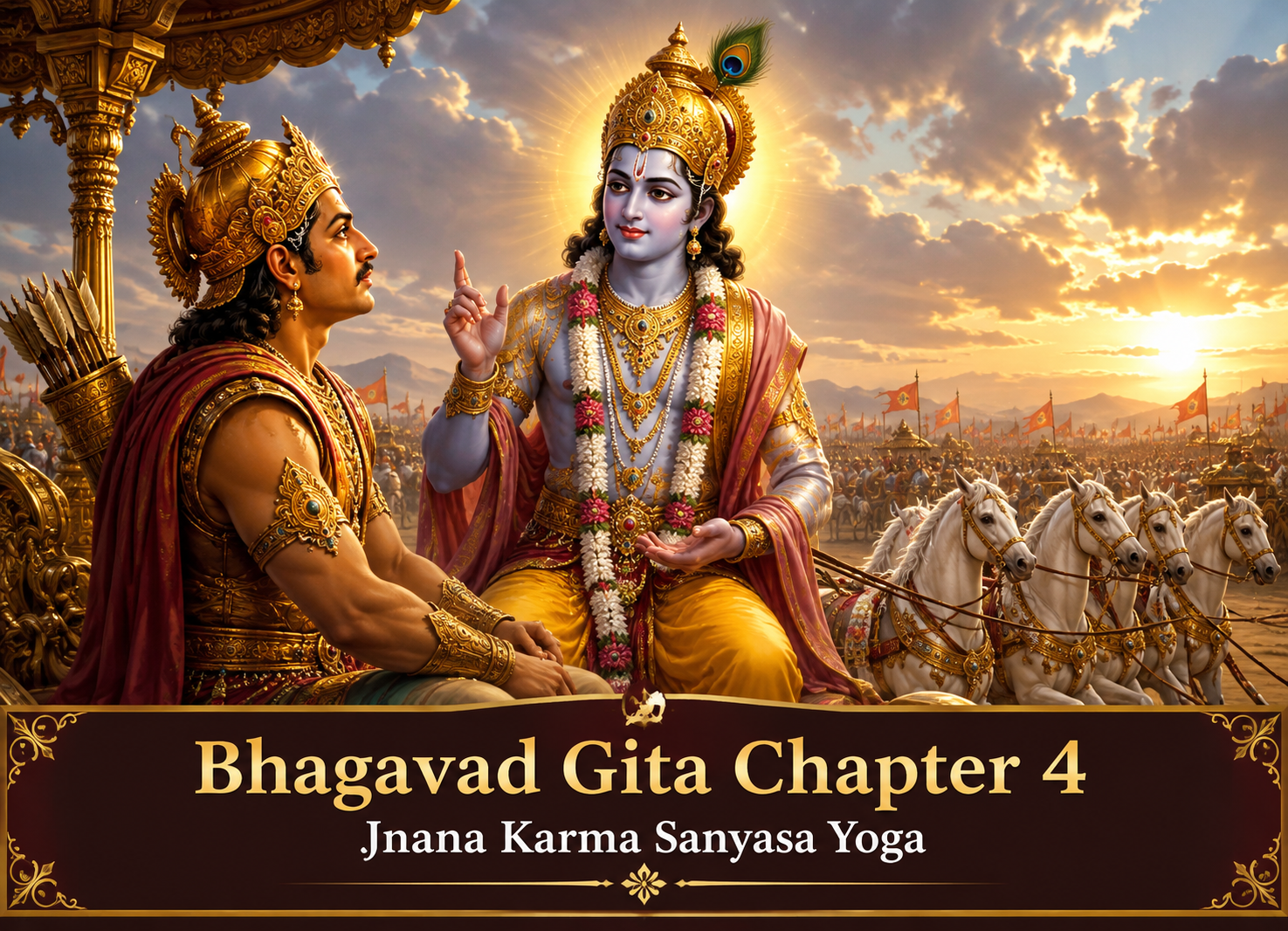
The Bhagavad Gita Chapter 4, traditionally known as Jnana Karma Sanyasa Yoga, is one of the most profound chapters of the Bhagavad Gita. It contains 42 verses and develops the teachings that Lord Krishna began explaining in the earlier chapters. The chapter connects spiritual knowledge, selfless action, devotion, dharma, divine incarnation, sacrifice, and liberation into one coherent spiritual vision.
The Sanskrit title Jnana Karma Sanyasa Yoga can be understood as the Yoga of Knowledge and Renunciation of Action. Krishna does not tell Arjuna simply to stop acting. Instead, He teaches him how action can become a spiritual discipline when it is performed without selfish attachment to its results.
Chapter 4 also contains some of the Bhagavad Gita’s best-known teachings. Krishna explains the ancient origin of Yoga, the importance of guru-parampara, the reason for His divine manifestations, the meaning of His birth and actions, the different forms of yajna, the superiority of knowledge, and the way spiritual wisdom destroys doubt and karmic bondage.
Among the most famous verses are:
यदा यदा हि धर्मस्य ग्लानिर्भवति भारत ।
yadā yadā hi dharmasya glānir bhavati bhārata
and
परित्राणाय साधूनां विनाशाय च दुष्कृताम् ।
paritrāṇāya sādhūnāṃ vināśāya ca duṣkṛtām
These verses explain Krishna’s divine manifestation for the protection of righteousness and restoration of dharma.
Another celebrated teaching appears in verse 4.7, where Krishna says that whenever dharma declines and adharma rises, He manifests Himself. Verse 4.8 then describes the purposes of such divine manifestation.
Chapter 4 therefore moves beyond the immediate battlefield situation. Arjuna‘s confusion becomes the starting point for a much larger discussion about the nature of God, human action, knowledge, spiritual discipline, and liberation.
This article presents all 42 verses of Bhagavad Gita Chapter 4, with the original Sanskrit, English transliteration, and a short, easy-to-understand explanation of each verse. The Sanskrit and verse sequence have been checked against established online editions of the chapter.
What Is Bhagavad Gita Chapter 4 About?
Bhagavad Gita Chapter 4 is called Jnana Karma Sanyasa Yoga.
The central idea is that right knowledge transforms action.
A person who acts only for personal gain becomes attached to results. That attachment creates anxiety, disappointment, pride, fear, and further bondage. Krishna teaches a different approach. One should perform one’s duty sincerely while understanding that the deeper Self is not the temporary body and that the ultimate reality is beyond the changing results of worldly action.
The chapter can be broadly divided into several themes:
- The ancient origin of Yoga
- The importance of spiritual succession
- Krishna’s divine nature
- The mystery of divine incarnation
- Dharma and the restoration of righteousness
- Freedom from attachment and fear
- Different approaches to spiritual practice
- The meaning of karma, akarma, and vikarma
- Action performed without selfish desire
- The many forms of yajna
- The superiority of knowledge
- The importance of approaching a genuine teacher
- The power of knowledge to destroy ignorance
- Faith, self-control, and peace
- The destruction of doubt through spiritual wisdom
These themes make Chapter 4 especially important for anyone interested in understanding Karma Yoga and Jnana Yoga together.
The Ancient Yoga Tradition
Krishna begins by telling Arjuna that the Yoga He is teaching is not a newly invented philosophy.
He says that He taught this imperishable Yoga to Vivasvan, associated with the Sun, who taught it to Manu, and Manu taught it to Ikshvaku. The teaching was then preserved through a succession of enlightened royal sages.
This idea is expressed through the concept of parampara, or a continuous tradition of spiritual teaching.
Krishna also explains that, over a long period of time, this teaching became lost. Therefore, He is again revealing it to Arjuna.
This has an important symbolic meaning. Spiritual knowledge may be ancient, but it must be continually understood, practiced, and transmitted. A teaching can become forgotten when people lose sight of its original purpose.
Bhagavad Gita Chapter 4 — All 42 Verses
Verse 4.1 — The Ancient Yoga
Sanskrit
श्रीभगवानुवाच ।
इमं विवस्वते योगं प्रोक्तवानहमव्ययम् ।
विवस्वान्मनवे प्राह मनुरिक्ष्वाकवेऽब्रवीत् ॥ ४.१ ॥
English Transliteration
śrī-bhagavān uvāca
imaṃ vivasvate yogaṃ proktavān aham avyayam
vivasvān manave prāha manur ikṣvākave ‘bravīt
Short Explanation
Lord Krishna says that He originally taught this imperishable Yoga to Vivasvan, the Sun deity. Vivasvan taught it to Manu, and Manu taught it to Ikshvaku.
The verse establishes that the spiritual knowledge Krishna gives Arjuna belongs to an ancient tradition. It is presented not as a temporary philosophy but as timeless spiritual wisdom.
Verse 4.2 — The Teaching Passed Through Tradition
Sanskrit
एवं परम्पराप्राप्तमिमं राजर्षयो विदुः ।
स कालेनेह महता योगो नष्टः परन्तप ॥ ४.२ ॥
English Transliteration
evaṃ paramparā-prāptam imaṃ rājarṣayo viduḥ
sa kāleneha mahatā yogo naṣṭaḥ parantapa
Short Explanation
The royal sages understood this Yoga through a proper succession of teachers. But over the passage of time, the teaching became lost.
Krishna highlights the importance of preserving genuine spiritual knowledge. Wisdom may remain in scriptures, but it can lose its living meaning if people stop practicing and understanding it correctly.
Verse 4.3 — Krishna Reveals the Ancient Secret to Arjuna
Sanskrit
स एवायं मया तेऽद्य योगः प्रोक्तः पुरातनः ।
भक्तोऽसि मे सखा चेति रहस्यं ह्येतदुत्तमम् ॥ ४.३ ॥
English Transliteration
sa evāyaṃ mayā te ‘dya yogaḥ proktaḥ purātanaḥ
bhakto ‘si me sakhā ceti rahasyaṃ hy etad uttamam
Short Explanation
Krishna says that the same ancient Yoga is now being taught to Arjuna because Arjuna is His devotee and friend.
The verse emphasizes that spiritual knowledge is not merely intellectual information. It becomes meaningful when received with trust, sincerity, devotion, and willingness to practice.
Krishna’s Divine Nature
Verse 4.4 — Arjuna’s Question
Sanskrit
अर्जुन उवाच ।
अपरं भवतो जन्म परं जन्म विवस्वतः ।
कथमेतद्विजानीयां त्वमादौ प्रोक्तवानिति ॥ ४.४ ॥
English Transliteration
arjuna uvāca
aparaṃ bhavato janma paraṃ janma vivasvataḥ
katham etad vijānīyāṃ tvam ādau proktavān iti
Short Explanation
Arjuna asks a natural question. Krishna’s present birth appears to be later than the birth of Vivasvan. How, then, could Krishna have taught this Yoga to Vivasvan in ancient times?
Arjuna’s question gives Krishna an opportunity to reveal the mystery of His divine nature.
Verse 4.5 — Krishna Remembers All Births
Sanskrit
श्रीभगवानुवाच ।
बहूनि मे व्यतीतानि जन्मानि तव चार्जुन ।
तान्यहं वेद सर्वाणि न त्वं वेत्थ परन्तप ॥ ४.५ ॥
English Transliteration
śrī-bhagavān uvāca
bahūni me vyatītāni janmāni tava cārjuna
tāny ahaṃ veda sarvāṇi na tvaṃ vettha parantapa
Short Explanation
Krishna says that both He and Arjuna have passed through many births. Krishna remembers them all, whereas Arjuna does not.
The verse introduces a major distinction between ordinary embodied beings and the divine consciousness described by Krishna. Human beings are limited by ordinary memory, while Krishna describes His awareness as extending beyond a single lifetime.
Verse 4.6 — The Divine Appears Through Its Own Power
Sanskrit
अजोऽपि सन्नव्ययात्मा भूतानामीश्वरोऽपि सन् ।
प्रकृतिं स्वामधिष्ठाय सम्भवाम्यात्ममायया ॥ ४.६ ॥
English Transliteration
ajo ‘pi sann avyayātmā bhūtānām īśvaro ‘pi san
prakṛtiṃ svām adhiṣṭhāya sambhavāmy ātma-māyayā
Short Explanation
Krishna explains that although He is unborn and imperishable and is the Lord of beings, He manifests Himself through His own divine power.
This verse is central to the Hindu understanding of avatar. Krishna’s manifestation is presented as different from an ordinary birth governed by ignorance and karma.
The Divine Purpose of Incarnation
Verse 4.7 — Whenever Dharma Declines
Sanskrit
यदा यदा हि धर्मस्य ग्लानिर्भवति भारत ।
अभ्युत्थानमधर्मस्य तदात्मानं सृजाम्यहम् ॥ ४.७ ॥
English Transliteration
yadā yadā hi dharmasya glānir bhavati bhārata
abhyutthānam adharmasya tadātmānaṃ sṛjāmy aham
Short Explanation
Whenever dharma declines and adharma rises, Krishna says that He manifests Himself.
This is one of the most famous teachings of the Bhagavad Gita. Dharma here is much broader than simply religious ritual. It includes righteousness, moral order, duty, justice, and the principles that sustain harmony.
Verse 4.8 — Protection of Dharma
Sanskrit
परित्राणाय साधूनां विनाशाय च दुष्कृताम् ।
धर्मसंस्थापनार्थाय सम्भवामि युगे युगे ॥ ४.८ ॥
English Transliteration
paritrāṇāya sādhūnāṃ vināśāya ca duṣkṛtām
dharma-saṃsthāpanārthāya sambhavāmi yuge yuge
Short Explanation
Krishna explains three purposes of His divine manifestation: protecting the righteous, overcoming destructive forces, and restoring dharma.
The phrase yuge yuge, meaning “age after age,” expresses the recurring nature of divine intervention in the traditional Hindu understanding.
Verse 4.9 — Knowing the Divine Birth and Actions
Sanskrit
जन्म कर्म च मे दिव्यमेवं यो वेत्ति तत्त्वतः ।
त्यक्त्वा देहं पुनर्जन्म नैति मामेति सोऽर्जुन ॥ ४.९ ॥
English Transliteration
janma karma ca me divyam evaṃ yo vetti tattvataḥ
tyaktvā dehaṃ punar janma naiti mām eti so ‘rjuna
Short Explanation
One who understands the divine nature of Krishna’s birth and actions in truth becomes free from ordinary rebirth and reaches Krishna.
The important word is tattvataḥ, meaning “in truth” or “in reality.” Krishna is not merely asking Arjuna to know a historical story. He is asking him to understand the spiritual meaning of divine manifestation.
Verse 4.10 — Freedom from Attachment, Fear, and Anger
Sanskrit
वीतरागभयक्रोधा मन्मया मामुपाश्रिताः ।
बहवो ज्ञानतपसा पूता मद्भावमागताः ॥ ४.१० ॥
English Transliteration
vīta-rāga-bhaya-krodhā man-mayā mām upāśritāḥ
bahavo jñāna-tapasā pūtā mad-bhāvam āgatāḥ
Short Explanation
Many people have reached the divine state by becoming free from attachment, fear, and anger, taking refuge in Krishna and being purified through knowledge and spiritual discipline.
This verse presents an important psychological teaching. Attachment, fear, and anger often reinforce one another. Spiritual wisdom gradually weakens their hold.
Verse 4.11 — Krishna Responds to Different Approaches
Sanskrit
ये यथा मां प्रपद्यन्ते तांस्तथैव भजाम्यहम् ।
मम वर्त्मानुवर्तन्ते मनुष्याः पार्थ सर्वशः ॥ ४.११ ॥
English Transliteration
ye yathā māṃ prapadyante tāṃs tathaiva bhajāmy aham
mama vartmānuvartante manuṣyāḥ pārtha sarvaśaḥ
Short Explanation
Krishna says that people approach Him in different ways, and He responds accordingly. All people ultimately move along paths connected with Him.
The verse is often understood as expressing the broad spiritual inclusiveness of the Gita. People may approach the Divine through different attitudes and disciplines.
Verse 4.12 — Desire for the Fruits of Action
Sanskrit
काङ्क्षन्तः कर्मणां सिद्धिं यजन्त इह देवताः ।
क्षिप्रं हि मानुषे लोके सिद्धिर्भवति कर्मजा ॥ ४.१२ ॥
English Transliteration
kāṅkṣantaḥ karmaṇāṃ siddhiṃ yajanta iha devatāḥ
kṣipraṃ hi mānuṣe loke siddhir bhavati karma-jā
Short Explanation
Those who desire quick results from their actions may worship particular divine powers associated with those results. Krishna points out that worldly success can be pursued through desire-driven action, but such success remains connected with the temporary world.
The deeper teaching of the Gita is to move beyond attachment to immediate rewards.
Karma and the Social Order
Verse 4.13 — The Fourfold Social Order
Sanskrit
चातुर्वर्ण्यं मया सृष्टं गुणकर्मविभागशः ।
तस्य कर्तारमपि मां विद्ध्यकर्तारमव्ययम् ॥ ४.१३ ॥
English Transliteration
cātur-varṇyaṃ mayā sṛṣṭaṃ guṇa-karma-vibhāgaśaḥ
tasya kartāram api māṃ viddhy akartāram avyayam
Short Explanation
Krishna describes the fourfold social order as based on guna and karma—qualities and actions. At the same time, He says that although He is described as its creator, He remains untouched by action.
This verse has been interpreted in many ways throughout Hindu philosophical history. The important point within the chapter is that Krishna connects social function with qualities and duties while emphasizing that the Divine is not bound by the actions it establishes.
Verse 4.14 — Krishna Is Not Bound by Karma
Sanskrit
न मां कर्माणि लिम्पन्ति न मे कर्मफले स्पृहा ।
इति मां योऽभिजानाति कर्मभिर्न स बध्यते ॥ ४.१४ ॥
English Transliteration
na māṃ karmāṇi limpanti na me karma-phale spṛhā
iti māṃ yo ‘bhijānāti karmabhir na sa badhyate
Short Explanation
Krishna says that actions do not bind Him because He has no selfish desire for their fruits.
This is a key principle of Karma Yoga. Action itself is not necessarily the source of bondage. Attachment to personal results is what creates bondage.
Verse 4.15 — The Wise Act Without Attachment
Sanskrit
एवं ज्ञात्वा कृतं कर्म पूर्वैरपि मुमुक्षुभिः ।
कुरु कर्मैव तस्मात्त्वं पूर्वैः पूर्वतरं कृतम् ॥ ४.१५ ॥
English Transliteration
evaṃ jñātvā kṛtaṃ karma pūrvair api mumukṣubhiḥ
kuru karmaiva tasmāt tvaṃ pūrvaiḥ pūrvataraṃ kṛtam
Short Explanation
Knowing this truth, seekers of liberation in ancient times continued to perform action. Krishna therefore tells Arjuna to act as the wise people of the past acted.
Spirituality does not require escaping every responsibility. Instead, one can transform ordinary responsibility into a spiritual practice.
Understanding Karma, Akarma, and Vikarma
Verse 4.16 — What Is Action?
Sanskrit
किं कर्म किमकर्मेति कवयोऽप्यत्र मोहिताः ।
तत्ते कर्म प्रवक्ष्यामि यज्ज्ञात्वा मोक्ष्यसेऽशुभात् ॥ ४.१६ ॥
English Transliteration
kiṃ karma kim akarmeti kavayo ‘py atra mohitāḥ
tat te karma pravakṣyāmi yaj jñātvā mokṣyase ‘śubhāt
Short Explanation
Even wise people can become confused about what truly constitutes action and non-action. Krishna therefore promises to explain karma so that Arjuna can become free from harmful consequences.
The verse reminds us that spiritual action cannot be judged merely by outward appearance.
Verse 4.17 — Karma, Akarma, and Vikarma
Sanskrit
कर्मणो ह्यपि बोद्धव्यं बोद्धव्यं च विकर्मणः ।
अकर्मणश्च बोद्धव्यं गहना कर्मणो गतिः ॥ ४.१७ ॥
English Transliteration
karmaṇo hy api boddhavyaṃ boddhavyaṃ ca vikarmaṇaḥ
akarmaṇaś ca boddhavyaṃ gahanā karmaṇo gatiḥ
Short Explanation
One must understand karma, vikarma, and akarma, because the nature of action is difficult to understand.
Karma generally refers to appropriate action, vikarma to improper or harmful action, and akarma to non-action. Krishna is preparing Arjuna to understand that spiritual action involves intention, consciousness, duty, and attachment—not merely physical movement.
Verse 4.18 — Seeing Action in Inaction
Sanskrit
कर्मण्यकर्म यः पश्येदकर्मणि च कर्म यः ।
स बुद्धिमान्मनुष्येषु स युक्तः कृत्स्नकर्मकृत् ॥ ४.१८ ॥
English Transliteration
karmaṇy akarma yaḥ paśyed akarmaṇi ca karma yaḥ
sa buddhimān manuṣyeṣu sa yuktaḥ kṛtsna-karma-kṛt
Short Explanation
The wise person can see “inaction in action” and “action in inaction.”
This famous paradox points to inner freedom. A person may perform many outward actions while remaining inwardly unattached. Another person may appear inactive while the mind remains filled with desire and restless thought.
True Karma Yoga concerns the state of consciousness behind action.
The Qualities of a Wise Worker
Verse 4.19 — Actions Without Selfish Desire
Sanskrit
यस्य सर्वे समारम्भाः कामसङ्कल्पवर्जिताः ।
ज्ञानाग्निदग्धकर्माणं तमाहुः पण्डितं बुधाः ॥ ४.१९ ॥
English Transliteration
yasya sarve samārambhāḥ kāma-saṅkalpa-varjitāḥ
jñānāgni-dagdha-karmāṇaṃ tam āhuḥ paṇḍitaṃ budhāḥ
Short Explanation
The wise call a person learned whose actions are free from selfish desire and whose karma has been burned by the fire of knowledge.
Knowledge changes the motive behind action. The person still acts, but action is no longer centered on personal craving.
Verse 4.20 — Freedom from Attachment to Results
Sanskrit
त्यक्त्वा कर्मफलासङ्गं नित्यतृप्तो निराश्रयः ।
कर्मण्यभिप्रवृत्तोऽपि नैव किञ्चित्करोति सः ॥ ४.२० ॥
English Transliteration
tyaktvā karma-phalāsaṅgaṃ nitya-tṛpto nirāśrayaḥ
karmaṇy abhipravṛtto ‘pi naiva kiñcit karoti saḥ
Short Explanation
The spiritually free person gives up attachment to the results of action and remains inwardly content. Even while acting, such a person is not bound by action.
This does not mean refusing to care about one’s responsibilities. It means performing them without allowing personal reward to become the center of one’s life.
Verse 4.21 — Simplicity and Self-Control
Sanskrit
निराशीर्यतचित्तात्मा त्यक्तसर्वपरिग्रहः ।
शारीरं केवलं कर्म कुर्वन्नाप्नोति किल्बिषम् ॥ ४.२१ ॥
English Transliteration
nirāśīr yata-cittātmā tyakta-sarva-parigrahaḥ
śārīraṃ kevalaṃ karma kurvan nāpnoti kilbiṣam
Short Explanation
A person who controls the mind and gives up possessiveness, acting only as required, is not bound by sinful consequences.
The verse encourages moderation and freedom from excessive possessiveness.
Verse 4.22 — Contentment
Sanskrit
यदृच्छालाभसन्तुष्टो द्वन्द्वातीतो विमत्सरः ।
समः सिद्धावसिद्धौ च कृत्वापि न निबध्यते ॥ ४.२२ ॥
English Transliteration
yadṛcchā-lābha-santuṣṭo dvandvātīto vimatsaraḥ
samaḥ siddhāv asiddhau ca kṛtvāpi na nibadhyate
Short Explanation
The wise person remains content with what comes naturally, rises above opposing experiences, avoids envy, and remains balanced in success and failure.
This is one of the most practical lessons of Karma Yoga. A person cannot control every result, but can work toward maintaining an even and disciplined mind.
Verse 4.23 — Action Becomes Liberating
Sanskrit
गतसङ्गस्य मुक्तस्य ज्ञानावस्थितचेतसः ।
यज्ञायाचरतः कर्म समग्रं प्रविलीयते ॥ ४.२३ ॥
English Transliteration
gata-saṅgasya muktasya jñānāvasthita-cetasaḥ
yajñāyācarataḥ karma samagraṃ pravilīyate
Short Explanation
When attachment disappears and consciousness becomes established in knowledge, action performed as sacrifice no longer creates bondage.
The idea of yajna is broadened here. It means dedicating one’s work to something higher rather than treating every action as a means of personal gain.
The Vision of Brahman in Yajna
Verse 4.24 — Everything Is Brahman
Sanskrit
ब्रह्मार्पणं ब्रह्म हविर्ब्रह्माग्नौ ब्रह्मणा हुतम् ।
ब्रह्मैव तेन गन्तव्यं ब्रह्मकर्मसमाधिना ॥ ४.२४ ॥
English Transliteration
brahmārpaṇaṃ brahma havir brahmāgnau brahmaṇā hutam
brahmaiva tena gantavyaṃ brahma-karma-samādhinā
Short Explanation
This is one of the most philosophically profound verses of the chapter.
The offering is Brahman, the oblation is Brahman, the fire is Brahman, and the one making the offering is also connected with Brahman. The person whose consciousness is absorbed in Brahman ultimately reaches Brahman.
The verse presents a vision in which the apparent divisions between worshipper, offering, action, and Divine reality are overcome.
Different Forms of Yajna
Verse 4.25 — Different Forms of Spiritual Sacrifice
Sanskrit
दैवमेवापरे यज्ञं योगिनः पर्युपासते ।
ब्रह्माग्नावपरे यज्ञं यज्ञेनैवोपजुह्वति ॥ ४.२५ ॥
English Transliteration
daivam evāpare yajñaṃ yoginaḥ paryupāsate
brahmāgnāv apare yajñaṃ yajñenaivopajuhvati
Short Explanation
Some practitioners worship through offerings to divine powers, while others offer the act of sacrifice itself into the fire of Brahman.
Krishna begins describing several forms of spiritual discipline. The outer practices may differ, but the inner principle is dedication.
Verse 4.26 — Sense Control as Sacrifice
Sanskrit
श्रोत्रादीनीन्द्रियाण्यन्ये संयमाग्निषु जुह्वति ।
शब्दादीन्विषयानन्य इन्द्रियाग्निषु जुह्वति ॥ ४.२६ ॥
English Transliteration
śrotrādīnīndriyāṇy anye saṃyamāgniṣu juhvati
śabdādīn viṣayān anya indriyāgniṣu juhvati
Short Explanation
Some practitioners offer their senses into the fire of restraint. Others offer the objects of the senses into the disciplined activity of the senses.
The basic idea is mastery. Instead of allowing the senses to control the mind, spiritual practice brings them under conscious direction.
Verse 4.27 — Offering All Actions to Self-Control
Sanskrit
सर्वाणीन्द्रियकर्माणि प्राणकर्माणि चापरे ।
आत्मसंयमयोगाग्नौ जुह्वति ज्ञानदीपिते ॥ ४.२७ ॥
English Transliteration
sarvāṇīndriya-karmāṇi prāṇa-karmāṇi cāpare
ātma-saṃyama-yogāgnau juhvati jñāna-dīpite
Short Explanation
Other practitioners offer the functions of the senses and vital energies into the fire of self-control, which is illuminated by knowledge.
The verse teaches that spiritual discipline involves the whole person—body, senses, mind, and vital energies.
Verse 4.28 — Charity, Discipline, Knowledge, and Yoga
Sanskrit
द्रव्ययज्ञास्तपोयज्ञा योगयज्ञास्तथापरे ।
स्वाध्यायज्ञानयज्ञाश्च यतयः संशितव्रताः ॥ ४.२८ ॥
English Transliteration
dravya-yajñās tapo-yajñā yoga-yajñās tathāpare
svādhyāya-jñāna-yajñāś ca yatayaḥ saṃśita-vratāḥ
Short Explanation
Some practice sacrifice through charity and material offerings. Others practice austerity, Yoga, self-study, or the cultivation of knowledge.
Krishna shows that spiritual life can take many forms. Sincere discipline can itself become a sacred offering.
Verse 4.29 — Regulation of the Breath
Sanskrit
अपाने जुह्वति प्राणं प्राणेऽपानं तथापरे ।
प्राणापानगती रुद्ध्वा प्राणायामपरायणाः ॥ ४.२९ ॥
English Transliteration
apāne juhvati prāṇaṃ prāṇe ‘pānaṃ tathāpare
prāṇāpāna-gatī ruddhvā prāṇāyāma-parāyaṇāḥ
Short Explanation
Krishna describes practitioners who discipline the movement of the vital energies through regulated breathing practices.
The larger teaching is about conscious discipline. Breath regulation is presented as one form of spiritual practice among many.
Verse 4.30 — Discipline of Food and Life
Sanskrit
अपरे नियताहाराः प्राणान्प्राणेषु जुह्वति ।
सर्वेऽप्येते यज्ञविदो यज्ञक्षपितकल्मषाः ॥ ४.३० ॥
English Transliteration
apare niyatāhārāḥ prāṇān prāṇeṣu juhvati
sarve ‘py ete yajña-vido yajña-kṣapita-kalmaṣāḥ
Short Explanation
Others practice moderation in food and discipline of the vital forces. Krishna says that all these practitioners understand yajna and become purified through their dedicated practices.
The verse emphasizes balanced discipline rather than uncontrolled indulgence.
Verse 4.31 — The Sacred Remains of Yajna
Sanskrit
यज्ञशिष्टामृतभुजो यान्ति ब्रह्म सनातनम् ।
नायं लोकोऽस्त्ययज्ञस्य कुतोऽन्यः कुरुसत्तम ॥ ४.३१ ॥
English Transliteration
yajña-śiṣṭāmṛta-bhujo yānti brahma sanātanam
nāyaṃ loko ‘sty ayajñasya kuto ‘nyaḥ kuru-sattama
Short Explanation
Those who partake of what remains after sacrifice attain the eternal Brahman. Krishna then says that even worldly life cannot properly flourish without the spirit of yajna, much less the highest spiritual state.
Yajna represents generosity, gratitude, responsibility, and dedication to something greater than oneself.
Verse 4.32 — Many Forms of Yajna
Sanskrit
एवं बहुविधा यज्ञा वितता ब्रह्मणो मुखे ।
कर्मजान्विद्धि तान्सर्वानेवं ज्ञात्वा विमोक्ष्यसे ॥ ४.३२ ॥
English Transliteration
evaṃ bahu-vidhā yajñā vitatā brahmaṇo mukhe
karma-jān viddhi tān sarvān evaṃ jñātvā vimokṣyase
Short Explanation
Krishna says that many different forms of yajna have been described. All arise from action and discipline. Understanding their true nature leads toward liberation.
The verse prepares the transition from ritual and discipline to the higher role of knowledge.
Knowledge Is the Highest Sacrifice
Verse 4.33 — The Sacrifice of Knowledge
Sanskrit
श्रेयान्द्रव्यमयाद्यज्ञाज्ज्ञानयज्ञः परन्तप ।
सर्वं कर्माखिलं पार्थ ज्ञाने परिसमाप्यते ॥ ४.३३ ॥
English Transliteration
śreyān dravya-mayād yajñāj jñāna-yajñaḥ parantapa
sarvaṃ karmākhilaṃ pārtha jñāne parisamāpyate
Short Explanation
Krishna declares the sacrifice of knowledge to be higher than sacrifices involving material offerings. Ultimately, all action culminates in knowledge.
This does not make charitable or ritual action meaningless. Rather, Krishna points toward the deeper purpose of action: awakening understanding.
Verse 4.34 — Approach a Wise Teacher
Sanskrit
तद्विद्धि प्रणिपातेन परिप्रश्नेन सेवया ।
उपदेक्ष्यन्ति ते ज्ञानं ज्ञानिनस्तत्त्वदर्शिनः ॥ ४.३४ ॥
English Transliteration
tad viddhi praṇipātena paripraśnena sevayā
upadekṣyanti te jñānaṃ jñāninas tattva-darśinaḥ
Short Explanation
Krishna advises Arjuna to approach those who truly know the truth with humility, sincere questions, and service.
This verse is often cited in discussions about the guru-disciple relationship. It does not encourage blind obedience. The inclusion of paripraśna, sincere questioning, shows that genuine learning includes thoughtful inquiry.
Verse 4.35 — Knowledge Removes Delusion
Sanskrit
यज्ज्ञात्वा न पुनर्मोहमेवं यास्यसि पाण्डव ।
येन भूतान्यशेषाणि द्रक्ष्यस्यात्मन्यथो मयि ॥ ४.३५ ॥
English Transliteration
yaj jñātvā na punar moham evaṃ yāsyasi pāṇḍava
yena bhūtāny aśeṣāṇi drakṣyasy ātmany atho mayi
Short Explanation
After gaining this knowledge, Arjuna will no longer fall into the same delusion. He will see all beings in the Self and then in Krishna.
Spiritual knowledge changes one’s vision. Instead of seeing existence only through separate identities, one begins to recognize a deeper unity.
Verse 4.36 — Knowledge Can Cross the Ocean of Error
Sanskrit
अपि चेदसि पापेभ्यः सर्वेभ्यः पापकृत्तमः ।
सर्वं ज्ञानप्लवेनैव वृजिनं सन्तरिष्यसि ॥ ४.३६ ॥
English Transliteration
api ced asi pāpebhyaḥ sarvebhyaḥ pāpa-kṛt-tamaḥ
sarvaṃ jñāna-plavenaiva vṛjinaṃ santariṣyasi
Short Explanation
Even if a person has made serious mistakes, Krishna says that the boat of knowledge can carry that person across the ocean of wrongdoing.
The verse emphasizes transformation rather than permanent condemnation. Genuine knowledge can lead a person away from ignorance and destructive patterns.
Verse 4.37 — Knowledge Burns Karma
Sanskrit
यथैधांसि समिद्धोऽग्निर्भस्मसात्कुरुतेऽर्जुन ।
ज्ञानाग्निः सर्वकर्माणि भस्मसात्कुरुते तथा ॥ ४.३७ ॥
English Transliteration
yathaidhāṃsi samiddho ‘gnir bhasmasāt kurute ‘rjuna
jñānāgniḥ sarva-karmāṇi bhasmasāt kurute tathā
Short Explanation
Just as fire turns fuel into ashes, Krishna says that the fire of knowledge destroys the binding effects of karma.
Knowledge does not simply provide information. In the Gita’s spiritual vision, genuine knowledge transforms the person who possesses it.
Verse 4.38 — Nothing Is More Purifying Than Knowledge
Sanskrit
न हि ज्ञानेन सदृशं पवित्रमिह विद्यते ।
तत्स्वयं योगसंसिद्धः कालेनात्मनि विन्दति ॥ ४.३८ ॥
English Transliteration
na hi jñānena sadṛśaṃ pavitram iha vidyate
tat svayaṃ yoga-saṃsiddhaḥ kālenātmani vindati
Short Explanation
Krishna says that nothing in this world is as purifying as knowledge. A person perfected through Yoga gradually discovers this knowledge within.
The verse teaches that spiritual wisdom cannot be rushed. Practice gradually prepares the mind to recognize deeper truth.
Verse 4.39 — Faith, Discipline, and Knowledge
Sanskrit
श्रद्धावाँल्लभते ज्ञानं तत्परः संयतेन्द्रियः ।
ज्ञानं लब्ध्वा परां शान्तिमचिरेणाधिगच्छति ॥ ४.३९ ॥
English Transliteration
śraddhāvān labhate jñānaṃ tat-paraḥ saṃyatendriyaḥ
jñānaṃ labdhvā parāṃ śāntim acireṇādhigacchati
Short Explanation
A person who has faith, sincere dedication, and controlled senses gains knowledge. Having gained knowledge, that person attains supreme peace.
Three qualities are especially important here: śraddhā, sincere faith; dedication, and self-control.
Knowledge develops when the mind is willing to learn and capable of remaining focused.
Verse 4.40 — The Danger of Doubt
Sanskrit
अज्ञश्चाश्रद्दधानश्च संशयात्मा विनश्यति ।
नायं लोकोऽस्ति न परो न सुखं संशयात्मनः ॥ ४.४० ॥
English Transliteration
ajñaś cāśraddadhānaś ca saṃśayātmā vinaśyati
nāyaṃ loko ‘sti na paro na sukhaṃ saṃśayātmanaḥ
Short Explanation
Krishna warns that ignorance, lack of faith, and destructive doubt can prevent a person from finding peace.
This does not mean that thoughtful questioning is wrong. Earlier, Krishna specifically encouraged sincere questioning. The problem here is paralyzing doubt that prevents a person from committing to any path of learning or practice.
Knowledge Frees the Individual
Verse 4.41 — The Yogi Becomes Free
Sanskrit
योगसंन्यस्तकर्माणं ज्ञानसञ्छिन्नसंशयम् ।
आत्मवन्तं न कर्माणि निबध्नन्ति धनञ्जय ॥ ४.४१ ॥
English Transliteration
yoga-sannyasta-karmāṇaṃ jñāna-saṃchinna-saṃśayam
ātmavantaṃ na karmāṇi nibadhnanti dhanañjaya
Short Explanation
One who has offered actions through Yoga, whose doubts have been cut away by knowledge, and who is established in the Self is no longer bound by karma.
This verse brings together the chapter’s two major themes: Yoga of action and Yoga of knowledge.
Verse 4.42 — Destroy Doubt With the Sword of Knowledge
Sanskrit
तस्मादज्ञानसम्भूतं हृत्स्थं ज्ञानासिनात्मनः ।
छित्त्वैनं संशयं योगमातिष्ठोत्तिष्ठ भारत ॥ ४.४२ ॥
English Transliteration
tasmād ajñāna-sambhūtaṃ hṛt-sthaṃ jñānāsinātmanaḥ
chittvainaṃ saṃśayaṃ yogam ātiṣṭhottiṣṭha bhārata
Short Explanation
Krishna concludes the chapter by telling Arjuna to destroy the doubt born from ignorance with the sword of knowledge and then rise and practice Yoga.
The ending is powerful. Krishna does not tell Arjuna to remain lost in philosophical discussion. Knowledge must lead to right action.
Major Teachings of Bhagavad Gita Chapter 4
1. Spiritual Knowledge Is Ancient
Krishna presents Yoga as an ancient spiritual teaching that has been transmitted through generations.
The reference to Vivasvan, Manu, and Ikshvaku establishes a long chain of transmission. The concept of parampara highlights the importance of preserving teachings through responsible teachers and sincere students.
For modern readers, this has a useful lesson: important knowledge should not be accepted or rejected casually. It should be studied carefully, understood in context, and practiced intelligently.
2. Dharma Must Be Protected
Verses 4.7 and 4.8 form the heart of Krishna’s teaching on divine incarnation.
When dharma declines, Krishna says that He manifests Himself. The purpose is connected with protecting righteousness and restoring balance.
The concept of dharma can be understood at several levels. It may refer to personal responsibility, moral conduct, social responsibility, cosmic order, or the broader principle of living in harmony with truth.
Therefore, the teaching is not simply about punishment and reward. It is about the restoration of balance.
3. God Can Manifest in the World
Chapter 4 is particularly important for understanding the Hindu idea of avatar.
Krishna says that although He is unborn and imperishable, He manifests through His own divine power. This makes divine incarnation different from ordinary human birth.
In Hindu traditions, Krishna’s teaching here has been interpreted as a central explanation of why the Divine appears within the world.
4. Selfless Action Is the Heart of Karma Yoga
Krishna does not tell Arjuna to stop acting.
Arjuna is a warrior with a difficult duty. His problem is not simply that he must act. His problem is that he is emotionally overwhelmed by the consequences of action.
Krishna therefore changes the way Arjuna should understand action.
He should:
- Perform his duty.
- Avoid selfish attachment.
- Accept success and failure with balance.
- Offer action to a higher purpose.
- Develop spiritual knowledge.
- Avoid allowing results to control his mind.
This is Karma Yoga.
5. Knowledge and Action Are Not Enemies
One of the most important features of Chapter 4 is its integration of Jnana and Karma.
At first, knowledge and action can appear to be opposites.
Knowledge seems to require contemplation.
Action seems to require involvement in the world.
Krishna shows that they can support one another.
Knowledge transforms the attitude with which action is performed. Action performed selflessly purifies the mind and prepares it for deeper knowledge.
Thus, the chapter does not simply say “act” or “renounce.” It teaches inner renunciation while continuing to perform appropriate action.
What Does Jnana Karma Sanyasa Yoga Mean?
The Sanskrit title Jñāna Karma Sannyāsa Yoga contains several important concepts.
Jñāna
Jñāna means spiritual knowledge or wisdom.
It is not merely collecting information. It means understanding the nature of the Self, reality, action, and the Divine.
Karma
Karma means action. In the Gita, it also has a deeper meaning connected with action and its consequences.
Sannyasa
Sannyasa means renunciation.
In this chapter, renunciation is strongly connected with giving up attachment to the fruits of action.
Yoga
Yoga means union, integration, or spiritual discipline.
Together, the title points toward a path in which knowledge and renunciation transform action into a means of spiritual liberation.
The Meaning of Yajna in Chapter 4
Yajna is often translated as “sacrifice,” but Chapter 4 gives the concept a much broader meaning.
Krishna describes several kinds of yajna:
- Material offerings
- Worship
- Austerity
- Yoga
- Self-study
- Knowledge
- Sense control
- Breath discipline
- Regulated living
- Acts of dedication
The deeper idea is that something is being offered for a higher purpose.
A person’s work can become yajna.
Learning can become yajna.
Self-discipline can become yajna.
Charity can become yajna.
Knowledge can become yajna.
The transformation occurs when the individual stops treating every action as an instrument of personal gratification.
Why Is Knowledge Compared to Fire?
Krishna repeatedly uses the imagery of fire.
Fire consumes fuel.
In the same way, spiritual knowledge consumes ignorance and the binding effects of karma.
This does not mean that knowledge is merely intellectual. A person may know many philosophical ideas and still remain controlled by anger, greed, fear, pride, and attachment.
The knowledge Krishna describes is transformative.
It changes how a person understands:
- The Self
- The body
- The world
- Duty
- Action
- Success
- Failure
- Desire
- The Divine
- Liberation
Therefore, jñāna is not just information. It is a change in vision.
Karma, Akarma, and Vikarma Explained Simply
One of the most difficult parts of Chapter 4 is the distinction among karma, akarma, and vikarma.
Karma
Karma can refer to action performed according to one’s duty and circumstances.
Vikarma
Vikarma refers to action that goes against proper principles and produces harmful consequences.
Akarma
Akarma literally suggests non-action, but Krishna’s teaching is more subtle. A person may perform outward actions yet remain inwardly free from the binding mentality of action.
This is why verse 4.18 is so important.
The truly wise person understands that physical activity alone does not determine spiritual bondage.
The inner attitude matters.
The Importance of a Spiritual Teacher
Verse 4.34 is one of the best-known teachings about learning from a realized teacher.
Krishna gives three ideas:
Praṇipāta — humility
Paripraśna — sincere questioning
Sevā — service
These three together create a balanced approach to learning.
Humility prevents arrogance.
Questioning prevents blind acceptance.
Service cultivates respect and discipline.
A genuine spiritual learning relationship therefore requires both openness and intelligent inquiry.
Why Does Krishna Emphasize Faith?
Verse 4.39 says that the person endowed with śraddhā, dedication, and self-control gains knowledge and eventually reaches peace.
Faith in this context does not need to mean abandoning reason.
Rather, it can mean having enough trust in the spiritual path to practice it seriously.
For example, someone learning meditation cannot understand its benefits merely by reading about it. Practice is necessary.
Similarly, someone studying the Gita may understand its teachings more deeply by applying them to everyday life.
Faith therefore becomes meaningful when it is joined with:
- Study
- Practice
- Self-discipline
- Reflection
- Sincere questioning
The Relationship Between Doubt and Knowledge
Chapter 4 ends with a strong teaching about doubt.
There is a difference between healthy questioning and paralyzing doubt.
Healthy questioning seeks truth.
Paralyzing doubt refuses to move toward any conclusion or practice.
Krishna encourages Arjuna to ask questions. Arjuna does exactly that throughout the Gita.
But once understanding becomes clear, Arjuna must act.
This is why the final verse says to destroy the doubt born from ignorance with the sword of knowledge and then rise.
The message is practical:
Understand → Reflect → Remove confusion → Act rightly.
Practical Lessons From Bhagavad Gita Chapter 4
Chapter 4 is not only a philosophical text. Its teachings can be applied to ordinary life.
Do Your Work Without Becoming Obsessed With Results
People naturally care about success. But excessive attachment can create unnecessary anxiety.
The Gita encourages sincere effort without making the result the sole measure of one’s worth.
Learn Before Acting
Knowledge helps us understand consequences.
A person who acts without understanding can create problems for themselves and others.
Chapter 4 encourages combining action with wisdom.
Question With Sincerity
Arjuna asks difficult questions.
Krishna does not condemn him for asking.
This teaches that sincere questioning can be part of spiritual growth.
Practice Self-Control
The chapter repeatedly discusses controlling the senses, mind, desires, and habits.
Self-control does not mean suppressing every natural feeling. It means learning to direct one’s behavior rather than becoming controlled by every impulse.
Turn Work Into Service
Work becomes spiritually meaningful when it contributes to something beyond narrow personal gain.
This is the spirit of yajna.
Develop Inner Balance
Success and failure, praise and criticism, gain and loss can all disturb the mind.
Chapter 4 teaches the value of maintaining inner steadiness.
Bhagavad Gita Chapter 4 and Modern Life
The world described in the Gita is ancient, but many of its psychological questions remain familiar.
People still worry about success.
People still fear failure.
People still struggle with anger and attachment.
People still face difficult responsibilities.
People still search for meaning.
People still wonder whether material achievement alone can provide lasting satisfaction.
Chapter 4 responds to these problems by changing the focus from external achievement to inner orientation.
A person may not control every circumstance.
But a person can gradually develop control over:
- Intention
- Attention
- Effort
- Attitude
- Discipline
- Response to success
- Response to failure
This is where Karma Yoga becomes relevant to modern life.
Krishna’s Teaching on Divine Incarnation
The avatar teaching of verses 4.6–4.9 is one of the most important sections of Chapter 4.
Krishna describes Himself as unborn and imperishable while also appearing within the world.
Verses 4.7 and 4.8 then explain that divine manifestation occurs when dharma declines.
Verse 4.9 takes the teaching further. Understanding Krishna’s divine birth and action in truth leads beyond ordinary rebirth.
Together, these verses establish several major Hindu theological ideas:
The Divine is beyond ordinary birth.
The Divine can manifest within the world.
The Divine manifestation is connected with dharma.
Understanding the Divine transforms the spiritual destiny of the seeker.
Why Bhagavad Gita Chapter 4 Is Important
Chapter 4 acts as a bridge between several major teachings of the Bhagavad Gita.
Chapter 2 introduces the immortality of the Self and the importance of disciplined action.
Chapter 3 emphasizes Karma Yoga.
Chapter 4 deepens these ideas by introducing:
- Divine incarnation
- Spiritual knowledge
- The nature of action
- Yajna
- The teacher-student relationship
- The purifying power of knowledge
- Freedom from karmic bondage
This makes Chapter 4 one of the foundational chapters for understanding the whole Gita.
A Simple Summary of All 42 Verses
For quick reference:
4.1 — Krishna explains the ancient origin of Yoga.
4.2 — The teaching was preserved through succession but eventually became lost.
4.3 — Krishna teaches the ancient Yoga to Arjuna because Arjuna is His devotee and friend.
4.4 — Arjuna asks how Krishna could have taught this Yoga in ancient times.
4.5 — Krishna says He remembers many births, while Arjuna does not.
4.6 — Krishna explains His divine manifestation despite being unborn.
4.7 — Krishna manifests when dharma declines.
4.8 — He protects the righteous and restores dharma.
4.9 — Understanding Krishna’s divine birth and action leads toward liberation.
4.10 — Freedom from attachment, fear, and anger leads toward the Divine.
4.11 — Krishna responds according to how people approach Him.
4.12 — Desire-driven worship seeks quick worldly results.
4.13 — The fourfold social order is described in terms of qualities and actions.
4.14 — Krishna remains untouched by karma because He has no attachment to its fruits.
4.15 — Seekers of liberation in the past performed action with this understanding.
4.16 — Even wise people can be confused about action.
4.17 — Karma, vikarma, and akarma must all be understood.
4.18 — The wise see inaction in action and action in inaction.
4.19 — Actions performed without selfish desire are purified by knowledge.
4.20 — Giving up attachment to results leads to freedom.
4.21 — Self-control and freedom from possessiveness prevent bondage.
4.22 — Contentment and balance in success and failure characterize the wise.
4.23 — Detached action performed as yajna does not bind.
4.24 — In the highest vision, the offering, sacrifice, and performer are all understood through Brahman.
4.25 — Different practitioners perform different forms of yajna.
4.26 — Sense control can itself become a sacrifice.
4.27 — The functions of the senses and vital energies can be offered through self-discipline.
4.28 — Charity, austerity, Yoga, study, and knowledge are different forms of yajna.
4.29 — Breath discipline is another form of spiritual practice.
4.30 — Regulated living and disciplined practice purify the practitioner.
4.31 — Those who live through the spirit of yajna progress toward the eternal.
4.32 — Many forms of yajna lead toward liberation when properly understood.
4.33 — The sacrifice of knowledge is higher than material sacrifice.
4.34 — Spiritual knowledge should be approached through humility, sincere questions, and service.
4.35 — Knowledge removes delusion and reveals spiritual unity.
4.36 — Knowledge can carry a person beyond the effects of past wrongdoing.
4.37 — Knowledge burns karma like fire burns fuel.
4.38 — Nothing is as purifying as knowledge.
4.39 — Faith, dedication, and self-control lead to knowledge and peace.
4.40 — Ignorance and destructive doubt prevent spiritual progress.
4.41 — Knowledge and Yoga free a person from karmic bondage.
4.42 — Krishna tells Arjuna to destroy doubt with knowledge and rise to action.
The Central Message of Chapter 4
If the entire chapter were reduced to one central message, it could be expressed like this:
Act with wisdom, dedicate your actions to a higher purpose, give up selfish attachment to results, seek genuine knowledge, and allow that knowledge to remove ignorance and doubt.
Krishna does not tell Arjuna that spiritual life requires abandoning responsibility.
Instead, He teaches Arjuna to transform his relationship with responsibility.
Action becomes Yoga when it is performed without selfish attachment.
Knowledge becomes liberating when it changes the way one sees oneself and the world.
Devotion becomes powerful when it is combined with understanding.
Yajna becomes meaningful when it expresses dedication rather than mere external ritual.
Conclusion
Bhagavad Gita Chapter 4, Jnana Karma Sanyasa Yoga, is a profound exploration of the relationship between knowledge, action, renunciation, devotion, and liberation.
The chapter begins with Krishna revealing the ancient origin of Yoga. He explains how this wisdom was passed through generations and why He is now teaching it to Arjuna.
Krishna then reveals one of the central teachings of the Gita: the Divine manifests when dharma declines and adharma rises. Verses 4.7 and 4.8 have therefore become among the most recognizable verses in Hindu spiritual literature.
The chapter then returns to the problem of human action. Krishna explains that action itself does not necessarily create bondage. The deeper problem is selfish attachment to its fruits.
This is the heart of Karma Yoga.
A person can work, serve, study, lead, teach, create, and fulfill responsibilities while gradually becoming free from the ego-centered desire to possess the results.
Chapter 4 also teaches that knowledge is the great purifier. Knowledge burns ignorance just as fire burns fuel. When genuine wisdom arises, the person begins to understand the difference between the temporary and the eternal, between selfish action and selfless action, and between external activity and inner freedom.
The chapter’s teaching about yajna further expands the meaning of spiritual practice. Sacrifice is not limited to ritual offerings. Charity, discipline, study, Yoga, sense control, breath regulation, and the pursuit of knowledge can all become forms of yajna when they are dedicated to a higher purpose.
Perhaps most importantly, Krishna teaches Arjuna that knowledge must ultimately lead to action. The chapter does not end with intellectual speculation. It ends with Krishna telling Arjuna to destroy the doubt born of ignorance and rise to perform his duty.
That is the enduring power of Chapter 4.
It teaches that spiritual wisdom is not an escape from life. It is a way of living life with greater clarity, discipline, responsibility, devotion, and freedom.
The ultimate lesson is therefore simple but profound:
Perform your duty sincerely.
Do not become enslaved by the fruits of your actions.
Seek genuine knowledge.
Question sincerely.
Control the restless senses and mind.
Dedicate your actions to a higher purpose.
Let wisdom remove ignorance and doubt.
And above all, understand that the highest form of action is action performed in freedom.
Bhagavad Gita Chapter 4 therefore remains a timeless guide to the transformation of ordinary action into spiritual practice. Its message is not merely about what we do, but about why we do it, how we do it, and what we become through it.
Bhagavad Gita Chapter 4 at a Glance
Chapter: 4 of 18
Sanskrit Name: ज्ञानकर्मसंन्यासयोग — Jñāna Karma Sannyāsa Yoga
Common English Meaning: The Yoga of Knowledge and Renunciation of Action
Number of Verses: 42
Main Speakers: Lord Krishna and Arjuna
Central Themes: Jnana, Karma Yoga, Dharma, Avatar, Yajna, Guru, Self-control, Liberation
Most Famous Verses: 4.7, 4.8, 4.9, 4.11, 4.18, 4.24, 4.34, 4.37, 4.38, 4.39, 4.42
Final Thought
Bhagavad Gita Chapter 4 teaches that knowledge should transform action, action should become an offering, and both knowledge and selfless action should ultimately lead the seeker toward freedom.
When action is guided by wisdom and freed from selfish attachment, everyday life itself can become a path of Yoga.
*Related Articles: 1.Bhagavad Gita Chapter 1: Arjuna Vishada Yoga
                   2.Bhagavad Gita Chapter 2: Shankhya Yoga- The Path of Wisdom and Selfless Action
                   3.Bhagavad Gita Chapter Explained 3:Karma Yoga and The Secret of Selfless Action
[Updadated on 20 August, 2026]