Guru Purnima: History, Significance, Rituals, and Celebration in Hinduism
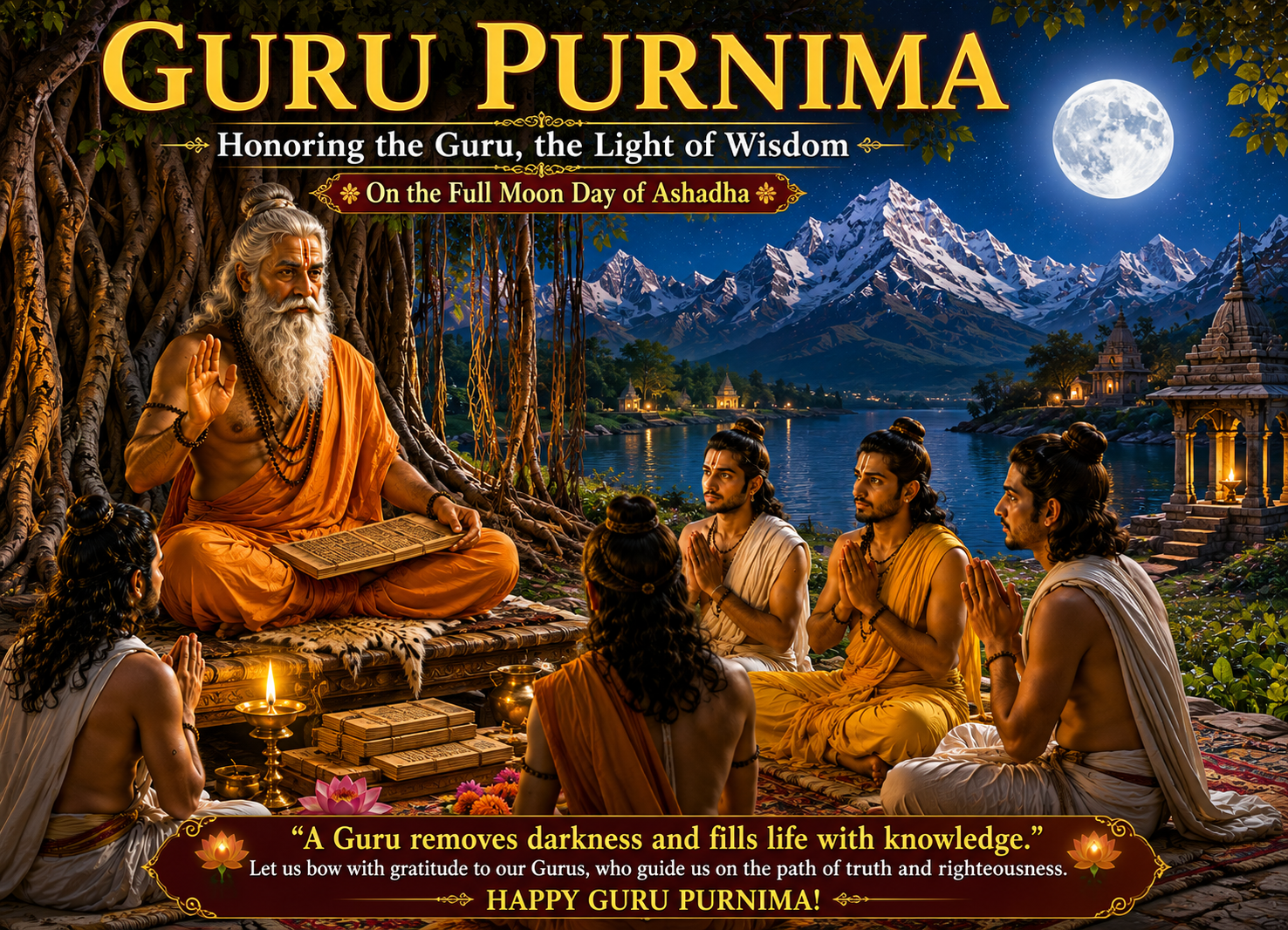
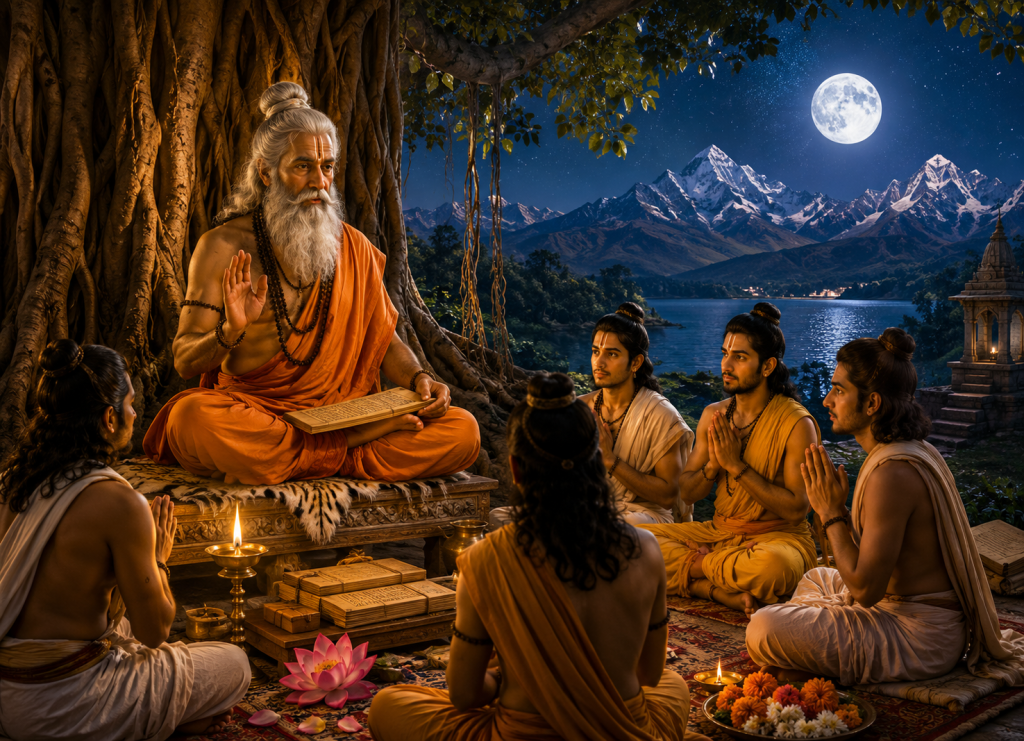
Among the many sacred festivals of Sanatana Dharma, Guru Purnima holds a unique place because it celebrates the eternal bond between a Guru (teacher) and a disciple (student). It is not merely a festival but a day dedicated to expressing gratitude toward those who guide us from ignorance to wisdom. Whether a Guru teaches spiritual knowledge, sacred scriptures, science, art, music, or life lessons, this auspicious occasion reminds us that true knowledge is one of the greatest gifts a person can receive.
Guru Purnima is observed on the full moon (Purnima) day of the Hindu month of Ashadha, which usually falls in June or July. The festival is celebrated with devotion by Hindus, Buddhists, and Jains, although each tradition observes it in its own unique way. In Hinduism, the day is dedicated primarily to Maharshi Ved Vyasa, the legendary sage who compiled the Vedas and authored the Mahabharata. Because of his immense contribution to Hindu philosophy and literature, Guru Purnima is also known as Vyasa Purnima.
For spiritual seekers, Guru Purnima is a day to remember that knowledge is the light that removes the darkness of ignorance. Ancient Hindu scriptures repeatedly emphasize that a Guru is not merely an instructor but a guide who transforms a disciple’s character, awakens inner wisdom, and leads the soul toward self-realization.
The importance of the Guru is beautifully expressed in the famous Guru Stotram:
Guru Brahma Guru Vishnu Guru Devo Maheshwarah
Guru Sakshat Parabrahma Tasmai Shri Gurave Namah
Meaning:
“The Guru is Brahma, the Guru is Vishnu, the Guru is Maheshwara (Shiva). The Guru is truly the Supreme Brahman. I bow respectfully to that revered Guru.”
This sacred verse reflects the profound respect that Hindu tradition gives to the Guru, placing the teacher on the highest spiritual pedestal.
Guru Purnima is celebrated in temples, monasteries, ashrams, educational institutions, and homes across India and many other countries. Devotees perform Guru Puja, offer flowers and fruits, chant sacred mantras, study scriptures, meditate, and seek blessings from their spiritual teachers. Many people also honor their parents, school teachers, and mentors, recognizing them as the first guides in their lives.
Beyond religious observances, Guru Purnima carries a universal message. Every person learns from someone—a parent, teacher, mentor, philosopher, or spiritual master. This festival encourages humility, gratitude, lifelong learning, and respect for knowledge, values that remain relevant in every age.
In this comprehensive guide, we will explore the fascinating history of Guru Purnima, its connection with Maharshi Ved Vyasa and Lord Shiva, its significance in Hinduism, Buddhism, and Jainism, traditional rituals, fasting rules, mantras, celebrations across India, spiritual meaning, and many other interesting aspects of this sacred festival.
What Is Guru Purnima?
Guru Purnima is one of the most revered festivals in Hinduism, dedicated to honoring the Guru—the person who dispels ignorance and illuminates the path of wisdom. The festival falls on the Purnima (full moon) of the Hindu lunar month of Ashadha, making it one of the earliest major festivals of the Hindu calendar after the arrival of the monsoon.
The word Guru comes from two Sanskrit syllables:
- Gu means darkness or ignorance.
- Ru means the remover or destroyer.
Thus, a Guru is “the one who removes the darkness of ignorance.” This definition goes far beyond classroom education. A true Guru nurtures intellectual growth, moral values, spiritual awareness, and self-discipline, helping disciples realize their highest potential.
In Hindu philosophy, every individual has many teachers throughout life. Parents are regarded as the first Gurus because they teach language, values, and culture. School teachers provide academic knowledge, while spiritual Gurus guide seekers toward liberation (Moksha). Guru Purnima is an opportunity to express gratitude to all these guides.
The day is also called Vyasa Purnima because it commemorates the birth anniversary of Maharshi Ved Vyasa, one of the greatest sages in Hindu history. He organized the four Vedas, composed the Mahabharata, and authored or inspired many of the Puranas and the Brahma Sutras. Without his extraordinary work, much of Hindu sacred literature might not have been preserved for future generations.
Guru Purnima is equally significant for followers of Buddhism. According to Buddhist tradition, Lord Buddha delivered his first sermon at Sarnath on this full moon day after attaining enlightenment in Bodh Gaya. This sermon, known as the Dhammacakkappavattana Sutta (“Setting the Wheel of Dharma in Motion”), marked the beginning of the Buddhist Sangha.
For Jains, Guru Purnima commemorates the occasion when Lord Mahavira accepted Gautama Swami as his chief disciple. Therefore, Jain devotees also pay homage to their teachers and spiritual guides on this day.
Today, Guru Purnima is celebrated not only in India but also in Nepal, Sri Lanka, Bhutan, Indonesia, Mauritius, Fiji, Trinidad and Tobago, and many other countries where Hindu and Buddhist communities preserve their ancient traditions.
Unlike festivals centered on material celebrations, Guru Purnima emphasizes gratitude, humility, learning, self-improvement, and spiritual awakening. It reminds us that knowledge is the greatest wealth and that a true Guru plays an irreplaceable role in shaping both individual lives and society.
History and Origin of Guru Purnima
Guru Purnima is one of the oldest and most meaningful festivals in the Indian spiritual tradition. Its origins can be traced back thousands of years to the Vedic age, when the Guru–Shishya Parampara (teacher-disciple tradition) formed the foundation of education, spiritual practice, and cultural preservation. Before schools and universities existed, knowledge was transmitted directly from a Guru to disciples who lived and studied in a Gurukul.
The word Guru holds profound significance in Sanskrit. It is commonly explained as a combination of two syllables:
- Gu – darkness or ignorance
- Ru – remover of darkness
Thus, a Guru is the one who removes ignorance and enlightens the disciple with wisdom and truth.
Ancient Hindu scriptures describe the Guru as a guide who not only imparts knowledge but also shapes the character, discipline, and spiritual consciousness of a student. The Guru teaches the principles of Dharma, helps the disciple understand life’s purpose, and inspires the pursuit of self-realization.
Because of this exalted role, Indian civilization has always regarded the Guru with the highest respect. The relationship between Guru and disciple is considered sacred and is based on trust, humility, devotion, and sincere learning.
Guru Purnima was established to honor this timeless tradition. On this day, disciples express gratitude toward their teachers through prayers, offerings, service, and remembrance. The festival reminds people that education is not merely the accumulation of information but the transformation of one’s mind, heart, and soul.
Today, although formal education has evolved, Guru Purnima continues to inspire millions to appreciate everyone who has contributed to their growth, including parents, school teachers, mentors, professors, spiritual masters, and even those whose wisdom has guided them through books and life experiences.
Why Is Guru Purnima Also Called Vyasa Purnima?
Guru Purnima is widely known as Vyasa Purnima because it commemorates Maharshi Ved Vyasa, one of the greatest sages in Hindu history. He is revered as the supreme Guru who preserved and organized Hindu knowledge for future generations.
According to Hindu tradition, Maharshi Ved Vyasa was born on the full moon day of the month of Ashadha. Therefore, disciples and scholars dedicate this sacred day to remembering his extraordinary contributions to Sanatana Dharma.
Ved Vyasa’s birth name was Krishna Dvaipayana. The name “Krishna” refers to his dark complexion, while “Dvaipayana” means “born on an island,” as he was born on an island in the Yamuna River. His father was the great sage Parashara, and his mother was Satyavati, who later became queen of King Shantanu.
The title Vyasa means “compiler” or “arranger.” He earned this title because he systematically classified and organized the vast body of Vedic knowledge into four distinct collections, making them easier to preserve and study.
Because of this monumental achievement, he became famous as Ved Vyasa, meaning “the compiler of the Vedas.”
For millions of Hindus, Guru Purnima is therefore not only a celebration of all teachers but also a tribute to the sage who safeguarded India’s sacred wisdom for humanity.
Maharshi Ved Vyasa: The Great Compiler of Hindu Scriptures
Few personalities have influenced Hindu civilization as profoundly as Maharshi Ved Vyasa. His literary and spiritual contributions continue to guide millions of people around the world.
Among his greatest achievements are:
Division of the Four Vedas
Before Ved Vyasa’s time, the Vedic hymns existed as one vast body of sacred knowledge transmitted orally. Recognizing the need for systematic preservation, he divided them into four Vedas:
- Rig Veda
- Yajur Veda
- Sama Veda
- Atharva Veda
He entrusted each Veda to different disciples, ensuring that the knowledge would be accurately preserved for future generations.
Composition of the Mahabharata
Ved Vyasa is traditionally credited with composing the Mahabharata, the world’s longest epic poem, containing more than 100,000 verses.
The Mahabharata is not merely a story of the Kurukshetra War. It is a profound guide to ethics, politics, family values, devotion, and spirituality.
Within the Mahabharata lies one of the world’s most influential spiritual texts—the Bhagavad Gita, in which Lord Krishna teaches Arjuna about duty, devotion, and the path to liberation.
Author of the Puranas
Traditional Hindu belief credits Ved Vyasa with composing or compiling the eighteen Mahapuranas, including:
- Vishnu Purana
- Shiva Purana
- Bhagavata Purana(Srimad Bhagavatam)
- Markandeya Purana
- Skanda Purana
- Brahma Purana
These texts preserve countless stories, philosophical teachings, pilgrimages, and traditions that continue to shape Hindu religious life.
Brahma Sutras
Ved Vyasa is also regarded as the author of the Brahma Sutras, one of the foundational texts of Vedanta philosophy.
The Brahma Sutras explain the teachings of the Upanishads and provide a systematic philosophical framework for understanding Brahman, the ultimate reality.
Because of these extraordinary contributions, Maharshi Ved Vyasa is honored as one of the greatest Gurus in human history.
Lord Shiva as Adi Guru
According to Hindu tradition, Lord Shiva is revered as the Adi Guru, meaning the First Guru. He is also worshipped as Adi Yogi, the first yogi who revealed the science of yoga and spiritual wisdom to humanity.
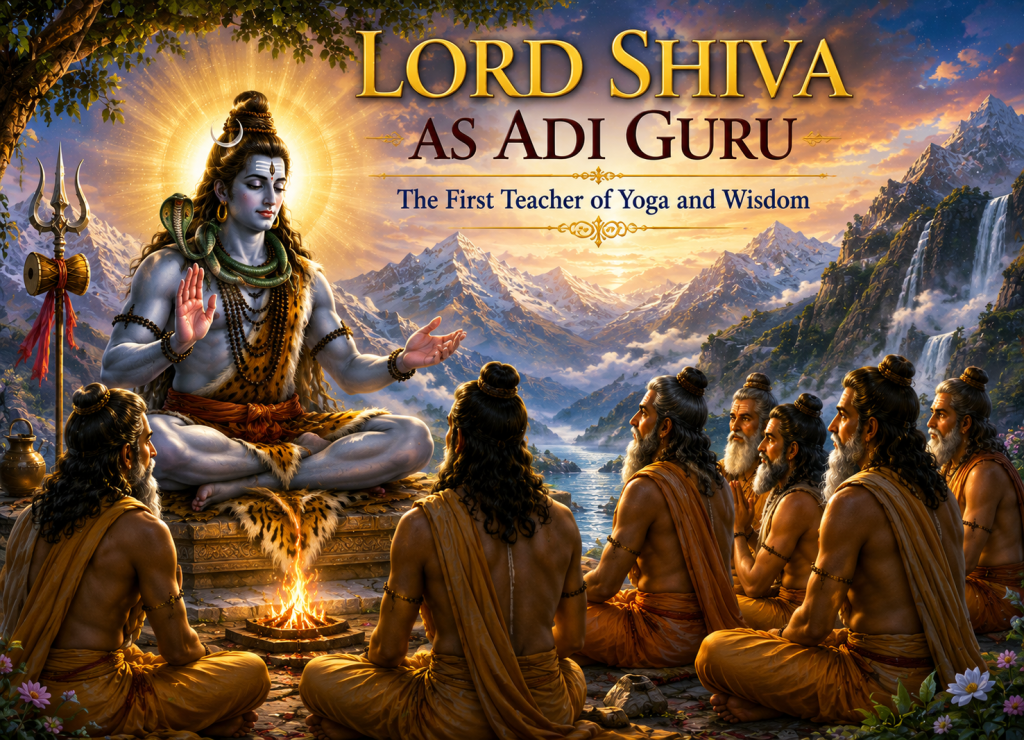
Ancient yogic traditions describe how Shiva entered a state of deep meditation in the Himalayas. His profound spiritual realization attracted devoted seekers who wished to learn the path to liberation.
After observing their sincerity and dedication, Shiva shared the knowledge of yoga, meditation, and self-realization with seven enlightened sages known as the Saptarishis.
The seven sages are traditionally identified as:
(Some Hindu traditions preserve slightly different lists of the Saptarishis for different cosmic ages.)
The Saptarishis traveled to different regions of the world, spreading spiritual knowledge, ethical principles, and yogic wisdom. Through them, the Guru–Shishya tradition flourished and eventually became the cornerstone of Indian civilization.
Although many regional traditions associate Shiva with various disciples, the widely accepted understanding in Hindu philosophy is that Shiva is honored as the primordial Guru because he first revealed the eternal knowledge of yoga and spiritual realization.
For this reason, many devotees worship Lord Shiva on Guru Purnima, especially those who have not yet accepted a personal spiritual Guru.
The Importance of the Guru in Sanatana Dharma
In Sanatana Dharma, the Guru occupies a position of extraordinary honor. Hindu scriptures repeatedly teach that spiritual progress becomes difficult without proper guidance.
The Mundaka Upanishad advises sincere seekers to approach a realized teacher with humility, devotion, and a desire to learn. The Guru helps the disciple understand the scriptures correctly and apply their teachings in daily life.
A true Guru does much more than provide information. A Guru:
- Removes ignorance through knowledge.
- Inspires righteous living.
- Develops discipline and compassion.
- Helps control the mind and senses.
- Explains the deeper meaning of the Vedas and Upanishads.
- Guides seekers toward self-realization and liberation (Moksha).
The relationship between Guru and disciple is built upon mutual trust, respect, and dedication. The disciple approaches the Guru with humility, while the Guru selflessly imparts wisdom for the spiritual upliftment of the student.
This sacred relationship has preserved India’s spiritual heritage for thousands of years and continues to inspire seekers across the world.
Guru Purnima in Hinduism
Guru Purnima is one of the most sacred festivals in Hinduism because it celebrates the Guru, the spiritual guide who leads a disciple from ignorance to wisdom. Unlike many Hindu festivals that commemorate the birth or victory of a deity, Guru Purnima is dedicated to honoring the divine principle of knowledge itself.
According to Hindu philosophy, human life has four important goals (Purusharthas): Dharma (righteousness), Artha (prosperity), Kama (righteous desires), and Moksha (liberation). Achieving these goals requires proper guidance, and the Guru plays a central role in helping a disciple understand and follow the right path.
The Vedas, Upanishads, Bhagavad Gita, and numerous other Hindu scriptures emphasize the importance of learning from a qualified teacher. Even great personalities such as Lord Rama, Lord Krishna, and the Pandavas studied under respected Gurus before fulfilling their divine missions.
In many Hindu monasteries (Mathas) and Ashrams, Guru Purnima is one of the most significant annual celebrations. Disciples gather to perform Guru Puja, listen to spiritual discourses, chant Vedic hymns, meditate, and seek blessings from their Gurus.
Many devotees also begin new spiritual practices on this auspicious day. Some receive Guru Diksha (spiritual initiation), while others renew their commitment to meditation, scripture reading, and self-discipline.
Guru Purnima reminds every Hindu that true success is measured not only by material achievements but also by wisdom, humility, compassion, and spiritual growth.
Guru Purnima in Buddhism
Guru Purnima is equally important in Buddhism, where it is commonly observed as Ashadha Purnima or Dhamma Day.
According to Buddhist tradition, after attaining enlightenment beneath the Bodhi Tree at Bodh Gaya, Gautama Buddha spent several weeks contemplating his realization. He then traveled to Sarnath, near Varanasi, where his five former companions were staying.
On the full moon day of Ashadha, Buddha delivered his first sermon, known as the Dhammacakkappavattana Sutta (“Setting the Wheel of Dharma in Motion”).
This sermon introduced the central teachings of Buddhism:
- The Four Noble Truths
- The Noble Eightfold Path
- The Middle Way
- Freedom from suffering through wisdom
The five ascetics—Kondanna, Vappa, Bhaddiya, Mahanama, and Assaji—became Buddha’s first disciples, forming the earliest Buddhist Sangha (monastic community).
Because this event marked the beginning of the spread of Buddhism, Buddhists around the world celebrate Guru Purnima with deep reverence.
On this day, Buddhist devotees:
- Visit monasteries and temples.
- Offer flowers, candles, and incense.
- Listen to Dhamma teachings.
- Practice meditation.
- Observe acts of generosity and compassion.
- Reflect on Buddha’s teachings.
For Buddhists, Guru Purnima is not only a remembrance of the Buddha’s first sermon but also a celebration of wisdom, mindfulness, and the compassionate guidance of enlightened teachers.
Guru Purnima in Jainism
Guru Purnima also occupies an honored place in Jain tradition.
According to Jain belief, after attaining Kevala Jnana (perfect knowledge), Lord Mahavira accepted Indrabhuti Gautama, widely known as Gautama Swami, as his chief disciple.
This event symbolizes the beginning of the formal Guru-disciple relationship within the Jain community.
On Guru Purnima, Jain devotees express gratitude to monks, nuns, teachers, and spiritual leaders who preserve and teach the principles of Jain philosophy.
Special prayers, scriptural readings, meditation sessions, and charitable activities are organized in Jain temples. Devotees also seek forgiveness, strengthen their commitment to non-violence (Ahimsa), truthfulness, and self-discipline.
Thus, although the traditions differ, Hindus, Buddhists, and Jains all recognize Guru Purnima as a day to honor those who illuminate the path of truth.
The Spiritual Significance of Guru Purnima
Guru Purnima carries a profound spiritual message that extends far beyond rituals and ceremonies.
In Hindu philosophy, ignorance (Avidya) is regarded as the primary cause of human suffering. A Guru removes this ignorance through knowledge, discipline, and spiritual guidance.
The Guru is compared to a lamp that lights another lamp without losing its own brilliance. By sharing wisdom, a Guru transforms the lives of countless disciples.
Guru Purnima teaches several timeless values:
Gratitude
The festival encourages people to remember everyone who has contributed to their growth—from parents and school teachers to mentors and spiritual masters.
Humility
Knowledge blossoms only when a person approaches learning with humility. Guru Purnima reminds disciples to remain open to guidance throughout life.
Self-Discipline
A true Guru inspires students to cultivate honesty, patience, compassion, and self-control. These virtues form the foundation of a meaningful life.
Lifelong Learning
Guru Purnima reminds us that education never ends. Every experience, every scripture, and every wise teacher provides an opportunity to grow.
Spiritual Awakening
For seekers on the spiritual path, Guru Purnima serves as a reminder that self-realization requires sincere effort, devotion, and the guidance of enlightened teachers.
Guru–Shishya Parampara: India’s Timeless Tradition
One of the greatest contributions of Indian civilization to the world is the Guru–Shishya Parampara, the sacred tradition of learning directly from a Guru.
For thousands of years, students lived in Gurukuls, where they learned not only academic subjects but also ethics, discipline, meditation, agriculture, warfare, music, astronomy, Ayurveda, and philosophy.
Education in ancient India focused on developing the whole person rather than merely preparing for a profession.
A disciple was expected to:
- Respect the Guru.
- Practice honesty.
- Serve selflessly.
- Maintain discipline.
- Study diligently.
- Live a simple life.
Similarly, the Guru accepted the responsibility of nurturing the disciple with compassion, wisdom, and impartiality.
This relationship was based on mutual trust rather than financial exchange. Knowledge was regarded as sacred and was shared with sincerity and responsibility.
Although modern education has changed significantly, the spirit of the Guru–Shishya tradition continues in schools, universities, music academies, yoga institutions, and spiritual organizations throughout the world.
Why Is the Guru Considered Equal to God?
One of the most distinctive features of Hindu philosophy is the extraordinary reverence shown to the Guru.
This does not mean that every teacher is worshipped as God in a literal sense. Rather, the Guru is honored because he or she serves as the medium through which divine knowledge reaches the disciple.
The famous verse says:
Guru Brahma Guru Vishnu Guru Devo Maheshwarah
Guru Sakshat Parabrahma Tasmai Shri Gurave Namah
This verse symbolizes the Guru’s many roles:
- Like Brahma, the Guru creates knowledge.
- Like Vishnu, the Guru preserves wisdom and protects righteousness.
- Like Shiva, the Guru destroys ignorance and negative tendencies.
- As Parabrahman, the Guru points the disciple toward the Supreme Reality.
Therefore, honoring the Guru is ultimately an expression of respect for knowledge, truth, and the Divine.
Lessons Guru Purnima Teaches in Modern Life
Although Guru Purnima originated in ancient India, its message remains highly relevant today.
In the modern world, people often learn from many sources—parents, teachers, professors, coaches, authors, scientists, spiritual leaders, and mentors. The festival encourages us to recognize and appreciate everyone who has positively shaped our lives.
Guru Purnima also reminds us that technology can provide information, but wisdom comes through reflection, experience, ethical living, and guidance from knowledgeable individuals.
Whether one follows a spiritual path or pursues academic excellence, Guru Purnima inspires lifelong learning, respect for teachers, gratitude, and the continuous pursuit of truth.
Guru Purnima Rituals and Puja Vidhi (Step-by-Step)
Guru Purnima is observed with deep devotion and reverence across India and many parts of the world. While rituals may vary according to family traditions, regional customs, and spiritual lineages, the essence of the festival remains the same—expressing gratitude to the Guru for guiding us toward knowledge, righteousness, and spiritual awakening.
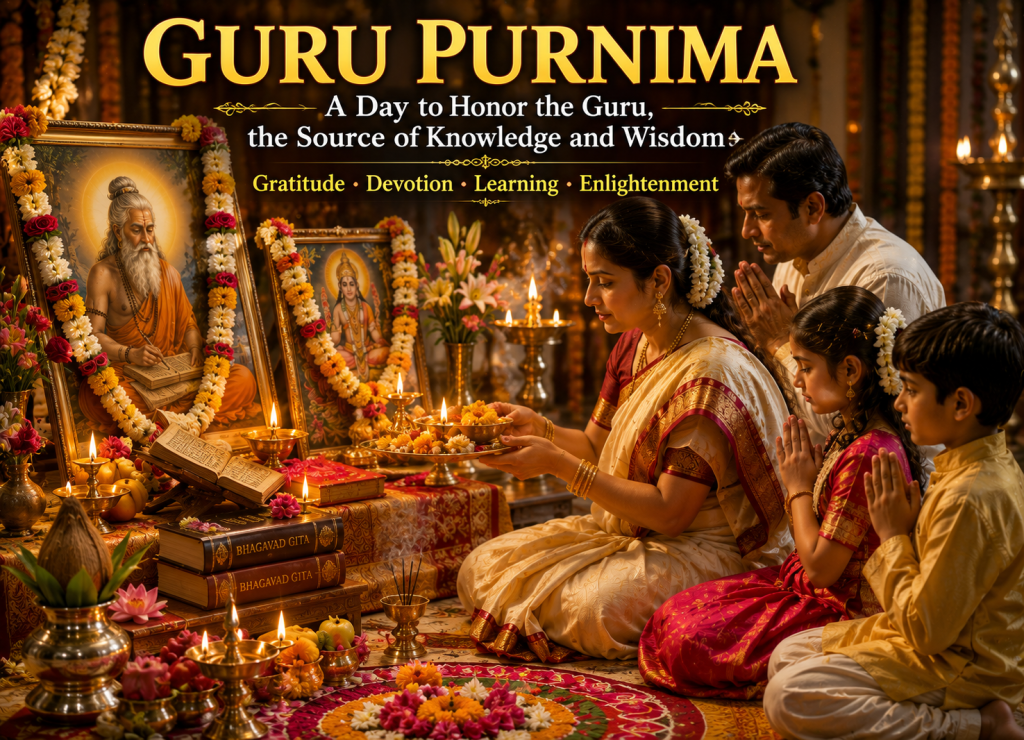
Many devotees begin preparations a day before the festival by cleaning their homes and prayer rooms. Ashrams and temples are beautifully decorated with flowers, lamps, mango leaves, and colorful rangoli to welcome devotees.
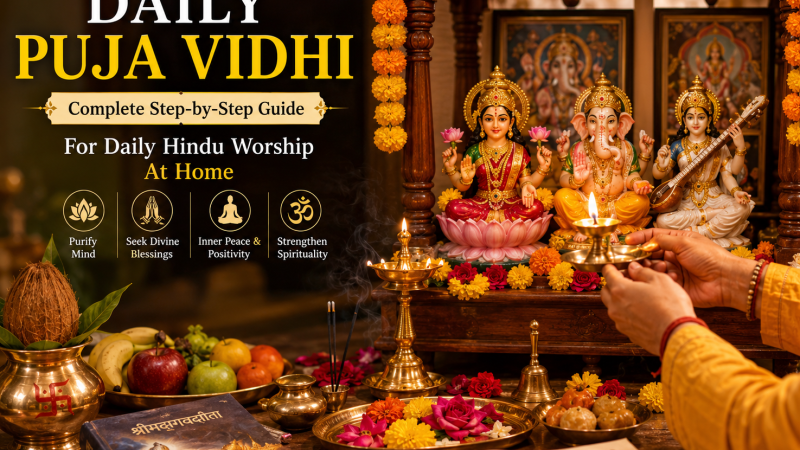
Below is a traditional Guru Purnima Puja Vidhi that can be performed at home or in a temple.
Step 1: Wake Up During Brahma Muhurta
The day begins during Brahma Muhurta, approximately one and a half hours before sunrise. This period is considered highly auspicious for meditation, prayer, and scriptural study.
After waking up, devotees offer gratitude to God and remember their Guru before beginning the day’s activities.
Step 2: Take a Sacred Bath
Devotees bathe early in the morning, preferably before sunrise. Some people take a holy dip in sacred rivers such as the Ganga, Yamuna, Godavari, Narmada, or Kaveri if possible.
Those unable to visit a sacred river simply take a clean bath at home while praying for physical and spiritual purity.
Many devotees wear clean white, yellow, or saffron-colored clothes, symbolizing purity, wisdom, and devotion.
Step 3: Clean and Decorate the Puja Area
The worship space is cleaned thoroughly before placing:
- A clean cloth
- An image or idol of one’s Guru
- A photograph or image of Maharshi Ved Vyasa
- Images of Lord Shiva, Lord Vishnu, Lord Krishna, or one’s Ishta Devata
- Flowers
- Fruits
- Incense sticks
- Oil or ghee lamps
- Sandalwood paste
- Kumkum
- Akshata (unbroken rice)
- Tulsi leaves (for Lord Vishnu or Krishna)
- Bilva leaves (for Lord Shiva)
The altar is decorated beautifully with fresh flowers and lamps.
Step 4: Offer Prayers to Lord Ganesha
As with most Hindu rituals, the puja begins by worshipping Lord Ganesha, the remover of obstacles.
Devotees chant simple Ganesha mantras and pray for a successful and peaceful observance of Guru Purnima.
Step 5: Worship Maharshi Ved Vyasa
Since Guru Purnima is also known as Vyasa Purnima, special worship is offered to Maharshi Ved Vyasa.
Devotees offer:
- Flowers
- Sandalwood paste
- Fruits
- Incense
- Lamps
- Sacred water
Many read passages from the Mahabharata, Bhagavad Gita, Bhagavata Purana, or other scriptures associated with Ved Vyasa.
Step 6: Worship Your Guru
The central ritual of Guru Purnima is Guru Puja.
If one’s Guru is physically present, disciples traditionally offer:
- Flowers
- Fruits
- Shawls or clothes
- Books
- Dakshina (voluntary offering)
- Garland
- Pranam (respectful bow)
If the Guru is not present or has attained Mahasamadhi, devotees respectfully worship the Guru’s photograph or remember the Guru through meditation and prayer.
Many disciples also seek blessings by touching the Guru’s feet, a gesture symbolizing humility and reverence.
Step 7: Chant Guru Mantras
One of the most important practices on Guru Purnima is chanting Guru mantras.
The most widely recited Guru mantra is:
Guru Brahma Guru Vishnu
Guru Devo Maheshwarah
Guru Sakshat Parabrahma
Tasmai Shri Gurave Namah
Meaning:
“I bow to the Guru, who is like Brahma the creator, Vishnu the protector, Maheshwara (Shiva) the transformer, and who reveals the Supreme Reality.”
Another popular Guru mantra is:
Akhanda Mandalakaram
Vyaptam Yena Characharam
Tatpadam Darshitam Yena
Tasmai Shri Gurave Namah
Meaning:
“I bow to the Guru who has revealed the Supreme Truth that pervades the entire universe.”
Many devotees chant these mantras 11, 21, 51, or 108 times according to their tradition.
Step 8: Read Sacred Scriptures
Scripture reading is considered especially auspicious on Guru Purnima.
Popular texts include:
- Bhagavad Gita
- Mahabharata
- Bhagavata Purana
- Shiva Purana
- Guru Gita
- Upanishads
- Ramayana
Reading even one chapter with devotion is believed to inspire spiritual growth and deepen one’s understanding of Dharma.
Step 9: Perform Meditation and Japa
Guru Purnima is an excellent occasion for meditation.
Many devotees spend time in:
- Silent meditation
- Pranayama (breathing exercises)
- Chanting their Guru Mantra
- Repeating God’s holy names (Nama Japa)
- Reflecting on the teachings of their Guru
Spiritual organizations often conduct collective meditation sessions and discourses on this day.
Step 10: Offer Charity
Charity (Dana) occupies an important place in Guru Purnima celebrations.
Devotees donate according to their ability.
Common donations include:
- Food grains
- Clothes
- Fruits
- Books
- Umbrellas
- Footwear
- Blankets
- Educational materials
- Financial assistance
- Cow feeding
- Meals for monks, students, or the poor
Hindu scriptures emphasize that charity performed with humility and without expectation of reward brings inner purification.
Guru Purnima Fasting Rules
Many devotees observe a fast (Vrata) on Guru Purnima.
The type of fasting varies according to age, health, and family tradition.
Some people observe:
- Complete fast without grains
- Fruit-only fast (Phalahar)
- Milk and fruits
- One vegetarian meal after sunset
- Simple Satvik diet
Foods commonly consumed include:
- Fruits
- Milk
- Yogurt
- Coconut water
- Dry fruits
- Sabudana
- Makhana (fox nuts)
Devotees generally avoid:
- Onion
- Garlic
- Alcohol
- Non-vegetarian food
- Excessive spices
- Negative speech
- Anger and arguments
The true purpose of fasting is not merely avoiding food but cultivating purity of body, mind, and speech.
How to Celebrate Guru Purnima at Home
Not everyone can visit a temple or Ashram on Guru Purnima. Fortunately, the festival can be observed meaningfully at home.
You may celebrate by:
- Offering prayers to your Guru or family deity.
- Worshipping Maharshi Ved Vyasa.
- Reading the Bhagavad Gita.
- Meditating for at least 20–30 minutes.
- Calling or visiting your parents and teachers to express gratitude.
- Donating food or clothes to someone in need.
- Feeding cows, birds, or other animals.
- Lighting a ghee lamp in your prayer room.
- Avoiding harsh words and practicing kindness throughout the day.
- Reflecting on the teachings that have positively shaped your life.
Even a simple prayer offered with sincerity carries great spiritual value.
Parents: The First Gurus
Hindu tradition teaches that a person’s first Gurus are the parents.
Long before formal education begins, parents teach a child:
- Language
- Good manners
- Moral values
- Compassion
- Discipline
- Respect for elders
- Love for God
- Cultural traditions
Ancient scriptures repeatedly instruct children to honor their parents.
The Taittiriya Upanishad beautifully advises:
Matru Devo Bhava — “Revere your mother as God.”
Pitru Devo Bhava — “Revere your father as God.”
Therefore, many families begin Guru Purnima by seeking the blessings of their parents before worshipping spiritual teachers.
Teachers Beyond Spiritual Life
Guru Purnima is also an opportunity to honor teachers from every field of life.
A Guru may be:
- A school teacher
- A college professor
- A music instructor
- A dance teacher
- A yoga master
- A mentor
- A coach
- A scientist
- An author
- Anyone who sincerely imparts wisdom and helps shape our character
Expressing gratitude to such teachers strengthens relationships and reminds us that learning is a lifelong journey.
The Universal Message of Guru Purnima
Guru Purnima is much more than a religious festival. It is a celebration of knowledge, gratitude, humility, and lifelong learning.
In a rapidly changing world, information is easily available, but wisdom remains priceless. The festival reminds us that true education is not only about acquiring skills but also about developing integrity, compassion, discipline, and self-awareness.
Whether one follows Hinduism, Buddhism, Jainism, or simply values education, Guru Purnima inspires everyone to honor those who illuminate the path of truth.
Guru Purnima Celebrations Across India
Guru Purnima is celebrated with great devotion throughout India. Although the rituals vary from one region to another, the spirit of the festival—honoring the Guru and expressing gratitude for knowledge—remains the same everywhere.
Uttar Pradesh
Uttar Pradesh is one of the most significant places for Guru Purnima celebrations. Thousands of devotees visit Sarnath, where Lord Buddha delivered his first sermon after attaining enlightenment. Buddhist monasteries organize meditation sessions, Dhamma talks, and prayers. Hindu temples also conduct Guru Puja, devotional singing, and scripture recitations.
Uttarakhand
In the Himalayan state of Uttarakhand, many saints and spiritual seekers gather at Rishikesh and Haridwar. Ashrams conduct yoga sessions, Vedic chanting, meditation, and discourses on the teachings of great Gurus.
Maharashtra
Many followers of saints such as Sant Dnyaneshwar, Sant Tukaram, and Sai Baba of Shirdi celebrate Guru Purnima with great enthusiasm. Temples are beautifully decorated, and devotees participate in bhajans, kirtans, and charitable activities.
Gujarat
Numerous spiritual organizations organize Guru Purnima celebrations with mass prayers, scripture reading, and devotional music. Devotees seek blessings from their spiritual teachers and participate in community service.
Karnataka
Ashrams and educational institutions celebrate Guru Purnima by honoring teachers and spiritual masters. Discourses on the Bhagavad Gita, Upanishads, and Vedanta philosophy are common.
Tamil Nadu
Many devotees worship Dakshinamurti, the form of Lord Shiva revered as the supreme Guru. Special abhishekams, Vedic chanting, and temple processions are organized in several Shiva temples.
West Bengal
Guru Purnima is observed with devotion in temples, ashrams, and homes across West Bengal. Followers of Sri Ramakrishna, Swami Vivekananda, Chaitanya Mahaprabhu, and various Vaishnava traditions organize devotional singing, scriptural discussions, and Guru worship.
Many educational institutions also arrange programs where students express gratitude to their teachers.
Guru Purnima Celebrations in Nepal
Guru Purnima is one of the most important festivals in Nepal.
Students traditionally visit their teachers with flowers, sweets, fruits, and greeting cards to express gratitude for their guidance. Schools and colleges often organize cultural programs dedicated to teachers.
Many Hindu devotees also visit temples dedicated to Lord Shiva and Lord Vishnu, while Buddhist monasteries conduct meditation sessions and Dharma teachings.
The festival beautifully highlights the shared cultural heritage of Nepal and India.
Guru Purnima Around the World
As Hinduism and Buddhism have spread across the globe, Guru Purnima is now celebrated in many countries, including:
- Bangladesh
- Sri Lanka
- Bhutan
- Indonesia
- Mauritius
- Fiji
- Trinidad and Tobago
- Guyana
- Suriname
- United Kingdom
- United States
- Canada
- Australia
- Singapore
- Malaysia
Hindu temples and Buddhist centers organize prayer meetings, Guru Puja, cultural programs, meditation retreats, and charitable activities.
The growing popularity of yoga has also introduced Guru Purnima to many people outside India, where yoga schools observe the day by honoring the ancient lineage of teachers.
Prominent Gurus Who Shaped Indian Spirituality
India has been blessed with countless enlightened teachers who have transformed the spiritual lives of millions. Some of the most influential Gurus include:
- Maharshi Ved Vyasa
- Adi Shankaracharya
- Ramanujacharya
- Madhvacharya
- Chaitanya Mahaprabhu
- Ramakrishna Paramahamsa
- Swami Vivekananda
- Swami Sivananda
- Swami Chinmayananda
- Swami Dayananda Saraswati
- A. C. Bhaktivedanta Swami Prabhupada
- Neem Karoli Baba
Each of these spiritual masters made invaluable contributions to philosophy, devotion, education, social reform, and the preservation of Sanatana Dharma.
Prominent Spiritual Gurus of Bengal
Bengal has produced many great saints and spiritual leaders whose teachings continue to inspire devotees around the world.
Some of the most respected Gurus associated with Bengal include:
Chaitanya Mahaprabhu (1486–1534)
The founder of the Gaudiya Vaishnava movement, Chaitanya Mahaprabhu emphasized devotion (Bhakti) to Lord Krishna through the congregational chanting of the Hare Krishna Mahamantra.
Nityananda Prabhu
The close associate of Chaitanya Mahaprabhu, Nityananda dedicated his life to spreading divine love and devotion among people from all walks of life.
Loknath Brahmachari (1730–1890)
Loknath Brahmachari is revered as a great yogi and saint. His teachings of devotion, compassion, and surrender continue to inspire countless devotees.
Harichand Thakur (1812–1878)
The founder of the Matua movement, Harichand Thakur preached equality, devotion, truthfulness, and social harmony.
Ramakrishna Paramahamsa (1836–1886)
One of India’s greatest mystics, Ramakrishna taught that all genuine spiritual paths ultimately lead to the same Supreme Reality. His life continues to inspire seekers across the world.
Sadhak Bamakhepa (1837–1911)
A renowned devotee of Goddess Tara, Bamakhepa is remembered for his deep devotion and extraordinary spiritual practices at Tarapith.
Sri Sri Ram Thakur (1860–1949)
Ram Thakur emphasized simplicity, devotion, truthfulness, and remembrance of God in everyday life.
Swami Vivekananda (1863–1902)
The foremost disciple of Ramakrishna Paramahamsa, Swami Vivekananda introduced Vedanta and Yoga to the Western world. His speech at the 1893 Parliament of the World’s Religions in Chicago remains historic.
Thakur Anukulchandra (1888–1969)
Founder of the Satsang movement, Anukulchandra inspired people to live disciplined, moral, and spiritually meaningful lives.
A. C. Bhaktivedanta Swami Prabhupada (1896–1977)
Founder of the International Society for Krishna Consciousness (ISKCON), Srila Prabhupada spread Krishna consciousness worldwide through his books, lectures, and temple movement.
Guru Purnima Wishes
Here are a few heartfelt Guru Purnima wishes that you can share with your family, teachers, friends, or spiritual mentors.
- Happy Guru Purnima! May your Guru’s blessings always guide you toward wisdom, peace, and success.
- On this sacred occasion, let us bow with gratitude to all the teachers who have illuminated our lives with knowledge and compassion.
- May the blessings of Maharshi Ved Vyasa and your revered Guru fill your life with happiness, wisdom, and spiritual strength. Happy Guru Purnima!
- A true Guru transforms ordinary lives into extraordinary journeys. Wishing you a blessed and joyful Guru Purnima.
- May this Guru Purnima inspire us to keep learning, growing, and walking the path of truth.
Interesting Facts About Guru Purnima
- Guru Purnima falls on the full moon day of the Hindu month of Ashadha.
- It is also known as Vyasa Purnima.
- The festival honors Maharshi Ved Vyasa, the compiler of the Vedas.
- Hindus, Buddhists, and Jains all observe Guru Purnima in different ways.
- According to yogic tradition, Lord Shiva is revered as Adi Guru, the first Guru.
- Guru Purnima celebrates the timeless Guru–Shishya Parampara.
- Many spiritual organizations initiate new disciples on this auspicious day.
- Meditation, charity, scriptural study, and Guru Puja are considered highly meritorious.
- Students often express gratitude to their teachers through cards, flowers, and respectful greetings.
- The festival highlights the universal value of knowledge beyond religious boundaries.
Frequently Asked Questions (FAQs)
1. What is Guru Purnima?
Guru Purnima is a Hindu festival dedicated to honoring Gurus, teachers, mentors, and spiritual guides who remove ignorance through knowledge and wisdom.
2. Why is Guru Purnima called Vyasa Purnima?
It is called Vyasa Purnima because it commemorates Maharshi Ved Vyasa, who compiled the Vedas and composed the Mahabharata.
3. Who celebrates Guru Purnima?
Guru Purnima is celebrated primarily by Hindus, Buddhists, and Jains, with each tradition observing the festival according to its own customs.
4. When is Guru Purnima celebrated?
Guru Purnima is observed on the full moon day (Purnima) of the Hindu month of Ashadha, usually falling in June or July.
5. Who is considered the Adi Guru?
According to Hindu tradition, Lord Shiva is revered as Adi Guru, the first Guru who imparted the wisdom of yoga and spiritual knowledge.
6. What are the main rituals of Guru Purnima?
Devotees perform Guru Puja, chant mantras, meditate, study scriptures, offer flowers and fruits, seek blessings from teachers, and perform charitable acts.
7. Can Guru Purnima be celebrated at home?
Yes. One can celebrate by worshipping one’s Guru or chosen deity, reading sacred scriptures, meditating, expressing gratitude to parents and teachers, and performing acts of charity.
8. Why is the Guru important in Hinduism?
The Guru guides disciples toward knowledge, righteous living, and spiritual realization. Hindu scriptures regard the Guru as the one who removes ignorance and reveals the path to truth.
9. Is fasting compulsory on Guru Purnima?
No. Fasting is a voluntary spiritual practice. The most important observance is devotion, gratitude, and sincere remembrance of one’s Guru.
10. What is the message of Guru Purnima?
Guru Purnima teaches gratitude, humility, lifelong learning, respect for teachers, and the pursuit of wisdom and self-realization.
Conclusion
Guru Purnima is far more than an annual festival—it is a timeless celebration of wisdom, gratitude, and the sacred relationship between a Guru and a disciple. Rooted in the ancient Guru–Shishya Parampara, it reminds us that true knowledge has the power to transform lives and guide humanity toward righteousness, compassion, and inner peace.
For Hindus, the day honors Maharshi Ved Vyasa, whose monumental contributions preserved the Vedas and many of Hinduism’s most revered scriptures. It also recognizes Lord Shiva as Adi Guru, the primordial teacher who revealed the path of yoga and spiritual realization. For Buddhists and Jains, Guru Purnima marks equally significant milestones in their religious traditions, making the festival a shared celebration of enlightenment and learning.
In today’s fast-changing world, the message of Guru Purnima remains as relevant as ever. It encourages us to appreciate our parents, teachers, mentors, and spiritual guides—the individuals who shape our character, broaden our understanding, and inspire us to become better human beings. By expressing gratitude, practicing humility, and committing ourselves to lifelong learning, we uphold the true spirit of this sacred occasion.
May the blessings of your Guru and the timeless wisdom of Sanatana Dharma illuminate your path with knowledge, peace, and divine grace.
Happy Guru Purnima! 🙏